
Which Dog Breeds Are Good With Cats? What the Data Says
This post contains affiliate links. As an Amazon Associate, we earn from qualifying purchases.
Which dog breeds are good with cats? Toy and Sporting group dogs lead most lists, including Golden Retrievers, Labrador Retrievers, Pugs, Cavalier King Charles Spaniels, and Papillons. But a 2022 study of 4,678 puppies found only 7.3% showed purely desirable behavior toward a household cat, and age at introduction predicted that better than breed did.
The gap between those two answers is where the which dog breeds are good with cats decision sits. A breed standard describes a tendency across a whole population. Your house only has one dog in it, and that dog’s first sixteen weeks matter more than its group.
What follows covers the breed-group lists with their caveats attached, the introduction timeline three separate welfare bodies publish, and the room setup that lets your cat walk away from the whole thing.
Key Takeaways
- Toy and Sporting group dogs top the AKC’s list, yet just 7.3% of puppies in the Generation Pup cohort showed only desirable behavior toward the resident cat.
- Introduce before 12 weeks if you can. Puppies brought in early, gradually, and into homes with other dogs scored better on that measure.
- Chasing is the norm. 48.6% of owners reported it, so plan for it instead of being blindsided by it.
- Cats do most of the threatening: 56.5% of cats had threatened the dog, against 18% of dogs threatening the cat.
- Keep them separated when you leave the house, even after the living room looks peaceful.
What the Generation Pup Numbers Actually Show
The Generation Pup cohort tracked 4,678 puppies, and 26.7% of them lived with at least one cat. That rate is nearly four times higher than earlier research suggested, which tells you multi-species homes are far more common than the old data assumed.
Of the 4,678 puppies in the Generation Pup cohort, 1,211 had been introduced to a household cat by the time of survey. Owner reports showed 58.9% were playful toward the cat, 56.6% were overexuberant, and 48.6% chased. Aggression toward the cat was reported in 1.7% of cases, and only 7.3% displayed exclusively desirable behavior.
Read those rows in order and a picture forms. Play and chasing dominate. Calm is a minority report. Outright aggression is rare at 1.7%.
| Behavior reported by owners | Share of puppies | What it looks like at home |
|---|---|---|
| Playful toward the cat | 58.9% | Play bows, bouncy greetings |
| Overexuberant or excitable | 56.6% | Body-slamming, blocking the cat’s path |
| Chased the cat | 48.6% | Cat runs, puppy follows |
| Calm interaction at least some of the time | About one-third | Nose touches, shared floor space |
| Aggression toward the cat | 1.7% | Growling, snapping, contact |
| Only desirable behavior | 7.3% | No chasing, no over-excitement |
The puppy-cat introduction mixed methods study measured all of this at 22 weeks of age or younger. These are puppy numbers, not adult-dog numbers, and that distinction matters when you are deciding whether a two-year-old rescue is safe around your cat.
The study’s qualitative arm found the mismatch directly: puppies wanted to play and chase far more than the cats wanted to engage. That is the whole conflict in one sentence.
Which Dog Breeds Are Good With Cats? The Breed-Group Answer
Which breeds show up on nearly every published list? Golden Retrievers, Labrador Retrievers, Pugs, Cavalier King Charles Spaniels, Bulldogs, Collies, and Papillons.
The AKC cat-friendly dog breeds guide sorts the question by group as well as naming individual cat-friendly breeds.
| Breed group | AKC’s read on cats | What it looks like in your living room |
|---|---|---|
| Toy Group | Affectionate, bred as companions | Follows the cat, wants to nap beside it |
| Sporting Group | Friendly and outgoing | Greets the cat like a new friend |
| Terrier Group | Bred to hunt and kill vermin | Locks onto a fast-moving cat |
| Sighthound (Hound Group) | Hardwired for a chase | Across the room before you react |
| Herding Group | Herds anything that moves | Corners the cat, stares, blocks doorways |
Toy and Sporting Group Dogs
Toy breeds were bred to be companions and lap warmers, and the AKC describes them as affectionate and sociable. Sporting breeds are the friendly, outgoing end of the spectrum. Neither group carries much predatory wiring aimed at something cat-sized.
That is why Toy and Sporting dogs dominate lists of the most affectionate dog breeds as well. Same breeding history, same result.
I’ve come around on these lists, honestly. They’re a useful first filter and a terrible final answer.
Terrier, Sighthound, and Herding Group Dogs
Terriers were developed to hunt and kill vermin. A fast-moving cat can trip those instincts, and the AKC says so plainly. Sighthounds are described as hardwired for a chase, which is exactly what a cat sprinting down a hallway looks like.
Herding breeds bring a different problem. They want to gather anything that moves, including you and your kids, and some cats find that level of attention unbearable.
None of this is a ban. Group-level lists of breeds good with cats are a starting filter, and the individual dog in front of you overrides the filter every time.
Why Age at Introduction Beats Breed Almost Every Time
Puppies introduced before 12 weeks of age were more likely to show only desirable behavior toward the cat. Puppies introduced to cats before that age, gradually, and in households with other dogs were more likely to show only desirable behavior toward the cat.
The RSPCA Knowledgebase reaches the same place from a different direction, noting evidence that early introduction helps both species read each other’s body language. The 2025 Scientific Reports dog-cat cohabitation study cites recent work pointing to early, gradual, owner-led introductions as the pattern that builds friendly relationships.
Treat 12 weeks as a trend line rather than a hard deadline. The dog to cat introduction you actually run matters as much as the calendar.
If your puppy is already past 12 weeks, the age finding no longer applies to you. Run the slow introduction anyway. The gradual half of that result is still yours to control.
There is a second variable in the same finding that gets almost no attention: households with other dogs produced better outcomes. A resident dog that already ignores the cat is teaching your new puppy what normal looks like.
Which is why watching the parents and littermates is a better preview of temperament than a breed label. Watching the parents and littermates is a better preview, and it costs you a phone call instead of a swab.
How Long Should You Keep Them Apart Before the First Meeting?

The sources do not agree, and you should know that before you pick a number. The Oregon Humane dog meets cat guide says keep them completely separate for at least a week, while the AKC says at least the first few days and the RSPCA says at least a week, perhaps a few weeks. The AKC guide to dog-cat harmony says at least the first few days, so each animal can absorb the other’s sounds and smells. The RSPCA says plan for at least a week, and possibly a few weeks.
My read: the AKC’s few days is a floor, not a plan. The RSPCA’s few weeks is the realistic version for a cat that has never lived with a dog.
Before you start: A cat that gets held, caged, or cornered for a meeting can stop using the litter box within days. Stress is one of the most common reasons cats abandon the box, and the habit is hard to rebuild once it breaks.
Here is the sequence, in order.
- Swap scent before you swap rooms. Put the cat’s used bed where the dog can investigate it, and a towel wiped on the dog’s paws where the cat sleeps. Skip this and the first face-to-face is also the first time either animal has smelled the other, which raises the odds of a defensive swat.
- Feed them on opposite sides of a closed door. Start with bowls a few feet back and move them closer over several days. Rush the distance and you get a dog who guard-barks at the door and a cat who stops eating.
- Move to a baby gate with the dog on leash. Ask for a sit, reward it, let the dog sniff the barrier for a second or two, then call it away. Sessions that run long teach the dog to fixate instead of checking in with you.
- Meet in a neutral room with the cat loose and the dog leashed. Keep visits short and end on a good note. A first meeting that ends in a chase sets you back to step one.
- Drop the leash to drag and stay in the room. Interrupt any chase and give the dog a time-out in another room. Skip the time-out and you have taught the dog that chasing is a game with no cost.
You will hear the difference before you see it. A dog that whines at the gate has a high, rising note that keeps climbing. A dog that is merely watching is silent, and silence is the sound you want.
That is the whole trick, honestly. Short, boring, repeated sessions.
The Setup That Lets Your Cat Opt Out
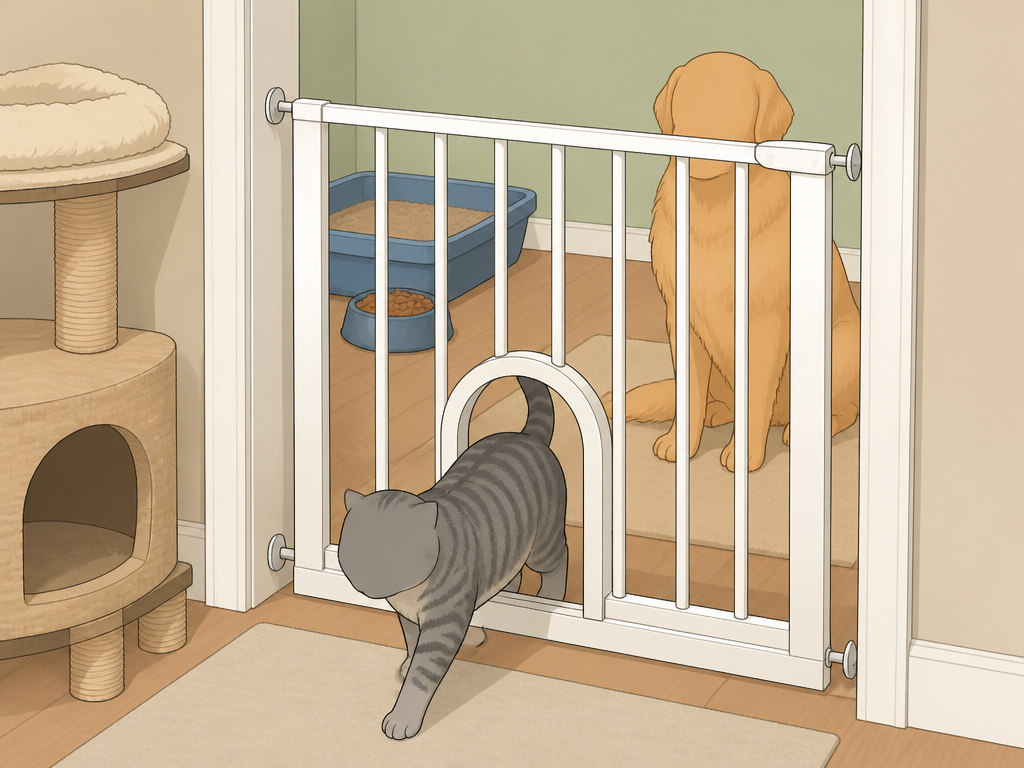
Your cat needs a room the dog cannot enter. Not a shelf, not a windowsill. A room with a door, or a gate the dog cannot clear, holding food, water, litter, and a soft place to sleep.
The Oregon Humane Society is blunt about this: never force the cat close to the dog by holding or caging her. The RSPCA adds that cat resources should move to a dog-free area before the dog arrives, not after.
- A gate with a built-in pet door. A baby gate with a small pet opening lets the cat pass and stops the dog, which is the entire job.
- Vertical space the dog cannot reach. A tall cat tree near the doorway gives the cat height and a sightline, which is where most cats prefer to watch from.
- Nail caps or trimmed nails. The AKC recommends one or the other to reduce injury to the dog during early meetings.
- A second litter tray in the dog-free room, because a cat who is avoiding the dog will not cross the house to use one.
Where this goes sideways: Moving the cat’s food and litter after the dog arrives instead of before. The cat learns the new spot under stress, and you get a hunger strike or a box strike within three days.
The scent work cuts both ways here. Put the dog’s paw towel where the cat sleeps, and the cat’s bedding where the dog can find it. Both animals get to investigate a strange smell on their own schedule, with no eye contact involved.
Where the Breed Lists Disagree With Each Other

The AKC calls Terriers a risk. Nylabone carves out an exception for one of them, noting the Boston Terrier may chase a cat out of fun rather than prey drive.
The Herding Group splits the same way. The AKC warns herding breeds may be too much for some cats, then lists the Collie, a herding breed, among its cat-friendly picks. Nylabone goes further and names the Shetland Sheepdog as cat friendly because of its mild nature and trainability.
A breed group tells you what a dog was built to notice. It tells you nothing about what that dog learned in its first sixteen weeks.
The research pushes back on group-level determinism from a different angle. Thomson et al., cited in the Generation Pup paper, found owners’ perceptions of amicability were shaped more by cat factors than dog factors, including the age at which the cat was introduced. The 2025 Japanese survey of 777 valid responses found both dog and cat factors predicted amicability, which differs from earlier Western findings.
If you want a herding dog anyway, read the herding dog breeds trade-offs first and go in with your eyes open. Collies are tolerant of other family pets. That is not the same as every herding breed being tolerant.
Supervising After the Introduction

The gate is open, both animals are on the rug, and the doorbell rings. In walks a friend’s dog that has never met a cat in its life.
I learned this one the hard way. My resident dog had years of boundary work behind him and ignored the cat completely. The visiting dog had none of that and treated the cat like something to be chased. Same house, same cat, completely different outcome.
Now I treat every visiting dog as untrained, no matter how well it behaves at home. The resident dog’s good habits do not transfer to a dog that has never been taught them.
The timelines here are longer than owners expect. The Oregon Humane Society says watch closely for a few weeks. The AKC says the settling period could take a few weeks or months, and until you are sure, do not leave them alone together. The AKC says do not leave them alone together until you are sure, which could take a few weeks or months.
Bad signs in the dog, per Oregon Humane: instant attempts to chase, straining at the leash, whining, or barking. See any of those and you go back a step. Not forward.
Instant attempts to chase, straining at the leash, whining, or barking are the bad signs I watch for. That flat, fixed posture is the visual tell that a chase is loading, and it looks nothing like a play bow.
If you are still choosing a dog, the multi-pet home question deserves its own pass before you fall for a face. Shelter staff screen for dogs that have already lived with a cat and dogs that do not chase squirrels, which is a better predictor than any group label.
For the longer game, dogs and cats as friends is a realistic goal in some houses and a fantasy in others. Coexistence is the floor. Aim there first.
And if you are starting from scratch on choosing a breed, put the cat’s temperament in the same column as the dog’s. The research keeps pointing at the cat’s age and comfort as the stronger variable.
Frequently Asked Questions
Are Golden Retrievers good with cats?
They are among the breeds most often named as cat friendly, and the AKC lists them. Nylabone’s guidance adds a practical caveat: train a Golden not to chase the cat early, because the chasing habit is easier to prevent than to undo.
What is the best dog breed for a house with a cat?
There is no single best breed. Toy and Sporting group dogs carry the lowest risk on paper, but the Generation Pup study found age at introduction, gradual introductions, and the presence of other dogs predicted desirable behavior better than breed did.
Can a Terrier live with a cat?
Yes, with conditions. The AKC warns that Terriers were bred to hunt vermin and a fast-moving cat can trigger those instincts. Nylabone treats the Boston Terrier as an exception, noting its chasing is usually playful rather than predatory. Supervision and a solid “leave it” cue carry the rest.
How long does it take for a dog and cat to get along?
Longer than a weekend. Published guidance ranges from at least a week of complete separation before introductions to a settling period of a few weeks or months before you can relax supervision. The Oregon Humane Society notes that cats who have never lived with a dog can take months to adjust.
Should I get a puppy or an adult dog if I have a cat?
Puppy gives you the 12-week introduction window the research points to. An adult dog gives you a known history, and shelters screen for dogs that have already lived with a cat and show low chase drive. Either can work. The puppy path depends on you actually running the training.
Do cats bully dogs in the same house?
More than owners expect. In one cited survey, 56.5% of cats had threatened the dog and 9.6% had caused injury, against 18% of dogs threatening the cat and 0.9% causing injury. A cat with claws and a safe escape route is not a passive participant.
The Bottom Line
If your dog is past 12 weeks and has never met a cat, the age finding in the research no longer applies to your situation. What you have left is management: gates, leashes, supervised sessions, and a cat-free room the dog cannot enter.
That is not a lesser outcome. It is the outcome most multi-pet homes actually live in.
One trigger worth memorizing before you start: instant attempts to chase, straining at the leash, whining, or barking. That is your stop signal. End the session, go back a step, try again tomorrow.
Everything else here assumes you will run the slow version. If you cannot commit to that, the honest answer is to wait on the dog rather than test the cat.
