
What to Do If a Dog Is Choking: Back Blows First
This post contains affiliate links. As an Amazon Associate, we earn from qualifying purchases.
If a dog is choking, give up to 5 back blows over the caudodorsal thorax, lateral to the spine, then check the mouth. The 2026 RECOVER guidelines put back blows ahead of abdominal thrusts, and switch to 30 chest compressions first once the dog goes unconscious.
That placement note is where the new guideline splits from nearly every handout still taped up in a clinic lobby. Back blows land beside the spine rather than across it, because a dog’s spine sits higher and sharper than a person’s, and a direct hit risks injuring it. Knowing what to do if a dog is choking starts with that same placement.
What follows is the sequence in order: how to tell choking from a cough, where to aim, what changes the moment the dog goes limp, and why the sources you will find online flatly contradict each other on the finger sweep. I am not a vet. I will show you who says what and let the guideline carry the weight.
Key Takeaways
- Back blows come first now. Up to 5, placed lateral to the spine over the caudodorsal thorax, never between the shoulder blades.
- A coughing dog is still moving air. A choking dog cannot breathe at all, and blue gums mean minutes rather than hours.
- Unconscious changes the whole protocol. Stop back blows, give 30 compressions at 100 to 120 per minute, then check the airway in under 10 seconds.
- Skip the blind finger sweep. The 2026 guideline advises against it because it can push an object farther into the airway.
- The vet visit is unconditional, even when the object comes out cleanly on your kitchen floor.
How Do You Tell Choking From Coughing?
Reverse sneezing, kennel cough, and a blade of grass up the nose all sound dreadful. Most of them are not choking.
Complete foreign body airway obstruction is fatal within a few minutes. A partial obstruction still moves air, so the animal coughs and hacks. A complete obstruction moves none: the animal makes high choking sounds, paws at the mouth, and the lips, gums, and tongue may turn blue. Both presentations are emergencies.
The PDSA draws the what to do if a dog is choking line in a way you can actually use in the moment. If the pet is coughing, air is still going in. If the pet is choking, it will struggle to breathe at all. That single test decides whether you are watching or intervening.
The AVMA brochure lists the same cluster of signs: difficulty breathing, heavy pawing at the mouth, choking sounds on the breath or cough, and blue-tinged lips or tongue. Two independent bodies, same picture.
| What You See | What It Means | How Fast |
|---|---|---|
| Coughing, still moving air | Partial obstruction, airway open | Vet today |
| High choking sound, no air | Complete obstruction | Seconds to minutes |
| Pawing mouth, blue gums | Oxygen running out | Immediate |
| Collapse or limpness | Switch to compressions | Immediate |
The Gum Check That Buys You Information
Gum color tells you what the airway is doing before the dog tells you anything. Press a fingertip against the gum above a canine tooth, let go, and watch how fast the pink comes back. That is the capillary refill time, and it is one of the fastest reads you get on a dog in trouble.
A gum line that has slid from bubblegum pink to a greyish blue is not a wait-and-see color. If you want the full method for checking a dog’s gums at home, that walkthrough covers the pressure test and what each shade means.
The 2026 Change: Back Blows Before the Heimlich
On 25 August 2026, the RECOVER Initiative published a guideline that formally reverses the order of basic life support for foreign body airway obstruction, moving from A-B-C to C-A-B, compressions first, even for a single rescuer. That is a change to the published RECOVER first aid clinical guidelines, not a footnote.
The what to do if a dog is choking maneuver order changed too. Back blows now come first, up to 5 of them, and abdominal thrusts are demoted to a fallback after those 5 blows. The guideline justifies the demotion with the only study in the set that directly compared the two techniques: back blows were approximately twice as likely to be effective as abdominal thrusts.
There is a second reason, and it is the one that made me reread the paragraph twice. Documented harms of abdominal thrusts in humans include aortic thrombosis, aortic dissection, aortic rupture, splenic rupture, gastric rupture, and tracheal tear. Some of those are fatal. The guideline notes that thrusts may carry even greater injury potential in dogs and cats, because many are small and chest and abdominal shapes vary so widely.
Where this goes sideways: Applying human Heimlich force to a twelve-pound terrier. The guideline flags abdominal thrusts as potentially harmful in small or thin animals and in animals with abdominal organomegaly, and a hard upward push on a small ribcage is exactly where that warning lands.
None of this means abdominal thrusts never happen. It means they are no longer the opening move, and the sources that still lead with them are working from older teaching.
The Back Blow Target: Caudodorsal Thorax, Beside the Spine
The target is the caudodorsal thorax, which is the upper part of the ribcage toward the tail end, delivered unilaterally or bilaterally, lateral to the spine. If you are picturing the human version between the shoulder blades, put that picture down.
Before you start: A choking dog bites down hard and has no idea it is you. Keep your face back from the mouth, and muzzle only if the dog is not vomiting, per the AVMA brochure. If the risk to you is high, the guideline recommends against bystander intervention at all.
Here is the sequence, with the reason each step matters:
- Get behind or beside the dog with one hand steadying the chest. A thrashing dog rolls out of a loose two-finger grip, and you lose the angle you just found.
- Strike with the flat of your hand over the caudodorsal thorax, just behind the shoulder and beside the spine. Land it on the spine itself and you risk injuring a structure far more prominent on a dog than on a person.
- Give up to 5 blows, checking between them. Blows past five add bruising without adding force, and the guideline stops at five.
- Look in the mouth between sets if you can do it without a bite. A visible object is a different problem from a hidden one, and the AVMA brochure allows removal with fingers or the flat side of a spoon when you can see it.
- Stop and switch if the dog goes limp. Back blows on an unconscious dog burn the seconds that compressions are supposed to buy.
What you are feeling for with that flat hand is a soft give followed by a hollow thump, not a crack. If your palm lands on something hard and bony, you have drifted onto the spine and need to move a hand’s width sideways.
What Changes If the Dog Goes Unconscious?
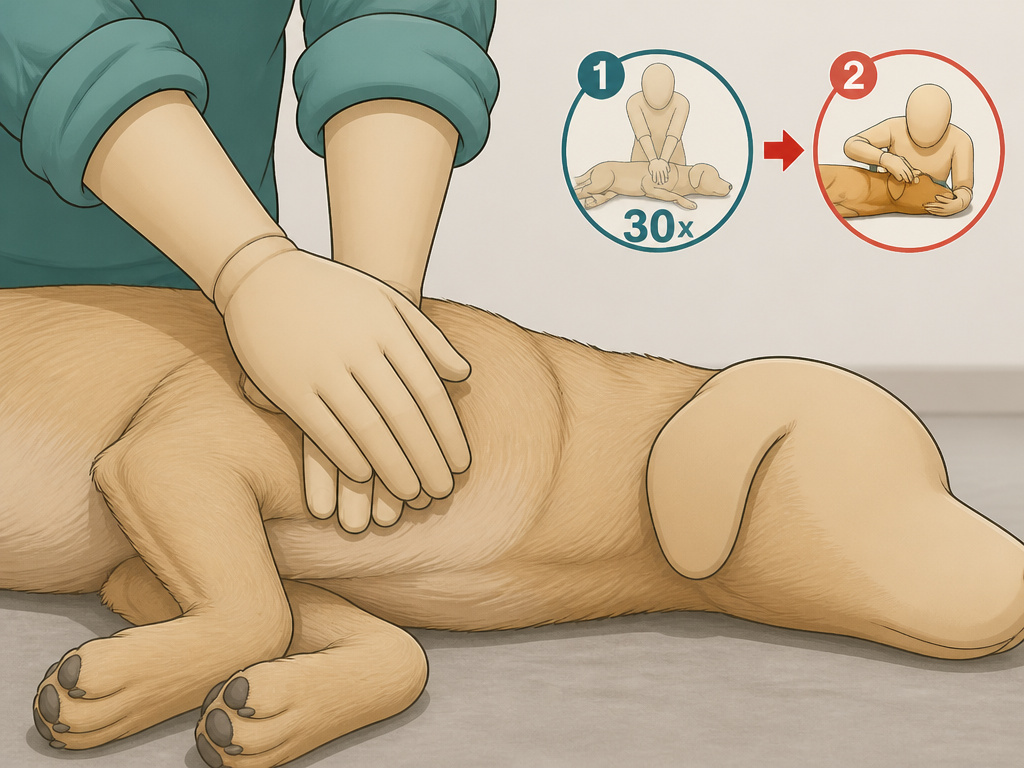
Everything changes, and it changes fast. RECOVER treats conscious and unconscious choking animals as two distinct protocols with different rules, and the switch point is the moment the dog stops responding.
The unconscious sequence is 30 chest compressions at 100 to 120 per minute, then a look at the airway that lasts less than 10 seconds, then 2 mouth-to-nose rescue breaths delivered in under 5 seconds. Compressions before airway, before breathing. That is the C-A-B order in practice.
If you need the full hand position and the breathing mechanics, the guide to performing CPR on a dog walks through it step by step. The page on what to do when a dog collapses covers the first thirty seconds before you start.
The C-A-B Switch in Plain Terms
The old order checked the airway first. The 2026 guideline puts compressions first, on the reasoning that circulation is what buys time while someone clears the obstruction. For a single rescuer with a limp dog on the floor, that means your hands go to the chest before your fingers go anywhere near the mouth.
The compression rate is where the sources stop agreeing. The Virginia Tech veterinary CPR guidelines list 100 to 200 per minute for dogs or cats. RECOVER and the AVMA brochure both say 100 to 120. Virginia Tech’s ceiling sits well above the guideline’s, and a rate that fast is hard to hold accurately with adrenaline in your arms.
The part nobody mentions: The 10-second airway check is a ceiling, not a target. Count it out loud if you have to. Fumbling in the dark past the 10-second ceiling costs you compressions you will never get back.
The Finger Sweep Argument Nobody Has Settled
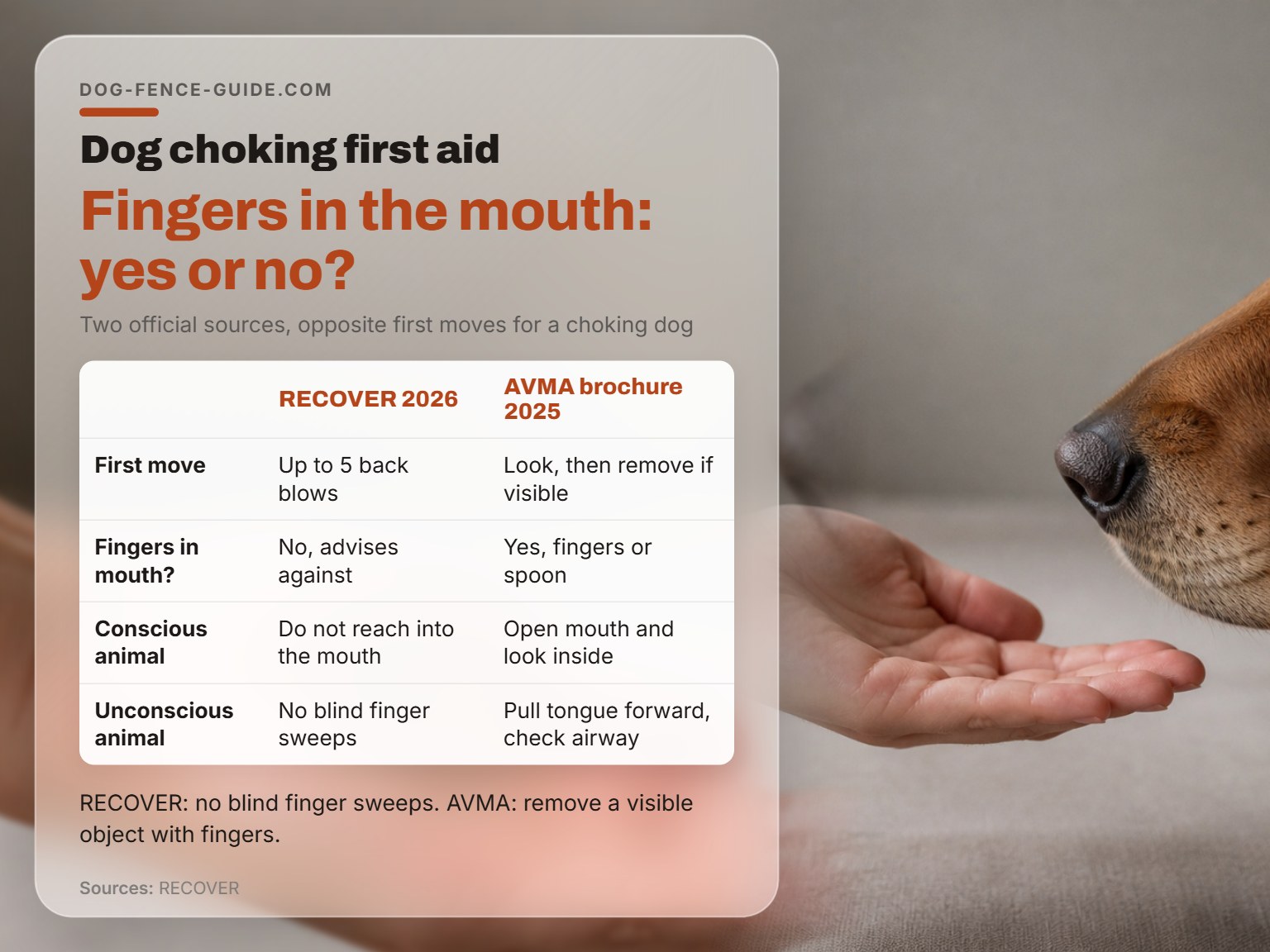
Two owners, same emergency, opposite instructions from two pieces of paper handed out by two different professionals. That is the current state of choking advice, and pretending otherwise would be dishonest.
The conflict is real and it is unresolved. RECOVER recommends against reaching into the mouth of a conscious animal and against blind finger sweeping in the unconscious one, while the AVMA brochure says to open the mouth and remove a visible object with fingers and the PDSA warns that fingers may cause panic and bites. The AVMA pet first aid brochure says to open the mouth and look, then remove a visible object with your fingers, using the flat side of a spoon to pull it closer if needed. The PDSA warns that fingers may make a choking pet panic harder and could get you bitten.
| Source | First Move | Fingers in the Mouth? |
|---|---|---|
| RECOVER 2026 | Up to 5 back blows | No, advises against |
| AVMA brochure 2025 | Look, then remove if visible | Yes, fingers or spoon |
| PDSA | Keep calm, seek vet care | Warns of panic and bites |
| Common video advice | Finger sweep first | Yes, sweep to throat |
The Red Cross dog choking guide and the Texas A&M Heimlich maneuver guide sit closer to the AVMA position, both featuring the Heimlich or finger extraction prominently. The video tier goes further still. Transcripts circulating online instruct sweeping an index finger to the back of the throat to feel for an object, which is precisely the blind sweep the guideline warns against.
Here is the honest version. A visible object you can reach without a fight is a different situation from a hidden one you are fishing for. The guideline’s objection is to the fishing.
Rule of thumb: Look, do not fish. If you can see it and it comes easily, take it. If you are hunting by feel, stop and go back to back blows.
Cats, Small Dogs, and the Swing Technique One Source Still Teaches
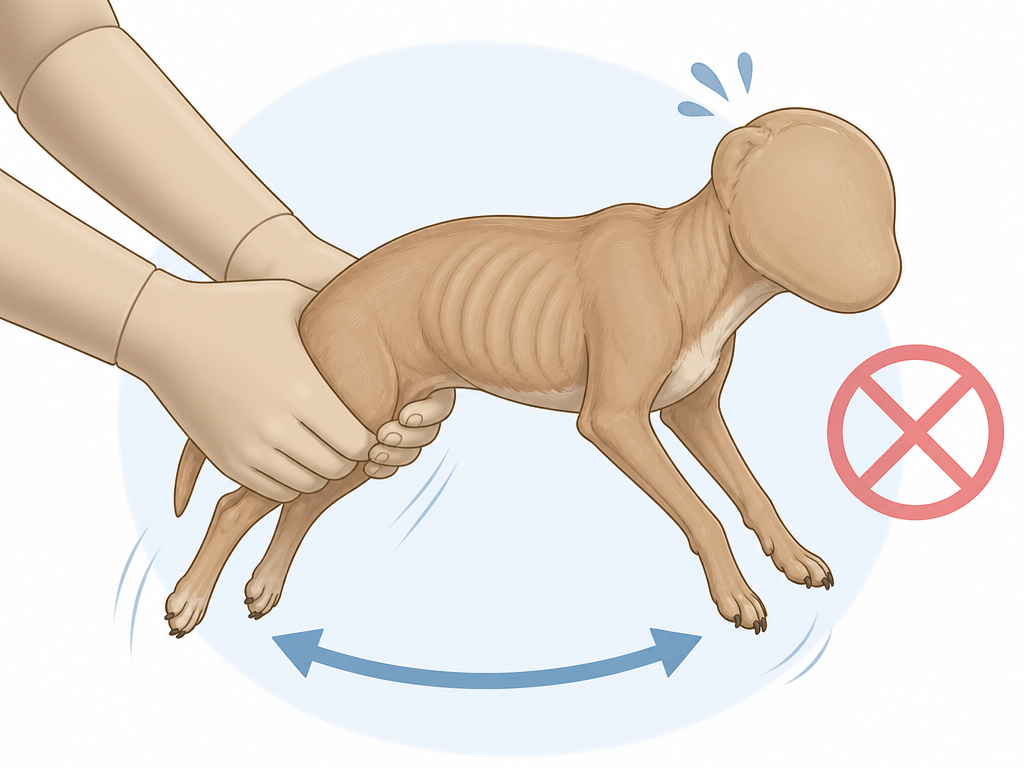
The AVMA brochure is the only source in this set that tells you to swing the animal. For cats and small dogs, when the object cannot be removed with fingers, it instructs owners to gently pick the pet up by the thighs and swing it in the air from side to side. If that fails, apply forward pressure to the abdomen just behind the ribcage.
RECOVER’s procedure box does not list the swing technique at all. Not as a caution, not as a footnote. It simply is not there.
That leaves you choosing between a technique with one professional-body endorsement and no procedure entry in the current consensus guideline. I would not swing a dog myself. If a vet is ten minutes away, drive, and have someone in the passenger seat keep the dog’s head lower than its chest.
I have watched owners try the hind-legs-up trick from a video, and the dog fought it the whole way. A struggling animal that is not getting air is using oxygen it does not have.
For cats specifically, the guideline is blunt about frequency: foreign body airway obstruction is an occasional problem in dogs and uncommon in cats. Rare does not mean impossible. It does mean the cat version of this emergency is more likely to be something else that looks identical.
When It Is Not a Foreign Body
Animals with upper airway obstruction from other causes can display the same signs, so the protocol may get applied to a non-foreign-body case. That is fine. The maneuvers are still the right first response to a dog that cannot move air.
The Veterinary Information Network adds a detail worth knowing for later: the throat normally contains small bones, which can be mistaken for a foreign body on a radiograph. Definitive evaluation needs sedation plus a fiber-optic endoscope or X-rays. That is a vet’s problem, not yours, but it explains why the vet will not simply take your word for it.
After the Object Comes Out, the Vet Visit Isn’t Optional
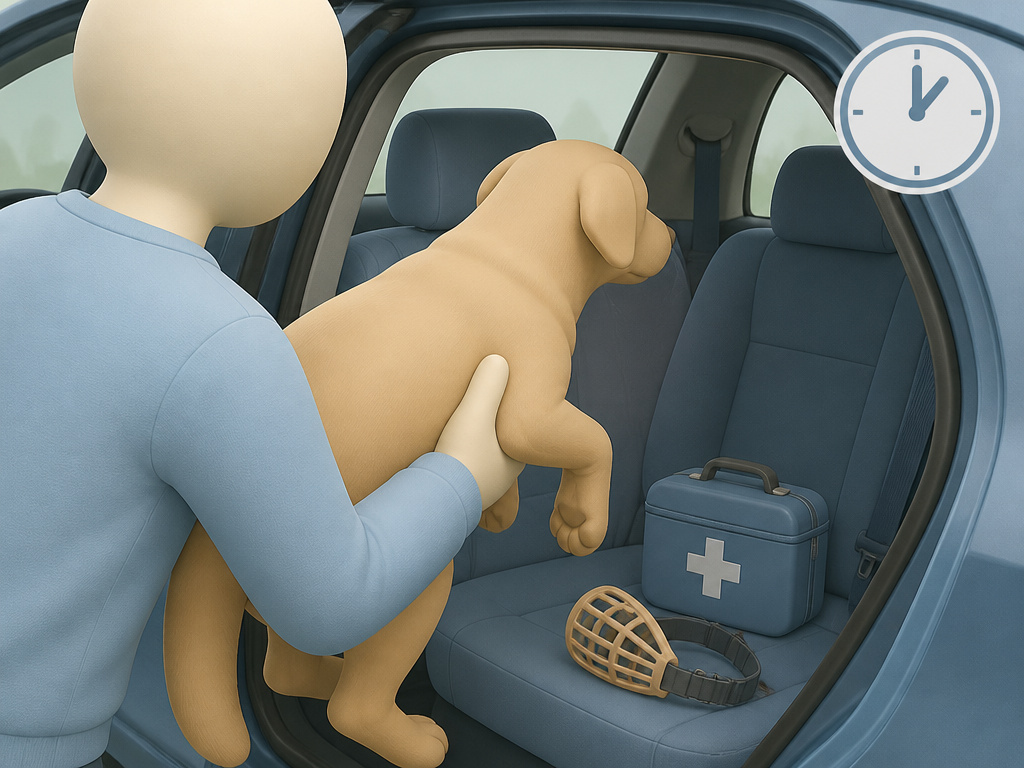
Any animal that received back blows or abdominal thrusts needs to be seen by a vet immediately, even if the object came out. RECOVER makes this unconditional, because complications from both the obstruction and the maneuvers occur with some frequency.
That is the part owners skip. The dog is breathing, the tail is wagging, and the whole thing feels finished. It is not. Tissue damage from the obstruction and bruising from the maneuvers both take hours to show up.
Watch for the signs of shock in dogs on the drive in: pale gums, a weak and rapid pulse, confusion, or a dog that goes cold at the extremities. Shock after a choking episode is uncommon but it is not nothing, and it is far easier to treat in a clinic than in a car.
If you do not already carry one, this is the week to build a dog first aid kit with a muzzle, a spare leash, and your vet’s number taped to the lid. The AVMA’s own checklist includes a muzzle and specifically warns against using it on a vomiting dog.
Three Causes of Repeat Choking (and the Slow-Feed Fix)
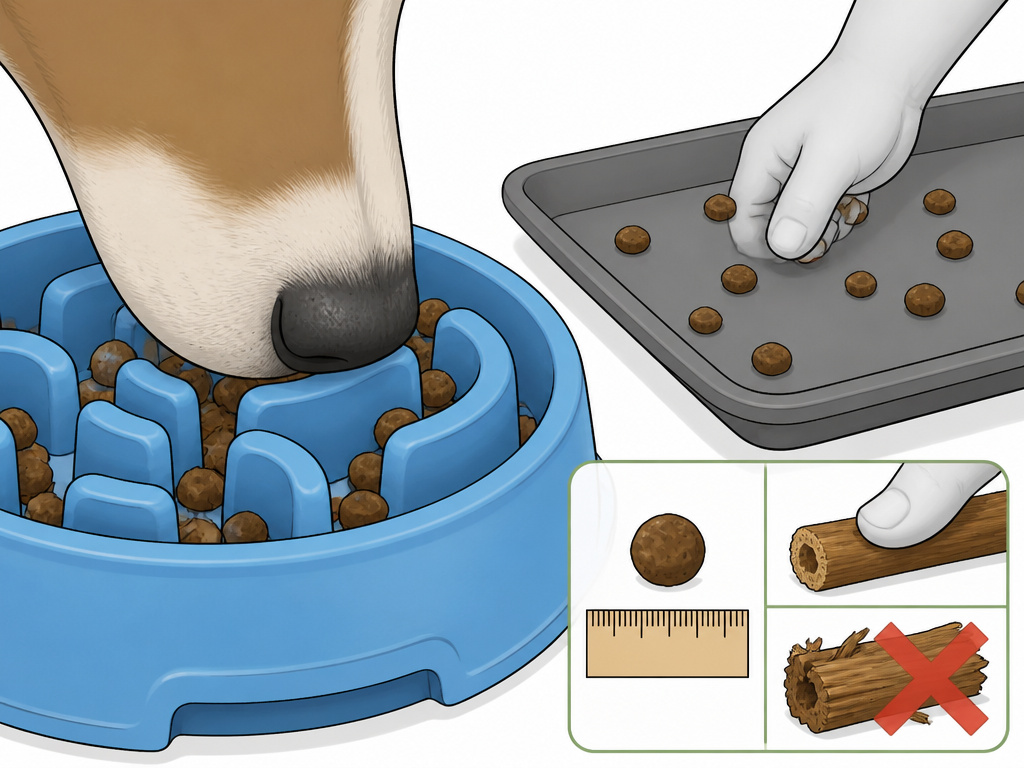
Three things cause most repeat episodes: speed, size, and the wrong chew. None of them are about the fence, and all of them are about the same gap in the routine.
This is the plumbing rule I keep coming back to. You do not fix a flooded floor by buying a bigger bucket. You find the joint that failed.
- Speed. A dog that inhales its bowl is aspirating air along with kibble. If yours is a dog that eats too fast, a slow feeder or a scatter feed across a baking tray is the cheapest fix in this whole article.
- Size. Kibble, treats, and chew ends all need to be smaller than the dog’s airway opening, not smaller than its enthusiasm.
- The wrong chew. Choosing safe chews comes down to a simple test: if you cannot press a thumbnail into it, it can break a tooth, and if it splinters into chunks, it can lodge. And yes, whether bully sticks are safe is the question I get most, because the last inch is the part that goes down whole.
There is one more piece, and it belongs in the same conversation. A dog that panics and bolts after a choking episode can end up in traffic, which is a worse emergency than the one you just handled. Register the microchip, and keep your contact details up to date, because an unregistered chip is a piece of glass in a dog’s shoulder.
Frequently Asked Questions
Can a dog still breathe if it is choking?
Sometimes, and that distinction drives everything. A partial obstruction still moves air, so the dog coughs and hacks and can breathe in. A complete obstruction moves no air at all, and the dog will struggle to breathe, make choking sounds, and may show blue gums. Coughing means watch closely. Silence and struggle means act.
Should I do the Heimlich on my dog?
Not as a first move under the 2026 RECOVER guideline, which puts up to 5 back blows ahead of abdominal thrusts and demotes the Heimlich to a fallback, though the AVMA brochure still describes the Heimlich for large dogs. The AVMA brochure still describes the Heimlich for large dogs, and both positions are worth knowing, but the newer guideline is the one that weighed the injury data.
How hard should a back blow be?
Firm enough to move the ribcage, delivered with the flat of your hand over the caudodorsal thorax beside the spine. You are not trying to break anything. If your palm lands on something hard and bony, you are on the spine and need to shift sideways before the next blow.
My dog coughed something up. Do I still need the vet?
Yes. The guideline is unconditional on this point: any animal that received back blows or abdominal thrusts gets seen immediately, even if the object came out. Complications from the obstruction and from the maneuvers both occur with some frequency, and most of them are not visible from the outside.
What if I can see the object but cannot reach it?
Do not go fishing. The guideline advises against blind sweeping in an unconscious animal because it can drive the object deeper, and the PDSA warns that fingers make a panicking pet panic harder. If it is visible and comes easily, take it. If not, back to blows and then to the car.
Before You Go
The one thing to do this weekend is not a maneuver. It is a two-minute check: call your microchip registry and confirm the phone number on file is the one in your pocket right now. Most chips are never registered or the details go stale after a move, and a dog that panics after a choking episode is exactly the dog that ends up at a shelter with a chip nobody can trace.
Then put your vet’s number and the nearest emergency clinic’s number on the fridge, at eye level, where you will actually see them with a dog in your arms.
Everything above assumes you can get your hands on the dog safely. If you cannot, the guideline’s own answer is to stop, because a bitten owner in a panic is a second patient and no help to the first.
