
What to Do If a Dog Has a Seizure: First Aid Steps
This post contains affiliate links. As an Amazon Associate, we earn from qualifying purchases.
If a dog has a seizure, start a timer, clear the space around him, keep your hands away from his mouth, and keep the room quiet and cool until it stops. Call your vet if it runs past two minutes, if it isn’t his first seizure in the past 24 hours, or if he doesn’t come round properly afterward.
Two minutes is the shortest trigger in the veterinary literature, and it comes from PDSA, the UK animal charity. Other sources hold out to three minutes, and several wait the full five. That spread is the most confusing part of seizure first aid, and it decides what to do if a dog has a seizure.
What follows is the order of operations: what a seizure looks like phase by phase, the first sixty seconds, which number applies to your dog, the hour afterward, and the plan to have in place before any of it happens.
Key Takeaways
- Start the clock before you touch anything. Duration is the number your vet will ask for, and it’s the one detail you can’t rebuild from memory later.
- Hands and face stay off the mouth. Dogs don’t swallow their tongues, and the jaw clamp is involuntary and strong enough to cause a severe bite or lost fingers.
- More than one seizure in 24 hours is a call even if each one was brief.
- The post-ictal hour isn’t over when the shaking stops. Confusion, pacing, and temporary blindness can run for hours.
What a Seizure Actually Looks Like, Phase by Phase
A dog goes stiff, slides onto his side, and starts paddling at the air. His jaw clacks shut over and over, and there’s foam at the corner of his mouth. That’s a generalized seizure, and it’s the picture most owners carry into the room with them.
A generalized seizure moves through three phases. The pre-ictal phase, or aura, can run from a few seconds to a few hours. The ictal phase is the seizure itself, lasting from a few seconds to several minutes. The post-ictal phase follows, with confusion that lasts minutes to hours.
VCA Animal Hospitals describes that pre-ictal stretch as altered behavior: hiding, whining, shaking, salivating, restlessness. Some dogs sense it coming and seek you out. Others give you nothing at all.
The ictal phase is the part everyone recognizes. A generalized seizure brings loss of consciousness, with all four limbs moving spastically and the head drawn backward. Expect urination, defecation, or heavy salivation.
The look-alikes that aren’t seizures
Focal seizures are easier to miss. Cornell’s neurology team describes “fly-biting,” where the dog snaps at nothing, and the “chewing gum fit,” where the jaw clacks while the rest of the body stays put. Cornell advises keeping watch, because focal seizures spread into generalized ones.
Tremors, cold shivering, and balance problems all mimic the real thing from across a room, which is why why dogs shake deserves its own look before you assume seizures.
Causes split into three rough buckets. Idiopathic epilepsy, meaning no identifiable cause, is the most common, and Cornell puts its usual onset between six months and six years old. Toxins, low blood sugar, liver and kidney disease, and brain tumors account for the rest.
Worth knowing before you start: a single seizure is rarely dangerous on its own. VCA’s guidance is blunt about this. The damage comes from duration and from repeated events, not from one short episode.
If the episodes are recurring rather than a one-off, the pattern matters more than any single event. Reading up on epilepsy in dogs before the next vet visit gives you better questions to ask.
The First 60 Seconds: What to Do, in Order
Start the clock before you touch anything.
Before you start: the jaw clamp is involuntary and strong enough to cause disfiguring bites, so keep hands and face clear of the mouth. Seizures raise core body temperature, so don’t wrap the dog or hold him against you. And don’t move a dog seizing on flat ground, because restraint can injure a thrashing animal.
- Start a timer or note the clock. Chappelle Veterinary Clinic says to look at a watch the moment it begins, because those seconds feel longer than they are. Skip it and you’ll tell the vet “a couple of minutes” when it ran five.
- Clear the floor around him. Cornell’s team says to remove anything breakable or anything that could fall on the dog. A coffee table corner is the difference between a bruise and a fracture.
- Keep the room cool and the lights low. PDSA notes that seizures raise body temperature, and Cornell warns that prolonged activity drives core temperature to life-threatening levels. Heat is the enemy here.
- Stay quiet and stay back. Don’t shout, shake, or slap to bring him round. PDSA states plainly that this will probably make the seizure worse.
- Let it finish before you move him. PDSA’s instruction is not to transport until the seizure has stopped, unless your vet has told you otherwise.
Video the event if you can. PDSA recommends it, and a short clip tells a neurologist more than a paragraph of description.
Not every dog paddles. Some simply drop, which is why what to do if a dog collapses starts with the same what to do if a dog has a seizure question this article does. MedVet notes one useful distinction: a fainting dog recovers instantly, while a seizing dog stays disoriented for minutes to hours.
How Long Is Too Long? Where the Sources Actually Disagree
Two minutes, three minutes, five minutes. Those are the three numbers in circulation, and nobody has reconciled them.
The two-minute, three-minute, and five-minute lines
PDSA sets the earliest trigger: call your vet if the seizure passes two minutes, or if it isn’t the first one in the past 24 hours. MedVet splits the difference, advising that if the seizure hasn’t stopped on its own after three minutes, you should begin transporting to an emergency facility.
Five minutes is where several clinical sources converge on the definition of status epilepticus, though PDSA calls for the vet at two minutes and MedVet says to start transporting at three. Cornell’s Dr. Peter Early calls it “an ongoing seizure that doesn’t self-resolve, typically considered more than five minutes.” VCA, Chappelle, and Garden State all land on the same five-minute line.
| Source | Call the vet at | What sits behind the number |
|---|---|---|
| PDSA | More than 2 minutes | Most conservative trigger published |
| MedVet | 3 minutes, then start driving | Builds transport time into the plan |
| VCA Animal Hospitals | 5 minutes | Definition of status epilepticus |
| Chappelle Veterinary Clinic | 5 minutes | Prolonged seizure threshold |
| Cornell Riney Canine Health Center | 5 minutes | Status epilepticus definition |
| Garden State Veterinary Services | 5 minutes | Emergency care threshold |
Here’s how I’d read that table. Use two minutes as your personal alarm, because it costs you nothing to pick up the phone early. Use three minutes as the point where you’re in the car. Treat five minutes as the emergency everyone agrees on.
The cluster-seizure rule is messier. PDSA says call if the seizure isn’t the first in 24 hours. MedVet sets the line at more than two seizures in 24 hours. Garden State says multiple seizures in a day need quick attention even when each one is brief. The sources differ on the exact count, so check which threshold your vet uses.
What Not to Do, and Why Each One Backfires

The instinct to hold your dog still is the one that gets people bitten when they look up what to do if a dog has a seizure.
| Do this | Not this | Why it matters |
|---|---|---|
| Time it on your phone | Guessing afterward | Duration decides whether it’s an emergency |
| Slide furniture and sharp edges away | Pinning the dog down | Restraint injures a thrashing animal |
| Keep hands and face clear | Reaching in to free the tongue | Dogs don’t swallow their tongues; jaws clamp |
| Keep the room cool | Blanketing or holding him close | Core temperature climbs during a long seizure |
| Speak softly, dim the lights | Shouting or shaking him awake | PDSA says it likely worsens the seizure |
The tongue thing deserves a direct answer. VCA states that dogs do not swallow their tongues during a seizure, and that putting fingers or an object in the mouth risks a severe bite or an injury to the dog. Chappelle is blunter: the jaw can clamp and not let go, and those bites cause lost fingers.
Never give human medication to stop a seizure. Garden State flags this specifically, because it can harm the dog and interfere with whatever the vet does next.
Common mistake: offering water while the dog is still groggy. Garden State’s instruction is small sips only once he’s fully alert and swallowing normally. A dog that can’t swallow properly will inhale it.
After the Seizure: The Post-Ictal Hour

Twenty minutes later your dog is pacing the hallway, walking into the doorframe, and doesn’t seem to know your voice.
That’s the post-ictal phase, and MedVet lists what shows up in it: confusion, temporary blindness, pacing, restlessness, and increased thirst and hunger. It runs minutes to hours. Cornell adds a warning that matters for anyone who wants to comfort their dog. Disorientation in this window sometimes shows up as aggressive behavior.
So keep your hands back a little longer than feels natural. That’s not a dog being difficult. He genuinely isn’t tracking where he is.
What goes in a seizure log
Garden State notes that a dog still badly disoriented after 30 minutes needs a quick evaluation. A written log is what turns those observations into a treatment decision later.
- Date, time, and duration. Note the start on a clock, not from memory.
- What happened before and during. Behavior changes, which limbs moved, whether he lost consciousness.
- What happened after. Confusion, blindness, pacing, appetite, and how long it took to settle.
A video plus a log is what a neurologist actually works from. Cornell makes the point that once an antiepileptic is started, it’s generally for life, so the record of frequency and severity is what justifies starting.
Should You Move a Dog That’s Seizing?
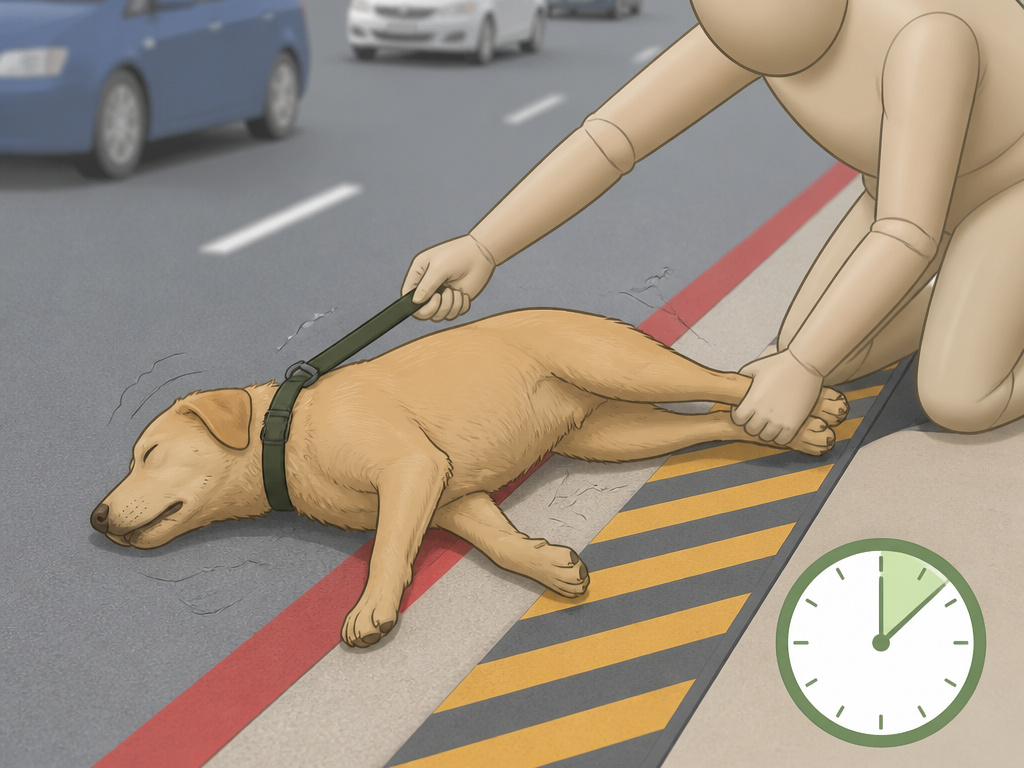
Two credible organizations give opposite instructions here, and both are right in context.
PDSA says don’t transport your pet until the seizure has stopped, unless your vet advises otherwise. MedVet says that if the seizure doesn’t stop on its own after three minutes, begin transporting to an emergency facility. Those aren’t contradictory once you separate “moving a dog on a rug” from “getting a dog off a highway.”
Chappelle handles the exception directly. If the seizure starts at the edge of a drop-off, on a busy road, at the top of stairs, or in water, take the dog by the collar, the scruff, or the hind legs and drag him clear. Protect yourself from the teeth while you do it.
Cornell adds a stair-specific move: if the dog is on steps, try to stay below him so he can’t fall further.
Rule of thumb: on flat ground, your job is the floor and the clock. If the floor is the hazard, the floor loses and you move the dog.
Once it’s over, transport matters too. Garden State advises calling the emergency clinic before you leave, describing duration, symptoms, and history so they can prepare. Put him on a flat surface or in a crate if he’s still disoriented, and keep the car quiet and cool.
When Daily Medication Becomes the Conversation

Levetiracetam is one anticonvulsant used in dogs, and Cornell notes it’s short-acting and dosed three times a day, which is why the extended-release version, Keppra XR, exists for twice-daily dosing. Cornell notes it’s short-acting and dosed three times a day, which is why the extended-release version, Keppra XR, exists for twice-daily dosing.
The trigger for starting daily medication is where the sources part company. MedVet considers anticonvulsant therapy when a dog has more than two seizures in six months. Cornell’s Dr. Early offers a general rule of more than one seizure a month. A 2024 review in Veterinary Sciences by Munguia and colleagues recommends starting when there are more than two seizures in one month, cluster seizures, or status epilepticus.
Three different thresholds, all from credible sources. Bring your log and let your vet apply the one that fits your dog.
Rescue medication at home
For dogs with a known history, vets send owners home with something to interrupt a prolonged or clustered event. MedVet names intranasal midazolam and rectal diazepam, plus oral levetiracetam or clorazepate in some cases.
The rectal route is contested. Cornell describes dispensing diazepam with a syringe and a rubber tube, introducing the tip about an inch into the rectum, and MedVet lists rectal diazepam as a way to stop an active seizure and buy time, while Munguia and colleagues state that the per-rectal route is not recommended in dogs because of poor bioavailability and subtherapeutic effects.
That’s a real disagreement between a university veterinary center and a 2024 peer-reviewed review. Ask your vet which route they want you trained on, and get trained before you need it. The 2024 review notes that owners can be taught to give intranasal benzodiazepines at home.
Cornell also describes a non-drug maneuver: gently pressing on the dog’s eyes through closed lids for 10 to 60 seconds, repeatable every five minutes. Ask before trying it.
Two smaller pieces belong here. Cornell reports that roughly 20% of dogs have refractory epilepsy and need more than one antiepileptic, which is why seizure medication is a longer conversation than one prescription. And Cornell lists Purina Pro Plan Veterinary Diet NeuroCare (NC), an MCT-containing diet, as an option for refractory cases. If you want to understand the MCT angle before that appointment, MCT oil for dogs covers the reasoning.
One more trigger worth knowing: some drugs lower the seizure threshold, which is why flea control for dogs with seizures is a separate decision from flea control for a dog with no history.
Building the Emergency Plan Before You Need It

Here’s the honest version of what I keep ready, and it has nothing to do with a fence being fancy. A slip lead hangs on the gate post. A card with my vet’s number and the nearest emergency clinic’s number lives in the same bag as the treats. Recent photos of the dog, side-on and face-on, sit in a phone album I can find without thinking.
That last part matters more than people expect. A panicked dog that bolts during or after a seizure is a lost dog, and a photo you can text to a neighborhood group in ten seconds beats a description.
What to have in place before the first seizure:
- A current ID tag on the collar, with a phone number you actually answer.
- A microchip whose registration you’ve checked. Plenty of chips are never registered or still point at an old address.
- A written contact list: your vet, the nearest 24-hour clinic, two neighbors, and the local shelter.
Batteries die and coverage drops, and a tracker that’s offline is a collar.
Water is the other piece. Chappelle warns that seizures in water carry a real drowning risk, and advises that dogs with a known seizure history shouldn’t play unsupervised near pools or ponds. The workaround is simple: get in the water with the dog on a long retractable leash, so there’s room to play but you’re still connected.
And if the seizure turns out to be a toxin instead of epilepsy, the clock is different. If the seizure turns out to be a toxin instead of epilepsy, the clock is different, and what to do if a dog is poisoned is the page to have open rather than the one to search for.
For a printable version of the basic steps, the American Red Cross pet first aid resource covers seizures alongside choking and bleeding, and it’s the kind of thing worth sticking inside a cupboard door.
The Bottom Line
This weekend, do one thing: write the plan on an index card and tape it inside the cupboard where the towels live. Date of birth, weight, current medications, your vet’s number, the nearest emergency clinic’s number, and one line that says “do not put anything in his mouth.”
Then check that the microchip registration comes back to your current address and phone number.
Everything above assumes you’re the one standing over the dog. If you’re not, the card is what the person who is will read.
Frequently Asked Questions
Can I hold my dog during a seizure?
No. Cornell is direct about this: your dog isn’t aware of his surroundings during a seizure and isn’t in control of his movements, so hugging or stroking the head risks a bite. Keep contact minimal and keep the space around him clear instead.
Should I put something in his mouth to stop him swallowing his tongue?
No. VCA states that dogs do not swallow their tongues during a seizure, and that putting fingers or an object in the mouth risks a severe bite or an injury to the dog. Chappelle notes the jaw clamp can cause lost fingers or disfiguring injuries.
How long should a seizure last before I call the vet?
PDSA says call if it passes two minutes. MedVet says begin transporting if it hasn’t stopped after three minutes. Five minutes is status epilepticus by the definition used at Cornell, VCA, Chappelle, and Garden State, and that’s an emergency.
What if he has a second seizure later the same day?
Call. PDSA says call your vet if the seizure isn’t the first one in the past 24 hours, and Garden State says multiple seizures in a day need quick attention even when each is brief. MedVet sets the line at more than two seizures in 24 hours.
Is a seizure painful for my dog?
No. The dog is unconscious during the event itself, and injury from thrashing is the real risk, which is why clearing the floor matters more than comforting him. Injury from thrashing is the real risk, which is why clearing the floor matters more than comforting him.
When does a dog need daily seizure medication?
The thresholds differ. MedVet considers it at more than two seizures in six months, Cornell’s Dr. Early uses more than one a month as a general rule, and the 2024 Veterinary Sciences review recommends it at more than two seizures in one month, cluster seizures, or status epilepticus.
