
Maltese Grooming Needs: Schedule, Tools, and Coat Care
This post contains affiliate links. As an Amazon Associate, we earn from qualifying purchases.
Maltese grooming needs run on four intervals: daily brushing, a bath every three to four weeks, a clip every four to eight weeks, and nails about every six weeks. The coat is single-layer hair with no undercoat, so it mats fast and punishes skipped days.
That single layer explains why the maltese grooming needs schedule looks fussy on paper. The hair grows continuously and sheds slowly, so dead strands stay in the coat instead of dropping to the floor. Every one of those strands is a chance for friction to lock two hairs together, and the legs, armpits and the patch behind each ear are where it happens first.
What follows is the working schedule, the two places reputable sources flatly disagree, and the body parts that quietly fall off the list when you’re only thinking about the coat.
Key Takeaways
- Daily brushing is the baseline for a long coat, and cindra.net says it is essential regardless of coat length. The every-three-days figure applies to a coat clipped short, not to a full one.
- Bath every three to four weeks is one source’s number. A veterinary source says six to eight weeks for non-shedding breeds. Both are defensible.
- Don’t let a Maltese air dry, per the American Maltese Association. Towel first, then blow dry on medium heat while brushing.
- Ears get checked weekly and cleaned about every four weeks. The hair inside the canal matters for airflow.
- A badly matted coat can be clipped down short by the groomer, and that decision isn’t yours once the mats are set.
Maltese Grooming Needs: How Often Is Often Enough?
Two reputable sources give different answers, and both are worth understanding before you book anything.
The Maltese coat is single-layer hair with no undercoat. Because the hair grows continuously and sheds slowly, dead strands stay trapped in the coat rather than dropping away. Those trapped strands wrap around live hair, and friction at the legs, armpits and behind the ears presses the tangle into a flat, felted patch.
Dogs NSW, quoted by WOOOF, puts the clip at approximately every 8 weeks. Dr. Zubair Khalid puts professional grooming at every 4 to 6 weeks. Neither is wrong, and neither is universal.
| Source | Clip interval | Reason given |
|---|---|---|
| Dogs NSW, quoted by WOOOF | About every 8 weeks | Keeps the trim short enough for home brushing to reach skin |
| Dr. Zubair Khalid, DVM | Every 4 to 6 weeks | Coat length and matting risk |
| AllGroom | Depends on the length you want | Clip frequency follows coat length |
The eight-week figure assumes you’re keeping the trim short enough that a brush reaches skin without a fight. The four-to-six-week figure assumes you want some length and are willing to pay for it. Pick the one that matches the coat you’re actually maintaining.
A full show coat is a different commitment entirely. WOOOF puts it at about an hour of grooming per day, which is a part-time job with a dog attached. If you’re weighing a standing appointment against a drop-in, how often to see a groomer covers the trade-off in more detail.
The Coat Change at 10 to 14 Months Catches Most Owners Out
A Maltese puppy starts with a soft, short coat that’s genuinely easy to keep. Somewhere between 10 and 14 months that changes into the adult coat, and AllGroom describes the result as suddenly extra high maintenance.
That’s the point where owners who’ve been coasting on a weekly brush get ambushed. The coat gets denser, tangles faster, and the routine that worked in month eight stops working in month thirteen. Which is why brushing a puppy you don’t strictly need to brush yet still matters. You’re not fighting tangles, you’re teaching the dog that standing still on a table is normal.
Where this goes sideways: Assuming the easy puppy coat is the coat you signed up for. The adult coat arrives over about four months, and the brushing routine that kept a puppy tangle-free will start losing ground within a week or two of the change.
Brushing frequency is the second place sources split. The American Maltese Association says a daily once-over with a pin brush or steel-tooth comb. VCA Animal Hospitals says every day or two. WOOOF says every 2 to 3 days at home. AllGroom says about every 3 days when clipped short, daily for a longer coat.
The pattern underneath the disagreement is simple. Shorter coat, less frequent brushing. Longer coat, daily. And cindra.net makes the case that daily brushing is essential regardless of length, noting that fine silky hair can mat within a day or two if it’s skipped, especially at the legs, armpits and behind the ears.
I’d take the daily habit over the minimum. It costs you five minutes and it means you find the tangle while it’s still a tangle.
Brushing a Maltese: Ends First, Skin Last
Work from the ends of the coat toward the skin, not from the root outward. Dragging a brush straight through a tangle from the root drives the knot downward and tightens it against the body, which is exactly where you don’t want it.
The tool set is small:
- A pin brush for the daily once-over, which the American Maltese Association names as the standard.
- A metal comb, and the test is whether the teeth reach skin without snagging.
- A slicker brush if the coat runs curly rather than silky. VCA recommends slickers for curly, non-shedding coats.
- A long-toothed comb with offset tines for a longer coat, which VCA flags as the right shape for long hair.
- Diluted coat conditioner in a spray bottle, which the American Maltese Association uses while brushing to cut static and reduce breakage.
If you want the shortlist rather than the categories, the best brushes for Maltese coats narrows it down, and the wider grooming supplies list covers the rest of the kit.
Two things matter more than the tool brand. Be gentle, and don’t pull hard on a tangle, which VCA states plainly. And keep the hair out of the eyes, either with a single or double topknot or by trimming it back, per the American Maltese Association.
A mat doesn’t feel like a knot. It feels like a piece of felted wool under your fingers, dense and slightly warm from the skin trapped underneath, and it doesn’t budge when you push at it. That’s your signal to stop brushing and change approach.
Why Does a Matted Coat Get Worse After a Bath?
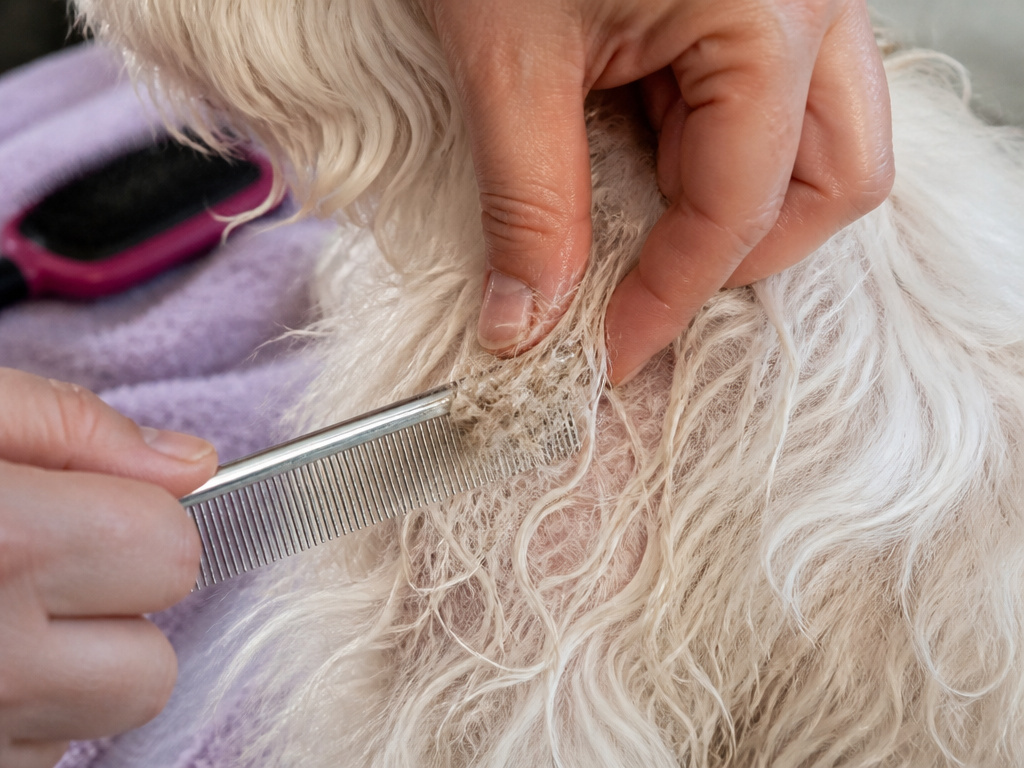
Because water tightens what’s already tangled. VCA warns that tangles can become impossible to remove after a bath, which is why VCA says the coat should be brushed out first, while malteseonly.com says the most important brushing happens after the bath.
Here’s where the sources genuinely disagree, and it’s worth knowing before you pick a side. The American Maltese Association says the coat should be thoroughly brushed with all mats removed before bathing. VCA says brush burrs and tangles out before bathing. Malteseonly.com takes the opposite view, arguing the most important brushing session is after the bath, when the coat is just damp out of the towel, because snarls give up to the brush when they’re washed, rinsed with conditioner and not yet dry.
My read: both are describing different coats. A coat with set mats gets combed out before water touches it. A coat that’s tangle-free but rumpled gets its real brush-out while damp. Do the pre-bath check first, then decide.
Before you start: A blow dryer on high heat will break a Maltese coat, so keep it on medium and test the air on your own wrist first. Clippers get hot during a long session and can burn skin, so pause and check the blade against your hand. And keep scissors away from any mat sitting against skin, because a mat hides how close the blade is.
Bath frequency is the other split. AllGroom puts the adult Maltese coat at every 3 to 4 weeks, and only when needed. VCA says non-shedding breeds generally need bathing every 6 to 8 weeks, with frequency varying by age, lifestyle, coat type and health. That’s roughly a two-times gap, and both are reasonable depending on how much time your dog spends in the dirt.
The sequence itself is less contested:
- Comb through first and deal with every mat you find, as the American Maltese Association and VCA advise, though malteseonly.com says the key brushing is after the bath.
- Wet the coat to the skin before shampoo goes on, per malteseonly.com. Surface-wet hair doesn’t lather properly and you end up using more product.
- Shampoo for white coats, then conditioner for long hair, which is the American Maltese Association’s pairing. AllGroom adds that conditioner smooths the cuticle and reduces knot formation.
- Towel, then blow dry on medium heat while brushing, per the American Maltese Association. Malteseonly.com is equally direct: medium only, never high.
- Dry one section at a time, and do the face last with a small metal comb, per malteseonly.com.
If your dog’s skin reacts to every shampoo you try, dogs with sensitive skin covers the gentler route, and the Maltese shampoo shortlist is built around white coats specifically.
Mats, Clippers, and the Scissors Argument
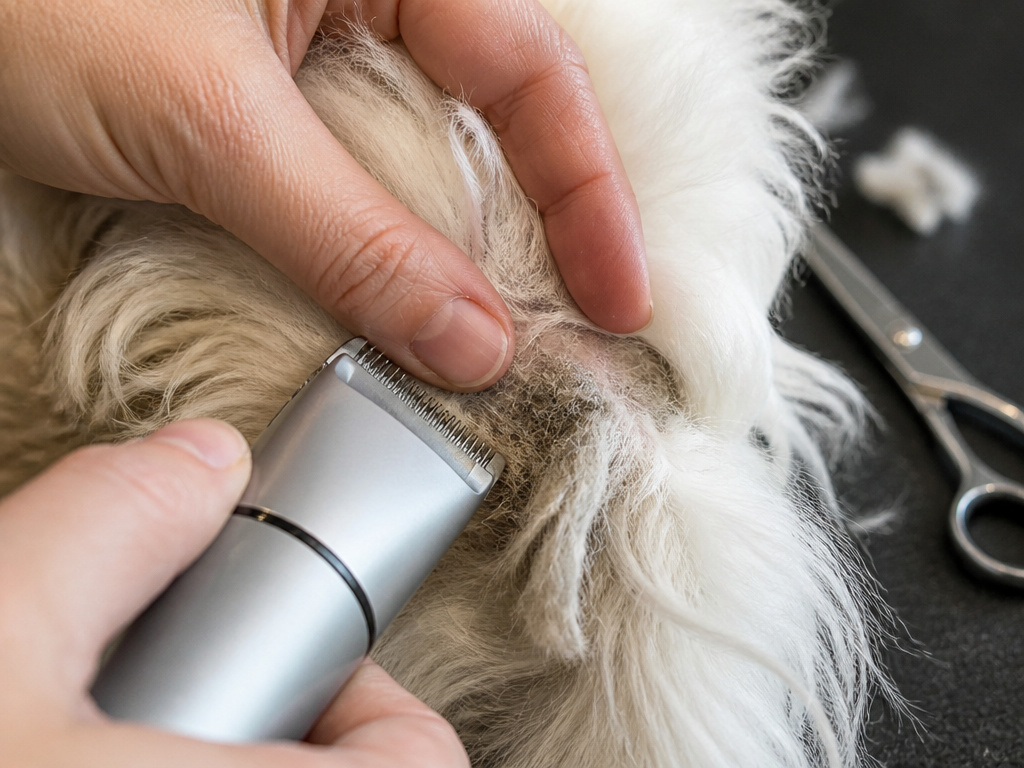
A tight mat sits directly against skin that moves underneath it, and that’s why the tool choice matters more than the technique.
VCA is unambiguous: only use clippers to remove mats, never scissors. The reason is mechanical. A mat pulls the skin up into itself, so the distance between the blade and the skin is smaller than it looks, and scissors cut what’s in front of them without telling you what that is.
Malteseonly.com offers a middle path for the early stage. Work the mat loose with your fingers first, gently, rather than brushing straight through it, because brushing through causes hair loss. If the mat is too large to work out by hand, spray it with detangler and try again.
Once a coat is severely matted, the decision leaves your hands. The American Maltese Association notes the groomer may have no choice but to cut the coat down very short. That’s the real cost of a skipped month, and it’s why a periodic short cut done on your schedule beats an emergency clip-down done on theirs.
Fair warning on the clip-down itself. VCA describes post-clipping alopecia, a condition where hair regrowth is delayed for up to two years, and notes it shows up especially in plush-coated breeds. VCA notes it shows up especially in plush-coated breeds, but it’s worth knowing before you ask for a full shave on a coat you’d like back.
For the actual clipping, AllGroom points to the Heiniger Saphir, a single-speed clipper with enough torque to handle the Maltese coat, and to MINI trimmers for paws, faces, ears and armpits where a full clipper is too much tool. If you’re trimming between appointments, shears for small dogs covers the hand-tool side.
Common mistake: Cutting into a mat with scissors because the clipper feels like overkill. The mat has pulled skin up into it, so the blade is closer to the dog than it appears, and the cut that opens the mat can open the skin too.
Eighty Percent Have Dental Disease by Age 3, and the Coat Gets All the Attention
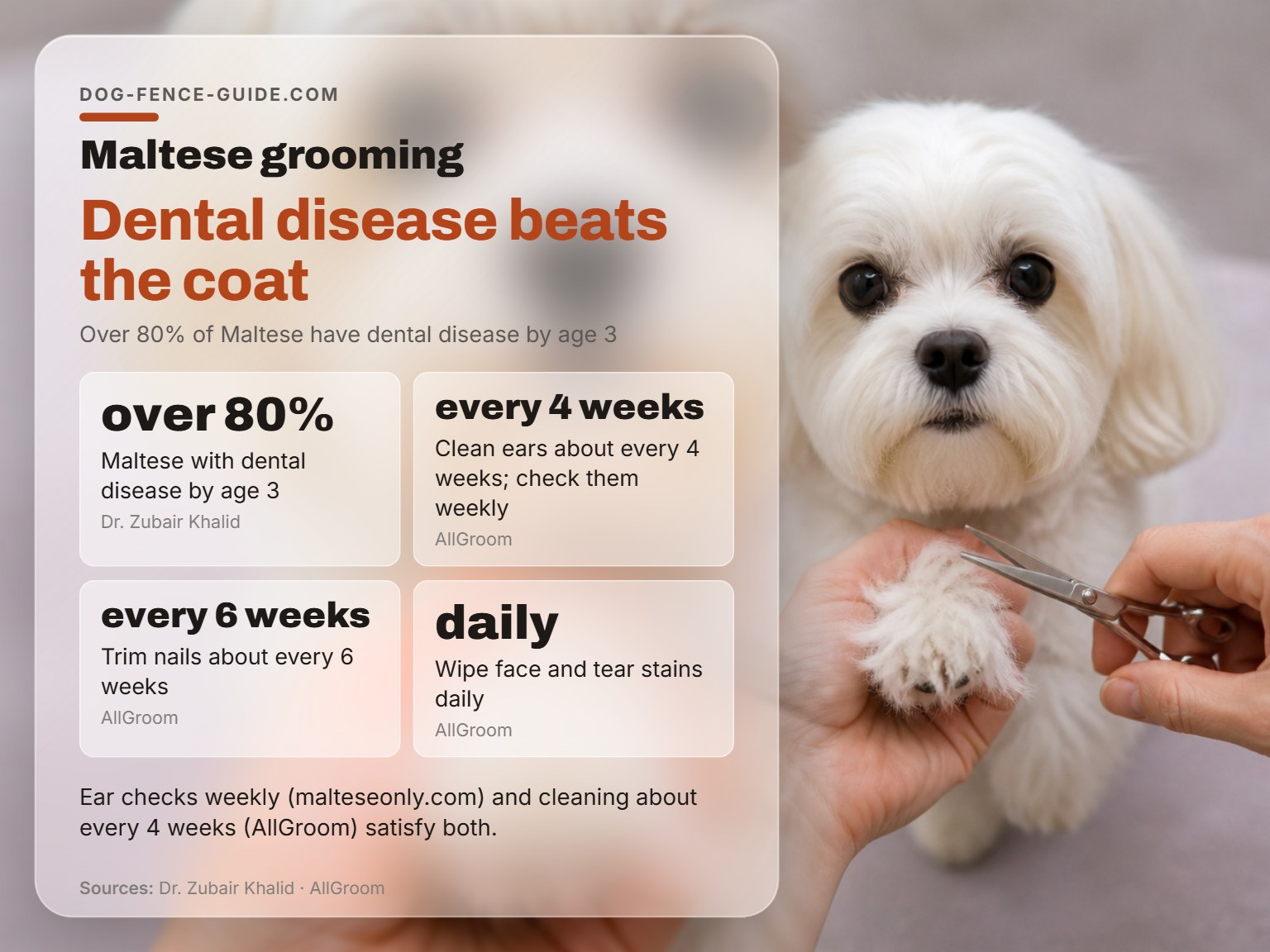
Dr. Zubair Khalid puts dental disease in Maltese at over 80% by age 3, which makes it a bigger health issue than anything the brush touches. Daily tooth brushing with a pet-safe enzymatic toothpaste is the standard, and dental chews and water additives don’t replace it.
The rest of the body has its own calendar, and it’s shorter than most owners assume.
| Part | Interval | Source |
|---|---|---|
| Ears checked | Weekly | malteseonly.com |
| Ears cleaned | About every 4 weeks | AllGroom |
| Nails trimmed | About every 6 weeks | AllGroom |
| Dewclaws | Same session as nails | malteseonly.com |
| Face and tear stains wiped | Daily | AllGroom; WOOOF |
The ear interval is another genuine split. AllGroom says clean ears every 4 weeks or so. Malteseonly.com says check them weekly, and argues it matters more for a drop-eared dog with heavy ear hair and for dogs that are bathed often. Checking weekly and cleaning monthly satisfies both without over-cleaning.
Ear hair is the part that decides whether any of this works. RSPCA South Australia, quoted by WOOOF, notes that trapped hair can cause ear and eye infections. Malteseonly.com recommends removing the excess hair in and around the canal so air can circulate, done at the groomer or at home. If you do it at home, the technique is baking soda on your fingers or a commercial ear powder, kept out of the canal itself.
A few details from malteseonly.com that are easy to miss and hard to forget once you’ve skipped them:
- Warm the ear cleaner first. Cold cleaner in the ear is a fight you’ll lose.
- Massage the base of the ear for a few minutes, then swab with fresh cotton for each ear.
- Cut nails at a 90-degree angle under good light, and don’t forget the dewclaws, which Maltese have on the front feet only.
Tear stains get their own rule: wipe under the eyes daily with a damp cloth and keep the hair trimmed back off the eye, per WOOOF. Staining that’s already in the hair grows out rather than washing out, so the daily wipe is prevention, not removal.
If your dog won’t tolerate ear handling at all, a dog muzzle used for the thirty seconds it takes to check is kinder than a wrestling match. VCA also notes that some dogs simply don’t tolerate grooming and may need the coat shaved down periodically, typically with sedation at the veterinarian.
Home Grooming vs the Salon: What 95 Minutes Buys You
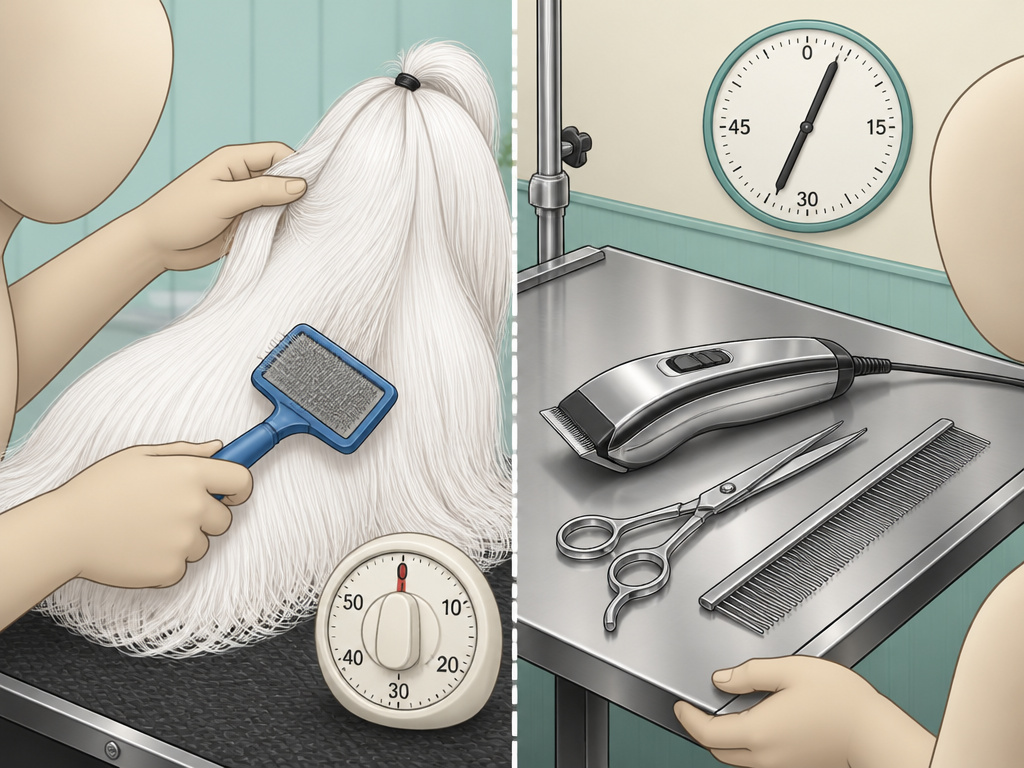
Two numbers frame the choice. WOOOF puts a Full Groom salon appointment at about 95 minutes, and the same source puts a full show coat at about an hour of grooming per day at home.
The salon wins in three situations. You want length and you don’t want to spend an hour a day defending it. The coat has already matted past the point where a brush helps. Or your dog handles a stranger’s hands better than yours, which is more common than people admit.
Home wins when the coat is clipped short, you’ve got the daily habit, and your dog stands still for a comb. That’s the majority of pet Maltese, honestly.
Bottom line: If you’re keeping the coat short, home grooming plus a professional clip every eight weeks covers it. If you’re keeping length, the salon stops being optional.
Two practical notes from WOOOF’s own booking terms, since they trip people up. Give 24 hours notice for a cancellation, and arriving more than 15 minutes late may mean the groom can’t be finished in the slot booked. That second one is worth reading twice if you’ve ever been late to an appointment with a wet dog in the car.
If you’re building the routine from scratch, grooming a dog at home walks through the sequence. And one honest flag: WOOOF states plainly that its groomers aren’t vets, and the same boundary applies to you. Skin that’s red, ears that smell wrong, or a dog that yelps on one leg are vet questions, not grooming questions.
What Grooming Does to Your Dog’s Collar Fit
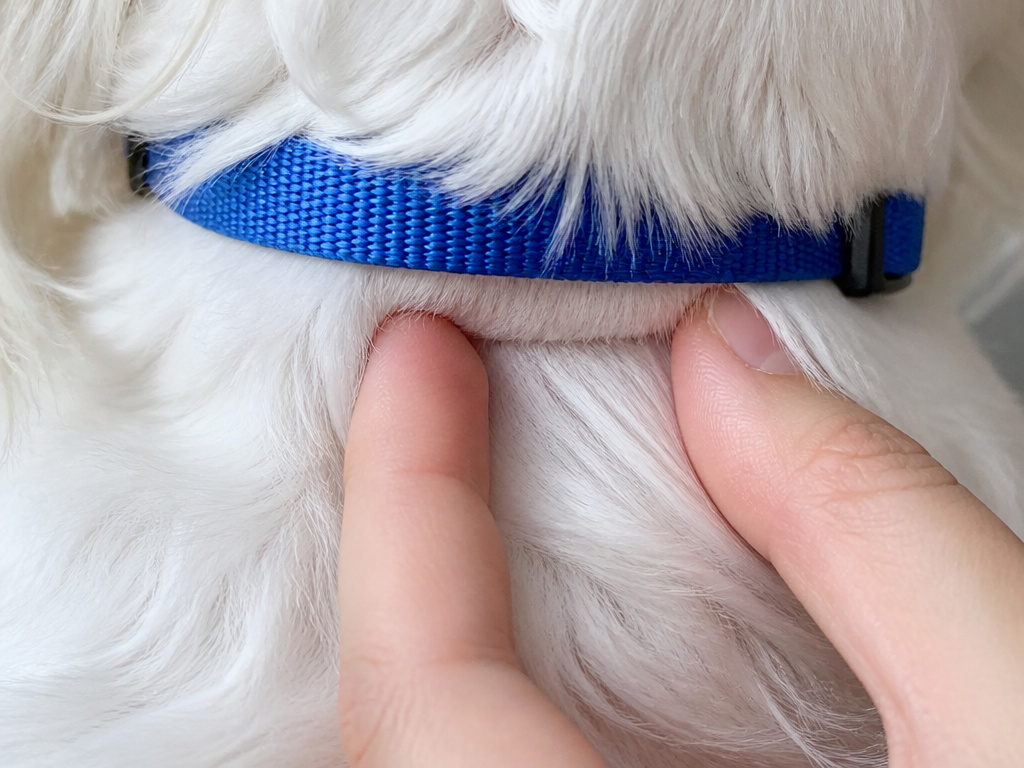
It’s February and the collar sits snug. By April it’s spinning on the neck, and nothing about the dog’s weight has changed. The coat changed.
This is the part I’ve actually spent time on, and it’s the reason I tell owners of long-coated small breeds to check collar fit weekly. Fur compresses under the contact points, so the collar ends up sitting on a thin layer of skin with no cushion. On a Maltese that means the correction, or even the pressure of a snug collar, feels sharper than it does on a short-coated dog of the same size.
The coat thickness also drifts between grooms. A coat that’s full in one month is thinner after a clip and thicker again six weeks later, and a collar fitted at one end of that cycle won’t fit at the other. Weekly checks catch it.
For a small dog, a properly fitted harness solves two problems at once. It takes pressure off a trachea that isn’t built for a collar correction, and it sits on the shoulders rather than the throat where the coat is thinnest.
I’ll be straight about my own limits here. The coat-compression point holds at any size. The rest, weigh against what you see on your own dog.
Frequently Asked Questions
How often should a Maltese be groomed?
Two credible answers exist. Dogs NSW, quoted by WOOOF, recommends clipping approximately every 8 weeks. Dr. Zubair Khalid recommends professional grooming every 4 to 6 weeks. The shorter interval suits a coat you’re keeping longer; the eight-week interval suits a short pet trim with daily brushing at home.
Can I skip daily brushing if my Maltese has a short clip?
AllGroom says brushing about every 3 days is ideal for a coat clipped short, which is a real reduction from the daily routine. But cindra.net argues daily brushing is essential regardless of coat length, because fine silky hair can mat within a day or two if skipped. Daily is the safer habit, and it takes minutes.
Should I brush before or after a bath?
The American Maltese Association and VCA both say brush out mats before bathing, because water tightens tangles and can make them impossible to remove, while malteseonly.com says the most important brushing happens after the bath. Malteseonly.com says the most important brushing happens after the bath, while the coat is damp. Do the pre-bath mat check, then brush again while damp.
How do I stop tear stains on a Maltese?
Wipe under the eyes daily with a damp cloth and keep the hair trimmed back off the eye, per WOOOF. AllGroom notes the face can be wiped as often as daily to prevent build-up. Existing stains grow out with the hair rather than washing out, so consistency matters more than any single product.
Do Maltese need their ear hair plucked?
Sources don’t agree. Dr. Zubair Khalid recommends plucking hair from the ear canal if needed. Malteseonly.com recommends removing excess ear hair so air can circulate, using baking soda or ear powder and keeping it out of the canal. RSPCA South Australia notes trapped hair can cause ear and eye infections. Weekly checks tell you whether it’s a problem on your dog.
What happens if I let a Maltese coat mat?
The groomer may have no choice but to cut the coat down very short, per the American Maltese Association. VCA notes that severely matted or hard-to-groom coats sometimes need shaving down with sedation at a vet. Post-clipping alopecia, a delayed regrowth condition, can follow in some coats for up to two years.
The Bottom Line
Here’s the trigger that decides your routine. If you can’t commit to brushing a long coat daily, book the short clip and brush every three days instead, as AllGroom advises, though cindra.net says daily brushing is essential regardless of coat length. That’s a legitimate choice, not a failure, and it’s cheaper than an emergency clip-down.
But re-check that decision at the ten-to-fourteen-month mark. The coat that made short-clipping easy as a puppy is not the coat you’ll have as an adult, and the routine that worked in month eight will quietly stop working.
Start this week with one thing: a metal comb, drawn from the ends toward the skin, once a day, for five minutes. If the comb reaches skin without snagging anywhere, your schedule is working. If it catches at the armpits or behind the ears, you found the problem before it became a mat, which is the entire point.
Peace of mind is the whole point.
