
Leonberger Grooming Needs: A Realistic Schedule
This post contains affiliate links. As an Amazon Associate, we earn from qualifying purchases.
Leonberger grooming needs are a daily brush, a bath only when the coat is genuinely dirty, and regular ear, nail, and tooth care. Sources split on brushing (parent clubs say daily, others say two or three times a week), but all flag the same mat spots: behind the ears, the back legs, and the chest.
The leonberger grooming needs split matters because the two camps are describing different coats. The International Leonberger Union says a dog with a very thick undercoat, long feathers, and a full mane takes more work than one with a more compact coat, and that one sentence explains most of the argument.
What follows is the leonberger grooming needs schedule I would actually run: the daily five minutes, the bath interval that holds up, the trim rules that change between a pet and a show ring, and the four hygiene jobs that get skipped.
Key Takeaways
- Daily brushing is the parent-club position. The Leonberger Club of America and PetMD both call for it; Hill’s and Artero put the floor at weekly or two to three times a week.
- Mats start behind the ears, in the armpits, on the back legs, and across the chest. Brush those four spots even on days you skip the rest.
- Bathe when the coat is dirty, not on a calendar if you follow VCA and Hill’s, or every 6 to 8 weeks if you follow Artero. Either way, dry down to the skin.
- Trim rules split by country. US show ring: feet only. European show ring: brushing, toenails, and toe tips only.
- Nails every other week or every 3 to 4 weeks, depending on which source you follow. Pick one and stay consistent.
How Often Should You Brush a Leonberger?
Ask six credible sources how often to brush a Leonberger and you get four different answers.
A Leonberger carries a medium-to-long, water-resistant double coat. The outer coat runs medium-soft to coarse, lies flat and straight, and permits some generalized wave. Feathering appears on the back of the forelegs, on the breeches, and around the ears, and mature males carry a mane across the neck and chest.
The Leonberger Club of America says daily brushing is required to remove mats and tangles. PetMD’s breed guide, written by Katie Grzyb, DVM, says brush every day. The International Leonberger Union asks for at least some brushing daily but describes the whole grooming job as a weekly task.
Then the numbers loosen. VCA Animal Hospitals says daily to weekly. Hill’s Pet, in guidance by Sarah Wooten, DVM, says weekly with daily passes during shedding season. Artero says two to three times a week. PDSA says a couple of times a week.
| Source | Brushing interval | Stated reason |
|---|---|---|
| Leonberger Club of America | Daily | Removes mats and tangles |
| International Leonberger Union | Daily minimum | Prevents knots and matting |
| PetMD (Katie Grzyb, DVM) | Every day | Matted fur without rigorous grooming |
| Hill’s Pet (Sarah Wooten, DVM) | Weekly, daily in shedding season | Tools must reach the undercoat |
| Artero | 2 to 3 times a week | Prevent matting, remove dead hair |
| PDSA | A couple of times a week | Remove dead hair, keep condition |
Here is what actually matters. Nobody in that table is wrong about the coat. They are answering different questions, and the question you need answered is which interval keeps your specific dog out of a mat.
Why the Daily Camp Wins on a Matt-Prone Coat
Dog hair felts the way wool does. Individual strands have surface scales that lock together when they rub against each other, and once they lock, a comb pulls at the tangle instead of separating it.
A coat brushed only once a week gives those scales days of rubbing in the same four spots. Daily brushing interrupts the lock before it sets. That is why the parent clubs land on daily, even while the International Leonberger Union calls the overall job weekly.
The daily pass is short. The weekly session takes considerably longer.
If you want the wider version of this argument across breeds, the grooming frequency breakdown by coat type covers it.
The Coat You Are Actually Dealing With
The Leonberger outer coat is medium-soft to coarse, lies flat and straight, and allows some generalized wave.
Underneath sits the part that decides your schedule. The breed carries a water-resistant double coat, with distinct feathering on the back of the forelegs, on the breeches, and around the ears. Mature males grow a mane that runs across the neck and chest.
That combination makes a Leonberger a different job from a short-coated giant. The feathering tangles against itself, the mane holds heat, and the undercoat packs down wherever the body rubs.
If you have handled a double-coated dog before, the mechanics will feel familiar. The long-haired dog grooming side is what catches people out, because feathering hangs loose and hides knots until they are solid.
Run a hand against the grain on the flank and the coat stands up in a dense wall that holds its shape for a second before settling.
That wall is the undercoat.
Where the Mats Start (and Why They Start There)
Run your fingers behind a Leonberger’s ear after a few days without combing and you may hit a knot.
That spot shows up on every list. VCA names behind the ears, the legs, and the tail. PetMD names behind the ears, the back of the legs, the undercarriage, and the chest. Artero names behind the ears, the neck, the armpits, the back of the legs, and the tail.
| Spot | Why it mats | What to do |
|---|---|---|
| Behind the ears | Fine hair plus trapped moisture | Comb through every other day |
| Armpits | Skin rubs against skin all day | Lift the leg, brush to the skin |
| Back of the legs | Feathering tangles as the dog moves | Work upward from the ends |
| Chest and mane | Dense coat, heavy on mature males | Brush in thin layers |
| Tail | Dense hair, constant wagging friction | Comb in sections, never pull |
The mechanism is the same in all five places. Two surfaces move against each other, hair gets caught between them, and the scales interlock. Add moisture and the knot tightens into a felt pad that no brush will open.
Artero recommends working the deep coat with a long metal-pin or slicker brush plus a metal comb, and that approach earns its place on a coat this dense. A light mist on a dry knot lets the comb slide instead of snagging.
Where this goes sideways: Brushing only the top of the coat. The outer layer looks smooth while the undercoat packs into felt underneath, and by the time the surface looks rough the mat is already against the skin.
If the skin under a mat is red or the dog flinches when you touch it, stop brushing and read up on sensitive skin before you keep going. Working a knot on irritated skin makes the dog hate the comb, and that is a harder problem to fix than the mat.
Bathing a Leonberger: How Often, and How to Dry It
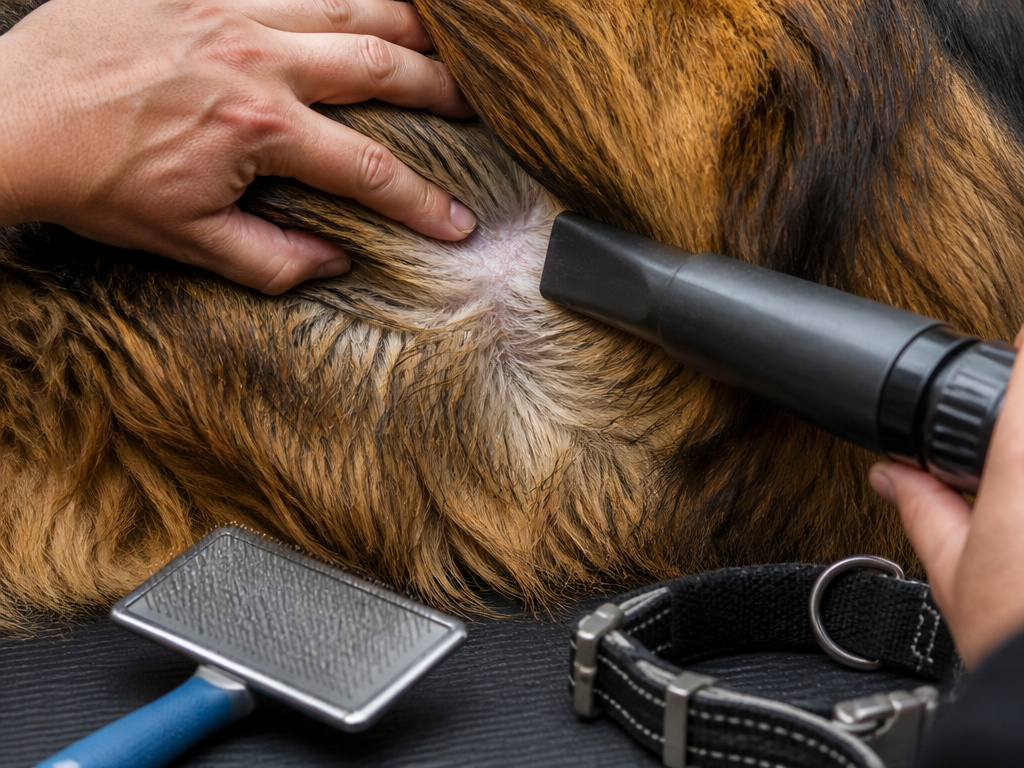
A bath is the easy half.
I helped with a client’s Leonberger once and sent her home damp because I ran out of patience with the dryer. Later, the skin under her collar was hot to the touch and she had a raw patch. The coat felt dry on top the whole time. That is the trap with this breed.
VCA says bathe only when necessary. Hill’s says as needed. Artero says every 6 to 8 weeks, or whenever the dog is genuinely dirty, using a shampoo made for long-haired or double-coated dogs. Both positions are defensible, and the 6 to 8 week version suits a dog that spends real time outdoors.
Whichever you pick, the drying rule does not move.
- Comb out every mat before water touches the coat. Wetting a knot tightens it into a pad, and you will end up cutting it out.
- Work shampoo down in sections rather than across the top. The double coat traps soap residue, and residue left against skin causes problems.
- Use a conditioner and rinse longer than feels necessary. Artero recommends conditioner specifically because it makes the post-bath brush-out easier.
- Dry with a high-velocity dryer while brushing. Skip this and the coat stays damp at the skin for hours, which is exactly how a hot spot starts.
Drying to the Skin, Not Just the Surface
The International Leonberger Union notes that Leonberger fur is slow to dry, and Hill’s warns that the double coat can trap soap residue and moisture.
That trapped layer is the whole problem. Skin that stays damp and warm under a dense coat is the condition hot spots form in, and VCA lists mat removal as the prevention step for exactly that reason.
The part nobody mentions: A dog that feels dry on the surface can still be soaked at the skin. Part the coat at the shoulder and touch it. If it is cool and damp, keep drying.
A high-velocity dryer is the difference between a dry dog and a damp one. A powerful professional hair dryer can help, and on a coat this size it is the tool that makes the job manageable.
Trimming: Pet Rules vs Show Ring Rules
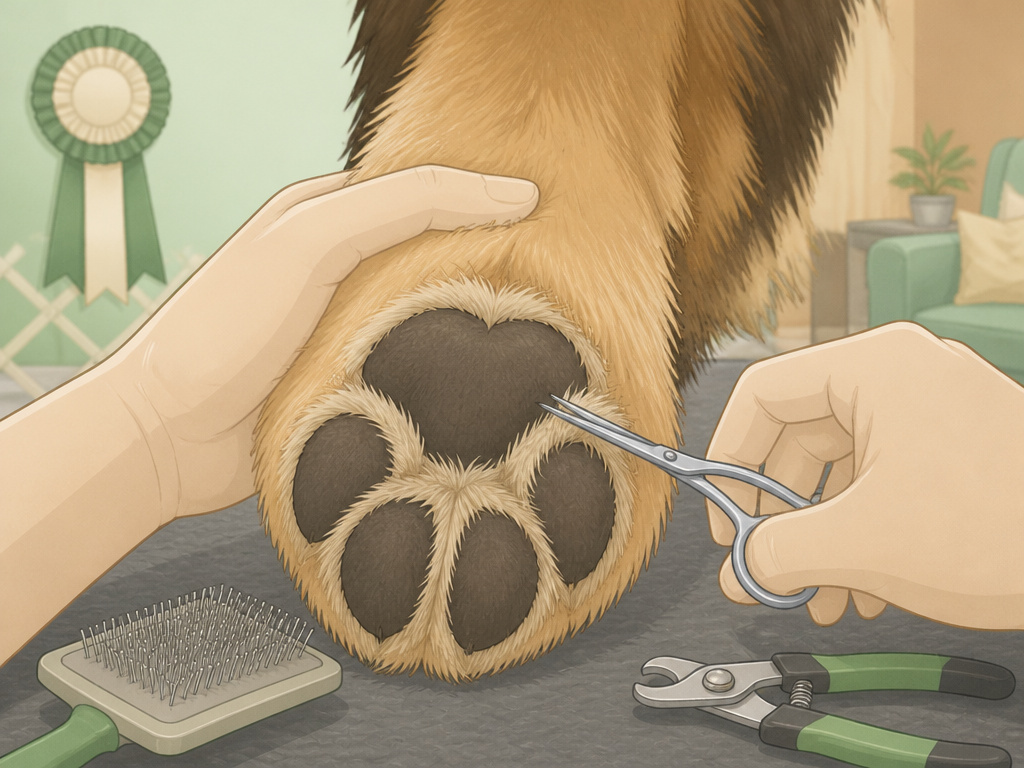
Two rulebooks govern what you are allowed to cut, and they disagree.
The Leonberger Club of America flyer is blunt about the US show ring: the only trimming done on a Leonberger is neatening up the hair on the feet.
The US Rule: Feet Only
Feet. That is the entire allowance. No shaping the mane, no tidying the breeches, no shortening the tail feathering.
The European Rule: Toe Tips Only
The International Leonberger Union goes further. In Europe, grooming beyond brushing, clipping toenails, and a little trimming to even out the coat on the toe tips is not allowed in the show ring. The natural look is the stated ideal.
For a pet, the rules relax. Artero describes natural tidy-ups on the paws, the rear, the ears, and the tail, plus trimming the hair between the paw pads for hygiene. PetMD’s guidance points the same direction.
Here is the catch. A dog trimmed to pet standards in the US can be non-compliant in a European show ring, because the two allowances are not the same.
If you are showing, read your ring’s rulebook before you pick up scissors. A tidy-up that looks professional at home can cost you the class.
The AKC Leonberger care guide gives you the breed at a glance; the coat and trim detail lives in the club documents, not the breed profile.
Ears, Nails, Teeth, and Eyes
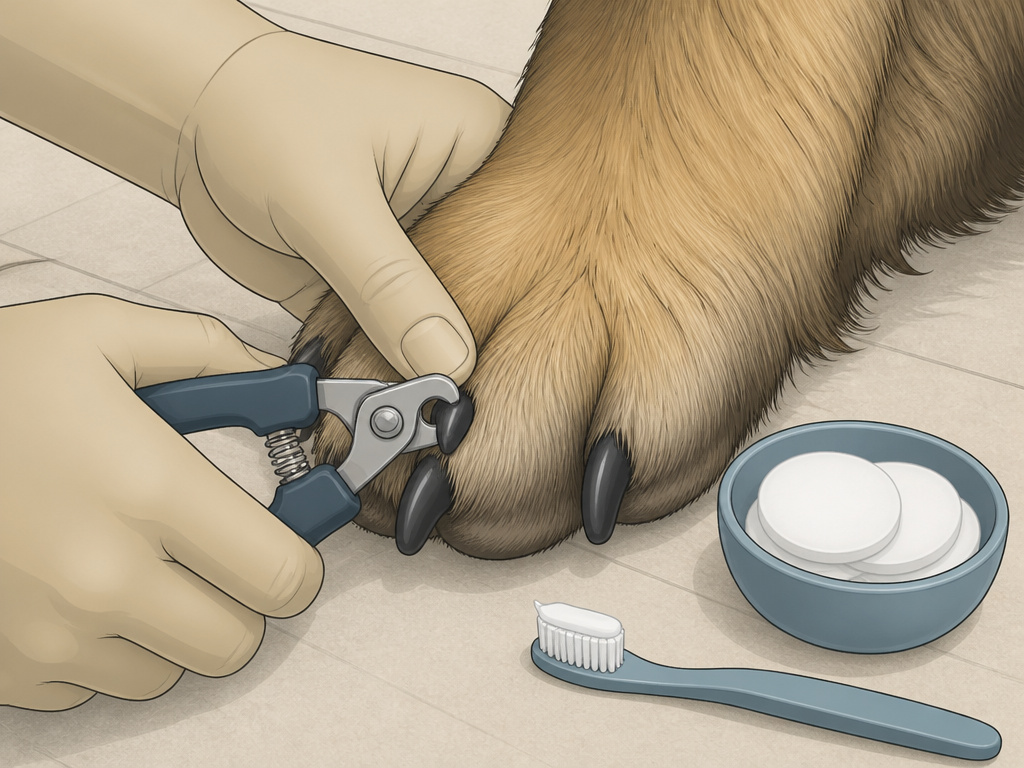
Four jobs sit outside the brush: ears, nails, teeth, and eyes.
The Leonberger Club of America lists proper ear, nail, and tooth care alongside periodic bathing as basic grooming. Artero adds eye checks for discharge and regular ear cleaning. VCA says check the ears and clean as needed.
Artero lists regular ear cleaning as part of Leonberger hygiene, and it is a reasonable default if you want one routine on the shelf.
Nails: Two Intervals, One Rule
Hill’s puts nail trims at every 3 to 4 weeks. The AKC breed page puts them at every other week. That is a real disagreement, and the honest answer is that it depends on your floor surface and how fast your dog wears them down.
The rule underneath both numbers is the same: check the nail, not the calendar. If you can hear clicking on tile, you are overdue.
Teeth get skipped more than anything else on this list. The parent club names tooth care as basic grooming, and Artero recommends brushing or a dental product. A giant breed with dental disease is an expensive problem later.
Which Brush Actually Reaches the Undercoat?
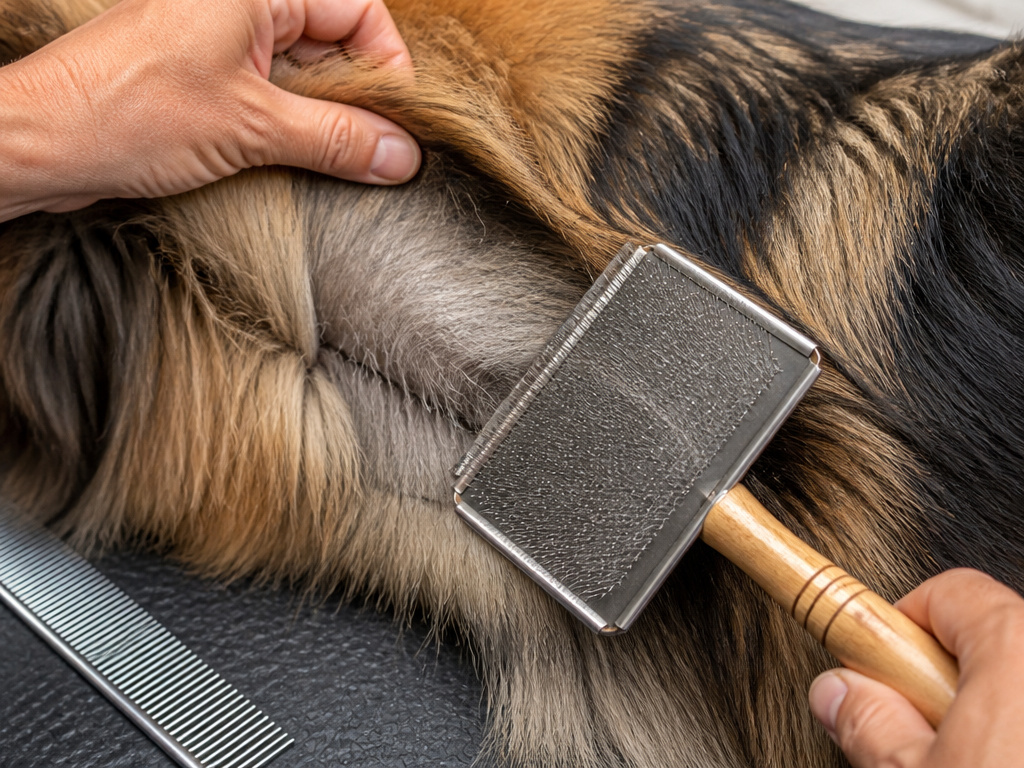
What does a Leonberger coat actually need in your hand?
Artero’s answer is a long metal-pin brush or a slicker brush to work the deep coat, plus a metal comb to check for knots. Brushing goes in layers, lifting the hair to reach the undercoat rather than skimming the surface.
- A long metal-pin or slicker brush for the bulk of the coat and the daily pass.
- A metal comb, used after the brush, to find what the brush slid over. This is the tool that tells you the truth.
- A high-velocity dryer, because the coat holds water longer than you expect.
- Rounded-tip scissors for pad hair and nothing else.
That comb is the piece most people skip. A brush can glide across a felted patch for weeks without catching, and the comb catches it on the first stroke.
A high-velocity dryer makes a hard, flat roar when it is working properly. A human hairdryer just whines and moves warm air around the surface.
If you want to compare tools before buying, the brushes for long-haired dogs rundown covers the pin-versus-slicker question, and the grooming supplies checklist covers the rest of the kit.
If you want one answer: a slicker brush and a metal comb, bought together, handle most of a Leonberger coat.
What a Realistic Week Looks Like
Picture a rainy Tuesday, a wet dog, and a coat that has collected half the yard.
A Newfoundland owner once told me she spends a long stretch each day on grooming during shedding season. I assumed she was exaggerating until I helped her for an afternoon. The undercoat came out in handfuls that looked like small animals, and a high-velocity dryer was the only thing that made a dent.
Leonbergers shed moderately year-round and moult with dramatic seasonal changes, usually twice a year, per the International Leonberger Union. PetMD describes the same pattern with heavier periods twice a year. Hill’s rates the breed’s shedding at 5 out of 5 and coat maintenance at 4 out of 5.
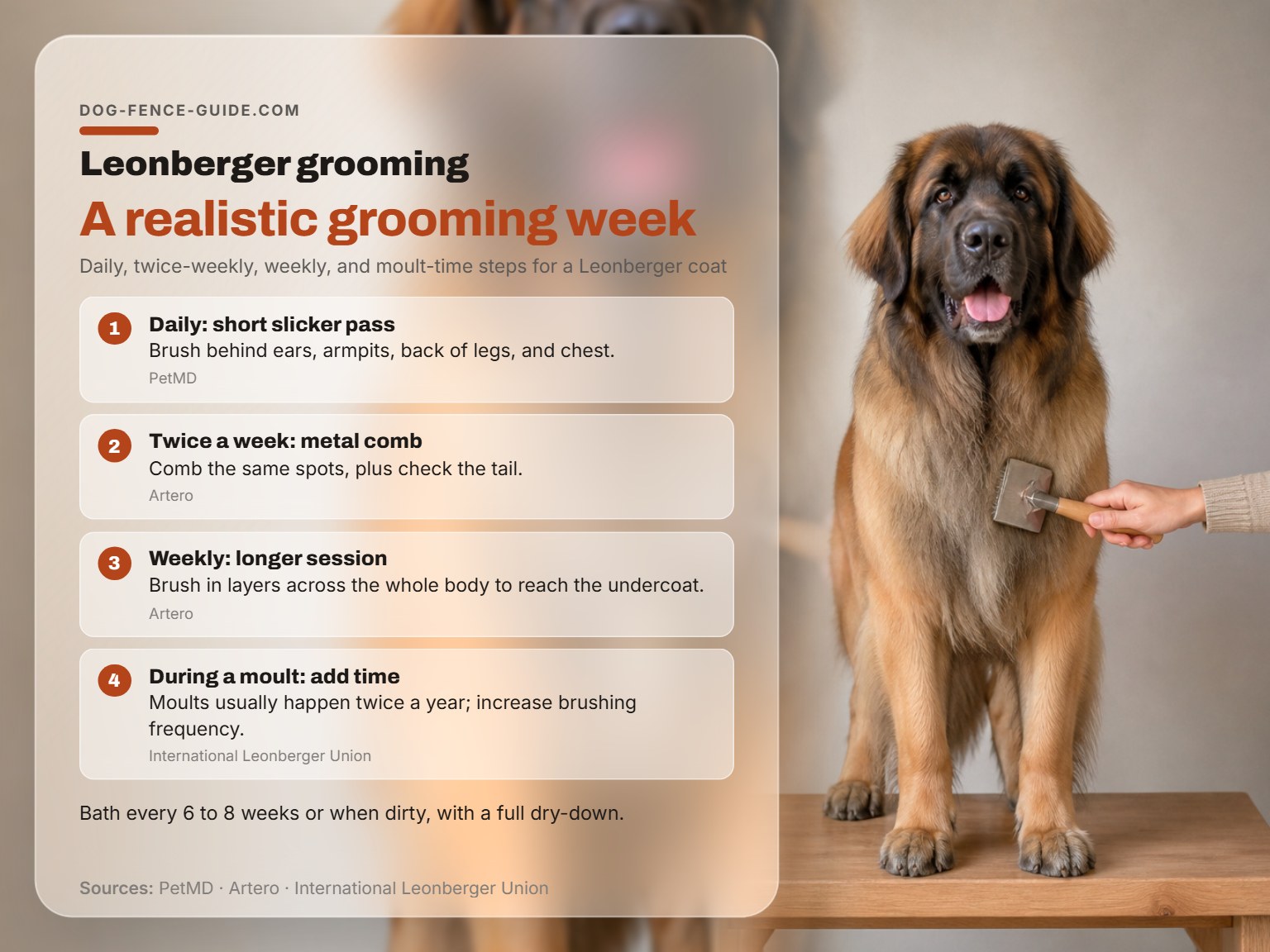
So the honest weekly shape looks like this:
- Daily: a short pass with the slicker, hitting behind the ears, the armpits, the back legs, and the chest.
- Twice a week: the metal comb through the same four spots, plus a look at the tail.
- Weekly: a longer session that reaches the undercoat in layers across the whole body.
- During a moult: add time, not pressure. More minutes, same gentle hand.
- Every 6 to 8 weeks, or when dirty: a bath with a full dry-down.
That is not a light schedule. It is, however, cheaper than a shaved dog and a vet visit.
If you would rather build the routine yourself than follow mine, the at-home grooming walkthrough covers setup and handling order.
Frequently Asked Questions
How often should a Leonberger be brushed?
Sources genuinely disagree. The Leonberger Club of America, PetMD, and the International Leonberger Union all point to daily brushing. Hill’s says weekly with daily passes during shedding season, Artero says two to three times a week, and PDSA says a couple of times a week. Daily is the safest floor for a mat-prone coat.
Do Leonbergers need haircuts?
No. Artero states the breed does not require full haircuts, and both parent clubs restrict show-ring trimming to the feet or toe tips. Pet tidy-ups on the paws, rear, ears, and tail are a separate question from what a show ring allows.
How often should you bathe a Leonberger?
VCA and Hill’s say bathe only when necessary or as needed. Artero recommends every 6 to 8 weeks, or whenever the dog is truly dirty. The part you can’t skip is drying the coat completely to the skin afterward, because the double coat traps moisture.
Why does my Leonberger get mats behind the ears?
Hair behind the ear is fine, and it rubs against the ear leather and the collar all day. VCA, PetMD, and Artero all name that spot first. Daily combing there interrupts the tangle before the strands lock together.
Can I shave a Leonberger in summer?
The coat is water-resistant and insulates against heat as well as cold, and the breed standard describes a double coat with feathering and a mane. Shaving removes that protection and the coat grows back unevenly. Brush out the undercoat instead.
The Bottom Line
The brushing argument will keep running, and you can stop waiting for it to settle. Pick daily if your dog mats easily, twice a week if the coat is compact and you stay on top of the four hotspots. Then hold that interval for a month and let the comb tell you whether it is working.
Two things I would change about how most people approach this. First, buy the metal comb before the fancy brush, because the comb is what finds the problem. Second, treat drying as part of the bath rather than an optional extra, since a damp coat at the skin is where the trouble starts.
This week, do one thing: run a metal comb behind both ears every night for seven days. If it comes through clean on day seven, your interval is right. If it catches, you have your answer, and it is not the answer a product label will give you.
Fair warning: the day you skip the ears is the day the mat sets.
