
How to Train a Dog Off Leash: Recall First, Then Freedom
This post contains affiliate links. As an Amazon Associate, we earn from qualifying purchases.
To train a dog off leash, build a recall that holds under squirrel-level distraction on a 10- to 15-foot line before you ever unclip it. Most dogs aren’t fully mature until 2 or 3 years old, and no training is ever 100 percent effective, so the leash stays on anywhere near a road.
The leash has been talking to your dog the whole time. Every small shift of your hand, every slight tension as she drifts toward the neighbor’s cat, is a cue she reads and you don’t notice you’re giving. Strip the leash away and those cues go with it, which is exactly how a dog with a flawless yard recall stands at a trailhead and acts like she’s never heard her name, and it’s why the how to train a dog off leash question is really about replacing those cues.
What follows is the order I actually run it in: the gear, the drill, the two games that build speed, and the specific ground where the clip never comes off no matter how good the dog looks.
Key Takeaways
- Start on a 10- to 15-foot line in a fenced area, and stretch the radius only after the short length gets boring to the dog.
- Most dogs aren’t fully mature until 2 or 3 years old, so a solid recall at ten months is a milestone, not a finish line.
- No training is ever 100 percent effective. Keep the leash on near roads, playgrounds, and construction, every single time.
- Never punish a recall, even a slow one. One bad ending teaches a dog that coming back was a mistake.
- Off-leash is optional. You can train the recall perfectly and still decide the leash stays on outside your own yard.
The Gear That Actually Matters Before the Clip Comes Off
The identification half of the gear list is the part that gets skipped, and it’s the half that decides whether a bad five minutes turns into a permanent loss.
A long line is a length of nylon or biothane rope, ranging from 10 to 50 feet, clipped to a back-clip harness rather than a collar. The harness spreads load across the chest and shoulders, which prevents the neck strain a collar produces when a running dog hits the end of the line.
Here’s what actually goes in the bag:
- A long line in nylon or biothane, sized to where you’re working
- A back-clip harness, so a dog that hits the end of the line doesn’t take it on the throat
- A microchip and a readable tag with your phone number, because even a well-trained dog can get separated from you
- Tiny pieces of cheese, hot dog, or freeze-dried beef liver
- A waist or belt leash for the early work
A nylon line dragged through wet grass comes back to your hand heavy and cold, and the end is slick with mud. Biothane comes back the same weight it went out. That difference matters on a cold morning when your hands are already numb.
The waist leash is the piece that surprises people. Clip the line around your hips and your hands stop micromanaging the dog, because your hands aren’t holding anything. VCA Animal Hospitals makes the point directly: on a hand-held leash a dog feels every small shift of your hands, and you apply pressure to steer without ever deciding to. Move the line to your waist and both of you have to pay attention to something other than tension, which is a small but real part of how to train a dog off leash.
If you want the fuller breakdown on long line training, that covers handling and tangles. Materials matter more than length here, and the best long leashes for dogs are almost all one of those two materials.
I’d skip the retractable lead entirely for this work. It teaches a dog that tension is normal, which is the opposite of what you want.
How Long Should the Long Line Be?
Three sources give three different answers, and each one is describing a different phase of the job.
| Source | Length | When it applies |
|---|---|---|
| VCA Animal Hospitals | 10 to 15 feet | First sessions in a fenced area |
| AKC recall guide | 15 to 20 feet | Moving to a park or bigger distraction |
| AKC off-leash guide | 10 to 50 feet | Full range of long-line products |
VCA’s 10-to-15-foot figure is for the first fenced sessions, where the goal is a short radius and a lot of repetitions. AKC’s 15-to-20 feet is for the jump to a park. Those numbers don’t overlap cleanly at 15 feet, and that’s fine, because they’re describing different jobs.
Start short. Add length when the short line stops being interesting.
Common mistake: Buying an unnecessarily long line for a suburban park. AKC notes that some locations don’t permit leashes longer than six feet, and a long line in one of those towns turns a training session into a conversation with animal control.
That ordinance detail can derail an off-leash plan before training even starts. Check it before you buy gear, not after.
Once the dog is reliable at 15 feet, distance training is the next layer: adding yards without adding confusion.
How to Train a Dog Off Leash, Step by Step
You’re standing ten feet from your dog with your hands empty and your knees bent, and the dog is watching your face. That’s the setup. Everything after it is repetition.
Before you start: A long line can wrap a leg or burn an open palm when a dog hits the end at speed, so keep a loose loop of slack and never coil it around your hand. Check the area for traffic and leash-law restrictions before the clip comes off. Keep the dog away from livestock, playgrounds, and roads entirely.
The 10-Foot Drill
This is the sequence from the UC Davis recall training guide, and it’s the one I run first in my own driveway.
- Get a vet check first. A health evaluation before any behavioral training rules out pain or a medical reason the dog isn’t responding. Skip it and you might spend that time training around a bad tooth.
- Confirm the dog knows her name. Say it, wait for eye contact, reward. If she won’t make eye contact in the kitchen, she won’t do it in a field.
- Walk about 10 feet away while someone holds the dog. No treats in your hand, none visible. The reward comes after, not as a bribe.
- Lower your body into an inviting, non-threatening posture, then give the cue once: name, then “Come,” in a clear, light, happy voice.
- Reward the moment she commits, not just when she arrives. Praise as she turns toward you, then pay up when she reaches you.
- If she doesn’t come, go get her. Walk out calmly, bring her back to the spot where you gave the cue, no punishment and no treats. Skipping this is how a cue becomes optional.
The one-command rule is easy to break. UC Davis is blunt about it: if the dog is already running away or already distracted, don’t say “Come” at all, because the dog won’t connect the word to the behavior. You’ve just spent a repetition teaching her that the word is background noise.
The metal clip on a long line makes a sound the dog may learn to associate with the end of the recall. Snap it on at the end of every recall and she’ll start slowing down before she reaches you. Which is exactly the problem the next section covers.
Two Games That Build Speed
AKC uses two games to add pace once the basic drill is solid.
- Catch Me. While walking on-leash, get her attention, turn and run a few steps, say “Come,” then stop and reward. Make sure she’s watching before you turn.
- Find Me. Call her from another room and reward heavily when she finds you. This one is genuinely fun for both of you.
Why Your Puppy’s Perfect Recall Falls Apart at 16 Weeks
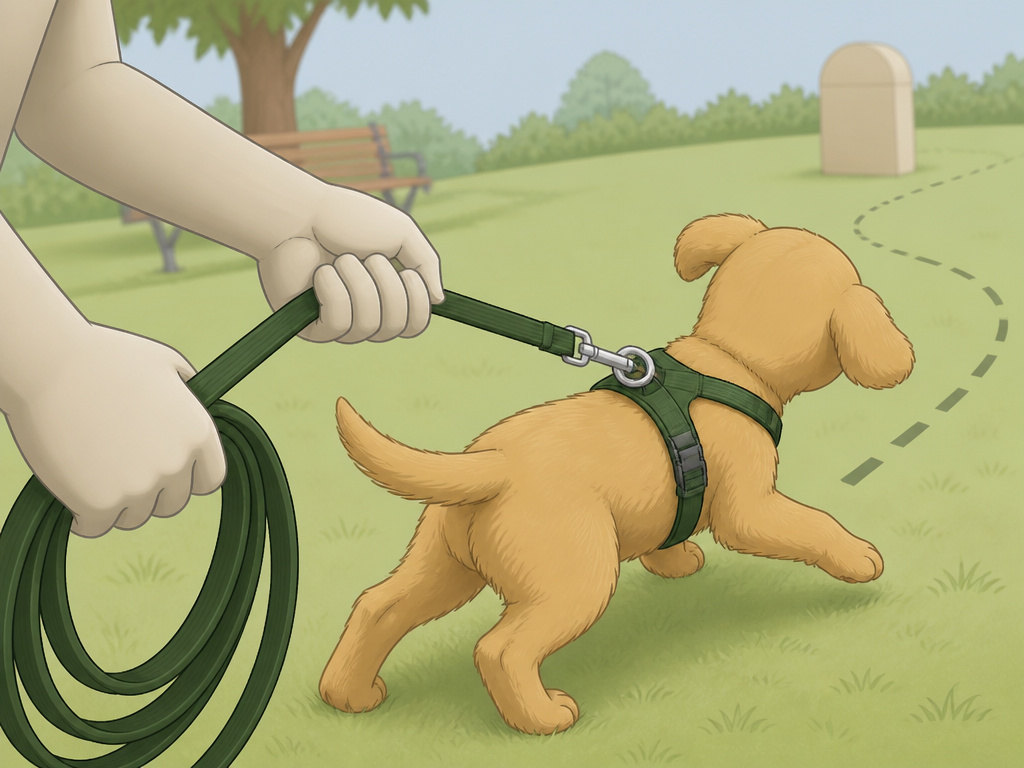
Somewhere between 14 and 16 weeks, the puppy that followed you across the kitchen starts acting like she’s never heard her name.
You’ll see the head come up and the ears swing forward just before she bolts. That’s the whole tell.
VCA explains the mechanism. Puppies between 7 and 14 weeks naturally follow their owners and come when called, because their world is small and they don’t explore widely. That creates the illusion of good recall. Starting at 14 to 16 weeks, many puppies begin exploring more and appear to forget everything. It’s normal development, and VCA’s advice is to have a long line or a smooth drag line ready and keep reinforcing through adolescence.
Most dogs aren’t fully mature until 2 or 3 years of age. Plan accordingly.
Many owners quit at 16 weeks. The puppy was perfect early on, so the regression reads as a verdict on the dog. It isn’t. It’s a stage with a known end point, and the people who keep the line on through it come out the other side with a dog that actually recalls.
The recall training fundamentals don’t change at 16 weeks. What changes is how much patience the week requires.
Where the Experts Disagree on Treats and Re-Leashing

Three reputable sources give three different answers on how to hand over a reward, and one of them calls the other one’s method a bribe.
| Question | One position | The other |
|---|---|---|
| Showing a treat to start the approach | VCA: no luring, keep rewards a surprise | AKC: show a favorite toy or treat |
| Treats in hand as you walk away | UC Davis: keep them out of sight | VCA: same idea, no bribe |
| Clipping the leash on after a recall | UC Davis: avoid it, reads as punishment | AKC: reattach in new or distracting places |
Treats: Lure or Surprise?
VCA is direct about it: don’t use treats as a lure or a bribe, and let the reward be a surprise. UC Davis says the same thing in mechanical terms, keeping treats out of sight or out of your hand as you walk away and give the command.
The AKC reliable recall training guide takes the other view, showing a favorite toy or treat to prompt the approach and adding the verbal cue only once the dog is already moving.
The disagreement is about timing, not treats. A reward that appears before the dog moves is a bribe. A reward that appears after the dog commits is payment. Get the order right and the disagreement mostly evaporates.
If you want the mechanics of positive reinforcement laid out properly, that’s the place to start.
Should You Clip the Leash Back On?
UC Davis advises against putting the dog back on leash directly after a recall where possible, because the dog can read it as punishment. AKC says to temporarily reattach the leash in new and distracting environments, if the dog stops coming when called, or after a fight with another dog.
Both are right, and the split is about frequency. If every single recall ends with a clip and a walk home, the recall becomes a warning. If the clip only appears when conditions genuinely changed, the dog doesn’t build that association.
The part nobody mentions: A recall that only ever ends the fun is a recall the dog will start avoiding. Random recalls during play, followed by a release back to play, are what keep the cue worth answering.
What the E-Collar Study Actually Found

PMC7387681 enrolled 63 dogs with known off-lead problems and split them into three groups of 21.
The training ran up to 150 minutes over 5 days, and the researchers measured two things: how many commands it took to get a response, and how long the dog took to respond. Both “Come” and “Sit” were tested.
The positive-reinforcement control group got significantly better responses to both cues after a single instruction, and had shorter response latencies than the e-collar group. The e-collar group wasn’t trained by novices either. It was handled by manufacturer-nominated trainers using electronic stimuli.
I’m not going to tell you the study proved e-collars never work. The study’s result should not be overstated. What it does undercut is the sales pitch that a stim collar produces faster, more reliable recall than reward-based training. On the measurement that matters, it didn’t.
For a while I believed the hardware did the work. Install the wire, fit the collar, done. Then I watched a family skip the training period entirely, and their dog was testing the boundary. Not escaping it. Probing it, constantly, which is a miserable way for a dog to live. I treat training as part of the system now, not an optional add-on, and that goes double for anything with a battery in it.
If you’re going to use one anyway, e-collar training has to start with the dog understanding the cue before the stimulation means anything. No e-collar trains the dog for you.
Where the Leash Never Comes Off

This list is short and it doesn’t have exceptions.
- Near cars, roads, playgrounds, or construction areas
- Anywhere a leash law applies, including your own front yard in some towns
- Around horses, sheep, or other livestock
- Anywhere you haven’t walked before and don’t know the hazards
VCA is absolute on the first one: it is never acceptable to walk a dog off-leash near cars, roads, playgrounds, or construction areas. Their reasoning is the same as a seatbelt’s. A driver still wears one.
UC Davis adds the honest caveat that makes the whole rule stick. No training is ever 100 percent effective, so the leash stays on in especially dangerous areas, near streets and heavy pedestrian or motor traffic. That’s not a knock on your dog. It’s a statement about probability.
The AKC off-leash readiness guide goes further than most training content will. There’s no rule that says you ever need to allow your dog off-leash. Never letting a dog off-leash outside your own home or yard is a completely legitimate choice.
A recall you trust is still a recall that can fail, because no training is ever 100 percent effective. Ask yourself whether you’d accept those odds at the edge of a parking lot. If the answer is no, the leash stays on.
Inside a fenced dog park etiquette situation, the rules shift again. Recall still matters, but so does whether your dog can read another dog’s signals before she’s in their space.
Escapes often come from an owner getting loose with the rules rather than from a badly trained dog. They came from an owner getting loose with the rules.
What Counts as a Real Distraction Test?

A squirrel in a tree is the baseline.
VCA sets the bar clearly: test each skill in a secure environment against high-level distraction, specifically a squirrel in a tree, a rabbit crossing the path, or a ball rolling across the street, before taking the dog off-leash in an uncontrolled area. That gate is not optional and it is not passable by repetition alone.
Breed matters here, and AKC doesn’t soften it. Terriers and sighthounds have a naturally high drive to chase and hunt, which makes them unreliable off-leash anywhere they might see or smell small prey. Smells can easily distract many hounds, which can result in an unreliable recall off-leash.
This is what proofing with distractions is for. You build the distraction on purpose, in a place where failure costs nothing.
A dog should be tested against high-level distractions in a secure environment before being trusted off-leash in an uncontrolled area.
Skip this if: Your dog is a terrier, a sighthound, or a scent hound and you’re working anywhere with visible prey. AKC flags all three groups as unreliable off-leash around small animals, and no amount of repetition rewires a breed’s prey drive. Use the long line and call it done.
Frequently Asked Questions
How long does it take to train a dog off leash?
There’s no fixed timeline. It depends on the dog’s age, breed, and how many clean repetitions you get in a week. Puppies hit a regression between 14 and 16 weeks, and most dogs aren’t fully mature until 2 or 3 years old. Train in short sessions and only when you’re confident the dog will respond.
Can every dog be trained off leash?
Every dog can learn a recall. Whether every dog should be off-leash in public is a different question. Terriers, sighthounds, and scent hounds carry instincts that make public off-leash work a bad bet, and AKC notes there’s no requirement to ever let a dog off leash at all.
Should I use an e-collar for recall?
The evidence isn’t on the collar’s side. In a study of 63 dogs, the positive-reinforcement group responded better after a single instruction and faster than the e-collar group, which was handled by manufacturer-nominated trainers. If you use one anyway, the dog needs to understand the cue before the stimulation means anything.
At what age can a dog go off leash?
Age isn’t the gate. Behavior is. A young dog with a rock-solid recall in a fenced field may be ready for a controlled open area. An older dog who blows off the cue in the kitchen isn’t ready for anything.
What do I do if my dog bolts and won’t come back?
Don’t chase, and don’t repeat the cue. UC Davis advises against using “Come” when the dog is already running or distracted, because the word stops meaning anything. Go get the dog calmly, walk her back to where you gave the cue, and reset with an easier repetition.
Before You Go
Before you buy a single piece of gear, stand ten feet from your dog in your own yard with empty hands and an empty pocket, and give the cue once. If she breaks before you finish saying it, you don’t have a gear problem. You have a foundation problem, and no long line fixes that.
Here’s the honest concession. If you live somewhere with a short-leash ordinance and no fenced space of your own, this whole progression may never get past the long line. That isn’t a failure. A dog who never runs free in public can still have a full, good life, and AKC says so plainly.
Three things to verify in your own yard: the local leash ordinance and its length cap, whether your dog’s tag is readable, and how long she holds a recall at ten feet before she breaks. Those three answers tell you more than any training video will.
Recall first, freedom second. Never the other way around.
