
How to Stop Submissive Peeing in Dogs: Step-by-Step
This post contains affiliate links. As an Amazon Associate, we earn from qualifying purchases.
To stop submissive peeing in dogs, remove the triggers instead of correcting the puddle. Submissive urination is fear-based, so scolding, looming over the dog, or a loud greeting makes it worse. Lower your posture, greet quietly, and let the dog come to you.
The bladder release is involuntary. It fires before the dog makes any decision, which is why the standard house-training playbook backfires here and why the how to stop submissive peeing in dogs question needs a different answer. You cannot reinforce a reflex, and you cannot punish one away.
What follows is the differential that separates submissive peeing from excitement peeing, the greeting protocol the veterinary sources line up behind, and the handful of points where they genuinely don’t agree. I’ll also flag the cases where the puddle is a medical symptom and the training conversation needs to wait.
Key Takeaways
- Submissive urination is fear-based, not defiance. Scolding it, even with a sharp tone, reliably increases the behavior.
- Six body-language signals of submissive behavior to look for: flattened ears, averted eyes, lowered head, cowering, tail tuck, and roll-over.
- Punishment is absolutely contraindicated according to board-certified veterinary behaviorist Debra F. Horwitz, DVM. It raises anxiety and it raises the puddles.
- An adult dog that suddenly starts leaking needs a vet visit before any training plan. Rule out medical causes first.
- Most dogs get past this. Whole Dog Journal’s assessment is that most dogs overcome submissive and excitement urination relatively easily with the right management.
Submissive vs Excitement Urination: Six Signals That Decide the Fix
Six signals separate submissive urination from excitement urination, and the dog’s body position gives away which one you’re dealing with before you ever look at the floor.
UC Davis School of Veterinary Medicine lists the submissive set: flattening of the ears, avoiding eye contact, lowering of the head and neck, sitting or cowering, tucking the tail, or rolling onto the back and exposing the belly. Count how many you see at the door.
Submissive urination is a fear response, triggered by approach, punishment, scolding, or a deep and loud voice. Excitement urination lacks submissive signals entirely and happens while the dog is standing or walking during greetings and play. The two require different handling, and only one is a confidence problem.
The position difference is the fastest read. A submissive puddle lands under a dog that was crouched, sitting, or rolled over, so you get a round patch roughly where the back legs were. Excitement urination happens mid-motion, and the evidence is a streak trailing behind the dog’s rear feet across the tile.
| Feature | Submissive Urination | Excitement Urination |
|---|---|---|
| Body language | Ears flat, tail tucked, cowering | No submissive signals present |
| Body position | Crouched, sitting, or rolled over | Standing or walking |
| Typical trigger | Approach, scolding, loud voice | Greetings and playtime |
| Age pattern | Dogs of any age | More frequent in puppies |
| Prognosis | Improves with trigger removal | Can resolve with age |
One naming note before we go further. Best Friends Animal Society points out that behavior science has debunked using “submissive” and “dominant” to describe a dog’s personality or emotional state, and offers “appeasement urination” as a more accurate term. The old label is still what everyone searches for, so I’ll keep using it, but the dog is appeasing a perceived threat, not submitting to a rank.
How to Stop Submissive Peeing in Dogs Without Punishment
Punishment is contraindicated. Horwitz uses the word “absolutely,” and the mechanism explains why the advice is so blunt.
Whole Dog Journal lays out the classical conditioning problem clearly. Submissive urination can quickly become a conditioned response, where the presence of a particular stimulus automatically triggers the release. The dog is not deciding to pee when you walk in. The response fires the way salivation fired for Pavlov’s dogs.
That means every scolding is a training rep for the wrong behavior. Best Friends is explicit that punishment of any kind, including harsh tones, can cause inappropriate urination. Whole Dog Journal goes further: even a slight stiffening of your body or a change in your voice can release a stream from a very sensitive dog.
If your dog pees the moment your voice drops, the voice is the trigger. Fix the voice before you touch anything else.
This is also where I’d push back on the dominance-correction crowd. Alpha-rolls and scruff corrections aimed at a dog that’s already appeasing will suppress the visible behavior for a while and leave you with a dog that stops warning you. That’s a worse outcome than a puddle.
Where this goes sideways: Correcting a dog mid-puddle teaches it to associate your arrival with something aversive. You get a dog that flattens before you’re through the door and releases faster, not slower.
The Door Protocol: Three Things You Change
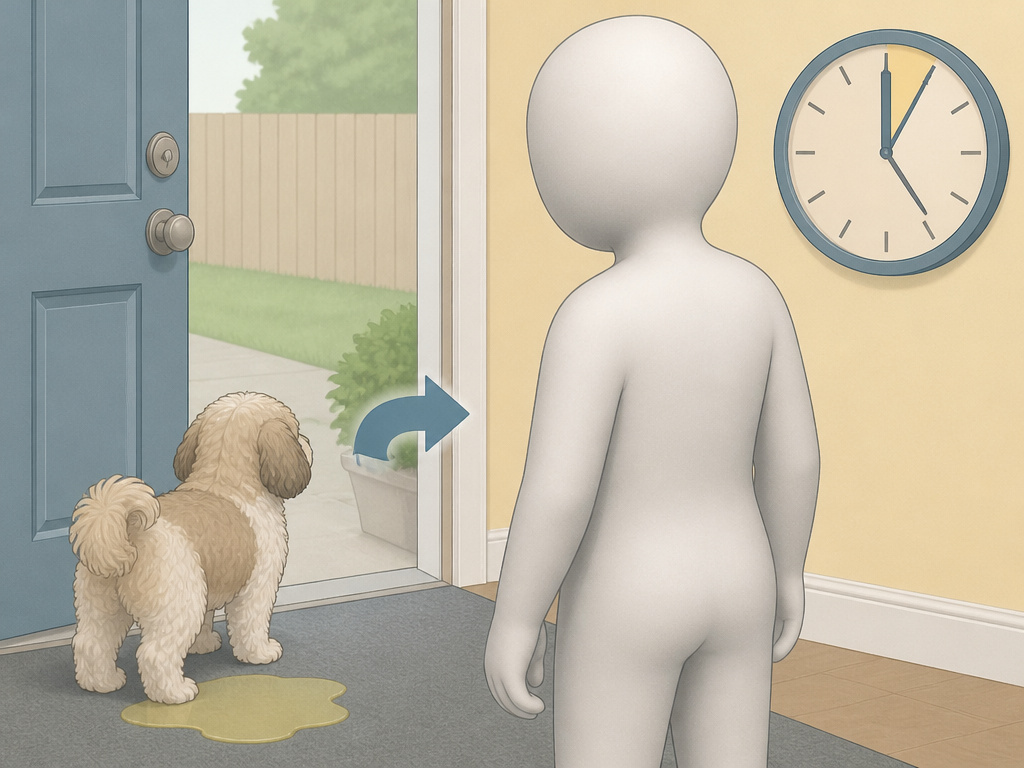
Three things change at your front door: your posture, your voice, and your timing. That’s the whole intervention, and it costs nothing.
The sound cue matters more than people realize. Your key in the deadbolt, the door swinging, the scramble of nails on the hallway floor, that sequence is the trigger stack. By the time the dog reaches you, the response is already loading. So the protocol starts before the door opens.
Here’s the sequence, drawn from Best Friends’ four-step greeting and Horwitz’s clinical guidance:
- Come in flat. No high voice, no direct eye contact, no reaching hands. Skipping this is what loads the trigger in the first place.
- Wait before you engage. Horwitz is specific: don’t touch or talk to the dog until it is settled. Touch a dog that hasn’t settled and you interrupt the calming process mid-stream.
- Get low and sideways. Crouch or sit so you appear smaller, and look off to the side rather than straight at the dog. Best Friends lists bending over the dog and approaching head-on among the postures dogs read as threatening.
- Let the dog close the distance. Wait quietly without moving and let it approach and smell you. If it doesn’t come, offer a small treat rather than reaching.
- Pet under the chin, one hand, slow. Reaching over the head is on Best Friends’ list of threatening gestures. Under the chin is not.
- Mark the end. Horwitz recommends a replacement greeting cue, “sit” given once the dog has settled, or “get your ball”, to change the underlying emotional response and reduce urination.
That last step is the one people skip. A cue gives the dog a job at the exact moment it would otherwise be bracing, and it converts a fear greeting into a trained one.
Do the Experts Even Agree on the Greeting?
You’d expect four veterinary and welfare sources to land on the same number. They don’t.
The disagreement is about timing, not principle. Everyone agrees you ignore the dog at first and greet calmly after. The split is on how long “at first” lasts and what happens in between.
| Source | What it says about the greeting |
|---|---|
| UC Davis School of Veterinary Medicine | Ignore the dog at the door, wait about 5 minutes, then give attention |
| Best Friends Animal Society | Take the dog outside first, greet calmly after it has calmed, no fixed interval |
| Debra F. Horwitz, DVM (Clinician’s Brief) | No touching or talking until the dog is settled, no fixed interval |
| American Kennel Club | Wait a few minutes |
My read: the fixed five minutes is the easiest version to follow and the least likely to be abandoned by week two. But Best Friends’ version solves a second problem at the same time, because it gets the dog outdoors where a puddle is a non-event. If your dog is soaking the hallway every single day, take the outside-first route.
One more disagreement worth naming, because it’s a single-source recommendation rather than a consensus. UC Davis suggests limiting water access to certain predictable times of day so outdoor potty schedules can be planned, while Best Friends and Horwitz do not recommend restricting water and instead focus on access to the elimination location and scheduling. I’d treat water restriction as an option for a dog with a chaotic schedule, not a default move.
What to Do in the Moment When It Happens
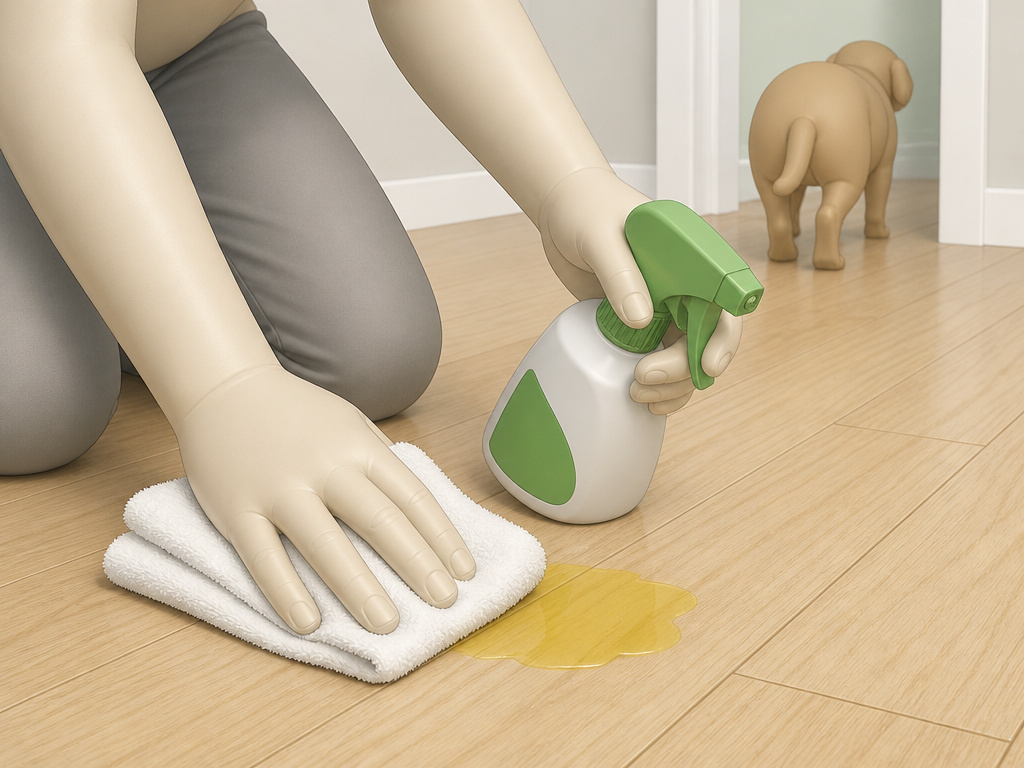
Say nothing. Clean it up.
That’s genuinely the instruction. UC Davis advises ignoring the urination entirely, noting that scolding makes things worse and that acknowledging the dog with praise may confuse it. Best Friends’ version is to not make a big deal of the accident, take the dog outside, and praise it once it urinates outdoors.
For the cleanup itself, use an enzymatic cleaner rather than a general-purpose one. Best Friends names Nature’s Miracle and Simple Solution specifically, because they neutralize the odor rather than masking it, which helps prevent the dog from urinating in that same spot again. Horwitz adds a detail I hadn’t considered until I read it: clean the spot in the dog’s absence, so you don’t accidentally deliver a punishment or a scolding while you’re doing it.
The part nobody mentions: A dog’s nose is doing a job your mop can’t. If the spot still smells like urine to the dog, it reads as the bathroom, no matter how clean it looks to you.
If you want a deeper bench on the cleanup side, enzyme cleaners that actually break down uric acid crystals are a different category from the spray you’d use on a kitchen counter.
When Is Submissive Peeing Actually a Medical Problem?
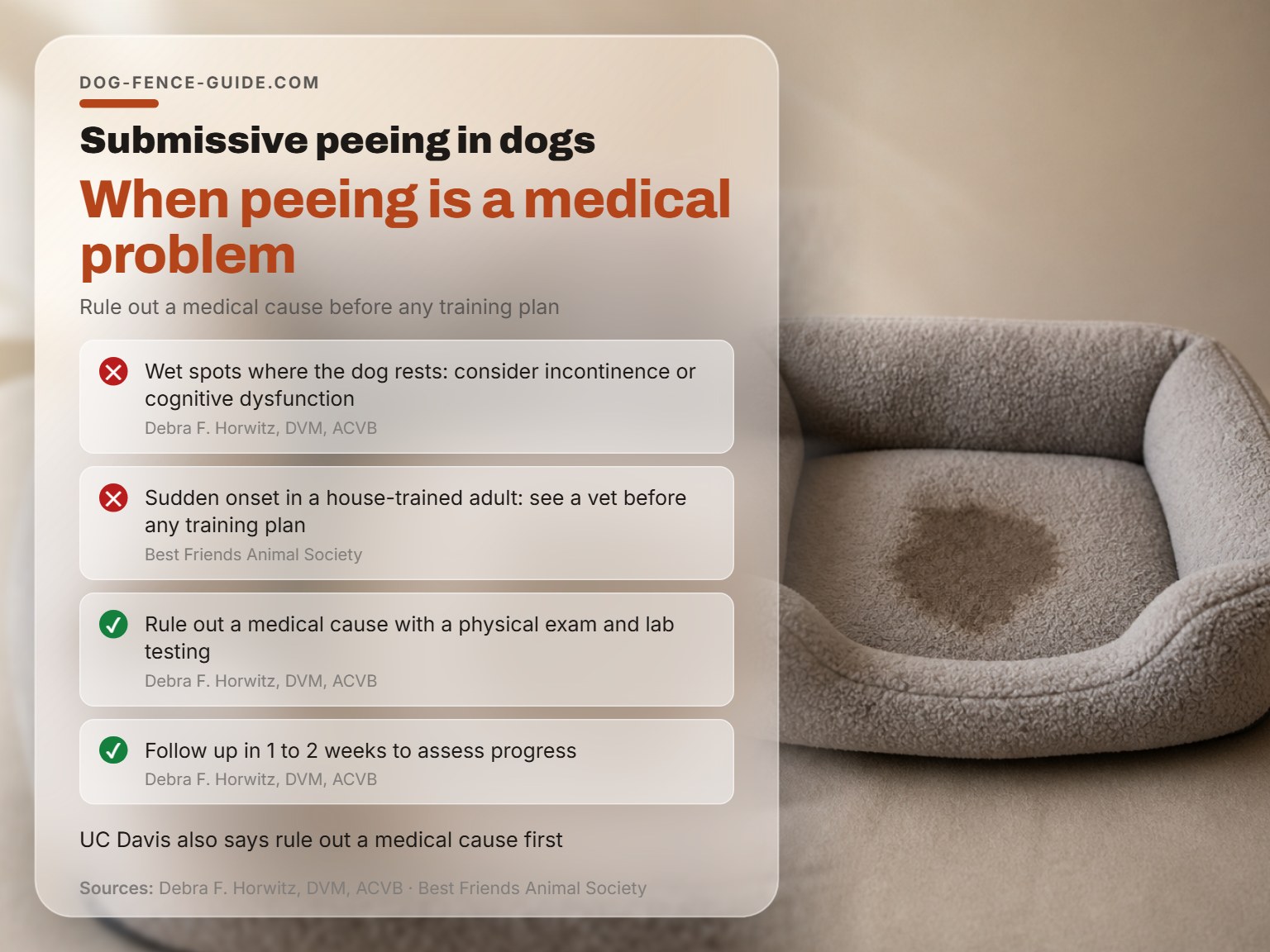
You come home and there’s a wet patch on the dog’s bed. The dog is asleep beside it. That is not a greeting problem, and no amount of posture work will touch it.
Horwitz is direct about the differential here. Wet spots where the dog rests, elimination in the presence of the owners, or other signs of cognitive decline should raise incontinence or cognitive dysfunction as the explanation. Best Friends makes the same point from the other direction: an adult dog who suddenly starts urinating inappropriately should see a veterinarian because there could be a medical cause. UC Davis opens its own guidance with the same instruction, rule out a medical cause first.
Horwitz’s clinical checklist is worth knowing before you call: a physical examination and laboratory testing, a full history focused on when and where elimination happens, then a diagnosis, then a plan, then a follow-up in one to two weeks to assess progress.
| What you’re seeing | Likely cause | Next step |
|---|---|---|
| Puddle only at greetings, submissive body language | Submissive urination | Trigger removal and greeting protocol |
| Puddle while standing or walking, no submissive signals | Excitement urination | Calm greetings; often resolves with age |
| Wet spots where the dog rests | Incontinence or cognitive dysfunction | Vet exam and lab work |
| Sudden onset in a house-trained adult | Possible medical cause | Vet visit before any training plan |
| Peeing plus destructive behavior when alone | Separation anxiety | A plan aimed at the anxiety itself |
Two of those rows have their own deep dives. If your dog is older and leaking at rest, senior dog incontinence covers the management side. If the volume is the thing that’s changed rather than the timing, why dogs pee so much is the right starting point.
Puppies, Breeds, and the Two-Week Management Plan
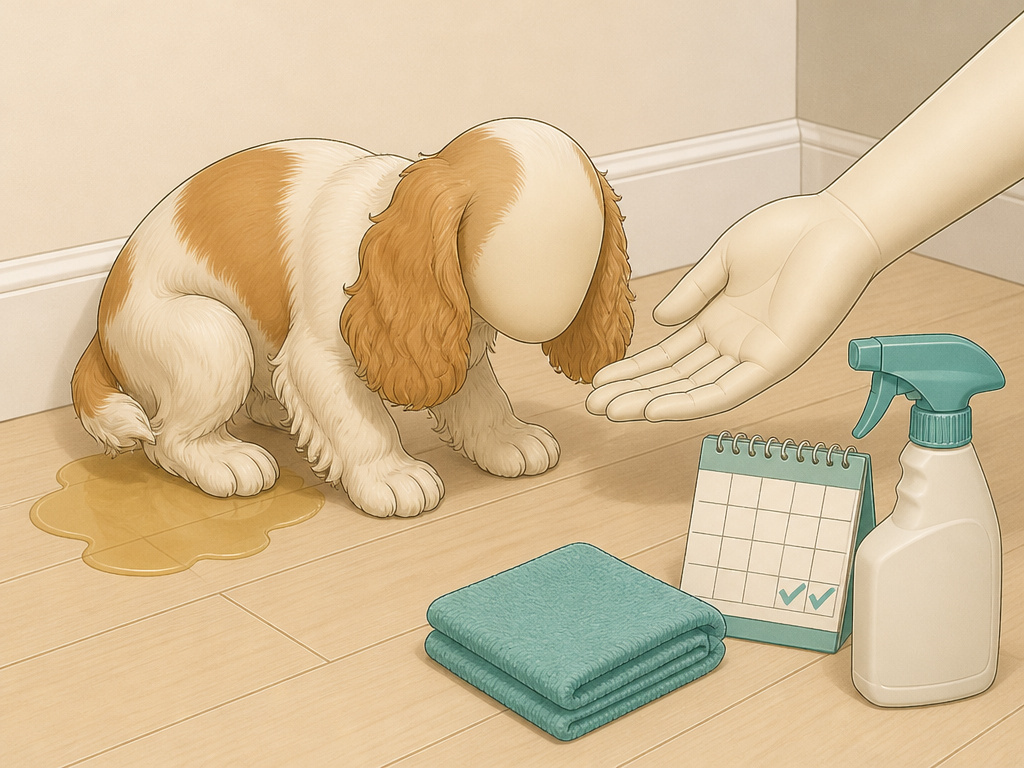
Whole Dog Journal names Cocker Spaniels as notorious submissive wetters, and the breed note matters more than it sounds.
UC Davis lists genetic predisposition as a potential cause of both submissive and excitement urination. Horwitz and Best Friends frame the behavior as anxiety and social-situation driven, with no genetic claim at all. Both can be true at once: a dog can be wired more reactive and still be fixable through the environment. What I’d take from the breed note is patience, not fatalism.
Puppies have the better prognosis on paper. UC Davis notes excitement urination occurs more frequently in puppies and can resolve with age, and Whole Dog Journal says puppies usually grow out of submissive urination if it’s handled properly, with the caveat that punishing it makes the problem worse. If you’re still in the house-training phase and the two problems are tangled together, puppy potty training is where to separate them.
Here’s the part I’d underline. My own approach with any fear-based behavior is a management plan first, with no training at all. You remove every opportunity for the dog to rehearse the problem, you change the greeting, you clean properly, and you wait. Then you add cues and confidence work once the dog physically can’t practice the wrong thing anymore.
The clients who get through this fastest are usually the ones who tell me up front they’re terrible at remembering routines. We hang the whole protocol off something they already do every day, the same door, the same five minutes, the same order of operations. Building a new habit is hard. Attaching one to an existing habit is nearly free.
Easy to miss: A dog that pees at greetings and also destroys the house when you leave has two problems, not one. Fix the separation anxiety first, or the greeting work keeps getting undone.
For the dog that’s anxious well beyond the front door, I’d look at dog calming diffusers as a background measure rather than a fix, and only after the greeting protocol has run a few weeks. Same with something like a ThunderShirt, useful for a dog that’s bracing all day, not a substitute for changing how you walk in.
And if the puddle is happening alongside leg-lifting on furniture, that’s a different behavior with a different plan. Indoor marking is worth ruling out separately, because the fix for marking is not the fix for appeasement.
The case that sticks with me from the literature is Whole Dog Journal’s Dalmatian. Ten months old, still peeing in the house despite punishment-based training, because the owner had misread a submissive urinator as a house-training failure. The dog was rehomed, put on a program, and the submissive urination was gone in a few short months. Same dog. Different environment.
Worth knowing before you start: If you can’t commit to changing your own greeting consistently, don’t start the protocol. Half-applied trigger removal gives you a dog that’s confused about which version of you is coming through the door, and that’s harder to fix than where you began.
Frequently Asked Questions
How long does submissive urination last in puppies?
Whole Dog Journal’s position is that puppies usually grow out of it as they mature, provided it’s handled properly. The variable is handling, not the calendar. A puppy whose greetings get calmer every week tends to fade out of it. A puppy that gets scolded for it tends to keep going.
Should I scold my dog when it pees during greetings?
No. Horwitz calls punishment absolutely contraindicated for submissive and excitement urination because it’s likely to increase both anxiety and urination. UC Davis says the same thing more plainly: scolding will make things worse. The dog is already appeasing you. Adding a threat doesn’t remove the fear that caused the puddle.
Does neutering stop submissive urination?
Not this behavior. Best Friends lists an unneutered male’s natural tendency to mark territory as a separate cause of inappropriate urination, and Horwitz notes that neutering intact dogs should reduce marking. Submissive urination is a fear response, so it isn’t hormone-driven in the same way. Neutering may help with marking. It won’t change how your dog greets you.
Is submissive peeing the same as excitement peeing?
They look similar and they’re handled differently. UC Davis draws the line at submissive signals: with excitement urination those signals are absent, and the urination happens while the dog is standing or walking during greetings and play. Excitement urination is also more common in puppies and can resolve with age. Submissive urination is fear-based and needs trigger removal.
When should I call a behavior professional?
Best Friends recommends considering a qualified behavior professional if the inappropriate urination continues despite your management. Horwitz notes that severe cases involving other fears, anxieties, and phobias may need treatment for those underlying conditions before the urination resolves. A dog that’s also fearful on walks, reactive to strangers, or unable to settle at home is past the point of a greeting tweak.
Can medication help a dog that submissive pees?
That’s a conversation for your vet or a veterinary behaviorist, not something to solve with an over-the-counter product. Horwitz’s framing is that when the problem is severe, treatment for the other fears and anxieties may be necessary to resolve it. Medication, where it’s used at all, sits inside a behavior plan rather than replacing one.
The Bottom Line
The short version of how to stop submissive peeing in dogs: change the greeting, not the dog. You’re not training a behavior out. You’re removing the threat that keeps firing it.
Here’s the threshold I’d give you. If your dog is still releasing at the door after one to two weeks of consistent, low-key greetings, same posture, same voice, same sequence every single time, stop guessing and get a vet exam. Not because the training failed, but because clean trigger removal that produces no change is a signal worth taking seriously. Horwitz’s own follow-up window is one to two weeks, which is a reasonable clock to hold yourself to.
And one concession, because this advice has a limit. Everything above assumes a dog whose fear is specific to greetings and handling. If your dog is bracing through most of its day, flinching at sounds, unable to settle, avoiding people generally, the front door is a symptom and you’re working on the wrong end of it. That dog needs a full behavior plan, and probably a veterinary behaviorist, before any of this will hold.
