
How to Prevent Bedsores in Senior Dogs: Daily Routine
This post contains affiliate links. As an Amazon Associate, we earn from qualifying purchases.
To prevent bedsores in senior dogs, rotate the dog’s position every 1 to 5 hours, keep the skin dry, and put real padding under the bony points. Padding alone is not enough: a 2019 veterinary pressure-mat study found static mats could not hold risk-zone contact pressure under 60 mmHg, especially in thin dogs.
The damage starts as a plumbing problem. A small vessel feeding the skin gets pinched shut between a bone and whatever the dog is lying on, and the tissue downstream starves. That’s why the how to prevent bedsores in senior dogs question starts with a color change, not a cut.
What follows is the rotation schedule, the bedding that earns its place, the five-minute skin check, and the one score that tells you a dog has drifted into the high-risk group.
Key Takeaways
- Turn on a schedule, not on a feeling. Swaim’s 2003 guidance for recumbent dogs puts the interval at every 1 to 5 hours, rotating left side, chest, right side.
- Padding buys time; it does not stop pressure. A 2019 study found static pressure-relieving mats alone could not hold risk zones under 60 mmHg, particularly in thin dogs, though Swaim 2003 and dogcancer.com endorse thick, well-padded bedding as helpful.
- Check the skin regularly. Part the hair over the elbows, hips, and ribs and look for a red patch that stays red when you press it.
- A score of 7 or more out of 10 means high risk. A risk scale built for dogs in long-term care separated dogs with ulcers (median 7) from dogs without (median 4).
- Dry skin matters as much as soft skin. Trapped urine softens skin and feeds the bacteria that turn a red patch into an open sore.
Why Bedsores Form Where the Weight Lands
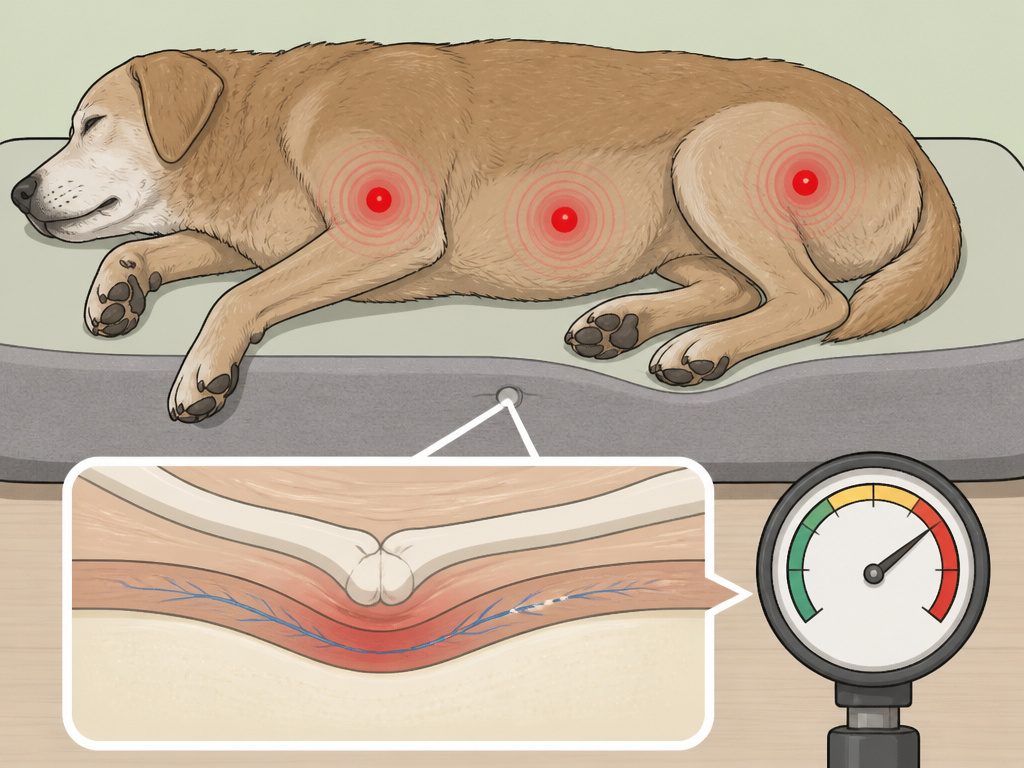
A bedsore starts as a pressure injury, long before the skin ever breaks. The skin over a hip or an elbow gets squeezed between the bone underneath and the surface below, and the small vessels feeding it collapse.
Contact pressure above 60 mmHg in a risk zone is the threshold a 2019 veterinary study set for tissue damage. The same study measured four support types with a TexiSense pressure mat over four hours of lateral recumbency. Static pressure-relieving mats failed to hold the risk zones below that line, particularly in thin dogs.
That study, published in the Journal of Small Animal Practice, is the closest thing veterinary medicine has to a hard number here. The veterinary pressure sore prevention study compared a blanket on the floor, a standard mattress, a veterinary memory-foam mattress, and a human-medicine memory-foam mattress.
The three spots that kept showing up were the same every time, regardless of body condition or support type: the skin over the scapula-humeral articulation (the shoulder joint), the greater trochanter (the point of the hip), and the thirteenth rib.
That last one catches people out. The thirteenth rib sits well back toward the flank, and under a thick coat it is easy to walk straight past.
How Often Should You Turn a Senior Dog?

Swaim’s 2003 guidance for recumbent dogs is every 1 to 5 hours, rotating from left side to chest to right side, while dogcancer.com advises every few hours, Caraty et al. 2019 recommend ‘frequent’ changes without a number, and one owner reports every 2 hours or as often as possible.
The published sources do not agree on much beyond that, so here they are side by side.
| Source | Repositioning guidance |
|---|---|
| Swaim 2003 (Auburn) | Every 1 to 5 hours, left side to chest to right side |
| dogcancer.com (2024 review) | Every few hours |
| Caraty et al. 2019 | “Frequent” changes in position, no number given |
| Owner report (video) | Every 2 hours, or as often as possible |
Read that table honestly and you’ll notice the gap: nobody has published a trial comparing one interval against another. The 1-hour floor in Swaim is a clinical judgment, not a measured optimum.
Which is why, when you compare a how to prevent bedsores in senior dogs schedule, I’d rather see an owner hit 3 hours reliably than aim for 1 and quit by Thursday. A dog turned four times a day beats a dog turned twelve times on day one and never again.
If your dog can still take a few assisted steps, senior dog mobility work during the day makes the turning easier at night. Stronger legs mean less dead weight in your arms at 2 a.m.
How to Prevent Bedsores in Senior Dogs: The Daily Routine
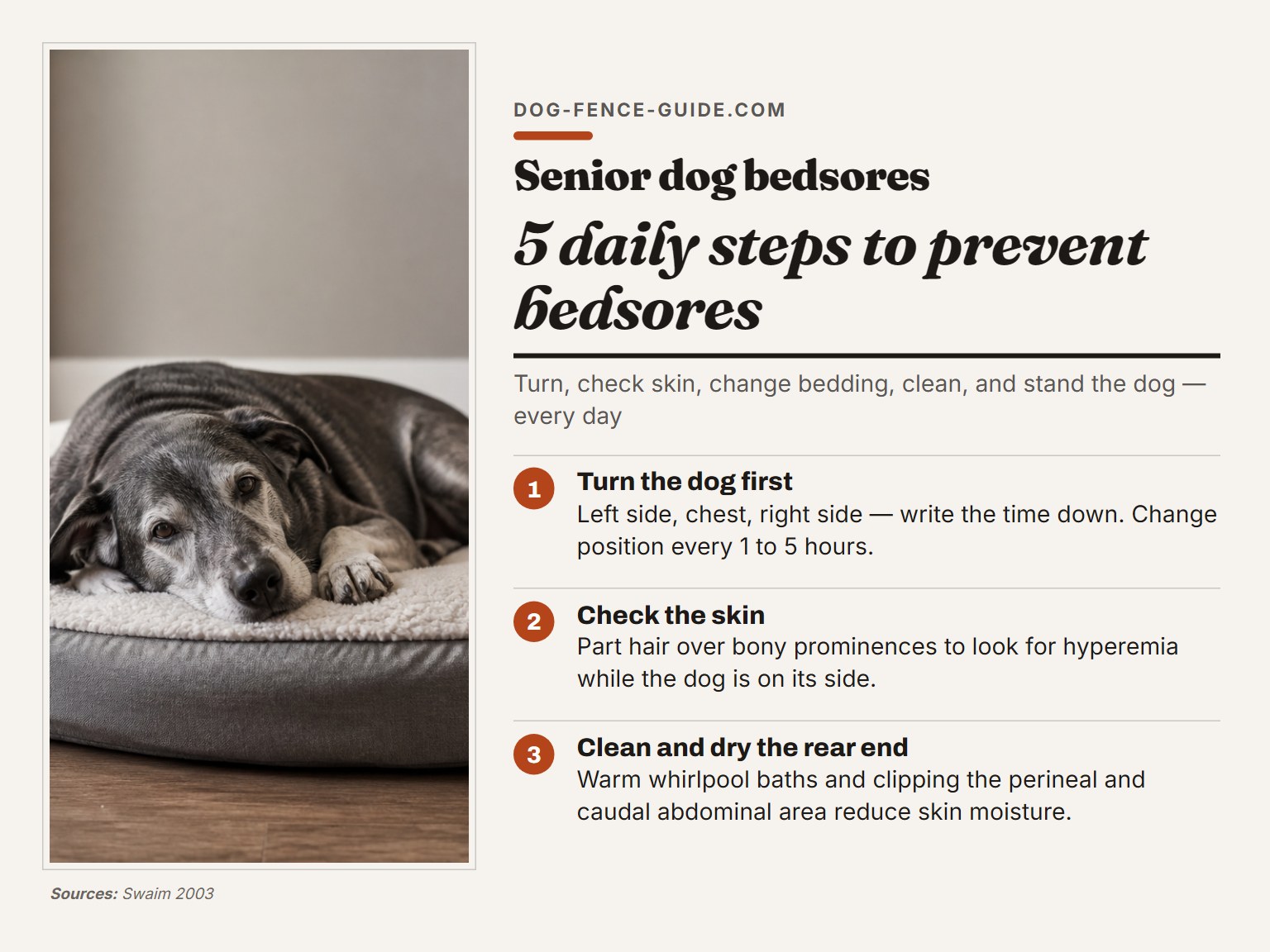
Five things, in this order, every day.
Before you start: Two hazards worth naming. Tape or a bandage tight enough to stay on a leg can also cut circulation, so check for swelling below it twice a day. And a dog that suddenly cannot stand may have a spinal or orthopedic emergency rather than stiffness, so get that looked at before you build a routine around it.
- Turn the dog before you do anything else. Left side, chest, right side, and write the time down. Skip the overnight turn and you have handed one hip six straight hours of the same pressure.
- Check the skin while the dog is already on its side. It costs nothing extra at that moment, and it is the only time you’ll get a clear look at the down-side elbow.
- Change the top layer, not just the cover. A wipe-down of the vinyl does not remove the moisture sitting in the fleece above it, and that moisture is what softens skin.
- Clean and dry the rear end. Swaim’s guidance is explicit here: warm whirlpool baths and clipping the perineal and caudal abdominal area keep an incontinent dog clean, and reducing local skin moisture is what stops the bacterial buildup that precedes an ulcer.
- Stand the dog for a few minutes. dogcancer.com recommends supporting the dog upright for even a few minutes, several times a day. It offloads the down-side hip and it gives the dog something to do besides lie there.
The routine that survives is the one you can do at 6 a.m. Before work. Build the schedule around your worst day, not your best one, and the good days take care of themselves.
If you want the wider picture on daily care for an older dog, the senior dog care basics cover feeding, grooming, and vet visits in more depth than fits here.
The Padding That Actually Works, and the Kind That Only Looks Like It
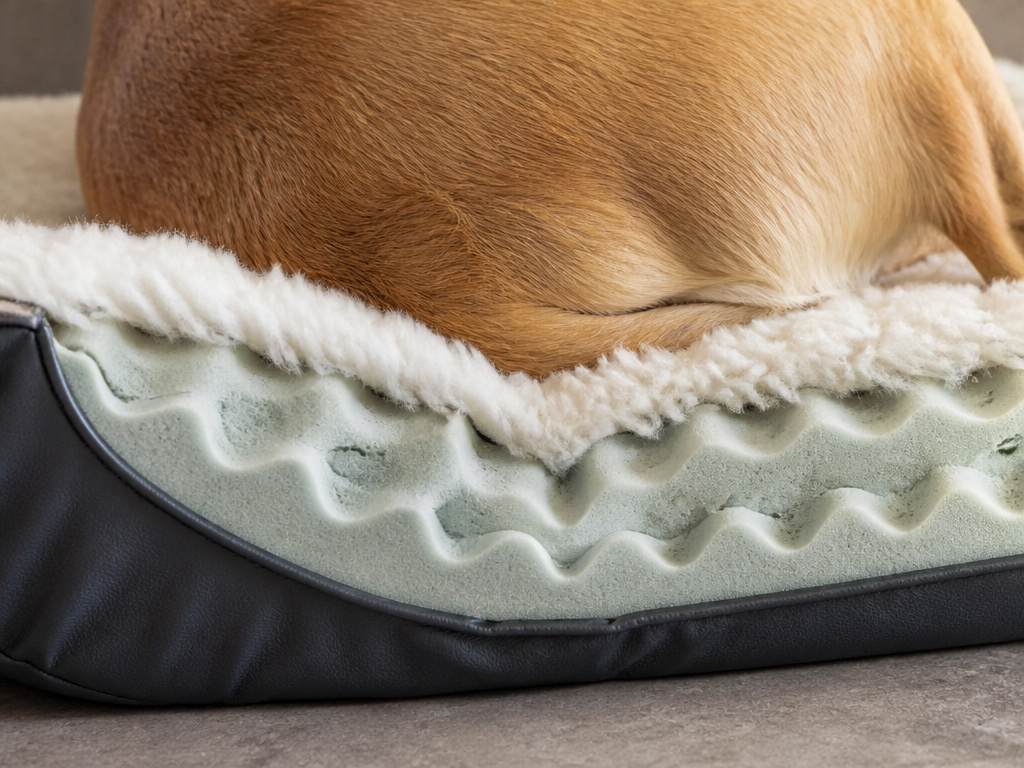
Thickness is the wrong thing to shop for. Contact pressure is the thing that matters, and a deep, soft bed can bottom out under a heavy dog and put the hip straight back onto the floor.
This is where the sources genuinely split. Swaim (2003) calls a thick egg-crate foam pad with a vinyl covering “one of the best types” of bedding for a recumbent dog, and recommends an artificial sheepskin mat over the top to add padding, allow air circulation, and conduct urine away from the skin. Caraty (2019) found static pressure-relieving mats insufficient on their own. Both are in the literature. Both are worth knowing.
| Support type | What it does well | Where it falls short |
|---|---|---|
| Egg-crate foam, vinyl cover | Cheap, replaceable, holds its shape | Vinyl holds warmth and moisture against the dog |
| Artificial sheepskin over foam | Wicks urine away, allows airflow | Needs frequent washing, mats down over time |
| Veterinary memory-foam mattress | Spreads load across a wider area | Still static; missed 60 mmHg in thin dogs |
| Human memory-foam mattress | One of the four supports measured in 2019 | Not shaped or sized for a dog’s body |
For a large dog, choose an orthopedic bed built around weight rather than looks, which is the right priority for a heavy dog. If your dog is leaking, a chew-resistant bed with a waterproof liner matters more than foam density at that point. For the sheepskin layer Swaim describes, a synthetic vet fleece does the same job and survives repeated hot washes.
Two things I’d skip. Don’t buy a bed sized to the dog standing up. One promotional video’s advice was to measure the dog stretched out asleep, nose to tail, then add a few inches, and that is the sizing rule that actually holds. And don’t stack extra padding over a point like an elbow.
Common mistake: Piling extra padding over a convex spot like an elbow or a hock. Swaim’s guidance is blunt about this: extra padding over a convex area actually increases pressure once the outer layers go on. The fix is a donut pad made from soft cast padding with a hole cut in the center, and the material named in the source is Specialist Cast Padding (Johnson & Johnson Orthopaedics, Raynham, MA).
If arthritis is part of the picture, beds for arthritic dogs need to be firm enough to get in and out of, not just soft enough to lie on. A bed a sore dog can’t climb out of is a bed it will avoid.
For the deeper comparison of foam types and firmness, the guide to memory foam dog beds covers what density actually does under a dog’s weight. And if your dog still sleeps with its head against something, orthopedic beds for senior dogs with a low entry lip are easier on a stiff dog than a deep-walled design.
What a Five-Minute Skin Check Should Catch
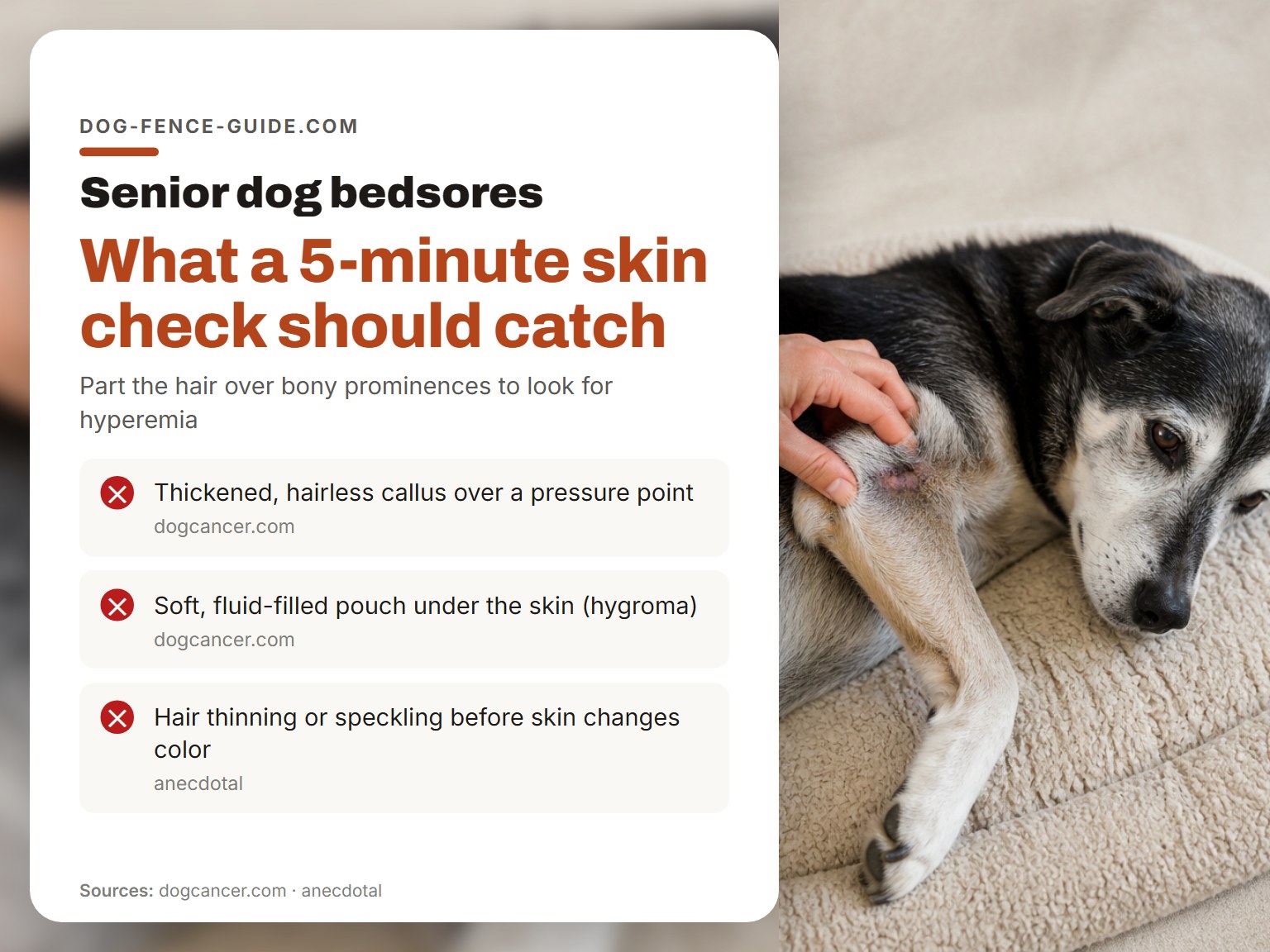
Sunday morning, dog flat on its side, my hands in the coat over each elbow and hip, looking for the one patch that shouldn’t be there.
The technique comes straight from Swaim: part the hair over the bony prominences and look for hyperemia, which is the clinical word for skin that has gone red because blood is pooling in tissue that isn’t getting fresh flow. Press it with a thumb. If the color drains out and comes back, you have time. If it stays red, you don’t.
What you’re looking for, in order of how often I find it:
- A flat red patch that doesn’t blanch under thumb pressure, usually over an elbow or the point of the hip
- A thickened, hairless callus, which dogcancer.com describes as one of the early forms a bedsore takes
- A soft, fluid-filled pouch under the skin, called a hygroma, which is the other early form
- Hair thinning or speckling over a pressure point, before the skin itself changes color
A red patch that stays red under your thumb is a vet call, not a wait-and-see. Sores that get caught at that stage are a nuisance. Sores that get caught a week later are a months-long problem.
One more thing worth saying plainly: a sore can be forming for hours before anything shows on the surface. The skin you can see is the last part of the tissue to give out.
Which Senior Dogs Are at the Highest Risk?
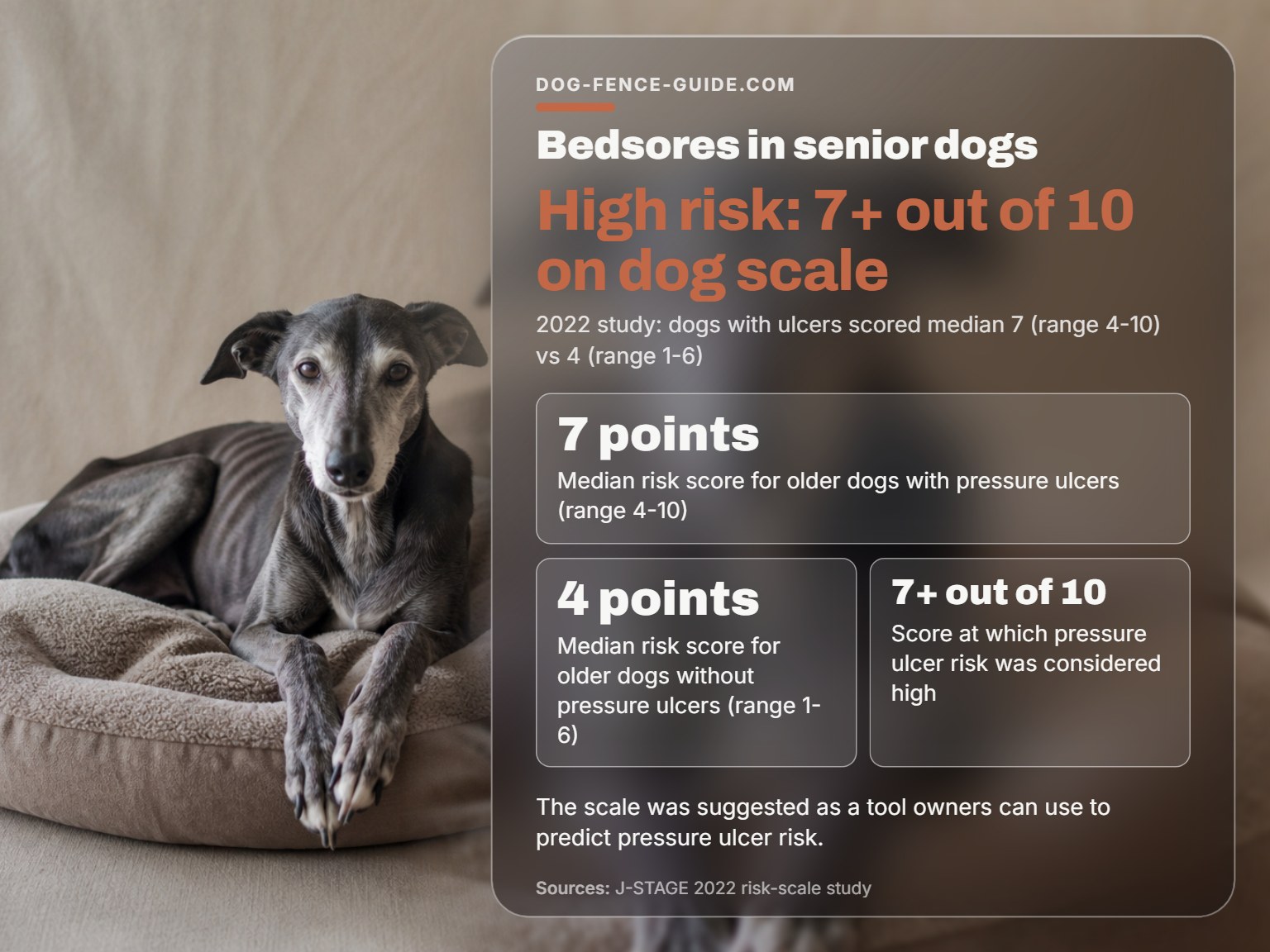
Seven out of ten. That is the score that flagged high risk on a pressure ulcer scale developed specifically for dogs in long-term care.
The 2022 study behind it compared older dogs with and without pressure ulcers. The dogs with ulcers scored a median of 7 points (range 4 to 10). The dogs without scored a median of 4 points (range 1 to 6). Risk was high at 7 or more out of 10, and the authors suggest owners can use it too.
The same study painted a clear picture of the dog most likely to develop one. Those dogs were leaner, had visible bone protrusions and joint contractures, and found it harder to eat, excrete, and reposition on their own.
- Giant and large breeds, per dogcancer.com
- Slender builds with minimal body fat over the bony points
- Short-haired dogs, which have less padding built in
- Dogs with joint contracture, where a limb stops extending normally
- Incontinent dogs, where skin stays wet
- Dogs that refuse a padded bed and choose the floor
That last one is a compliance problem, not a bedding problem. Dogcancer.com’s answer is to confine the dog to a padded crate or pen so it can’t relocate to the hard floor, which sounds harsh until you’ve watched a dog choose tile over a padded bed for a week straight.
Here is where the standard advice gets shaky. A 2014 pressure-mapping case study of two bedridden Shiba dogs found that high-pressure areas on the body did not necessarily match where ulcers actually formed. Ulcers turned up on skin with no bony prominence at all. The authors put it down to joint contracture and weight loss reducing the dog’s ability to bear weight normally, and recommended pressure redistribution devices that adjust to the degree of contracture rather than static mats.
So the bony-points model is a starting map, though Swaim 2003 and dogcancer.com focus prevention on bony prominences while the 2014 case study found ulcers sometimes formed on skin with no bony prominence.
Keeping the Skin Dry When Your Dog Can’t Hold It
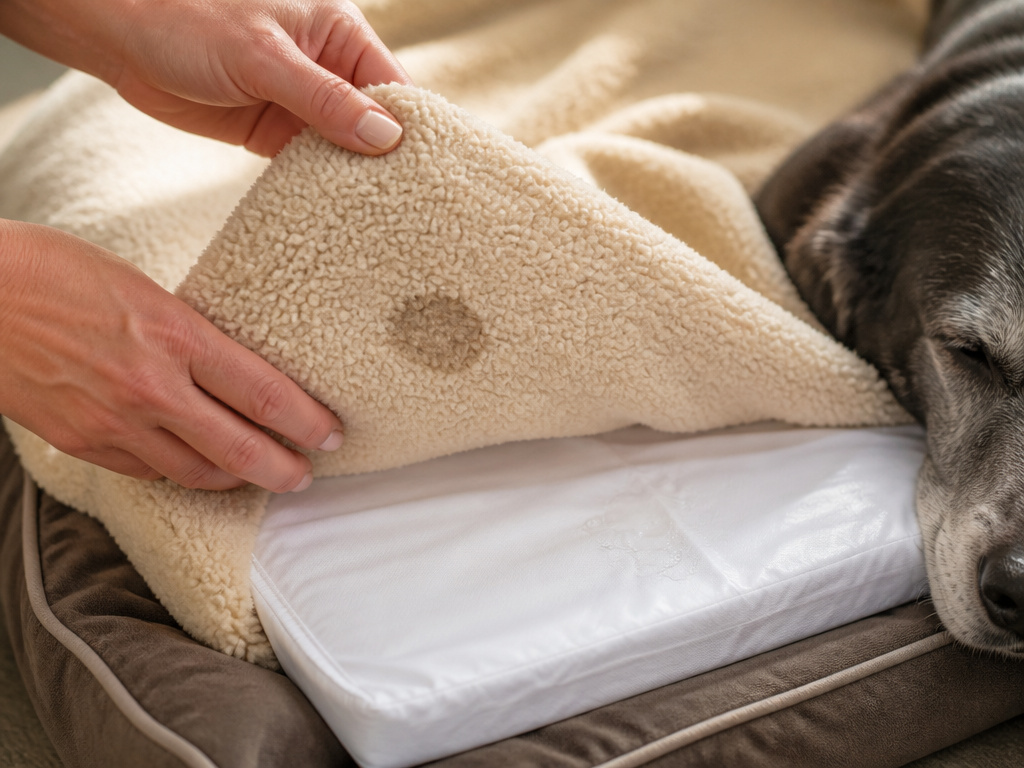
For my own incontinent senior, a waterproof crib mattress pad under a fleece throw changed the whole routine. It cost less than the pet-branded pads, and the fleece pulls moisture away from skin instead of holding it there. I check and rotate every morning, and I haven’t seen a hot spot yet.
Wet skin fails differently from dry skin. Swaim’s article is direct about the mechanism: local moisture drives bacterial proliferation and skin maceration, and both contribute to decubital ulcer development. Skin that has been sitting in urine goes soft and wrinkled, the way a finger goes after a long bath, and soft skin tears at a fraction of the pressure.
The practical layer, from the sources:
- Prompt, thorough clean-up after every accident, per dogcancer.com, with frequent baths or diapers for a dog that is leaking regularly
- Warm whirlpool baths and sponge baths, which both Swaim and dogcancer.com recommend to limit bacterial growth
- Clipping the perineal and caudal abdominal area, which Swaim names specifically for incontinent dogs
- A moisture-conducting top layer, which is exactly what the artificial sheepskin mat is for
Where this goes sideways: A vinyl cover that keeps urine out of the foam also keeps moisture against the dog if the layer above it isn’t changed. The waterproof barrier is doing its job. The fleece on top is the part that has to be swapped daily.
There is more on bedding, cleaning, and dignity-preserving setup in the senior dog incontinence page if leaks are the main issue you’re managing.
The Extra Support That Takes Weight Off the Bony Points
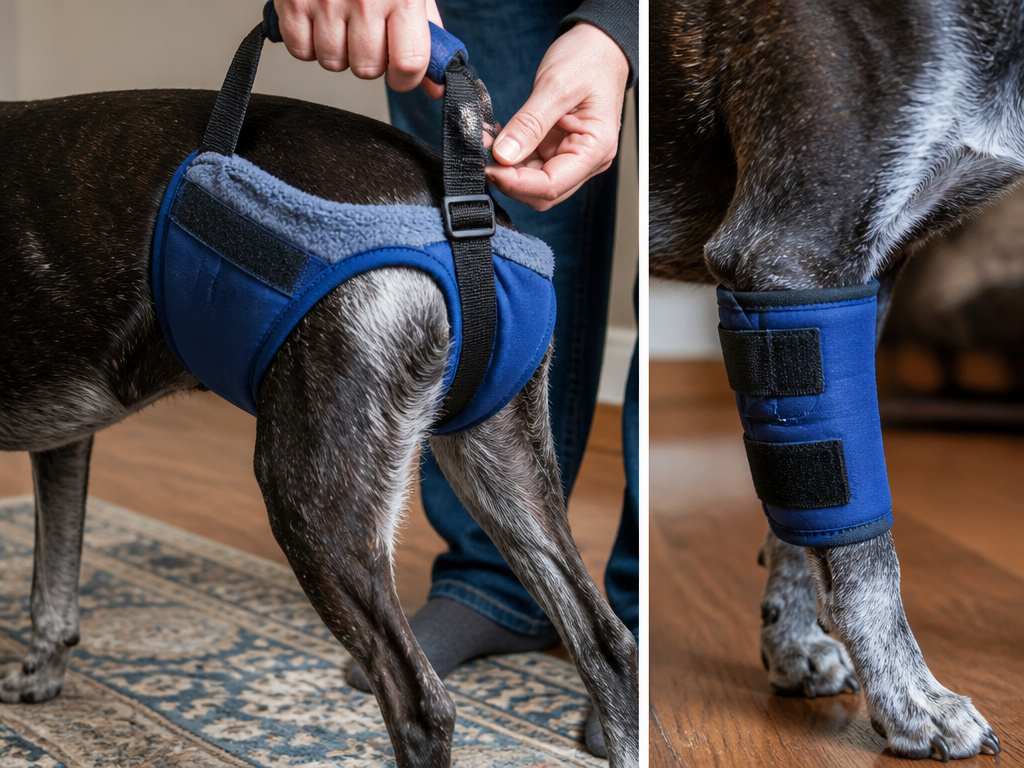
Three pieces of equipment do most of the work here: a sling, a cart, and a splint.
Swaim’s guidance is a sling for 2 to 4 hours a day, which offloads the acromion of the scapula, the tuber coxae, and the greater trochanter, especially in large dogs. VCA Animal Hospitals puts it more simply: for a dog that can no longer move around on its own, a sling or harness may be all that is required. Beyond that, two-wheel carts, four-wheel carts, and wagons are all on the list.
Wheeled carts support the pelvic area in paraparetic or paraplegic dogs, keeping pressure off the bony prominences of the hindquarters while giving the dog back some mobility. That mobility matters for the same reason the standing breaks do.
Splints are the piece most owners never hear about. A splint over an elbow can hold it in extension and prevent the pressure, movement, and resulting ulcer that come with a joint that keeps folding. Side splints that extend beyond the perineal area can be built into a body bandage to protect the ischiatic tuberosities during attempts to sit.
One thing I’d add that no veterinary article mentions: the floor itself. A senior dog that slips on hardwood is bracing and scrambling, and that scrambling loads the joints and the skin in ways a calm dog never does. Anti-slip dog socks or a couple of cheap runner rugs along the dog’s main path remove a surprising amount of that daily strain.
A bolster dog bed is worth considering for a different reason: the raised edge gives a dog something to push against when it stands, which means less sliding and less help needed from you.
Frequently Asked Questions
Do bedsores on dogs heal on their own?
Early-stage redness can resolve if pressure comes off the spot and stays off it. Once the skin is open, dogcancer.com notes that pressure sores often become a chronic condition that is difficult to treat and fully heal, particularly in incontinent dogs where urine keeps irritating new skin. That is the argument for catching them at the red-patch stage.
Is a memory foam bed enough on its own?
Not according to the 2019 pressure-mat study, which found static pressure-relieving mats failed to hold risk zones below 60 mmHg, particularly in thin dogs. A bed is one layer of a routine that also includes turning, skin checks, and moisture control. Swaim’s 2003 article endorses padded bedding more enthusiastically, so the honest answer is that the two sources disagree.
How do I know if my senior dog is in pain from a pressure sore?
Dogs with ulcers in the 2022 risk study were harder to reposition and to move on their own. A dog that flinches when you part the hair over a hip, or that stops lying on one side entirely, is telling you something.
Can I use human wound products on a dog’s pressure sore?
Ask your vet before you put anything on broken skin. The one human product described in an owner video was a heel cup taped over an elbow, taped not very tight to avoid cutting off circulation. That is a padding workaround, not a treatment.
Should I wake my dog to turn it at night?
Swaim’s guidance is every 1 to 5 hours, and one experienced owner admitted that flipping a newly down dog every 2 hours is not realistic for most people. Turn the dog as often as you genuinely can, and be more careful about the skin check on the mornings after a long unbroken stretch.
The Bottom Line
Here is the threshold that should change what you do: if you press a red patch over an elbow, hip, or rib and the color does not drain out and come back, that is a same-week vet call. Everything else here is maintenance. That one is a decision point.
And if you take one action this weekend, make it the boring one. Get down on the floor with your dog while it’s lying on its side, part the hair over both elbows and both hips, and look. Five minutes. You’ll either find nothing, which is the good outcome, or you’ll find the thing that was going to cost you a month.
