
How to Prepare a Dog for a Natural Disaster: Kit and Plan
This post contains affiliate links. As an Amazon Associate, we earn from qualifying purchases.
You prepare a dog for a natural disaster by building a kit, planning where the dog can actually go, and rehearsing the carrier before you need it. Many evacuation shelters, including Red Cross centers, do not accept pets, so the destination matters more than the supplies.
The destination is where most plans quietly fold. A household can own a perfect kit and still spend the night in a parking lot, because nobody called the motel to ask whether it takes a large dog. The supplies are the easy half of how to prepare a dog for a natural disaster.
What follows is the order that holds up under pressure: kit quantities, the shelter math, the records that get a dog through a door, and the rehearsal that keeps a scared dog from bolting at the worst possible moment.
Key Takeaways
- Three days of food is the floor, per Mississippi State University Extension. The AVMA checklist goes to 3 to 7 days of food and at least 7 days of water. Pick a number and rotate it.
- Red Cross shelters generally do not accept pets. Service animals under federal ADA rules are the exception, and only select shelters take regular pets.
- The rabies certificate is the document that matters most, because a sheltered or lost dog is more likely to meet other animals and wildlife.
- Practice the carrier and the car ride now. A dog that panics at the crate door costs you the minutes you will not have.
- Never leave a dog chained outdoors, and never assume a fence line survived the storm intact.
What Actually Goes in a Dog Disaster Kit
Four categories carry the weight: documents, food and water, handling gear, and sanitation. Comfort items are the fifth, and they still count.
The kit is built around the carrier. An appropriately sized crate with current contact information transports the dog and doubles as temporary housing, which is why the crate gets chosen first. Every supply then goes into a waterproof container that is labeled with contact details and light enough for one person to carry alone.
A carrier that has lived in the garage comes out smelling of gasoline and old dust. The dog reads that before you have set it down, which is part of how to prepare a dog for a natural disaster.
That is the argument for buying the carrier now and letting it live in the house, where it picks up the smell of the dog instead of the smell of the lawnmower. I would spend carrier money before I spent it on a second crate.
Before you start: A scared dog can bite, so muzzle-train before you need it and keep a length of gauze in the kit for a field wrap. Floodwater after a storm carries sewage, and the CDC is blunt about it: don’t let the dog play in it or drink it, and wash your hands after any contact with urine. Store the tote where you can reach it in the dark.
The core list, in rough order of how often it gets used:
- Copies of records: rabies certificate, vaccination record, microchip number, allergies, and current medications with doses.
- Enough food for at least three days, in a sturdy sealed container, plus a can opener if you pack canned food.
- Clean water and a collapsible bowl.
- An extra leash and collar, because the one on the dog is the one that fails.
- A muzzle or a long piece of gauze.
- Sanitation supplies: bags, paper towels, and litter if there is a cat in the house.
- A basic first aid kit.
- A printed photo of the dog. Not just the one on your phone.
- Blankets, a towel, and one toy.
Mississippi State University Extension prefers canned food for its storability and moisture content, as long as the dog is not on a special diet. That is one of the few places the guidance picks a side.
For the carrier itself, an appropriately sized hard-sided crate with current contact information is a solid choice. It is rigid, it stacks in a truck bed, and the door hardware survives being thrown around. For a dog that panics in a hard crate, a soft-sided carrier may work better for short car trips because the sides give when the dog leans on them.
For a muzzle, choose one that lets a dog pant and drink while wearing it, which matters on a hot day in a parking lot. A waterproof bag keeps the paper records dry even if the tote takes on water.
How Much Food and Water Should the Kit Hold?
Three days is the floor. Seven is the number on the veterinary checklist. Both are defensible, and the sources do not agree.
| Kit item | MSU Extension | AVMA checklist |
|---|---|---|
| Food | Minimum 3 days | 3 to 7 days |
| Water | “Clean water,” no day count | At least 7 days |
| Medicine | “Medications,” unquantified | Two-week supply |
| Muzzle | Gauze, improvised in the field | Muzzle plus thick gloves |
The gap between three days and seven is not a rounding error. It is the difference between a kit you will actually open, check, and repack twice a year and one that sits in the garage until the kibble goes stale.
A basic first aid kit belongs in the tote as well. The CDC treats pet first aid as a stopgap on the way to a vet, never a replacement for one.
Will Red Cross Shelters Take Your Dog?
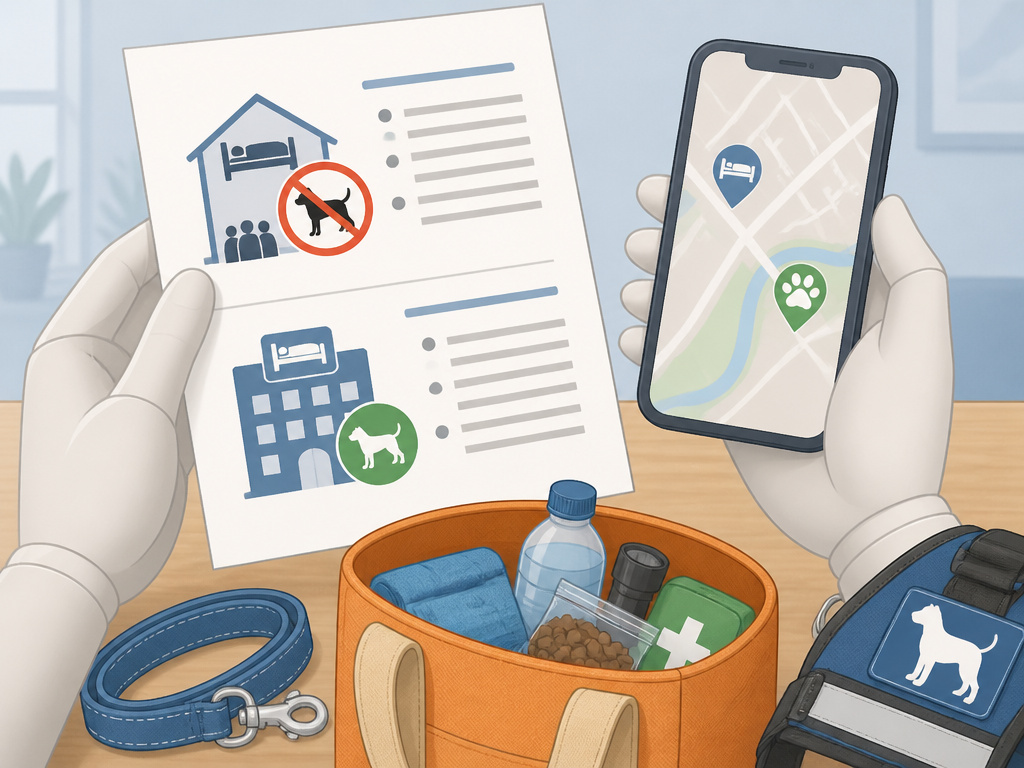
Usually not.
The CDC states it plainly: pets may not be allowed in local shelters unless they are service animals, and many disaster evacuation centers, including Red Cross evacuation centers, do not accept pets. The FDA adds that only select emergency shelters accept regular pets, so finding a pet-friendly shelter may be difficult.
Service Animals Are the Exception
Pets that help people with disabilities are allowed in general population shelters and Red Cross shelters as long as they meet the requirements for service animals under federal law, according to the FDA. That is a narrow exception covering trained service animals under the ADA. It does not cover the family dog.
What to Do When No Shelter Takes Pets
The CDC’s own remedy is to identify shelters or out-of-town friends and relatives where the pets can stay, before you need them. Mississippi State University Extension lists the same options in more detail: boarding facilities, veterinary hospitals, pet-friendly hotels, and family members who live outside the affected area.
If the plan is a relative’s house three hours away,
RedRover shelters and cares for animals displaced by disasters in the United States and Canada. The sheltering assistance line is (800) 440-3277, and it belongs in your phone contacts now, not in a search bar later.
The part nobody mentions: A shelter list saved two years ago is a guess. Call the two nearest pet-friendly hotels and your county animal control office this month, write the answers on paper, and put the paper in the tote.
Shelter in Place or Evacuate? Where the Guidance Splits
The cone shifts west overnight and the phone starts buzzing at five in the morning. That is a hurricane, and you have hours. A tornado gives you the time it takes to hear the siren.
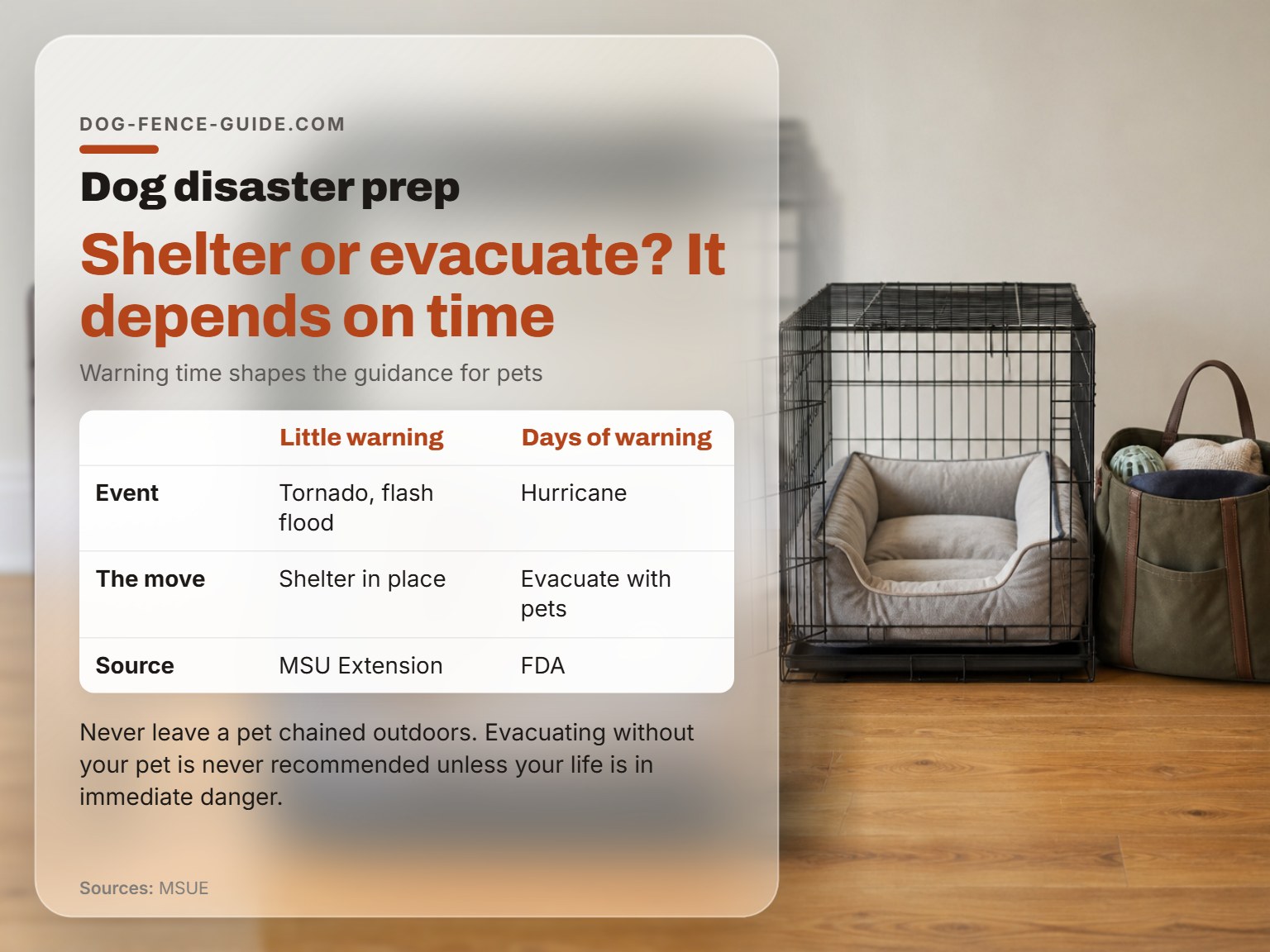
The sources split on this, and the split is about warning time.
| Event | Warning you get | The move |
|---|---|---|
| Hurricane | Days | Evacuate early with the dog and the tote |
| Wildfire | Hours to days | Leave before the order, since roads close |
| Tornado | Minutes | Shelter in place, interior room, crate |
| Flash flood | Minutes | Shelter in place, move to high ground |
Mississippi State University Extension says that when there is little time to react, as with tornadoes, flash floods, earthquakes, or manmade hazards, the safest thing to do is shelter in place. The FDA’s top instruction reads the other way: bring your pets with you when evacuating, and be ready to leave storm-surge areas.
The CDC’s position sits underneath both. Leaving pets out of an evacuation plan puts pets, owners, and first responders in danger, and its one hard prohibition is that a pet is never left chained outdoors.
Both agencies are describing different clocks. A hurricane gives you days to load a crate and find a motel that takes dogs. A tornado gives you the walk to the basement.
Mississippi State University Extension says that with little warning, as with tornadoes or flash floods, the safest thing is to shelter in place, while the FDA’s top instruction is to bring your pets with you when evacuating. The one move that is always wrong is leaving the dog tied in the yard.
Mississippi State University Extension is equally direct about the other direction: evacuating without your pet is never recommended unless your life is in immediate danger, because an area unsafe for you is unsafe for the dog.
The Records Folder That Gets Your Dog Through the Door
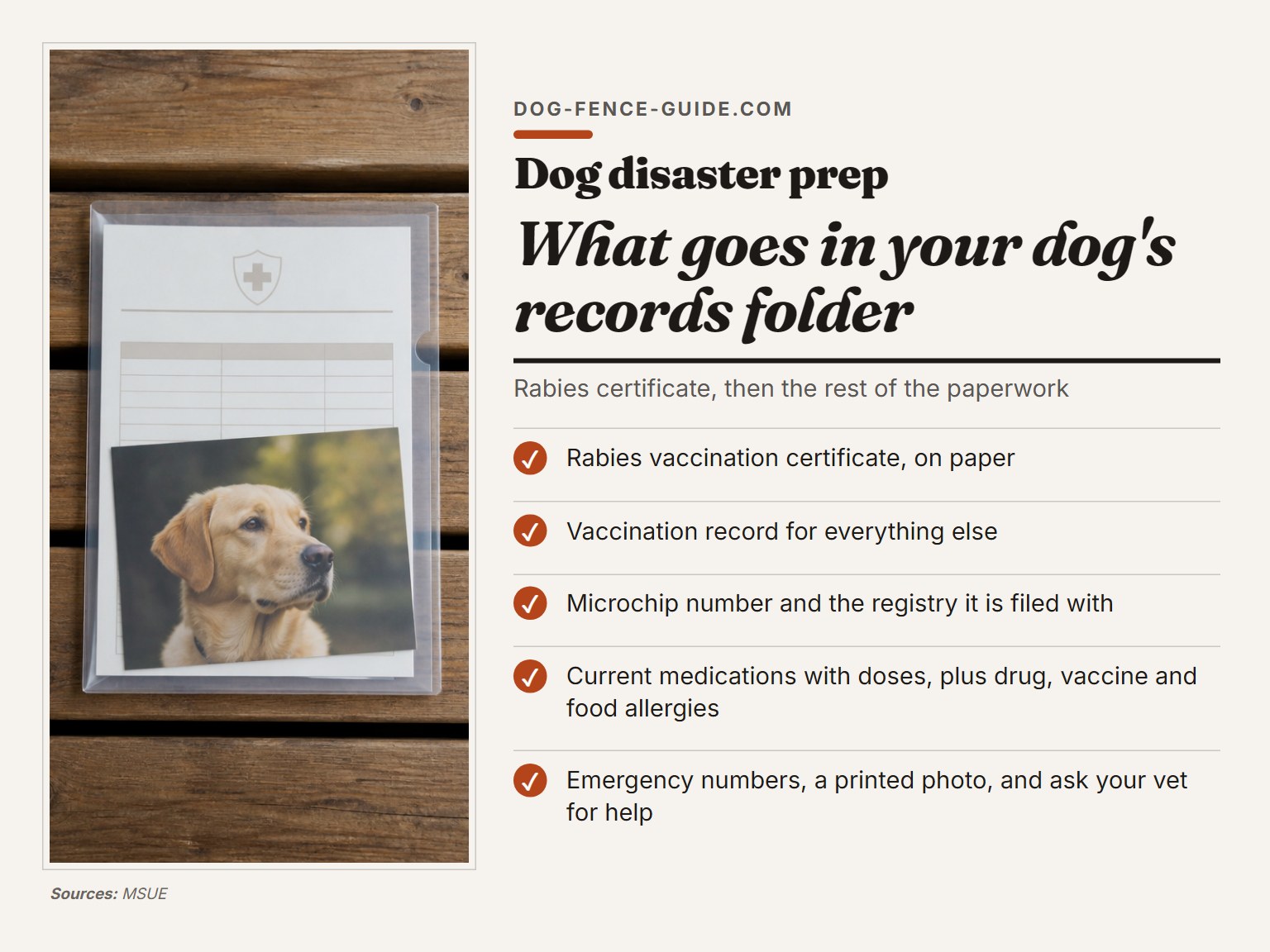
The rabies certificate is the document Mississippi State University Extension calls most important, since a sheltered or lost dog is more likely to meet other animals and wildlife.
Mississippi State University Extension calls rabies the most important vaccine for exactly this reason. A sheltered or lost pet is more likely to come into contact with other pets and possibly wildlife, and that is the scenario the certificate covers.
What Goes in the Folder
- The rabies vaccination certificate, on paper.
- The vaccination record for everything else.
- The microchip number and the registry it is filed with.
- A list of current medications with doses.
- Drug, vaccine, and food allergies.
- Emergency numbers: your vet, the nearest emergency hospital, and a relative who will answer.
- A printed photo of the dog.
The CDC suggests asking your vet for help putting the veterinary records together. That is also the fastest route, because the clinic already has the paperwork on file.
Then check the microchip. The registry that holds your contact details is only useful if the number on file is current. A chip with an old cell number is a chip that does nothing.
I called several clinics when I was vet-shopping and asked one question: what is your protocol if I call after hours with a bloated dog? Two said go to the emergency clinic and stopped there. One gave me the address and told me to call ahead. That one got my business.
A vet who asks about your fence and your routine before they ask about vaccines is a good sign. If they are running a checklist and never ask how the dog actually lives, that tells you something about how they will handle a weird symptom later.
After a storm, familiar scents and landmarks may change, and a confused dog will run.
Practice the Carrier Before the Night You Need It
That was the day I realized we had rehearsed everything except the one place that matters.
Now we do happy visits regularly. Walk in, get weighed, eat a treat, walk out. No exam, no needles.
The trick that worked was smaller than I expected. I bring a towel that smells like home and ask the technician to let us wait in the car until the room is ready. The dog walks in calmer because he never had time to marinate in the waiting-room anxiety.
Keep the visit short.
The Two-Minute Carrier Drill
- Leave the crate out with the door open. Skipping this is why a dog bolts when the door finally swings.
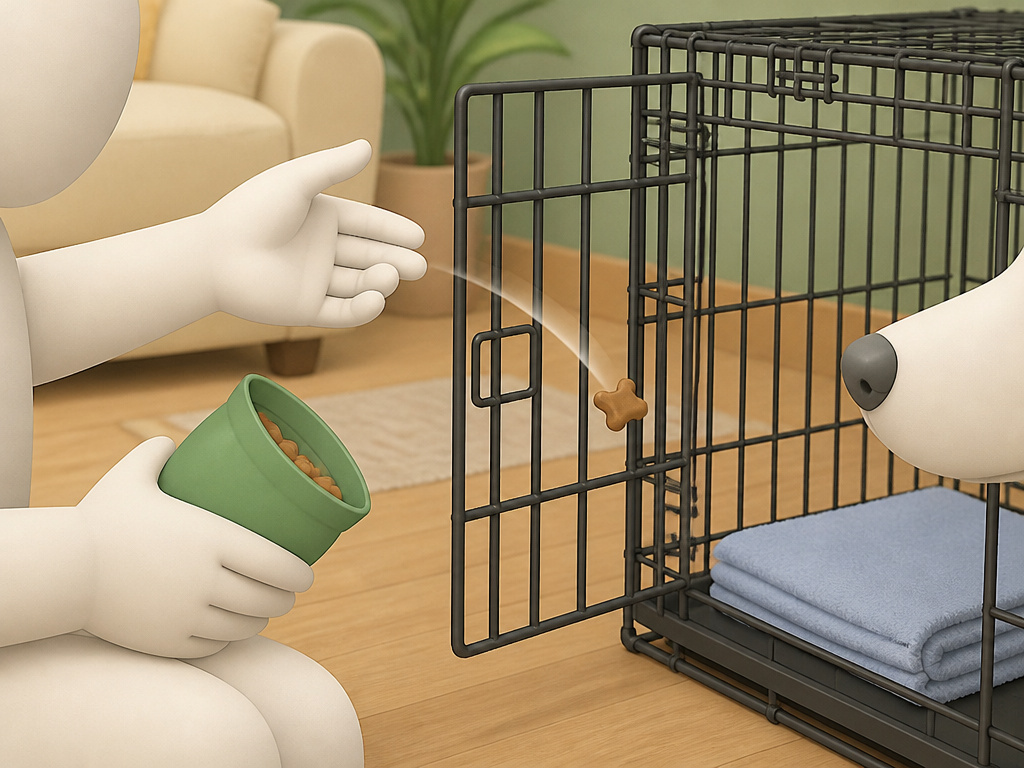
- Toss a treat in and walk away. Don’t shut the door at first, or the crate becomes a trap with a hinge.
- Feed one meal inside the crate with the door open. A dog that eats in a place stops treating it as a threat.
- Close the door briefly, then open it before the dog complains. Get the timing wrong and you teach the dog that the door means being trapped.
- Put the crate in the car with the engine off for one short session, then take a two-minute drive.
The CDC recommends practicing transport by taking your pet for rides in a car similar to the one you would evacuate in. That is practical advice dressed as a formality, and it is the step almost everyone skips.
If you don’t own a car, the CDC says to make arrangements with neighbors, family, and friends ahead of time and to contact local government about transportation options during a disaster. That plan takes longer to build, so it has to start earlier.
Noise, Crowds, and the Stress Nobody Plans For
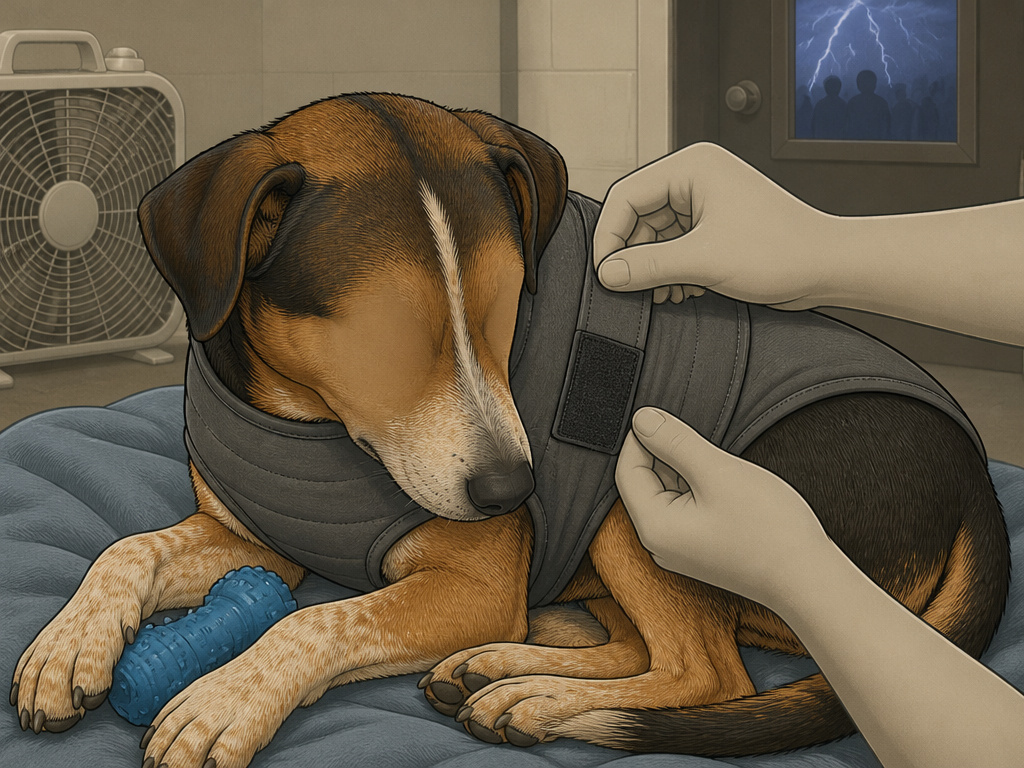
Everyone packs for the storm. Almost nobody packs for the four hours after it, when the dog is in a strange room and the sky is still doing something loud.
A dog sheltered with other animals may be more susceptible to infectious diseases and conditions, according to Mississippi State University Extension. That is one reason rabies is the priority vaccine and why parasite preventives matter, since fleas, ticks, and other parasites travel with crowds and outdoor environments.
Thunder is the obvious noise problem. The fireworks that come with a summer holiday hit the same nerve, and the same preparation covers both.
Three things help, roughly in this order:
- A pressure wrap, if the dog tolerates one. A thunder jacket helps some dogs and does nothing for others, so test it on a quiet day first.
- A small room with no windows and a fan running to mask the low-frequency boom.
- Something to chew, because a working jaw settles a dog faster than a soothing voice does.
Calming supplements for dogs are the third option, and the one to run past your vet rather than order at 11 p.m. During a storm. I would test anything new on a quiet Tuesday, not on the night the sirens go.
The Escape That Happens After the Storm
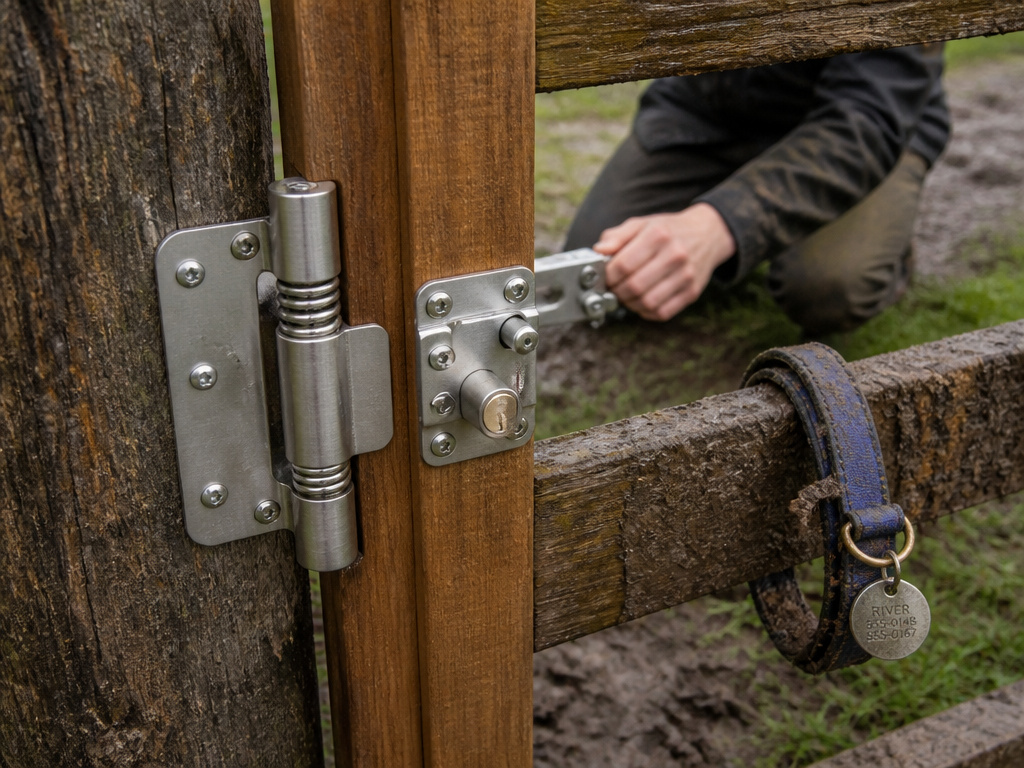
The fence line takes a beating and the gate takes more.
After an emergency, familiar scents and landmarks may change, and the CDC notes this is what causes pets to become confused and lost. A dog that has never once pushed a gate will bolt through an open one when the whole block smells wrong.
This is where I would spend money before I spent it on taller panels. A self-closing, self-latching gate with a lockable latch does more for a dog’s safety than another foot of fence height, and it does it on the ordinary Tuesday when someone props the gate open with an armful of groceries.
A self-closing hinge and latch set is what I would fit. They swing shut on their own spring and latch without anyone remembering to do it, which is the entire point, because the failure mode here is a human being distracted.
Post-storm, walk the perimeter on your hands and knees:
- Check the gate latch by pushing it, not by looking at it.
- Look for gaps at dog height, where the ground has washed out under a panel.
- Clear downed wire and debris a dog can climb.
- Confirm the ID tag is still on the collar and still readable.
- Call the microchip registry and confirm the number on file.
American Humane’s household checklist is short and unglamorous: keep supplies ready and current, practice the evacuation plan, and make sure ID tags and microchips are up to date.
Where this goes sideways: A dog that gets out after a storm does not run home. The scents that made home recognizable are gone, so he runs until something stops him. That is why the tag and the chip matter more the day after an event than in the year before it.
After a flood, the yard smells like mud and diesel, and nothing is where it was. A dog reads that as a different place entirely.
Frequently Asked Questions
Should I evacuate with my dog or leave it home?
Take the dog. The FDA’s top instruction for pet owners is to bring pets with you when evacuating, and the CDC warns that pets left behind are likely to be injured or lost even if you try to create a safe place for them. Mississippi State University Extension says evacuating without your pet is never recommended unless your life is in immediate danger.
What if my dog won’t go into a carrier?
Build the association before you need it. Leave the crate out with the door open, feed meals inside it, and close the door for a few seconds at a time before the dog complains. A carrier the dog already sleeps in is the only kind that works on a night when you are in a hurry.
How much food should I pack for my dog?
Mississippi State University Extension says a minimum of three days in sturdy containers. The AVMA evacuation kit checklist runs 3 to 7 days of food and at least 7 days of water. Choose the longer number if you live where a road can stay closed, and rotate the stock twice a year either way.
Do pet-friendly shelters exist?
Yes, but only select emergency shelters accept regular pets, according to the FDA. Most Red Cross evacuation centers do not. The workable plan is usually a pet-friendly hotel, a boarding facility, a veterinary hospital, or a relative outside the affected area, identified before the storm has a name.
What documents does a dog need after a disaster?
The rabies vaccination certificate is the priority, since a sheltered or lost dog is more likely to meet other animals and wildlife. Pair it with the full vaccination record, the microchip number, a medication list with doses, known allergies, emergency phone numbers, and a printed photo of the dog.
The Bottom Line
How to prepare a dog for a natural disaster is a smaller job than the checklists make it look. The trigger to act is a phone call, not a purchase. This week, call the two nearest pet-friendly hotels and ask whether they take a large dog, then write the answers on paper and drop the paper in the tote.
One concession worth stating plainly: everything above assumes you have a car and somewhere to go. If you don’t, the CDC’s advice is to line up rides with neighbors, family, and friends in advance and to contact local government about transportation during a disaster. That plan takes longer and has to be built sooner.
And if you only do one thing, make it the gate. A self-closing latch works every ordinary day of the year. The storm is the rare event. The gate is the one that fails on a Tuesday.
