
How to Keep Dogs Off the Bed: What Actually Works
This post contains affiliate links. As an Amazon Associate, we earn from qualifying purchases.
Control access first, then train an alternative behavior, and learn how to keep dogs off the bed. Close bedroom doors, keep the dog leashed indoors during sessions, and reward the dog every time he settles on his own bed. Consistency across the whole household matters more than any specific technique, and the AKC’s reward-based “place” method is the safest starting point.
The access-control step is where owners try to skip ahead when learning how to keep dogs off the bed. Leash-in-the-house and closed doors feel like a workaround, but they give you the training window you need before the dog ever gets a chance to rehearse the jump.
What follows: the setup that makes training possible, the step-by-step method, and the honest disagreements between the sources you’ll find on this topic. The AKC and PetSafe recommend opposite responses to the same problem, and you need to pick a side before you start.
Key Takeaways
- Close the bedroom doors and keep the dog leashed indoors during training; free access to any bed is the single biggest reason training stalls.
- Reward the alternative behavior, not the absence of the bad one. The AKC method builds a positive “place” cue rather than correcting jumps.
- Everyone in the house has to follow the same rules. One person letting the dog up “just this once” resets weeks of work.
- Resource-guarding dogs should not be on the bed at all until they demonstrate they won’t act that way; VCA treats this as a hard line.
- Older or arthritic dogs may need the opposite plan: ramps, steps, and a low firm bed rather than a soft one.
Why the First Week Decides the Whole Thing
PetSafe says you should see a huge improvement over a few days or weeks. What decides which end of that range you land on is how strictly you control access in the first stretch.
Every jump onto the bed is a rehearsal, which is why how to keep dogs off the bed comes down to access. The dog is practicing the behavior for the next time you’re not watching.
Bed-manners training depends on two variables the dog can read: access and reward. Access must be predictable, and reward must follow the desired behavior within seconds. When access is inconsistent or reward is delayed, the dog learns that the bed is sometimes available and the behavior is sometimes worth trying.
Diggs Pet is blunt about this: letting the dog on the bed even briefly sends mixed signals. Once you decide the dog sleeps off the bed, stick to it fully. No exceptions. Not even once.
The household has to agree on that rule before training starts. PetSafe puts it first in their guide: everyone in the house must be on board and follow the same steps. One person who lets the dog up when nobody’s looking undoes everyone else’s work.
Common mistake: Letting the dog up “just this once” because he looks sad. The dog reads it as the rule changing, and you’ll see him testing the bed again within a few days.
What Does the Setup Actually Look Like?
The click of the bedroom door latch is the sound you’ll hear most in the first week. The door does the work. It’s not a metaphor; the door is doing more than the “place” cue early on, because it prevents the rehearsal.
PetSafe splits the setup into two situations: when you’re home and when you’re not.
When you’re home:
- Close the doors to all bedrooms.
- Keep the dog on a leash inside so he can’t get to the bedrooms.
- Maintain close supervision and call him immediately if he’s out of sight.
When you’re not home:
- Keep the dog in a confined area away from the beds.
- Close off all bedrooms.
- Crate the dog while you’re away.
Animals Matter takes a softer line on barriers. They treat the closed door or a temporary puppy gate as a fallback “if all else fails,” and recommend removing the barrier once the dog gets the hang of the command. PetSafe treats the door as core behavior management, used continuously.
Honestly, treat the door like PetSafe does until the dog has stopped testing. Remove it later, once the dog has stopped testing. A barrier you pull too early just gives the dog a chance to practice the jump again. (Biscuit figured out a baby gate in about four minutes, which is why I don’t trust “escape-proof” claims.)
Why does the door matter more than the cue? Because the dog can’t rehearse a behavior he can’t access.
The same access rules apply to couches and chairs. If you want to keep dogs off furniture throughout the house, the setup is identical: control access, reward the alternative, stay consistent.
The “Place” Cue: Lure, Name, Then Add Duration
The AKC GoodDog! Helpline method, taught by trainer Breanne Long, is the cleanest reward-based protocol in the sources. It builds a positive cue the dog offers on his own, rather than a correction you have to deliver.
Before you start: If your dog has ever growled, snapped, or bitten when someone approached the bed, do not start training without a vet or behaviorist. A guarding dog on the bed is a bite risk, and the risk compounds every night you leave it unaddressed.
The Lure Phase (No Cue Yet)
Gather treats, the dog, and the dog’s bed. Lure him onto the bed and into a down position. At this stage, don’t add a word to the behavior.
Reward by dropping a treat between his paws on the bed. Keep dropping treats while he stays in the down. Release him with “ok” or “free” after a few seconds.
Adding the Cue Word
Stand near the bed without luring. Wait to see if the dog offers getting on the bed. If he does, reward. If he gets on and lies down without prompting, reward heavily.
If you wait more than 30 seconds and the dog hasn’t moved toward the bed, go back to luring a few more times. Then try the standing step again.
Once the dog gets on and lies down without prompting, add the cue word. “Place” or “bed” both work. Say it as the dog starts to get on and lie down, then reward when he’s down.
Building Duration and Distance
Increase only one variable at a time. If the dog stayed in a down on his bed for 10 seconds yesterday, try 15 seconds today, not 30.
If the dog gets up during the duration or distance stage, go back to him, cue “place,” and try again.
Once the behavior is solid, you don’t have to reward every time. But if you stop rewarding altogether, the dog may decide it’s no longer worth getting on his bed.
The reward timing matters more than most owners realize. Dogs link a reward to whatever they were doing right before it arrived. Drop the treat after the dog has already stood up, and you’ve rewarded standing.
If you’re still picking out the bed itself, the dog bed buying guide covers size, fill, and washability.
What Do You Do When the Dog Is Already on the Bed?
The sources disagree here more than anywhere else in the guide. Four credible guides give four different answers to the same moment.
| Source | Recommended response | Approach |
|---|---|---|
| PetSafe (2016) | Punish immediately until dog gets off | Aversive |
| Diggs Pet | Gently place on the ground, no shoving | Physical, neutral |
| Animals Matter | Say “Off!” and toss a treat off the bed | Cue plus reward |
| AKC GoodDog! | Reward when dog offers the desired behavior | Pure reward |
The Gentle Placement Method
Diggs Pet’s version is the simplest: gently place the dog on the ground. Never push or shove. The point is to remove the dog from the bed without adding drama, because drama is a reward for a dog who wants attention.
The “Off!” Cue and Treat Toss
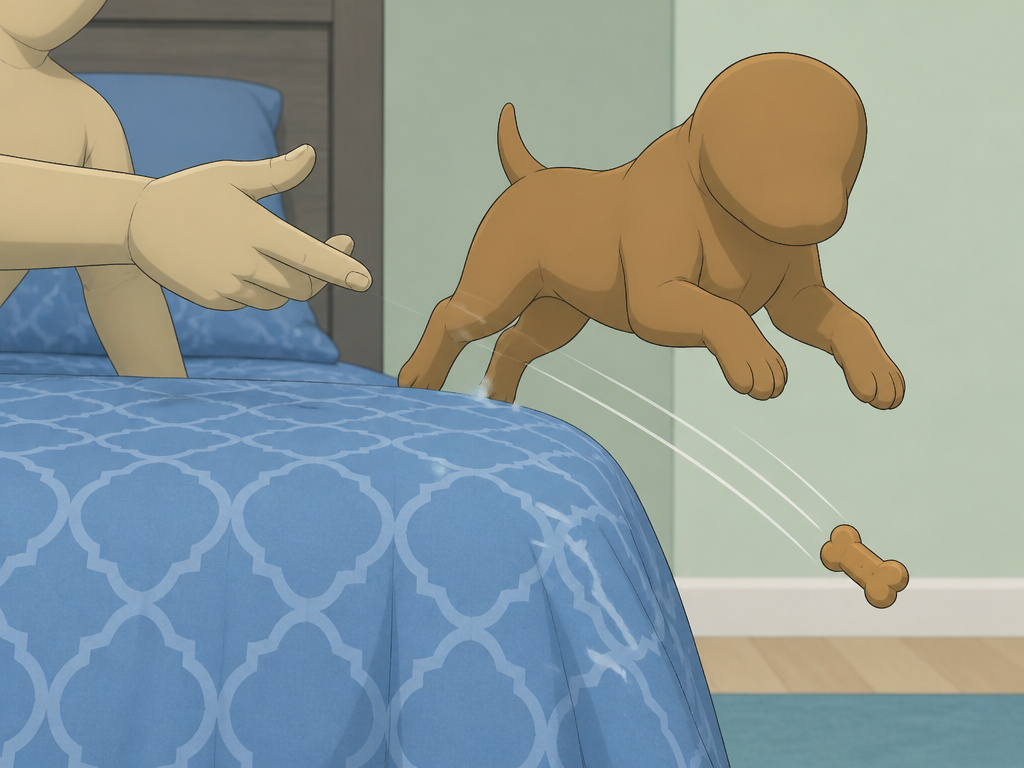
Animals Matter teaches a verbal cue. Say “Off!” as you toss a treat or toy off the bed for the dog to follow. When he leaves the bed, he gets the reward. Repeat.
They also suggest the reverse: if the dog isn’t on the bed, signal him to come up, reward him, then signal him to leave. That teaches him he’s rewarded only for acting on your signal.
Fair warning: I’d skip the “signal him up, then signal him off” version if you’re following PetSafe’s plan. It contradicts their entire approach, and mixing the two methods just teaches the dog that the bed is sometimes available. Pick a lane.
For most owners, the “Off!” cue plus treat toss is the least confrontational option. The dog learns the cue, gets rewarded for obeying it, and you don’t have to physically move him.
Where the Experts Disagree on Aversives and Whining
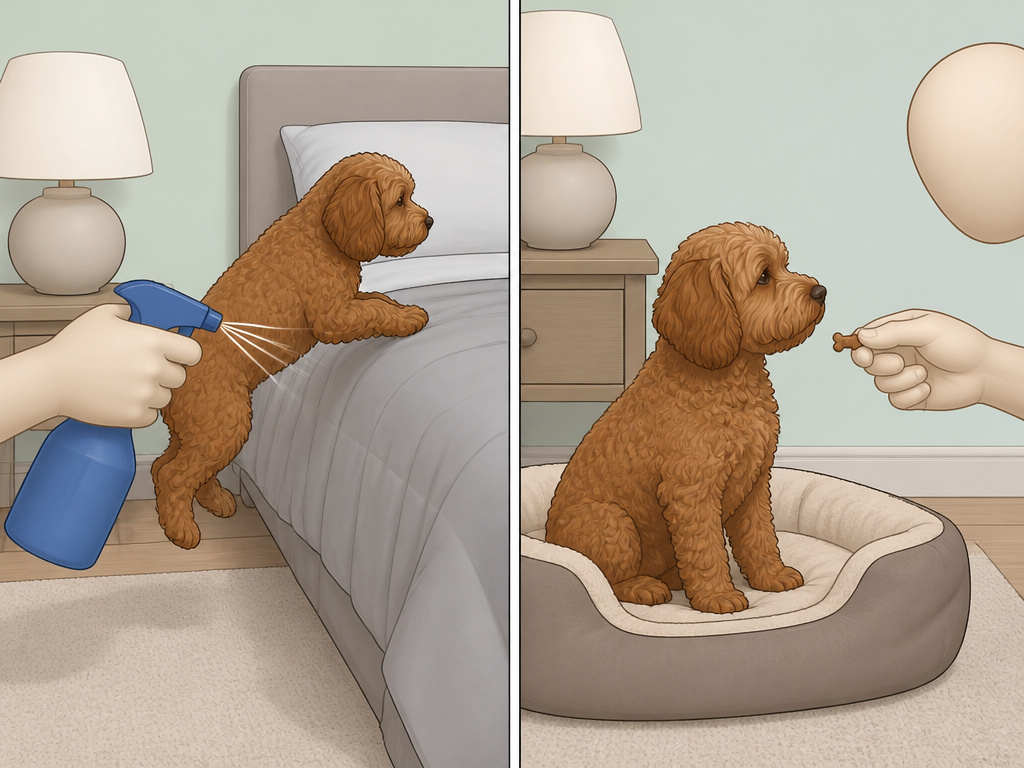
PetSafe, a training-equipment manufacturer, explicitly endorses punishment. Their guide, dated November 12, 2016, recommends a loud “No,” a squirt bottle with plain water, or a loud annoying sound as appropriate punishments for bed-jumping.
The AKC’s protocol contains no aversive step at all. It’s lure, reward, add cue, add duration. Opposite advice for the same task.
The Aversive Debate
PetSafe presents the squirt bottle as reliably effective. Municipal animal-care guidance on aversive training methods for dogs is less confident. The general behavior consensus is that aversives work best when paired with a positive alternative, and some dogs ignore a squirt bottle entirely.
PetSafe’s own caveat is worth reading closely: the punishment should be one the dog dislikes enough to stop the behavior but isn’t so strong that the dog runs away in fear. That’s a narrow window, and it’s easy to miss.
Where this goes sideways: Using a squirt bottle on a nervous or reactive dog. The dog may stop jumping on the bed but start flinching when you reach for anything on the nightstand. Fear generalizes faster than the behavior you were targeting.
What to Do About Whining
Diggs Pet is direct: talking to or telling a whining dog to stop is ill-advised, because they take any reaction as reinforcement. Ignore the whining and it eventually stops.
PetSafe recommends verbal correction like a loud “No” as an appropriate punishment. That’s the opposite response to the same behavior.
Diggs says to ignore whining because any reaction reinforces it, while PetSafe recommends a verbal correction like a loud “No” as an appropriate punishment. Any reaction, including a correction, is attention. Attention is what the dog wanted. Ignore the whining, reward the quiet.
The AKC’s full protocol is worth reading in the original: AKC dog bed training guide.
If you’re considering a deterrent spray as a backup, the dog repellent spray options and the dog deterrents roundup cover what actually works on fabric.
When the Bed Is the Right Place
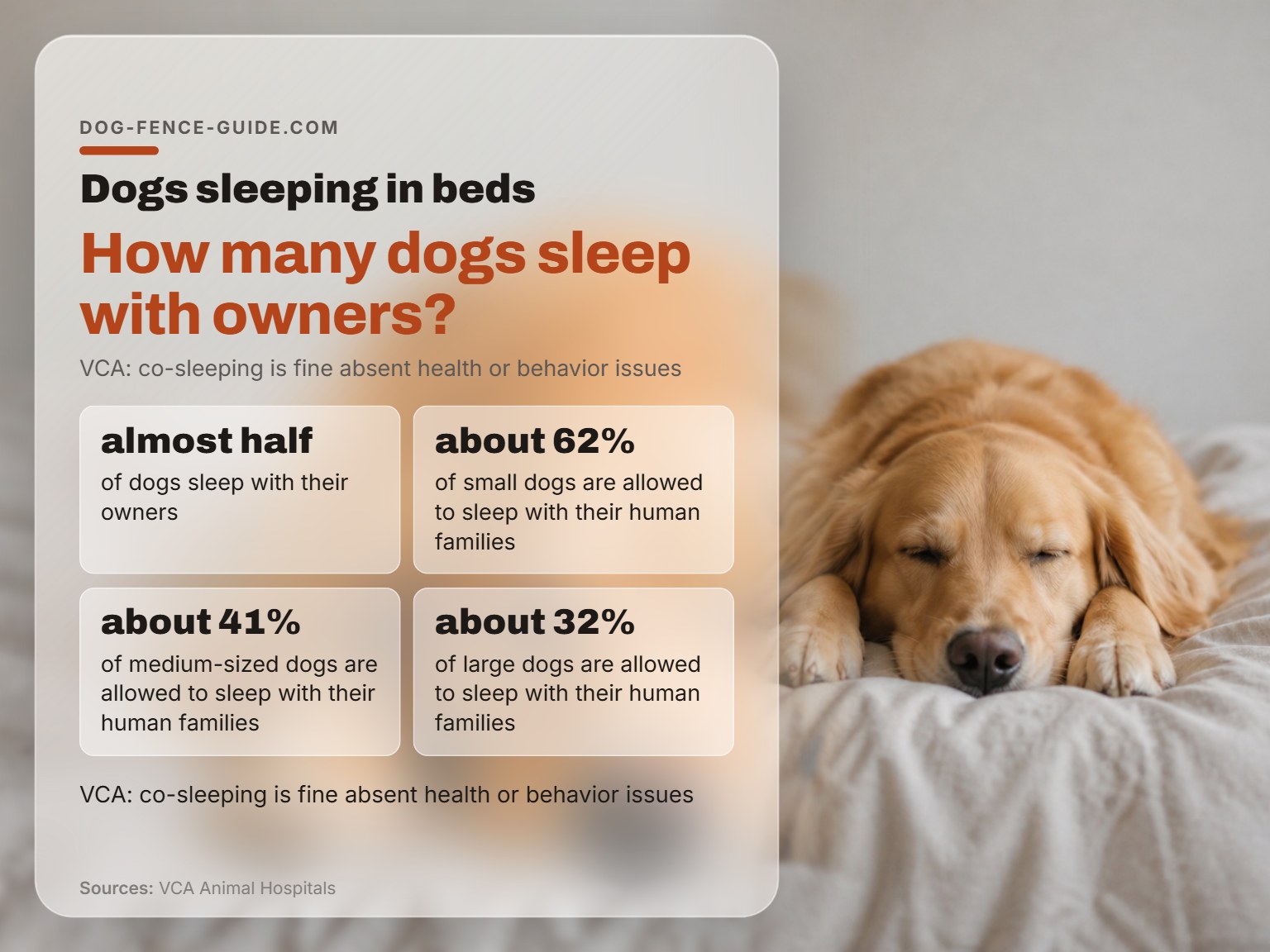
Sometimes the bed is exactly where the dog should be. VCA Animal Hospitals frames the whole question differently from PetSafe. Their position: co-sleeping is fine absent health or behavior issues, but there are specific cases where the bed is the wrong place.
Arthritic and Older Dogs
VCA notes that soft beds don’t support aging joints well enough. VCA notes that soft beds don’t support aging joints well enough for dogs with musculoskeletal issues like arthritis. Dogs in pain may prefer comfortable padding on a solid surface, low on the ground for easy access.
For arthritic dogs, VCA recommends accommodations rather than exclusion. Small arthritic dogs can be lifted onto the bed. Large arthritic dogs need a ramp or steps. To keep sheets dry, place pee pads on the bed.
That’s the opposite of PetSafe’s plan, which keeps the dog off all beds regardless of mobility needs. VCA recommends accommodations like ramps, steps, or lifting a small arthritic dog onto the bed, while PetSafe keeps the dog off all beds regardless of mobility needs.
A sturdy set of dog steps for bed access solves the climbing problem without forcing the dog to jump. And if incontinence is the issue, pet-friendly sheets plus pee pads handle the mess better than repeated washing.
Resource-Guarding Dogs
VCA draws a hard line here that PetSafe never mentions. A dog that guards the bed or guards a family member too forcefully should not be allowed on the bed until he demonstrates he won’t act that way. Talk to your veterinarian about the problem.
That’s a safety rule. A guarding dog on the bed is a bite risk, especially if you roll over and startle him. VCA notes that an unintentional bite hurts as much as an intentional one.
| Dog profile | Recommended plan | Why |
|---|---|---|
| Healthy adult, no guarding | Access control plus AKC “place” cue | Standard path |
| Resource-guarding dog | No bed access plus vet consult | VCA hard line |
| Arthritic or older dog | Ramps, steps, low firm padding | VCA accommodations |
| Anxious dog | Calming bed plus gradual training | Reduces distress |
| Incontinent older dog | Pee pads plus waterproof sheets | Protects bedding |
Do You Need a Barrier, a Camera, or Just a Door?
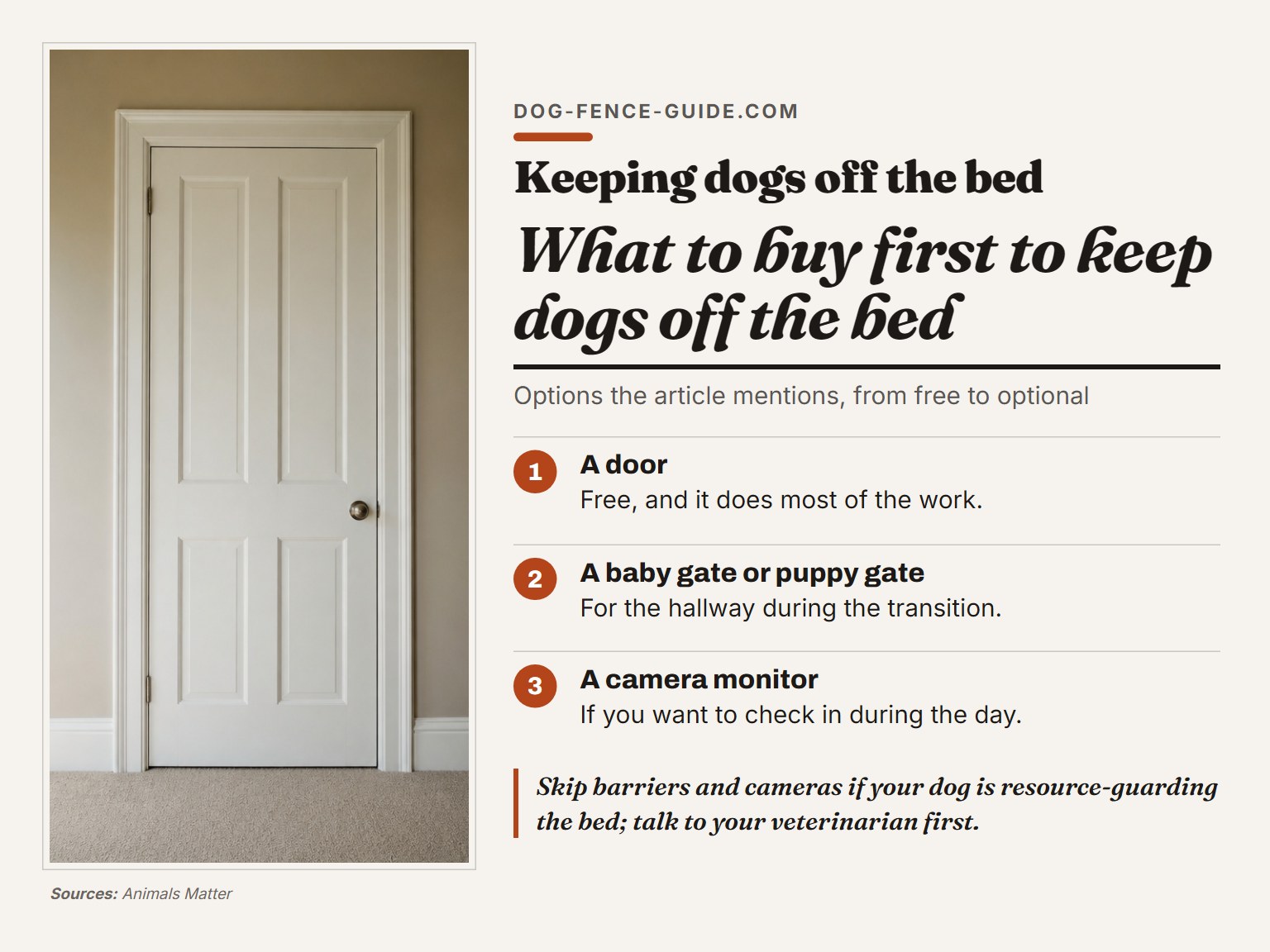
For most owners, the door is enough. But if your dog is home alone during the day and you want to know whether he’s testing the bed, a camera monitor helps.
Animals Matter recommends the Furbo dog camera for exactly this: it lets you say “Off!” through an app when you’re away. That’s useful during the transition, less useful once the dog has stopped testing.
PetSafe sells three tools that fit different parts of the plan. The Clik-R Training Tool is listed at $4.99. The Pawz Away Mini Pet Barrier creates off-limit areas without a physical door. The SMART DOG Trainer uses a smartphone as the collar’s remote with tone, vibrate, or 15 levels of static.
The static-collar option is the one I’d skip for bed training. Aversive collars work on the same principle as the squirt bottle, and the same caveats apply: some dogs ignore them, some dogs become fearful, and the behavior you’re targeting is one the dog can rehearse whenever you’re not watching.
Here’s the order I’d buy these in:
- A door. Free, and it does most of the work.
- A comfortable alternative bed. The dog needs somewhere to land.
- A baby gate or puppy gate for the hallway during the transition.
- A camera monitor if you want to check in during the day.
- A clicker if you’re doing the AKC protocol.
For the alternative bed itself, a comfortable orthopedic bed gives the dog a place to land that isn’t yours. If your dog is anxious about being separated from you, a dog beds for anxiety option with a bolster or cave shape helps more than a flat mat.
Skip this if: Your dog is resource-guarding the bed. No camera, barrier, or clicker fixes a guarding problem. That’s a vet conversation first.
Frequently Asked Questions
How long does it take to train a dog to stay off the bed?
PetSafe says you should see a huge improvement over a few days or weeks. The AKC’s “place” cue takes longer to proof, especially if you’re building duration and distance. The AKC’s “place” cue takes longer to proof, especially if you’re building duration and distance.
Should I punish my dog for jumping on the bed?
PetSafe endorses punishment, including a loud “No,” a squirt bottle, or a loud sound. The AKC’s protocol uses no aversives at all. If you’re following the AKC plan, skip the punishment and reward the alternative behavior instead. The two methods contradict each other, and mixing them confuses the dog.
Is it cruel to keep my dog off the bed?
VCA says co-sleeping is fine absent health or behavior issues, so keeping the dog off the bed is a preference, not a welfare requirement. The key is giving the dog a comfortable alternative bed and not using the bedroom as punishment. A dog with a warm, comfortable bed of his own is not deprived.
What if my dog cries or whines at the bedroom door?
Diggs Pet says ignore it. Any reaction, including telling the dog to stop, reinforces the whining. If you’re following PetSafe’s plan, a verbal correction is acceptable. Pick one approach and stick to it, because mixing responses teaches the dog that whining sometimes works.
Can I let my dog on the bed sometimes?
Diggs Pet says no. Letting the dog up even briefly sends mixed signals and undoes training. Animals Matter deliberately invites the dog up during training to teach the “off” cue, but that’s a structured exercise, not casual access. Diggs Pet says no bed access even briefly, while Animals Matter deliberately invites the dog up during training to teach the “off” cue.
The Bottom Line
One rule outranks everything else here: if your dog guards the bed or guards a person on it, stop training and call your vet. The AKC’s reward-based method assumes a dog who is safe to approach. A guarding dog is a different problem, and no amount of treat-tossing fixes it.
For everyone else, the sequence is the same. Close the door this week. Leash the dog indoors during sessions. Pick one bed and work it until the dog offers the behavior on his own.
The training timeline is honest: PetSafe says a few days to a few weeks. Some dogs take longer. The door is doing the heavy lifting in the meantime.
Start with your dog, not the product. A comfortable alternative bed, a closed door, and a consistent household will get you further than any gadget.
