
How to Introduce a Puppy to Water: Step-by-Step
This post contains affiliate links. As an Amazon Associate, we earn from qualifying purchases.
Here is how to introduce a puppy to water without forcing anything: wade in first, keep a life vest on the pup, and pick a day when water temperature plus air temperature reaches at least 100 degrees F, the number the AKC’s quoted trainer uses.
That 100-degree figure decides more than any treat does. Cold water is where pups learn to hate the whole business, and a bad first lesson is hard to undo. The how to introduce a puppy to water question covers a different gap, one measured in seconds rather than degrees.
The rest of this walks the age question, the temperature gate, the gear worth buying, and the first session in order. It also covers the how to introduce a puppy to water problem, which is where plenty of these afternoons stall.
Key Takeaways
- Water plus air should total 100 degrees F before the pup gets in. Below that, cold water brings limber tail and hypothermia risk.
- Never throw, push, or pull a puppy in. The AKC warns it can damage the dog’s courage about swimming for life.
- A life vest buys the few seconds before the paddling reflex engages. Without one, a panicking pup can gulp water and go under.
- Eight to twelve weeks is the window Tracy Harmeyer gives, but 16 weeks, when most pups are fully vaccinated, is Dr. Cahn’s safer call for lakes.
- Teach the exit before the entry. A pup that reaches the pool wall and finds nothing to climb will panic.
What Age Can a Puppy Start Swimming?
Eight to twelve weeks is the window Tracy Harmeyer gives in her MNNAVHDA paper.
Puppies are not born knowing how to swim. A pup that walks off a drop-off keeps paddling on instinct while its body works out buoyancy, and a flotation device covers exactly that gap. Without one, a pup that panics can gulp water and go under in the few seconds it takes the paddling reflex to engage.
That is the argument for a vest, and it is also the argument for starting young. A six-week-old pup that follows its dam into the water has a head start that treats cannot buy back later.
The Age Disagreement, Laid Out
The published advice splits into four camps, and they are not arguing about the same thing. Some are describing a warm pond with a handler in the water. Others are describing a lake full of other dogs.
| Who says it | Age they give | What it assumes |
|---|---|---|
| Tracy Harmeyer (MNNAVHDA) | 8 to 12 weeks | Warm water, handler knee deep |
| Harmeyer, using the dam | 6 weeks | A breeder runs the first lesson |
| Pat Nolan | As soon as the pup is home | Warm water is available now |
| Dr. Cahn, via BetterPet | 16 weeks | Fully vaccinated, lake swimming |
| Some published guides | 6 months | Caution over early timing |
Dr. Cahn’s position is the one I would hand to most owners. Most pups are fully vaccinated by 16 weeks, so wait until then for lakes and areas with other dogs, and go earlier only in a private backyard pool.
Harmeyer’s 8-to-12-week window assumes warm water and a handler willing to wade in to the knees. Take away either one and the window moves. That is why the calendar matters less than the pond.
The AKC guide to teaching dogs to swim puts no number on age at all, which tells you something about how much the age question actually decides.
The 100-Degree Rule for Water and Air
Michele Godlevski applies one hard gate before any dog swims: water temperature plus air temperature has to equal at least 100 degrees F.
BetterPet publishes the same number, so this one has two sources behind it rather than one trainer’s habit. Where they part company is what the number means for a puppy.
Pat Nolan notes that some trainers like 56-degree water and others prefer 60, then adds his own floor: pups need warmer than either, with warm air on top of it.
The positions, side by side:
- AKC and BetterPet: water plus air at 100 degrees F or above, full stop.
- Some trainers quoted by Nolan: 56 degrees F water is fine for adult dogs.
- Other trainers quoted by Nolan: 60 degrees F is the preferred training temperature.
- Nolan’s own floor for pups: warmer than 56 to 60, plus warm air.
Run the arithmetic on a warm afternoon and warm water and you land comfortably past the gate. A cool day with cool water can pass on paper and still feel cold on the skin.
Wade into cold water and the cold hits your thighs first, then your ribs, and your own breathing changes before the pup’s does. That is your body telling you what a small dog feels faster.
Cold water carries two named risks. BetterPet lists limber tail, also called cold tail or swimmer’s tail, and hypothermia in extreme cases. Godlevski’s rule is blunter: a dog that shivers or stops using its tail needs a vet, not a longer lesson.
What You Actually Need Before the First Session
The AKC and BetterPet recommend a life vest, though Harmeyer’s drop-off protocol uses a check cord and no vest.
The AKC notes that some breeds have a weight distribution that makes swimming without one close to impossible. BetterPet goes further and calls the vest required for any dog learning to swim, while Harmeyer’s drop-off protocol uses a check cord and no vest.
What a Life Vest Has to Do
Three things, per BetterPet: it fits close to the body, it has a handle, and it is bright enough to spot from a distance. The handle is the part you will actually use, because it is how you guide a pup to the steps or lift it out.
Look for a vest that covers all three for a growing pup. Other vests worth a shortlist should also carry a grab handle across the back.
Put the vest on at home, days before the water. BetterPet’s advice to precondition the dog to the jacket is the cheapest step in this process and it costs nothing but a Tuesday evening.
If your dog is big, wear a vest yourself. Both the AKC and BetterPet flag the same hazard: a panicking large dog climbs on the handler, and a dog with no float can push a person under.
On the line, the sources split: BetterPet says keep a leash on during lessons, while Harmeyer uses a check cord with only enough slack for the pup’s feet to touch bottom. BetterPet says keep a leash on during lessons. Harmeyer uses a check cord instead, with only enough slack for the pup’s feet to touch bottom. Both give you a hand on the dog; they differ on how much work the line is allowed to do.
Bring something that floats. Floating toys work, and Mike Stewart keeps it simpler still: throw a couple of balls around and make a game of it.
If you want a shortlist rather than a paragraph, this rundown of dog life vest options covers fit and handles in more detail.
Step-by-Step: The First Water Session
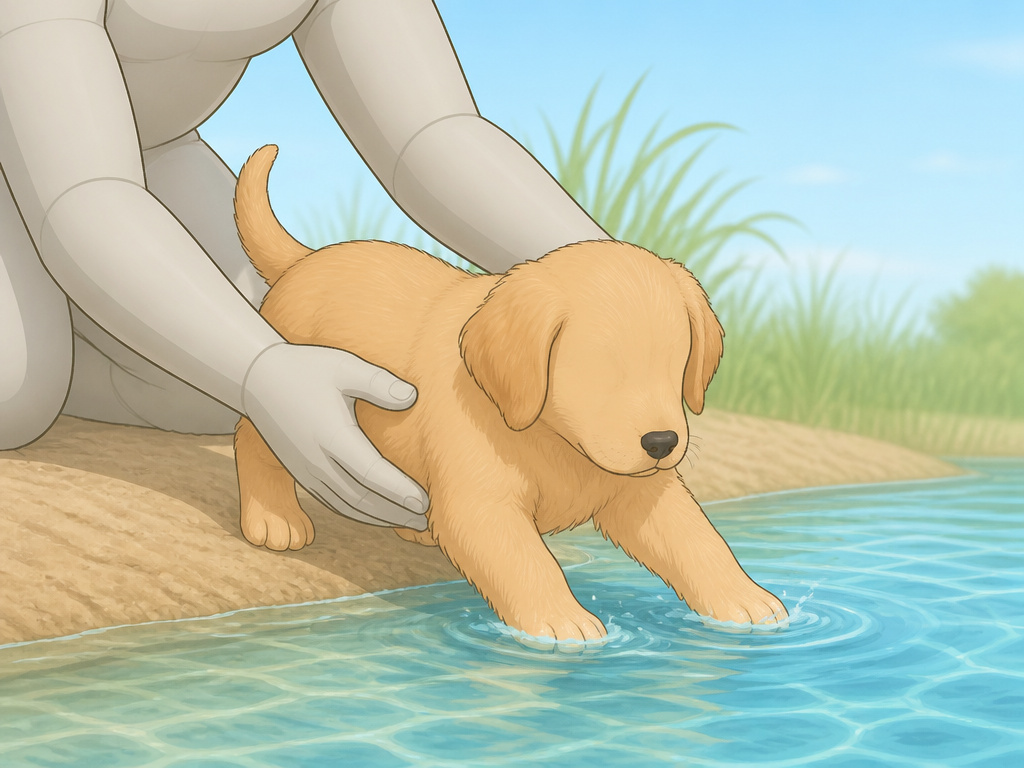
Four things happen in this order: the pup warms up, you get in, the pup follows, and you stop while it is still having fun.
Before you start: Water and air below the 100-degree combined gate can bring on limber tail or hypothermia, so check both temperatures before you leave the house. A pup without flotation can gulp water and go under in the few seconds before the paddling reflex engages. A panicking large dog will climb on the handler, so wear your own vest if your dog is big enough to push you under.
- Warm the pup up first. Stewart’s method is to get the puppy warm so the water feels like relief. A pup that is already cool reads the water as a second chill and backs out.
- Pick a warm day and warm water. Stewart and Nolan both put temperature ahead of every other variable. Cold water is the mistake you cannot undo, because Nolan’s warning is that a dog who learns to dislike cold water may never change its mind.
- Wade in before you call. Stewart is direct about this: the pup goes in because you go in, though the AKC says that if you cannot enter the water, stay near the exit to help the dog find the way out. Harmeyer and Nolan both wade in too, though the AKC says that if you cannot enter the water, stay near the exit to help the dog find the way out.
- Never chase. If the pup retreats to the bank, Stewart says get to the water’s edge and call from there. Chasing turns the lesson into tag, and the pup wins by staying dry.
- Use a gradual slope if you have one. The AKC and Nolan both prefer a bottom that drops off gradually, while Harmeyer’s protocol trains pups at a drop-off. A pup that can walk in and out on its own terms learns faster than one facing a wall of depth.
- Let another dog do some teaching. The AKC, Harmeyer, and BetterPet recommend a confident swimmer dog, while Nolan’s method relies on retrieve, following you, or chasing another dog. Harmeyer adds a detail worth copying: use two bumpers so your pup has something to retrieve when the other dog gets there first.
- Harmeyer’s rule is not to quit the first session early, though other sources don’t set that requirement. Harmeyer’s rule is that you keep going until the pup steps off and swims to you, though other sources don’t set that requirement. Stop before that and you have taught the pup that standing at the edge is the whole game.
Watch the front legs before the pup touches the water. Harmeyer notes that they start moving as if swimming while the pup is still in the air, which tells you the reflex is already there and waiting.
If you want the longer version of that progression, the teach a dog to swim walkthrough goes session by session. For the retrieve side, a few floating dog toys are worth more than a bag of treats in deep water.
Why Some Puppies Won’t Step Off the Drop-Off
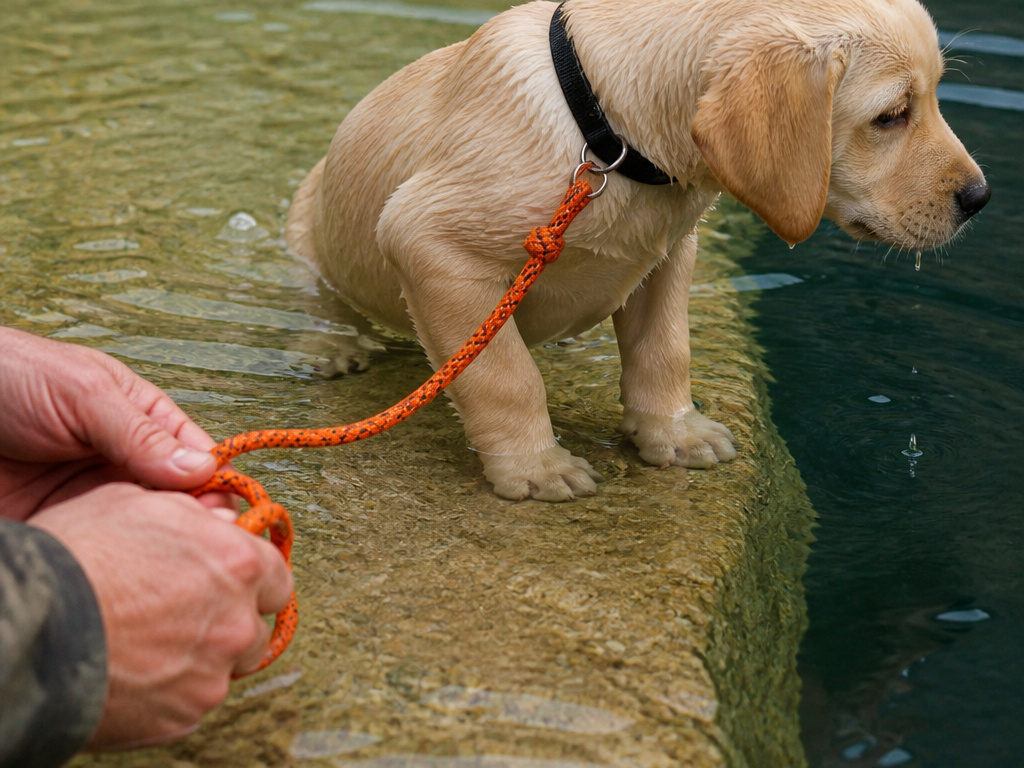
The pup wades in to its chest, plants its front feet, and stops. The bottom ahead is gone, and nothing you say from the bank changes that.
Harmeyer’s paper addresses this exact moment. Her answer is a check cord and a pup made just uncomfortable enough at the edge to choose to step off, with the handler going in up to the waist or chest depending on the size of the pup.
I won’t hand a check cord to someone who has never used one. Tug and release is a timing skill, and a nervous handler who yanks teaches the pup that the water is where bad things happen. Practice the release on dry land first.
The sources genuinely disagree here, and the split is about method rather than outcome.
| Decision | Check cord method (Harmeyer) | No-force method (AKC, Nolan, BetterPet) |
|---|---|---|
| Who is in the water | Handler, waist or chest deep | Handler wades in or waits at the exit |
| What moves the pup | Tug and release on a check cord | The pup chooses, drawn by you or a dog |
| How much line | Enough slack for feet to touch bottom | Leash on for control, no pulling |
| What is allowed | Mild discomfort at the edge | No pushing, no throwing, no pulling |
| Session ends when | Pup steps off and swims to you | Pup is calm and willing to re-enter |
The AKC’s warning is the one that should slow you down. Throwing a puppy in can damage the dog’s courage about swimming for life. Nolan says the same from the training side: rush a pup and it panics, and a panicked pup is harder to teach than one that never saw water.
Harmeyer’s method does not involve throwing the pup. It is a standing pup, a check cord, and a handler who makes it uncomfortable enough that the pup decides to jump off. Read her closely and the check cord is doing the same job as your voice from the bank, just with more pull.
The getting puppies past the drop-off paper is worth reading in full before you try any of it.
Where this goes sideways: Tugging a pup that is already swimming. The line goes slack the moment the feet leave the bottom, or you drag a paddling dog sideways and it gulps water.
Pups that shut down at the water’s edge often have the same reaction in the bath, and the desensitization steps for dogs that fear water transfer straight across.
Which Water Is Easiest on a Puppy?
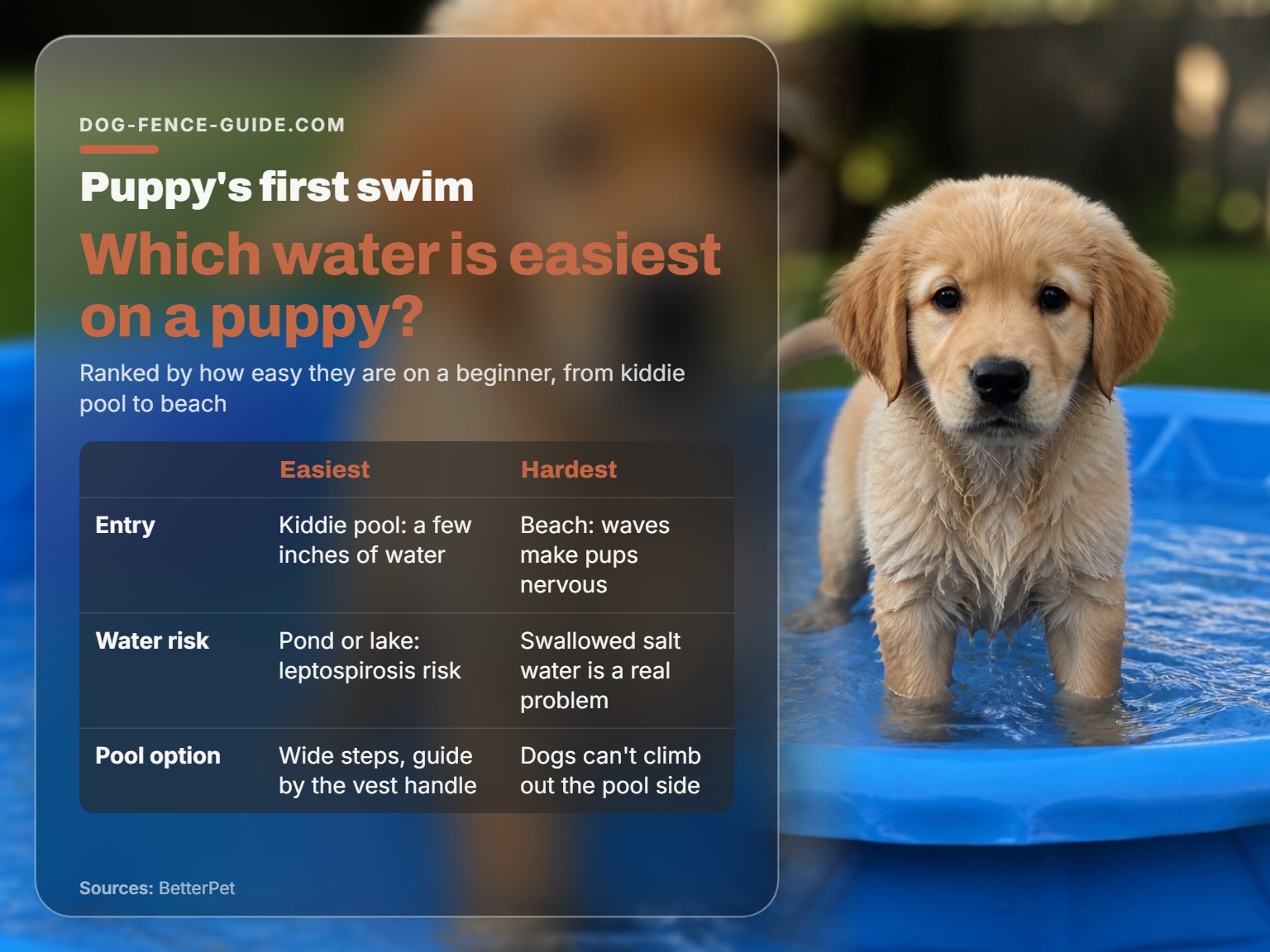
A pond beats a pool for a first swim, and water quality has nothing to do with it.
Godlevski’s reasoning is visual. Bright blue pool water can look unnatural to a dog, and a pond or lake reads as more natural. BetterPet lands in the same place, calling a lake or pond with a shallow decline an excellent choice.
If you have to choose between a pool with wide steps and a pond with a muddy bank, take the pool. A clean exit beats a natural look every time, because the exit is the skill the pup has to learn.
The four options, ranked by how easy they are on a beginner:
- Kiddie pool: BetterPet’s suggestion for pool-only yards. A few inches of water, and the pup walks out whenever it wants.
- Backyard pool: workable when the steps are wide and you guide the pup to them by the vest handle.
- Pond or lake: the easiest entry, with the caveat that contaminated water can carry leptospirosis.
- Beach: the hardest of the four. Waves make pups nervous and swallowed salt water is a real problem.
The beach is the one I would save until the pup can actually swim. BetterPet is clear that a graduated entry helps and the waves still undo it.
Bottom line: a shallow, warm, quiet entry with a clean exit beats a scenic one every time.
If the beach is the plan anyway, this guide to taking a dog to the beach covers the tide and rinse side of the trip.
Pool Exits, Gates, and the Part Everyone Skips
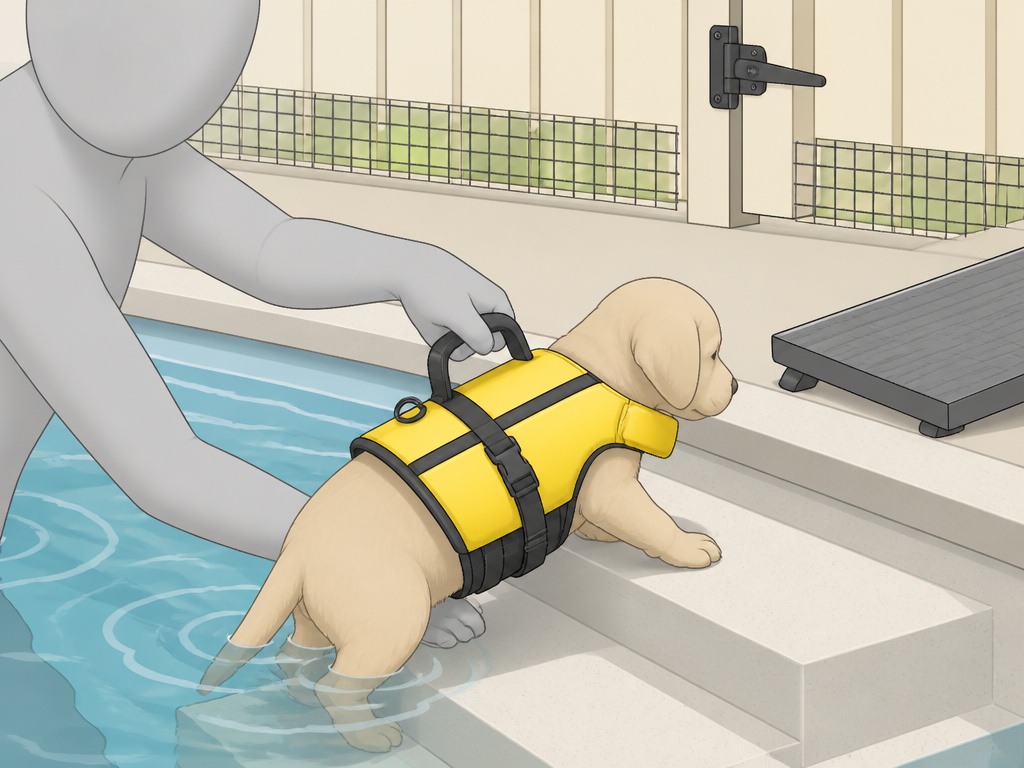
The exit matters more than the entry.
BetterPet makes the point plainly: it is very unlikely your dog can pull itself up out of the water at the side of a pool. A pup that swims to the wall and finds nothing to climb will panic, and panic is what turns a lesson into an emergency.
Teach the steps before you teach the swim. Hold the vest handle, guide the pup to the steps, and let it rest there. Godlevski’s version works from the water: point the dog toward the shore or the ramp while you swim together.
If you can’t get in, stay near the exit. The AKC allows for that, and standing at the steps so the pup can find you beats standing at the far end shouting.
Easy to miss: The gate latch. Most yard escapes happen at the gate rather than the fence line, and a pool gate that swings shut on its own is worth more than a taller panel.
Around a pool, that means a self-closing, self-latching gate and a fence the pup can’t squeeze under. Line the bottom with hardware cloth if you have a small breed or a digger. A temporary barrier works while the pup is tiny, a gate keeps a wet dog out of the kitchen, and rolled wire will close a gap you haven’t fixed yet.
The two-minute number is the one to keep in your head. BetterPet notes that a dog underwater for less than two minutes can still suffer brain and organ damage.
A pool ramp for dogs solves the exit problem permanently if you would rather not rely on steps. Read the drowning dog rescue steps once, before you need them.
After the Swim: Rinse, Dry, and Watch the Tail
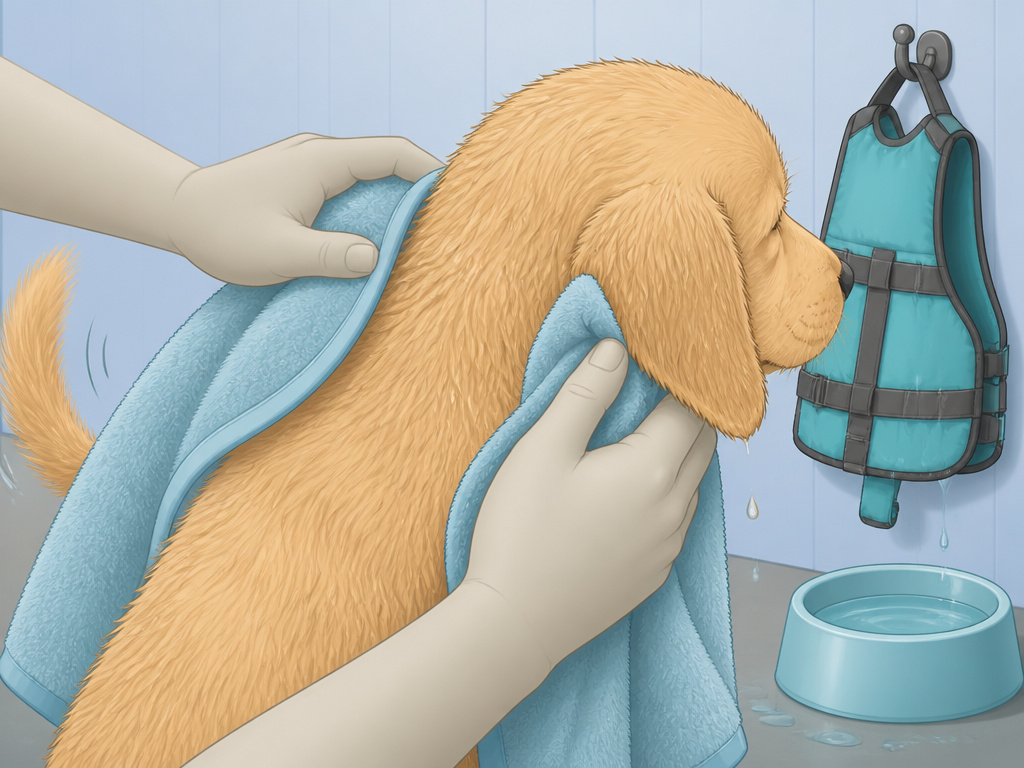
Ever smelled a life vest that sat in a hot car for a week?
That smell is algae and pool chemicals cooking together, and it is why BetterPet says to rinse both the dog and the vest with clean water after every swim.
The Tail Is the Tell
Limber tail shows up after cold water, and it looks like a tail that has gone limp and stiff at the base. BetterPet names it as a cold-water risk. Godlevski’s line is the one to act on: a dog that shivers or stops using its tail needs a vet.
The rest of the aftercare list is short:
- Ears: dry them properly. Dogs that swim often run a risk of swimmer’s ear.
- Coat: towel dry all the way down, especially on a double coat.
- Paws: check for cuts and scrapes you didn’t see in the water.
- Fresh water: keep it available. Too much salt or chlorine can poison a dog.
- The vest: rinse it and hang it, or the next swim starts with that smell.
Lake water carries its own list. BetterPet flags leptospirosis and other parasites in contaminated lakes and rivers, which is worth a word with your vet if your pup swims the same pond every week.
The keeping dogs safe around water checklist covers the rest of it, including the parts that apply long after the lessons are done.
Frequently Asked Questions
Can I just let my puppy figure out swimming on its own?
No. The AKC is direct about this: a dog without flotation can panic, gulp water, and drown in the few seconds it takes the paddling reflex to kick in. Even a pup that charges into the water chasing a toy can hit a drop-off it never saw coming.
How cold is too cold for a puppy to swim?
Water temperature plus air temperature below 100 degrees F is the gate the AKC and BetterPet both use. Pat Nolan adds that pups need water warmer than the 56 to 60 degrees F some trainers accept for adult dogs, with warm air on top of it.
Should my puppy wear a life vest in shallow water?
The AKC and BetterPet recommend one, at least for the first few sessions, though Harmeyer’s drop-off protocol uses a check cord and no vest. BetterPet calls the vest required for a dog learning to swim, and the AKC notes some breeds can’t swim well without one. Put it on at home first so the vest is familiar before the water is.
What if my puppy hates the water and won’t go in?
Some dogs never take to it, and BetterPet says that is fine. Try a quieter spot, a warmer day, and a confident dog to follow. If the pup still refuses, pick another activity rather than turning the pond into a fight.
Do I need to rinse my puppy after every swim?
Yes, if the water was chlorinated, salty, or from a lake. Rinse the dog and the vest with clean water, dry the ears, and check the paws. Skipping it leaves algae and chemicals sitting against the skin.
Before You Go
Everything above assumes warm water and a healthy pup. If you have a cold pond and a fall-born puppy, the calendar wins. Wait for spring, let the pup get older, and start then. Nolan’s warning is that a dog who decides it hates cold water may never change its mind, and that is a much harder problem than a late start.
This week, do one thing: put the vest on the pup in the kitchen, feed a few treats, and take it off. That is the whole session. The water can wait until the vest is boring.
And if you only have a pool, put the money into the gate latch before anything else. A pup that can’t reach the water unsupervised gets to be a beginner on your schedule, not its own.
