
How to Give a Dog Supplements: The 6-Step Sequence
This post contains affiliate links. As an Amazon Associate, we earn from qualifying purchases.
To give a dog supplements, match the format to the dog before you match the product: run a test ball of canned food first, hand-pill only if that fails, and never tilt the head back for liquids. Most dogs on complete and balanced food don’t need a supplement at all unless a vet prescribes one.
Complete and balanced food is the hinge the whole decision swings on. If your dog already eats a diet that meets its needs, the American College of Veterinary Nutrition’s position is that a supplement isn’t needed unless your vet prescribes one. Get the diagnosis first. Everything after that is technique.
What follows is the practical half: the test-ball check, the six-step hand-pilling sequence, the head-tilt rule for liquids, and the three ingredients that have actually put dogs in the hospital.
Key Takeaways
- The label is not a prescription. FDA-CVM’s Compliance Policy Guide Sec. 690.100 sets six marketing restrictions on these products, and no standardized monitoring system is in place.
- Run a test ball before the real dose. WSU’s protocol uses a small ball of canned food or cheese to find out whether your dog chews or gulps.
- Never tilt the head back for liquids. WSU warns that liquid is more likely than a pill to go down the windpipe, and Cornell’s guideline says the same about the chin.
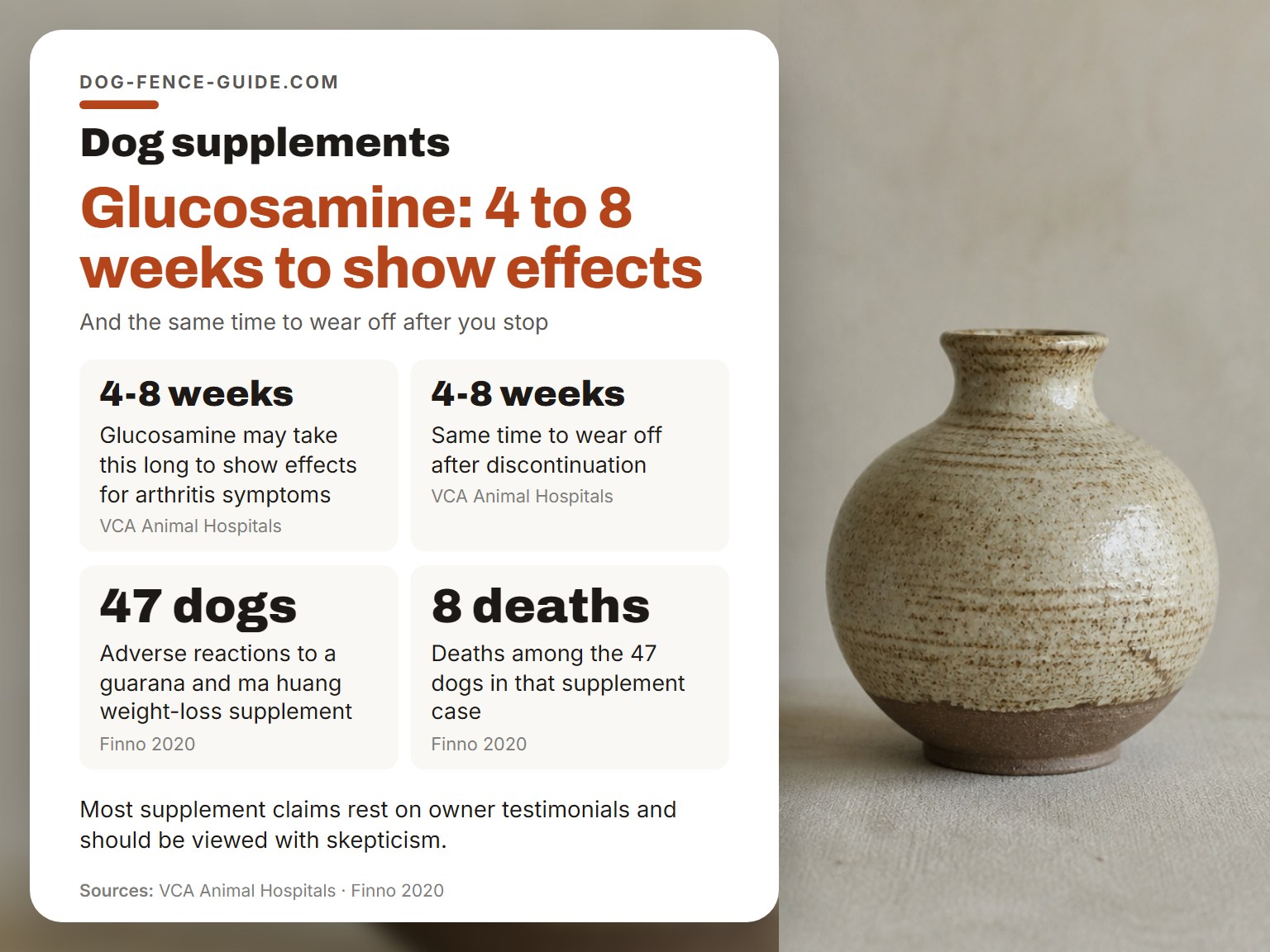
- Glucosamine takes four to eight weeks to show an effect, and about the same time to wear off once you stop.
- Some supplements have killed dogs. A guarana and ma huang weight-loss product caused reactions in 47 dogs, including 8 deaths.
Do Dogs on Complete and Balanced Food Need Supplements at All?
For a healthy dog eating a complete and balanced commercial diet, the American College of Veterinary Nutrition says no unless your vet prescribes one, while the Zoetis Pet-Tabs label provides weight-banded daily dosing for an over-the-counter multivitamin, i.e., routine use without a prescription.
Supplement products sold for dogs are not regulated as pharmaceuticals in North America. The FDA requires a disclaimer stating the product is not intended to diagnose, treat, cure or prevent any disease. Few supplements have been through rigorous scientific trials, and much of the available information comes from owner testimonials.
That is the regulatory picture, and it is thinner than most people expect. The Zoetis Pet-Tabs label sits on the other side of the argument. It prints weight-banded daily dosing for an over-the-counter multivitamin: 1/2 tablet daily for puppies and dogs under 10 lb, 1 tablet daily for dogs over 10 lb.
Two credible sources, two different answers. Here they are side by side.
| Source | Position on routine use | What it means at home |
|---|---|---|
| American College of Veterinary Nutrition | No supplement unless a vet prescribes one | Skip the shelf, book the exam |
| Zoetis Pet-Tabs label | 1/2 tablet under 10 lb, 1 tablet over 10 lb | OTC vitamins are sold for routine use |
| VCA Animal Hospitals | Manufacturer non-disclosure is a reason to walk away | Ask for safety data before you buy |
| FDA-CVM CPG Sec. 690.100 | Six marketing restrictions, no monitoring system | The label is not proof of anything |
The gap between those positions is the whole problem with choosing dog supplements based on the label alone. A product can be legal to sell and still have no independent check behind it.
Here is the honest version. If your dog is healthy, eating well, and holding weight, the supplement is probably solving a problem you don’t have. I would skip the shelf and book the exam instead.
Skip this if: Your dog’s real problem is a boundary, not a body. A calming chew won’t stop a dog that has decided the far side of the yard is better, and no supplement fixes a fence line.
The Test Ball That Tells You Chewer or Gulper
The dog takes the meatball, chews twice, and spits the tablet onto the kitchen floor. That is the moment the whole method falls apart.
WSU’s protocol is to press the medication into the center of a small ball of canned dog food or cheese. Then hand over a test ball with nothing in it. The test tells you two things: whether the dog will eat the ball at all, and whether it chews or gulps.
Chew or gulp decides most of how to give a dog supplements. Gulpers are the easy case. A dog that swallows the ball in one motion, with a soft wet pop instead of a crunch, will take the real dose the same way.
Chewers are the problem. WSU’s guidance names the failure mode exactly: if the dog chews the meatball and spits out the pill, the tablet or capsule partially dissolves and becomes difficult to handle. If it bites down, the bad taste makes a second attempt harder.
That is why the test ball comes first. Once a tablet has been chewed and rejected, you have lost the calm window and you are working with a dog that now knows what you are doing.
| What you see | Likely cause | Next move |
|---|---|---|
| Dog chews the ball, spits the tablet | Tablet partly dissolved, hard to handle | Switch to a pilling device |
| Dog bites down and backs away | Bad taste makes attempt two harder | Wait, then change format |
| Dog refuses the test ball | Doesn’t like the carrier food | Change the food, retest |
| Dog gags on liquid | Syringe too far back or chin tipped up | Side of mouth, small slow squirts |
| Bottle smells sour or looks discolored | Product has degraded | Return or replace it |
That sequence holds whether you are working out how to give a dog a pill or hiding a joint chew in food. Get it in, close the mouth, and move on.
Common mistake: Hiding a pill in cheese when your vet said to give it on an empty stomach. WSU’s guidance is clear that the food method only applies when the medication can be given with food. For empty-stomach dosing, the whole approach is off the table.
If your dog is a gulper, mixing supplements in food is the easiest route you will ever get for giving them. A spoonful of dog food toppers added over the regular bowl does the same job when your dog is bored with dinner.
VetriScience’s own guidance adds a step most owners skip: disguise it in a pill-hiding treat, or top it with a high-value food like peanut butter, cheese, or a favorite soft treat. Notice that VetriScience attaches no compatibility caveat to the cheese, while Cornell advises checking with your veterinarian or pharmacist first because not all medications are compatible with cheese products. A brand blog and a veterinary pharmacy are answering different questions.
I would run the test ball even if your dog has never refused a treat. It costs one ball, and it tells you which method you are using.
How to Give a Dog Supplements by Hand: The 6-Step Sequence
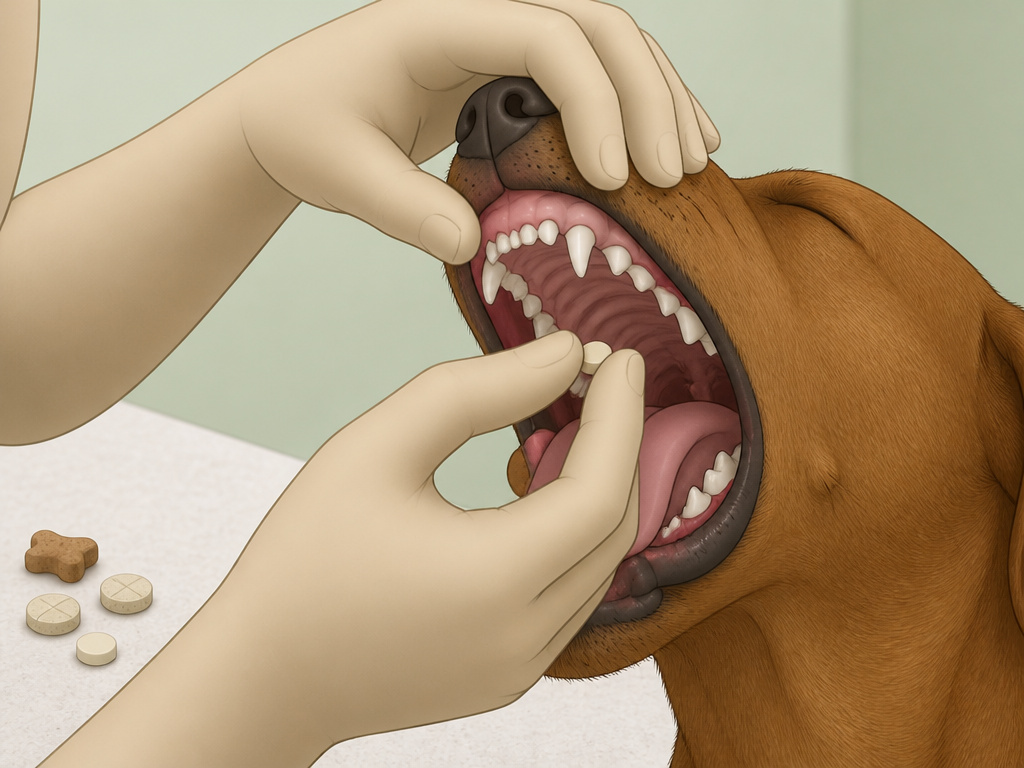
Hand-pilling is the fallback. Save it for the dog that spits out every ball you roll.
Before you start: A dog’s mouth carries a lot of bacteria, and WSU warns that bites can cause deep punctures. Fold the upper lip over the teeth as you open the mouth, so a bite lands on the dog’s own lip instead of your hand. If you are bitten, clean the wound thoroughly and get medical attention.
Cornell’s pharmacy guideline and the WSU veterinary oral medication guide agree on the order of operations. Here it is.
- Prep everything before you call the dog. Cornell’s guideline is to set tablets and capsules out individually and draw liquids into an oral syringe first. Calling the dog early gives it time to read the room and leave.
- Call the dog in a happy voice and back its rear end into a corner. Cornell recommends the corner so the dog cannot reverse away from you. A dog that can back up will.
- Hold the head from the top with your left hand if you are right-handed. That is WSU’s instruction. Long-nosed dogs get the upper jaw between thumb and index finger; short-nosed dogs get the cat-style hold.
- Tilt the head back and fold the upper lip over the teeth. WSU notes the lower jaw usually does not drop far enough on its own. Place your thumb on the roof of the mouth as you open it.
- Drop the pill as far back over the tongue as possible, close the mouth, and blow on the nose. Cornell warns against pushing your hand too far in, because the dog can choke and gag. If the pill is not far enough back, WSU says the dog will spit it out and you may need index finger and thumb, working fast.
- Praise the dog and give a treat. Cornell’s guideline is plenty of praise in a happy voice, and possibly a treat, so the next time goes easier.
The lower jaw has a soft give before it opens. If you are meeting hard resistance, you are pulling at the wrong angle, and that is when fingers get bitten.
A dosing routine is like a pipe run. It never fails at the part you took your time on.
When a Pilling Device Beats Your Fingers
WSU notes that several styles of pilling devices exist for placing a pill or capsule over the base of the tongue without putting your fingers in the dog’s mouth. If your dog has already learned to clamp down, buy one.
I would not hand-pill a dog that has learned the routine. Once a dog has spat out two tablets, the third attempt is a wrestling match, and Cornell’s point about moving quickly stops being possible.
If the first two attempts fail, switch tools or ask your vet about suspending the dose in liquid. WSU’s warning on that is specific: some medications lose effectiveness in a suspension, so the vet makes that call, not you.
What Happens When a Supplement Goes Wrong
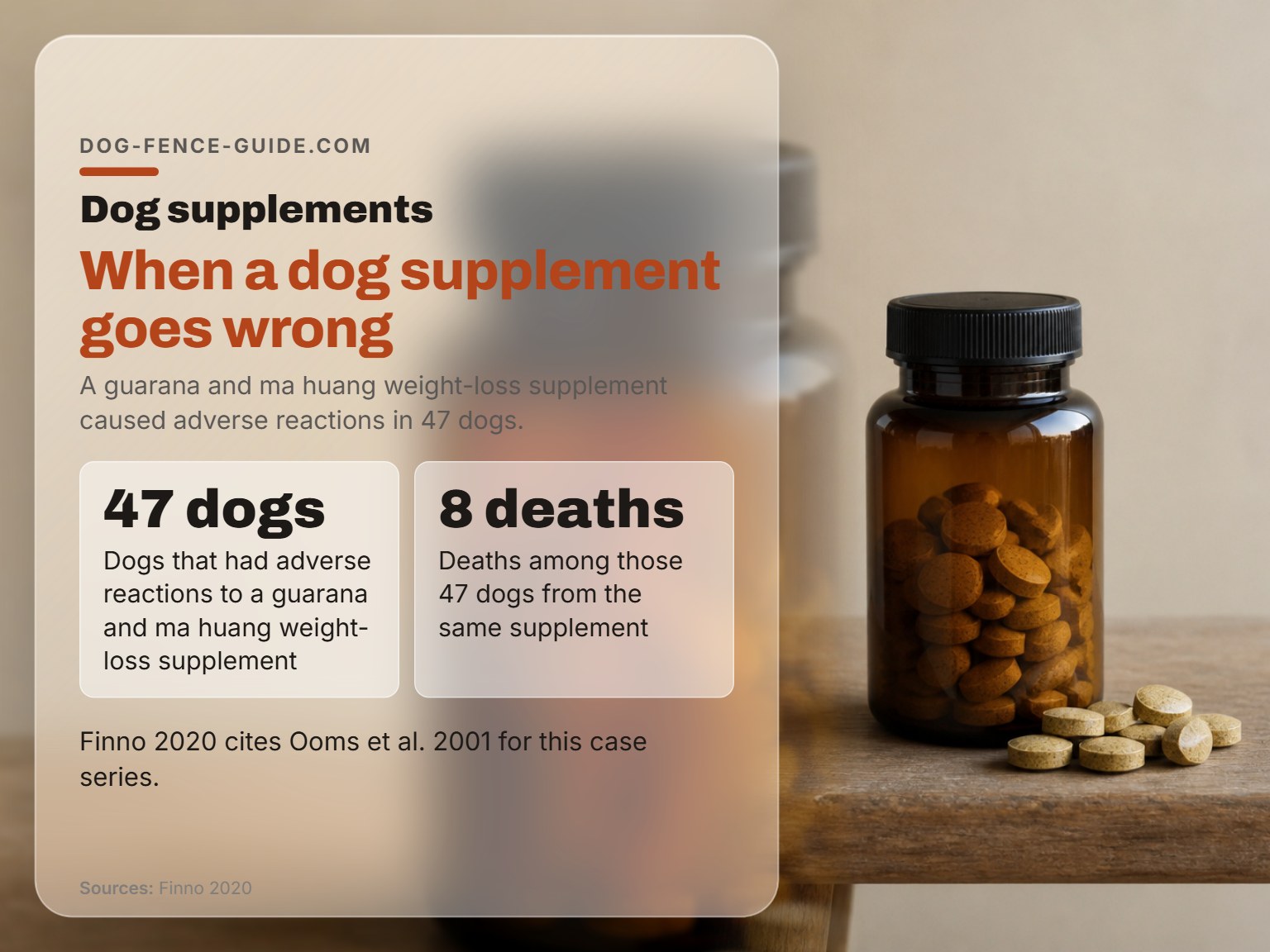
Forty-seven dogs. Eight of them died.
That count comes from a case series on a guarana and ma huang weight-loss supplement, cited in Finno’s 2020 review in Nutrition Today. It is the only hard incident number in the veterinary pet supplements and nutraceuticals study, and it is worth sitting with.
Garlic, Guarana, and the Species Problem
What a compound does in a person or a rat does not predict what it does in a dog, because each species absorbs and clears it differently. Finno’s review makes that point directly, and it is the reason human supplement research transfers so badly.
- Garlic causes hemolytic anemia in horses, dogs and cats when given in excess. That means the body destroys red blood cells faster than it can replace them. A human portion is not a dog portion.
- Pyrrolizidine alkaloids are plant compounds that can damage the liver. They turn up in herbs marketed as immune stimulants, and horses are the most sensitive species to them.
- Guarana and ma huang appeared together in a weight-loss product that produced adverse reactions in 47 dogs, including 8 deaths.
VCA’s rule for the shopping side is blunt and useful. If a manufacturer is unwilling to provide safety and efficacy data, it is safer to err on the side of caution and not use the product. Treat non-disclosure as the answer.
That applies to the natural aisle too. VCA’s own wording is that all medicines and medicinal plants are potentially toxic if used inappropriately or at high doses. That covers the herbal products people reach for as natural supplements for their dogs.
The two sources also frame the vet’s role differently. Finno’s review states that a veterinarian is legally liable if a recommended supplement leads to adverse effects. VCA calls the veterinarian the best source of information on supplement safety in domestic animals and does not mention liability at all. Same actor, opposite emphasis.
Liquid Supplements and the Head-Tilt Rule
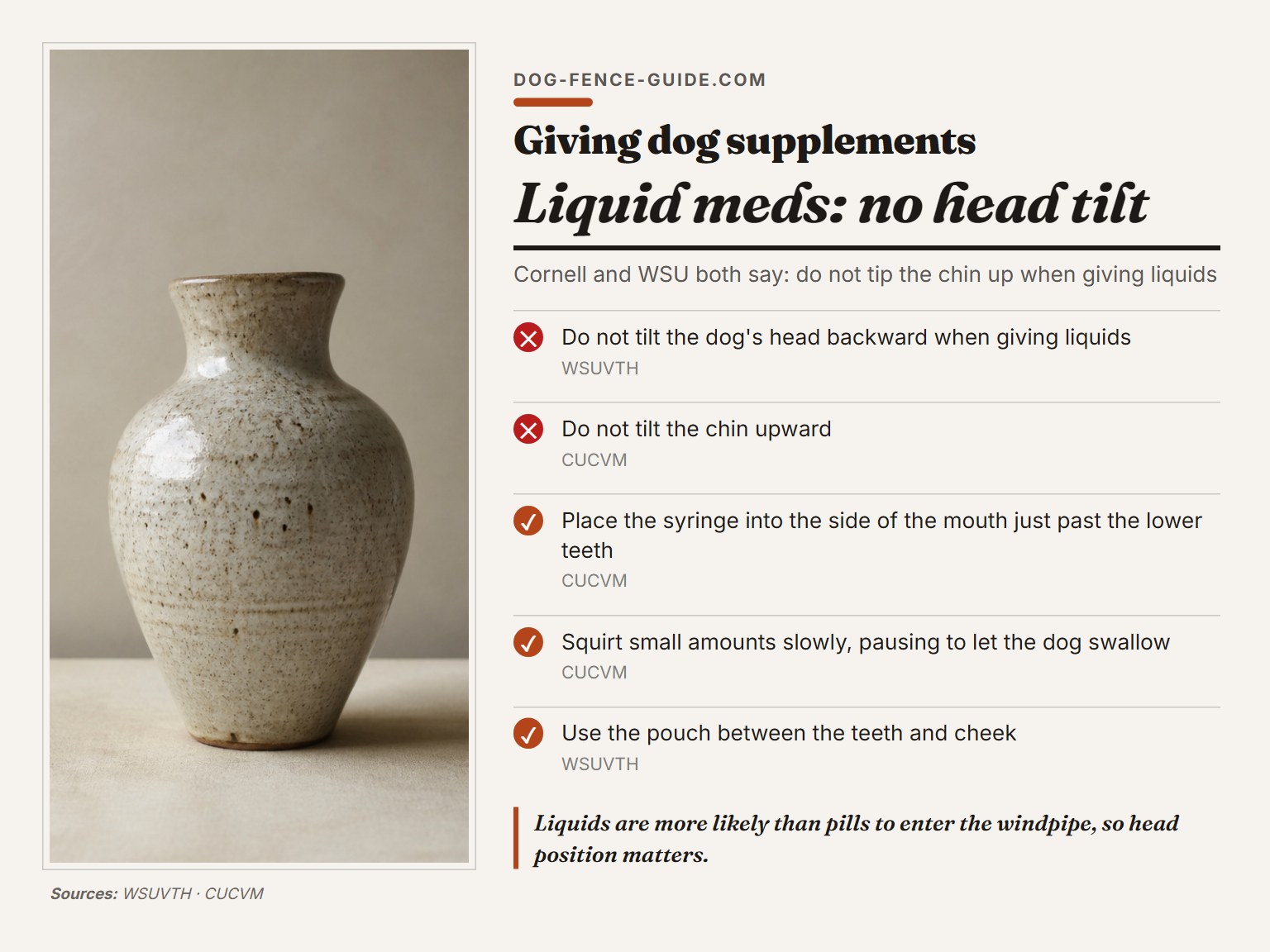
Cornell’s pharmacy guideline puts the syringe at the side of the mouth, just past the lower teeth, and squirts small amounts slowly with a pause between each one.
The head position is the part that matters most. WSU’s instruction is to not tilt the dog’s head backward when giving liquids, because liquid is more likely than a pill to enter the windpipe. Cornell’s guideline says the same about the chin and adds the placement detail.
Both university hospitals land in the same place, which is unusual in this space. Do not tip the chin up. Put the syringe into the side pouch between the teeth and cheek, squirt slowly, and let the dog swallow between squirts.
A dog that gags on liquid is not being dramatic. WSU’s reason for the no-tilt rule is inhalation into the windpipe, and that is a breathing risk, not a mess risk.
Tablet, Liquid, or Soft Chew: Pick by Dog, Not by Convenience
Format matters more than brand for most owners, and each format wins a different job.
A tablet is the right call for a dog that gulps a test ball whole. The Zoetis Pet-Tabs label shows why: the dose is printed by weight, 1/2 tablet daily under 10 lb and 1 tablet daily over 10 lb, so a tablet you can split is the format that matches the label.
A soft chew wins for the dog that has learned to find a pill in anything. It is also the format most likely to be handed out like a treat, which is how dogs end up on three supplements nobody prescribed.
Liquid is the last resort. It needs the most technique, and it is the one where the head position can actually hurt the dog. If you have to use it, follow the Cornell veterinary oral medication guidelines on placement rather than improvising.
When a vet has already signed off, choose a product whose manufacturer will share safety and efficacy data.
Storage, Expiry, and the Smell Test
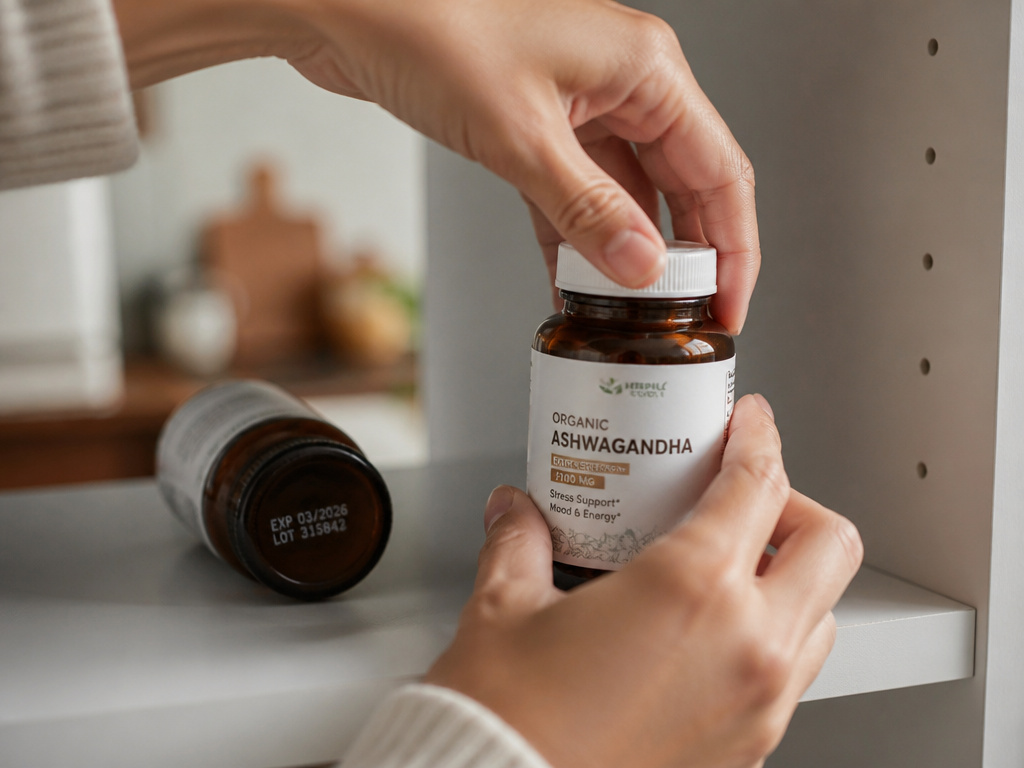
A supplement that has gone off usually tells you before the label does.
VetriScience’s guidance is to store supplements in the original packaging in a cool, dry place, away from extreme heat or light, and to keep the package sealed tightly after every use. Check the expiration date on the back of the package, not the front.
- Keep the original packaging. The bottle is part of the product, not just the wrapper.
- Seal it every single time. A lid left loose for a week is a week of air and humidity.
- Check the date on the back. That is where the manufacturer puts it.
- Return it if it looks wrong. Severe discoloration, crumbling, damage, or an excessively bad smell are all reasons to send it back rather than use it.
A supplement that has turned smells excessively bad, not like the product should. That cue arrives before the date on the bottle does.
If a bottle has sat open in a warm kitchen for a long time, treat it as expired. The printed date is a ceiling, not a guarantee, and heat and light push a product toward that ceiling faster.
Powders are the format most likely to sit open for months, so supplement powders deserve the tightest seal in the cupboard of any format. FDA-CVM’s Compliance Policy Guide Sec. 690.100 puts six restrictions on how these products get marketed, and no standardized monitoring system backs any of it up. A big tub that sits open for a long time is a lot of unverified product.
I would rather buy a small bottle and replace it often than a big one that sits open.
How Long Does It Take Before You Know It’s Working?
I bathe my own dogs regularly, and I have never had a vet blame a coat problem on under-bathing. The people I know who bathe weekly are also the people buying itch supplements. That is not a coincidence.
Which is the honest version of the timeline question. Before you count weeks on a supplement, check whether the problem was ever the supplement’s to fix.
For the ones that do work, the clock is slow. VCA’s guidance is that glucosamine for arthritis symptoms may take approximately four to eight weeks to show effects, and can take the same time to wear off after you stop.
That creates a trap. VCA also notes it is common for supplements to be given alongside other supplements or lifestyle changes, which makes it hard to attribute any improvement to one product. If you started a new food, a new joint chew, and longer walks in the same week, you will never know which one helped.
The two sources disagree on how much evidence exists. Finno’s review says most supplement claims rest on subjective assessment and owner testimonials and should be viewed with skepticism. VCA says reliable information is becoming increasingly available and points owners toward ahvma.org, while noting some supplements are well researched in humans but not in animals.
I land closer to Finno on this one. The long-term data is genuinely thin, and anyone who tells you otherwise is usually selling something.
For an older dog, the timeline matters more, because senior dog supplements are often stacked on top of a prescription diet and a pain medication. Change one thing at a time.
Frequently Asked Questions
Can I give my dog a supplement without asking the vet?
The American College of Veterinary Nutrition’s position is that dogs on complete and balanced food do not need supplements unless a vet prescribes them, while the Zoetis Pet-Tabs label provides weight-banded daily dosing for routine over-the-counter use. VCA also says the veterinarian is the best source of information on supplement safety in dogs.
What if my dog chews the pill and spits it out?
That is the failure mode WSU warns about. The tablet partially dissolves and becomes difficult to handle, so the next attempt is harder. Switch to a pilling device, or ask your vet whether the medication can be suspended in liquid.
Should I tilt my dog’s head back to give liquid medication?
No. WSU warns that liquid is more likely than a pill to enter the windpipe, so the head stays level. Cornell’s guideline says the same about the chin and adds the placement: syringe into the side of the mouth, just past the lower teeth, small squirts with pauses.
How long does glucosamine take to work in dogs?
VCA’s guidance is approximately four to eight weeks to show effects. It can take about the same time to wear off after you stop giving it, which is why a short trial tells you almost nothing.
Is a natural supplement safer than a regular one?
No. VCA’s wording is that all medicines and medicinal plants are potentially toxic if used inappropriately or at high doses. Natural describes where an ingredient came from, not how safe it is in a dog.
Do I need to finish the whole bottle?
Finish the course your vet prescribed. Cornell’s guideline is that the dog needs all of the medication for the entire length of time prescribed, and that you should contact your vet if you keep having trouble getting it in.
Before You Go
One number to hold onto: 47 dogs reacted to a single herbal weight-loss product, and 8 of them died. That is what the unregulated side of this category looks like when it goes wrong.
So here is the trigger. If your dog is healthy, eating a complete and balanced diet, and holding weight, stop and book the vet exam before you buy anything. If a vet has already diagnosed something and put a supplement on the list, the only thing left is how to give a dog supplements without a fight.
Fair warning, though: format is where most people fail. A soft chew your dog takes without a fight beats a tablet you have to wrestle in, and a test ball beats both.
Before you buy, ask yourself three questions. Does my dog actually need this, or am I treating a coat problem that a bath schedule would fix? Did a vet prescribe it, or did a label sell it to me? And if the manufacturer won’t share safety data, what does that tell me?
Start with the dog, not the bottle.
