
How to Find Dog-Friendly Hotels: Step-by-Step
This post contains affiliate links. As an Amazon Associate, we earn from qualifying purchases.
To find dog-friendly hotels, check three things before you book: a written dog policy you can read on the hotel’s own site, the fee and damage deposit stated in full, and whether dogs are allowed in at least one indoor shared space. The Roch Dog Friendly Standard (RDFS-02) treats all three as mandatory floors, not extras.
A written policy, a stated fee, and one shared indoor space sound like small items to confirm. They’re the three places hotels quietly fail, and each one stays invisible until you’re standing at reception with a lead in your hand. Knowing how to find dog-friendly hotels means checking these details before you book.
What follows is the order I’d run the checks in: read the policy, ask the phone questions, pick a room with real, stable, non-disposable food and water bowls of appropriate size, then walk the yard at dog level before you unpack.
Key Takeaways
- A published policy beats a filter checkbox. A “pets allowed” tick on a booking site is a listing attribute, not a promise about access.
- Failing one of six RDFS-02 requirements caps a hotel’s grade at C, however good the rest of the stay looks on paper.
- Weight limits run from under 13 kg (30 lb) to 36 kg (80 lb) at the properties Booking.com compared, so confirm the number rather than the badge.
- Ground floor and upper floor are both correct answers, for different dogs. Work out which problem you’re solving first.
- Inspect the yard on your hands and knees, not from the doorway. Gates and gaps decide how the trip ends.
What Does “Dog Friendly” Actually Mean on a Hotel Listing?
Three organizations define the phrase three different ways, and the definitions don’t overlap cleanly. You’re the one who has to reconcile them at the front desk.
A hotel clears the Roch Dog Friendly Standard only by meeting six mandatory requirements, covering a published pre-booking policy, real bowls, access to a shared indoor area, disclosed fees, a stated damage deposit, and a stated dog limit. Failing any one caps the grade at C regardless of everything else.
| Source | What it means by “dog friendly” | What you can check |
|---|---|---|
| Roch Dog Friendly Standard (RDFS-02) | Six mandatory requirements, graded A+ to F | Written policy, bowls, shared-area access |
| Booking.com | A filter plus a “pets stay free” badge | Fee and size fields only |
| VCA Animal Hospitals | Pet-friendly, not just pet-tolerant | Green space, whether the dog stays alone |
The Roch standard is blunt about the gap it exists to close. “A dog friendly hotel welcomes dogs, it does not merely permit them,” it states, and it treats being allowed to stay as the floor rather than the measure.
Booking.com takes a different route. It turns the phrase into a search filter and a badge, which is useful for sorting and says nothing about whether your dog can sit with you in the bar.
VCA Animal Hospitals draws the line that matters most to owners. It insists on a hotel that is pet-friendly rather than pet-tolerant, and it adds welfare criteria the other two ignore, including whether the property will let your dog stay in the room alone.
KAYAK concedes the same weakness in its own industry. Hotels that accept pets without the amenities, it notes, are considered more “pet tolerant” than pet-friendly.
Why does any of this matter commercially? The Royal Kennel Club’s own research found that one in three dog owners would take more holidays or day trips in the UK if more places were dog friendly. A quarter have cancelled plans over worry about leaving the dog at home. Hotels know that, and some of them price accordingly.
The Six Requirements That Separate Dog Friendly From Dog Tolerant
Six requirements form the floor under the Roch Dog Friendly Standard (RDFS-02), and they’re written as outcomes rather than amenities. Each one is checkable before you pay.
- R1: a written policy you can get before booking. It has to be published on the hotel’s own site or listing, or provided in writing on request, and it has to match what the hotel claims on third-party platforms. Skip this and you’re relying on a verbal yes, which the standard explicitly rejects.
- R2: real bowls in the dog room. Stable, non-disposable, and the right size for the dog. A disposable bowl tells you the hotel is performing friendliness rather than providing it.
- R3: access to one indoor shared area. A lounge, bar, restaurant, or cafe, used for something other than walking through to the exit. A hotel that only lets your dog cross the lobby fails, and you’ll feel it on a wet day.
- R4: the fee, with amount and structure. Even when the answer is that dogs stay free, the policy has to say so before you book. A fee that appears at check-in was not disclosed pre-booking, which the standard requires.
- R5: the damage deposit, with the amount. A policy that does not state whether a damage deposit applies, and the amount, fails. You need the figure, not the possibility.
- R6: the maximum number of dogs per room. This is the field that catches multi-dog households, so confirm the maximum number of dogs per room before booking.
Failing any single one of those caps the hotel’s grade at C. It cannot be awarded A+, A, or B however well it does elsewhere, because the six are a floor to clear rather than points to trade off.
Clearing all six requirements gets a hotel into the graded range. It does not make it good. The grade is what tells you the rest.
One detail worth knowing: this document is RDFS-02, the second version. It replaced RDFS-01, which assessed hotels pass or fail. Revisions aren’t applied retroactively, so a hotel graded under the older version carries that grade until it’s reassessed. Grades can also be time-limited and revised or withdrawn.
Certified hotels sit in a public Roch Dog directory where owners compare properties by grade. That’s a faster starting point than reading endless listing pages.
Where to Read a Policy Before You Pay
Would you rather trust a filter checkbox or a phone call? The three main sources answer that differently, and the split is worth knowing before you lose an evening to browser tabs on how to find dog-friendly hotels.
Booking.com leads with platform tools: the “pets stay free” badge and the filter, and also advises checking the hotel’s own website, calling reception, and reading recent reviews from other pet owners. The Royal Kennel Club leads with the property itself, advising owners to call beforehand and check the website, and to choose accommodation that is “Open for Dogs”.
Roch’s R1 goes further than either. It requires the policy in writing before booking and explicitly rejects informal permissions and terms disclosed only at check-in.
Those aren’t the same test. A friendly verbal yes from reception satisfies the Kennel Club’s check and fails R1 outright. If you want the stricter version, ask for the policy in writing and keep the reply.
Here’s the phone script I use, in this order:
- “Is my dog allowed in the bar or lounge, or only through the lobby to the door?”
- “What’s the total fee, and is it per night, per stay, or per dog?”
- “How much is the damage deposit, and when does it come back?”
- “How many dogs can share one room?”
- “Can the dog stay in the room if we go out for dinner?”
That last question is worth getting in writing too.
| What you see | What it means in practice | The question that settles it |
|---|---|---|
| “Pets allowed” filter ticked | A listing attribute with no access floor | “Is my dog allowed in the bar or lounge?” |
| “Pets stay free” badge | Covers the fee, nothing else | “What’s the damage deposit, and how much?” |
| “Pet friendly” in the description | Could be pet-tolerant instead | “Are there bowls in the room, and where’s the relief area?” |
| “Fenced yard” on a rental listing | Verified by nobody at all | “Can I see photos of the gates and the gaps under them?” |
Hotels or rentals? KAYAK advises hotels over apartments for short stays, because privately managed rentals seem to have very strict rules around pets. BetterPet recommends the opposite and points to vacation rentals and B&Bs as alternatives.
My own read splits by trip length. For a short stop, take the hotel: the policy is written, the desk is staffed, and there’s someone to call. For a longer stay, a rental with a real garden beats a run of lift rides, provided you run the same checks you’d run on pet-friendly rentals anywhere else.
Fees, Deposits, and the Dog Limit Nobody States Clearly
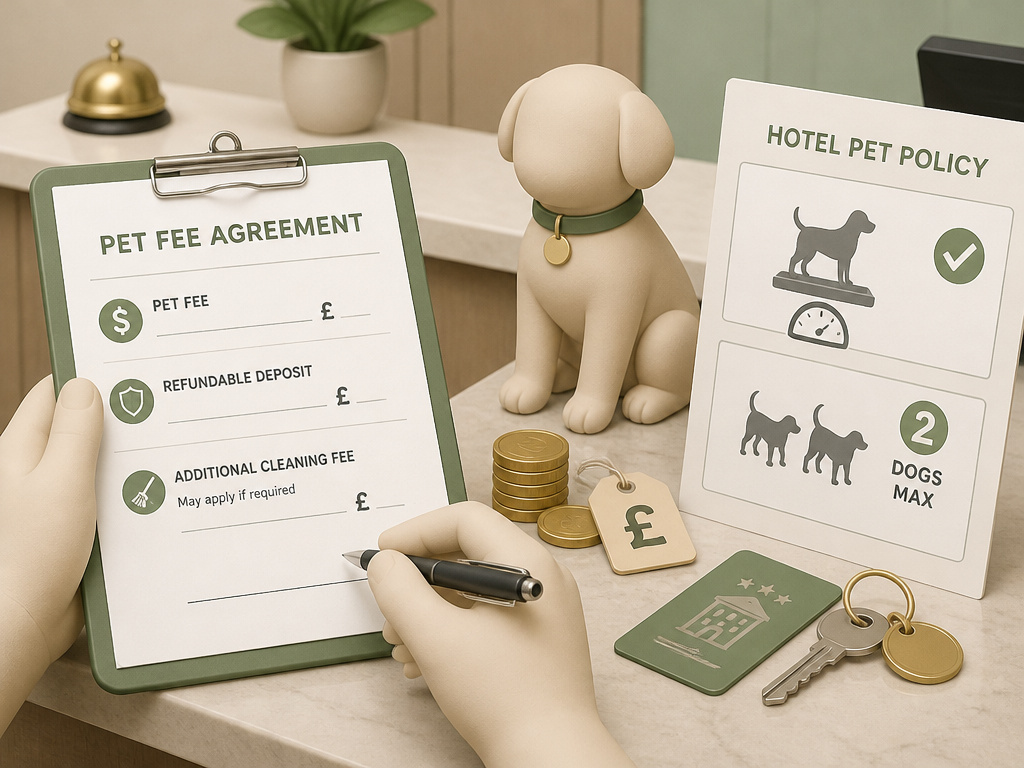
Booking.com’s chain-by-chain fee comparison is the clearest evidence that “pet friendly” works as a pricing category as much as a welcome. Booking.com reports that IHG and Kimpton charge no pet fee and set no limits. Hilton’s fee changes hotel by hotel and generally runs £20–£95 per stay. Hyatt quotes a single non-refundable fee, generally £55. Choice averages a nightly charge of about £20. Marriott’s non-refundable fees generally range from £15 to £185 per night or stay. Wyndham sets a nightly figure property by property, generally £15/night.
Booking.com also warns that policies vary within the same chain, so the brand over the door tells you nothing about the property you’re booking when you compare a how to find dog-friendly hotels. Two Hiltons in the same chain can run different rules.
Weight limits are the second trap. Booking.com puts the spread at pets under 13 kilograms (30 pounds) at the low end and up to 36 kilograms (80 pounds) at the high end. BetterPet gives the multi-dog version: a hotel with a 150-pound total restriction puts you in breach with three dogs even if every individual dog is small.
VCA notes some hotels add a sliding daily charge for each additional pet, while others charge a flat one-time fee. Ask which structure applies before you assume the second dog is free.
KAYAK adds a detail that surprises owners. Most hotels require dog owners to sign an agreement accepting financial responsibility for damage, so budget for the deposit as a real cost rather than a formality.
Service Animals and Emotional Support Animals Are Not the Same Booking
Booking.com draws the legal line clearly, and it’s worth reading twice. Service animals are protected under the Equality Act 2010 and the Americans with Disabilities Act, must be allowed in all areas where the public is usually allowed, and carry no pet fees. They’re limited to dogs and miniature horses trained to perform specific tasks.
Emotional support animals sit outside both laws. They may be subject to the hotel’s pet policy and pet fees, and they require documentation from a licensed mental health professional.
If you’re crossing borders with a dog, the same policy-first habit applies to international dog travel, where the paperwork has to be settled weeks before the room.
Ground Floor or Upper Floor? Two Sources, Two Answers
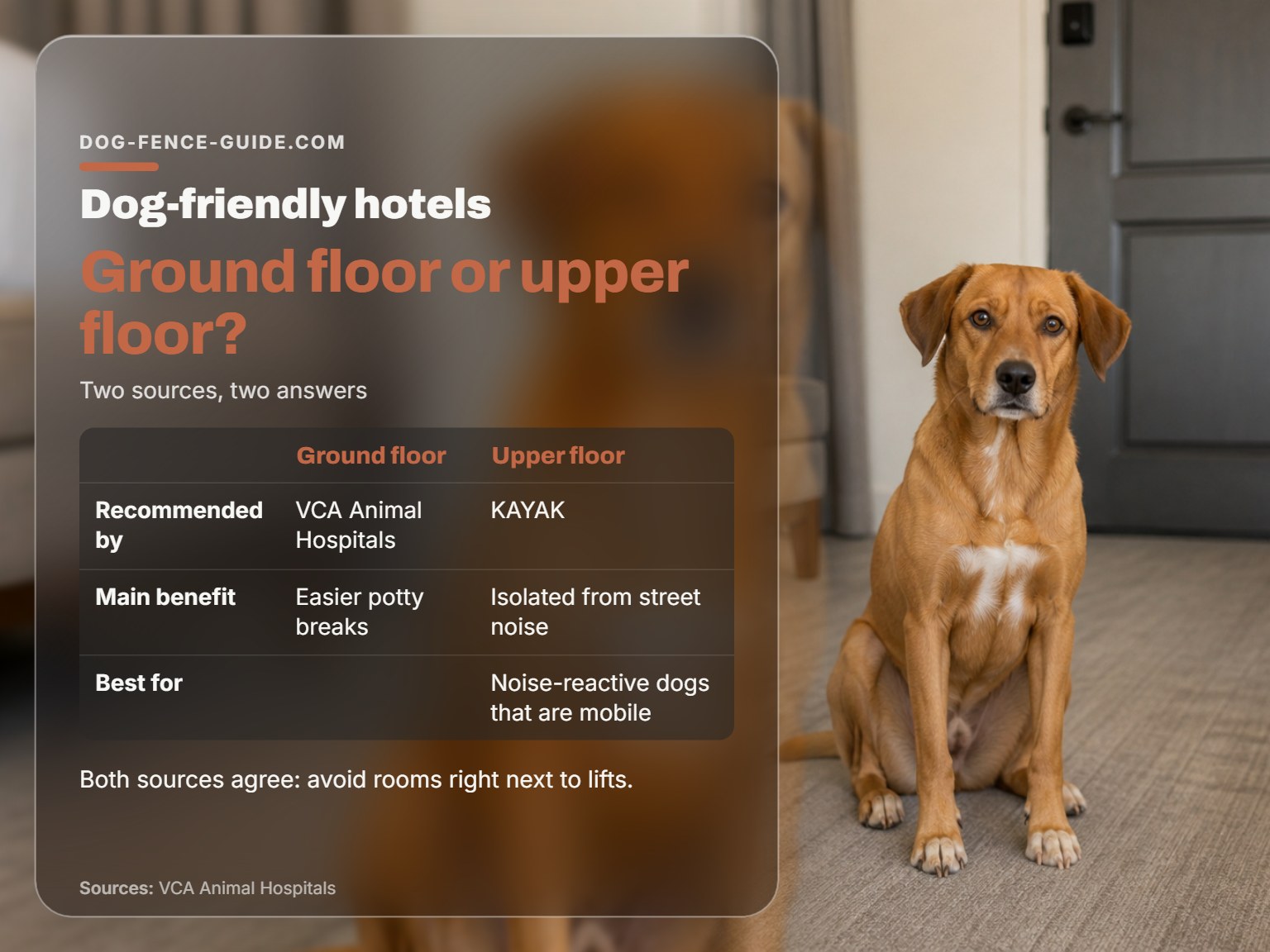
Both pieces of advice are right, which is the annoying part. VCA Animal Hospitals recommends requesting a ground-floor room, because potty breaks get easier, especially for a dog that can’t manage stairs or shies away from lifts. KAYAK recommends the upper floors, because they’re more isolated from street noise.
Neither source is wrong. They’re solving different problems.
The decision rule I’d use: if your dog is noise-reactive and mobile, take a high floor away from the lift and the ice machine. If your dog is older, arthritic, blind, or panics in a lift, take the ground floor and accept the traffic noise. Pick the problem you can live with.
I won’t book a room for my own dogs without knowing where the nearest real grass is. Not a courtyard, not a paved relief strip. Grass. A dog that has held it through a long drive needs a spot close to the car door.
The Elevator Detail Both Sources Agree On
VCA advises avoiding rooms right next to lifts, since they carry noisy people and agitate pets. KAYAK’s preference for upper floors comes from the same instinct about noise. Both are telling you that the corridor outside your door matters as much as the room itself.
Flooring is the other practical detail. KAYAK suggests tiled or wooden floors, which clean up in one pass. Carpet holds the smell of the last dog long after housekeeping has been through, and you’ll notice it the moment you open the door.
VCA adds one more check. If your dog’s food or medication needs to stay cold, confirm you can get an in-room fridge before you arrive.
A portable dog bed does more for a nervous dog than any room upgrade. Familiar smell, familiar shape, and the dog settles instead of pacing the carpet at midnight.
What to Pack and What to Do on Arrival
Three things happen on arrival: you read the policy, you check the room, and you walk the yard. Do them in that order, before the dog comes out of the car.
The Royal Kennel Club’s list covers the basics: a lead, a collar and an ID tag, and a crate if your dog sleeps better in one. It also advises checking your insurance documents before you travel, and looking around the accommodation before welcoming the dog into a new space.
VCA adds the items owners forget:
- A collar and ID tag with your phone number, even if the dog is microchipped. A chip needs a scanner; a tag needs eyes.
- Extra food and medication, packed for a delayed return rather than the planned one.
- A copy of the medical records, in case you need an emergency vet at an hour nobody wants.
- Pet waste bags, because not every hotel supplies them.
- A towel for wet weather, and a note of where the cleaning equipment lives.
Kennel Club guidance also covers the two rules guests break by accident: check that no human food or drink left out by the host is reachable by the dog, and respect any no-dogs-on-the-furniture policy rather than testing it.
The Yard Check Nobody Does
A rental listing that says “fenced yard” may not have been verified, so check the gates and gaps yourself. Run your hand along the bottom of the gate before the dog goes out. A gap you can slide your fingers under is a gap a terrier will test, and it’ll test it while you’re still carrying bags.
Where this goes sideways: Booking on the strength of a “pets stay free” badge without reading the property’s own policy. The badge covers the fee and nothing else, so the weight cap or the two-dog limit surfaces at check-in, with the car already unloaded and the dog already out.
Fair warning: a gate that swings on one hinge looks fine from the doorway and obvious up close. Get down there.
Getting there is its own set of checks. If you’re taking a dog on a train rather than driving, the carrier rules and the booking window change the plan. Flying means an airline-approved carrier sized to the airline’s own limits, not the manufacturer’s description. The rest of the dog travel gear list is shorter than the internet suggests.
Frequently Asked Questions
Is a hotel that charges a pet fee still dog friendly?
Yes. The Roch Dog Friendly Standard requires the fee to be disclosed before booking with its amount and structure, and it says nothing about the fee being zero. A disclosed fee is compliant. A fee that appears at check-in is not.
Can I leave my dog alone in a hotel room?
VCA advises verifying this with the hotel before you go out without your dog. BetterPet notes that some hotels allow it but may charge extra if staff become aware. Get the answer in writing, and don’t assume the answer transfers to the next hotel in the same chain.
What if the hotel’s website and its booking listing disagree?
Under RDFS-02, the published policy has to be consistent with claims made on third-party platforms, so a mismatch is the hotel’s failure rather than your mistake. Screenshot both, book on the stricter reading, and confirm by phone.
Do I need to book a room specifically for the dog?
VCA recommends making a reservation specifically for the pet and reading the policy first, since some properties set size or number limits. Turning up with more dogs than the room allows is the failure case, and it’s usually discovered at the desk.
What does “pet tolerant” mean?
It means the hotel accepts pets without providing for them. KAYAK uses the term for properties that take pets but lack the amenities, and VCA draws the same line in stronger language. The tell is a hotel that accepts pets but lacks the amenities that make the stay work for them.
The Bottom Line
If the dog policy isn’t on the hotel’s own website, treat that as your answer and book somewhere else. A property that won’t publish its terms before you pay is telling you how the rest of the stay will go.
One concession. For a short stop on a long drive, with a quiet older dog and a confirmed ground-floor room, the full inspection is overkill. Pay the fee, walk the yard once, sleep.
The first step this week is small. Open the hotel’s own site rather than the booking platform, find the dog page, and read it. If there isn’t one, you’ve just saved yourself a bad check-in.
