
How to Brush a Doodle Dog: Six-Step Line Method
This post contains affiliate links. As an Amazon Associate, we earn from qualifying purchases.
To brush a doodle dog, work in thin sections from the skin outward with a long-bristled slicker, then finish each section with a metal comb. Andis sets curly coats at daily brushing and wavy coats at 3 to 5 times weekly, while groomer Joy Burton argues for a real 30-minute session every other day and The Doodle Brush recommends three times per week.
That 30-minute figure is where the how to brush a doodle dog trouble usually starts. A doodle coat traps shed hair inside the curl instead of letting it fall away, so loose hair felts against the skin while the surface still looks brushed. Andis lists friction, moisture, and incomplete brushing as the three causes, and a long coat simply gives a mat more room to hide.
What follows: the four Andis coat types and their real intervals, a six-step line-brushing method, the comb test that decides when you are finished, and the one bathing mistake that undoes the whole job.
Key Takeaways
- Coat type decides the schedule, not the breed. Andis states that breed alone does not determine coat type, and that texture can change significantly as a puppy matures.
- Andis sets curly coats at daily brushing and wavy coats at 3 to 5 times weekly, while Joy Burton argues for a real 30-minute session every other day and The Doodle Brush recommends three times per week.
- The metal comb is the pass/fail test. If it stops when you run it to the skin, that section is matted no matter how good the surface looks.
- Never bathe over mats. Water tightens tangles and accelerates mat formation, so brush thoroughly before the tub.
- Budget about 30 minutes per session. A small brush on a 60-pound doodle turns that 30-minute job into a two-hour one.
Why Doodle Coats Mat Under a Brush That Looks Like It’s Working
A doodle can be brushed every single day and still walk into the groomer with a felted layer under a flawless top coat. Joy Burton, the Fear Free certified groomer behind The Doodle Pro, describes lifting that top coat and finding solid felt near the skin. Same dog, same devoted owner, two completely different stories depending on how deep you go.
Doodle coats trap shed hair inside the curl rather than releasing it. That trapped hair felts closest to the body, where a surface brush never reaches. Andis lists friction, moisture, and incomplete brushing as the primary causes of matting, and names nine high-risk zones including behind the ears, the armpits, and the tail base.
The back is the easiest place to brush, which is why Burton focuses effort on the friction zones instead. Burton calls the result a Doodle Mohawk: a dog shaved everywhere except a strip down the spine.
Mats are not cosmetic. The Doodle Pro notes that mats cause irritation, pain, and potential skin infections, which is why groomers reach for clippers rather than fight a felted coat.
A coat behaves like a pipe run. You do not judge it by the strongest section, you judge it by the weakest joint, and on a doodle that joint is the armpit or the collar line.
Every time I pick up a brush, I run my hands over the whole dog first. Ears, armpits, between the toes. The brush starts the job; my hands finish the check. I found a hot spot behind a front leg that way, and it would soon have been a vet visit.
Which Doodle Coat Type Are You Actually Brushing?
Ever watched a doodle owner brush faithfully every day and still get the shave-down speech? The coat type is usually the missing piece. Andis divides doodle coats into four types, and the home routine changes with each one.
| Coat Type | Professional Grooming | Home Brushing |
|---|---|---|
| Curly | Every 4-6 weeks | Daily brushing and combing |
| Wavy or fleece | Every 4-6 weeks | 3-5 times weekly, plus comb checks |
| Cotton or wool | Every 3-5 weeks | Near-daily maintenance |
| Straight or shedding | Every 6-8 weeks | Weekly brushing |
Why Breed Doesn’t Tell You the Coat Type
Andis states it plainly: breed alone does not determine coat type. Two Goldendoodles from the same litter can carry different textures, and the wavy or fleece coat is the one that fools people. It hides tangles beneath a soft surface, so a light brush over the top feels like it worked.
If your dog falls in the curly column, grooming a curly coat is a longer conversation than a weekly pass with a slicker.
The Nine Zones Where Mats Actually Form
Andis lists these as the high-risk areas, and they are almost all places a brush never lands by accident:
- Behind the ears
- Under collars
- Harness pressure points
- Armpits, which get the least airflow of anywhere on the dog
- Belly and sanitary areas
- Tail base
- Legs and furnishings
- Paw pads
- Beard and muzzle, the part you look at most and reach least
Andis’s shorter at-home guide trims that list to five high-friction areas, which tells you where to spend your time on a busy night.
How to Brush a Doodle Dog: The Six-Step Line-Brushing Method
Six steps, in this order. Skip step four and everything before it was decoration.
Before you start: Andis lists a dematting tool among recommended home tools, while Joy Burton says to leave the de-matting blade in the store; if you do use one, keep the blade flat against the coat and stop the moment it snags. Scissors are riskier still on a felted coat, which is why groomers reach for clippers instead. Andis also lists damp collars and harnesses as a don’t, because water tightens tangles and accelerates mat formation.
- Match the brush to the dog, not the drawer. A small brush on a 60-pound doodle turns a 30-minute job into a two-hour one, per The Doodle Pro.
- Part the coat into layers until you can see skin. Andis’s at-home guide describes parting down to visible skin before the brush touches the coat.
- Brush from the skin outward in short, gentle strokes. Starting at the surface is what leaves the felted underlayer exactly where it was.
- Comb that section before you move on. If the comb catches, the brushing is not finished, and moving on just buries the problem.
- Work the friction zones, not the back. Burton’s list is armpits, thighs, behind the ears, collar line, tail base, and belly.
- Finish with a full comb pass over the whole dog. This is the step that catches what your hands missed.
What to Do When the Comb Stops
Stop brushing that section and work it in smaller slices. Burton runs a metal comb through a section down to the skin, and if it stops, that section is matted no matter how good the surface looks. More pressure does not fix felt. Smaller sections do.
A dog that hates being brushed will often tell you with its feet before it tells you with a growl. Burton’s approach is to brush the dog standing up and let it walk away when it needs to, then start again.
How Often Should You Brush a Doodle Dog? Four Sources, Four Answers
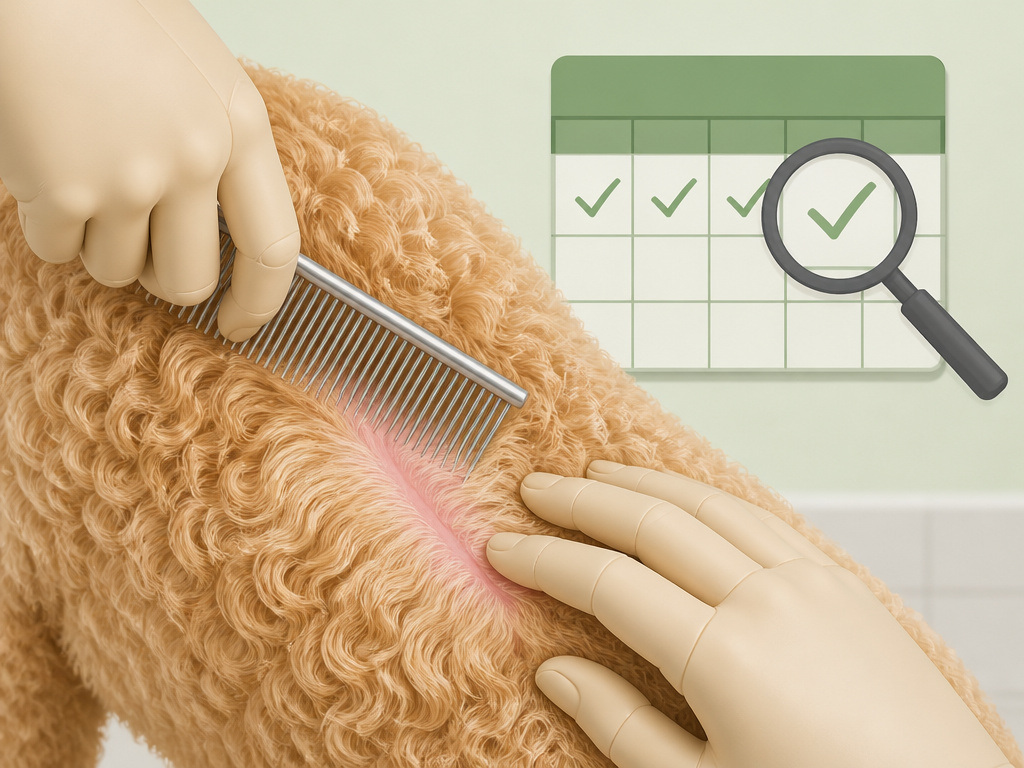
Four sources, four cadences, and the gap between them is wider than most owners expect. Andis’s professional guide prescribes daily brushing and combing for curly coats. Burton argues for a real 30-minute brush-and-comb session every other day, three to four days a week, and explicitly argues against the daily quick pass. The Doodle Brush recommends three times per week.
| Source | Home Cadence | Position |
|---|---|---|
| Andis (Tammy Siert) | Daily brushing and combing | Manufacturer guidance, coat specific |
| Andis at-home guide | Daily curly, 3-5 weekly wavy | Same maker, coat specific |
| The Doodle Pro (Joy Burton) | Every other day, 3-4 sessions | Argues against the daily quick pass |
| The Doodle Brush | Three times per week | Brush brand, Poodle-cross guidance |
Andis’s professional guide says wavy coats need brushing 3 to 5 times weekly.
The disagreement is really about what counts as a session. A quick pass and a 30-minute line-brush both get called brushing, and only one of them reaches the skin.
Where this goes sideways: Counting sessions instead of checking depth. Quick passes through the week leave the same felted underlayer as one, because none of them got a comb to the skin.
Coat type and what the comb does when you run it through are the main things that move your number up or down.
If you want a schedule built around your dog’s coat rather than a brand’s recommendation, a guide to how often to brush breaks it down by coat type.
The Metal Comb Is the Only Test That Counts
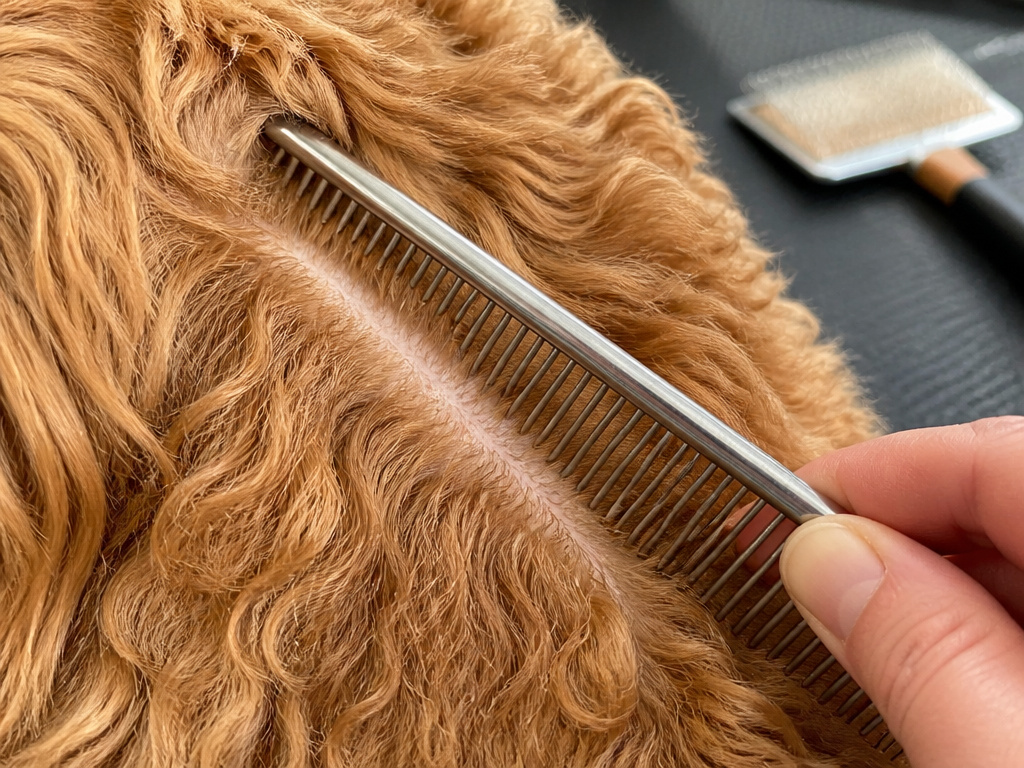
A slicker will skate right over a mat near the skin and leave you feeling pleased with yourself. The comb will not be fooled. Burton’s standard is simple: run the comb through a section down to the skin, and if it stops, the section is matted.
Andis uses the same rule from the other direction. The professional guide states that if the comb catches, the brushing is not finished.
The slicker separates the coat; the comb verifies it. If the comb stops, that section is not finished, and the fix is more line brushing in smaller sections, not more pressure on the brush.
Slicker vs Comb: What Each Tool Actually Does
The slicker does the separating. It opens the coat, lifts trapped shed hair, and pulls tangles apart. The comb does the verifying, and it is the only tool that reaches the skin consistently. The Doodle Pro notes that most slickers only brush the top part of the fur, which is why a stainless steel comb is the required half of the pair.
Here is where the sources split. Andis, Burton, and The Doodle Brush all require a comb check. Doodledoods.com describes line brushing with a slicker alone and does not mandate one. Three out of four is not a close call.
There is a Greyhound comb in my drawer for exactly this reason: it finds what the slicker misses behind the ears and under the front legs.
If the comb stops in several places, you are past what a slicker will fix, and matted dog hair needs a different set of tools.
Bathing, Drying, and the Mistake That Cements Mats
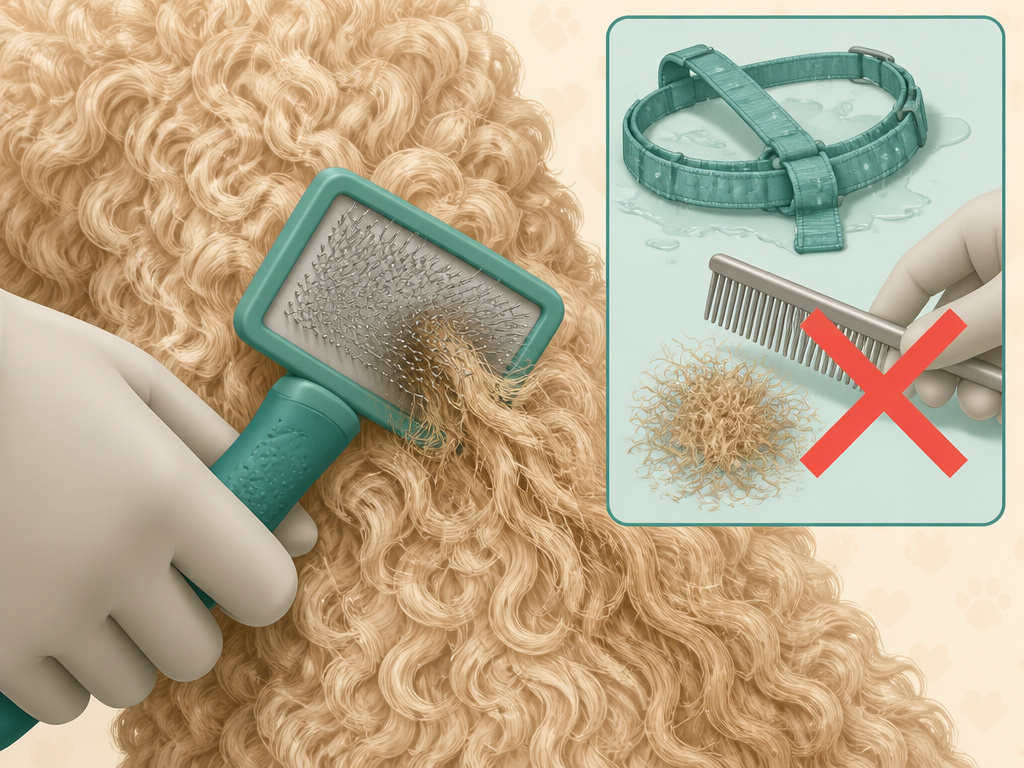
The dog comes in from the rain, the harness comes off damp, and someone runs a comb through an hour later. That is how a small tangle turns into a mat. Andis names baths, rain, snow, and swimming together, because water tightens tangles and accelerates mat formation. Damp collars and harnesses left on the dog are on the don’t list for the same reason.
Both Andis and The Doodle Pro put a thorough brushing before the bath, and both call bathing over mats the biggest mistake in the routine. Burton is blunt: water cements tangles, and brushing them out afterwards is often impossible.
Doodledoods.com takes a narrower position. It says bathing and fully blow drying beforehand may not be necessary unless you are using clipper combs, in which case it is definitely a must. That is a statement about clipping, not about mat prevention, so read it carefully.
Drying matters as much as washing. Andis requires complete drying with brushing during the dry, and lists air drying as a don’t. Burton recommends a high-powered pet dryer and notes that a personal blow dryer is usually louder and less powerful, which matters when the dog is already tired of the process.
Skip this if: Your dog is already matted. A bath will tighten what is there and make removal harder, so book the groomer first and wash afterwards.
My own dogs get bathed on a regular cadence, and no vet has ever blamed a coat problem on under-bathing. That is a bathing cadence for my dogs, not a coat-type schedule for yours.
The at-home dog grooming routine is really this: brush, wash, dry, comb, repeat in that order. Andis also lists a detangling spray for doodles among the recommended home tools, though sources disagree on whether a de-matting tool belongs in the kit.
Tools That Earn Their Drawer Space
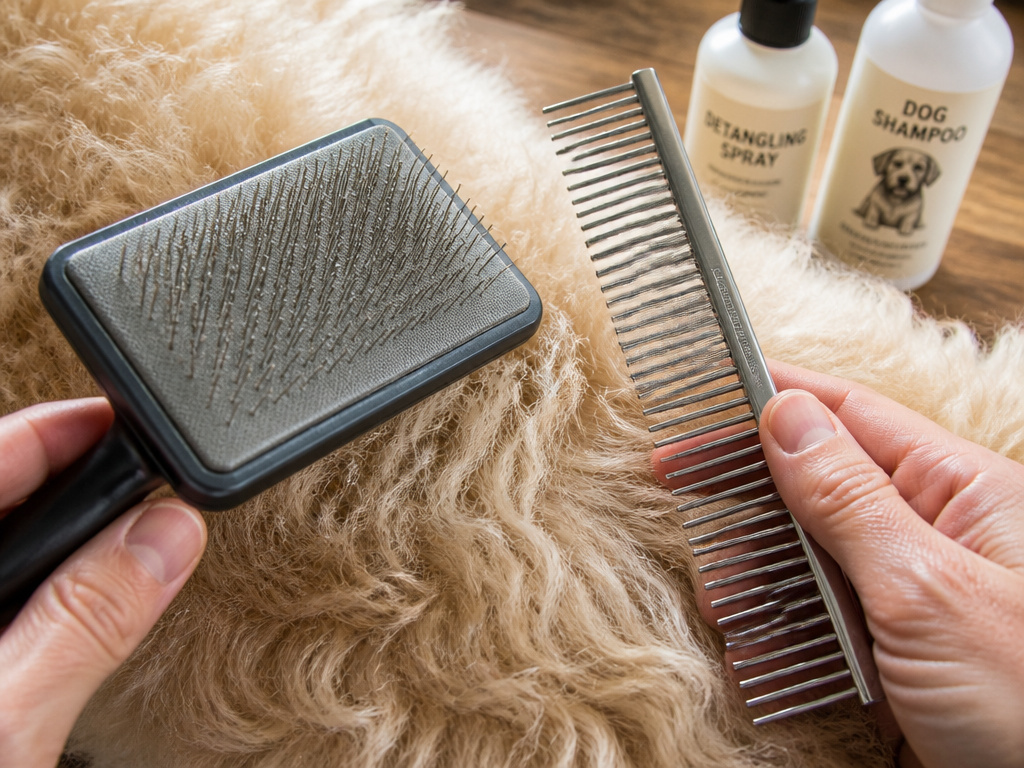
Andis’s at-home guide names three tools: a slicker brush, a steel comb, and a dematting tool. Burton’s list overlaps on two of those and rejects the third. She wants a long-bristled slicker and a metal Greyhound comb, and her instruction on the blade is to leave it in the store.
That is a genuine disagreement between a manufacturer and a working groomer: Andis lists a dematting tool among recommended home care tools, while Burton does not want one on a doodle. Andis lists a dematting tool among recommended home care tools. Burton does not want one on a doodle. You are choosing between a tool list and a groomer’s preference, and if you are unsure, the comb-first approach is the one that cannot hurt the dog.
The working kit is short:
- A long-bristled slicker sized to your dog. Burton specifies bristles that are long, exit at a straight angle, then angle slightly down.
- A metal comb, ideally a Greyhound style. This is the tool that confirms the work.
- A detangling spray for the tangles that are still loose.
- Dog-safe shampoo and conditioner. Doodledoods.com notes that human products can do more harm than good.
- Nail and ear tools if you are doing the whole routine, including monthly ear hair removal per The Doodle Brush.
I have never regretted spending on a comb. I have regretted every short-bristled slicker I ever bought, because a brush that skims the surface makes you feel finished when you are not.
For most doodles, a long-bristled slicker plus a metal comb covers the entire job. A long-bristled slicker and a Greyhound-style metal comb are the pair Burton describes.
Flat pin brushes are the trap here. They are built for short and medium coats and will skim a doodle coat without ever touching the skin.
If you would rather not guess, a guide to the best brushes for doodles narrows the field to the ones with real bristle length. Andis names a slicker brush among its recommended tools, so check availability before you settle for a short-bristled substitute.
One more request belongs in this section. Ask your groomer to keep the friction zones shorter than the rest. Not shaved, just shorter. Trimming a doodle coat is a different job from brushing, but it decides how much brushing you will be doing.
Frequently Asked Questions
How long does it take to brush a doodle?
About 30 minutes for a full brush-and-comb session, according to Fear Free certified groomer Joy Burton. That number assumes a brush sized to your dog. A small brush on a 60-pound doodle turns a 30-minute job into a two-hour one.
Can I use a human hairbrush on my doodle?
No. Flat pin brushes are built for short and medium coats and skim the surface on a doodle. You want a long-bristled slicker with bristles that exit at a straight angle and then point slightly down, plus a metal comb to check the work.
What do I do if my doodle already has mats?
Brush what you can reach, then stop. A metal comb that stops means the section has felted, and felted coat does not comb out with more pressure. Andis’s guidance is not to bathe over mats, because water tightens them further. A groomer with clippers is the honest answer at that point.
Does bathing help get mats out?
It makes them worse. Andis states that water can tighten tangles and accelerate mat formation, and The Doodle Pro calls bathing over mats the biggest mistake doodle owners make. Brush thoroughly before the bath, never over a mat.
How do I know if I’ve brushed down to the skin?
Run a metal comb through the section. Andis’s at-home guide treats a comb that glides through easily as the tangle-free signal, and the professional guide says that if the comb catches, the brushing is not finished.
Should I shave my doodle to make brushing easier?
That is a groomer’s call, not a home decision. A shave-down is usually the result of mats that already formed rather than a shortcut around brushing.
Before You Go
One change many groomers recommend is switching from a daily quick pass to a real session every other day, though Andis still advises daily brushing for curly coats. Burton’s argument is that 30 minutes of line brushing every other day outperforms a rushed daily pass, and the comb test is what proves which one you actually did.
If the comb stops in one zone, work that zone in smaller sections. If it stops in three or more, stop brushing and book a groomer. You are past what a slicker will fix, and every extra pass on a felted coat is uncomfortable for the dog.
Everything above assumes a coat that is still workable. If your doodle is already matted to the skin, no tool described here will undo it, and clippers are the kinder answer.
So the whole answer to how to brush a doodle dog fits in one sentence: reach the skin in small sections, then prove it with a comb. Three questions before your next appointment:
- Is my dog’s coat curly, wavy, cotton or wool, or straight?
- Am I finishing with a metal comb, or only with a slicker?
- Is the coat fully dry, and is the harness off?
Get those three right and the shave-down conversation mostly stops happening.
