
How Often Should You Bathe a Dog? The Honest Range
This post contains affiliate links. As an Amazon Associate, we earn from qualifying purchases.
How often should you bathe a dog? Published answers run from once a week to a few times a year for a healthy dog, and the difference tracks coat, activity and skin rather than breed alone. A dog with diagnosed skin disease gets bathed far more often, sometimes daily, on a vet’s instruction.
That range is wider than it sounds, and it explains how the how often should you bathe a dog question lets two owners with genuinely healthy dogs both be right while doing completely different things. A short-coated dog that sleeps on the couch and a double-coated dog that swims twice a week are solving different problems. Bathe them on the same schedule and one of them pays for it.
What follows is the published range laid out source by source, a coat-by-coat table you can match to your own dog, and the technique details that decide whether a bath helps or starts three weeks of scratching.
Key Takeaways
- Once a week is safe, not required. The WSU veterinary teaching hospital calls weekly bathing safe with a veterinary shampoo; Texas A&M caps it there unless a vet directs otherwise.
- Coat length moves the number more than breed. Medium and long coats land at four to six weeks, short coats at one to three months, and hairless breeds at weekly.
- Medicated baths run on a completely different clock. Ceva’s protocol is weekly plus a mousse or spray between baths; Bajwa’s review allows up to daily for severe cases.
- Rinse until the water runs clear, then keep going. Leftover shampoo causes more irritation than the dirt did.
- Human shampoo is where the sources split outright. Blue Cross recommends baby shampoo; WSU, Texas A&M and Ceva all say dog-formulated only.
How Often Should You Bathe a Dog? What Each Source Actually Says
The ASPCA sets its floor at once every three months.
Published bathing intervals for healthy dogs range from weekly to a few times yearly. The spread reflects coat type, activity level, and skin condition rather than disagreement about biology: a short-coated indoor dog and a double-coated dog that swims weekly are not the same bathing problem. Owner preference is a legitimate factor in the healthy-dog case.
Those are the two ends of a real spread, and both come from organizations that handle dogs professionally. Texas A&M’s Dr. Mark Stickney approaches the same territory from the cautious side, warning that anything beyond once a week will dry out the skin unless a vet directs it for a condition.
| Source | Interval for a healthy dog | What it hinges on |
|---|---|---|
| ASPCA | At least once every three months | Minimum baseline |
| Blue Cross (UK) | Every few months | Normal healthy coat |
| Chewy (Dr. Billmaier) | 4-6 weeks medium/long; 1-3 months short | Coat length |
| WSU vet hospital | Once a week is safe | Veterinary shampoo |
| Texas A&M (Dr. Stickney) | No more than once a week | Skin oil |
| PetMD (Dr. Mitchell) | Once a week to a few times a year | Coat, breed, season |
The middle of the range is where most guidance lands. Chewy’s Ashley Davidson puts the typical dog at about once a month. PetMD’s Dr. Sandra C. Mitchell describes the happy medium as anywhere from once a week to a few times a year, which is a polite way of saying the number depends entirely on the dog in front of you.
The peer-reviewed literature is even more reluctant to commit. A 2025 clinical review by Dr. J. Bajwa declines to set a fixed interval for healthy dogs at all, listing coat, odor and owner preference as the deciding factors.
That refusal is the most useful thing in the whole pile. If a board-certified veterinary dermatologist won’t hand you a number, no blog is going to improve on it.
Odor-causing bacteria often live in the mouth and ear canal, and a bath won’t touch either.
Match the Interval to the Coat in Front of You
Coat length moves the bathing number more than breed name does.
| Coat type | Interval | Who says so |
|---|---|---|
| Short, smooth coat | Every 1-3 months | Chewy (Dr. Billmaier) |
| Medium to long coat | Every 4-6 weeks | Chewy (Dr. Billmaier) |
| Thick or double coat | Every 1-3 months | Chewy (Dr. Billmaier) |
| Hairless (Crested, Xolo) | Weekly | AKC (Beth Cristiano) |
| Dry or sensitive skin | Every 6-8 weeks | Chewy (Dr. Bethany Hsia) |
| Senior, low activity | Less often, wipes between | PetMD (Dr. Mitchell) |
Draw your own conclusion.
Double coats get pushed toward the longer end of the one-to-three-month range. The calendar is a starting point.
Run a hand against the grain along the spine. A coat that feels tacky rather than dry is holding oil, and that’s your signal to move the bath up a week.
The double-coat exception
Thick and double-coated breeds like Huskies and Golden Retrievers can go one to three months between baths, per Dr. Billmaier. Monica Handy of Woofie’s Mobile Pet Spa warns that overbathing these coats strips too much oil and disrupts seasonal insulation.
Easy to miss: Double coats get bathed on a short-coat schedule all the time. The oil that insulates a Husky through February takes longer to rebuild than the four weeks between baths, and you won’t see the problem until the undercoat goes dull and patchy.
What Fourteen Days of Daily Bathing Did to Sixteen Labradors
Sixteen Labrador retrievers were bathed every single day for two weeks in a 2023 study published in Frontiers in Veterinary Science, and it’s the closest thing this topic has to a controlled answer.
The protocol used a 1.6% dilute dish detergent solution and sampled the dogs’ skin microbiota at multiple points over the study. Skin microbial DNA was sequenced at each point.
The results cut both ways. Shannon diversity and Chao1 both increased, and several rare amplicon sequence variants rose. Relative abundance of Actinobacteria, Firmicutes and Proteobacteria dropped significantly (p < 0.05).
The authors’ conclusion was blunt: repeated daily bathing with dilute dish detergent significantly reduced normal healthy dermal microbial taxa and created significant changes in the canine dermal microbiota.
Why does that matter to someone bathing a pet twice a month? Because it puts a number on the tension the frequency charts paper over. Search-and-rescue dogs can be deployed for up to fourteen consecutive days and require daily decontamination. Canines decontaminated daily at the Oso, Washington mudslides reportedly showed skin irritation within three days, which faded once the detergent stopped.
The study has real limits and the authors say so. There was no water-only control group, the sample was sixteen dogs of one breed, and COVID-19 travel restrictions kept the population small.
Fair warning: nobody has run the equivalent trial on a couch-bound spaniel bathed monthly. The working-dog data is the best available, and it’s about decontamination, not coat condition.
Ten Minutes Is the Number Most Baths Skip
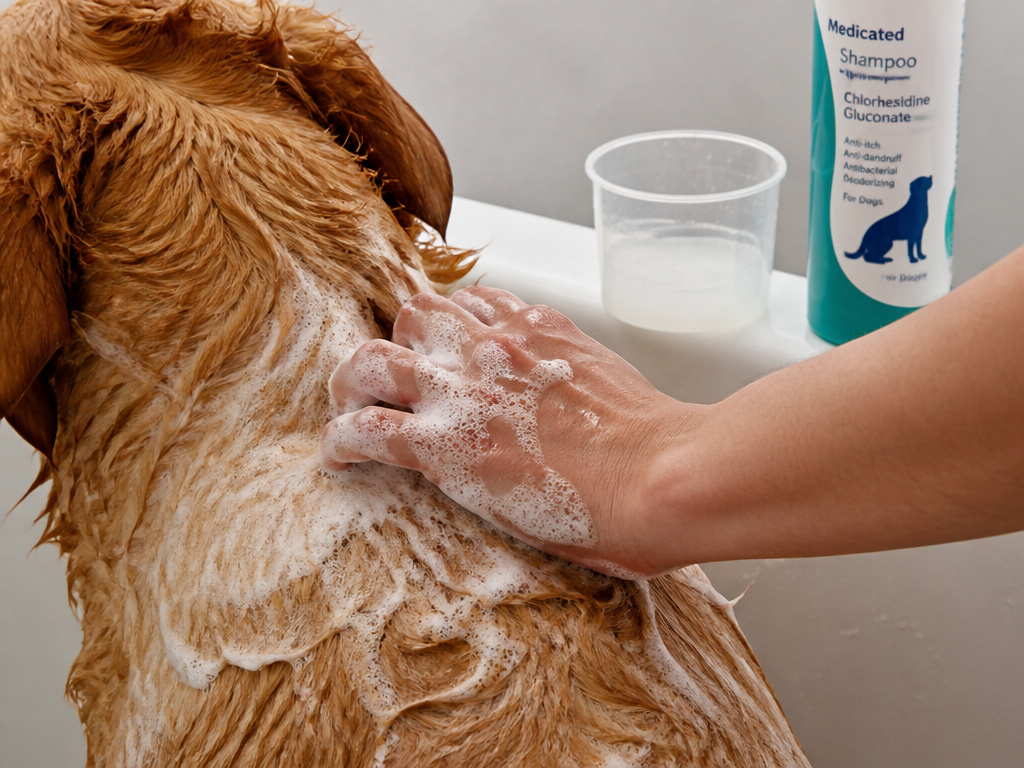
Ten minutes on the label means ten minutes, and almost nobody gives it ten.
Ceva Animal Health’s medicated bathing protocol says to leave shampoo on the dog for a full ten minutes to optimize effectiveness. Blue Cross says to follow the label, which usually means five to ten minutes. Bajwa’s review names the failure directly: owners underestimate technique and contact time, and treatment fails despite the right product being chosen.
Here’s the sequence that actually holds up, with what goes wrong at each step:
- Brush out tangles before the water goes on. Wet fur mats harder than dry fur, per WSU, and a mat you create today becomes a shaved patch next month.
- Dilute the shampoo in a cup first. A diluted mix spreads through a double coat better than a dollop on the back.
- Work from the neck down, avoiding eyes and ear canals. Ceva’s card is explicit about the neck-down start and the two zones to skip.
- Let it sit the full contact time. Cut this short and you’ve washed the dog without treating anything.
- Rinse until the water runs clear, then rinse the clear areas last. Ceva’s medicated sequence rinses healthy skin first and the affected areas last, so you aren’t washing treatment onto broken skin.
If the label says five to ten minutes, the bath is not finished at three. Contact time is the cheapest part of the treatment and the first thing owners cut.
Skin that’s very dirty or seborrheic gets a cleansing shampoo first, then the medicated product, so the active ingredient can actually reach the skin. That sequencing comes straight out of the clinical review, and it’s the step most home bathers never hear about.
The Rinse Is the Part That Decides Whether Your Dog Itches
Ever run a hand over a dog’s back after a rinse and had it come away slick?
That film is shampoo, and it’s the reason a dog scratches for three days after a bath that looked perfectly fine. Bajwa’s review says to rinse thoroughly until the water runs clear because incomplete rinsing can lead to skin irritation. Blue Cross goes further and says the rinse has to reach the skin itself.
That’s not a technique problem. It’s just where the water doesn’t reach on its own.
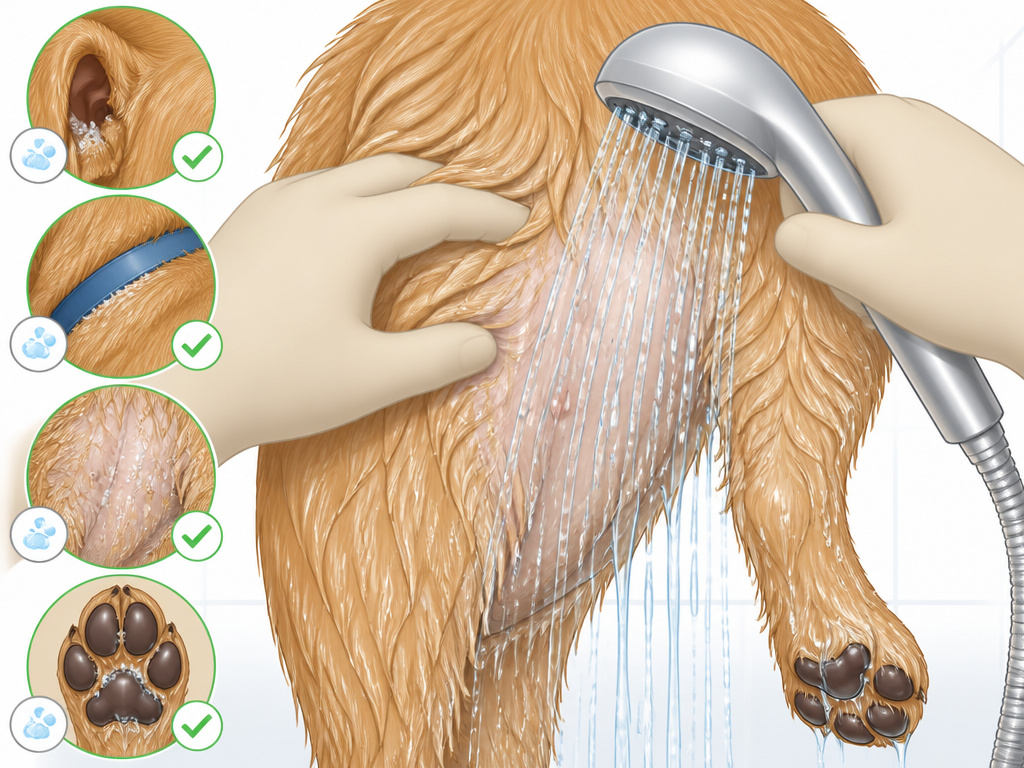
Check these four spots before you reach for the towel:
- Behind the ears, where the coat is dense and water runs around rather than through.
- Under the collar line, which stays soapy longer than any other part of the neck.
- The belly and inner thighs, where the coat thins out and shampoo pools.
- Between the foot pads, which Ceva’s protocol specifically calls out for washing and which almost nobody rinses with the same care.
Suds hide in exactly the places you’d hide if you were trying to avoid a rinse.
I won’t defend a fragrant deodorizing shampoo for a dog that smells.
If the scratching starts soon after the bath, the dog itching after bathing checklist walks through the usual culprits in order.
Is Baby Shampoo Ever Okay on a Dog?
Where the veterinary schools land
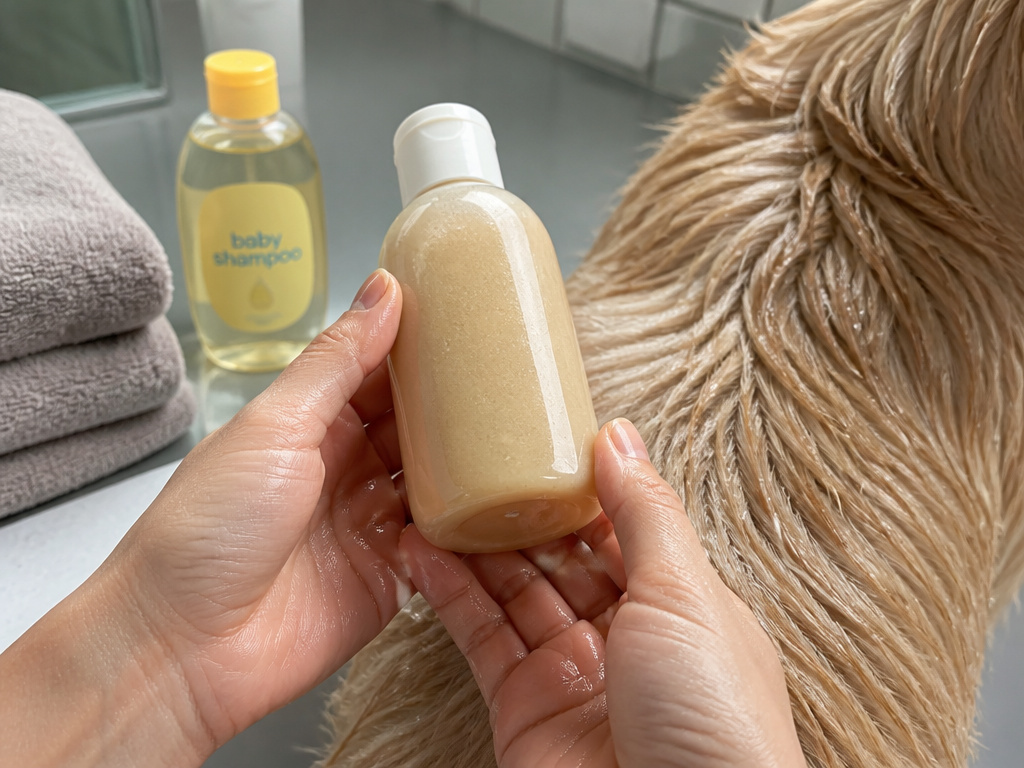
WSU states plainly that human shampoo strips natural oils and may irritate dog skin, and that you should stick with products formulated for veterinary use. Texas A&M’s Dr. Stickney makes the pH argument: human shampoos and conditioners have pH levels that can harm a pet’s skin and cause irritation. Ceva’s client card says to use only a shampoo formulated for dogs and recommended by your veterinarian.
Blue Cross, a UK animal welfare charity, recommends a baby shampoo for dogs with normal healthy coats.
Both positions are published by organizations with real animal welfare credentials. I’ll tell you which one I follow and why: the pH argument is a mechanism, and the baby shampoo recommendation isn’t. A dog’s skin sits at a different pH than a human’s, and a shampoo built for the wrong pH doesn’t need to cause visible damage to cause irritation.
What to use instead
For routine baths on a healthy coat, an oatmeal-based dog shampoo is the low-risk default, and how cleanly it rinses out matters more than the marketing copy on the front.
If your dog has a diagnosed skin condition, stop shopping and call the vet. Medicated shampoos are dosed products, and the review literature is clear that chlorhexidine-containing shampoo has been recommended at 19 mL per square meter of body surface area. That’s not a number you guess at.
A good dog shampoo for home bathing is one your vet recognizes, not one that smells like a candle.
Worth knowing before you start: A dog with a history of allergies can react to a shampoo that’s perfectly fine for every other dog in the house. If the skin goes red or the scratching ramps up after the bath, stop and rinse with plain water rather than finishing the bath.
Setting Up the Bath So the Dog Isn’t the Hard Part
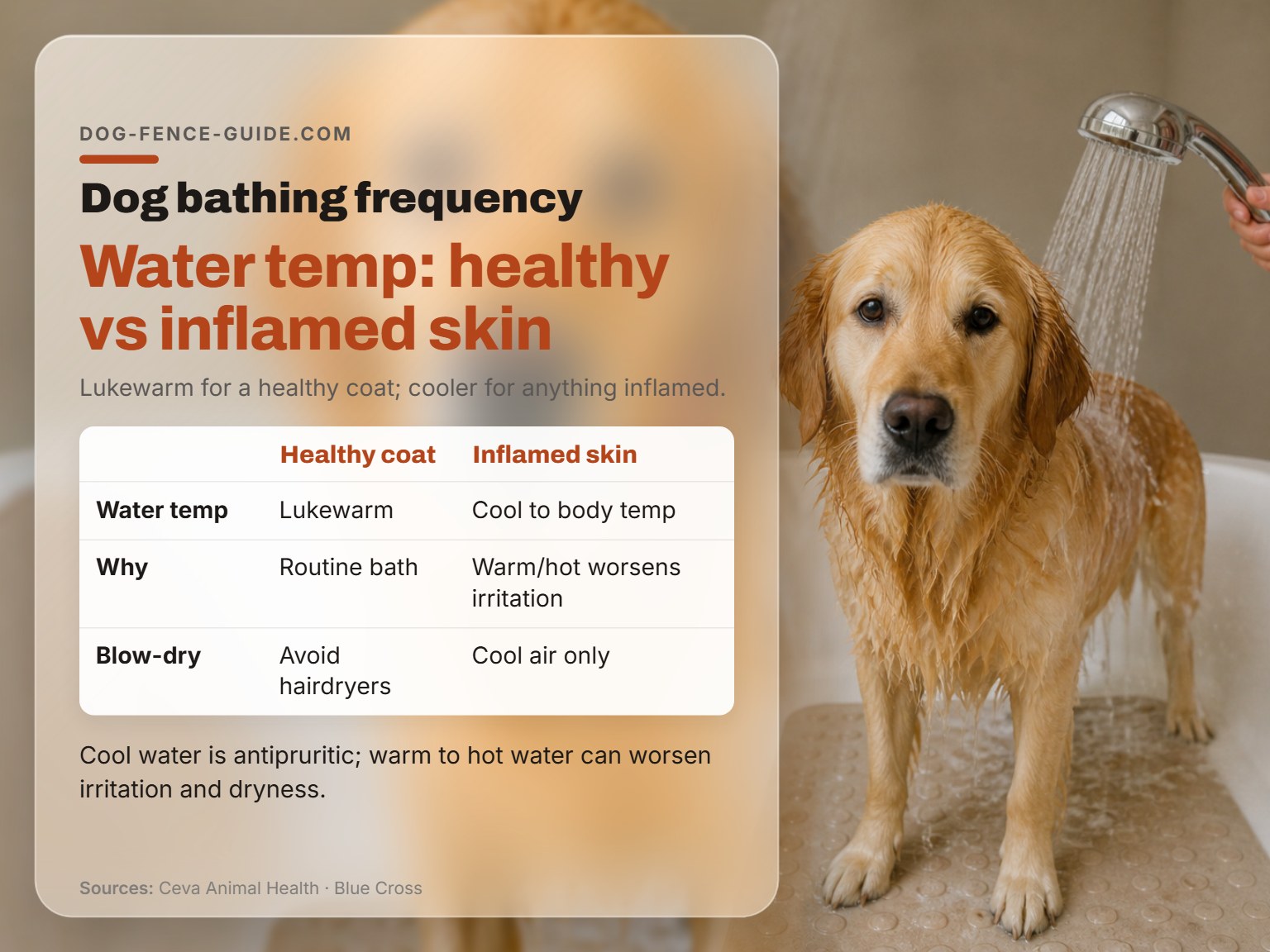
Three things decide whether a bath goes smoothly: footing, water temperature, and where you start on the body.
Before you start: Water above body temperature worsens irritation on inflamed skin, and shampoo left in the ear canal sets up an infection that outlasts the bath by weeks.
Temperature is where the sources genuinely diverge, and the split is useful rather than confusing. Ceva’s healthy-dog card says lukewarm water. Ceva’s medicated card says cool water. Bajwa’s review advises cool to body-temperature water for dermatological patients specifically, because warm to hot water can worsen irritation and dryness, and cool water is antipruritic.
So: lukewarm for a healthy coat, cooler for anything inflamed. That’s a coherent rule, not a contradiction.
The rest of the setup is short:
- Non-skid mat or wet towel on the tub floor, every time.
- Brush out tangles before the coat gets wet.
- Wet and rinse from the neck down, keeping water out of the eyes and the inside of the ears.
- A wet washcloth for the face instead of shampoo, which is the ASPCA’s recommendation and the one most people ignore.
Drying splits the same way. Blue Cross says hairdryers can dry out or irritate skin and are probably best avoided entirely, recommending a towel and keeping the dog warm until the coat is fully dry. Bajwa allows blow-drying on cool air only, since warm to hot air irritates inflamed skin.
Either way, the towel does the work. The routine for drying a dog after bathing matters more in winter, when a damp double coat stays damp for hours.
When the smell isn’t the coat
Dry shampoo is cosmetic. Blue Cross is direct about it: dry shampoos are no substitute for a bath with shampoo, and a dog that needs washing still needs washing after you’ve sprayed him.
If the smell returns within a day of a real bath, check the ears and the teeth before you bathe again. Those are the two most common sources of odor-causing bacteria, per the ASPCA, and neither one improves with more shampoo.
Common mistake: Bathing the dog an hour before he goes back out to patrol the yard. He rolls, you rinse him again the same afternoon, and the coat never dries all the way through between soakings.
Frequently Asked Questions
Can I bathe my dog more than once a week?
WSU says once a week is safe with a veterinary shampoo but warns that going beyond that strips the coat’s protective oils. For a diagnosed skin condition the answer changes completely, and Bajwa’s review allows bathing as often as once daily depending on severity and treatment goals.
What water temperature should I use?
Lukewarm for a healthy dog, per Ceva’s healthy-bathing card. For a dog with inflamed or allergic skin, cool to body temperature is the better call, since warm to hot water can worsen irritation and dryness. Cool water also has a mild anti-itch effect.
How do I know if I’m bathing too often?
Watch the coat and the skin rather than the calendar. Dry, flaky skin and a coat that feels brittle instead of oily point toward overbathing. Dr. Bethany Hsia puts dogs with dry or sensitive skin at every six to eight weeks for that reason. The reverse signal is a coat that feels tacky against the grain, which means oil is building up and the bath is due.
Should I use a hairdryer on my dog?
Blue Cross advises against it, saying hairdryers can dry out or irritate an animal’s skin, and recommends towel-drying plus keeping the dog warm until the coat is fully dry. Bajwa’s review permits blow-drying on cool air only. Warm or hot air on inflamed skin makes things worse.
Does my dog need a bath after every muddy walk?
Dr. Billmaier’s guidance is yes for a dog that swims in the ocean, rolls in mud, or otherwise gets clearly dirty, even if he was bathed recently. A damp washcloth rubdown handles the short-coated dog who picked up dust at the park, per groomer Jorge Bendersky. Mud is a different category from dust.
Before You Go
Here’s the concession first, because it matters more than anything above it: if your dog has a diagnosed skin condition, every interval above is overridden by your vet’s schedule. Medicated bathing is dosed treatment, and the cadence is set by severity, not by coat type.
For everyone else, two thresholds do most of the work. If you can smell the dog from arm’s length and the coat feels tacky against the grain, you’re past due. If the skin is flaking and the coat feels brittle and dry, you’re bathing too often, and the fix is a longer interval plus a conditioner rather than a different shampoo.
Measure first, decide second. Three things to verify before your next bath: the label’s stated contact time, whether your shampoo is actually formulated for dogs, and whether the tub floor has something on it that won’t slide. Get those three right and the frequency question mostly answers itself.
