
How Much Should a Puppy Eat? By Age and Body Condition
This post contains affiliate links. As an Amazon Associate, we earn from qualifying purchases.
How much a puppy should eat depends on expected adult weight rather than current weight: Merck’s benchmark is 2-4 g per day per kg of anticipated adult size through the first five months. Start with the bag’s daily total, then adjust to body condition.
That benchmark is a rate, not a portion, which is why two eight-week-old puppies can need wildly different amounts in the bowl, and it is also why how much should a puppy eat depends on its expected adult size. Run the arithmetic and a future 30 kg Labrador is gaining 60 to 120 grams a day. A future 8 kg terrier is gaining 16 to 32.
What follows is the working method: how the bag chart compares to the veterinary numbers, how meal frequency changes with age, what a large-breed label actually has to say, and the one weekly measurement that tells you whether any of it is working.
Key Takeaways
- Weekly weight gain is the real feedback loop. A puppy gaining a little every week is being fed correctly, whatever the bag says.
- Meal frequency drops with age: four small meals at six to twelve weeks, three from three to six months, two after six months.
- Large and giant breeds need the AAFCO large-size-dog statement on the label, not a smaller scoop of a standard puppy food.
- Treats stay under 10% of daily calories, and training rewards count toward that.
- A skipped meal is usually fine. More than a day of refusal, or vomiting and lethargy, means a vet call.
The Bag Chart Is a Starting Point, Not a Prescription
Up to 50% either way.
That’s the margin PetMD puts on bag feeding charts. Their vets write that charts often don’t give the most accurate amount because they ignore the individual puppy’s needs and current physical condition. A puppy may need up to 50% more or fewer calories than the listed figure, depending on body condition score.
Banfield takes a warmer line. Their vets call the bag chart a great place to start, since it lists amounts by current weight and expected adult size. Pedigree lands in the same spot, calling its charts a starting point you adjust with body condition and vet advice. Chewy tells owners to feed the quantities set by their vet and the food label.
Merck Veterinary Manual is blunt about the whole exercise. Any daily feeding recommendation is an estimate or starting point, modified by continual evaluation of weight, condition, skin and coat, performance, and attitude.
So Banfield, Pedigree, and Merck treat the chart as a starting point, while PetMD warns charts often aren’t accurate and a puppy may need up to 50% more or fewer calories than the listed figure. They split on how much weight to give it after that.
Growth rates in puppies stay rapid through the first five months, then begin to plateau after six months. Skeletal maturity arrives at 8-12 months in small and medium breeds and at 10-16 months in large and giant breeds. A growth diet is required until that point, not merely until visible growth stops.
The practical read on how much should a puppy eat: use the chart to get in the ballpark, then let the puppy tell you the rest. Every source says the same thing, just with different levels of enthusiasm.
Which bag you start with matters too. The how to choose puppy food walkthrough covers what actually separates a growth diet from an adult maintenance formula.
The part nobody mentions: Feeding charts are built around expected adult size, not the puppy in front of you. If you don’t know that number yet, the chart is filling in a blank with an average.
How Often Should a Puppy Eat at Each Age?
Three meals, four meals, or two: the number changes with age, and the sources don’t line up at the younger end.
Here’s the honest version. Merck says puppies between weaning and six months old should be fed three times a day, with small breeds possibly needing more than three. The AKC says four feedings a day are usually adequate at six to twelve weeks, then drop to three between three and six months. Pedigree publishes four meals at six to twelve weeks and three at three to six months. Banfield’s example splits an eight-week-old’s daily ration into three or four small meals.
| Source | 6-12 weeks | 3-6 months |
|---|---|---|
| Merck Veterinary Manual | 3 meals daily | 3 meals daily |
| AKC | 4 meals daily | 3 meals daily |
| Pedigree | 4 meals daily | 3 meals daily |
| Banfield | 3 or 4 meals daily | Not specified |
Everyone converges by six to twelve months. Merck, the AKC, and Pedigree all land on two meals a day in that window.
I feed four small meals a day until about twelve weeks, then three until six months. That puts me with the AKC and Pedigree rather than Merck, and I’m comfortable there because a young puppy’s stomach is small and four smaller meals are easier on it than three larger ones.
Small breeds run on a faster clock. Merck notes they may need more than three feedings, and Banfield warns that very young or small-breed puppies can develop low blood sugar quickly. PetMD puts puppies under three months at three to four feedings a day.
Where this goes sideways: Cutting a young puppy to two meals too early. Small-breed puppies can drop their blood sugar between long gaps, and the first sign is a puppy that’s wobbly and disinterested rather than hungry.
If you want the age-by-age breakdown in more detail, the how often should a puppy eat guide walks the schedule hour by hour.
The 2-4 Gram Rule and the Sunday Weigh-In
Merck’s growth benchmark is the closest thing to a universal number in puppy feeding.
Puppies gain an average of 2-4 g per day for every kilogram of their anticipated adult weight during the first five months. Growth rate starts to plateau after six months. That single rate does more work than any chart on any bag.
When you compare a how much should a puppy eat, the number that matters is the trend, not the total. Merck’s guidance is to monitor weight gains weekly and adjust feeding so the puppy gains a small amount each week. Slow growth is preferable to fast growth, and overfeeding during growth raises the growth rate in a way that’s incompatible with proper skeletal development. It also feeds obesity later in life.
I weigh puppies weekly on a kitchen scale and keep a running log in a kitchen drawer. The rule in my house is simple: if the number stalls across two consecutive weekly weigh-ins, I’m calling the vet. Not adjusting the food. Calling.
That log has caught more problems than any feeding chart ever did, because it reflects the actual puppy rather than an average.
Large-breed puppies fed 50-70% of their littermates’ free intake showed no stunting of adult height, length, or bone and muscle mass. Only total body fat changed.
That finding is the strongest argument against topping up a puppy that seems hungry. The frame you’re building doesn’t get bigger with more food. It gets fatter.
The puppy weight gain tracking method covers how to run the log and what a flat week actually means.
How Many Calories Does a Puppy Actually Need?
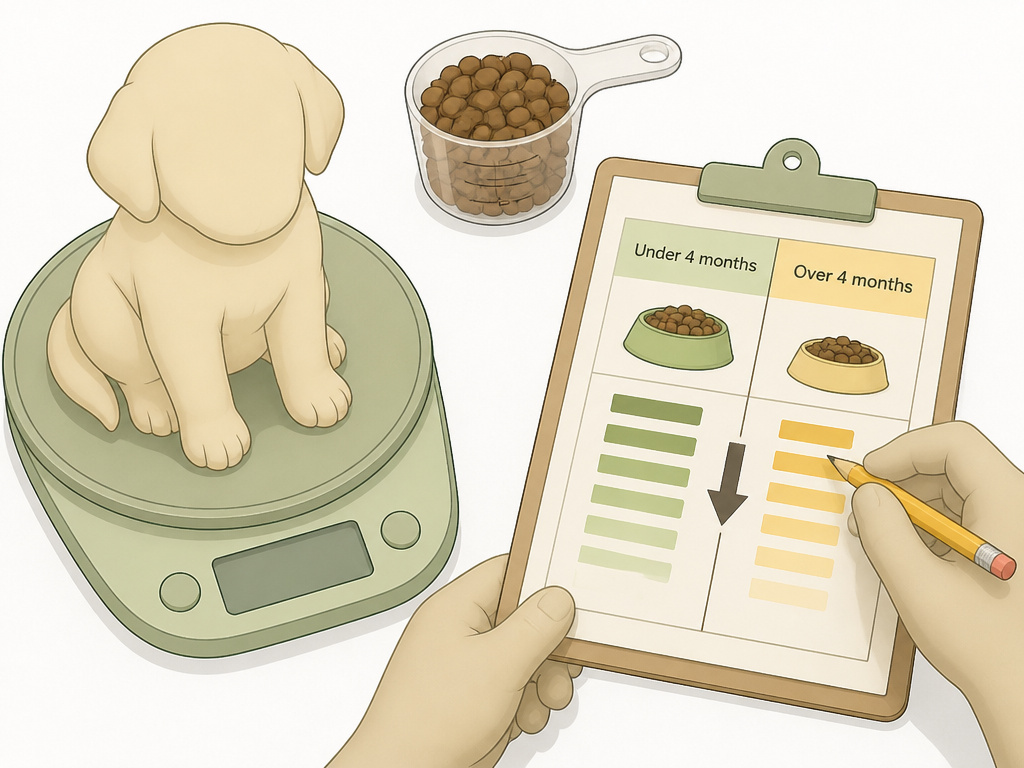
A ten-pound puppy under four months old averages 649 calories a day. Past four months, the same ten pounds averages 433.
PetMD publishes both tables, and the drop is steep. Their figures are averages for healthy puppies, with individual needs varying up to 50% in either direction.
| Puppy’s weight | Under 4 months | Over 4 months |
|---|---|---|
| 5 lb | 392 kcal/day | 261 kcal/day |
| 10 lb | 649 kcal/day | 433 kcal/day |
| 25 lb | 1,294 kcal/day | 863 kcal/day |
| 50 lb | n/a | 1,456 kcal/day |
The reason for the fall is straightforward. PetMD notes that protein and fat requirements begin to decline once a puppy reaches three months, though both stay above adult levels. PetMD notes that protein and fat requirements begin to decline once a puppy reaches three months, though both stay above adult levels.
Those calorie figures are also the honest answer to why the bag chart frustrates people. A chart gives you a single figure to work from. The puppy in front of you might sit 50% above or below it.
The dog calorie needs breakdown covers how the math changes once your puppy crosses into adulthood.
Large Breed Puppies Need a Different Diet, Not Just Smaller Portions
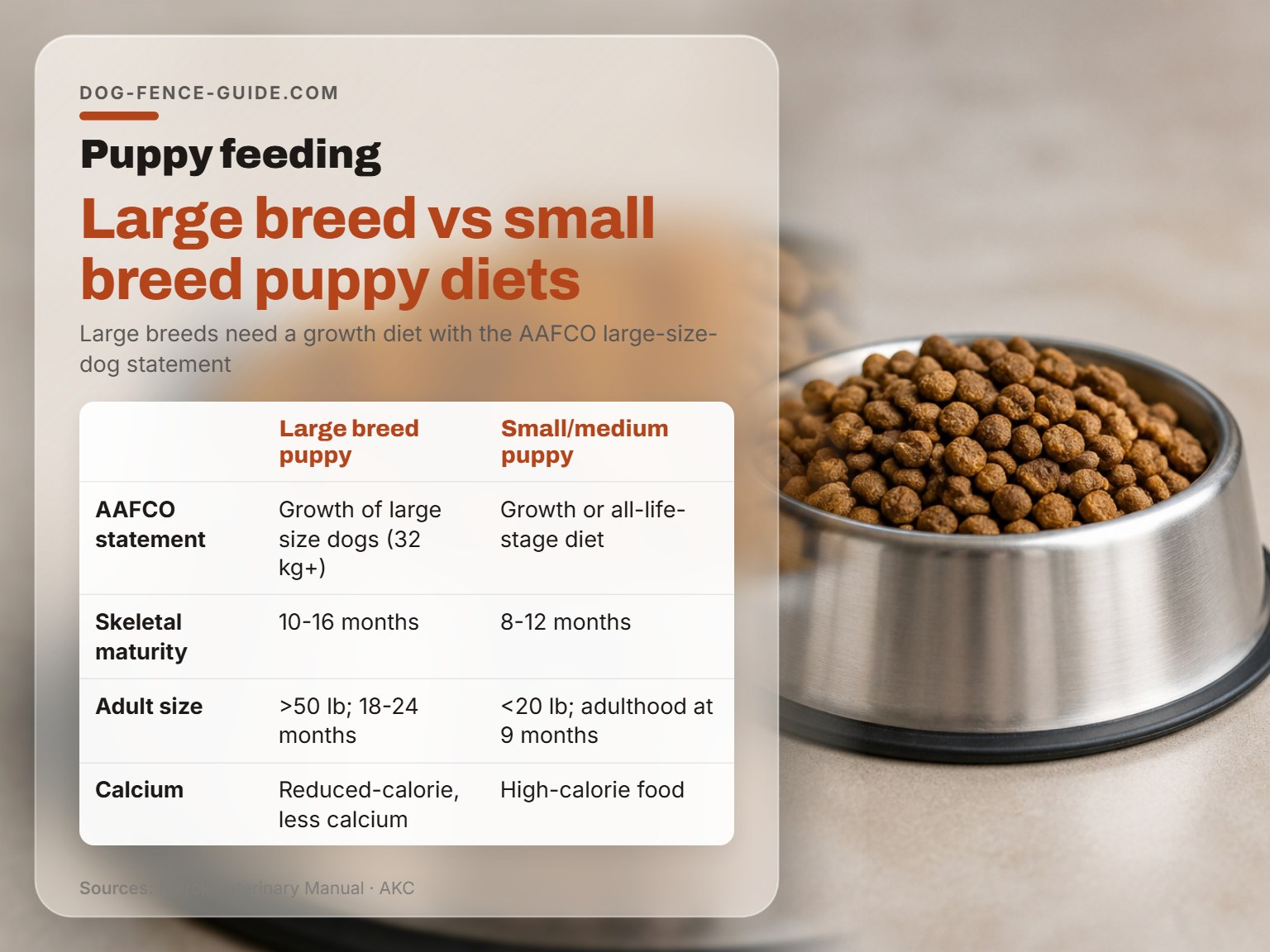
The AAFCO statement on the bag matters more than the scoop you use.
Merck is specific about this. Large and giant breed puppies should be fed complete and balanced growth diets carrying the Association of American Feed Control Officials statement reading “including growth of large size dogs (32 kg or more as an adult).” Small and medium breed puppies can be fed a growth or all-life-stage diet that doesn’t meet that criteria.
That’s a category distinction, not a portion tweak. Getting it wrong means the mineral profile is built for a different animal.
Do You Actually Need a Large-Breed Formula?
Yes, if your puppy is headed past 32 kg as an adult. The AKC defines large-breed puppies as those that will weigh more than 50 pounds when full-grown, and its nutrition guide notes they take about 18 to 24 months to reach adult size. Merck says skeletal maturity may not be completed until 10-16 months in large and giant breeds.
Choose a growth diet that carries the AAFCO large-size-dog statement on the specific bag rather than trusting the word “large” on the front of it. Read the AAFCO statement on the specific bag rather than trusting the word “large” on the front of it.
The Calcium Supplement Trap
Merck states plainly that supplementing calcium, phosphorus, and vitamin D beyond a complete and balanced growth diet is rarely necessary and may be contraindicated. The AKC points the other way entirely, noting that reduced-calorie foods with less calcium help support the proper rate of growth in large-breed puppies.
Both positions point at the same thing: the mineral content is already engineered, and adding to it works against you.
A short checklist before you buy:
- The AAFCO large-size-dog statement on the label, word for word.
- A growth diet that matches your puppy’s expected adult size.
- No calcium or phosphorus topper unless your vet has diagnosed a specific need.
- A measuring cup or food scale, because Banfield says to portion each meal rather than eyeballing it.
The feeding a large breed puppy guide goes deeper on portion control across the first year.
Common mistake: Adding a calcium supplement to a large-breed puppy’s food “for the bones.” Merck flags supplementation as rarely necessary and possibly contraindicated, and Merck flags supplementation as rarely necessary and possibly contraindicated.
What Does a Correctly Fed Puppy Look and Feel Like?
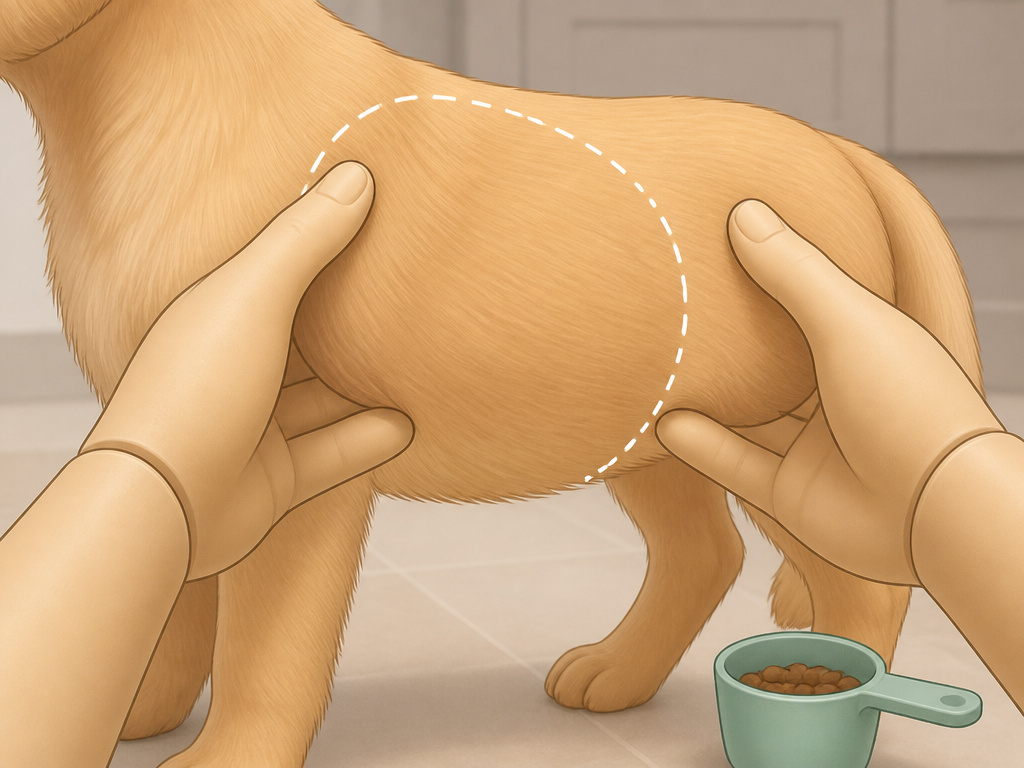
Can you feel your puppy’s ribs without pressing hard?
That’s the check that beats every chart. Run your hands along both sides of the ribcage. Pedigree describes the test as ribs you can feel and a waist you can see.
The AKC has a phrase for this: watch the dog, not the dish. Body condition, not how much food went in or stayed in the bowl, should set portion sizes. Pedigree describes the same test as ribs you can feel and a waist you can see.
The AKC adds a useful timeline marker. A puppy should be losing its potbelly and pudginess by twelve weeks. If it’s still roly-poly at that age, keep feeding puppy-size portions until the body type matures.
Here’s where the sources genuinely disagree, and it matters:
- Banfield says to use a measuring cup or food scale, not your eyes, to portion each meal.
- PetMD says charts often miss by up to 50% either way and that food-restricted meals are the most effective method for growing puppies.
- Chewy says it usually isn’t necessary to determine exactly how much a puppy is eating, as long as they gain weight daily and don’t cry for food between scheduled feedings.
Skipped Meals, Picky Eaters, and When to Call the Vet
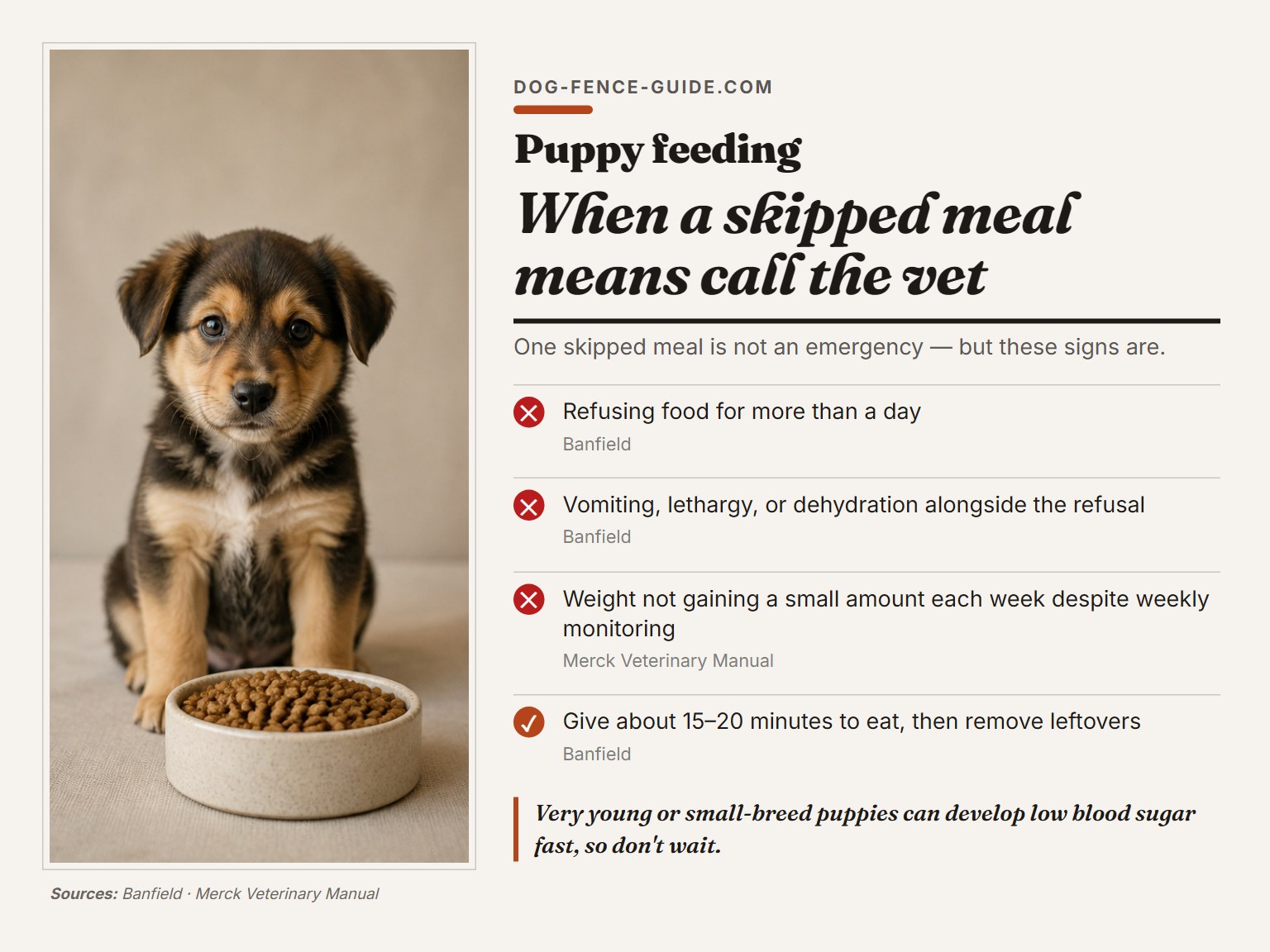
One skipped meal is not an emergency.
The AKC is relaxed about it. An occasional skipped meal or a puppy picking at food may simply mean they’re ready to drop a feeding, or that you served too much, in which case reduce the quantity at future meals.
Banfield adds the guardrails. Give the puppy about 15-20 minutes to eat, then remove the leftovers. And if a puppy refuses food for more than a day, or shows vomiting, lethargy, or dehydration, call a vet right away. Very young or small-breed puppies can develop low blood sugar fast, so don’t wait.
Chewy is direct about the feeding style itself: don’t always leave food down, because it raises the odds of overeating.
Red flags that mean a call rather than a wait:
- More than a day of refusing food.
- Vomiting, lethargy, or signs of dehydration alongside the refusal.
- A puppy showing signs of low blood sugar, such as being wobbly or disinterested.
- Weight that isn’t gaining a small amount each week despite weekly monitoring.
The picky puppy guide covers the non-medical causes once you’ve ruled the serious ones out.
Bottle-Fed Puppies: Where the Math Gets Tight
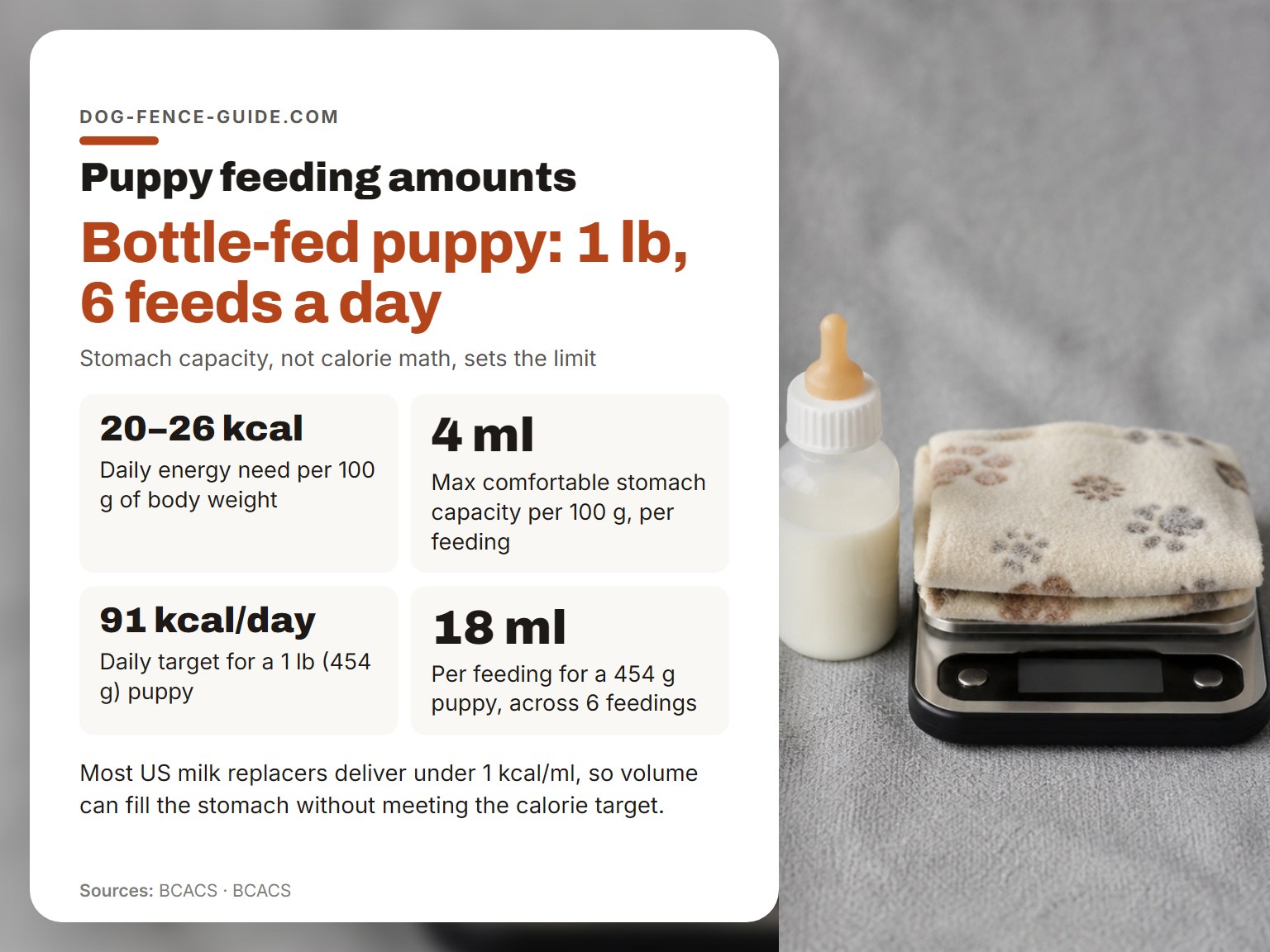
Stomach capacity, not calorie math, sets the limit on a bottle-fed puppy.
Bernalillo County Animal Care Services publishes a chart built on Lawler’s 2008 paper in Theriogenology. The daily energy requirement is roughly 20-26 kcal per 100 g of body weight. The maximum comfortable stomach capacity is about 4 ml per 100 g per feeding. The chart assumes a formula concentration of 0.9 kcal/ml.
For a one-pound puppy at 454 grams, that works out to 91 kcal a day, 101 ml of formula, 18 ml per feeding, and six feedings a day.
Before you start: A puppy’s stomach holds roughly 4 ml per 100 g of body weight per feeding, and pushing past it risks aspiration, vomiting, diarrhea, and gas buildup. Most commercial US milk replacers deliver less than 1 kcal/ml, so the volume a chart gives you can fill the stomach without meeting the calorie target. Never rush a feeding or feed a puppy that’s struggling to swallow.
The Bottle-Feeding Steps That Keep a Puppy Safe
- Weigh the puppy in grams. The whole calculation runs off body weight, and an estimate in pounds throws the volume off.
- Set the daily target at 20 kcal per 100 g. A 454 g puppy lands at 91 kcal a day, per the county chart.
- Convert calories to volume. At the chart’s assumed 0.9 kcal/ml, that same puppy needs about 101 ml of formula a day.
- Cap each feeding at 4 ml per 100 g. For a 454 g puppy that’s 18 ml, spread across six feedings.
- Recheck the density on your actual product. Most US commercial replacers come in under 1 kcal/ml, so the volume needed to hit the calorie target goes up, and that’s where capacity and calorie math collide.
Six feedings a day means a rotation running around the clock, which is the part people underestimate.
Chewy is blunt about the stakes: bottle-feeding the wrong product, the wrong way, in the wrong amount, or on the wrong schedule can lead to illness or even death. Bernalillo County notes that puppies between three and a half and five weeks are usually eating some solid food, which reduces the milk replacer needed.
When Should a Puppy Switch to Adult Food?
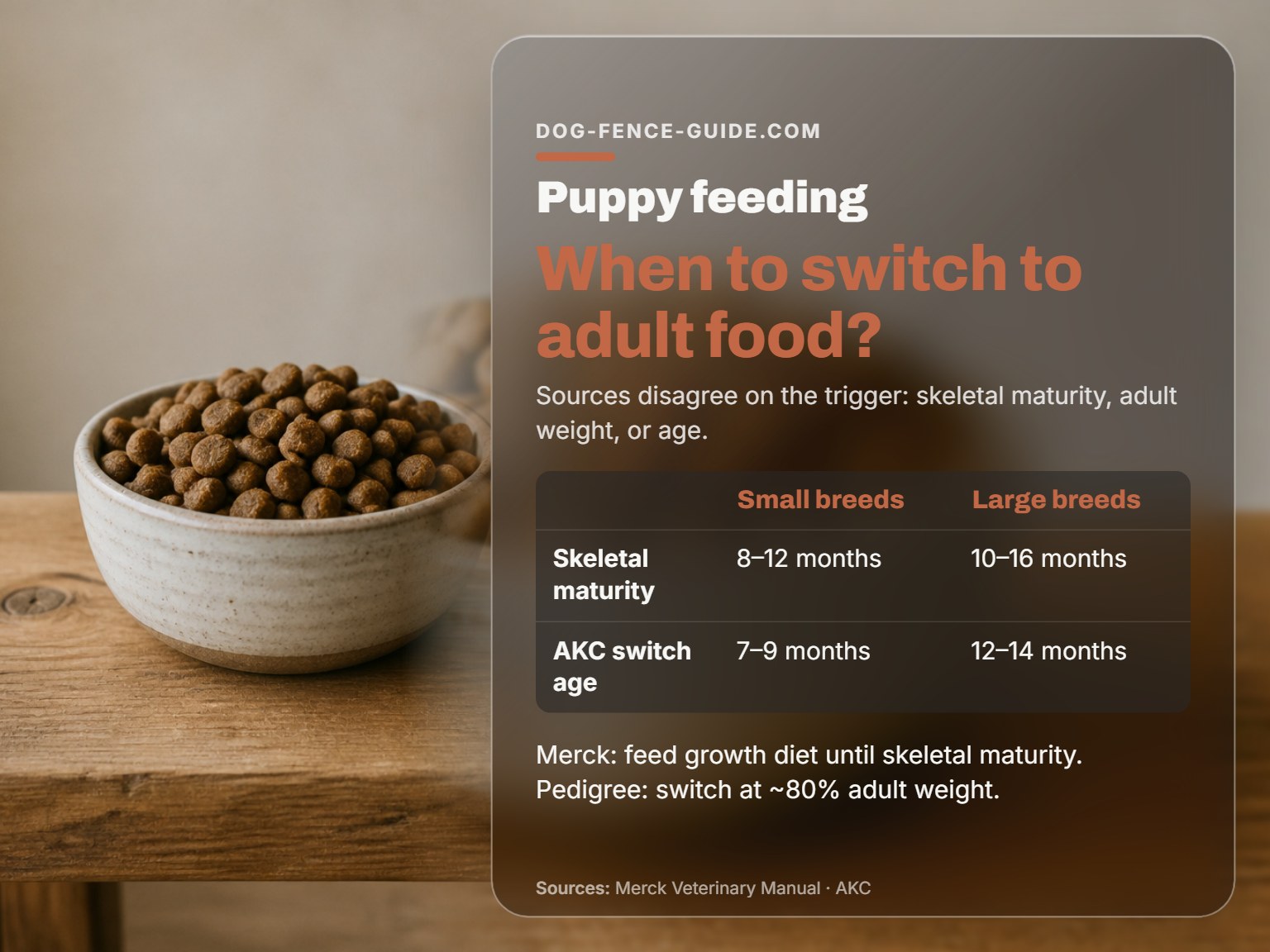
A nine-month-old Chihuahua and a nine-month-old Great Dane are both nine months old, and they’re at completely different points in the same decision.
This is the messiest disagreement in puppy feeding, so here it is laid out rather than smoothed over.
Merck says to keep feeding a complete and balanced growth diet until skeletal maturity, which is 8-12 months for small and medium breeds and 10-16 months for large and giant breeds. Merck also notes that after a dog reaches about 90% of expected adult weight, a less nutrient-dense diet than the growth diet is generally recommended.
The AKC says small-breed puppies can switch at 7 to 9 months and larger breeds at 12, 13, even 14 months. Pedigree uses roughly 80% of expected adult weight as the trigger, with a size table: toy and small breeds under 25 pounds at 9-10 months, medium breeds 25-50 pounds at 12-15 months, large breeds 50-90 pounds at 15-18 months, and giant breeds over 90 pounds at 18-24 months. Chewy puts the switch at 9 to 12 months.
What the Sources Actually Disagree On
They disagree on the trigger, not the direction. Merck anchors to skeletal maturity. Pedigree anchors to a percentage of adult weight. The AKC and Chewy anchor to age bands.
I’d take the later date when two of them conflict. A few extra weeks on puppy food costs you less than switching a large breed early.
Whenever you do switch, Pedigree recommends transitioning over 7 to 10 days to avoid upsetting the dog’s stomach. Banfield adds that after spaying or neutering, a puppy’s metabolism may slow slightly and they could need fewer calories than before surgery.
The puppy food vs adult dog food comparison covers the nutritional differences, and the how much to feed my dog guide picks up the portion question once your dog is on adult food.
Frequently Asked Questions
Should I leave food down for my puppy all day?
No. Chewy warns that leaving food down increases the chances of overeating, and PetMD calls food-restricted meals the most effective method for growing puppies. Banfield suggests giving the puppy 15-20 minutes to eat, then removing the leftovers.
How much should I feed a puppy that’s still nursing?
Nursing puppies aren’t on a measured ration. Chewy notes newborns need to eat every 2-3 hours, and puppies 2 to 4 weeks old should be fed every 6-8 hours. Once you’re bottle-feeding, the calorie math changes entirely and stomach capacity becomes the limiting factor.
Is it OK if my puppy skips a meal?
Usually, yes. The AKC says an occasional skipped meal or picking at food may mean the puppy is ready to drop a feeding or was given too much, and suggests reducing the quantity at future meals. Banfield draws the line at more than a day of refusal, or refusal alongside vomiting, lethargy, or dehydration.
Do puppy feeding charts work for mixed breeds?
They work as a starting point, which is all any of them claim to be. Pedigree and Banfield both describe charts as a place to start, and Merck states that any daily feeding recommendation is an estimate modified by ongoing evaluation. For a mixed breed, the chart needs an estimate of expected adult weight.
How do I know if my puppy is overweight?
Body condition, not the bowl. The AKC’s test is whether your puppy is still losing its potbelly and pudginess by twelve weeks. Pedigree describes it as ribs you can feel and a waist you can see. Merck’s weekly weighing is the objective backup.
The Bottom Line
Here’s the trigger I’d give anyone: if your puppy’s weight is flat across two consecutive weekly weigh-ins, stop adjusting portions and call your vet. Flat weight is a signal, and the fix isn’t always more food.
Short version: pick a growth diet that matches your puppy’s expected adult size, measure the daily total with a cup, split it across the right number of meals for the age, and let the scale and your hands on the ribcage do the fine-tuning.
One concession worth stating plainly. Everything above assumes a healthy puppy with no underlying condition. A puppy with an underlying condition will not respond to portion adjustments the way this method predicts, and no feeding chart will fix that. That’s a vet’s job, not a bag’s.
Peace of mind here comes from the log, not the label.
