
Hound Dog Breeds Pros and Cons: Are They Right for You?
This post contains affiliate links. As an Amazon Associate, we earn from qualifying purchases.
Hound dog breeds pros and cons balance instinct against control: in a 1,867-dog boarhound hunt-trial study, hounds averaged 3.69 for obedience and 3.54 for scent work, but only 0.24 on the scored announcing task. You get a sociable, single-minded dog that needs a secure fence and patient, scent-led training.
That 0.24 sits in a category called announcing, which hunt trials score separately from nose work. A low score there means hounds ranked poorly at the specific task of announcing game. It is a trial metric, not a decibel reading.
Purina’s breed guide fills in that gap. Scent hounds bay, and one baying dog sets off the next.
What follows walks the real hound dog breeds pros and cons: what the trial numbers do and don’t prove, where recall breaks down, why sighthound blood work reads wrong on standard lab ranges, and the temperature limits that decide whether a hound can live outdoors at all.
Key Takeaways
- Obedience scores don’t transfer to recall. Hounds topped the obedience category in hunt trials, yet off-lead recall is the failure owners describe most.
- At least two-thirds of dog breeds carry a recognized genetic disorder, so ask any breeder or rescue to share screening results before you commit.
- Plan the fence around the nose, not the size. A scent hound follows a line under, through, or past a barrier that would stop a dog running on sight.
- Outdoor housing tops out at 85 F (29.5 C), with a hard 4-hour limit outside the 45-85 F (7.2-29.5 C) safe range.
- Train each hound separately if you keep more than one. A second dog doubles the noise and halves the attention.
What the Hunt-Trial Data Actually Shows About Hound Trainability
The largest performance dataset on hounds comes from hunt trials run between 2005 and 2015: 1,867 dogs across 39 breeds, scored on a 0 to 180 scale.
Boarhound hunt trials scored dogs from 0 to 180 points, with a mean of 116.74 across the cohort. Obedience averaged 3.69 and scent work 3.54. Announcing and barking averaged 0.24, the lowest of the scored categories, while tracking on the lead averaged 2.76. Obedience and lead-tracking were the only two scores the study did not link to breed.
Read that again and notice where hounds landed. Obedience came out on top, ahead of scent work and searching. The boarhound hunt trial training study also found breed was the largest single factor in most of the scores, which cuts against the idea that hound behavior is a blank slate you shape entirely through training.
What the Scores Measured (and What They Didn’t)
A hunt trial is a working test, not a obedience class. Dogs are scored on how they perform a job in the field, in front of judges, on game.
I’ve been guilty of reading a trial score as a training rating. It isn’t one. A 3.69 in obedience means hounds performed well within that trial’s scoring rubric. It does not mean your beagle will sit on the first ask while a rabbit is moving.
The practical read: hounds cooperate when the task makes sense to them. Give them a job that runs on scent and they show up. Ask for a stationary sit while the world smells interesting and you get the dog Purina describes.
Why Do Hound Owners Say Training Is Hard When the Scores Say Otherwise?
Purina tells owners that hounds view training as a dark art, while a peer-reviewed hunt-trial analysis puts hounds at the top of the obedience scores, the two sources disagree on how trainable hounds really are. Both statements survive scrutiny once you know what each one measures.
| Claim | Who says it | What the evidence shows |
|---|---|---|
| Hounds are hard to train | Purina breed guide | Trial obedience averaged 3.69, the top category |
| Instinct overrides obedience | Purina breed guide | Breed behaviour differences are highly heritable across 14 traits |
| Patience fixes the problem | Purina breed guide | Heritability means part is a constraint, not a gap |
| Recall is unreliable | Purina breed guide | Off-lead recall was not a scored trial category |
The heritable breed behavior differences study is the one that reframes the argument. It found breed differences across 14 behavioral traits are highly heritable. That means a hound’s tendency to follow a scent line is built in, not a training failure you can drill out of him, though Purina holds that patience and consistency can still work through training challenges.
What “Highly Heritable” Does and Doesn’t Mean
Heritable does not mean fixed. It means the starting position is set by genetics, and the range you can move within is narrower than it is for a breed with less drive.
Purina’s own advice lines up with that reading, even if the framing is softer. The guide says hounds need patience, consistency, and a reward worth working for. It also recommends teaching a Watch Me cue while the dog is still a puppy. That cue is the whole game later, when you need his eyes on you instead of on a squirrel.
If you’re weighing how much drive you can live with day to day, it helps to compare a high-energy dog breed against your actual routine before you fall for a face.
The Pros Nobody Argues About: Nose, Company, and a Built-In Job
A scent hound hits the end of a long line, drops her nose, and goes quiet. That silence is the tell. She’s working, and the whole world has narrowed to one square foot of grass.
That focus is the biggest pro in the hound dog breeds pros and cons, and it’s free. You don’t have to manufacture a job for a hound. You have to give the job somewhere to happen.
Purina notes that scent hounds bred to hunt in packs are usually sociable with other friendly dogs and genuinely enjoy canine company. That matters if you already have a dog and you’re adding a second. Two hounds will entertain each other in a way a single hound and a busy owner never quite manage.
- Nose first, always. Scent work is self-rewarding, so a hound will practice it whether you ask or not.
- Good with other dogs, particularly other pack-bred scent hounds.
- A relatively quiet baseline demeanor around the house, per Purina’s breed guide, with noise spiking when dogs play together.
- Exercise that fits the instinct. Long, slow walks for scent hounds; short sprints for sighthounds.
That last point is where owners go wrong most often. A sighthound walked only at a scent hound’s slow pace may be under-exercised. A scent hound pushed to sprint like a sighthound is just confused.
If you want a calmer companion and you’re honest about your energy budget, a low-energy dog breed is a fairer comparison than a hound you plan to tire out. Hounds don’t tire out on your schedule.
The Cons That Actually Bite: Recall, Noise, and the Fence Line
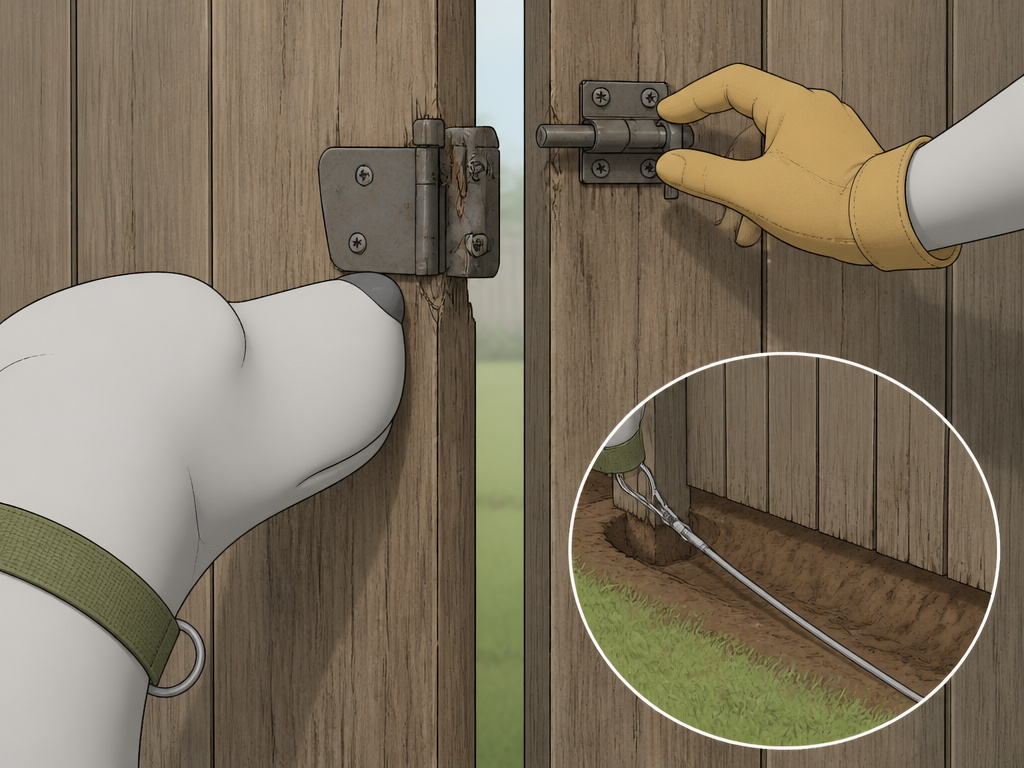
Recall is the con that decides whether a hound works in your yard.
One hound owner I worked with was certain her dog’s nose would beat any boundary training we tried. We put him on a long line and ran the same boundary repetitions every evening, same order, over several weeks. He held the line.
The lesson wasn’t that hounds are easy. It was that a scent-driven dog can learn a boundary when the plan accounts for how long it actually takes. Short, boring, repeated sessions beat every clever trick we tried first.
Purina is blunt about the trade-off: with two or more scent hounds, one dog barking or howling sets off the other, and training becomes more time-consuming because each dog needs individual work to build a strong bond. That’s the honest cost of the second dog.
The Three Escape Routes Hounds Actually Use
Hounds don’t usually go over. They go under, through, or past you.
Work the perimeter in this order, because this is the order failures show up:
- The gate latch. Check it before you check anything else. A latch a smart dog can nose open is a common exit point in a fenced yard, and it’s the cheapest thing on this list to fix.
- The bottom edge. Scent hounds dig when a line runs under the fence. A barrier along the base can stop digging before it starts.
- The gap at the hinge side. Gates sag. A gap at the hinge post is a shoulder-width invitation for a determined dog.
- The sightline past the fence. A hound who can see the thing he wants will keep testing the barrier. Reducing the sightline past the fence can reduce the testing.
I’ve pulled hounds out of a neighbor’s yard through an open gate more often than over a fence panel. The panels get all the shopping attention.
Where this goes sideways: Relying on a wireless containment collar for a hound with strong prey drive. The correction arrives after the dog has already committed to the chase, and a dog in drive is not processing a static impulse. Owners report the system holding fine for a while and then failing completely on the first deer.
If you’re still deciding where your dog comes from, rescue vs breeder matters here. A rescue that has already tested the dog around prey animals will tell you more about his recall than any breed label will.
Sighthound Bloodwork and the Breed-ID Trap
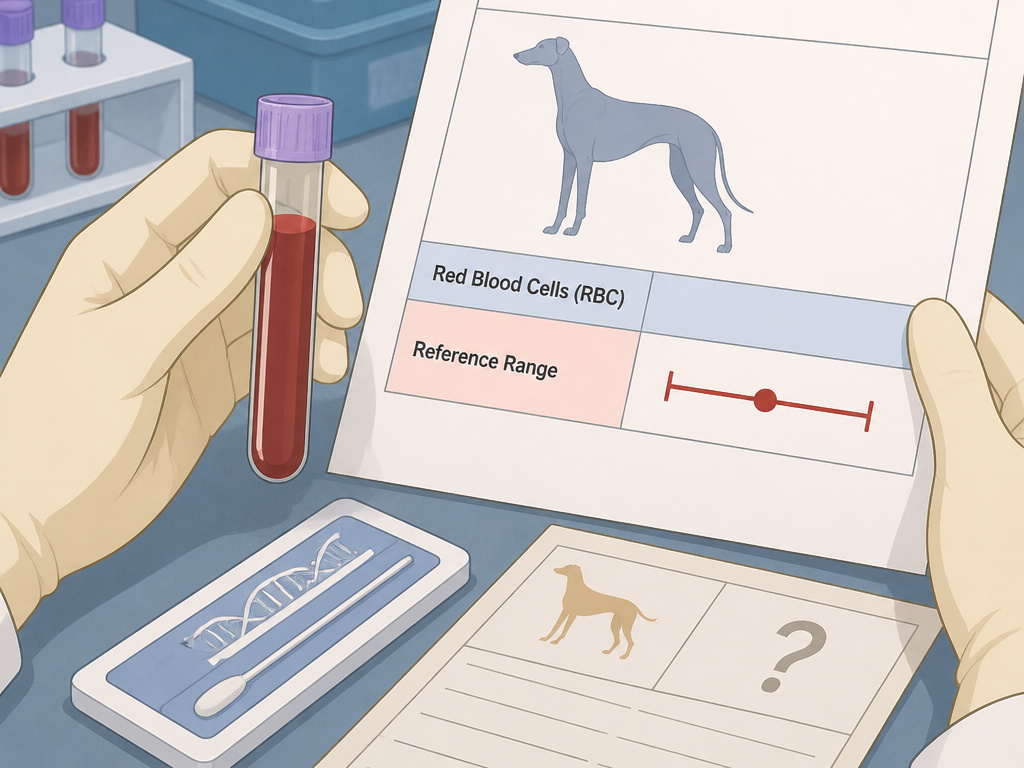
At least two-thirds of dog breeds have one or more recognized genetic disorders, according to the AAHA breed-specific considerations guide. That number changes how you should read any breed profile, including this one.
AAHA also warns that visual identification of a dog’s breed isn’t always correct. If you’re advising someone on a mixed-breed hound, the breed label on the intake form may be a guess. AAHA recommends DNA testing for mixed breeds to flag orthopedic, cardiac, ophthalmologic, gastrointestinal, or drug-sensitivity concerns.
The bloodwork question is where the sources genuinely split.
AAHA’s position is advisory: normal reference ranges may vary in selected breeds, red blood cell mass in sighthounds being the example given, and breed-specific ranges can be useful.
The retired racing Greyhound blood gas study measured it directly. Retired racers showed significantly higher pH, PO2, oxygen saturation, and total hemoglobin, plus a lower P50, which reflects tighter oxygen binding, compared with non-Greyhounds. Standard canine ranges will flag those values as abnormal.
Both positions point the same direction in practice. Tell your vet the dog is a sighthound before the labs get read.
Easy to miss: Breed-specific screening results are worth asking about directly. AAHA recommends sharing them in a public database where possible, as with collie eye screening or hip dysplasia screening. A breeder who has those results on hand is telling you something a breeder who doesn’t is not.
If you’re comparing registries and paperwork, the purebred vs mixed breed question runs deeper than pedigree. Health screening history matters more than the certificate.
How Long Can a Hound Stay Outside Before the Heat Wins?
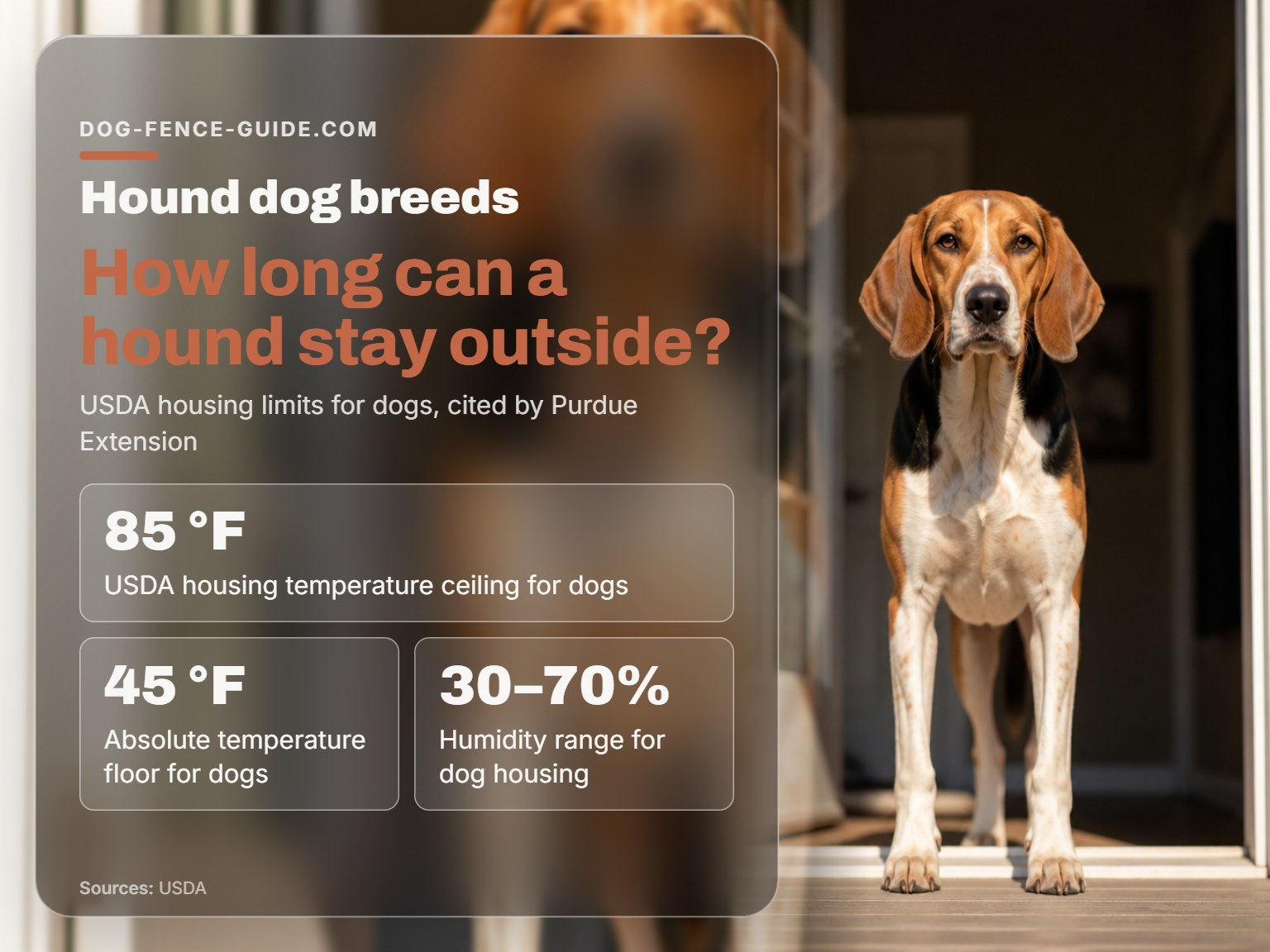
How long can a hound actually stay outside on a hot afternoon? The USDA sets the answer, and it has nothing to do with breed.
| Measure | Limit | Source |
|---|---|---|
| Housing temperature floor, non-acclimated dogs | 50 F (10 C) | USDA via Purdue Extension |
| Housing temperature ceiling | 85 F (29.5 C) | USDA via Purdue Extension |
| Absolute temperature floor | 45 F (7.2 C) | USDA via Purdue Extension |
| Maximum time outside the safe range | 4 consecutive hours | USDA via Purdue Extension |
| Humidity range for dog housing | 30-70% | USDA via Purdue Extension |
Those figures come from the Purdue Extension dog temperature requirements publication, which cites the USDA Animal Welfare Act regulations. They apply to housing, not to a dog standing at the door asking to come in.
Before you start: A hound left outdoors above 85 F (29.5 C) is outside the USDA housing ceiling, and flat-faced or heavy-coated dogs are at greater risk. Below 45 F (7.2 C) the risk shifts to thin-skinned sighthounds. Dogs should never be kept outside 45-85 F (7.2-29.5 C) for more than 4 consecutive hours, so bring the dog in or provide compliant housing.
Acclimation Changes the Number
The 50 F (10 C) floor applies to non-acclimated dogs. A dog that has acclimated to cold will handle more than a dog newly moved outside.
That’s a real distinction, and it’s also the one owners misuse. Acclimation buys you some margin. It does not buy you a pass on the 45 F (7.2 C) absolute floor.
If you’re planning long-term around one dog, the dog breed lifespan comparison is worth a look before you build the run. Size and lifespan can vary in ways that surprise people.
Frequently Asked Questions
Are hounds good family dogs?
Purina describes hounds as affectionate companions that need appropriate outlets and supervision because of their hunting instincts. The sociable pack-bred scent hounds tend to do well with other friendly dogs. The caveat is supervision outdoors, where a scent line can override everything you’ve taught.
Are hounds really harder to train than other breeds?
The evidence is more mixed than the reputation suggests. Hounds scored highest in obedience among hunt-trial categories at 3.69, but Purina notes their instincts can override obedience in day-to-day life. Both are describing the same dog in different settings.
Do hounds need a special fence?
They need a fence tested at the bottom edge and the gate, not just at the panel height. Scent hounds dig and follow lines under barriers, so a buried apron along the base and a latch that can’t be nosed open matter more than adding height.
Can a hound live outside?
The USDA limits apply regardless of breed: never more than 4 consecutive hours outside the 45-85 F (7.2-29.5 C) range, with humidity between 30% and 70%. Sighthounds with thin coats and low body fat are poor candidates for cold-weather outdoor housing.
Why does my vet read my Greyhound’s bloodwork as abnormal?
Retired racing Greyhounds have measurably different blood gas and hemoglobin values from other dogs. AAHA notes that breed-specific reference ranges can be useful, and the Greyhound study confirms standard canine ranges misclassify them. Flag the breed before the labs are interpreted.
Before You Go
Here’s the trigger that should change your plan. If your hound has already tested a boundary and lost interest in it, you’re fine. If your hound has tested a boundary and found a way through, stop shopping for fence panels and go fix the gate hardware this weekend. The second escape is often faster than the first.
One concrete first step: walk your perimeter tonight with a torch and check the bottom edge and the latch. Not the panels. Those two spots.
I’ll admit the limits of what I can tell you here. My hands-on experience runs to suburban yards and standard residential fencing, not to multi-acre rural perimeters where terrain, livestock, and cost all behave differently. If you’re fencing several acres for a hound, treat this as a starting point and get eyes on the actual ground.
And if you take one thing from all of this: the breed label predicts less than the individual dog in front of you. Hounds are a category, not a personality. Meet the dog, test the recall on a long line, and then decide what to build around him.
