
Dental Disease Symptoms and Prevention in Dogs
This post contains affiliate links. As an Amazon Associate, we earn from qualifying purchases.
Dental disease symptoms and prevention in dogs share one number: 24 hours. That’s how fast saliva minerals begin hardening plaque into tartar, and more than 80% of dogs over three already have active dental disease. Watch for bad breath, pawing at the mouth, and dropped food. Brush daily, and ask your vet when a professional cleaning is due.
That 24-hour figure explains why the brown line along the gum is a symptom rather than the disease itself. Calculus is the hardened shell. The bacteria living underneath it keep inflaming the tissue, and the damage that matters happens below the visible edge where no toothbrush reaches.
What follows is the practical version: the signs worth photographing, the brushing cadence the evidence actually supports, the chews that crack teeth, and what a real cleaning involves.
Key Takeaways
- Bad breath is the early warning, and it usually arrives before anything visible changes at the gumline.
- Plaque hardens within 24 hours. Once it’s calculus, brushing won’t lift it; only scaling will.
- Daily brushing beat a dental chew and a dental diet by more than three times in a controlled trial.
- Skip antlers, hooves, and hard nylon. A chew should bend under thumb pressure or it doesn’t go in the bowl.
- A first professional cleaning is due by one year for cats and small- to medium-breed dogs, two years for large breeds.
What Are the First Signs of Dental Disease in Dogs?
Bad breath is usually the first thing an owner notices, and often the last thing they act on. It has a sour, faintly metallic edge that’s different from ordinary dog breath, and it turns up well before anything visible changes at the gumline.
Plaque is a sticky biofilm of bacteria that forms on the tooth surface. Saliva minerals, calcium among them, begin hardening that film into dental calculus within as short as 24 hours. Once calcified, calculus cannot be brushed away; removal requires scaling above and below the gum line with ultrasonic and hand instruments.
Cornell’s veterinary team puts halitosis at the top of the list, alongside oral pain and difficulty eating. VCA adds the behavioral signs owners tend to explain away: pawing at the mouth, head shaking, jaw chattering, chewing with obvious discomfort, dropping food, trouble swallowing, heavy drooling, and blood in the saliva.
Few dogs show obvious signs at all. That’s the part that trips people up.
| Sign | What it can point to | What to do next |
|---|---|---|
| Bad breath that bounces back | Plaque and calculus buildup | Book a dental exam |
| Pawing at the mouth | Oral pain or a fractured tooth | Get it looked at this week |
| Dropping food mid-meal | Pain on chewing | Get it looked at this week |
| Drooling, or blood in saliva | Gum inflammation | Book the soonest appointment |
| Chewing on one side only | Pain in one tooth or jaw | Book the soonest appointment |
| Jaw chattering or head shaking | Mouth pain, often molar | Get it looked at this week |
Bad breath that keeps returning after the usual fixes is the one worth chasing. The bad breath that shows up once and clears on its own usually isn’t worth chasing.
In my experience, a dated photo series gets a faster diagnosis than a verbal description at the appointment. Photograph anything new, note the date, and bring the phone in.
Dental Disease Symptoms and Prevention in Dogs: The 24-Hour Window
Twenty-four hours. That’s the window the Cornell dental disease and home care guidance gives before saliva minerals start turning soft plaque into hard calculus.
Plaque is a biofilm, a sticky layer of bacteria that organizes itself into something antibiotics struggle to reach. The tongue and normal chewing clear some of it. The rest calcifies, and once it does, it stays.
That’s the whole reason prevention is a daily job and treatment is a professional one. Calculus sits above and below the gum line, and lifting it takes ultrasonic and hand scalers in a vet’s chair.
Here’s where the two conditions split. Gingivitis still reverses with treatment. Periodontitis involves attachment loss that doesn’t come back, which is why the timeline matters so much.
If you can see the tartar line, the disease is already older than the stain. Book the exam and stop shopping for a better chew.
The numbers behind that are bleak. Over 80% of dogs past age three have active dental disease, and more than two-thirds have some degree of periodontal disease. Tooth decay, by contrast, accounts for less than 10% of canine dental problems, so the enemy here is gum disease rather than cavities.
The USDA periodontal disease fact sheet is a free starting point if you want the government version of the same ground.
Brushing Is the Only Method That Wins by a Wide Margin
Every chew, diet, and water additive on the shelf is fighting for second place.
A randomized blinded trial compared daily brushing against a daily dental chew and a dental diet. Brushing came out more than three times as effective at controlling plaque. The chew and the diet were not significantly different from each other.
Cornell calls brushing the most effective method of home care for preventing dental disease. That’s a plain statement, and the trial backs it.
| Method | What the evidence shows | Where it falls short |
|---|---|---|
| Daily brushing | More than 3x the plaque control of a chew or diet | Needs a dog that tolerates it |
| Every-other-day brushing | Reduced deposits over 8 weeks in one study | Tested alongside a water additive |
| Dental chew | Measurably better than nothing | Far behind brushing |
| Dental diet | Similar to a chew in the same trial | Often marketed as brushing-equivalent |
| Water additive | Part of a combination protocol | Little standalone evidence |
The sources don’t fully agree on cadence. Cornell frames daily brushing as the standard. A 2024 study by Gawor and colleagues tested every-other-day brushing over eight weeks and still found deposit reduction, though that protocol paired brushing with a water additive.
Read both carefully and you get a usable answer. Cornell frames daily brushing as the standard, while Gawor et al. 2024 found every-other-day brushing paired with a water additive still reduced deposits, so daily is the target and every other day is a fallback when life gets in the way.
Common mistake: Brushing the flat tops of the teeth. Plaque collects at the gumline, so a brush that never touches the groove leaves the deposits that actually matter.
Four steps get a dog from suspicious to cooperative.
- Start with a finger and a dab of paste. Skip this and you get a dog that bolts at the sight of a brush, which takes months to undo.
- Do the outer surfaces first. The tongue handles some of the inner faces; the outer gumline is where deposits collect.
- Angle the bristles into the gumline, not across the crown. Polishing the part that was never the problem does nothing.
- Stop while it’s still going well. One calm pass beats a wrestling match, and a bad session costs more than a skipped one.
On cadence, the brushing frequency question has its own long answer. On gear, a soft-bristled toothbrush and toothpaste made for dogs is the entire kit. A soft-bristled toothbrush and pet toothpaste made for dogs is the entire kit.
The Chews That Crack Teeth (and a Two-Second Test)
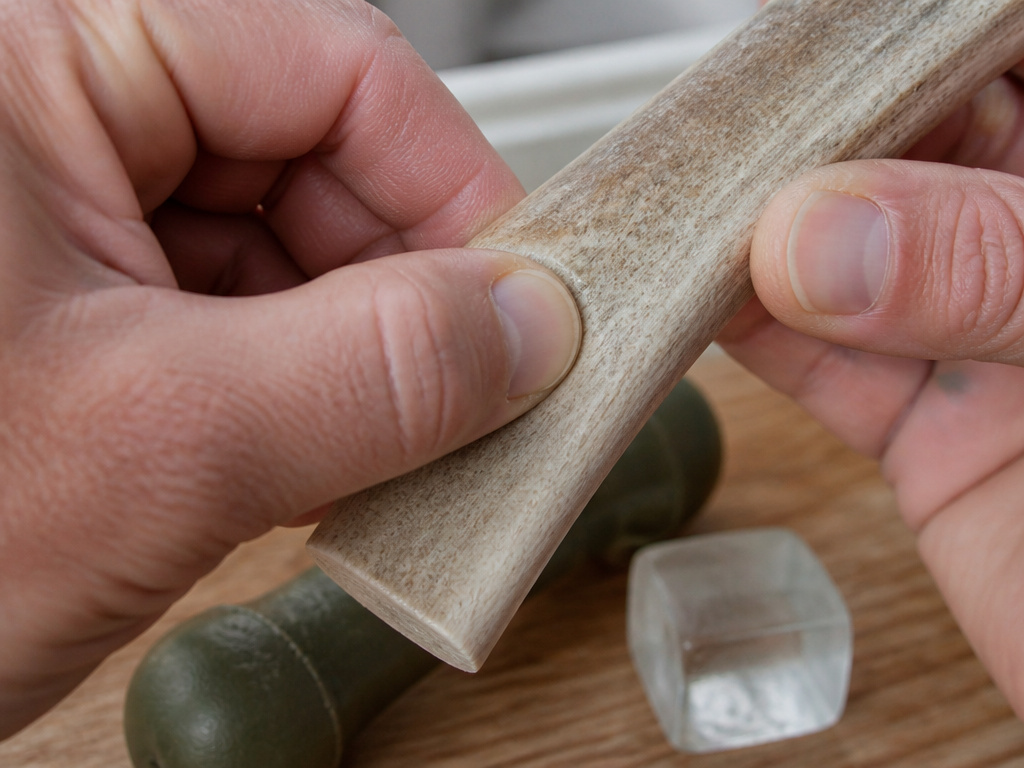
Antlers and hooves are the most reliable tooth-breaking tools in the pet aisle.
VCA puts most tooth fractures down to objects that are too hard: ice cubes, bones, hard nylon chews, antlers, and horse and pig hooves. Cornell’s team says the same thing from the other direction, warning that bones, antlers, hooves, rawhide, and hard manufactured toys can wear or fracture teeth and can also cause gastrointestinal damage or obstruction.
Before you start: A chew that won’t give under thumb pressure can wear or fracture a tooth, and hard fragments can lodge in the gut. Test every chew before it goes in the bowl, and take away anything that won’t dent.
The test is quick. Press your thumbnail into the chew. If it doesn’t dent at all, it’s hard enough to do damage. If it gives, it’s in the right category. VCA’s phrasing is that any chew toy or dental treat should bend and give upon compression.
- Antlers, hooves, and bones. Top of VCA’s fracture list, with obstruction risk on top.
- Ice cubes. Cheap, common, and hard enough to crack a premolar.
- Hard nylon chews. The “indestructible” ones are the worst offenders for a committed chewer.
- Rawhide. Cornell lists it with the hard items for wear and obstruction risk.
- Anything that won’t dent under your thumbnail. That’s the whole test.
If you want a starting point, test any chew with your thumbnail before it becomes a habit. The dental chews question deserves more than a label read, because VOHC’s seal of acceptance is the closest thing to an independent check on the shelf.
One more thing worth knowing, and it isn’t about the chew itself. AAHA notes that fractured teeth are often preventable through chew and toy selection plus behavior modification for separation anxiety and cage-biting. An anxious dog in a crate chews harder than a relaxed one on the kitchen floor.
What Actually Happens at a Professional Cleaning
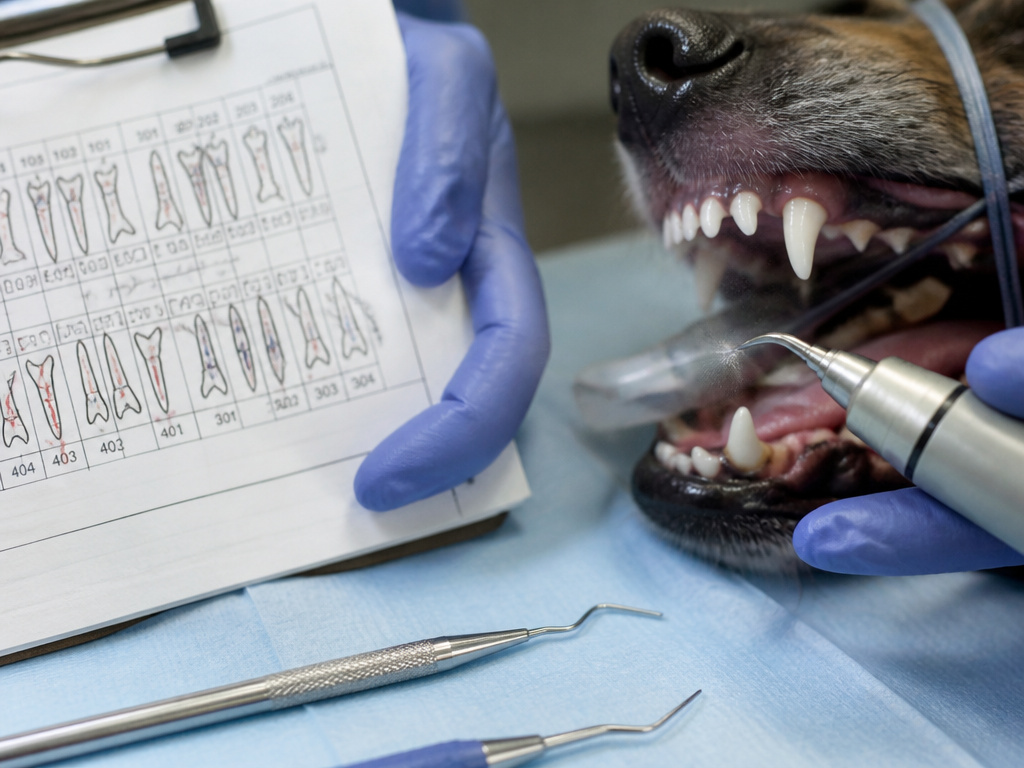
Your dog goes under, someone calls out a number for each tooth, and a second person writes it on a chart.
The chart is the point. The Australian Veterinary Association’s guidelines require plaque and calculus scores, missing and extra teeth, tooth mobility, bleeding on probing, furcation involvement, and gum recession all recorded as part of the medical record.
A complete exam and dental radiographs only happen under anesthesia. Cornell is direct about that, and VCA goes further: scaling tartar on an awake dog is cosmetic, and it neither diagnoses nor treats disease.
The ultrasonic scaler makes a thin, high whine and throws a fine mist. The hand scaler that follows is quiet and much slower, and that’s the part that gets below the gum line.
There’s a genuine disagreement in the guidance here, and it’s worth naming. Cornell describes a conscious exam at annual visits, or more often depending on age, breed, dental health, and history. The AVA states that a professionally thorough and complete dental examination isn’t possible in a conscious dog. Both are true at different depths: the awake look catches gross problems, and the anesthetized exam finds the rest.
I’d ask two questions before any cleaning: will there be full-mouth radiographs, and will you show me the chart afterward? A practice that answers yes to both is doing the procedure the guidelines describe.
The AAHA dental care guidelines recommend a first true prophylaxis by one year of age for cats and small- to medium-breed dogs, and by two years for larger breeds. A true prophylaxis means cleaning, polishing, and intraoral radiographs in a mouth with no obvious lesions.
One distinction gets lost in the shuffle. A prophylaxis is for a mouth without periodontitis. If there’s attachment loss, the dog needs periodontal therapy, which is a different procedure with a different plan and a different cost conversation.
The professional cleaning conversation goes better when you know what you’re agreeing to. If you want the management side in more depth, this canine periodontal disease review article is a fair next read.
Which Dogs Need to Start Earlier?
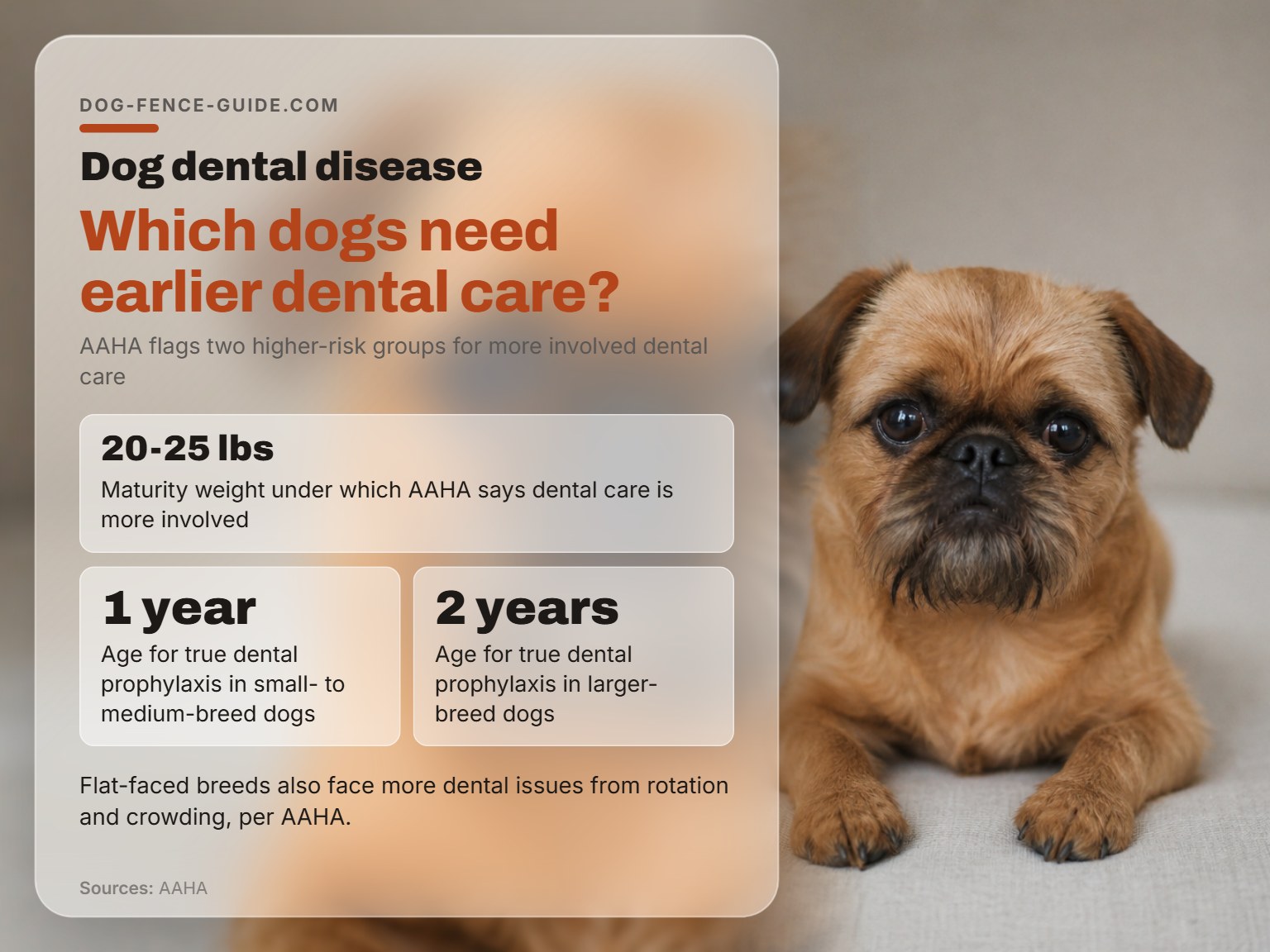
The AAHA guidelines single out two groups: dogs that will mature under 20 to 25 pounds, and flat-faced breeds.
Small breeds and brachycephalic dogs are more prone to periodontal disease because the jaw is small and the teeth crowd, per VCA. AAHA says the same and adds rotation to the crowding problem.
For a puppy that will mature under 20 to 25 pounds, AAHA says owners should be told up front that dental care will be more involved than for a larger dog. That’s a sentence worth hearing early rather than years later.
- Dogs maturing under 20 to 25 pounds. AAHA flags these owners for a more involved routine from the start.
- Flat-faced breeds. Rotation and crowding, per AAHA, plus VCA’s crowding point.
- Puppies with retained baby teeth. AAHA recommends prompt extraction to prevent displacement of the incoming tooth.
- Young dogs missing a permanent tooth. AAHA recommends radiographs to confirm it truly isn’t there.
Home brushing can start once the permanent teeth are through. Puppies actively shedding baby teeth may find it uncomfortable, and AAHA’s guidance is to avoid creating a negative association during that window. Push through it anyway and you’ll spend the next decade paying for it.
I’ll be honest about a gap here. I’ve never owned a large-breed dog, so my read on large-breed timing comes from the guidelines rather than my own kitchen floor. The two-year benchmark is theirs, not mine.
Where Diet, Chews, and Supplements Fit
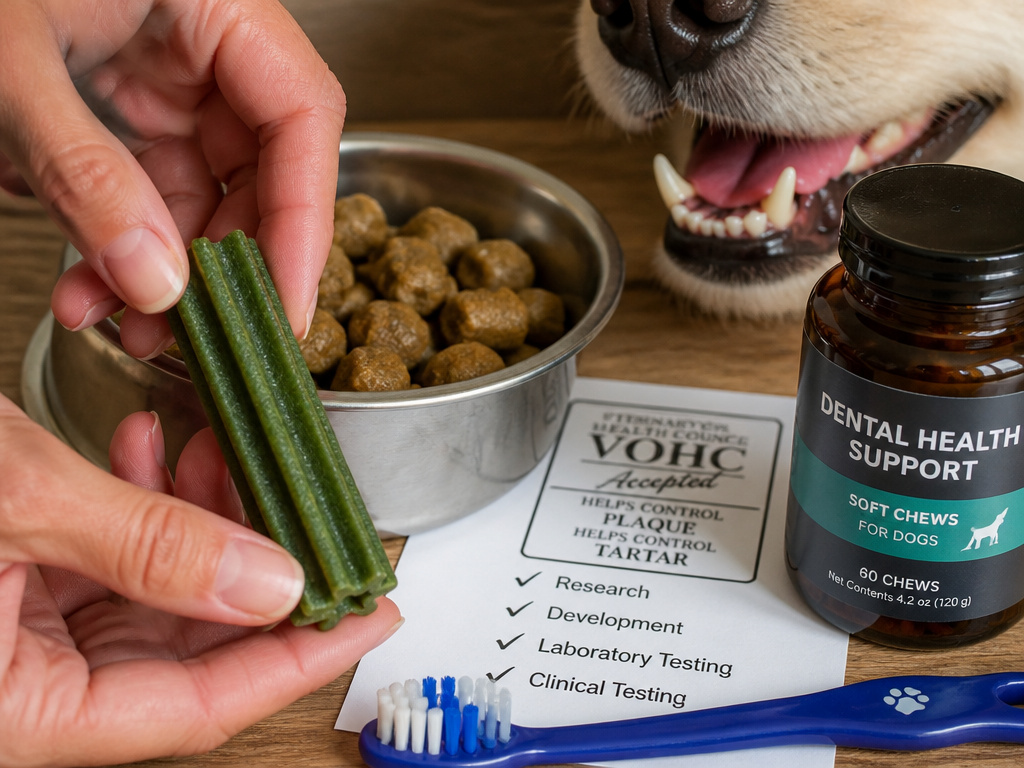
Three things sit between daily brushing and nothing: diet, chews, and supplements.
A dental diet is a real tool. The trial above found a dental diet and a daily chew weren’t significantly different from each other, and both trailed brushing by a wide margin. That’s still better than nothing, and it’s a lot easier to sustain than a brush.
Dental diets should be checked against the VOHC list before you commit. The dental food aisle rewards reading, not brand loyalty.
Supplements are the weakest link in the chain. AAHA notes that some experts prefer products with dual action, mechanical plus chemical, because the combination reaches more tooth surfaces. Treat that as a preference rather than a proven ranking.
Where this goes sideways: Buying three products at once. If something irritates the mouth or upsets the gut, you won’t know which one did it, and you’ll have to start over.
There’s a caveat in the research that almost never makes it onto packaging. Many dental products are validated on a clean tooth model, meaning the mouth was scaled first. Owners use them on unscaled teeth. The evidence for that real-world case is thinner than the marketing suggests.
VOHC’s seal of acceptance is the closest thing to an independent check, and both Cornell and the AVA point owners to it. The dental care products that carry it have at least been tested against something.
So: brush first, feed a dental diet if it’s practical, and treat chews and supplements as support rather than substitutes. That ordering is the whole article in one line.
Frequently Asked Questions
How often should I brush my dog’s teeth?
If daily isn’t realistic, a 2024 study found every-other-day brushing still reduced deposits over eight weeks, though that protocol paired brushing with a water additive. Cornell lands on brushing as the most effective home method, while Gawor et al. 2024 found every-other-day brushing paired with a water additive still reduced deposits, so treat daily as the goal and every other day as the fallback.
Can I just use dental chews instead of brushing?
No. In a controlled trial, daily brushing controlled plaque more than three times as well as a daily dental chew or a dental diet, and the chew and diet weren’t significantly different from each other. Chews are support. Buy ones that bend under thumb pressure and check the VOHC list.
How do I know if my dog needs a professional cleaning?
Ask at the annual exam, but note that Cornell describes a conscious exam at annual visits while the AVA states a professionally thorough and complete dental examination isn’t possible in a conscious dog. Cornell describes a conscious exam at annual visits, while the AVA states a professionally thorough and complete dental examination isn’t possible in a conscious dog, so the awake look is a screening step. AAHA’s benchmark is a first true prophylaxis by one year for small and medium dogs, two years for large breeds.
Is anesthesia safe for a dental cleaning?
Cornell and VCA are both clear that a thorough exam, radiographs, and scaling below the gum line require general anesthesia, and the AVA’s definition of a prophylaxis is built around it. Scaling tartar on an awake dog is cosmetic and doesn’t treat disease. Ask your vet what screening and monitoring they use for your dog’s age and breed.
Do small dogs really need dental care earlier?
Yes. VCA notes small breeds and flat-faced dogs are more prone to periodontal disease because of small jaws and crowded teeth, and AAHA flags any puppy maturing under 20 to 25 pounds for a more involved routine. Start the brushing habit early, once the permanent teeth are in.
What’s the first sign most owners miss?
Bad breath, because it arrives gradually and owners adapt to it. VCA also lists pawing at the mouth, head shaking, jaw chattering, dropping food, trouble swallowing, drooling, and blood in the saliva. Photograph anything new with a date so your vet has a timeline to work from.
The Bottom Line
Dental disease symptoms and prevention in dogs come down to one trigger: if you can see a brown line at the gumline, or the breath has gone metallic, you’re past the brushing-only stage. Book the exam.
The first step this week is smaller than that. Put a dab of pet toothpaste on your finger and let your dog lick it off. That’s the whole session.
Brushing works like seasoning a cast-iron skillet: thin layers, repeated often, and no shortcuts. Skip a month and you’re back to bare metal.
One concession. If your dog already has attachment loss, none of the home routine treats it. That’s periodontal therapy, and the plan belongs to your vet.
And the contrarian bit, which I’ll stand behind: I’d argue the chew aisle causes more dental injuries than it prevents. A plain soft brush and a boring daily routine beat a basket of antlers every time.
