
10 Best Robot Dog Toys in 2026
This post contains affiliate links. As an Amazon Associate, we earn from qualifying purchases.
The Ruko 18011 Smart Robot Dog is the best overall robot dog toy. It combines over 30 animated LED facial expressions with obstacle-avoidance sensors and programmable custom moves, making it feel genuinely responsive for kids ages 3 and up. For open-source coding, the Petoi Bittle X V2 takes the win, while the Ruko R1 Mini delivers the best portable stunt experience.
The challenge with robot dog toys is finding one that matches your child’s age and interests. Some kids want a cuddly, responsive pet, while others want to code new tricks or watch their dog flip across the room. Playtime, programming depth, and physical size all matter more than you might expect.
This guide is research-based, drawing on manufacturer specifications, expert round-ups, and patterns in owner feedback across ten top models. We break down what each robot dog does best so you can match the right one to your family.
Top 10 Robot Dog Toys in the Market
Certain content that appears on this site comes from Amazon. This content is provided "as is" and is subject to change or removal at any time.
The Best Robot Dog Toys, Reviewed
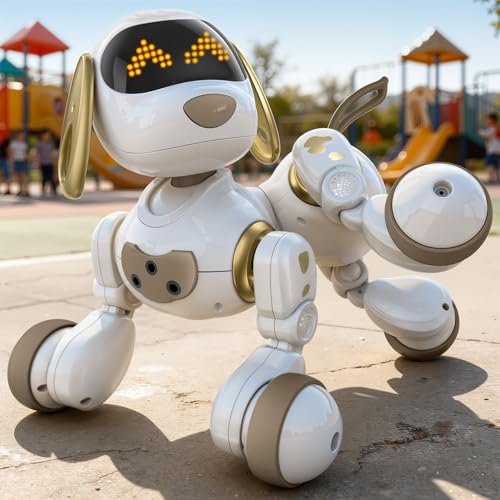
Ruko 18011 Smart Robot Dog
What We Like
- 30+ animated LED facial expressions
- Programmable up to 50 custom moves
- Obstacle-avoidance sensors for indoor safety
- Gesture and remote control up to 98 feet
Trade-offs
- 45-minute playtime per 3-hour charge
- Remote requires 2 AAA batteries (not included)
- USB C-C cable not compatible
Seventy glowing LED lights driving more than thirty facial expressions mean this robot dog doesn’t just move, it reacts. Kids see happy eyes, goofy faces, and silly moods without needing a screen, which makes pretend play feel more like interacting with a real pet. The programming mode lets them chain up to fifty custom moves into a dance routine or trick parade, turning play into a low-pressure introduction to sequencing and logic. For a family that wants a companionable toy with actual interactive depth, this one delivers without demanding a smartphone or a Wi-Fi connection.
The trade-off is battery life: forty-five minutes of play from a three-hour charge means you’ll be plugging it in more often than you’d like, especially if two kids are tag-teaming. If your child is happy with a simpler remote-control pup that runs longer between charges, other options exist. But for the kid who wants a dog that actually seems to have a personality and can learn new tricks, this Ruko earns its place as the top pick.
Product photos
Petoi Bittle X V2 Programmable Robot Dog

What We Like
- Fully assembled and ready to code
- Open-source with Arduino C++ and Python
- Supports optional sensors and Raspberry Pi
- Hand-guide legs to teach new gaits
Trade-offs
- 1-hour playtime limits extended sessions
- Not optimized for carpet, grass, or uneven surfaces
A fully assembled robot dog that you can program in Arduino C++, Python, or block coding means this is not a toy you just switch on and watch. It is a platform for learning how robots actually think. With 35+ lifelike actions and the ability to customize up to 10 voice commands using C++, it is built for classrooms, STEM camps, or anyone who wants to understand what makes a quadruped walk, sit, or backflip. The open-source design and optional sensor support let you go from basic block coding to advanced ROS/ROS2 integration, so it grows with your skill level rather than collecting dust after a week.
This robot works on flat, hard floors only, carpet, grass, or mud will stop it cold, which limits where you can play. And with just one hour of playtime per charge, you will want to keep a charger handy if you are running a full lesson. Unlike the Loona Robot Pet Dog, which is heavier and more of an autonomous companion, the Bittle X V2 demands you put in the work to program it. That is exactly the point for anyone serious about robotics education.
Ozega Smart Robot Dog

What We Like
- Voice control with 13 commands
- Store up to 50 custom action sequences
- LED face shows real-time emotions
- Touch sensor on back for interaction
Trade-offs
- No gesture or follow mode mentioned
- No self-righting or stunt flip capability
- Emotion display is LED face only, no sound
A 100-foot remote range and the ability to store up to 50 custom motion sequences make this robot dog less of a toy and more of a tiny choreographer. The LED face shifts through emotional expressions as kids program its moves, so the dog doesn’t just follow orders, it seems to react. That combination of STEM programming and emotional feedback is what earns it the spot for families who want play that builds logic while also teaching a child to read a reaction. It suits younger kids especially well, since the voice controls are simple (sit, forward, dance) and the touch sensor on the back gives an immediate, satisfying wiggle.
You do not get gesture controls or stunt tricks like the Ruko R1 Mini offers, so if your kid wants flips and self-righting, this is not the one. The Ozega stays focused on programming and emotional interaction instead of acrobatics, which means quieter, more deliberate play. Unlike the Ruko 18011, which has 30 LED expressions but only 13 voice commands, the Ozega gives you more control over the dog’s behavior sequence. Just do not expect it to bark or do backflips. It is a thoughtful, screen-adjacent toy for a child who likes to be the director, not just the driver.
Product photos
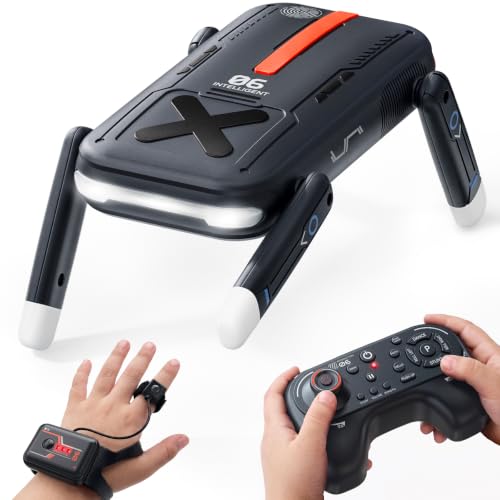
Ruko R1 Mini Robot Dog
What We Like
- Self-righting after every fall
- 4-way stunt flips for variety
- Gesture-sensing watch control
- Adjustable volume for parents
Trade-offs
- Remote requires 2 AAA batteries not included
- No voice control or app connectivity
Weighing just 0.6 pounds and measuring 6.3 inches long, the Ruko R1 Mini Robot Dog is light enough for a child to carry from room to room. The self-righting design means it automatically stands back up after a fall, so kids don’t need help to keep playing. Unlike standard robot dogs that only flip forward and backward, this one performs stunt flips in all four directions. The gesture-sensing watch control lets a child tilt a hand to walk or turn, and a fingertip button switches to flip mode, all without a phone or tablet.
The trade-off for that compact size is a 50-minute runtime on a two-hour charge, so you’ll want to plan play sessions or keep the USB cable handy. Compared to the larger Ruko 18011 Smart Robot Dog, the R1 is smaller and lighter, making it easier to carry and store. If your child is between three and nine and you want a robot dog that flips in all directions and rights itself, this is a good fit. It is not ideal for older kids who expect voice commands or app-based programming, or for anyone who dislikes buying AAA batteries for the remote.
Loona Robot Pet Dog

What We Like
- ChatGPT-4o voice conversations
- Face and gesture recognition
- Auto-charging with multiple preset routes
- Home monitoring via camera and speaker
Trade-offs
- Requires well-lit environment for camera accuracy
- Charging dock needs open space on both sides
- Clear pronunciation needed for voice commands
A ChatGPT-4o brain under the hood means this robot dog actually talks back in real-time conversation, not just responds to a handful of preset commands. It recognizes your face, follows you around, and will go find its charging dock on its own when the battery gets low. That takes about 2.5 hours to refuel. If you want a pet that doubles as a home monitoring camera you can check while away, and you do not mind paying more for that level of smarts, this is the one that feels less like a toy and more like a tiny roommate.
All that AI needs good conditions to work: a bright room, a clear voice, and a charging dock placed in an open spot with nothing blocking either side. The Ozega Smart Robot Dog is a simpler, lower-cost option if you just want a remote-control puppy that does tricks, but it lacks the conversational AI and home monitoring features. Loona is for someone who wants the closest thing to a real pet that runs on software updates.
Product photos
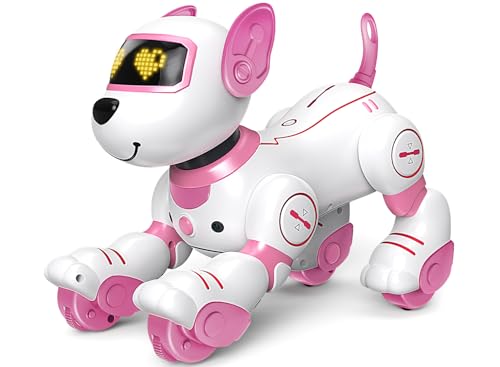
Great Dachong Robot Dog Toy
What We Like
- Touch & Follow responsive interaction
- Programmable custom movement sequences
- Lifelike tricks: sit, bow, handstand, push-ups
- No feeding or cleanup required
Trade-offs
- No voice control mentioned in features
- At 5 inches tall, it's shorter than some robot dogs
The Touch & Follow technology means this robot dog actually responds when you pat its head or walk away. That turns playtime into a back-and-forth game rather than a one-way remote control session. For a parent who wants an interactive pet experience without the mess of a real animal, that responsiveness is the whole point. It suits younger kids especially well, since the touch gestures are intuitive, no app pairing or voice commands to fumble with. The programmable tricks add a layer of creativity that keeps it from being a one-trick pony, and the dancing routines with light-up eyes give it enough showmanship to hold attention during a playdate or after-dinner wind-down.
The trade-off is size and control depth. If your child is on the older end of the 3-12 range and craves more complex interaction, voice commands or app-based programming, the Great Dachong’s reliance on touch and remote may start to feel limited. But for a first robot pet that rewards physical play and doesn’t require a tablet, it hits a sweet spot between simplicity and engagement.
Product photos
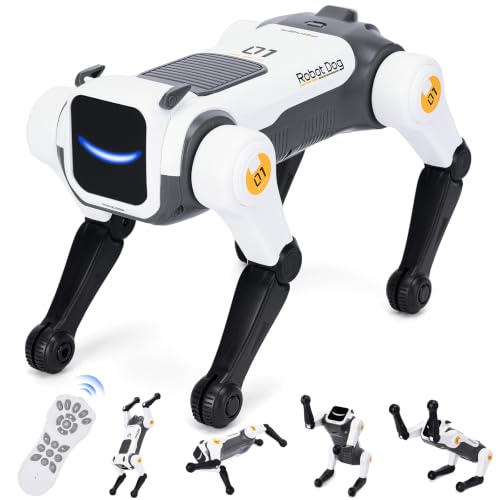
FUUY Robot Dog Toy
What We Like
- Two batteries for uninterrupted play
- Voice and remote control modes
- STEM programmable mode for logic building
- Fun tricks like somersaults and pee attack
Trade-offs
- Small 1-inch dimensions limit physical presence
- No gesture or touch sensor controls
Two removable batteries, each delivering up to two hours of play from a 1.5-hour charge, mean this robot dog can keep going with a quick swap. That dual-battery setup is the key feature: swap the spent one for the spare and continue playing without waiting for a recharge. It suits families who want a programmable toy that fosters logical thinking through motion sequences, plus voice and remote control for kids who just want to make it dance or do that goofy pee-attack prank. The STEM mode lets older children create a series of commands, improving concentration and creativity.
At just one inch in each dimension, this robot dog is tiny, more of a tabletop companion than a floor-stomping pet. Unlike the Ruko R1 Mini Robot Dog, which is over six inches long and does flips with self-righting, the FUUY is much smaller and will not cover ground the same way. But the big advantage here is battery life: it comes with two removable 3.7V 1200mAh rechargeable batteries. Each delivers up to 2 hours of play from a 1.5-hour USB charge, so swapping in a spare keeps the fun going without waiting.
Product photos
MindPal Robot Dog

What We Like
- Built-in 6 stories, 6 songs, 6 dances
- Programmable action sequences via remote
- Adjustable 5-level volume control
- Auto shutdown after 3 minutes saves battery
Trade-offs
- 50-60 min battery limits extended play sessions
- No gesture or voice control like some competitors
- Requires remote for programming, no app option
The MindPal Robot Dog comes with six built-in stories, six songs, and six dances, so a child can cycle through content without needing a phone or tablet. Using the programming buttons on the remote, kids can create custom action sequences, which supports logical thinking. For a parent looking for a toy that keeps a 6-year-old engaged with ready-to-use entertainment, this fits the bill.
A 50-to-60-minute run time feels short once a kid gets hooked on a dance routine. The lack of voice or gesture control means the child has to keep track of the remote rather than just clapping or calling commands. Unlike the Ruko 18011, which offers 30 LED expressions and gesture control, the MindPal focuses on its preloaded story-and-song library instead of those interactive response modes. If your priority is a self-contained entertainment package rather than a more responsive pet-like experience, this makes more sense.
Product photos
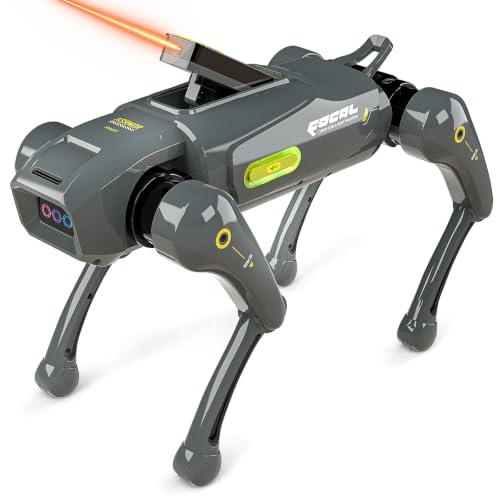
Raqivudo Smart Robot Dog
What We Like
- 16 distinct voice commands
- Programmable action sequences
- Stories, dance, and stunts
- Rechargeable battery included
Trade-offs
- Remote needs 2 AAA batteries (not included)
- 40-minute playtime per 2.5-hour charge
- No gesture or touch sensors listed
Sixteen voice commands let kids tell this robot dog to walk, sit, lie down, shake hands, dance, flip, or turn on its LED spotlight without reaching for a remote. That range of spoken interactions makes it feel less like a remote-control car and more like a responsive pet. That is exactly the point for a child who wants the companionship of a dog without the feeding and cleanup. The included command reference card helps younger kids learn the phrases quickly, and the 98-foot control range means they can keep playing across a living room without losing connection.
The trade-off for all that voice versatility is battery life: forty minutes of play after a two-and-a-half-hour charge means you will want to plug it in between sessions, especially if siblings or friends join in. Unlike the Ruko 18011, which offers 30 LED expressions and touch sensing, the Raqivudo trades those interactive sensors for a deeper voice-command library. It also requires two AAA batteries for the remote that are not in the box, a small annoyance on an otherwise well-thought-out toy. Best suited for families who want the novelty of talking to their robot dog and watching it respond, rather than relying on gestures or app control.
Product photos
SunFounder PiDog AI Robot Dog Kit

What We Like
- Multi-LLM support for natural conversations
- 12 servos enable 32 realistic dog actions
- Rich sensor suite: vision, hearing, touch
- Comprehensive learning resources and community
Trade-offs
- Requires separate Raspberry Pi (not included)
- Targeted at engineers, not plug-and-play for kids
- No battery life or charging details provided
The SunFounder PiDog is built around a Raspberry Pi and supports multiple large language models like ChatGPT, Gemini, and Grok, so it can hold conversations, interpret hand gestures, and even recognize math problems. That makes it a serious robotics project for older teens and adults who want to push beyond basic remote-control tricks. With 12 servos and 32 dog-like actions, it walks, wags, and responds to touch and voice in ways that are programmable and interactive.
You have to supply your own Raspberry Pi, and this is a development robot for engineers, not a toy for kids straight out of the box. Compared to the Petoi Bittle X V2, which weighs 1.3 pounds and measures 4.3 inches long, the PiDog is larger at 10.4 inches long, but it offers more sensor variety including ultrasonic, touch, gyroscope, sound, camera, speaker, and microphone. If you enjoy tinkering with Python and want a robot dog that can talk and respond to its environment, this one is a capable platform.
How We Evaluated Robot Dog Toys
We evaluated each robot dog toy against four key criteria: interactivity and responsiveness, programming depth, physical durability and safety, and battery life. These factors determine whether a robot dog actually gets played with or ends up in a closet after a week.
Interactivity covers everything from voice and gesture controls to touch sensors and facial expressions. A robot dog that responds to its environment keeps kids engaged longer than one that just runs a preset routine. Programming depth matters for older kids and STEM learners, some models offer drag-and-drop coding, while others require Arduino C++ or Python.
We also considered physical design, including self-righting mechanisms, obstacle sensors, and size. The best robot dog toys balance durability with kid-friendly features like adjustable volume and auto-shutdown. For more context on how these models compare to the broader market, our guide to the best robot dog covers high-end options, and our roundup of robot puppy toys focuses on the most kid-friendly designs.
Owner feedback patterns confirmed what the specs suggest: expressive faces and responsive controls matter most for young children, while programmable models satisfy older kids and hobbyists. This evaluation is based on published data and community reports.
What To Look For In Robot Dog Toys
Finding the right robot dog toy means matching the robot’s capabilities to your child’s age, attention span, and interests. Here’s what to prioritize.
The best robot dog toy for your family balances interactivity, battery life, and programming depth. Kids under 6 need responsive play and safety sensors; older kids benefit from coding options and stunt features.
Interactivity and Control Methods
Voice commands, gesture controls, and touch sensors define how a child interacts with the robot. Some models, like the Raqivudo Smart Robot Dog, offer 16 distinct voice commands for hands-free play. Others, like the Ruko R1 Mini, include a gesture-sensing watch for steering. Touch sensors add another layer, the Ozega Smart Robot Dog responds to petting on its back, while the Great Dachong Robot Dog Toy follows hand movements.
For younger children, simple remote or gesture control works best. Older kids and tech enthusiasts may prefer voice control or app-based programming. The Loona Robot Pet Dog even supports ChatGPT-4o voice conversations, making it one of the most advanced interactive dog toys available.
Battery Life and Charging
Robot dog toys typically run 40 to 60 minutes per charge, with charging times of two to three hours. The FUUY Robot Dog Toy solves this by including two batteries for hot-swap play, while the Ruko 18011 offers 45 minutes of playtime on a three-hour charge. The MindPal Robot Dog auto-shuts down after three minutes of inactivity to preserve battery.
If extended play sessions matter, prioritize models with dual batteries or quick-charge features. For shorter, supervised play, standard battery life is usually sufficient. The SunFounder PiDog AI Robot Dog Kit does not provide battery details, which may matter for buyers who care about runtime.
Programming and STEM Depth
Not all robot dog toys are programmable. Basic models offer preset tricks and sequences controlled by remote or voice. Mid-range options, like the Ruko 18011, let you program up to 50 custom moves. Advanced models, like the Petoi Bittle X V2 and SunFounder PiDog, support Arduino C++, Python, and even multi-LLM AI for natural conversations.
For kids ages 6 to 12, the FUUY Robot Dog Toy offers a STEM programmable mode without requiring a computer. Older students and hobbyists benefit from open-source platforms that teach real coding skills. The Petoi Bittle X V2 is fully assembled and ready to code, while the SunFounder PiDog requires a separate Raspberry Pi, so it’s best for experienced makers.
- Check whether the robot dog requires a separate device (phone, tablet, Raspberry Pi) to program.
- Look for adjustable volume controls and auto-shutdown features for safety.
- Consider the robot’s size and whether it fits on carpet, grass, or hard floors.
- Verify the charging cable type, some models use USB C-C, which may not work with older chargers.
- Read the age recommendation carefully; some models are designed for kids 3+, others for teens and adults.
The most common mistake is buying a robot dog that’s too advanced or too simple for the child’s age and patience level. Match programming depth to the kid, not the price tag.
Robot Dog Toys Compared
The table below compares all ten robot dog toys across key factors like interactivity, programming depth, battery life, and best-use scenarios.
| Product | Dimensions | Control Type | Programmable |
|---|---|---|---|
| Ruko 18011 Smart Robot Dog | 9.8 × 8.3 × 9.8 inches | 2.4GHz Remote & Gesture Control | Up to 50 custom sequences |
| Petoi Bittle X V2 Programmable Robot Dog | 4.3 x 7.6 x 4.3 in | Voice Commands | Block, Arduino C++, Python |
| Ozega Smart Robot Dog | 6 x 9 x 10 inches | 2.4GHz Remote & APP Control | Up to 50 |
| Ruko R1 Mini Robot Dog | 6.3 x 4.1 x 3.4 inches | Gesture sensing + 2.4GHz remote | Yes |
| Loona Robot Pet Dog | 19 x 18 x 18 inches | Voice & Gesture Control | N/A |
| Great Dachong Robot Dog Toy | 9.0 x 9.0 x 5.0 inches | Remote, Touch & Follow | Yes |
| FUUY Robot Dog Toy | 1.0 x 1.0 x 1.0 inches | Voice + 2.4GHz remote | Yes |
| MindPal Robot Dog | 8.5 x 5.1 x 7.1 in | Remote control | Yes |
| Raqivudo Smart Robot Dog | 1.0 x 1.0 x 1.0 inches | Voice & 2.4GHz Remote | Yes |
| SunFounder PiDog AI Robot Dog Kit | 10.4 x 7.0 x 3.4 inches | Voice&Video Recognition | Python |
Frequently Asked Questions
What is the best robot dog toy for a 5-year-old?
The Ruko 18011 Smart Robot Dog is the best choice for a 5-year-old because it combines expressive LED faces, obstacle-avoidance sensors, and simple gesture control at a safe 98-foot range. It requires no app and works straight out of the box, making it ideal for young children who want a responsive pet without complicated setup.
Can robot dog toys teach coding to kids?
Yes, several robot dog toys include programmable modes. The FUUY Robot Dog Toy offers a STEM mode for kids ages 6 to 12, while the Petoi Bittle X V2 supports Arduino C++ and Python for older students. The SunFounder PiDog goes further with multi-LLM AI, but it requires a separate Raspberry Pi and is best for teens and adults.
How long do robot dog toy batteries last?
Most robot dog toys run between 40 and 60 minutes on a full charge. The FUUY Robot Dog Toy includes two batteries for uninterrupted play, while the MindPal Robot Dog lasts 50 to 60 minutes. Charging times range from two to three hours, depending on the model.
Do robot dog toys work on carpet?
Most robot dog toys work best on hard, flat surfaces. The Petoi Bittle X V2 is not optimized for carpet, grass, or uneven terrain. The Ruko 18011 and Ruko R1 Mini handle indoor floors well thanks to their obstacle-avoidance sensors and self-righting mechanisms. Check the manufacturer’s surface recommendations before buying.
Are robot dog toys safe for toddlers?
Robot dog toys for toddlers should have no small parts that can be swallowed, smooth edges, and automatic shut-off features. The Ruko 18011 is designed for ages 3 and up with obstacle sensors to prevent collisions. The Great Dachong Robot Dog Toy is also a safe, no-fuss option for preschoolers because it has no feeding or cleanup requirements.
The Bottom Line
The Ruko 18011 Smart Robot Dog is the best overall robot dog toy for most families because it balances expressive interactivity, programmable moves, and safety features at a reasonable price point. It suits kids ages 3 and up who want a responsive pet they can teach tricks to without needing a phone or tablet.
If your child is more interested in stunts and flips, the Ruko R1 Mini is a fantastic portable option that rights itself after every fall and performs four-way flips. For older kids and teens who want to learn real coding, the Petoi Bittle X V2 offers genuine open-source programming with Arduino and Python support.
The single most important factor when choosing a robot dog toy is matching the robot’s interactivity level to your child’s age and attention span. A robot that responds to touch, voice, or gestures will get played with far longer than one that only runs preset routines.
