
10 Best Gps Dog Fences For Small Dogs in 2026
This post contains affiliate links. As an Amazon Associate, we earn from qualifying purchases.
For small dogs, a GPS fence needs to be accurate enough to keep them safe without being so bulky it weighs them down. The Halo Collar 5 Wireless Dog Fence is our best overall pick because of its industry-leading GPS accuracy and the included Cesar Millan training program, which helps small breeds learn boundaries quickly. For owners who want no recurring fees, the Dogtra GPS Fence No Subscription offers custom virtual fences, while the PetSafe Guardian GPS 2.0 is the best choice for tiny dogs with its lightweight, 0.3-pound collar.
A standard invisible fence’s buried wire is a hassle, and many wireless fences use circular boundaries that don’t fit a small dog’s typical yard. GPS fences solve both problems, but small dogs have unique needs: a collar that’s too heavy can cause neck strain, and a fence with poor accuracy can let a 10-pound dog slip right through.
This guide is built from a close look at manufacturer specs, expert round-ups, and patterns in owner feedback. We focused on the criteria that matter most for small breeds, collar weight, neck size minimums, boundary accuracy, and subscription costs, so you can find the right fit without guesswork.
Top 10 GPS Dog Fences For Small Dogs in the Market
Certain content that appears on this site comes from Amazon. This content is provided "as is" and is subject to change or removal at any time.
The Best GPS Dog Fences For Small Dogs, Reviewed
Halo Collar 5 Wireless Dog Fence
What We Like
- GPS accuracy within 2 feet
- AlwaysOn GPS with 24/7 tracking
- Built for rural and remote areas
- Cesar Millan training program included
Trade-offs
- Subscription required to activate fence features
- Static correction is optional but requires setup
- Relies on cellular and Wi-Fi connections
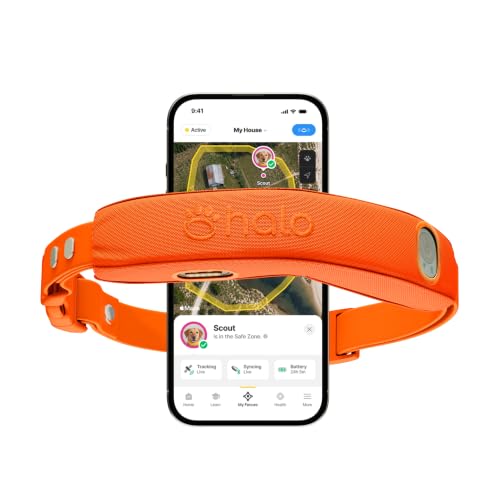
The Halo Collar 5 delivers GPS accuracy within two feet of your dog’s actual location, thanks to its dual-frequency L1 and L5 satellites paired with real-time ground-station corrections. That kind of precision matters when you’re setting a boundary for a small dog who might slip through a poorly defined zone. It works on any yard size, from a tiny suburban patch to a rural property, and updates your dog’s position twenty times per second. The collar uses Wi-Fi, Bluetooth, and cellular connections to keep location data flowing, so it’s suited for open spaces where other GPS collars might struggle.
The Halo Collar 5 requires a subscription to activate GPS tracking and fence features, so it’s not a buy-it-and-forget-it system like the Dogtra GPS Fence, which has no subscription. The ongoing cost gets you dual-frequency GPS accuracy within 2 feet of your dog’s actual location, always-on tracking with instant smartphone alerts, and built-in training guidance from Cesar Millan. For owners who want professional support and real-time boundary notifications, that recurring fee may be worth it.
Dogtra GPS Fence No Subscription

What We Like
- No monthly subscription fees
- IPX9K waterproof rechargeable collar
- Custom-shaped virtual fences via app
- Come home sequence with return reminder tone
Trade-offs
- Requires 3/4 acre minimum property size
- No live tracking or notifications included
- 15 lb minimum weight excludes tiny breeds
No subscription fees means this collar costs exactly what you pay upfront and nothing more. That is the single biggest reason to consider it over the Halo Collar 5 or PetSafe Guardian GPS 2.0 if you hate recurring charges. The Dogtra GPS Fence works with dogs as light as 15 pounds and offers 100 adjustable correction levels for tone, vibration, or stimulation, so you can tailor the response to your dog’s temperament. The IPX9K waterproof rating is built for outdoor use, and the app lets you draw custom-shaped boundaries that match your yard rather than forcing a perfect circle.
The Dogtra GPS Fence requires a property of at least 3/4 acre, so it’s not for apartment balconies or tiny yards. It also doesn’t include live tracking or notifications, meaning if your dog gets out, you won’t receive an alert. For owners with enough space who want a no-subscription containment system, this collar is a straightforward choice, just confirm your yard size first.
Product photos
PetSafe Guardian GPS 2.0 Dog Fence

What We Like
- Fits necks as small as 8 inches
- Weighs 0.3 pounds
- Dual-frequency GPS antenna increases reliability of location tracking
Trade-offs
- Requires monthly or annual subscription
- Needs 2.4 GHz Wi-Fi for setup
- Each additional dog needs own collar and subscription
A collar that fits a neck as small as 8 inches and weighs just 0.3 pounds means this is built for the smallest of small dogs. The 10-pound minimum weight threshold opens the door for breeds that most GPS fences simply ignore. For someone with a tiny dog who needs a containment system that doesn’t overwhelm them physically, this is the one that makes the most sense on paper.
The catch is the subscription. Unlike the Dogtra GPS Fence No Subscription, which asks for nothing after the purchase, PetSafe requires a monthly or annual plan for each collar. If you have two small dogs, that is two subscriptions. The setup also demands a 2.4 GHz Wi-Fi connection, so if your home network runs only on 5 GHz, you will need to dig up an old router or adjust your settings. For the peace of mind of a collar that actually fits a Chihuahua or a Yorkie, that trade-off might be worth it, but it is a real cost you should see coming.
Product photos
SpotOn Nova GPS Dog Fence Collar
What We Like
- No subscription for unlimited fences
- Customizable keep-out zones
- Works in dense tree cover
- Certified 1:1 training support included
Trade-offs
- 0.8 lb collar is heavy for tiny dogs
- Neck size min 10 inches limits very small breeds
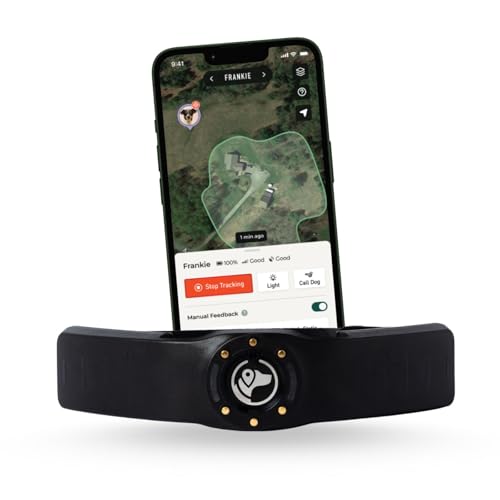
No subscription means you can draw a boundary around a flower bed or a neighbor’s driveway as easily as your whole yard, with unlimited fences of any shape and size. That flexibility, paired with dual-band GPS that holds signal under heavy tree cover, makes this a strong match for anyone who needs a custom layout rather than a simple circle. The collar fits dogs with neck sizes from 10 to 26 inches, and at 0.8 pounds, owners of very small dogs should check whether their pet can comfortably carry that weight.
The real trade-off here is weight. At 0.8 pounds, the SpotOn Nova is heavier than the Halo Collar 5 (0.4 pounds per the comparison list), so for a very small dog, the Halo might be a lighter option. But if your yard has tricky terrain, dense trees, uneven ground, odd corners, and you want to set up a boundary that follows exactly what you see, the SpotOn’s unlimited custom fences and certified training support give you a level of control that may suit your needs.
Product photos
PRTRLFC GPS Wireless Dog Collar Fence
What We Like
- Huge circular range up to 6561 ft
- No app, Wi-Fi, or subscription fees
- IPX7 waterproof for all weather
- Built-in memory saves boundary settings
Trade-offs
- Circular boundary only, no custom shapes
- Performance drops near buildings or woods
- No vibration or static in pre-warning zone
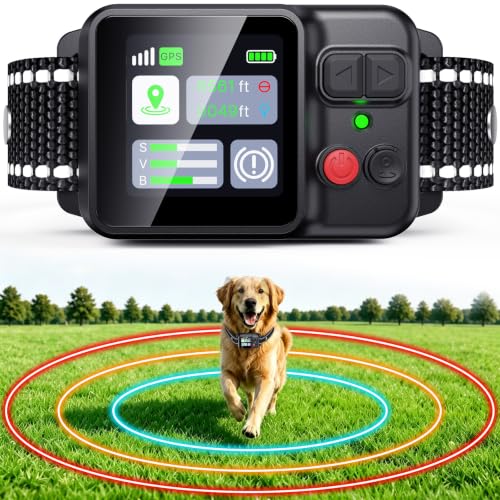
A 6561-foot radius covers a huge area, ideal if you have open land and a dog that loves to roam. The collar runs entirely on its own with no app, no subscription, and no extra transmitter, so setup is just setting the range and picking a correction level. For owners who need coverage measured in acres rather than yards, this system delivers plenty of space without locking you into monthly fees.
The trade-off is that the boundary is a simple circle, and the pre-warning zone only beeps, no vibration or static until the dog actually crosses the line. In heavy woods or around buildings, GPS accuracy can waver, so it works best on wide-open fields or farmland. If you need a fence that snakes around your house or follows a property line, the SpotOn Nova lets you draw custom shapes, but you’ll pay more for that flexibility.
Product photos
TTPet GPS Wireless Dog Fence System
What We Like
- Huge adjustable range up to 1,999 yards
- No buried wires, base station, or subscription needed
- IPX7 waterproof for rain, mud, and swimming
- Smart memory saves boundary settings
Trade-offs
- Only supports dogs 18 lbs and heavier
- Circular boundary only, no custom shapes
- Requires recalibration when moving to new location
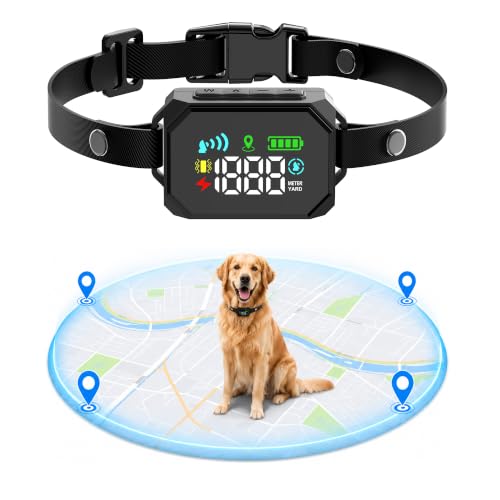
A maximum range of 1,999 yards and coverage up to 2,500+ acres means this system can contain a dog over a very large area without any buried wire. That makes it a practical option for owners of farms, ranches, or big yards where traditional fencing would be difficult or expensive. The AI-enhanced GPS chip is designed to reduce drift and keep the virtual boundary consistent. Once you calibrate the system, it remembers the center, radius, and correction settings so you don’t have to repeat the full setup each time you power it on. For small-dog owners, the 18-pound minimum weight limit is the first thing to check if your pup is on the lighter side.
The trade-off for that enormous coverage is that the boundary is always a circle. You cannot create a custom shape that follows a property line or wraps around a house the way some other systems allow. And while the IPX7 rating handles rain and splashes without complaint, the system is designed for open outdoor spaces rather than tight suburban lots. If your dog is over 18 pounds and you need to contain them across a truly large area without digging or monthly fees, this is the system that gets the job done.
Product photos
RAINLEOTI GPS Wireless Dog Fence

What We Like
- App and remote control options
- No monthly subscription fee
- Custom polygon GPS boundary
- IP67 waterproof collar
Trade-offs
- App range limited to 100 ft
- Requires clear sky for GPS signal
The dual control setup gives you flexibility to adjust boundaries or correct behavior from a distance. A free smartphone app and a handheld remote with a range of up to 1,640 ft make this convenient for training a dog that tends to wander. The collar fits necks as small as 8 inches and dogs as light as 10 pounds, so it works for very small breeds. With no subscription fee and a custom polygon fence you draw yourself, this system offers flexibility without ongoing costs.
The app connects only within roughly 100 feet of the collar, so you’ll need the handheld remote, which works up to 1,640 feet, for quick corrections when your dog is out of phone range. Like any GPS fence, it needs a clear view of the sky; dense trees or buildings will degrade performance, so this isn’t ideal for a heavily wooded lot. Compared to the SpotOn Nova, which also has no subscription, the RAINLEOTI fits dogs as light as 10 pounds and necks as small as 8 inches, making it a better option for very small dogs.
Product photos
GLADSMILE GPS Wireless Dog Fence
What We Like
- Dual fence modes for irregular yards
- IPX7 waterproof for wet conditions
- 40-hour rechargeable battery
Trade-offs
- No app control for adjustments
- Custom boundaries require walking the perimeter, no app drawing
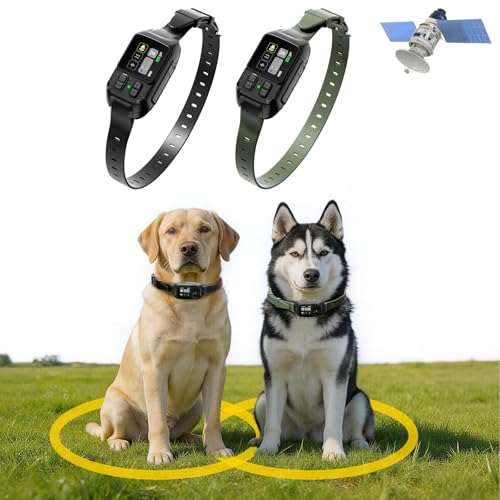
For a two-dog household, skipping a monthly subscription is the Gladsmile’s standout feature, cutting ongoing costs while covering both pets at once. The boundary adjusts from a tight 49-foot radius out to 6561 feet, so you can tailor it for a postage-stamp yard or a sprawling property. Three correction modes, beep, vibration, and static, let you start with the mildest option and escalate only if needed, a real help when training a dog as light as 15 pounds.
If you need to wrap around a oddly-shaped lot or avoid a garden bed, the PetSafe Guardian GPS 2.0 lets you draw up to 50 custom fences from your phone. But the Gladsmile keeps things simple and offline, which some owners prefer when they just want a reliable boundary that doesn’t depend on a mobile signal or app updates.
Product photos
DOGOITM GPS Wireless Dog Fence
What We Like
- Built-in pedometer tracks daily activity
- No subscription fees required
- Circular and polygon fence modes
- Three adjustable correction modes
Trade-offs
- No app control, settings adjusted on collar only
- 15 lb minimum weight excludes the smallest breeds
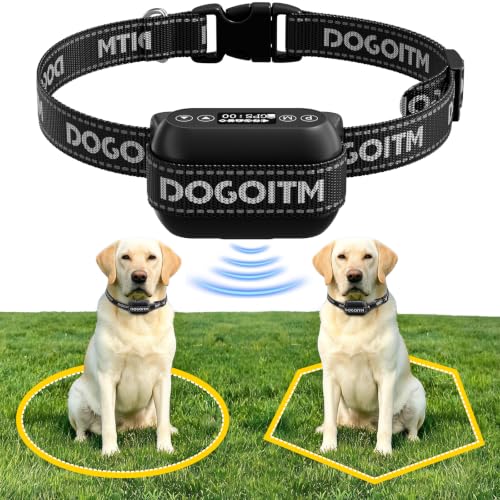
A built-in pedometer that logs your dog’s daily walks and sprints is the standout feature here, letting you gauge whether your small dog is getting enough movement or just napping the day away. That step counter, paired with a 50-hour battery life and IPX7 waterproofing, makes this collar a practical choice for owners who want containment plus a window into their dog’s activity without pulling out a phone. The three correction modes with adjustable intensity mean you can dial it down for a sensitive 15-pounder or up for a stubborn escape artist, all without monthly fees or buried wires.
The DOGOITM GPS fence requires at least a 65-foot radius to work, so you’ll need a yard that can accommodate a circle that size. You set the boundary by pressing up and down keys on the collar itself, no app, no phone needed. That keeps setup simple, but it also means you can’t tweak the boundary from your couch. For dogs under 15 pounds, this collar won’t fit; the PetSafe Guardian GPS 2.0 can handle dogs as small as 10 pounds.
Product photos
NBSUN Wireless Dog Fence GPS System
What We Like
- Custom polygonal fences for irregular yards
- No monthly subscription required
- Adjustable static intensity 0-5 levels
- IP7 waterproof for rain and swimming
Trade-offs
- Bluetooth pairing needed for app setup
- No built-in GPS tracking beyond fence
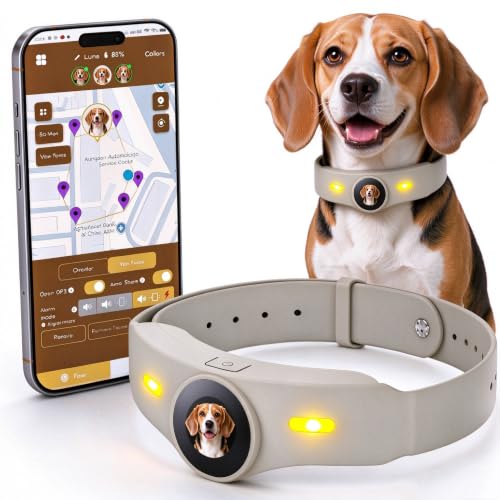
The free app lets you draw circular or polygonal fences, so the boundary can follow the shape of a garden, a shed, or a winding property line. With an adjustable range from 64 feet to 3,280 feet, it covers small yards up to larger lots. The dual-core GPS connects to 12 or more satellites for stable positioning, which helps the collar maintain the boundary even in areas with partial overhead cover.
The NBSUN system comes with 10 markers to define the boundary. For yards with many tight turns you may need to simplify the shape. That’s a trade-off compared to the SpotOn Nova, which lets you create unlimited fences of any shape and size. Still, for owners of small, medium, or large dogs with a moderately irregular lot, the combination of polygonal fence drawing, four correction modes with adjustable intensity, and a 36-48 hour battery makes this a practical, no-subscription solution without buried wires.
Product photos
How We Evaluated GPS Dog Fences For Small Dogs
This evaluation is based on research. We reviewed manufacturer specifications, expert round-ups from dog-training and pet-safety sources, and analyzed patterns in owner feedback across many real-world setups. We cross-referenced reported experiences with the technical data to identify consistent strengths and weaknesses.
Four criteria drove our rankings. First, collar weight and neck size minimums, a fence is useless if the collar is too heavy for a 10-pound dog or won’t fit an 8-inch neck. Second, boundary accuracy and shape, small yards need tight, reliable containment, and the ability to create custom polygons instead of simple circles.
Third, subscription model, some owners prefer a one-time purchase, while others want the live-tracking features a subscription enables. Fourth, ease of setup and training, small breeds often need more patient boundary training, so built-in training programs and clear instructions matter.
A research-led evaluation has limits. We can’t speak to how a collar feels after a year of daily wear, nor can we predict how a specific dog will react to a particular correction type. We can tell you what the specifications say and what owners commonly report, so you go in informed.
What To Look For In GPS Dog Fences For Small Dogs
Choosing a GPS fence for a small dog isn’t just about range. You need to match the collar to your dog’s size, your yard’s shape, and your budget for ongoing fees.
Focus on collar weight (under 0.5 lbs for dogs under 20 lbs), neck size minimums (8 inches for tiny breeds), boundary shape options (polygon vs. Circle), and whether a subscription is required. Also check the minimum property size, some fences need 3/4 acre.
Collar Fit and Weight
A small dog’s neck and spine can’t support a heavy collar. Look for collars under 0.5 pounds for dogs under 20 pounds. The PetSafe Guardian GPS 2.0 weighs just 0.3 pounds and fits necks as small as 8 inches, making it the clear choice for tiny breeds. The SpotOn Nova, at 0.8 pounds, is better suited for sturdier small dogs with necks 10 inches and up. Always measure your dog’s neck before buying, a loose collar won’t deliver consistent correction or tracking.
Boundary Accuracy and Shape
GPS accuracy matters more for small dogs because a 5-foot error zone could put them in a neighbor’s yard. The Halo Collar 5 provides GPS accuracy within 2 feet, which is suitable for tight suburban lots. Many fences only offer circular boundaries, which can waste space or leave gaps. For irregular yards, look for fences with polygon or custom-shape capabilities, like the SpotOn Nova or NBSUN system. If your yard is very small, check out GPS dog fences for small yards for models that work in tight spaces.
Subscription vs. No Subscription
Some GPS fences require a monthly or annual subscription for the fence features to work. The Halo Collar 5 and PetSafe Guardian GPS 2.0 fall into this camp, offering live tracking and cellular connectivity in return. Others, like the Dogtra and SpotOn Nova, have no subscription fees, you pay once and own the system. If you prefer a one-time purchase, the best GPS dog fences with no-subscription models are worth a close look.
Minimum Property Size and Range
Not every GPS fence works on a postage-stamp yard. The Dogtra GPS Fence requires a minimum 3/4 acre property, while the PRTRLFC works on smaller lots thanks to its circular boundary down to a 65-foot radius. For large open properties, the TTPet system covers up to 1,999 yards. Always measure your yard and check the fence’s minimum range requirement before buying.
- Measure your dog’s neck circumference and weigh them to confirm the collar fits.
- Check your yard’s shape and size against the fence’s boundary options and minimum range.
- Decide whether a monthly subscription fits your budget or if you prefer a one-time purchase.
- Verify the fence works in your area’s terrain, heavy tree cover can degrade GPS signals.
- Look for a training program or guide included with the fence, especially for small breeds.
A good rule of thumb: the lighter the collar and the smaller the neck minimum, the more likely it will work for your small dog.
GPS Dog Fences For Small Dogs Compared
The table below lays out the key specs for each of our top picks so you can compare collar weight, boundary options, and subscription requirements side by side.
| Product | Min Dog Weight | Subscription | Correction Types | Waterproof |
|---|---|---|---|---|
| Halo Collar 5 Wireless Dog Fence | Small to Large Dogs | Required | Sound, vibration, static (optional) | N/A |
| Dogtra GPS Fence No Subscription | 15 lbs | None | Tone/Vibration/Correction | IPX9K |
| PetSafe Guardian GPS 2.0 Dog Fence | 10 lb | N/A | Tone, vibration, 10 static levels | Waterproof |
| SpotOn Nova GPS Dog Fence Collar | N/A | None required | N/A | N/A |
| PRTRLFC GPS Wireless Dog Collar Fence | 15-120 lbs | No recurring subscription fees | Beep, Vibration, Static | IPX7 |
| TTPet GPS Wireless Dog Fence System | 18+ lbs | N/A | Beep, Vibration & Shock | IPX7 |
| RAINLEOTI GPS Wireless Dog Fence | 10-120 lbs | No Subscription Fee | Pre-boundary vibration, adjustable training | IP67 |
| GLADSMILE GPS Wireless Dog Fence | 15-120 lbs | No‑Subscription | Beep, Vibration, Static | IPX7 |
| DOGOITM GPS Wireless Dog Fence | 15 lbs | No Subscription | Three correction modes | IPX7 |
| NBSUN Wireless Dog Fence GPS System | Small Medium Large | No Monthly Fees | Light, sound, vibration, static | IP7 |
Frequently Asked Questions
What is the lightest GPS dog fence collar for small dogs?
The PetSafe Guardian GPS 2.0 is the lightest option at just 0.3 pounds, and it fits necks as small as 8 inches. It’s designed specifically for dogs 10 pounds and up, making it the best choice for tiny breeds.
Do GPS dog fences require a monthly subscription?
Some do, some don’t. The Halo Collar 5 and PetSafe Guardian GPS 2.0 require a monthly or annual subscription for fence features and live tracking. Models like the Dogtra GPS Fence No Subscription and SpotOn Nova have no recurring fees, you pay once and own the system.
Can I use a GPS dog fence in a small yard?
Yes, but you need to check the minimum range. Some fences like the Dogtra require a 3/4 acre minimum, while others like the PRTRLFC work on smaller lots. For yards under half an acre, look at small yard GPS fences specifically designed for tight spaces.
How accurate are GPS dog fences for small dogs?
Accuracy varies by model. The Halo Collar 5 is the most accurate, with GPS accuracy within 2 feet. Most other models are accurate within 3 to 6 feet, which is still enough to keep a small dog contained in most yards. For a deeper look at the trade-offs, read our breakdown of GPS fence pros and cons.
What is the difference between a GPS fence and a wireless fence?
A wireless fence uses a base station to create a circular boundary, while a GPS fence uses satellite signals to define a custom-shaped perimeter. GPS fences can be moved with you and work on larger properties, but they often require a clear sky view and may need a subscription. Wireless dog fences for small dogs are simpler but less flexible.
The Bottom Line
The Halo Collar 5 Wireless Dog Fence is the best overall choice for small-dog owners who want the most accurate containment and 24/7 tracking, especially on rural or large properties. Its 2-foot GPS accuracy and built-in Cesar Millan training program give you both precision and a clear path to teaching your dog the boundaries. Just know that it requires a subscription.
If you’d rather avoid monthly fees, the Dogtra GPS Fence No Subscription is a strong pick for owners with at least 3/4 of an acre. The PetSafe Guardian GPS 2.0 is the one to get for tiny dogs under 10 pounds. For irregular yards, the SpotOn Nova offers the most flexible boundary shapes without a subscription.
The single most important factor is collar fit. A fence that’s too heavy or too loose won’t keep your small dog safe, no matter how advanced the GPS is. Measure your dog’s neck, weigh them, and start there.
