
8 Best Dog Stimulation Toys in 2026
This post contains affiliate links. As an Amazon Associate, we earn from qualifying purchases.
The Outward Hound Nina Ottosson Dog Tornado Puzzle earns our Best Overall spot because its three spinning layers and 12 hidden compartments hit the sweet spot between challenge and reward. It also doubles as a slow feeder for fast eaters. For dogs that need more complexity, the KADTC Dog Chess Puzzle Toy offers a multi-level challenge with 17 hiding spots. Beginners should start with the Trixie Rod Board Dog Activity Toy, a simple Level 1 puzzle that builds confidence.
A bored dog finds trouble, chewed baseboards, dug-up flower beds, endless barking. But a dog whose brain is tired is a calm, happy dog. The right stimulation toy doesn’t just occupy your pup; it channels natural foraging instincts, slows down mealtime, and turns a restless afternoon into a satisfying mental workout.
We built this guide by studying manufacturer specs, expert round-ups, and patterns in owner feedback across eight top-rated puzzle toys for dogs. Our goal is to help you match a toy to your dog’s skill level, play style, and feeding needs, without the guesswork.
Top 8 Dog Stimulation Toys in the Market
Certain content that appears on this site comes from Amazon. This content is provided "as is" and is subject to change or removal at any time.
The Best Dog Stimulation Toys, Reviewed
Outward Hound Nina Ottosson Dog Tornado Puzzle

What We Like
- 12 hidden compartments challenge problem-solving
- 3 spinning layers adjust difficulty
- Doubles as slow feeder for fast eaters
- 15 minutes play equals 30 minutes exercise
Trade-offs
- Holds only 1/2 cup of kibble
- Not suitable for dogs who prefer to chew rather than puzzle
Twelve hidden treat compartments spread across three spinning layers mean your dog has to figure out which bones to lift and which direction to spin before finding the reward. That mental workout is the whole point of a stimulation toy, and this one delivers it in a compact 9.8-inch footprint that fits on most kitchen floors without tripping you. It suits the dog who already knows the basics of treat puzzles but isn’t ready for advanced slider-and-flip games. The 1/2-cup kibble capacity also lets you use it as a slow feeder, and the manufacturer states that 15 minutes of brain-engaging play equals 30 minutes of physical activity.
The trade-off is that Level 2 Intermediate sits right in the middle of the difficulty spectrum. A clever pup will solve it quickly, and a very young or easily discouraged dog might give up before the first treat appears. Compared to the KADTC Dog Chess Puzzle Toy, which offers three adjustable difficulty levels from beginner to advanced, the Tornado has fewer ways to ramp up the challenge once your dog masters the spin pattern. But for the owner who wants one puzzle that works for most dogs without constant reassembly, the balance of complexity and treat capacity makes it the most versatile option in this guide.
Product photos
KADTC Dog Chess Puzzle Toy

What We Like
- 17 hiding spots across 3 difficulty levels
- Large enough for wide paws and long snouts
- Non-slip rubber pads grip floors
- Doubles as a slow feeder for kibble
Trade-offs
- At 16.7 inches wide, it needs floor space
- No carrying handle or storage solution
- Flat design means no vertical challenge
Seventeen hiding spots spread across three adjustable difficulty levels mean this puzzle can be made easier or harder as your dog learns. The large 16.7-inch surface gives a dog room to slide a disc over a dispensing hole, and the four rubber pads keep it from sliding across tile when a determined paw shoves. It suits owners who want a single toy that starts simple and gets harder, because you mix discs, doors, cups, and maze paths to raise the challenge. The food-grade ABS construction stands up to daily pawing, and you can load kibble to turn dinner into a slow-feeding hunt for fast eaters.
Size is the main trade-off: at 16.7 inches across, it takes up a noticeable patch of floor, unlike the KONG Wobbler that has a smaller footprint. You also get no vertical elements, so dogs that prefer to nudge or flip objects upward may find the flat layout less engaging than some other puzzles. Still, for a dog that needs a slow, thinking challenge across multiple skill levels, the KADTC covers a lot of ground with its large surface and adjustable difficulty.
Product photos
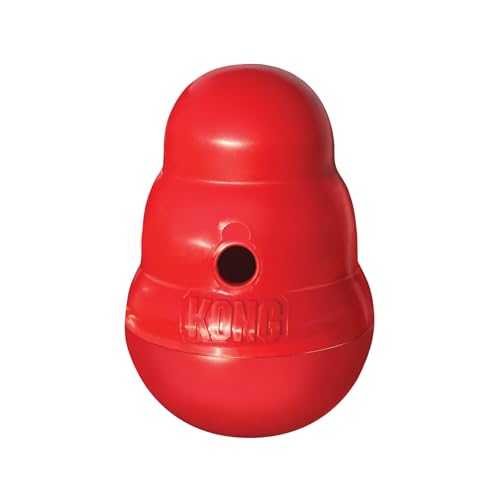
KONG Wobbler Interactive Treat-Dispensing Toy
What We Like
- Screw-top filling for easy kibble loading
- Dishwasher safe for simple cleaning
- Wobble action engages natural instincts
- Slows eating to support weight management
Trade-offs
- No adjustable difficulty for advanced problem-solvers
- Single dispensing method limits variety of play
The KONG Wobbler’s 1.7-pound weight and 7.5-inch height make it a treat-dispensing toy that wobbles when nudged, encouraging dogs to work for their food. The screw-top opening allows for quick filling with kibble or treats, and the whole toy is dishwasher safe for easy cleaning. It’s designed to extend mealtime and help dogs lose unwanted pounds by engaging their natural instincts.
This is a one-trick wobble: no sliding compartments, no spinning layers, no adjustable difficulty. If your dog solves the KONG Wobbler quickly and wants more, the Nina Ottosson Dog Tornado Puzzle offers three spinning layers and 12 hidden compartments for a different kind of challenge. But for a straightforward feeder that extends mealtime and supports healthy eating, the KONG Wobbler does what it’s designed to do.
Product photos
Trixie Rod Board Dog Activity Toy

What We Like
- Level 1 difficulty suitable for beginners
- Dishwasher safe for easy cleaning
- BPA, Phthalate, Lead-Free materials
- Encourages species-specific foraging behavior
Trade-offs
- Flat design limits treat capacity per session
- Not suitable for unsupervised pets, per safety warning
At just 2.2 inches tall and 1.2 pounds, the Trixie Rod Board keeps the challenge low to the ground and easy for a novice puzzler to approach. The premise is straightforward: push aside sliding rods to uncover hidden treats. That simplicity is exactly what makes it a smart starting point for dogs who’ve never worked a food puzzle before. The Level 1 rating means your pup gets a clear win early on, building confidence without frustration. Materials are BPA, Phthalate, and Lead-Free, and the whole board goes in the dishwasher when the game is done, practical for daily use.
The flat, single-layer design holds fewer treats than something like the Nina Ottosson Dog Tornado, which stacks three spinning layers for 12 compartments. If your dog solves puzzles quickly and you’re looking for longer engagement, you’ll outgrow this one faster. But for a first puzzle, that limited scope is actually a feature: it keeps the learning curve gentle and cleanup quick. Best for owners introducing their dog to food puzzles for the first time, not for dogs who already breeze through intermediate-level games.
TRIXIE Mini Mover Dog Puzzle Toy

What We Like
- Advanced sequential steps challenge smart dogs
- Safe BPA, Phthalate, and Lead-Free materials
- Dishwasher safe for easy cleaning
- Lift, push, pull & slide actions
Trade-offs
- Not suitable for unsupervised pets
- Requires treats to maintain interest
Fifteen minutes of mental stimulation equals thirty minutes of physical exercise, so this Level 3 puzzle gives clever dogs a concentrated brain workout that tires them out faster than a walk. It demands a dog that’s already solved simpler toys and is ready for sequential steps, lift, push, pull, and slide to uncover hidden compartments. For owners of smart, easily bored pups who’ve mastered basic puzzles, this is the next logical step up.
A dog that hasn’t built up to this level may just walk away, and the toy relies on treats to keep them engaged. The Outward Hound Nina Ottosson Dog Tornado is a Level 2 puzzle with 12 hidden compartments across three spinning layers. The TRIXIE Mini Mover asks more of your dog’s problem-solving skills through lift, push, pull, and slide actions. It’s not a toy for casual play, it’s a focused enrichment tool for dogs who need a real challenge.
Product photos
KONG Classic Stuffable Dog Toy

What We Like
- Hollow interior for stuffing treats
- Erratic bounce keeps dogs engaged
- Dishwasher safe for easy cleaning
- Recommended by veterinarians and trainers
Trade-offs
- Natural rubber formula for average chewers only
- Not built for power chewers who destroy rubber toys
A hollow interior that you can stuff with kibble, peanut butter, or KONG Snacks turns this rubber chew into a mental workout that lasts far longer than a plain bone. The erratic, unpredictable bounce keeps dogs engaged and entertained during fetch, while the durable natural rubber formula holds up to average chewing without splintering. It’s the kind of toy that pulls double duty: solo enrichment when stuffed, interactive play when thrown, all backed by a brand recommended by veterinarians and trainers worldwide since 1976.
This is a one-trick pony in terms of complexity. Unlike the Nina Ottosson Dog Tornado, which offers three spinning layers and twelve hidden compartments for a puzzle-solving challenge, the KONG Classic relies entirely on you to stuff it. Once the treat is gone, the mental stimulation drops off unless you refill it. For dogs who need a longer, more layered problem to solve, the Tornado’s intermediate puzzle design gives them more to figure out on their own. But for a straightforward, durable chew that doubles as a treat-dispensing boredom buster, this KONG is hard to beat.
Product photos
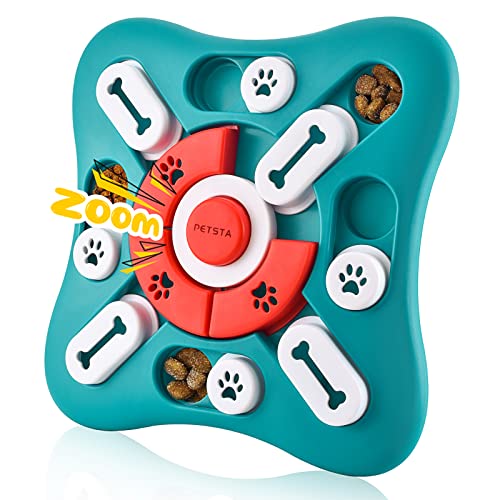
PETSTA Dog Puzzle Toy
What We Like
- Squeak button grabs dog's attention
- Three difficulty levels adjust challenge
- 16 holes slow feeding beyond 20 minutes
- Anti-skid pads keep it stable
Trade-offs
- 1.3-inch height limits treat capacity
- No removable parts for deep cleaning
A built-in squeak button in the center makes this puzzle stand out from the usual slide-and-hide crowd. That noise pulls in dogs who might otherwise walk past a treat toy, and once they’re hooked, the 16-hole dispenser stretches mealtime past twenty minutes. Three difficulty levels let you start easy and work up, so a puppy or a seasoned puzzle pro both get something that fits. The anti-skid pads on the bottom keep the whole thing planted on the floor while your dog spins and slides the sliders. This is the pick for a dog that needs extra encouragement to engage with a brain game, or for an owner who wants slow feeding without a flat, boring mat.
The low profile is the main compromise here. At just 1.3 inches tall, the sliding tracks hold a modest amount of kibble, so a large dog or a heavy feeder will empty it fast compared to a deeper puzzle like the Nina Ottosson Dog Tornado with its three spinning layers. And because all the play parts are built in and non-removable, you cannot pop them out for a thorough scrub. Hand washing or the dishwasher works, but sticky residue may linger in the crevices.
Product photos
Starmark Treat Dispensing Bob-A-Lot

What We Like
- Holds 1.5 cups of food
- Wobbling motion encourages play
- Adjustable gates control food flow
- Slows fast eaters
Trade-offs
- Not recommended as a chew toy
- Requires supervision during play
The 1.5-cup capacity turns a full meal into a wobbling, spinning game, so your dog works for every bite instead of inhaling it in ten seconds. That makes it a natural fit for dogs who gulp their food or need a mental challenge at mealtime. The adjustable gates let you dial the difficulty from easy to tricky depending on kibble size and your dog’s persistence.
This is a feeder, not a chew toy, so the plastic body won’t survive a determined gnawer, supervise play and wash after use. The rounded, weighted base keeps the toy moving, spinning, and wobbling, which entices your dog to keep playing. If your dog is a gentle nosed-poker who loves food puzzles, this is a smart slow-feeding tool; if they’re a power-chewer, you’ll need a tougher option.
This toy is best for owners of fast-eating or food-motivated dogs who want an adjustable, wobbling feeder for mealtime enrichment. It is not recommended as a chew toy, so aggressive chewers or dogs who need a durable rubber toy should look elsewhere.
How We Evaluated Dog Stimulation Toys
We started with the specs: treat capacity, number of compartments, difficulty levels, and materials. Manufacturer documentation told us which toys are dishwasher-safe, which use non-toxic plastics, and which carry safety warnings. Then we cross-referenced that data with expert round-ups from trainers and behaviorists who know how dogs actually interact with puzzles.
Four criteria drove our rankings. Difficulty progression matters most. A toy that’s too easy bores a smart dog, while one that’s too hard frustrates a beginner. Treat capacity and feeding utility separates toys that work as meal replacements from those that only hold a few kibble. Durability and safety covers materials, chew resistance, and whether the toy can be left unsupervised. Ease of cleaning keeps the toy hygienic for daily use. For dogs that need physical engagement alongside mental work, we also looked at options like toys for high-energy dogs that combine wobbling or rolling action with treat dispensing.
This is a research-led evaluation, not a hands-on test. We rely on published specs, expert consensus, and what owners consistently report about their dogs’ experiences. The best toy for your dog is the one that matches their individual skill level and chewing habits.
What To Look For In Dog Stimulation Toys
Finding the right puzzle means matching the toy’s demands to your dog’s personality. Here’s what separates a toy your dog will master from one they’ll ignore or destroy.
Choose a toy with adjustable difficulty if your dog is a fast learner. Look for dishwasher-safe materials if you plan to use it daily. Check treat capacity, 1.5 cups or more means it can replace a meal. Avoid toys with small parts if your dog is a determined chewer.
Difficulty Level and Skill Progression
A good puzzle grows with your dog. Beginner toys like the Trixie Rod Board use a single action, sliding rods to reveal treats, which builds confidence without frustration. Intermediate puzzles like the Outward Hound Tornado add spinning layers and multiple steps. Advanced options like the TRIXIE Mini Mover require sequential actions: lift, push, pull, and slide. Dogs that master one level need the next challenge, or they lose interest. Some owners rotate several toys for smart dogs to keep problem-solving skills sharp.
Treat Capacity and Feeding Utility
The most versatile stimulation toys double as slow feeders. A toy that holds 1.5 cups of kibble, like the Starmark Bob-A-Lot, can replace an entire meal, turning dinner into a 20-minute brain game. Smaller puzzles with half-cup capacity work best between meals or for training sessions. If your dog inhales food in seconds, a treat-dispensing toy that slows eating supports weight management and reduces bloat risk. Many owners find that combining treat-dispensing toys with their dog’s regular kibble eliminates the need for extra treats.
Material Safety and Chew Resistance
Puzzle toys are made of plastic, rubber, or a combination. BPA-free, phthalate-free, and lead-free materials are the baseline for safety. Dogs that like to chew rather than puzzle will pry apart plastic compartments or crack thin walls. For those dogs, a sturdier rubber option like the KONG Classic works better, though even that isn’t built for power chewers. Always follow the manufacturer’s supervision warnings; many puzzles shouldn’t be left with dogs unattended.
- Can you remove all parts for thorough cleaning, or is the toy sealed?
- Does the toy have non-slip pads or grips to stay put on hard floors?
- Is the toy dishwasher-safe for easy sanitizing between uses?
- Are there any small pieces a determined dog could swallow?
- Does the toy have a carrying handle or storage solution for travel?
If your dog destroys every toy in under an hour, skip plastic puzzles entirely and look for heavy rubber options designed for power chewers.
Dog Stimulation Toys Compared
The table below compares each toy’s difficulty level, treat capacity, material, and cleaning method so you can quickly spot the right fit for your dog.
| Product | Dimensions | Weight | Treat Capacity |
|---|---|---|---|
| Outward Hound Nina Ottosson Dog Tornado Puzzle | 9.8 x 7.2 x 3.1 in | 1.2 pounds | 1/2 cup kibble |
| KADTC Dog Chess Puzzle Toy | 16.7 x 16.7 x 2.6 in | 2.3 pounds | 17 hiding spots |
| KONG Wobbler Interactive Treat-Dispensing Toy | 7.5 x 5.1 x 5.1 in | 1.7 pounds | Screw-top opening |
| Trixie Rod Board Dog Activity Toy | 13.8 x 7.7 x 2.2 in | 1.2 pounds | N/A |
| TRIXIE Mini Mover Dog Puzzle Toy | 9.8 x 7.8 x 3.0 in | 1.1 pounds | N/A |
| KONG Classic Stuffable Dog Toy | 1.6 x 1.1 x 1.1 in | 0.0 pounds | Hollow interior for treats |
| PETSTA Dog Puzzle Toy | 10 x 10 x 1.3 in | N/A | 16-hole dispenser |
| Starmark Treat Dispensing Bob-A-Lot | 4.5 x 6.5 in | 1.5 pounds | 1.5 cups |
Frequently Asked Questions
How do I know which difficulty level my dog needs?
Start with a beginner puzzle like the Trixie Rod Board. If your dog solves it in under five minutes on the first try, move to an intermediate level. Dogs that give up and walk away need simpler toys. Most dogs progress through levels over several weeks, not days.
Can stimulation toys replace a dog’s regular meal?
Yes, many puzzles hold enough kibble to replace a full meal. The Starmark Bob-A-Lot holds 1.5 cups, and the Outward Hound Tornado holds about half a cup. Using a treat-dispensing toy for meals slows fast eaters and adds mental work to feeding time.
Are puzzle toys safe for puppies?
Puzzles are safe for puppies under supervision, but choose ones with large pieces that can’t be chewed apart. The KONG Wobbler works well for puppies because the rubber is soft enough not to damage teeth but durable enough to hold up. Avoid toys with small sliding parts until your puppy is past the mouthing stage.
How long should a dog play with a stimulation toy?
Aim for 15 to 20 minutes per session, which is roughly the time it takes to work through a puzzle’s treats. Fifteen minutes of puzzle play equals about 30 minutes of physical exercise in terms of mental fatigue. Stop the session once the treats are gone to keep the toy special.
What if my dog loses interest in a puzzle toy?
Rotate between two or three different puzzles to keep the challenge fresh. Dogs that solve the same puzzle repeatedly get bored, just like people. If your dog ignores a toy after a few tries, step up to an advanced puzzle or switch to a different style, like a wobble feeder or a stuffable chew toy.
The Bottom Line
The Outward Hound Nina Ottosson Dog Tornado Puzzle is the best overall choice for most dogs because it balances mid-difficulty challenge with slow-feeding utility. Its three spinning layers and 12 compartments keep a single dog engaged through a full meal session without overwhelming a beginner. It’s the toy you’ll reach for daily.
If your dog has already mastered intermediate puzzles, the TRIXIE Mini Mover offers the sequential steps that smart dogs crave. For fast eaters who need a slower meal, the KONG Wobbler and Starmark Bob-A-Lot both dispense kibble through movement. And if your dog is new to puzzles, the Trixie Rod Board builds confidence without frustration.
The single most important factor in choosing a stimulation toy is matching the difficulty level to your dog’s current ability. Too easy, and the toy collects dust. Too hard, and the dog gives up. Start simple, watch how your dog responds, and level up from there.
