
9 Best Cleaners For Dog Kennels in 2026
This post contains affiliate links. As an Amazon Associate, we earn from qualifying purchases.
The best cleaner for dog kennels is ArkGuard Kennel Disinfectant Concentrate with Hose-End Sprayer, a concentrated, EPA-registered disinfectant that kills parvovirus and rabies virus while covering large outdoor runs efficiently. For smaller setups, the REScue One-Step Ready-to-Use Disinfectant Cleaner offers fast parvo kill without mixing, and the ATP KennelSol Disinfectant & Cleaner Concentrate is a top choice for professional facilities.
The challenge with kennel cleaning isn’t just removing visible dirt, it’s eliminating pathogens like parvovirus that survive on surfaces for months, while also controlling persistent ammonia odors. A cleaner that handles one but not the other leaves your kennel unsafe and unpleasant.
This guide compares nine kennel cleaners based on their active ingredients, dilution rates, contact times, and surface compatibility. We evaluated manufacturer specifications, EPA registrations, and patterns in owner feedback to help you match the right product to your facility’s size and needs.
Top 9 Cleaners For Dog Kennels in the Market
Certain content that appears on this site comes from Amazon. This content is provided "as is" and is subject to change or removal at any time.
The Best Cleaners For Dog Kennels, Reviewed
ArkGuard Kennel Disinfectant Concentrate with Hose-End Sprayer
What We Like
- Kills parvovirus and rabies virus
- Neutral pH, no bleach smell
- Hose-end sprayer for outdoor runs
- Broad spectrum at low dilution rate
Trade-offs
- DANGER label requires careful handling
- 10-minute wet time slows cleaning pace
- Must remove animals during application
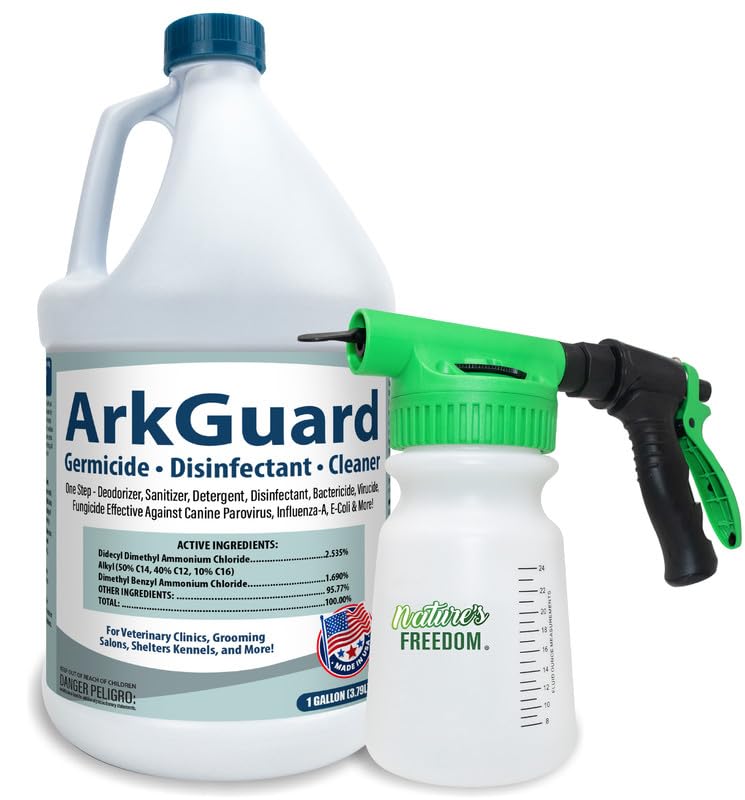
An EPA-registered concentrate that kills canine parvovirus and rabies virus at a 9-ounce-per-gallon dilution means this disinfectant is for high-stakes situations. The 2-ounce-per-gallon rate handles kennel cough, distemper, influenza, and salmonella in the same 10-minute wet time, so a single gallon stretches to 64 gallons of ready-to-use solution. The included hose-end sprayer with a 24-ounce reservoir turns a garden hose into a quick way to treat outdoor runs and concrete without dragging buckets around. Anyone who needs broad-spectrum disinfection with a tool that makes large areas manageable will find this useful.
The 10-minute wet time is the main trade-off you need to plan around. In a busy kennel, that means clearing animals out, spraying, then waiting before you can let them back in. The DANGER label isn’t kidding about the concentrated formula, so gloves and eye protection are required during mixing. For a shelter where parvo is a real concern, that pause buys you the kill coverage specified on the label.
Product photos
REScue One-Step Ready-to-Use Disinfectant Cleaner
What We Like
- Kills canine parvovirus in 60 seconds
- Ready-to-use, no mixing required
- Disinfectant cleaner and deodorizer
Trade-offs
- Spray nozzle not included
- 32 oz bottle covers limited area per use
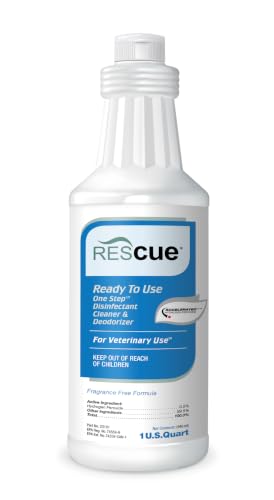
A 60-second kill time against canine parvovirus means you can disinfect a kennel run or crate between dogs without waiting around. Rescue One-Step is a ready-to-use formula, so there is no measuring, mixing, or guessing, just spray and wipe. That simplicity makes it a natural fit for foster homes, small kennels, or anyone who needs a quick, reliable disinfectant without hauling out a hose or measuring cup. The Amazon listing notes it is intended for veterinary use, animal shelters, foster homes, kennels, and litter boxes.
The trade-off is that this is a 32-ounce bottle with no spray nozzle included, so you will need to supply your own trigger or use it with a pump sprayer. For a single crate or litter box, that is fine. If you are cleaning multiple runs or a whole kennel daily, the concentrate version from Rescue (also in this guide) may stretch further and cost less per gallon, though specific pricing is not provided here. This RTU bottle is best as a grab-and-go disinfectant for spot cleaning or small spaces, not as the primary supply for a busy commercial kennel.
ATP KennelSol Disinfectant & Cleaner Concentrate

What We Like
- EPA-registered for animal pathogens
- Concentrated formula reduces product usage
- Deodorizes with wintergreen scent
- Safe for daily use on high-contact surfaces
Trade-offs
- Requires dilution before use
- Requires a dwell time to disinfect effectively
An EPA-registered concentrate that targets canine parvovirus, bacteria, and fungi, this is designed for high-volume settings like veterinary clinics, shelters, and kennels where biosecurity is critical. It handles routine cleaning of floors, crates, and litter boxes while being gentle on equipment, which matters when you’re scrubbing down multiple kennels day after day.
The concentrated formula means you have to mix it yourself, so a measuring cup and a sprayer or mop bucket are necessary, unlike the REScue One-Step Ready-to-Use, which comes pre-diluted in a 32-ounce spray nozzle. ATP KennelSol fits best in high-volume professional settings where dilution is already part of the daily routine, not for someone who just wants to wipe down a single crate without thinking about ratios.
Product photos
REScue Disinfection Concentrate

What We Like
- Veterinary-grade disinfectant concentrate
- Works on hard and soft surfaces
- Veterinarian-recommended disinfectant
Trade-offs
- No hose-end sprayer included for large-area application
- Requires 1:16 dilution, not ready-to-use.
The 1:16 dilution stretches a gallon into plenty of ready-to-use cleaner, which matters when you’re disinfecting runs, crates, and grooming tools day after day. It’s veterinarian-recommended and works on both hard surfaces and soft fabrics after accidents, so you’re not switching products between the concrete floor and the dog bed. This is the one to grab if you need proven parvo protection without a lingering chemical odor.
Product photos
F10 Ready To Use Veterinary Disinfectant Spray
What We Like
- Odorless formula avoids chemical smells
- Broad spectrum kills bacteria, viruses, fungi
- No rinsing needed after air drying
- Non-corrosive on compatible surfaces
Trade-offs
- Ready-to-use size limited to 1 liter
- Requires air drying for full effectiveness
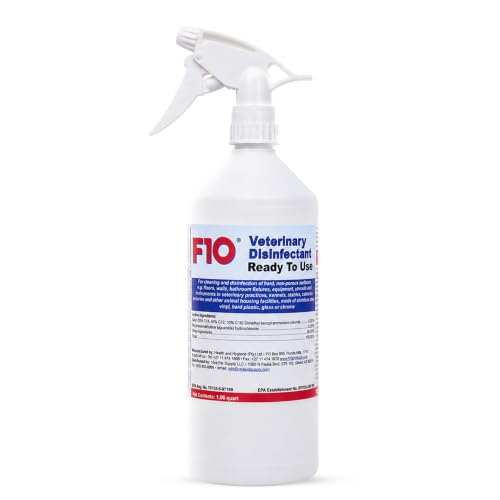
An odorless, pre-diluted spray means you can disinfect a kennel run without the strong chemical smell that often lingers. F10’s formula is EPA-registered for control of bacteria, viruses, fungi, and spores as specified on the approved label, and it dries without requiring rinsing, so animals can return to a clean space sooner. This is the spray to grab when you need a ready-to-use disinfectant that doesn’t add extra steps.
One liter of ready-to-use disinfectant goes fast if you’re spraying down a dozen runs daily, so it’s best for smaller jobs. Compared to a concentrate like ArkGuard Kennel Disinfectant that comes in a 1-gallon jug and requires mixing, this spray saves you the hassle of dilution. For spot-cleaning cages, travel crates, or small shelter rooms where convenience and no odor matter more than economy, the lack of mixing and the lack of smell make it a practical option.
Petology 256:1 Pet Disinfectant and Deodorizer
What We Like
- 256:1 concentrate makes 256 gallons
- EPA-registered against parvo, rabies, distemper
- One-step cleaner, disinfectant, deodorizer
- No rinsing required after 10-minute contact
Trade-offs
- Requires 10-minute wet contact time for disinfection
- Only for non-porous surfaces like floors and crates
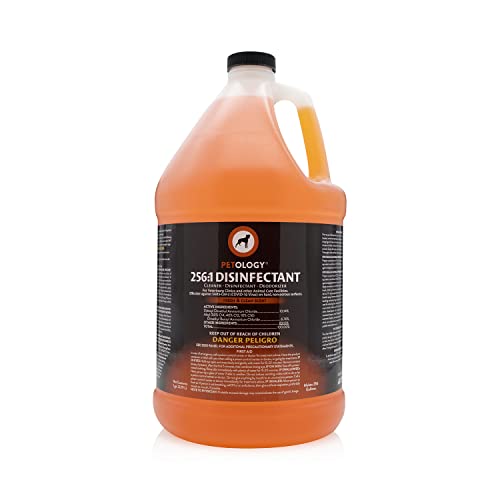
A single gallon of this concentrate makes 256 gallons of ready-to-use solution when diluted at 256:1. That means a kennel can cover a lot of surface area from one jug. It kills pathogens including parvo, rabies, and canine distemper, and works as a cleaner, disinfectant, and deodorizer in one step on floors, crates, and walls. No rinsing is needed after the 10-minute contact time. For facilities that use large volumes of disinfectant, the dilution ratio keeps storage compact.
The 10-minute contact time is non-negotiable if you want actual disinfection, not just cleaning. That slows down turnaround between occupied runs or cages compared to a spray-and-wipe product like the REScue Ready-to-Use spray, which works faster but costs more per gallon. Also, the five scent options (cherry, fresh, lavender, lemon, wintergreen) are pleasant enough, but if your dogs or staff are sensitive to fragrance, there is no unscented version. For high-volume kennels that can plan a cleaning schedule around the dwell time, the concentrate makes 256 gallons of cleaner from one gallon, which reduces cost per gallon compared to ready-to-use products.
Product photos
ProVetLogic Kennel & Turf Care Floor Cleaner

What We Like
- Works on floors and synthetic turf
- Treats clogged drains
Trade-offs
- Concentrate requires mixing before use
- Not a disinfectant, only cleans and deodorizes
A concentrated gallon that handles both hard kennel floors and synthetic pet turf means you don’t need two separate cleaners sitting in the shed. For anyone running a multi-surface dog run or shelter, this simplifies the cleaning routine into one bottle.
Compared to the REScue Ready-to-Use spray, which comes in a spray nozzle bottle and requires no mixing, this ProVetLogic concentrate asks for a little more setup. But if you’ve got both concrete and artificial turf to clean, the versatility justifies the extra step.
Product photos
Orb-3 Enzyme Kennel Cleaner
What We Like
- Enzymatic formula targets odor at source
- pH-neutral and safe on most water-safe surfaces
- Biodegradable and free of harsh chemicals
- Concentrated for cost-effective dilution
Trade-offs
- Not a disinfectant or sanitizer
- Requires dilution for routine cleaning
- No spray nozzle included for spot treatment
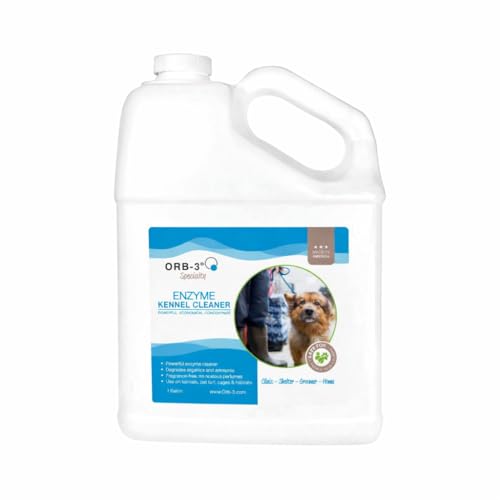
A pH-neutral enzymatic cleaner that breaks down organic soils rather than masking them means you’re actually removing the source of kennel odor, not layering perfume over it. That matters when you’ve got multiple dogs in a confined space and the smell keeps coming back. The concentrated formula requires dilution for routine cleaning, and it works on concrete, turf, carpet, and sealed wood, so you don’t need separate products for the run and the crate. For anyone running a home kennel, shelter, or multi-pet household who wants a cleaner that handles urine and mess without leaving chemical residue, this is the straightforward enzymatic option.
This is an enzymatic cleaner and deodorizer, not a disinfectant, so if your facility needs EPA-registered sanitizing against viruses or bacteria, you’ll need a separate product. That’s by design: the enzyme technology breaks down organic soils and odor-causing residues rather than masking them, which makes it a practical choice for daily odor control in kennels, shelters, and multi-pet homes.
Showseason Animal Products 1008 Cleaners
What We Like
- Fast-acting formula for tough odors
- Safe on multiple surfaces
- Soaks into porous surfaces
Trade-offs
- Heavy at 10 pounds for a gallon
- Requires dilution before use
- Not a disinfectant, only cleaner/deodorizer
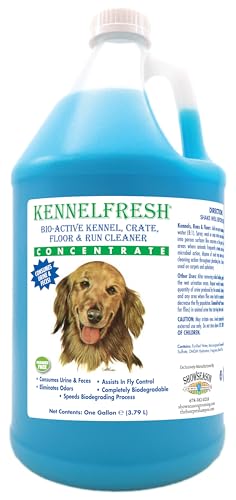
An 8:1 dilution ratio means this concentrate stretches further than many ready-to-use sprays, and the formula is designed to soak into porous concrete and grout where odors hide. The instructions even suggest pouring leftover mop water down drains to keep cleaning action going in the plumbing. It suits anyone who wants a single product that handles tough pet odors without extra steps.
The trade-off is weight and prep. At 10 pounds per gallon jug, it is noticeably heavier than something like the REScue Ready-to-Use spray, which comes in a lighter 2.1-pound bottle. You also have to mix it yourself, which adds a step compared to grab-and-go options. But if your main headache is flies around the kennel and you do not mind a little measuring, the fly control makes this worth the extra effort. Just keep in mind this is a cleaner and deodorizer, not a disinfectant, so if you need pathogen kill, you will still need a separate product.
Product photos
How We Evaluated Cleaners For Dog Kennels
We built this guide from manufacturer documentation, EPA-registered label claims, and common patterns in kennel owner experiences. For each product we verified the pathogen kill list, required contact time, dilution ratio, and whether it functions as a cleaner, disinfectant, or both. Products that claim to kill parvovirus had to list it on their label, we didn’t take marketing language at face value.
The four criteria that mattered most were pathogen effectiveness (especially parvo and distemper), ease of application across typical kennel surfaces, safety for animals and handlers during use, and value per gallon of ready-to-use solution. A disinfectant that requires a 10-minute wet time is useless if the kennel can’t stay empty that long.
A research-led evaluation has limits, we didn’t culture swabs or measure pathogen reduction in a lab. What we can tell you is exactly what each product claims on its label, how owners report it performs in real kennels, and which trade-offs matter for different cleaning routines. For a deeper look at compatible surfaces, see our guide to kennel flooring options.
What To Look For In Cleaners For Dog Kennels
Choosing a kennel cleaner starts with knowing what you’re trying to kill, how much surface you need to cover, and how long the area can stay empty between animals. The wrong product wastes time or leaves pathogens behind.
Pick a disinfectant that kills the specific pathogens in your facility, requires no rinsing on surfaces animals contact, and has a contact time your cleaning schedule can actually support.
Pathogen Kill Spectrum
Not all kennel cleaners kill parvovirus, distemper, or rabies. Check the EPA registration number and the label’s organism claim list, “broad spectrum” on the bottle isn’t specific enough. For shelters and boarding kennels, a product that kills canine parvovirus in under 10 minutes is the minimum standard. Some ready-to-use formulas like REScue One-Step achieve parvo kill in 60 seconds, which changes how fast you can cycle a kennel.
Contact Time and Wet Time
A disinfectant only works if the surface stays wet for the entire contact period listed on the label. Some products require 10 minutes of continuous wetness, that’s a long time to keep a crate or run damp in a busy kennel. Shorter contact times (60 seconds to 5 minutes) are easier to maintain and reduce the risk of missed spots. If your routine involves spot-cleaning between occupied runs, a shorter wet time product is worth paying more for.
Surface Compatibility and Rinsing Requirements
Concrete, sealed floors, stainless steel crates, and synthetic turf all react differently to chemicals. Some disinfectants are non-corrosive on metal; others can pit stainless over time. Many kennel disinfectants require no rinsing after air drying, which saves labor and prevents chemical residue from contacting animals. For floor cleaners that target ammonia buildup on concrete and turf, look for a product formulated specifically for those surfaces.
- Verify the product is labeled for the surfaces in your kennel (concrete, sealed wood, plastic, metal, turf)
- Check whether it requires rinsing or is safe to leave on after drying
- Confirm the concentrate dilution rate matches your mixing equipment and water hardness
- Ensure the sprayer type (hose-end, trigger, pump) fits your kennel layout
- Read the safety label, some concentrates require gloves and eye protection during mixing
If you can’t keep the surface wet for the full contact time, the disinfectant isn’t working, shorten your cycle or switch to a faster-acting product.
Cleaners For Dog Kennels Compared
The table below compares all nine kennel cleaners across their key specifications, including pathogen kill claims, dilution ratios, and contact times, so you can see at a glance which product fits your facility.
| Product | Formulation | Target Pathogens | Weight |
|---|---|---|---|
| ArkGuard Kennel Disinfectant Concentrate with Hose-End Sprayer | Concentrate | Canine parvovirus, Rabies, Bordetella, Distemper, Influenza, Coronavirus | 10.0 pounds |
| REScue One-Step Ready-to-Use Disinfectant Cleaner | Ready-to-Use | Canine parvovirus | 2.1 pounds |
| ATP KennelSol Disinfectant & Cleaner Concentrate | Concentrate | Canine parvovirus, bacteria, fungi | 6.0 pounds |
| REScue Disinfection Concentrate | Concentrate | Ringworm, Influenza, Calicivirus, Kennel Cough, Parvovirus | N/A |
| F10 Ready To Use Veterinary Disinfectant Spray | Ready-to-use spray | bacteria, viruses, fungi, spores | N/A |
| Petology 256:1 Pet Disinfectant and Deodorizer | Concentrate | Parvo, Influenza, Avian Influenza | 8.0 pounds |
| ProVetLogic Kennel & Turf Care Floor Cleaner | Concentrated | N/A | 8.0 pounds |
| Orb-3 Enzyme Kennel Cleaner | Concentrated | N/A | N/A |
| Showseason Animal Products 1008 Cleaners | Concentrate | N/A | 10.0 pounds |
Frequently Asked Questions
Can I use a regular household cleaner on my dog kennel?
Household cleaners like bleach or all-purpose sprays are not formulated for animal pathogens and may not kill parvovirus or distemper. Bleach requires a specific dilution ratio and a 10-minute contact time to disinfect, and its fumes can irritate dogs’ respiratory systems. Use an EPA-registered kennel disinfectant instead.
What cleaner kills parvo in kennels?
Products with accelerated hydrogen peroxide (like REScue) or potassium peroxymonosulfate (like ArkGuard and ATP KennelSol) are proven to kill canine parvovirus. Check the label for “canine parvovirus” in the organism claim list, not all disinfectants are effective against it. Contact time matters: some kill parvo in 60 seconds, others require 10 minutes.
How often should I disinfect a dog kennel?
High-traffic kennels should be cleaned daily and disinfected at least weekly, or between every new animal in shelter and boarding settings. Spot-clean soiled areas immediately. For daily cleaning between full disinfections, an enzyme cleaner like Orb-3 can handle odor without degrading surfaces.
Do I need to rinse kennel disinfectant before putting my dog back in?
Most modern kennel disinfectants are labeled as no-rinse after air drying. Check the specific product label, some require rinsing with potable water, especially on surfaces animals will contact. Leaving residue on surfaces can cause skin irritation or be ingested during grooming.
What is the best way to clean a dog crate?
Remove the bedding and any debris first, then apply a kennel-safe disinfectant and let it sit for the full contact time listed on the label. Rinse if required, then dry thoroughly before replacing bedding.
The Bottom Line
For most kennel operators, the ArkGuard Kennel Disinfectant Concentrate with Hose-End Sprayer is the best overall choice. It kills parvovirus and rabies virus, and the included hose-end sprayer covers large runs efficiently. The neutral pH won’t damage surfaces, so it’s safe for regular use. This concentrated product requires careful handling, but the broad-spectrum pathogen kill and low dilution rate make it the workhorse for serious facilities.
If you have one or two crates and want to skip mixing, the REScue One-Step Ready-to-Use Disinfectant Cleaner kills parvo in 60 seconds with no dilution. For professional kennels that need a concentrated, daily-use disinfectant with a wintergreen deodorizer, the ATP KennelSol Disinfectant & Cleaner Concentrate is a strong choice. If odor removal without disinfection is your main concern, an enzymatic cleaner for pets like Orb-3 targets urine and ammonia at the source.
The single most important factor is matching the product’s contact time to your real cleaning schedule. A 10-minute wet time you can’t maintain is worse than a faster-acting product that costs a bit more per use. For a broader look at pet cleaning supplies, our full guide covers everything from crate wipes to turf deodorizers.
