
10 Best Brushes For Siberian Husky in 2026
This post contains affiliate links. As an Amazon Associate, we earn from qualifying purchases.
For a Siberian Husky, the right brush makes the difference between a manageable grooming session and a losing battle with fur. The Pecute Self-Cleaning Slicker Brush earns our best overall spot because its one-click fur ejection and fine 135° bristles handle a double coat without tiring your hand. For heavy shedding, the Be Best Pets Deshedding Brush digs deep, while the Thunderpaws 2-in-1 Design tackles blowouts with both dematting and deshedding in one tool.
A Husky’s thick double coat sheds year-round and blows out completely twice a year. Most owners find that a single brush isn’t enough, you need different tools for the undercoat, the topcoat, and sensitive areas like the face and paws. The wrong brush leaves loose fur in the coat, leading to mats and more fur on your furniture.
This guide is based on manufacturer specifications, expert grooming advice, and patterns in owner feedback across the ten best brushes for Siberian Huskies. We break down what each tool does best so you can build a grooming kit that actually works for your dog.
Top 10 Brushes For Siberian Husky in the Market
Certain content that appears on this site comes from Amazon. This content is provided "as is" and is subject to change or removal at any time.
The Best Brushes For Siberian Husky, Reviewed
Pecute Self-Cleaning Slicker Brush

What We Like
- One-click self-cleaning ejects fur instantly
- Fine 135° bristles with protective massage tips
- Lightweight 89g with non-slip TPR handle
- Engineered for double coats and white fur
Trade-offs
- Small brush head for a large double-coated breed
- Too small for large double-coated breeds like Huskies
The one-click self-cleaning button ejects fur instantly, so you don’t have to pick hair out of the bristles by hand, a real time-saver during heavy shedding periods. Fine 135° stainless steel bristles with protective massage particles capture undercoat, dander, and dirt, and the brush is described as extremely effective on white-coated pets. At just 89g with a non-slip TPR handle, the brush reduces wrist fatigue, making it easy to maintain the recommended 2-3 sessions per week for double-coated dogs.
The trade-off is size: the brush head is compact, so covering a large double-coated dog like a Husky takes more strokes than a wider tool such as the Chris Christensen Mark I. However, the self-cleaning mechanism cuts cleanup time, and the lightweight design keeps frequent sessions comfortable. It’s a practical choice for owners who want less mess and a brush that’s easy on the wrist.
Product photos
Artero Bella Double-Sided Slicker Brush

What We Like
- Two pin faces for detangling and opening coat
- Flexible head follows legs, chest and body
- Removes loose undercoat while detangling
- Bamboo handle in multiple sizes
Trade-offs
- Will not cut through tight pelted mats
- Requires splitting mats first before use
Two pin faces in one brush let you open a dense topcoat with the gray side’s thin, randomly placed pins, then flip to the black side’s thicker rows to detangle and pull out shedding undercoat without switching tools. The flexible head bends to follow the dog’s legs, chest, and body. This brush is designed for owners who want to reduce the number of tools on the grooming table and keep the process moving, especially during heavy shedding periods.
The trade-off is that this slicker brush is not a mat-splitter. If your dog has tight pelted mats, the kind that feel like felt against the skin, you’ll need to break them apart with a rake or dematting comb first, then finish with this brush. Compared to the Freshly Bailey Dematting Comb, which is a dedicated dematting tool, the Artero Bella is better suited for maintenance grooming between full dematting sessions. It’s a two-in-one detangling tool, not a rescue tool for neglected coats.
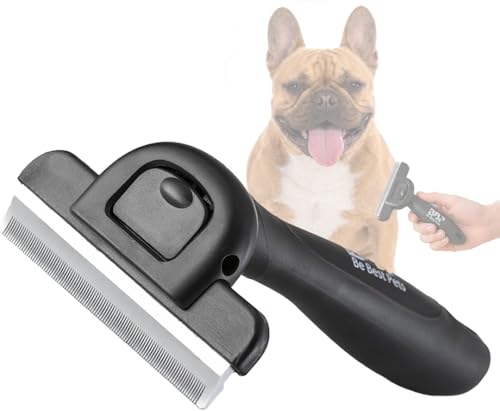
Be Best Pets Deshedding Brush
What We Like
- Rounded stainless steel teeth protect skin
- Ergonomic handle reduces wrist strain
- Penetrates topcoat to remove deep undercoat
- Non-slip grip for better control
Trade-offs
- No self-cleaning mechanism; loose fur must be picked out
- Single-sided design limits versatility
A brush that reaches deep into the undercoat without hacking at the topcoat is exactly what an owner of a double-coated breed needs. The Be Best Pets Deshedding Brush delivers that with its rounded stainless steel teeth that glide through thick double coats. The ergonomic non-slip handle reduces hand fatigue during long grooming sessions, making it easier to tackle heavy shedding. This tool is designed to remove loose undercoat fur before it spreads around your home, helping reduce shedding on furniture, floors, and clothing.
This deshedding brush is a single-sided undercoat rake designed to penetrate through the topcoat and reach deep into the undercoat where most shedding begins. It is a reliable solution for double-coated breeds that require deeper grooming beyond standard brushes. The rounded stainless-steel teeth glide smoothly through the coat while staying gentle on your pet’s skin, reducing pulling and discomfort during grooming. The comfortable, non-slip handle provides a secure grip for better control during grooming sessions, reducing wrist strain and hand fatigue so you can brush longer with ease.
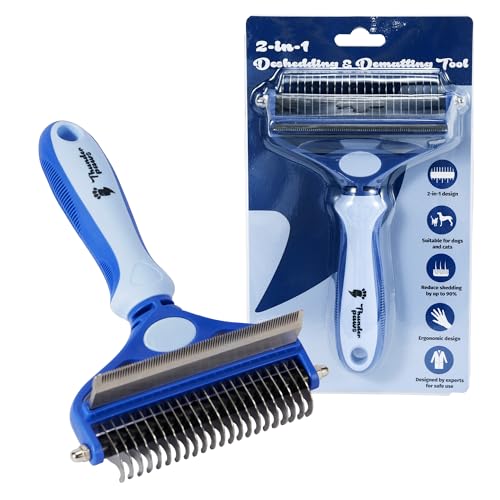
Thunderpaws 2-in-1 Deshedding Brush
What We Like
- Reduces shedding up to 95%
- Two functions in one tool saves time
- Rounded safety tips won't scratch skin
- Ergonomic handle reduces hand fatigue
Trade-offs
- Rake teeth only 17, less coverage than a full dematting rake for severe mats
Seventeen deep-reach rake teeth on one side and sixty-eight fine de-shedding teeth on the other mean you can tackle mats and loose undercoat in a single grooming session without swapping tools. For a Siberian Husky owner staring down spring blowout, that time savings is real. The rubberized handle keeps your hand from cramping during the ten to fifteen minutes it takes to work through that thick double coat. Thunderpaws built this specifically for breeds like Huskies, with rounded safety tips on every tooth so you don’t scratch sensitive skin while pulling out the fluff that would otherwise end up on your couch.
The fine de-shedding side collects a lot of hair fast, so you’ll be stopping to pick it out mid-session during heavy shedding periods. Compared to the FURminator Large Dog Undercoat deShedding Tool, which has a single-purpose blade and a built-in fur ejector, the Thunderpaws gives you dematting capability in the same handle but asks you to manually clear the teeth. If your Husky rarely gets mats and you prioritize pure shedding removal speed, the FURminator might suit you better. But if you want one tool that handles both jobs without scratching, this is the smarter buy.
Product photos
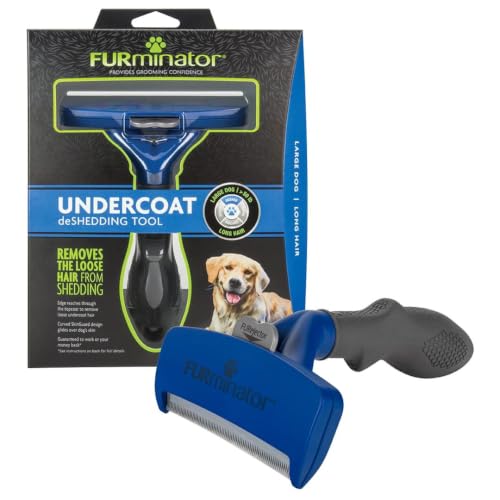
FURminator Large Dog Undercoat deShedding Tool
What We Like
- Ergonomic handle for comfortable grooming
- FURminator button releases hair easily
- Reaches undercoat without damaging topcoat
- Designed for large long-haired dogs
Trade-offs
- 0.6 pounds is heavier than some slicker brushes
- Designed for dogs over 50 pounds only
- Weekly use recommended for best results
For dogs over 50 pounds with long hair, this tool reaches through the topcoat to remove loose undercoat hair without cutting skin or damaging the topcoat when used as directed. The ergonomic handle makes grooming comfortable on a large dog, and the FURminator button lets you eject the collected fur in one quick push instead of picking it out by hand. That single feature saves time and mess compared to brushes that require manual hair removal.
At 0.6 pounds, this tool is heavier than the Pecute Self-Cleaning Slicker Brush at 0.2 pounds. That lighter brush might be easier to maneuver for detail work around the ears and tail, but for the main task of stripping the undercoat from a large long-haired dog, the FURminator’s reach and the convenience of that release button make it a practical choice. Just plan to use it weekly, and it’s designed for dogs over 50 pounds.
Product photos
Freshly Bailey Dematting Comb

What We Like
- Two-sided design for detangling and deshedding
- Lifts loose undercoat fur during brushing
- Removes mats and knots before they worsen
- Sized for home grooming between pro sessions
Trade-offs
- At 6.7 inches, short handle limits leverage on a large Husky
- Only one dematting side, no option for different tooth spacing
A dual-sided comb that tackles both mat removal and undercoat shedding in one tool means you don’t have to swap brushes halfway through a grooming session. The dematting side loosens light knots before they tighten into painful mats, and the deshedding side lifts loose undercoat fur that would otherwise end up on your couch. For medium to long-haired cats and dogs with double coats, this is the kind of regular maintenance tool that keeps the coat manageable between full grooming appointments.
The Freshly Bailey Dematting Comb measures 6.7 inches long, which is shorter than the 11.0-inch Artero Bella Double-Sided Slicker Brush. That means you’ll be working closer to your pet, but for regular home grooming between full sessions it’s still a practical tool. Owners who brush frequently find it keeps coats cleaner and more manageable without needing a longer reach.
KIZO ESLO XL+ Undercoat Rake

What We Like
- XL head covers more coat per stroke
- 2-sided hooked-blade for mats and deshedding
- Rounded stainless-steel edges reduce pulling
- Solid wood handle with contoured grip
Trade-offs
- Only suited to long, thick double coats
- Not for short-haired or single-coated breeds
An extra-large head that spans more coat per stroke means fewer passes when you’re working through a Husky’s dense undercoat during shedding season. The two-sided hooked-blade design gives you wide teeth for stubborn mats on one side and fine teeth for lifting loose fur on the other, so you aren’t switching tools mid-session. Rounded stainless-steel edges glide through fur with less pulling and scratching, which matters when your dog is already shedding enough to stuff a pillow. This rake is built for heavy-duty home grooming on thick double coats, and the solid wood handle keeps a comfortable grip even when your hand gets tired.
At 0.4 pounds, this rake is lighter than some other heavy-duty grooming tools, which may mean you need to apply more downward pressure when working through tight mats. The XL head covers more coat per stroke, saving time on broad areas, but it is designed specifically for long, thick double coats, not for fine or short single coats. It’s built for the kind of dense undercoat a Husky or other double-coated breed brings during shedding season.
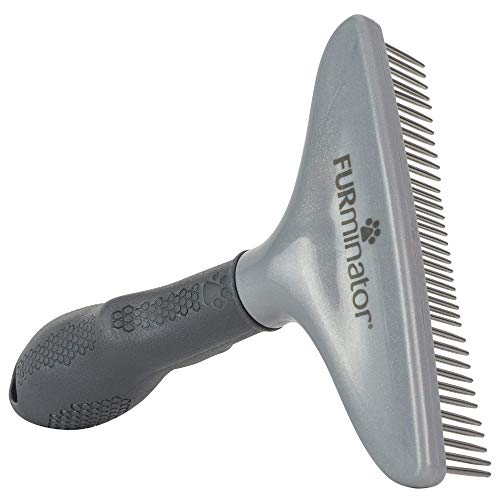
FURminator Grooming Rake Tool
What We Like
- Rotating metal teeth prevent mats
- Ergonomic non-slip handle for control
- Designed for dense double coats
- Suitable for daily undercoat care
Trade-offs
- At 0.4 lb, heavier than slicker brushes
- Daily use required for best results
The rotating metal teeth set this rake apart from a standard comb, they pivot as you pull through a Husky’s dense undercoat, grabbing loose hair without snagging or yanking on the topcoat. That daily-use design means you can work through a few square inches each evening rather than fighting a matted mess once a week. For owners committed to a quick maintenance routine, the ergonomic non-slip handle gives you the control to navigate tricky spots like the ruff and tail without your hand cramping up.
The weight is 0.4 pounds, which is heavier than some slicker brushes like the Pecute Self-Cleaning Slicker Brush at 0.2 pounds. That heft comes from the metal teeth and sturdier build needed to reach the undercoat on dogs and cats with thick fur or dense double coats. For owners who prefer a lighter tool for quick touch-ups, a slicker brush may be a better fit, but for daily undercoat maintenance this rake is designed to handle the job.
Product photos
Tpotato Deshedding Dog Rake

What We Like
- Double-sided rake with 9 and 17 teeth
- Lightweight at 0.4 pounds
- Ergonomic non-slip rubber handle
- Includes a separate cat comb
Trade-offs
- Requires 2-3 uses per week, daily in shedding season
- Only for long-haired, double-coated pets.
At 0.4 pounds, this rake is light enough to use on a large dog without your arm tiring quickly. The double-sided head gives you two options in one tool: nine wider teeth for working out mats and tangles, and seventeen finer teeth for thinning and deshedding. That combination is designed for long-haired, double-coated pets like Golden Retrievers or Persians during shedding season, and the rubber handle with a non-slip stripe keeps it from sliding around when your hands get tired. For someone who wants a functional deshedding tool without extras, this gets the job done for the budget-minded owner.
The catch is that this rake is built strictly for long-haired dogs, so if your pet has a thinner coat or you also own a short-haired breed, you will need a second brush. Compared to the Pecute Self-Cleaning Slicker Brush, which works on short and long coats alike, the Tpotato is more specialized and less versatile. But for a long-haired double-coated pet, the 17-tooth side helps remove loose undercoat and dead hair, and the included cat comb is a nice bonus for cleaning up around the face and tail. It is a straightforward, no-fuss tool that does what it promises.
Product photos
Chris Christensen Mark I Slicker Brush

What We Like
- Ultra-soft flexible pad with foam cushion
- Handmade in Germany from natural beechwood
- Contoured handle allows brushing in any direction
Trade-offs
- Extra-small head limits use to detail areas on a Husky
- No self-cleaning mechanism; pins require manual cleaning
A 2.75-inch head and 12mm pins make this slicker brush purpose-built for precision work, not full-coverage deshedding. For a Siberian Husky owner who already owns a heavy-duty undercoat rake, this brush is the detail tool that finishes the job where larger tools can’t reach.
That same small head and short pin length mean the Mark I is not designed for tackling a Husky’s dense double coat in a single pass. Compared to the Pecute Self-Cleaning Slicker Brush, which has a one-click cleaning mechanism, the Mark I feels like a specialist’s instrument rather than a daily driver. It is the brush you pull out for detail work on larger breeds, paw tidying, or a cat that dislikes grooming, not the one you grab for a full shed-out.
Product photos
How We Evaluated Brushes For Siberian Husky
We evaluated these brushes by looking at their design, materials, and how well they match the specific needs of a Siberian Husky’s double coat. Our research drew from manufacturer specifications, professional grooming resources, and consistent patterns in what thousands of owners report working, and not working, for their Huskies.
The four criteria that mattered most were coat compatibility, cleaning ease, handle comfort, and versatility. A brush that works on a Husky must reach the dense undercoat without scratching the skin or damaging the outer guard hairs. Self-cleaning mechanisms save significant time during heavy shed seasons, and a comfortable grip matters when you’re brushing a large dog for twenty minutes or more.
Because this is a research-based evaluation, we focused on what the specifications and owner consensus actually say. No brush works for every dog, and no single tool replaces a full grooming routine, but knowing which brush fits which job gets you closer to a clean, comfortable Husky.
What To Look For In Brushes For Siberian Husky
A Siberian Husky’s coat is a double-edged grooming challenge. You need tools that remove the soft undercoat without cutting or damaging the longer guard hairs, and you need them to be comfortable enough to use regularly.
Choose brushes with rounded or protected tips to avoid scratching your Husky’s skin. Look for self-cleaning mechanisms if you groom frequently, and prioritize ergonomic handles for longer sessions. A good Husky brush kit includes at least one undercoat rake and one slicker brush.
Coat Compatibility
The most important factor is whether the brush reaches the undercoat without harming the topcoat. A Husky’s guard hairs are the coat’s waterproof outer layer, and cutting them with a furminator-style blade can permanently damage the coat’s insulating properties. Undercoat rakes and slicker brushes with fine, bent bristles (like the 135° angle on the Pecute) lift loose undercoat while leaving guard hairs intact. For the face, ears, and paws, a smaller, ultra-soft brush like the Chris Christensen Mark I prevents discomfort in sensitive areas.
Cleaning and Maintenance
Huskies shed enough fur that cleaning the brush mid-session becomes a major factor. Self-cleaning mechanisms, a button or lever that ejects the fur, save significant time and keep you brushing instead of picking hair off the pins. The Pecute and FURminator tools both offer this feature. Without it, you’ll need to pull fur out by hand or use a comb, which can slow down a grooming session considerably, especially during seasonal blowouts.
Handle and Ergonomics
A Husky is a large, strong dog, and you’ll be brushing for extended periods. Look for a non-slip grip (rubber or TPR handles) and a weight that won’t fatigue your wrist. The Be Best Pets deshedding brush and the FURminator tools offer ergonomic handles that reduce strain. The Freshly Bailey comb’s short handle can limit leverage on a large Husky, while the KIZO ESLO XL+‘s solid wood handle gives a comfortable, secure grip for covering large areas.
- Check that the brush head is large enough to cover your Husky’s body efficiently, the KIZO XL+ head covers more coat per stroke.
- Ensure the tooth tips are rounded or have protective caps to prevent skin irritation.
- For daily maintenance, choose a tool light enough that you’ll actually reach for it.
- If you groom on a table or the floor, consider the brush’s length and how it fits your hand.
One good undercoat rake and one good slicker brush cover most of a Husky’s grooming needs. Add a fine comb for the face and you’re set.
Brushes For Siberian Husky Compared
The table below compares all ten brushes across their key specs and best-use scenarios, so you can see at a glance which tools fit your Husky’s coat and your grooming routine.
| Product | Weight | Bristle/Teeth Type | Target Coat |
|---|---|---|---|
| Pecute Self-Cleaning Slicker Brush | 0.2 pounds | 135° stainless steel with protective tips | Double coats & white fur |
| Artero Bella Double-Sided Slicker Brush | 0.3 lb | Two pin faces: thin random and thick rows | Double coats |
| Be Best Pets Deshedding Brush | N/A | Stainless steel, rounded | Thick double coats, heavy shedding |
| Thunderpaws 2-in-1 Deshedding Brush | N/A | 17 deep-reach rounded rake teeth + 68 fine de-shedding teeth | Double-coated breeds |
| FURminator Large Dog Undercoat deShedding Tool | 0.6 pounds | Stainless steel | Long hair |
| Freshly Bailey Dematting Comb | 0.3 lb | 2 sides: dematting + deshedding | Medium to long, double-coated |
| KIZO ESLO XL+ Undercoat Rake | 0.4 pounds | 2-sided hooked-blade | Long, thick & double coats |
| FURminator Grooming Rake Tool | 0.4 pounds | Rotating metal | Thick fur or dense double coats |
| Tpotato Deshedding Dog Rake | 0.4 pounds | 9-teeth and 17-teeth | Long-haired, double-coated only |
| Chris Christensen Mark I Slicker Brush | 0.0 pounds | 12mm pins, stainless steel | All coat types |
Frequently Asked Questions
How often should I brush my Siberian Husky?
During most of the year, brushing two to three times per week keeps loose fur under control. During seasonal blowouts in spring and fall, daily brushing is necessary to remove the heavy undercoat before it mats.
What is the best brush for a Husky’s undercoat?
An undercoat rake or a quality deshedding tool works best for removing the dense, woolly undercoat. The Be Best Pets Deshedding Brush and the FURminator Large Dog Undercoat deShedding Tool are two top options that reach deep without damaging the topcoat.
Can I use a FURminator on a Siberian Husky?
Yes, but only on the undercoat and with care. The FURminator Large Dog Undercoat deShedding Tool is designed for dogs over 50 pounds and reaches the undercoat without damaging guard hairs when used weekly as directed. Avoid over-brushing, which can irritate the skin, and never use a furminator-style blade on the topcoat.
Do I need more than one brush for my Husky?
Most Husky owners benefit from having at least two brushes: an undercoat rake for deep shedding sessions and a slicker brush for daily maintenance and detail work. Some owners add a dematting comb for the feathering on the legs and tail. Our Husky grooming guide explains which tools cover which jobs.
What should I use to bathe my Husky before brushing?
A good shampoo for Siberian Huskies helps loosen dead undercoat before brushing. Look for a formula designed for double coats that won’t strip the natural oils. Brush your Husky thoroughly before a bath to remove loose fur, then brush again after drying to catch any remaining undercoat that loosened during washing.
The Bottom Line
The Pecute Self-Cleaning Slicker Brush is the best overall choice for most Husky owners because it combines a gentle, effective brushing action with a self-cleaning mechanism that saves time during heavy shedding. It’s lightweight and easy to use for frequent sessions, though you’ll want a larger undercoat rake for the full-body blowout seasons.
If your Husky is going through a heavy shed, the Be Best Pets Deshedding Brush or the Thunderpaws 2-in-1 Design will handle the deep undercoat removal more efficiently. For owners on a budget, the Tpotato Deshedding Dog Rake offers a functional dual-sided design at an affordable price point. The Chris Christensen Mark I is the best choice for sensitive areas like the face and paws.
The single most important thing is to match the brush to the job. One tool won’t do it all for a Husky, but the right two or three tools will keep your dog comfortable and your home noticeably cleaner.
