
Bernedoodle Grooming Needs: Brush and Groom Schedule
This post contains affiliate links. As an Amazon Associate, we earn from qualifying purchases.
Bernedoodle grooming needs depend on which coat the dog grew: curly coats need daily brushing, wavy or straight coats need brushing three to four times a week, and published groom intervals run from six weeks to twelve depending on the coat and the source.
That spread matters because the coat packs down quietly at the skin while the top layer still looks brushed. By the time the matting is visible, a groomer is often reaching for clippers instead of a comb.
What follows is the coat-by-coat schedule, the places matting actually starts, the puppy window where good routines fall apart, and the honest disagreement between sources on how often a salon visit is really needed.
Key Takeaways
- Brush down to the skin. A slicker that glides across the surface leaves the under-layer packed, and that’s the layer that mats.
- Coat type can set the brushing schedule. Petful advises curly coats get daily brushing and wavy and straight coats get three to four sessions a week, while Brisbane Bernedoodles and Groodles does not set a different schedule per coat type and says the groomer should guide the trim.
- Salon intervals are a range, not a rule. Published answers run from every six weeks (WOOOF) to every eight to twelve weeks (Alpine Bernedoodles).
- The 6-to-12-month coat change is the danger window. Brushing has to increase as the adult coat comes in.
- Shaving is a last resort on a Bernese-coated dog, per AKC guidance on double coats.
Bernedoodle Grooming Needs Start With the Coat You Got
Run your fingers up the flank against the grain and watch what happens. Tight coils that spring back mean the curly coat. Loose S-waves mean the fleece.
A furnished coat grows continuously instead of shedding out. Furnishings are the genes behind the beard, eyebrows, and moustache, and they decide whether a dog sheds at all. Hair that does not shed keeps growing, so the coat needs regular trims and brushing to stay soft and free of tangles.
That explanation comes from Brisbane Bernedoodles and Groodles, and it’s the cleanest one on the web. Furnishings decide shedding. Shedding decides whether hair keeps growing. Whether hair keeps growing decides how often you’re holding a brush.
Pro Plan is the only source that says out loud what the others dance around: the Bernedoodle coat can land anywhere from low maintenance to high maintenance. Be ready for either. WOOOF, a grooming salon, normalizes one type instead, describing most Bernedoodles as carrying a heavy soft layer under a curly coat.
Both can be true. Petful points out that even littermates differ, so a litter can throw one curly puppy and one straight-coated puppy.
The Bernese half of the cross is a heavy double coat, which is why bernese mountain dog brushes look nothing like doodle tools. The Poodle half is single-coated and keeps growing. When you’re shopping, curly-haired dog grooming gear is the right shelf to be on if your dog landed on the wool side.
| Coat Type | Home Brushing | Professional Groom | Mat Risk |
|---|---|---|---|
| Curly (wool) | Daily, down to the skin | Every 6 weeks | Highest |
| Wavy (fleece) | 3 to 4 times a week | Every 8 weeks | Moderate |
| Straight | A couple of sessions a week | Every 8 weeks | Lowest |
Petful builds its whole schedule around those three coat types. Brisbane Bernedoodles and Groodles doesn’t. Its site says plainly that it doesn’t set a different bernedoodle grooming needs schedule per coat type and that the groomer should guide the trim.
Here is the catch. Petful’s coat-type split is more useful for planning your week, while Brisbane Bernedoodles and Groodles holds that there is no coat-type-specific schedule and the groomer should guide the trim. The breeder’s point holds for the first few months, when you genuinely can’t tell what the adult coat will be. If you’ve groomed a goldendoodle grooming needs coat before, you already know the drill; the Bernedoodle version is the same job with a heavier under-layer on some dogs.
The part nobody mentions: You won’t know which coat you actually got until the adult coat arrives. Puppy coats mislead, and the brushing routine that worked in spring can be wrong by winter.
How Often Should You Brush a Bernedoodle at Home?
The published answers run from once a week to once a day, and every source states its number with total confidence.
PetMD, reviewed by a veterinarian, says brush every week. Petful says a curly Bernedoodle brushed less than daily will mat, full stop, while a wavy coat needs three to four sessions a week and a straight coat can stretch to a couple. WOOOF says line brush down to the skin every two days. The AKC’s general double-coat guidance is at least weekly, with more frequent grooming during shedding periods.
None of those are wrong. They’re answering for different coats and different tolerances.
If you want one rule to hold onto: let the comb tell you the truth, not the calendar.
Before you start: Clippers get hot with use and can burn skin, so alternate between two pairs or use a cooling product. Scissors cut skin as easily as they cut mat, so keep blunt-tipped bandage scissors for ears and paws. A dog in pain will bite, even a gentle one, so stop and hand the last inch to a groomer.
- Start at the skin, not the surface. Part the coat with one hand and bring the slicker up from underneath in short strokes. Skip this and you get a dog that looks brushed with a felt layer hiding underneath.
- Work in sections the size of your palm. Big sweeping passes feel efficient and leave the middle of each section untouched, which is exactly where a mat starts.
- Follow every slicker pass with a steel comb. The comb is the honest test. If it stops with a soft tick halfway down the leg, there’s a knot the brush slid right over.
- Do the high-friction zones last, not first. Ears, armpits, and collar line are the places a dog will object to, so arrive there with a dog that’s already relaxed.
- Stop while the dog is still enjoying it. One session that ends while the dog is still enjoying it beats three fights, and a dog that learns brushing ends on a good note will stand still next time.
A slicker should drag slightly and then release. If it skates through with no resistance at all, you’re polishing the top layer and calling it done.
The full sequence, including how to hold the coat and which direction to work, is covered in this how to brush a doodle walkthrough.
How Often Does a Bernedoodle Need a Professional Groom?
WOOOF’s salon books Bernedoodles every six weeks and says so flatly on its breed page.
Four credible sources give four different answers, and the honest thing is to lay them out rather than pick a favorite. WOOOF says six weeks. Brisbane Bernedoodles and Groodles says six to eight. Petful says six to eight as well, but splits it: every six weeks for a curly coat, every eight for wavy or straight. Alpine Bernedoodles says professional grooming is usually needed about every eight to twelve weeks, depending on how much you do at home and the look you want. PetMD recommends regular professional sessions without committing to a fixed interval.
The gap between six weeks and twelve weeks is real, and it isn’t a rounding error. A salon that sees packed under-layer every day lands on the short end. A breeder who sees dogs kept short lands on the long end.
I’d treat six weeks as the floor and eight as the working number for most pet Bernedoodles. Petful says curly coats genuinely need the short end, while Alpine Bernedoodles puts professional grooming at about every 8 to 12 weeks. A wavy coat on a dog that gets combed properly can stretch.
One operational detail worth knowing before you book: WOOOF notes a safe handling fee starting at $34 applies where a dog needs two groomers or extra time to stay safe and comfortable. That’s the honest cost of a coat that’s been maintained. A coat that hasn’t been maintained takes longer, and most salons charge for the extra time or hand you a shaved dog.
Call ahead if you’re running late, too. WOOOF asks for 24 hours’ notice on changes and notes that arriving more than 15 minutes late may mean the booked groom can’t be finished.
Where Matting Actually Starts
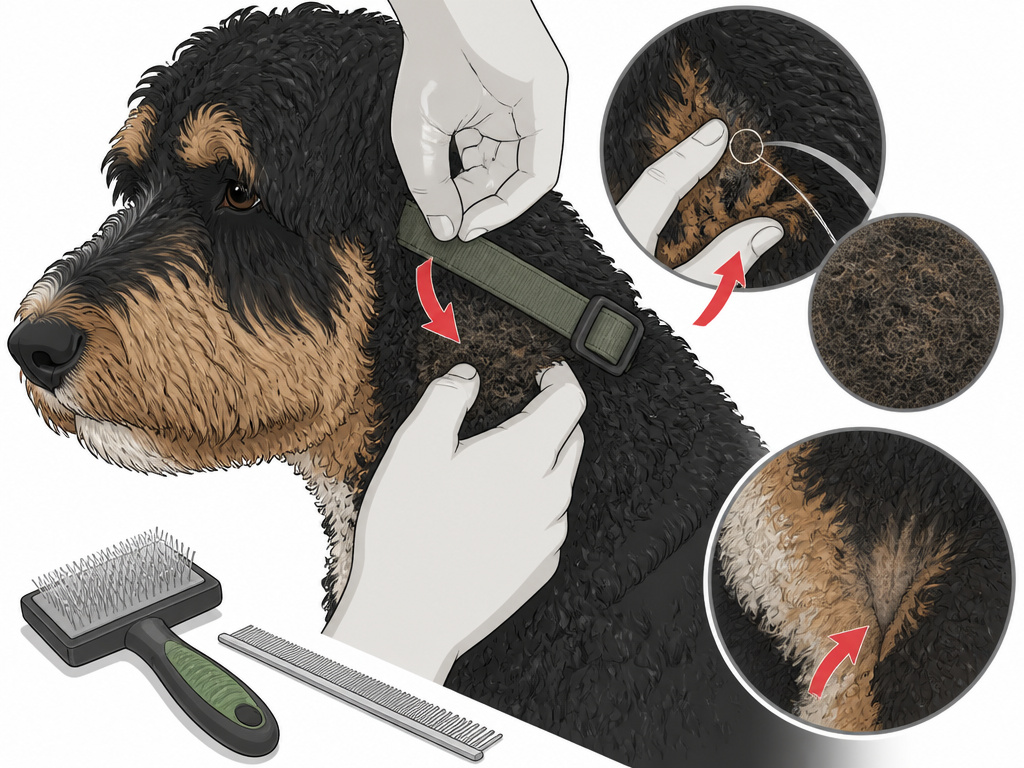
Matting starts in the same handful of places on almost every Bernedoodle, and none of them are where you’d check first.
Put the two lists together and you have your inspection route.
| Hot Spot | Why It Forms There | What To Do |
|---|---|---|
| Behind the ears | Ear leather traps hair and moisture | Comb weekly, dry well after swims |
| Under the collar | Friction packs loose hair into felt | Remove the collar and comb beneath it |
| Armpits | Movement rubs two coat surfaces together | Small slicker, short strokes, often |
| Base of tail and thighs | Sitting pressure compacts the under-layer | Rake first, then comb, then check by feel |
| Between the paw pads | Debris and body weight press hair flat | Trim level with the pad, don’t dig in |
The visual cue is easy once you know it. A packed coat looks perfectly fine from above and feels like felt the moment you push two fingers into it.
That’s the plumbing analogy, and it holds. The leak is never in the long straight run of pipe. It’s at the joints. On a dog, the joints are the collar line, the armpits, and the ear leather.
Common mistake: Brushing the visible coat and calling it done. The top layer recovers in seconds and hides the packed layer underneath, so the dog looks groomed right up until the clippers find it.
Knots need to come out before they turn into mats, which is the whole argument for a doodle detanglers spray and a comb rather than a firmer brush.
The 6-to-12-Month Window Where Good Routines Fail
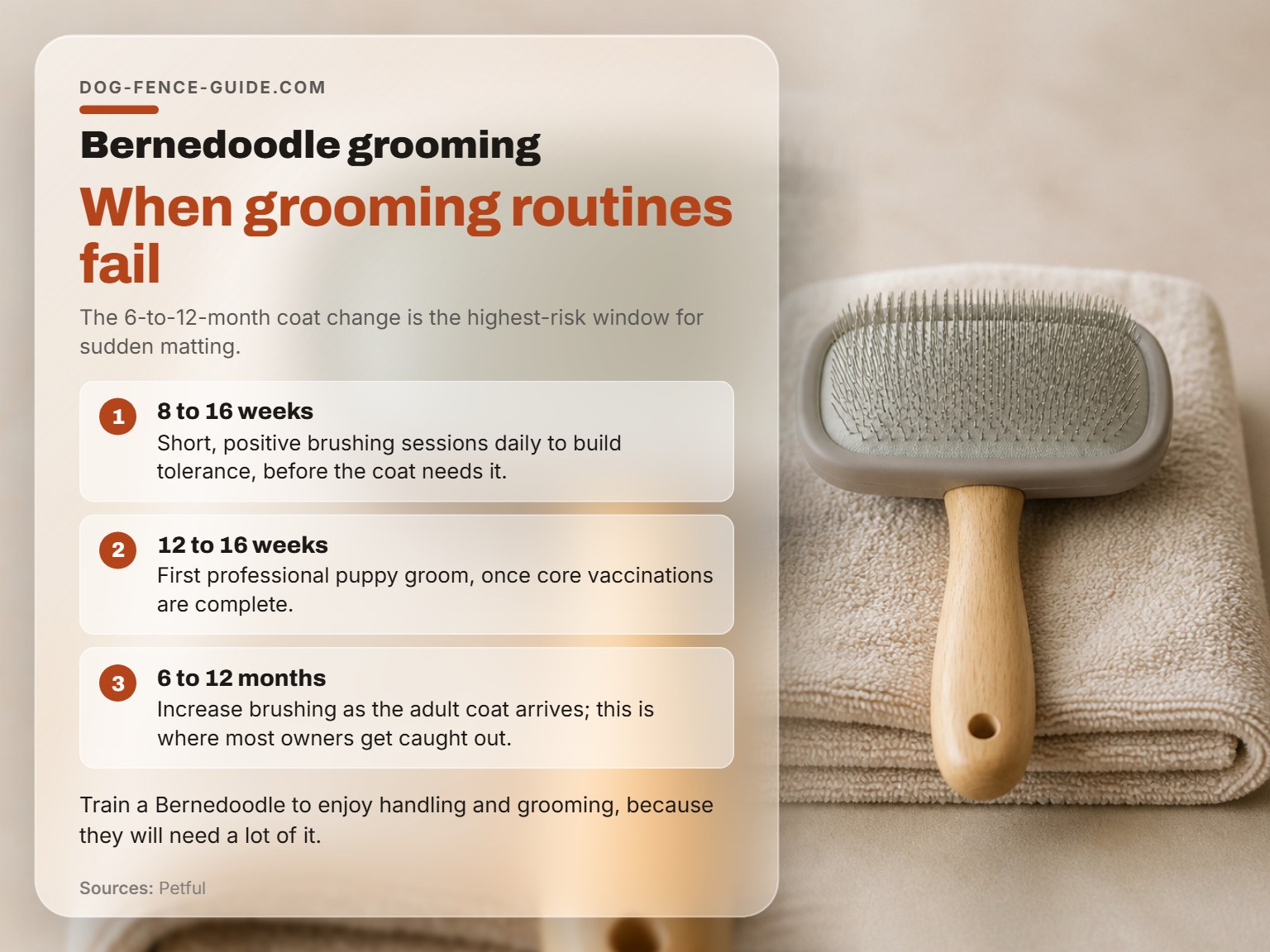
The routine that worked on a nine-week-old puppy will fail at eight months, and it won’t be your fault.
Petful calls the adolescent coat change from 6 to 12 months the highest-risk window for sudden matting, and says brushing should increase as the adult coat comes in.
What changes is density. Puppy coat is soft and relatively open. Adult coat comes in underneath it, and the two layers sit on top of each other until the puppy coat sheds out.
- 8 to 16 weeks: short, positive brushing sessions daily, before the coat even needs it. This is tolerance training, not maintenance.
- 12 to 16 weeks: first professional puppy groom, once core vaccinations are complete.
- 6 to 12 months: increase brushing as the adult coat arrives. This is where most owners get caught out.
- Adult: settle into the coat-specific schedule above and hold it.
Start at home the week you bring the puppy home. Petful is direct about that, and it’s the single easiest thing to get right early and impossible to fix later.
Pro Plan makes the same point from the training side: it’s important to train a Bernedoodle to enjoy handling and grooming, because they’ll need a lot of it. A dog that tolerates brushing is a dog you’ll actually brush.
Should You Shave a Matted Bernedoodle?
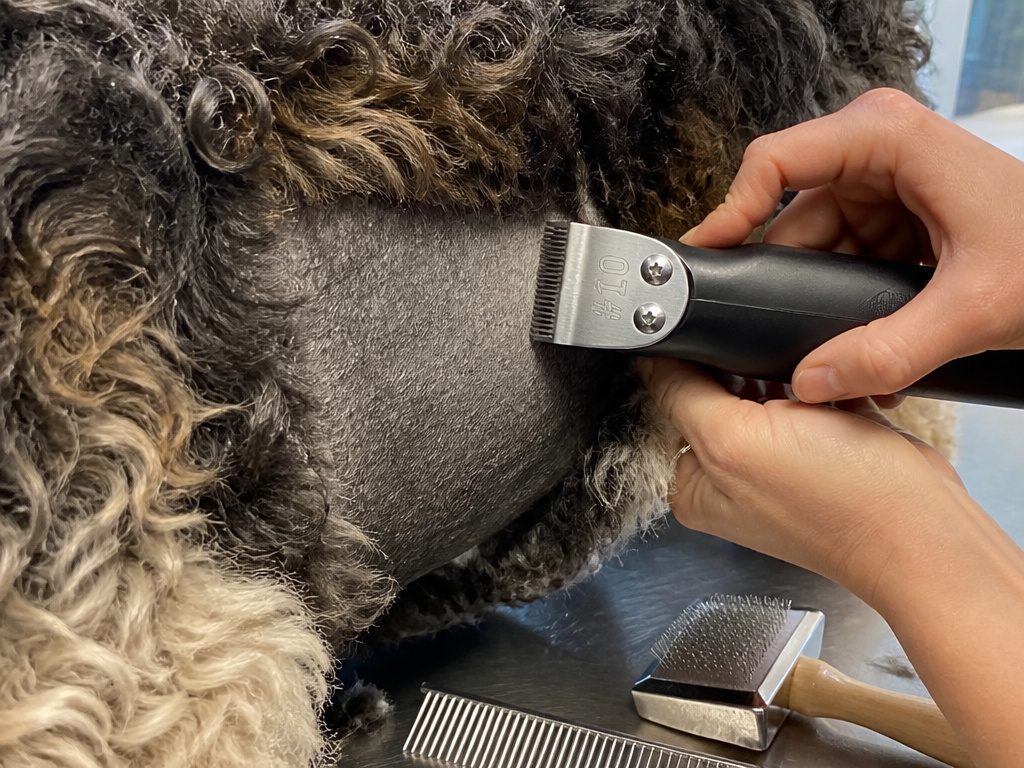
Clippers are the last resort, not the first move.
The AKC’s expert guidance is unambiguous for double-coated breeds. Grooming experts generally advise against shaving them, and there are generally only two reasons to shave a dog: it needs surgery, or a groomer can’t safely brush out severe matting. Where a double coat is heavily tangled or overgrown between appointments, certified master groomer Jennifer Bishop-Jenkins recommends a gradual approach rather than reaching straight for the clippers.
Shaving a double coat can disrupt the relationship between the topcoat and undercoat, which can affect temperature regulation, coat regrowth, and skin protection. On a Bernese-coated Bernedoodle, that hair may not come back the way it went.
Here’s where the Bernedoodle complicates the rule. The cross can inherit the Bernese double coat or the Poodle single coat, and the shaving guidance applies to the Bernese side. Australia’s national training register lists ACMGRM305 dog grooming unit as a current Australian national training unit covering grooming dogs to meet breed style and coat requirements, so the vocational standard treats coat-appropriate grooming as a real skill.
Petful notes the other side of it: the curly coat is the one that most often ends up shaved short at the groomer because the owner couldn’t keep up. That’s the outcome to avoid, and it’s avoidable with a comb and ten minutes.
If you’re doing touch-ups at home between appointments, trimming a doodle around the eyes and paws is the sensible scope. Full-body work is a different job, and doodle clippers that stall in a dense coat do more damage than a sharp pair that cuts cleanly.
Alpine Bernedoodles adds a practical note that gets skipped: keeping the hair trimmed around the eyes is usually necessary between professional sessions. That’s a two-minute job with blunt-tipped scissors, and it’s the difference between a dog that can see and a dog that can’t.
Tools That Do the Actual Work
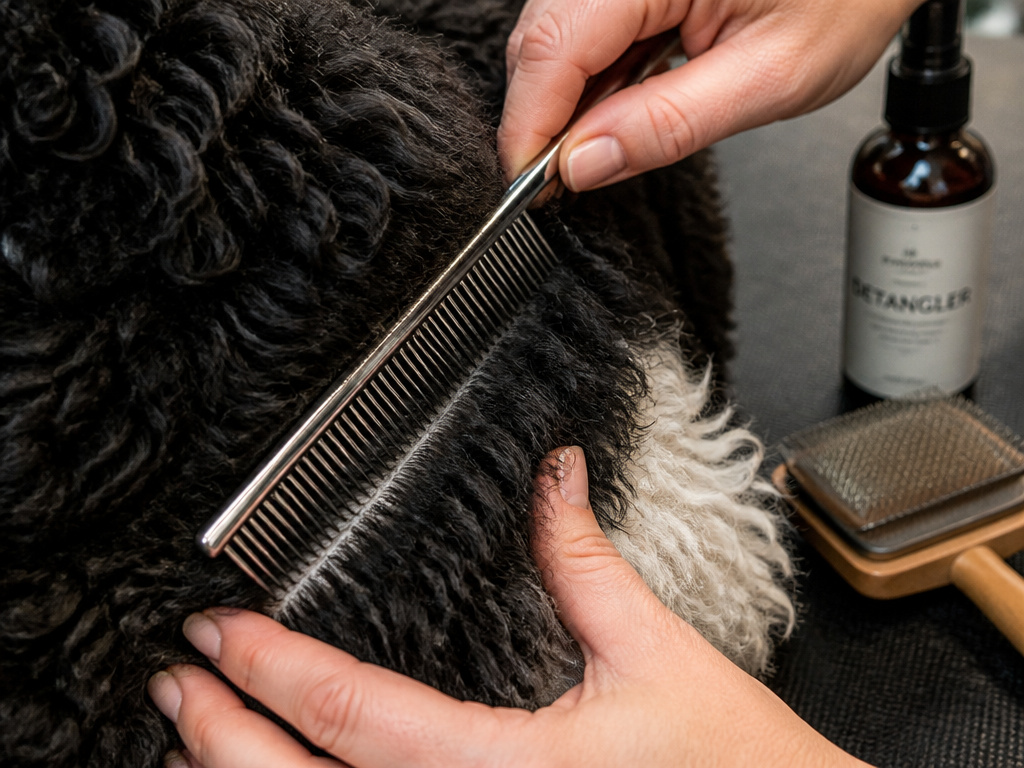
Three tools cover almost everything: a slicker brush, a steel comb, and a detangler.
- Quality steel comb. Cheap, unglamorous, and the only tool that tells you the truth about whether you finished the job.
- Detangler spray. For working through a knot instead of cutting it out. Spray the knot, not the dog.
- Clipper for touch-ups. For paw pads, sanitary trims, and eye corners. Quiet enough that most dogs stop arguing about it.
- Isle of Dogs shampoo. A routine bath, used sparingly.
The brush matters more than the shampoo, and the comb matters more than the brush. If you’re buying one thing this week, buy the comb. The best brushes for doodles guide goes deeper on pin types and why a soft pin brush is the wrong tool for a wool coat.
A doodle shampoo choice barely moves the needle compared with brushing frequency. Don’t overthink it.
One more thing PetMD flags that has nothing to do with the coat: daily teeth brushing with doggy toothpaste to deter plaque. Coat care gets all the attention. Teeth get skipped.
Frequently Asked Questions
Is a Bernedoodle high maintenance to groom?
PetMD’s vet-reviewed breed guide says flatly that the Bernedoodle is not a low-maintenance breed, while Pro Plan notes the coat can be anything from low maintenance to high maintenance. Pro Plan takes a wider view, noting the coat can be anything from low maintenance to high maintenance and that owners should be prepared for either. Both are describing the same animal: the range is wide, but the low end of it is smaller than most people hope.
Can I shave my Bernedoodle in summer to keep it cool?
The AKC’s guidance for double-coated breeds advises against it. Shaving can disrupt the relationship between topcoat and undercoat, which can affect temperature regulation, coat regrowth, and skin protection. The exception in that guidance is surgery or severe matting a groomer can’t safely brush out. If your dog inherited the Poodle side rather than the Bernese side, the calculus is different.
How often should a Bernedoodle puppy be groomed?
Petful recommends short, positive brushing sessions daily from 8 to 16 weeks, and a first professional puppy groom around 12 to 16 weeks once core vaccinations are complete. The point of the early sessions is tolerance, not tidiness. A puppy that learns brushing is normal will stand still as an adult.
Does a Mini Bernedoodle need less grooming?
No. Petful is explicit that a Mini Bernedoodle needs the same coat care as a standard, just on a smaller body.
Do Bernedoodles actually shed?
Pro Plan rates the breed 1 out of 5 for shedding and 5 out of 5 for grooming needs. WOOOF’s groomers say they do shed, but most of it stays trapped in the coat, and that trapped hair is what forms knots. The practical answer: less hair on your floor, more hair in your brush.
What if my Bernedoodle hates being brushed?
Pro Plan’s advice is to train the dog to enjoy handling and grooming, because the breed will need a lot of it. That means short sessions, a treat after, and stopping before the dog has had enough. A dog that has learned brushing predicts a fight will fight every time.
Before You Book
Run a steel comb over your dog once, this week, in the four places matting starts. If the comb stops anywhere below the surface, don’t book a bath-and-tidy. Book a full groom, and tell them on the phone that there’s a mat behind the ear or under the collar, because that changes how long the appointment needs to be.
If your dog has the curly coat and you’re already brushing daily and still finding mats, the schedule isn’t the problem. The technique is. Short strokes, from the skin up, with a comb behind every pass.
I’d rather see a shorter, practical trim every six weeks than a long coat that gets shaved to the skin once a year. The first keeps the dog comfortable. The second is what happens when a schedule was never realistic to begin with.
Start with your own dog and your own comb, not with a calendar someone else published.
