
Are Pig Ears Safe for Dogs? What the Sources Say
This post contains affiliate links. As an Amazon Associate, we earn from qualifying purchases.
Pig ears are safe for most medium and large dogs as an occasional chew, roughly once or twice a month, according to Dr. Julie Sanders, DVM. A dried pig ear of 2oz/56g carries 242 calories, and treats should stay under 10% of a dog’s daily calorie intake. The bigger risk is Salmonella: 154 people across 34 states got sick from pig ear treats between 2015 and 2019.
That 2015-2019 stretch is the part worth slowing down on when you ask are pig ears safe for dogs. The outbreak ended with a regulatory reversal. The FDA and CDC first told people to stop buying pig ears entirely, then switched to conditional use with a hygiene protocol on October 30, 2019.
What follows walks through what that investigation actually found, where the veterinary sources split on safety, the calorie math that decides portion size, and the dogs that should never get one at all.
Key Takeaways
- Under 10% of daily calories. One 2oz/56g dried ear is 242 calories, so a single ear takes a big bite out of the treat budget.
- Salmonella is the documented risk. 154 human cases across 34 states between 2015 and 2019, with 35 hospitalizations.
- Soft and flexible beats white and stiff. A brittle ear splinters; a leathery one bends in your hand.
- Skip pig ears for puppies under six months, small breeds, and dogs with sensitive GI tracts or a pancreatitis history.
- Wash your hands after handling one. Only 32% of patients in the outbreak said they always did.
What the 2015-2019 Outbreak Actually Found
One hundred fifty-four people in 34 states got sick.
The outbreak case definition covered seven Salmonella serotypes: I 4,[5],12:i:-, Cerro, Derby, Infantis, London, Newport, and Rissen. Isolation dates ran from June 10, 2015 to September 15, 2019, and 94% of the 154 cases fell in 2018-2019. Salmonella was isolated from 137 pig ear treats and four dogs. Thirty-five people were hospitalized; no deaths were reported.
The multistate Salmonella outbreak investigation published in Lancet Regional Health Americas lays out the rest, and the exposure numbers are the ones that matter inside a household.
Of 122 patients with data, 107 (88%) had contact with a dog before getting sick. Of 97 with data, 65 (67%) had handled pig ear treats directly.
Children were not a footnote. Twenty-seven of the 154 cases, or 20%, were in kids under 5. Ages ran from under 1 year to 90, with a median of 40.
The bacteria were also hard to treat. 77% of human isolates and 43% of the treat isolates were resistant to at least three antimicrobial classes.
Handwashing was the soft spot.
Among 47 patients who reported contact with pig ear treats, 15 (32%) said they always washed up afterward. Eighteen (38%) said they rarely or never did. Five (11%) said their dog showed signs of infection, like diarrhea, after eating the treat.
Are Pig Ears Safe for Dogs? Where Each Source Lands
Four credible sources answer this question, and they land in different places. Which one you asked decides the answer you got.
| Question | One position | The other position |
|---|---|---|
| Safe to feed at all? | WSAVA: raw animal treats carry pathogen risk | FDA: fine with hygiene since Oct 2019 |
| Calories per ear | WSAVA: 242 per 2oz/56g | Daily Paws: just over 200 per 50g |
| Protein and fat | Adopt a Pet: 60-75% protein, 20% fat | One popular feeding video: 22% protein, 15% fat |
| Hard-chew risk | WSAVA: warns on antlers and hooves, not ears | Adopt a Pet: brittle baked ears can splinter |
Start with the WSAVA feeding treats guidance. It puts unprocessed, raw animal-based treats in the pathogen-transmission column and names contaminated pig ears as the example. The same document sets the calorie ceiling at less than 10% of a dog’s daily calorie intake.
The FDA pig ear treat investigation page reads differently. As of October 30, 2019, the agency and the CDC stopped telling people to avoid pig ears entirely. They now say that if you feed them, use caution and practice good hygiene.
Daily Paws, quoting Dr. Julie Sanders, DVM, goes further still. She calls pig ears safe for most medium and large dogs when given occasionally, about once or twice a month, and says plainly that they are not an everyday food.
Adopt a Pet’s Dr. Chyrle Bonk, DVM, lands closest to Sanders. Her position is occasional treat only, mostly because of fat content.
The are pig ears safe for dogs macronutrient numbers are a mess. Adopt a Pet puts protein at 60-75% and fat around 20%. A widely shared natural-feeding video puts pig ears at 22% protein and 15% fat. Those two sets cannot both describe the same product.
Take either set seriously and the takeaway holds: a pig ear is a dense piece of food.
The hard-chew question is the last split. WSAVA warns against excessively hard chews and names antlers and hooves. It does not name pig ears. Adopt a Pet makes a different argument, that baking or smoking an ear too hard turns it brittle, raising mouth-damage and perforation risk.
The Calorie Math That Decides Portion Size
A pig ear is closer to a meal than a snack.
Two sources, two numbers, same practical answer. WSAVA lists a dried pig’s ear at 2oz/56g for 242 calories. Daily Paws puts a 50-gram ear at just over 200. The gap is small enough that nothing changes in how you feed it.
| Measure | Figure | Source |
|---|---|---|
| Treat ceiling | Under 10% of daily calories | WSAVA |
| Dried pig ear, 2oz/56g | 242 calories | WSAVA |
| Pig ear, 50g | Just over 200 calories | Daily Paws |
| Protein | 60-75% | Adopt a Pet |
| Fat | Around 20% | Adopt a Pet |
Run the 10% rule against your own dog before you unwrap anything. Whatever the daily ration is, a single ear takes a big bite out of the treat budget.
Dr. Sanders suggests cutting ears into halves, thirds, or quarters for smaller dogs. That is the simplest fix available, and it takes no equipment.
If portioning feels like too much fuss, choosing smaller chew treats solves the same problem by starting small instead of asking you to do surgery on a dried ear.
A 242-calorie ear is a big number for a small dog. Work out 10% of your dog’s daily ration first, then decide whether the ear still fits inside it.
How to Pick a Pig Ear That Isn’t a Liability
Five checks, in this order.
Before you start: Raw and dried pig ears can carry Salmonella on the surface. Keep them off the counters where you prep human food, keep them away from children under 5, and wash your hands with soap before you touch anything else. A dog that licks your face after chewing one is moving whatever was on that ear onto you.
- Read the ingredient line. It should say pig ear and nothing else. Adopt a Pet is direct about this: if the list is full of unpronounceable additives, pick a different brand.
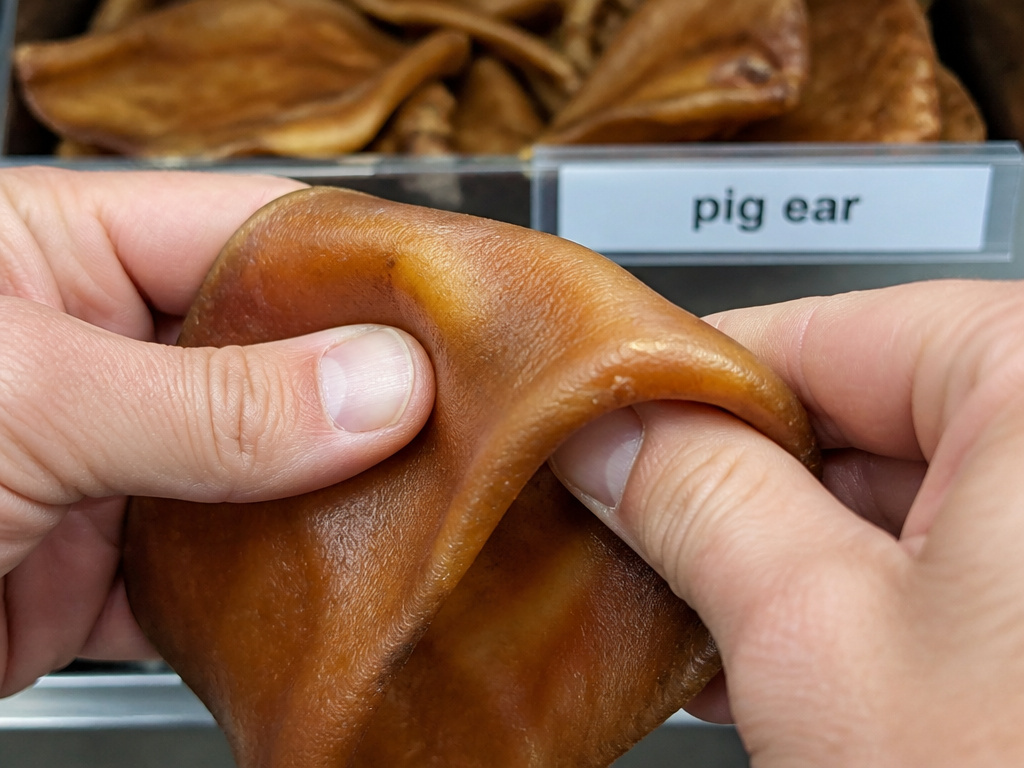
- Bend it. An ear that folds like a thick leather strap and springs back is the one to pick. A bad one cracks at the crease and leaves a dry, pale seam. Overcooking or smoking makes them brittle, and brittle means splinters in the mouth or the gut.
- Bend it before you buy it. Same test, done in the store, takes two seconds and saves a return trip.
- Check the recall history. Chef Toby Pig Ears, Berkley & Jensen 30-packs, and Brutus & Barnaby all came off shelves during 2019.
- Size it to the dog. Halve, third, or quarter it for anything smaller than a medium breed.
Fair warning: step three is the one people skip, and it is the only one that catches a bad batch before your dog does.
Why the Bulk Bin Is the Worst Place to Buy
The FDA is unusually specific here. Bulk pig ears that are not packaged or wrapped may be commingled from multiple sources, which means nobody can tell you where any individual ear came from. Effective irradiation may not have happened for bulk product either.
That is the failure mode in one sentence: a bin mixes suppliers, and the pathogen control you were relying on may never have been applied.
Common mistake: Scooping ears out of an open bin because they look fresher. The FDA traced part of the outbreak to bulk product specifically, and it asks retailers to wash and sanitize those bins and every surface they touch.
The Chef Toby pig ear recall is the clearest example of how this plays out. Dog Goods USA bought from a single Brazilian supplier between September 2018 and August 2019, and expanded its recall to all 30-packs of Berkley & Jensen brand ears sold at BJ’s after Rhode Island Department of Health testing found Salmonella.
The Brutus & Barnaby pig ear recall covered all four sizes and every state, sold through Amazon, Chewy, the company’s own site, and one Florida retail store. Buyers were told to destroy whatever was left.
What a White Ear Tells You, and What It Doesn’t
Owners in natural-feeding circles read a pale, bleached-looking ear as irradiated and avoid it. That concern runs against the FDA’s framing, which treats irradiation as a pathogen-control step and flags its absence in bulk product as a problem.
There is no consensus here, and anyone telling you otherwise is picking a side. What both positions agree on is that you should know what the ear went through before it reached the shelf.
If you want a chew where the sourcing question is simpler to answer, edible dog chews made from a single named ingredient are easier to vet.
Which Dogs Should Skip Pig Ears Entirely

Some dogs should never get one, and the list is longer than the treat aisle suggests.
- Puppies under six months. Dr. Sanders steers clear entirely at that age.
- Small breeds. She does not recommend pig ears for small-breed dogs, because they get GI upset from them more often.
- Dogs with a sensitive GI tract. Vomiting, gas, and diarrhea are the common problems, with pancreatitis and bloody diarrhea as the serious ones.
- Dogs with a pancreatitis history. Fat content is the driver here, per Adopt a Pet.
- Dogs on a veterinary-prescribed diet. WSAVA is explicit that conventional treats may not be appropriate, and that you should ask the veterinary team first.
- Households with children under 5. Twenty-seven of the 154 outbreak cases were in kids that age.
That last one deserves more weight than it usually gets. The hygiene protocol assumes an adult is doing the handling, the cleaning, and the handwashing. A two-year-old is not.
I would not hand a pig ear to a dog in a house with a toddler, full stop. The protocol only works if everyone in the room can follow it, and that is not a fair thing to ask of a small child.
If your dog falls into two or more of those groups, skip the pig ear and look at non-rawhide chews instead. The point of a chew is enrichment, and there are several ways to get there.
The Hygiene Routine That Cuts the Risk Most
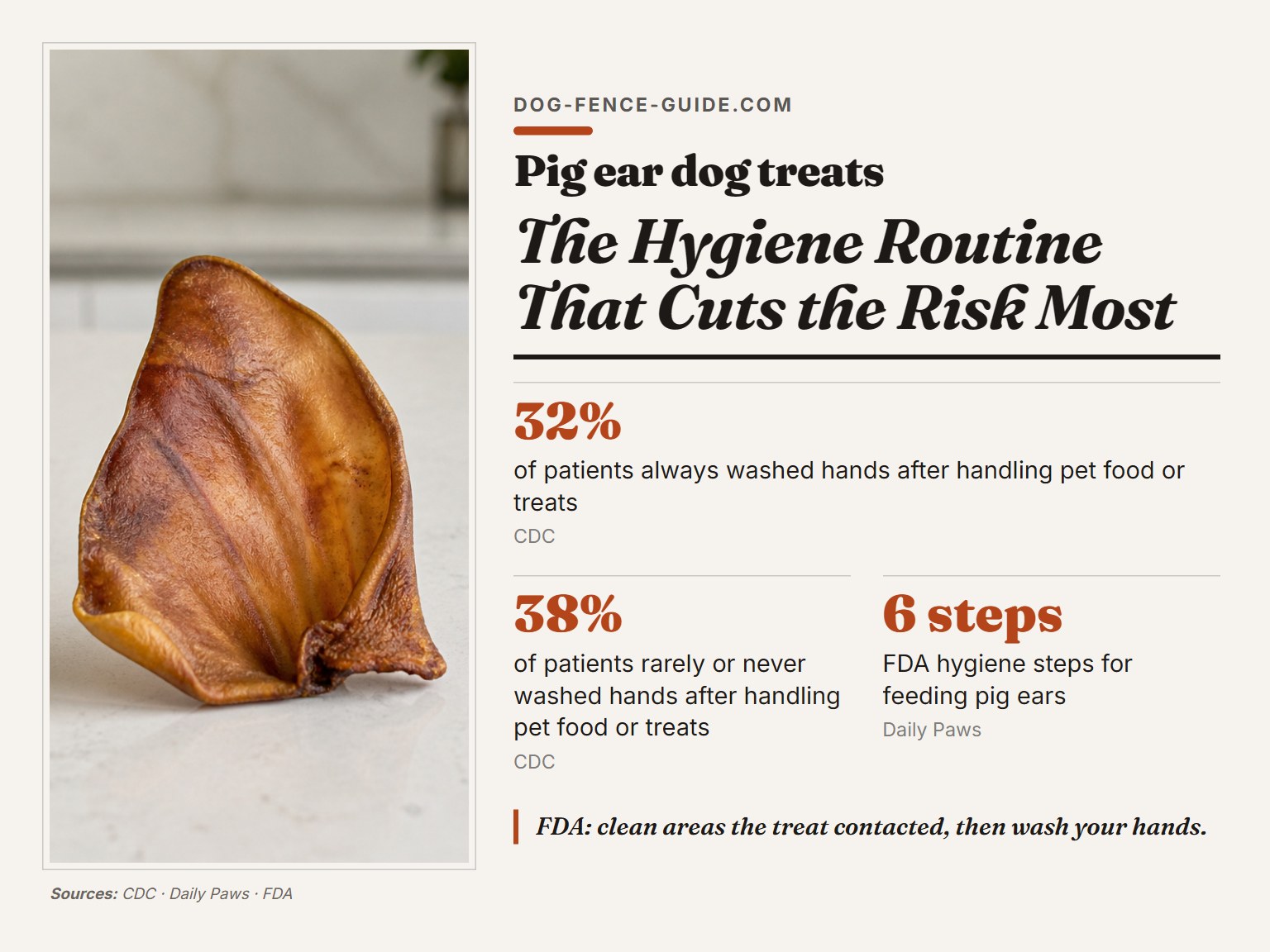
The FDA’s list is six steps long, and most people do one of them.
- Monitor the dog while it has the treat.
- Pick the treat up when the dog is done with it.
- Keep treats away from small children.
- Clean the areas the treat contacted.
- Wash your hands.
- Don’t let the dog lick you, your family, or surfaces in your home.
The fifth step is the one with data behind it. In the outbreak, only 32% of patients who handled pig ear treats always washed their hands afterward, and 38% rarely or never did.
The Counter and the Floor, Not the Dog
Most of the contamination path runs through surfaces, not through the dog’s mouth. The FDA notes that infected pets can shed Salmonella in their feces and saliva without ever showing signs of being sick.
That is the part that catches people. A dog with no symptoms is still a transmission route.
So the counter where you set the ear down, the floor where it landed, and the dish towel you wiped it with all matter. Wipe them, then wash your hands, in that order.
Easy to miss: The dog’s water bowl. A dog that chews a contaminated ear and then drinks leaves Salmonella on the rim, and that bowl sits on your kitchen floor all day.
Pig Ears vs Cow Ears vs Bully Sticks

Cow ears show up first for a reason.
Adopt a Pet lists cow or buffalo ears, collagen chews, tendon chews, and sweet potato chews as the alternatives to pig ears. Cow ears are the closest match in texture and the easiest swap.
- Cow ears. Same cartilage family, and they appear on the alternatives list.
- Collagen and tendon chews. Longer-lasting, and no ear sourcing question.
- Sweet potato chews. The plant-based option, and the one least likely to upset a sensitive stomach.
The one number I can find on cow ears comes from the same natural-feeding video that contradicts the vet sources, so treat it as a claim rather than a fact. It puts cow ears at 12% fat and 26% protein against 15% fat and 22% protein for pig ears.
When Cow Ears Make More Sense
For a household with young kids, cow ears are the easier call. The recall history that made 2019 so messy was specific to pig ears, and the FDA’s import alert targets pig ears and other pet treats rather than cow ears by name.
For a dog that needs a chew to last, cow ears for dogs are the better starting point than a soft pig ear that disappears fast.
Where Rawhide and Bully Sticks Fit
Rawhide is a separate conversation with its own risks, and it is not a like-for-like swap for an ear. Bully sticks sit in the same “dense animal chew” category and come with their own set of questions.
If you are choosing between the three for a dog that has never had any of them, start with the smallest, softest option and work up.
Frequently Asked Questions
Can I give my dog a pig ear every day?
No. Dr. Julie Sanders, DVM puts it plainly: “This is definitely not an everyday food.” The calorie load is the reason. At 242 calories per 2oz/56g ear, a daily pig ear blows through the 10% treat ceiling for most dogs.
What happens if my dog swallows a pig ear whole?
If the dog is breathing normally, Dr. Sanders says no emergency action is needed, but the dog should be watched closely. Pig ears are readily digestible in the stomach and unlikely to cause an obstruction, though rarely it can happen. A piece stuck in the esophagus is a different problem and needs a vet.
Are pig ears high in fat?
Adopt a Pet puts fat at around 20%, which is why the same source calls them an occasional treat only. Large amounts can lead to pancreatitis and weight gain. That fat load is the main reason small breeds and dogs with a pancreatitis history should skip them.
Do I need to cook a pig ear before giving it to my dog?
No. Cooking and smoking are what make ears brittle, and brittle ears are the ones that splinter. Adopt a Pet notes that ears baked at low temperatures or dried slowly stay flexible, while quickly dried ones turn hard.
Are pig ears safe for puppies?
Not under six months. Dr. Sanders generally recommends steering clear of pig ears until a puppy is older, and suggests asking your vet about timing. Puppies also chew differently, which raises the choking risk on any chew.
Is the pig ear outbreak over?
Yes. The FDA and CDC lifted the blanket recommendation to avoid pig ears on October 30, 2019. Import Alert 72-03 remains in place, which means imported pig ears without physical examination are still detained at the border.
Before You Buy
Here is the honest version. The useful question is narrower than the headline one: safe for your dog, in your kitchen, with your kids in the room.
If your dog is a small breed, under six months old, or has a pancreatitis history, the answer is no and the rest of this does not apply to you.
The one thing that would change my answer for everyone else is a verified supply chain. The FDA permits pig ears when suppliers control for pathogens and prevent cross-contamination after processing. A brand that can show you that has moved the risk down a level. Most cannot show you that, which is why the hygiene routine is doing the real work.
So before you buy, ask yourself three questions:
- Can I name where this ear came from, or is it out of an open bin?
- Is my dog small, young, or prone to stomach trouble?
- Am I willing to wash my hands and wipe the counter every single time?
Three clean answers and you are fine. Any hesitation on the first one, and put it back.
