
5 Best Harnesses For 3 Legged Dog in 2026
This post contains affiliate links. As an Amazon Associate, we earn from qualifying purchases.
For a three-legged dog, the right harness means the difference between struggling and moving with confidence. The Ruffwear Web Master Dog Harness earns Best Overall for its escape-resistant fit, reinforced lift handle, and four adjustment points that give you balanced control for front-body support. For dogs needing rear-end help, the Walkabout Back End Harness delivers targeted hind leg support, while the PetSafe CareLift offers full-body lift for getting in and out of the car.
A three-legged dog shifts weight differently than a four-legged one, and a standard harness won’t account for that imbalance. The front leg that remains bears extra load, and the rear leg on the missing side often lacks the strength to push up or balance on stairs. You need a harness that lets you lift, steady, and support without pulling the dog off-center or rubbing against the remaining limbs.
This guide compares five harnesses built for tripod dogs, looking at lift support, adjustability, and comfort based on manufacturer specs, expert recommendations, and patterns in owner feedback. We break down which design works for front-end weakness, rear-leg support, or full-body lifting so you can match the harness to your dog’s specific needs.
Top 5 Harnesses For Three Legged Dogs in the Market
Certain content that appears on this site comes from Amazon. This content is provided "as is" and is subject to change or removal at any time.
The Best Harnesses For Three Legged Dogs, Reviewed
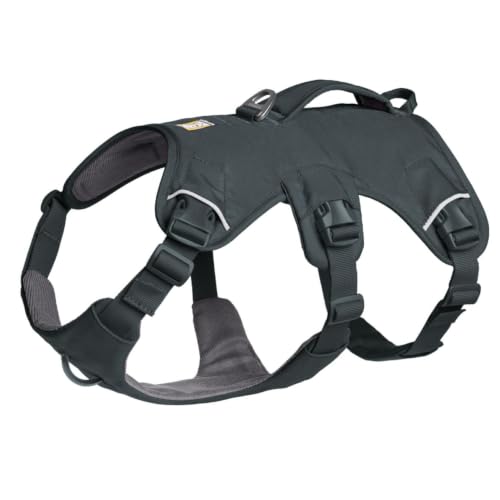
Ruffwear Web Master Dog Harness
What We Like
- Reinforced lift handle for balanced support
- Escape-resistant fit with four adjustment points
- Full-body support design for stable lifting
- Triple leash clip-in points for flexible control
Trade-offs
- Medium size only fits specific chest girths
- No back-end support for rear leg lifting
The reinforced lift handle is built into the frame for balanced support when lifting your dog, which helps with mobility assistance, trail scrambles, or getting dogs in and out of vehicles. The chest and belly panel distributes weight evenly for stable, comfortable lifting, making it useful for aging dogs, amputees, or pups recovering from injury. Four points of adjustment allow a snug, customized fit that stays secure, even on deep-chested breeds or dogs that tend to slip out of other harnesses. This harness suits owners who want a single design that handles both daily walks and mobility assistance without switching gear.
The Web Master’s full-body support design distributes weight evenly across the chest and belly for stable lifting, making it ideal for aging dogs or those recovering from injury. Compared to the PetSafe CareLift, which includes a padded shoulder strap for full-body support, the Web Master focuses on front and midsection lift without dedicated back-end assistance. Owners who need rear-leg support would benefit from adding a separate back-end harness.
Product photos
EzyDog Convert Dog Harness

What We Like
- Soft cotton lining for long-hike comfort
- Quick release buckle for easy on/off
- Reflective trim for low-light visibility
- Traffic handle for extra control
Trade-offs
- Saddle bags not compatible with XXS/XS sizes
- No rear support for dogs needing balance assistance
A fully adjustable chest strap and soft cotton lining mean this harness is built for dogs that actually move, not just stroll around the block. The quick release buckle gets you out the door fast, and the reflective trim plus a welded D-ring give you solid control on trails or evening walks. For an active dog that wants to hike, scramble, and cover ground, the EzyDog Convert keeps things secure without adding bulk or rubbing points that could slow a dog down.
This harness uses a durable polyester outer shell that stands up to rough trails and thick brush, so it’s built for active dogs that already move well on their own. It lacks any rear support or lifting features, which means it won’t help a dog that struggles with balance or needs help standing up from a slick floor. For a dog that’s steady on all four legs and needs a tough, comfortable harness for hiking or walking, it delivers exactly that.
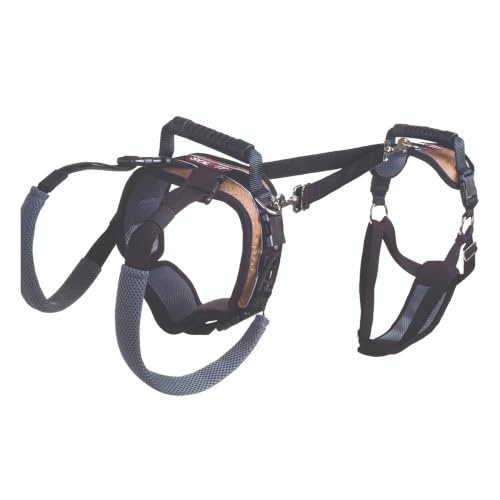
PetSafe CareLift Dog Lift Harness
What We Like
- Front and rear lift handles
- Padded shoulder strap reduces strain
- Removable protection shield for males
- Adjustable sizing for comfortable fit
Trade-offs
- At 1.9 lb, heavier than most harnesses
- Bulky design makes storage difficult
The dual-handle setup on this harness is what sets it apart from a standard walking harness: you can actually help a dog stand up or steady them on stairs without straining your back. The front and rear handles let you support your dog’s full body without putting pressure on sore joints. The padded shoulder strap and adjustable sizing help you get a comfortable fit for a recovering or elderly dog. For anyone managing a dog that needs lifting help, this harness provides the support you need.
The trade-off is weight. At 1.9 pounds, this harness is noticeably heavier than something like the Ruffwear Web Master (0.5 pounds). For a small or very weak dog, that extra weight might be more than they can handle. But if your dog has the strength to carry it and you need genuine lift support, the CareLift’s design makes that possible in a way a lightweight walking harness cannot. It is built for the job, and it does it well.
Walkabout Back End Harness

What We Like
- Original patented support harness design
- Soft neoprene material for comfort
- Comfortable support handles for lifting
- Recommended by specialists for 30 years
Trade-offs
- Only supports rear end, not full body
- Requires correct abdomen fit to work
A harness that focuses entirely on the back end means you get a lifting aid designed to support a dog’s rear legs without interfering with the front. The soft neoprene material wraps around the abdomen, and the built-in handles give you a secure grip to take weight off weak or missing rear limbs. For a dog with back end weakness, this lets you provide targeted help exactly where it’s needed, reducing strain on both the dog and your own back.
This harness is designed for back-end weakness only, so if your dog needs chest or neck support, you’ll need a separate harness. Compared to the Ruffwear Web Master, which has a three-strap style and a lift handle, the Walkabout is a more specialized tool. It’s meant for pets needing assistance with walking due to rear leg issues.
Product photos
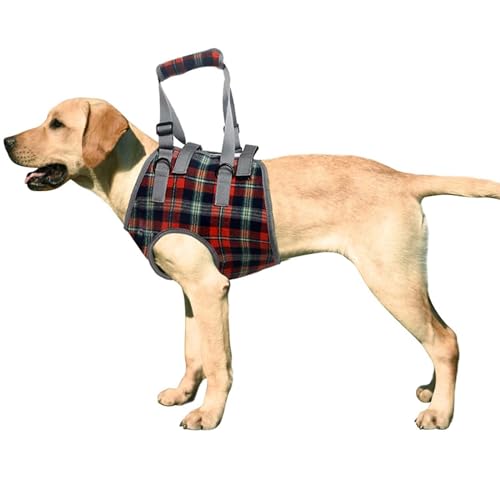
ROZKITCH Dog Lift Harness
What We Like
- Padded handle for comfortable carrying
- Breathable soft mesh lining for chest
- Quick magic sticker and buckle setup
- Lifts front legs without bending over
Trade-offs
- Supports front legs only, not hind end
- No rear support for three-legged dogs needing back help
At just 0.6 pounds, this harness is light enough that your dog won’t feel weighed down, and the padded handle saves your hand when you need to lift. It wraps around the chest and front legs with a soft mesh lining that breathes, so a dog recovering from an ACL tear or dealing with arthritis can get help walking and climbing without overheating. The magic sticker and buckle system takes seconds to put on, which matters when your dog is wobbly and impatient. This is a straightforward front-leg assist sling, not a full-body rig, and it does that one job well for dogs who mainly need help with their front end.
The trade-off is that this harness focuses entirely on front leg support, so if your three-legged dog also needs help with the rear or has a missing back leg, you will want a different setup. Compared to the PetSafe CareLift, which wraps the whole body and weighs nearly two pounds, the ROZKITCH is much lighter and simpler but offers no hind-end lift. For a dog that just needs a steady hand under the chest during walks or stairs, this is a practical, no-fuss tool.
Product photos
How We Evaluated Harnesses For Three Legged Dogs
We started by reviewing the design intent of each harness, whether it supports the front end, rear end, or the full body, because a three-legged dog’s needs depend entirely on which leg is missing. We compared lift handle placement, strap adjustability, and whether the harness stays secure during movement. Manufacturer data on weight, fit range, and material informed the baseline, and we cross-referenced that with patterns in owner feedback about real-world use on tripod dogs.
Three criteria mattered most. First, lift support: a handle positioned over the dog’s center of gravity lets you help them stand or climb stairs without twisting their spine. Second, adjustability: a harness that fits snugly around the chest and belly prevents the dog from slipping out, especially when they shift weight suddenly. Third, comfort against the skin: the remaining legs rub against straps more on a three-legged dog, so padding and soft lining reduce chafing.
An evaluation has limits. Individual fit varies by breed, body shape, and the specific leg that is missing. What we can offer is a clear map of which harness design solves which problem, so you can narrow your choices before trying one on your dog.
What To Look For In Harnesses For Three Legged Dogs
A three-legged dog needs a harness that helps you compensate for lost balance, not just one that clips to a leash. The right design gives you a handle to lift, straps that stay put during a wobble, and material that won’t rub the remaining legs raw.
Look for a harness with a lift handle over the dog’s balance point, four or more adjustment points for a snug fit, and soft, breathable lining at contact points. Avoid harnesses with bulky buckles that press into the side where a front leg is missing.
Lift Handle Placement
The handle must sit where you can lift without tilting the dog. On a three-legged dog, a handle positioned too far forward pulls the front end up but leaves the rear dragging. A handle too far back lifts the hips but strains the remaining front leg.
The Ruffwear Web Master places its reinforced handle over the shoulder area, letting you lift the front body without torquing the spine. Full-body lift harnesses like the PetSafe CareLift add a second handle at the rear so you can distribute weight evenly. If your dog is missing a front leg, a forward handle that supports the chest is critical.
If they are missing a rear leg, a handle over the hindquarters lets you help them stand from a lying position.
Adjustability and Escape Resistance
A three-legged dog can shift weight abruptly when they stumble, and a loose harness lets them twist out mid-lift. Look for at least four adjustment points, two at the chest and two at the belly, so you can dial the fit to your dog’s specific proportions.
The Ruffwear Web Master uses four points of adjustment and a padded chest plate that wraps securely. The Walkabout Back End Harness relies on a correct abdomen fit to stay in place; if it is too loose, the rear support slides sideways. Measure your dog’s chest girth and belly circumference before buying, and choose a harness with independent strap adjustments rather than a one-size-fits-all elastic band.
Material and Skin Comfort
The remaining legs bear extra weight, and the side where a leg is missing has less muscle to pad the harness straps. Soft, breathable lining reduces friction on the chest and belly. The EzyDog Convert uses a cotton lining that stays comfortable on long hikes, while the ROZKITCH Dog Lift Harness uses breathable mesh on the chest panel.
Neoprene, as used in the Walkabout Back End Harness, offers a good balance of cushion and durability. Avoid harnesses with exposed plastic buckles or rough webbing that sits directly against the dog’s skin on the missing-limb side.
- Check that the harness does not have a strap that crosses directly over the shoulder blade of the remaining front leg.
- Run your hand along the inside of the harness to feel for rough seams or hard plastic edges.
- Measure twice: once at the widest part of the chest and once around the belly just behind the ribs.
- Test the lift handle by simulating a lift before putting it on the dog, it should not collapse or shift in your grip.
A good rule of thumb: if the harness has more than two adjustment points, it is more likely to fit a tripod dog well.
Harnesses For Three Legged Dogs Compared
The table below compares the five harnesses side by side, highlighting their support type, key features, and which three-legged dog they fit best.
| Product | Weight | Key Feature | Adjustability |
|---|---|---|---|
| Ruffwear Web Master Dog Harness | 0.5 pounds | Reinforced lift handle | Four points |
| EzyDog Convert Dog Harness | 0.8 pounds | Traffic handle | Fully adjustable chest strap |
| PetSafe CareLift Dog Lift Harness | 1.9 pounds | Full-body lift sling | Adjustable sizing |
| Walkabout Back End Harness | N/A | Support handles | N/A |
| ROZKITCH Dog Lift Harness | 0.6 pounds | Front leg chest support sling | Strap length and size adjustable |
Frequently Asked Questions
Can a three-legged dog wear a regular harness?
A standard harness is not designed for the weight imbalance of a tripod dog. It may shift, rub against the side where a leg is missing, and lack a lift handle for helping the dog up stairs or into the car. A harness built for mobility support, with a handle and multiple adjustment points, gives you the control you need without causing discomfort.
Which harness is best for a dog missing a front leg?
The Ruffwear Web Master Dog Harness supports the front body with a reinforced lift handle and a secure, escape-resistant fit. It lets you lift the dog’s chest without pulling them off balance. For front-leg lifting specifically, the ROZKITCH Dog Lift Harness offers a padded handle and soft mesh chest lining, though it does not support the rear end.
Which harness is best for a dog missing a back leg?
The Walkabout Back End Harness is designed specifically for supporting a dog’s hind legs. It uses a neoprene wrap and comfortable handles to lift the hindquarters without putting pressure on the front legs. It has been recommended by specialists for decades and targets the back end only, which is exactly what a dog missing a rear leg needs.
What is the difference between a lift harness and a support sling?
A lift harness wraps around the dog’s body and distributes weight across the chest and belly, with handles that let you lift from above. A support sling typically loops under the belly or hindquarters and requires you to hold it like a towel. Harnesses are more secure for walking and stairs, while slings are simpler for short lifts like getting into a car.
How tight should a three-legged dog’s harness be?
The harness should be snug enough that you cannot pull it sideways more than an inch, but loose enough to slide two fingers flat between the strap and the dog’s body. On the side where a leg is missing, the strap may sit closer to the body, check that it is not pressing into the ribcage. Recheck the fit after the dog has worn it for ten minutes, as tripod dogs shift weight and can loosen the straps.
The Bottom Line
For most three-legged dogs, the Ruffwear Web Master Dog Harness is the best starting point. Its four-point adjustment gives you a custom fit that stays secure during movement. The reinforced lift handle lets you help your dog up stairs, into the car, or over obstacles without straining their remaining joints. It is the right choice for active tripod dogs that need front-body lift and escape-resistant security.
If your dog has rear-end weakness or is missing a back leg, the Walkabout Back End Harness targets exactly that problem without adding bulk to the front. For dogs that need full-body support, the PetSafe CareLift Dog Lift Harness gives you handles at both ends and a padded shoulder strap. It helps with getting in and out of the car, standing from a lying position, or climbing stairs.
The single most important factor is matching the harness to the missing leg. Front-leg missing dogs need chest and shoulder support; rear-leg missing dogs need hindquarter lift. Measure your dog, read the fit guides, and choose the design that solves your dog’s specific balance problem, not a general-purpose harness that leaves you guessing.
