
2 Best Harnesses For Zipline Riding Dogs in 2026
This post contains affiliate links. As an Amazon Associate, we earn from qualifying purchases.
For dogs who love to run a line, the BuleVina X Back Mushing Harness is the best overall pick. Its balanced pull distribution and comfort padding make it ideal for active dogs, while the PUPTECK Soft Mesh Harness and Trolley System is the top choice for a complete, heavy-duty stationary run.
A zipline setup puts unique stress on a dog’s body and gear. The harness must transfer pull forces evenly across the chest and back, not the neck, and it needs to stay secure during sudden stops or direction changes. A flimsy harness or one designed only for casual walks can cause injury or fail entirely mid-run.
This guide is based on manufacturer specifications, expert recommendations for pulling and tethering gear, and patterns in owner feedback from active outdoor setups. We focused on two distinct solutions: a dedicated sledding harness for serious pullers and a complete trolley system for all-day roaming.
Top 2 Harnesses For Zipline Riding Dogs in the Market
Certain content that appears on this site comes from Amazon. This content is provided "as is" and is subject to change or removal at any time.
The Best Harnesses For Zipline Riding Dogs, Reviewed
BuleVina X Back Mushing Harness

What We Like
- X-back design distributes pull evenly
- Neck and ribcage padding for comfort
- Reflective inserts for night visibility
- Tailored for wolf-like Nordic breeds
Trade-offs
- Designed for pulling sports, not general walking
- Neck measurement critical; sizing errors likely
A chest range of 25.5 to 33.5 inches and an X-back construction that spreads pulling force across the body make this harness a practical choice for dogs that actually work on a line. It is built for sledding, bikejoring, and canicross, activities where the dog needs to lean into the harness without chafing or pressure points. The padding at the neck and ribcage adds comfort for sustained pulling, and the reflective stitching helps if you are out at dawn or dusk. This harness suits owners with a single medium-sized Nordic breed who wants a dedicated pulling rig rather than a do-everything walk harness.
This harness is built specifically for pulling sports like sledding, canicross, and bikejoring, so it’s not meant for casual walks or setups where the dog hangs from a trolley. The PUPTECK Soft Mesh Harness and Leash Set with Trolley System 100 ft + 10 ft is a different product entirely. For a dog that actively pulls forward under tension, this BuleVina design works well. Measure your dog’s neck carefully, size L fits a narrow 45- to 50-pound window, and a poor fit here means the harness slides or rubs.
Product photos
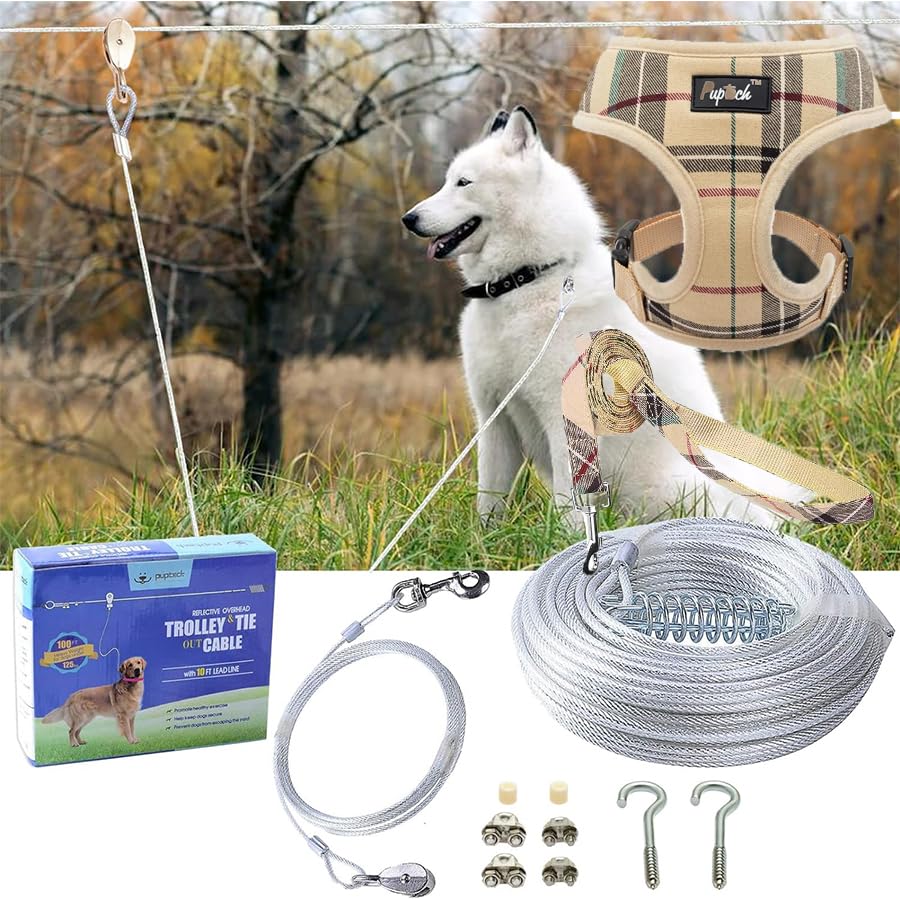
PUPTECK Soft Mesh Harness and Trolley System
What We Like
- 100 ft steel cable for wide roaming
- Vinyl coating resists corrosion in all weather
- Shock-absorbing spring reduces sudden tension
- Rated for dogs up to 125 pounds
Trade-offs
- Harness size S fits only small chests (14"-18")
- Single-point trolley limits dog to one axis
- No included hardware for tree or post mounting
A 100-foot steel cable with a shock-absorbing spring means this trolley system gives a large dog real room to run while softening those sudden lunges that yank a post or a collar. The vinyl coating keeps the cable sliding smoothly through rain, snow, and sun, so you are not replacing rusted hardware every season. It is built for dogs up to 125 pounds, which puts it squarely in heavy-duty territory for owners who need a stationary run rather than a walking leash.
The trade-off is that the included harness only comes in size S, which fits chests from 14 to 18 inches. If your dog has a larger chest, you will need to buy a separate harness that matches the trolley clip. The BuleVina X Back Mushing Harness is designed for pulling and running, but the PUPTECK system includes its own harness for smaller dogs and a longer run length with a built-in spring buffer.
How We Evaluated Harnesses For Zipline Riding Dogs
Our evaluation started with the physical demands of ziplining. We looked at harness construction, stitching quality, strap width, and attachment points, because a zipline dog needs to absorb sudden tension without the harness twisting or slipping. We also compared how each design distributes force across the dog’s body.
The three criteria that mattered most were fit security, material durability, and the intended use case. A harness that works for a dog about 45-50 pounds pulling a sled may be overkill, or completely wrong, for a small terrier on a backyard trolley. Trade-offs like sizing precision and included hardware were weighed.
A research-led approach has limits. We haven’t run these setups ourselves, so we rely on what owners report over time. For a deeper look at the category, our guide on zipline harnesses covers more options and common pitfalls.
What To Look For In Harnesses For Zipline Riding Dogs
The right zipline harness keeps your dog safe and comfortable while handling the forces of a running start or a hard stop. Focus on fit, force distribution, and the specific demands of your setup.
Pull Distribution and Body Support
A zipline dog doesn’t just walk, they launch, turn, and sometimes hit the end of the line at speed. A harness that concentrates force on one point, like the neck or lower back, can cause strain over time. The best designs use an X-back or Y-shaped layout to spread pull across the ribcage and shoulders. For active dogs that need full shoulder freedom, Y-shaped harnesses allow a natural gait without restricting movement.
Durability and Hardware
The harness is only as strong as its weakest link. Look for reinforced stitching at stress points, wide nylon webbing (at least 1 inch for medium dogs), and a metal D-ring that won’t deform under load. Plastic buckles are fine for walks but can crack under the repeated shock of a zipline stop. For dogs that pull hard or are strong pullers, harnesses for dogs that pull focus on reinforced attachment points and escape-proof design.
Fit and Sizing Precision
A harness that slips during a run is dangerous. Measure your dog’s neck and chest girth carefully, many zipline harnesses require exact neck measurements because the design relies on a snug fit behind the ears. If you’re unsure about sizing, a harness selection guide can walk you through the process. For trolley systems, check whether the included harness fits your dog or if you’ll need to buy a separate one.
- Measure your dog’s neck and chest girth with a soft tape measure before ordering.
- Check that the harness has at least two independent adjustment points.
- Verify the D-ring is located on the back, not the neck, for zipline attachment.
- Look for reflective stitching if the line is in a low-light area.
- Confirm the trolley hardware is rated for your dog’s weight plus a safety margin.
A good rule of thumb: if the harness doesn’t have a dedicated pulling design or reinforced attachment point, it’s not suitable for zipline use.
Harnesses For Zipline Riding Dogs Compared
The table below compares the two best options for zipline riding dogs, highlighting their key specs and best-use cases.
| Product | Material | Reflective | Max Dog Weight | Chest Range |
|---|---|---|---|---|
| BuleVina X Back Mushing Harness | Nylon with padding | Yes | N/A | 25.5-33.5 in |
| PUPTECK Soft Mesh Harness and Trolley System | Steel cable, vinyl-coated | N/A | 125 lbs | 14"-18" |
Frequently Asked Questions
What kind of harness is best for a zipline dog?
A harness designed for pulling sports or active tethering is best. Look for an X-back or Y-shaped design that distributes force across the chest and back, not the neck. The harness should have reinforced stitching, a metal D-ring on the back, and a snug fit that won’t slip during sudden stops.
Can I use a regular walking harness for a zipline?
No. Regular walking harnesses are not built to handle the repeated shock of a zipline stop. They often have plastic buckles, thin straps, and attachment points that can fail under tension. A dedicated pulling or trolley harness is necessary for safety.
How do I measure my dog for a zipline harness?
Measure the neck girth at the widest point and the chest girth behind the front legs. For X-back harnesses, the neck measurement is especially critical because the design relies on a snug fit behind the ears. Use a soft tape measure and add two fingers of space for comfort.
What is the difference between a trolley system and a single-point tie-out?
A trolley system uses a cable or line between two anchor points, allowing the dog to run back and forth along a single axis. A single-point tie-out anchors the dog to one spot, limiting movement to a circle. Trolleys offer more freedom and are better suited for active dogs who want to run.
How long should a zipline cable be for a dog?
The length depends on your yard size and your dog’s activity level. A 50-foot cable is common for small yards, while 100 feet or more allows larger dogs to reach full running speed. Make sure the cable is rated for your dog’s weight and has a shock-absorbing spring to reduce sudden tension.
The Bottom Line
For owners of medium-sized Nordic breeds who want a dedicated pulling harness for active sled or pulling work, the BuleVina X Back Mushing Harness is the best overall choice. Its X-back design and padding make it purpose-built for dogs that need to pull hard without injury.
If your setup is a stationary trolley system for a small to medium dog, the PUPTECK Soft Mesh Harness and Trolley System offers a complete solution with a long cable and weather-resistant coating. It’s the right pick for owners who want everything in one box.
The single most important factor is matching the harness to the activity. A zipline run puts forces on a dog’s body that a walk never will, choose a harness built for that job, not a compromise.
