
How to Stop a Dog Jumping Over a Fence: Step-by-Step
This post contains affiliate links. As an Amazon Associate, we earn from qualifying purchases.
To stop a dog jumping over a fence, deal with both halves: RSPCA Australia says work out why the dog is jumping first, then block the escape route. Whole Dog Journal treats six feet as generally considered a safe bet for most dogs, but the record dog jump is 75.5 inches, so height on its own rarely settles the argument.
That 75.5-inch record was logged as a clean jump, and the word “clean” is doing real work. Give a determined dog one paw-hold on a rail and the arithmetic changes. Six feet of fence with a foothold halfway up is a four-foot fence with a step, which is the how to stop a dog jumping over a fence problem in miniature.
What follows walks the yard in order: the reasons dogs leave, the four fence modifications that hold up, the parts list for a wire extension, and the places where the sources genuinely disagree about what works.
Key Takeaways
- Work out the reason first. RSPCA Australia lists boredom, loneliness, being scared alone, and undesexed dogs roaming for mates as the main drivers.
- Six feet is a benchmark, not a guarantee. Whole Dog Journal calls it generally safe for most dogs and admits there’s no fool-proof guide.
- Adding one foot to a fence the dog already clears can backfire. Whole Dog Journal warns it may push the dog to try harder rather than stop.
- Skip the shock collar. RSPCA Australia, Whole Dog Journal and trainer Robert Haussmann all land against invisible boundaries, for three different reasons.
- Fix the gate and remove the step-ups. Dogster names garbage cans, rock piles and low branches as launch pads that help the dog get over the fence.
Why Is Your Dog Jumping the Fence in the First Place?
RSPCA Australia’s first instruction is to work out the reason before touching the fence, because the reason decides which modification you actually need.
A dog clears a fence in one of three ways: over the top, under the bottom rail, or through a gap. The over-the-top route depends on a foothold, whether that is a rail, a bin, a rock, or a branch. Remove the foothold and the effective fence height rises without any new material.
The national welfare body’s list of drivers is short and specific:
- Boredom. A yard with nothing in it is a yard worth leaving.
- Loneliness, or being scared at being left alone. Some dogs go looking for company over the fence.
- Looking for you, following someone friendly, or chasing something that moved.
- An undesexed dog searching for mates, which RSPCA Australia flags as a common and specific driver.
Those reasons, in the organisation’s own framing, generally mean the dog’s mental and physical needs aren’t being met at home. The practical response is to cut the time the dog spends alone and arrange companionship or walks to break up the solitary stretch, before you even think about how to stop a dog jumping over a fence.
If the dog is escaping or showing signs of anxiety or distress, RSPCA Australia sends you to a vet rather than to a hardware shop. Separation anxiety is a real possibility, and no fence panel fixes it.
One thing worth separating out: the dog that launches at the fence line and the dog that launches at your visitors are running the same motor. If the dog jumping up at your front door is also live, the door work and the yard work reinforce each other.
Same motor. Different fence.
The Four Fence Modifications That Actually Work
Every modification below does one of two jobs: it removes the grip, or it puts distance between the dog and the boundary.
| Modification | Best For | Main Limitation |
|---|---|---|
| Tubing over the top rail | Dogs that grip and climb | Does nothing for a clean jumper |
| Roller bar | Chain link and smooth rails | Needs a solid top fixing point |
| Angled netting | Dogs that get a paw over | Sags without steady tension |
| Interior fence buffer | Dogs that build momentum | Eats usable yard space |
Fence Topper: Tubing Over the Top Rail
RSPCA Australia’s version is the simplest: top the fence with PVC piping or rubber tubing so the dog can’t get a grip on the rail.
The sources don’t agree on the method here, and it’s worth knowing that before you buy anything. Ipswich City Council builds a wire-mesh extension on conduit brackets instead of laying tubing over the top rail. Dogster offers a third route, either a commercial fence-extension top or a DIY one made from L-footers turned upside down as a base for netting.
Three bodies, three physical solutions, no cross-reference between them. Pick the one that matches your fence material.
A dog’s claws on a bare timber rail make a scrabbling, scratching sound a half-second before the jump. Run a length of PVC over that rail and the same claws skate off with a hollow tap.
Roller Bar and Angled Netting
RSPCA Australia describes the roller bar as a smaller-diameter PVC pipe sitting loose inside a larger-diameter pipe, suspended above the fence line. The dog can’t get a foothold because the whole assembly turns.
Angled netting does the same job differently. Run netting along the fence at an angle and the dog has nothing flat to push against.
Dogster points at coyote rollers for chain link specifically, a pipe at the top of the fence that rolls when the dog tries to climb. If your dog is a climber rather than a jumper, this is the detail that matters.
For a wider look at which barrier suits which escape style, the best fence for dogs that escape is worth reading before you commit to a material.
The Interior Fence Buffer
RSPCA Australia recommends a shorter interior fence set two to three feet from the exterior fence, with shrubs planted in the middle to create a buffer zone. Dogster says about 3 feet inside the main fence, on the reasoning that it stops the dog building enough momentum to clear the outer barrier.
Those are the same figure. Treat it as one number, not two independent confirmations.
Dogster adds a step that costs nothing: remove the launch pads. Garbage cans, piles of rocks, tree branches, anything the dog is using as a step. Watch the dog and you’ll find the one you didn’t notice.
Blocking the view helps too. Boards, slats or a cover on a chain link fence cut the temptation to jump at whatever is on the other side.
How Tall Does the Fence Need to Be?
Whole Dog Journal puts 6 feet forward as generally considered a safe bet for most dogs, then immediately undercuts it by saying there’s no fool-proof guide to the right height.
The same article notes the record for highest jump by a dog is 75.5 inches, or 6.3 feet, and that record was set for a clean jump. Add a paw-hold and even a 6-foot fence may not be enough for a real athlete.
Taller dogs usually call for taller fences, but small dogs get serious airtime and have less mass to weigh them down. The fence height guide covers that trade-off in more detail.
Measure from the dog’s side, standing where the dog stands. The number that matters is the gap between the top of the fence and the top of the nearest thing the dog can stand on.
The part nobody mentions: Ipswich City Council notes that if the work increases fence height, building, amenity and aesthetics approval may be required. Properties in a Character Area Zone have extra requirements, and dividing-fence work needs neighbour consent under Queensland law. A taller fence isn’t always a legal option.
Six feet is a starting number.
The DIY Wire Extension: An Exact Parts List
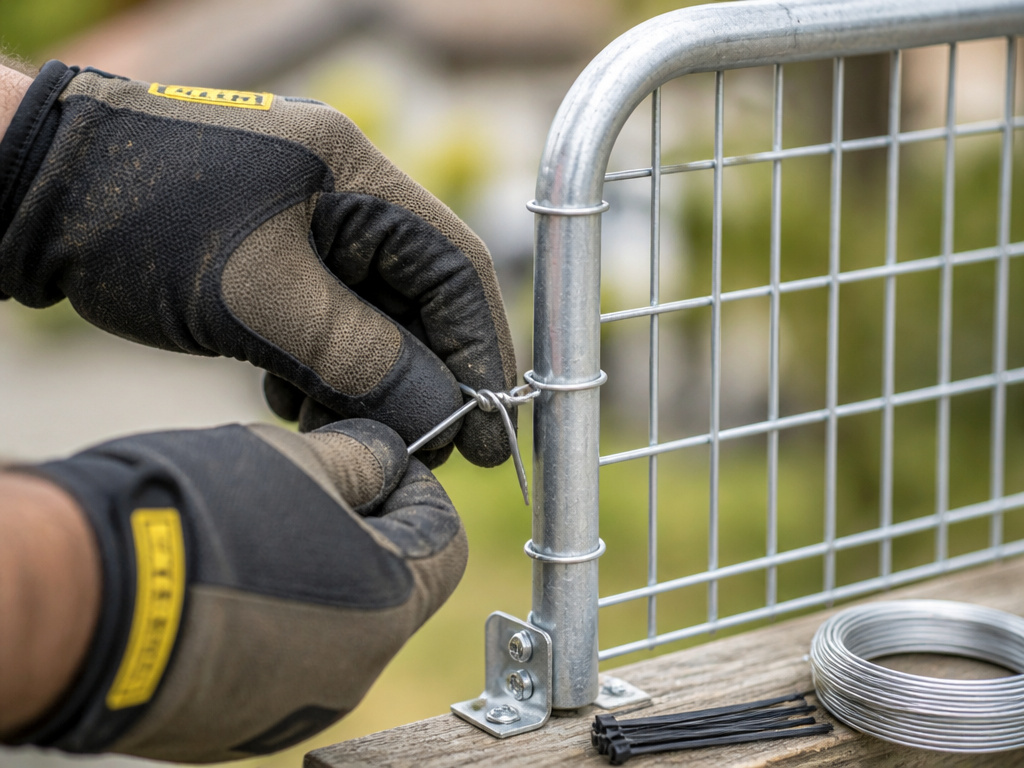
Ipswich City Council publishes the only spec-grade parts list in this whole pile, and it describes a wire-mesh extension bolted to the existing fence rather than tubing laid over the top rail.
| Component | Spec | Job |
|---|---|---|
| Animal netting | 900 x 50 x 13 mm | The barrier itself |
| 90-degree sweep bends | 2 x 32 mm | Curves the top away from paws |
| Rigid electrical conduit | 1 x 32 mm x 2000 mm | The upright post |
| Galvanised tie wire | 1.57 mm x 95 m roll | Laces netting to the frame |
| Button-head screws | 30 mm minimum | Fixes brackets to the fence |
| Zip ties | 50 mm minimum | Fastens netting to conduit |
Before you start: Cut conduit ends and tie-wire tails are sharp and sit at eye level once the extension is up, so cap or bend every cut end before you climb down. Ladder work at fence height on soft ground needs a second person footing it. And if the fence is a dividing fence, get the neighbour’s agreement in writing before you drill into their side.
The council’s build sequence, with what goes wrong if you skip a step:
- Cut the rigid conduit so enough stays usable above the bracket. Cut it shorter and the extension sits too low to change what the dog can clear.
- Pre-drill each curved bracket with evenly spaced holes for the tie wire. Drill after assembly and the bit walks off the curve.
- Fix each bracket into the sweep bends and screw it to the fence. Too few screws let the bracket pivot in wind, and the netting sags.
- Run the galvanised tie wire through the pre-drilled holes and lace the netting to the frame. Undersized zip ties in place of wire can snap under UV.
- Fasten the netting to the conduit with 50 mm zip ties. Skip proper fastening and the netting creeps along the conduit every time the dog hits it.
The full build is documented in the council stop fence jumping wire project, including the PDF guide.
Fair warning on the wire: 1.57 mm galvanised tie wire bites into bare fingers. Wear gloves.
How to Stop a Dog Jumping Over a Fence When Height Isn’t the Problem
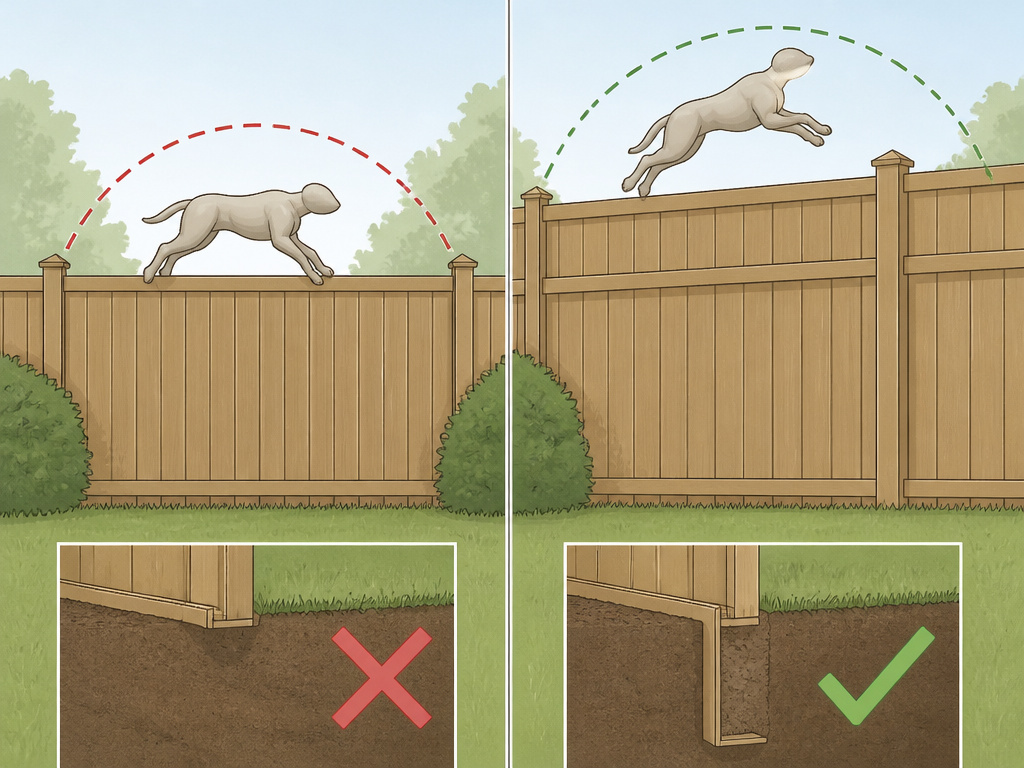
Whole Dog Journal makes a claim that runs against every “just make it taller” answer on the internet: adding only a foot to a fence the dog has already cleared may end up encouraging her to try harder.
The same warning applies underground. A footer extending slightly past the previous dig depth might teach the dog to dig deeper. If digging is the method, the stop a dog digging under a fence problem needs a buried barrier rather than a slightly longer skirt.
Where this goes sideways: Raising a fence by one panel’s worth and stopping there. The dog has already proved the old height was beatable, and the new height becomes the next target.
I stopped quoting “add a foot” to people years ago. If a dog has cleared the fence once, the honest options are an extension that removes the grip, or an interior buffer. A slightly taller version of the same fence just resets the target.
For any dog with real prey drive, I still recommend a physical fence first, with a buried footer turned inward at the base. That combination handles the two escape styles that actually show up: over the top and under the bottom.
Same fence, new target. That’s the trap.
Invisible Fences and the Argument Nobody Wins
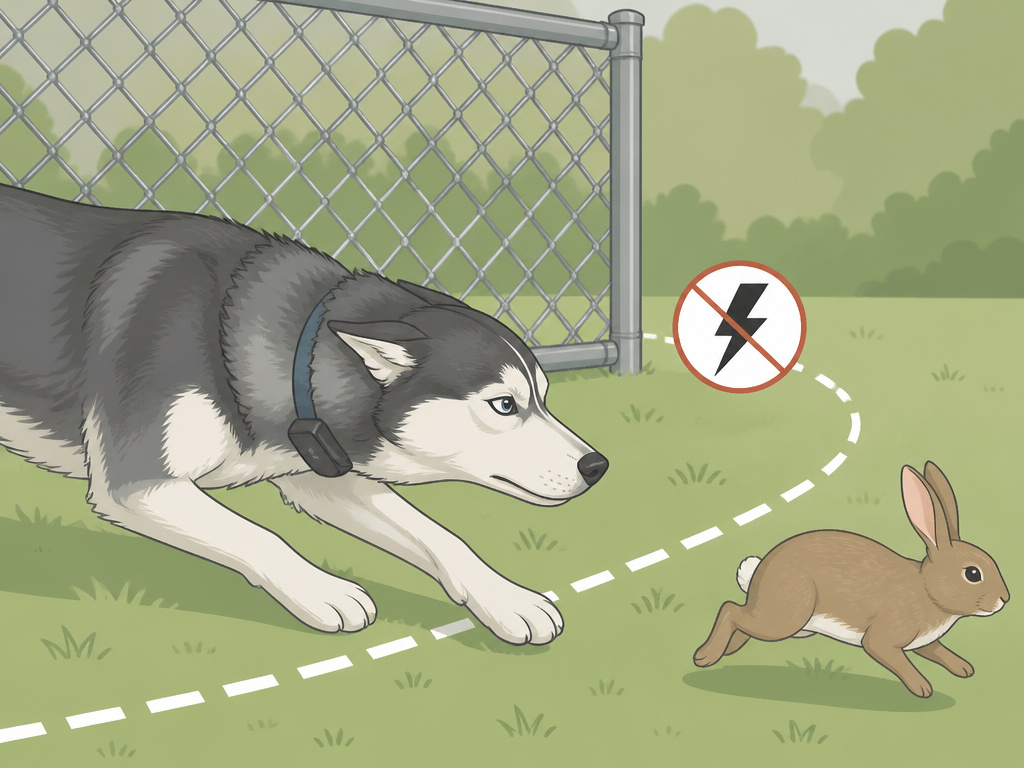
I watched a husky take a correction at a wireless boundary, pause, and then walk straight through it because the rabbit on the other side was more interesting than the collar.
That dog needed chain link. Three separate sources reach the same conclusion about shock-based containment by three different roads, and the disagreement is about why, not whether.
RSPCA Australia is explicitly opposed to any electronically activated or other device that delivers electric shocks, such as invisible boundaries, and describes them as inhumane. That’s an organisational policy position, stated plainly.
Whole Dog Journal’s objection is about reliability. The question it raises is whether the boundary holds when something scary or thrilling happens. A loose dog runs through a barrier the dog can’t see, a fight starts, and the dog has to choose between the boundary and her own life.
Robert Haussmann, a Certified Professional Dog Trainer writing for Adopt a Pet, objects on emotional grounds. Force or pain-based tools like invisible fences and shock collars may produce short-term change, he writes, but the emotional association toward the trigger is likely to get worse.
Here is the honest version. Wireless circular-boundary systems get sold as a universal fix, and the three sources above treat them as anything but. If you want the physical options laid out side by side, fences to keep dogs in covers the containment side properly.
Training, Reactivity, and the Gate Nobody Checks
AWLA’s guidance covers a failure mode that has nothing to do with height: barrier reactivity, where a dog is reactive only when a fence is between it and the trigger, and fine when the barrier disappears.
The management rules are blunt. Never leave a fence-reactive dog outside unattended, because it’s unsafe and because it gives the dog time to practise the behaviour. In a multi-dog household, separate outside time so each dog gets worked individually.
Visual barriers help here, and AWLA lists the practical ones:
- Porch shade rolls, which are cheaper than re-fencing
- Chain-link slats
- Tarps, plywood or fibreglass reinforced plastic
- Landscaping, bamboo or reed rolls
- Coyote rollers, for the jumpers rather than the barkers
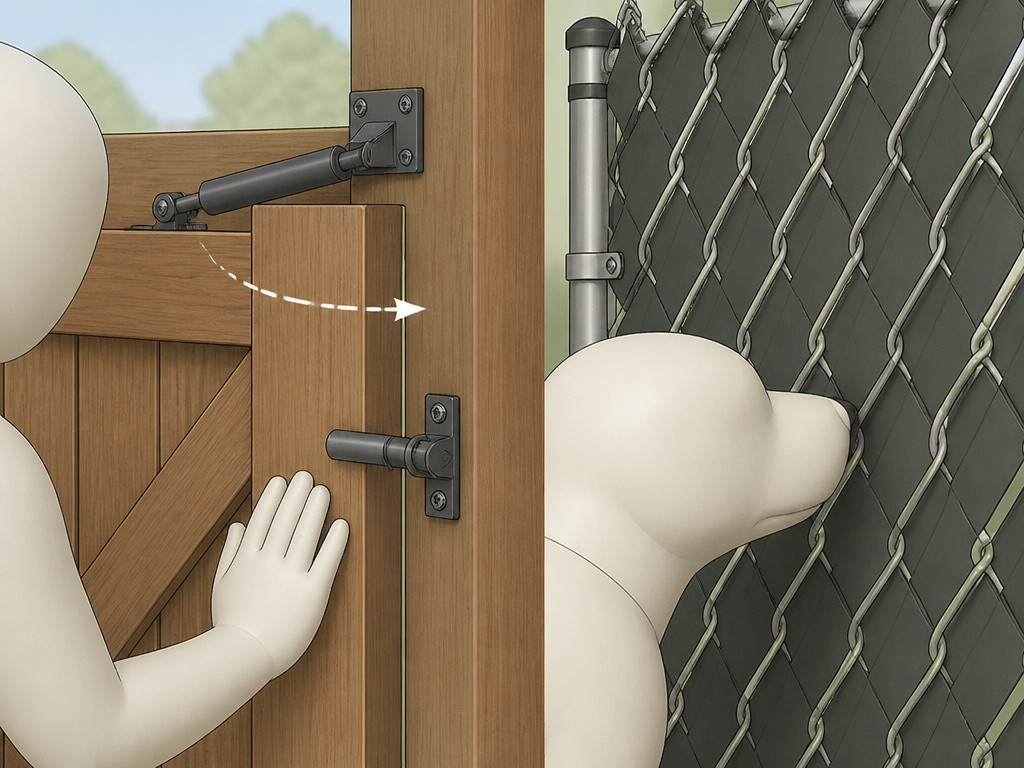
Now the gate. Most escapes I hear about start there rather than at the fence line, and the usual culprit is a latch that doesn’t close itself. A delivery driver, a child, a gust of wind, and the gate is standing open.
A self-closing hinge that’s working gives you a slow, weighted click as the gate swings home. A worn one swings freely and stops wherever you let go. A self-closing hinge and a latch that clicks home is a better use of money than another foot of timber. The dog-proof a gate walkthrough covers the full hardware list.
On the training side, Haussmann recommends the Karen Overall Relaxation Protocol, starting indoors with something as small as staying while the owner takes three steps back. Reward the dog with treats and attention whenever it stays calm as people pass, which changes the emotional association rather than suppressing the behaviour.
AWLA adds a targeting exercise: hand out, fingers down and palm forward, about 5 inches from the dog’s nose, mark and reward when the nose touches, then repeat 5 times moving the hand an inch left or right each time. That gives you a way to move the dog off the fence line without touching it.
One warning from AWLA worth repeating: don’t begin recall training outside at the fence line. Start inside, with fewer distractions.
So where does that leave the training-versus-hardware argument? Whole Dog Journal says the only reliable way to keep a dog from jumping the fence is to build a better fence, and that training can’t be guaranteed to hold when something frightening or exciting happens while you’re away. RSPCA Australia orders it the other way, working out the reason and meeting the dog’s needs first, with fence modification as an additional step. Dogster lists training, professional or DIY, among its twelve tips alongside the physical changes.
Training changes what the dog wants to do. Hardware decides what the dog can do. You need both, and the sources only disagree about which one you reach for first.
Walk the fence line first.
Frequently Asked Questions
Will a taller fence stop a dog jumping over it?
Whole Dog Journal treats 6 feet as generally safe for most dogs, then concedes there’s no fool-proof guide. The record dog jump is 75.5 inches. Height works against a clean jumper and does far less against a climber that can find a foothold partway up.
Do invisible fences stop dogs jumping out?
RSPCA Australia opposes them outright as inhumane. Whole Dog Journal questions whether the boundary holds when something frightening or thrilling happens. Robert Haussmann warns that force or pain-based tools can worsen the dog’s emotional association with the trigger.
How far from the fence should an interior fence go?
RSPCA Australia says two to three feet from the exterior fence, with shrubs planted between. Dogster says about 3 feet inside the main fence. Neither cites a measurement study, so treat it as a single unsourced figure.
Can I stop a dog jumping the fence without building anything?
Partly. Remove launch pads, block the view through the fence, cut the time the dog spends alone, and fix the gate latch. Those reduce opportunity. They don’t change what the dog can physically clear.
Why does my dog only jump the fence when I’m not home?
Whole Dog Journal notes that training can’t be guaranteed to hold when something frightening or exciting happens while you’re absent. That’s the argument for hardware doing the containment work rather than behaviour alone.
The Bottom Line
Before you buy a single fitting, walk the perimeter at dog height. Get down on your hands and knees and look for the foothold, the gap under the bottom rail, and the gate that doesn’t latch itself. That crawl tells you more than any product page will.
One concession worth stating plainly: none of this fixes a dog that’s leaving because it’s terrified of being alone. If your dog is escaping and showing signs of anxiety or distress, RSPCA Australia’s advice is to talk to your vet, and that comes before any fence work.
If you only do one thing this week, do the gate. A self-closing hinge and a latch that clicks home on its own stops more escapes than another foot of timber ever will.
