
How to Check a Dog’s Gums: Step-by-Step
This post contains affiliate links. As an Amazon Associate, we earn from qualifying purchases.
To check a dog’s gums, lift the lip, look for salmon pink color, then press the gum until it blanches and time how fast the color comes back. Under two seconds is normal. Anything other than salmon pink, or a slower refill, is a call to your vet.
That two-second window is the only hard number in the whole check. It measures something specific: how fast blood refills the tiny vessels in the gum after you squeeze them empty. Color reads circulation too, but through a different route, which is why a dog with textbook pink gums can still fail the refill test. Knowing how to check a dog’s gums helps you read both signs together.
What follows is the check in the order I do it: color, refill, hydration, then the lumps-and-tartar pass most owners skip. After that comes the part that decides what you actually do next, which is urgency, and the two veterinary sources that disagree about it.
Key Takeaways
- Salmon pink is the target. PDSA treats light pink, white, bright red, and blue-tinged gums as abnormal and says to contact your vet straight away.
- Under two seconds is normal capillary refill. Press until the gum blanches, release, and count.
- PetMD says weekly. PDSA says regularly, with no number. Weekly gives you something to compare against.
- Black and grey gums are normal. A fully pigmented mouth is the exception, and the vet has to read the color.
- Never force the check. A dog that pulls away needs slow training or a vet visit, not a wrestling match.
What Counts as a Normal Gum Color on a Dog?
Salmon pink, moist, and slightly slippery, with no smell and no lumps. PDSA calls salmon pink the target and treats anything else as a possible health problem. Sandra C. Mitchell, DVM, at PetMD describes healthy gums as bubble-gum pink or salmon pink, which is the same color family under a different name.
A normal canine gum is salmon pink to bubble-gum pink, moist to the touch, and free of swelling, lumps, or odor. Capillary refill time, measured by pressing the gum until the tissue blanches and then releasing, runs under two seconds. Light pink, white, bright red, and blue-tinged gums fall outside that range and warrant a call to a veterinary practice.
Four things go into the look, and only one of them is color:
- Color across the gum itself, not just the thin line where gum meets tooth.
- Texture: moist and slippery, with a wet sheen.
- Smell: nothing at all. PetMD lists odor near the mouth as a sign something is off.
- Surface: no swelling, lumps, bumps, ulcers, or bleeding spots.
That wet sheen is easier to read than any shade of pink. A healthy gum catches the light along the tooth line. A dry gum looks matte by comparison, like the difference between a wet plate and a chalky one.
Checking gum color at least weekly is PetMD’s advice, while PDSA says to check regularly with no fixed interval.
Veterinary teaching, such as the JAVMA conscious oral examination study, treats the how to check a dog’s gums question as a structure you work through in a fixed order rather than a spot you glance at. Both jaws, both sides, back teeth included.
Some breeds have naturally dark or spotted gums. PDSA calls black or grey coloring completely normal. PetMD says the same, with one addition: if the color changes over time, that is worth a look.
I would rather you look once a week and get the shade slightly wrong than look once a year and get it exactly right.
The Two-Second Capillary Refill Test
Capillary refill time is the one part of the gum check with a hard number attached. PDSA puts normal at under two seconds and links a slower refill to poor circulation.
Here is the sequence, with what goes wrong at each step:
- Find a pink patch of gum above a tooth. Press a pigmented patch instead and nothing will blanch, which reads as a failed test when the test never started.
- Press firmly with a fingertip until the spot turns white. Light pressure leaves the blood where it is, and you get no white patch to time.
- Release and watch the color return. Under two seconds is normal. Count it out loud if you have to.
- If it runs long, write down the number and call your vet. A slow refill on its own is worth reporting, and a slow refill alongside a pale color is worth reporting today.
Common mistake: Pressing with a fingernail instead of the flat of the finger. You get a white dent rather than a blanched patch, and the color that comes back is the color of the tissue you just compressed.
The Hydration Check
PDSA says well-hydrated gums feel moist and your finger comes away a bit damp. Dry and sticky gums point at dehydration. PetMD uses the words tacky and dry for the same finding.
Your fingertip should slide. If it drags, the gum is tacky, and that is the finding.
One timing caveat from PetMD: a dog that has been panting hard will have drier gums than usual. Let the dog settle, offer water, and recheck when they are ready to nap. If the gums are moist by then, you are fine. If they are still dry and tacky, that is a veterinary hospital trip, particularly with lethargy, vomiting, diarrhea, or no appetite alongside it.
White, Yellow, Blue, Red: What Each Gum Color Points At
Color is the fastest read and the easiest one to misread. PDSA ties each shade to a specific list of possible causes, and the lists are worth knowing before you need them.
| Gum color | What PDSA lists it as a sign of | Second thing to check |
|---|---|---|
| White | Severe anemia, blood loss, shock, kidney disease, pain, anxiety | Whether the dog is weak or collapsed |
| Pale pink | Anemia, low blood pressure, shock | Recent vomiting or diarrhea |
| Yellow | Liver problems, red blood cell damage | Lips, inner ears, and eye whites for yellow |
| Blue or purple | Breathing problems, choking, heart disease, low temperature, low blood pressure | How hard the dog is working to breathe |
| Bright red | Heat stroke, high blood pressure, poisoning | Whether the dog just exercised or is panting |
| Muddy brown | Paracetamol (acetaminophen) poisoning, which PDSA calls rare | Whether any human painkiller is within reach |
Notice how many of those entries overlap. White, pale pink, and blue all trace back to circulation or oxygen, which is why the refill test earns its place next to the color check.
White gums also appear on the list for pain and anxiety. Signs of pain in dogs are easy to miss when the dog is stoic, and a gum check is one of the few hands-on ways to catch it early.
The Color Change That Matters More Than the Color
PetMD’s most useful line about how to check a dog’s gums is about change, not shade. Gums that shift color over time are worth investigating even when the new color sits close to normal.
A shade you have never seen on your own dog before is worth a phone call, even if it looks close to pink. You cannot compare a color against a memory.
That is the whole argument for a baseline.
A dog whose gums have always been slightly pale is a different case from a dog whose gums went pale last Tuesday.
How Often Should You Check a Dog’s Gums?
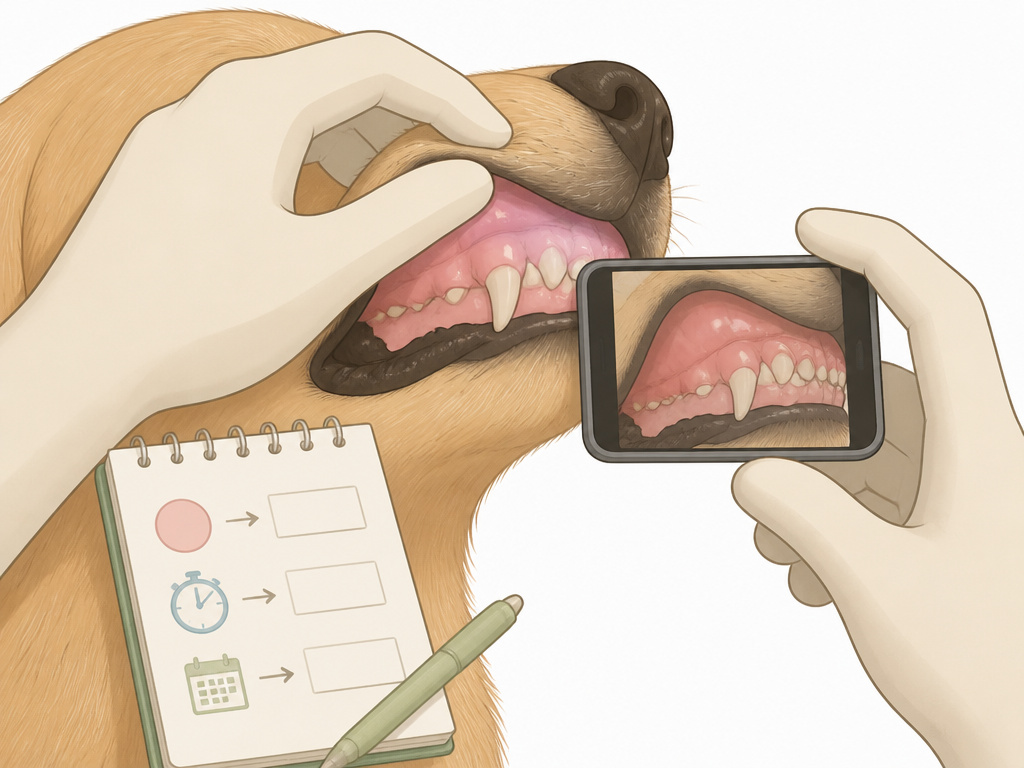
PetMD’s answer is at least once a week, plus any time you see or smell something that does not seem right. PDSA’s answer is regularly, with no fixed interval, so that you know what is normal for your dog and can spot problems early.
Both are describing the same habit. PetMD gives a number, at least weekly, while PDSA gives no fixed interval.
Here is the part nobody tells you about routine checks: the check is the excuse, and your hands are the actual exam. I run my hands over the whole dog when I pick up a brush. Ears, armpits, between the toes. The mouth is just one stop on that circuit. That habit found a hot spot behind a front leg on a Tuesday that would have been a vet visit by Friday. Same principle, different body part.
A useful baseline record takes about thirty seconds to write down:
- The color you saw, in your own words.
- The refill time, counted.
- Whether the gums felt moist or tacky.
- The date, so the next entry has something to sit against.
A photo on your phone does the job too. PetMD suggests exactly that, and it is the single most useful thing you can hand your vet.
If you already handle monitoring glucose at home for a diabetic dog, you will recognize the pattern: a short, boring, repeated measurement that only matters on the day it changes. Gum checks work the same way. If you have a puppy and want the wider version of this habit, the signs of a healthy puppy go well beyond the mouth.
PDSA Says Call Now, PetMD Says Wait: How Urgent Is It?
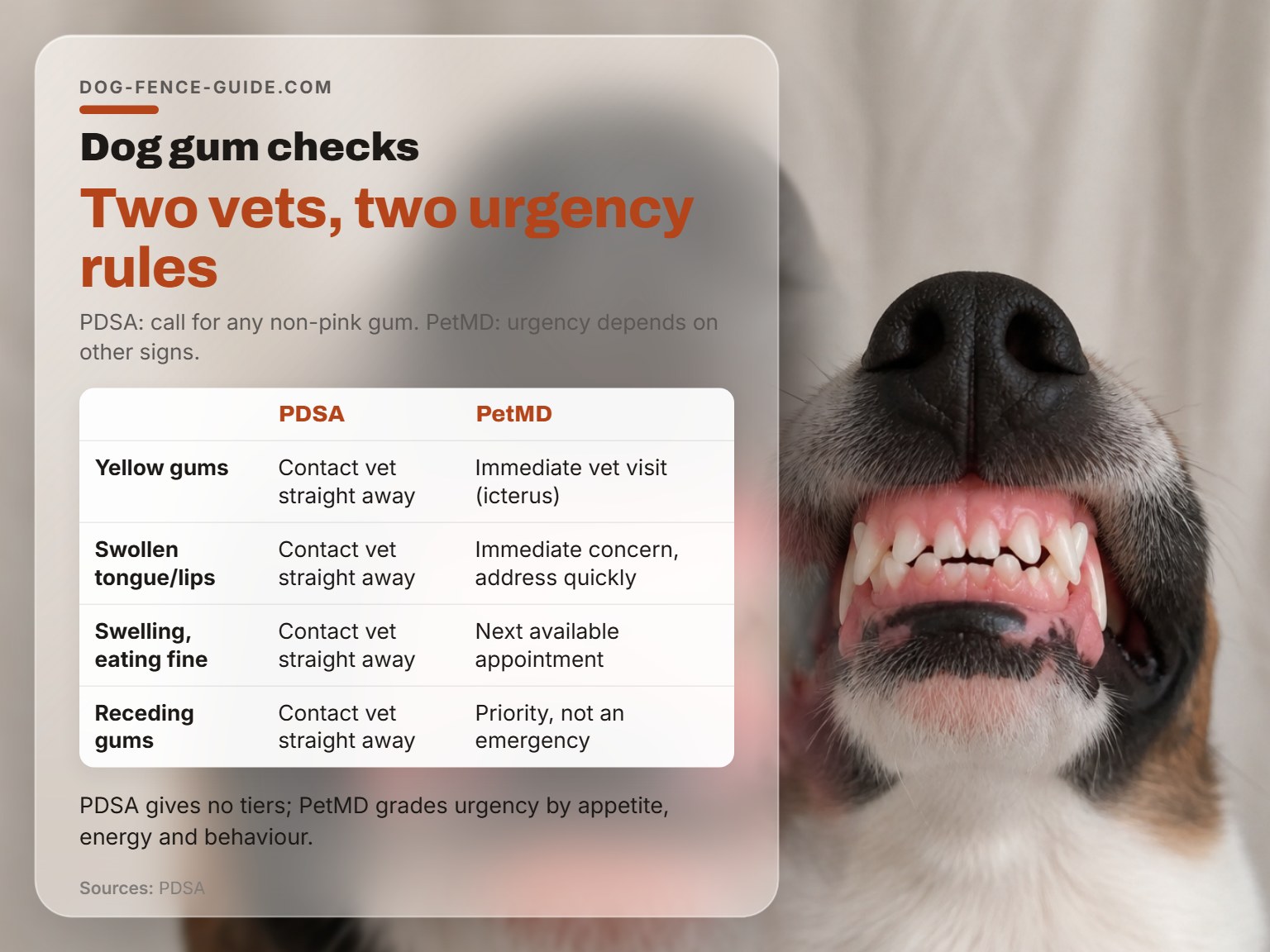
Two credible veterinary sources give two different answers about urgency, and neither one is wrong. PDSA’s position is blunt: contact your vet straight away if the gums are any color other than salmon pink, with no tiers and no exceptions. PetMD’s position is graded.
| Situation | PDSA’s position | PetMD’s position |
|---|---|---|
| Yellow gums | Contact the vet straight away | Immediate veterinary visit (icterus) |
| Swollen tongue or lips with gum swelling | Contact the vet straight away | Immediate concern, address quickly |
| Gum swelling alone, dog eating normally | Contact the vet straight away | Next available appointment |
| Receding gums | Contact the vet straight away | Priority, not an emergency |
| Tartar at or over the gumline | Contact the vet straight away | Prompt dental work |
The gap is about what each source assumes you can see. PDSA writes for an owner who cannot read the rest of the dog, so the safe move is a phone call every time. PetMD writes for an owner who can also judge appetite, energy, and behavior, and it lets those findings move the appointment up or down the queue.
That is the whole disagreement.
I use PDSA’s line as my default and PetMD’s tiers as a tiebreaker. If the dog is eating, drinking, and behaving normally, I book rather than panic. If anything else is off, I stop negotiating with myself and call.
If you are unsure which column you are in, PDSA’s advice is to call straight away, while PetMD would have you weigh appetite, energy, and behavior. When a dog is sick, the signs show up outside the mouth too, and a gum color that worries you is one data point among several.
Pigment, Reluctance, and the Red Gums That Fade
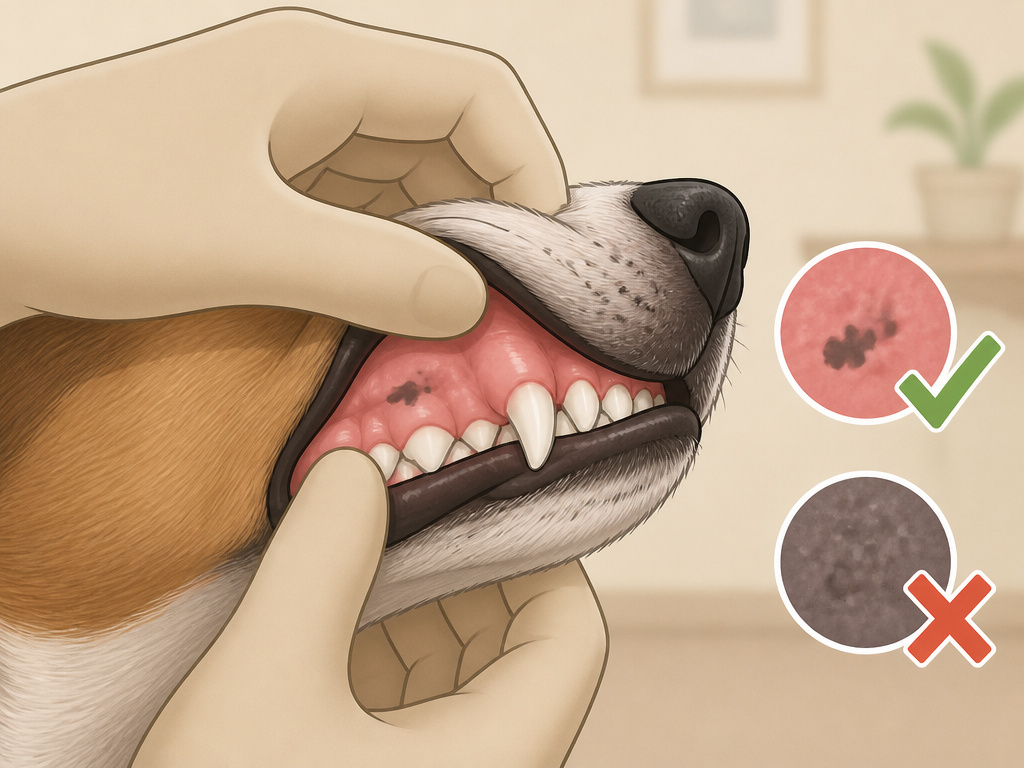
Your dog comes in from ten minutes of hard running with a brick red mouth. Ten minutes later the gums are salmon pink and the dog is asleep on the floor.
Pigmented mouths are the other common dead end. PDSA calls black or grey gum coloring completely normal. The catch is a mouth that is pigmented all the way through, where you cannot find a pink patch to read at all. In that case the color check moves to your vet. PetMD adds a second catch: dark or spotted gums are fine, but a color that changes over time is worth investigating.
There should be no odor at all when you get close to the mouth. PetMD lists that alongside swelling and lumps as a sign something needs a look. If the smell arrives before the color change does, trust the smell.
Teaching a Dog to Accept the Check
PDSA is direct about this: never force a dog to have their gums checked. If they will not let you, do not stress them and do not risk a bite. Ask your vet for advice instead.
The AAHA dental guidelines note that a conscious oral exam can be helped along with drug protocols that reduce a dog’s stress and anxiety. That is a vet-side tool, and it is one more reason not to turn the kitchen into a wrestling match.
For the home side, cooperative care training works. The Karen Pryor Clicker Training approach and the Kikopup videos both build handling tolerance in small steps, and the order matters more than the reward:
- Touch the muzzle, reward, stop.
- Lift the lip for one second, reward, stop.
- Lift the lip, look, reward, stop.
- Add the press-and-release only once steps one through three are boring.
Where this goes sideways: Forcing the lip up on a dog that is already pulling away. You get a bite, the dog learns that hands near the mouth predict a fight, and every future attempt gets harder.
If you are lifting a lip on a mastiff, get a second pair of hands and skip the one-person version entirely.
What to Do After the Check: Teeth, Tartar, and the Vet Visit
A gum check takes seconds. What you do with the result takes longer.
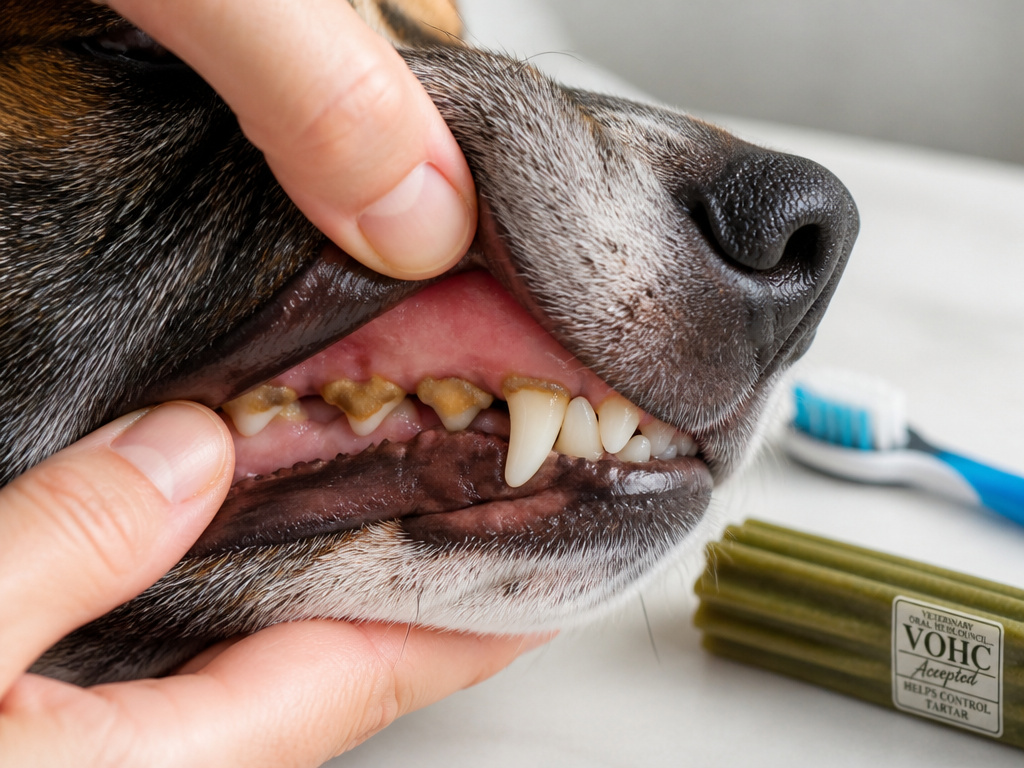
Start with the gumline itself. PetMD describes tartar that builds in plates and touches or overlaps the gums as very painful, and it can lead to periodontal disease. A dog with tartar at or over the gumline needs dental work promptly, not at the next annual visit.
Brushing helps, and PetMD lists it as a healthy habit that improves oral health.
Tartar, Brushing, and What the Vet Does Differently
The AAHA guidelines make a point that surprises most owners: many teeth that look normal from the outside have important pathology that only shows up on intraoral radiography under general anesthesia. A visual check, yours or your vet’s, cannot see under the gumline.
The follow-up looks like this:
- Book the dental work promptly if tartar sits at or over the gumline.
- Expect a recheck appointment in 10 to 14 days, even after a routine cleaning.
- Hold off brushing until any surgically manipulated gum has healed.
- Choose chews carrying the VOHC seal over antlers and bones.
For chews, AAHA points owners toward products accepted by the VOHC, the Veterinary Oral Health Council, to reduce plaque and calculus.
The USDA APHIS periodontal disease monitoring aid and the 2019 AAHA dental care guidelines are the two clinical documents worth reading if you want the full picture beyond the home check.
Frequently Asked Questions
How do I check my dog’s gums without getting bitten?
Approach from the side, not head-on, and keep the session to a couple of seconds. PDSA’s guidance is not to force it, because a stressed dog is a biting dog. Build tolerance in steps with rewards, and let your vet do the check if your dog still refuses.
What color should a dog’s gums be?
Salmon pink. PDSA treats light pink, white, bright red, and blue-tinged gums as abnormal. PetMD describes healthy gums as bubble-gum pink or salmon pink. Black and grey patches are normal pigmentation, not a problem.
How long should capillary refill take?
Under two seconds. Press the gum until it turns white, release, and the color should return in under two seconds. PDSA links anything longer to poor circulation.
Can I check my dog’s gums right after a walk?
Let the dog settle and rehydrate, then recheck when they are ready to nap. Checking mid-panting gives you a reading you cannot trust.
What if my dog’s whole mouth is dark?
Then the color check is your vet’s job, not yours. PDSA says a fully pigmented mouth makes it hard to read color at home, and the vet can check instead. You can still check texture, refill time where a pink patch exists, and smell.
Do I need to check my dog’s gums every day?
No. PetMD suggests at least weekly, while PDSA suggests regularly without a fixed interval. Either way, a weekly check is enough to build a baseline and is easier to keep up than a daily habit.
The Bottom Line
Pick one day a week and run the check right before you brush your dog’s teeth. Same day, same order: color, press and release, texture, then a quick look at the gumline for tartar. Thirty seconds, written down or photographed.
The threshold that decides everything: PDSA says if the color is anything other than salmon pink, or the refill runs past two seconds, you are making a phone call, while PetMD tiers urgency based on other signs.
One concession worth making. If your dog has a fully pigmented mouth, most of this article collapses into a single sentence: your vet reads the color, and your job is to book the appointment and describe what changed. That is the home check telling you where its limits are.
