
How to Trim a Dog’s Paw Hair: Step-by-Step
This post contains affiliate links. As an Amazon Associate, we earn from qualifying purchases.
To trim a dog’s paw hair, use a small, narrow clipper blade or blunt-edge scissors and take the interdigital hair down even with the paw pads or slightly shorter, working from the toes toward the large pad in a scooping motion. Start with a clean, dry foot, because dirty fur shortens blade life.
That finish line is where the advice splits. The American Kennel Club’s chief veterinarian puts interdigital hair even with the pads or slightly shorter. PawsUniversity, a grooming-school guide, stops at anything past pad level. The Vet Desk, a vet-reviewed site, says cut as close as you can. Same cut, three different stopping points.
What follows is the tool choice, the scooping motion that keeps a blade off skin, the coat-by-coat schedule, and the three situations where the standard cut stops working: mats, snow, and a dog that treats the clipper like a threat.
Key Takeaways
- Even with the pads or slightly shorter is the AKC target, and it’s the one written by a veterinarian.
- Clean and dry first. PetEdge notes that clipping dirty fur dramatically shortens blade life, so a muddy paw costs you a blade.
- Medium or short on an adjustable blade, or a #10 to #40 blade, depending on which guide you follow.
- Every 2 to 4 weeks for Poodles, Doodles, Maltese, and Golden Retrievers. Smooth-coated breeds rarely need it at all.
- Skip the bristle brush between the toes if your dog hates it. A comb does the same job with less drama.
What Untrimmed Paw Hair Actually Causes
Andis, the clipper manufacturer, ties unclipped paw pads to two specific problems: mats forming in the hair, and dirt and debris collecting between the pads. Neither one shows up on a dog standing still on a rug.
Paw pad hair grows downward between the digital pads and the large metacarpal or metatarsal pad. Left alone, the hair collects sand, salt, and grit, packs into hard tangles against the skin, and covers the leathery pads that supply traction. The result is a foot that slips on smooth floors and holds moisture against the skin.
The traction issue is the one you notice first. PetEdge’s grooming guide points out that untrimmed pad fur covers the pads that provide natural grip, so the dog slides on hardwood and tile. On a slick hallway floor, that’s a daily stress on hips and shoulders.
| Problem | What’s happening | Fix |
|---|---|---|
| Slipping on tile | Pad fur covers the traction pads | Trim even with pad level |
| Hard knots under the pad | Mats hold moisture against skin | Work the blade under the tangle |
| Nails growing into the pad | Overgrowth presses into soft tissue | Trim nails on the same schedule |
| Snow packed between pads | Ice catches in interdigital hair | Dry the foot, then trim |
Nails belong in the same conversation. Andis notes that nails left too long can grow into the pads, causing pain and infection, and that overgrown nails change a dog’s gait in ways that show up in the hips, shoulders, and elbows. If you’re already holding a foot, trimming dog nails in the same session can save yourself a second wrestling match.
Winter adds its own failure. The Vet Desk describes interdigital hair catching ice and snow until tiny snowballs pack between the pads. You’ll hear the dog stop and chew at a foot on a walk before you see anything.
How Short Should You Cut a Dog’s Paw Hair?
Pick a target before the clipper touches fur. The sources don’t agree, and you’ll second-guess yourself halfway through the second paw if you haven’t decided.
| Source | Target length | Written by |
|---|---|---|
| AKC | Even with pads or slightly shorter | Chief veterinarian |
| PawsUniversity | Only hair past pad level | Grooming school guide |
| The Vet Desk | As short as possible | Vet-reviewed site |
I use the AKC line as my default, because it’s the only one of the three written by a veterinarian, though PawsUniversity and The Vet Desk set different targets, and I only go shorter on a dog that’s visibly sliding on the kitchen floor. The gap between “past pad level” and “as short as possible” is small enough that it rarely matters on a dog that gets trimmed on schedule, and the how to trim a dog’s paw hair question rarely comes down to that difference.
Blade guidance splits the same way. PetEdge’s Daryl Conner selects the medium or short setting on an adjustable trimmer blade. PawsUniversity specifies a #10 to #40 blade, or a battery mini trimmer with a head about 1 inch wide. The adjustable setting is friendlier for a first-timer who wants to sneak up on the length.
Easy to miss: The hair you can see from the top of the paw is not the hair that matters. The stuff that mats sits underneath, between the digital pads and the large pad, where you have to lift the foot to see it at all.
The AKC at-home dog grooming guide is blunt about the bigger point: don’t clip or shave a dog without proper training, and use small blunt-edge scissors or a narrow clipper blade only after someone has walked you through it. That’s a veterinarian telling you the tool is not self-teaching.
Clippers or Scissors: Pick the Tool Before You Touch a Paw
Clippers win the underside of the paw. Every credible source here lands in the same place for the pad itself, even while they argue about blade size.
PetEdge is direct about it: trimmers remove the hairs closest to the skin safely, and scissor work comes after, as a finish. The AKC allows small blunt-edge scissors, but only for someone who’s been taught, and only as an alternative to a narrow clipper blade. Owners who’ve never done it tend to overthink how to trim a dog’s paw hair; the actual cut takes seconds once the foot is still.
Here’s what belongs on the table:
- A clipper with a #10 to #40 blade, or a 5-in-1 adjustable model on medium or short.
- Blunt-tip grooming scissors for the perimeter only.
- Styptic powder, because a blade that catches a wrinkle draws blood fast.
- A narrow-head mini trimmer, about 1 inch wide, for the tightest gaps between toes.
For most home setups I’d point you at an Andis clipper, because the blade range covers what a paw actually needs and replacements are everywhere. If your dog is small and twitchy, a 5-in-1 adjustable blade on its medium setting slips between tiny toes without the bulk of a full body. Comparing the best dog paw trimmers side by side mostly comes down to head width and whether the blade is adjustable.
I won’t run a full-size clipper on a nervous dog’s back feet. The body is too wide to see past, and you end up guessing where the pad stops and the skin starts. A mini trimmer with a 1-inch head is slower and much harder to get wrong.
If the tool is new to you, the basics of how to use dog clippers carry straight over to the paw: light pressure, let the blade do the work, keep the blade edge parallel to skin.
How to Trim a Dog’s Paw Hair: The Scooping Method, Step by Step
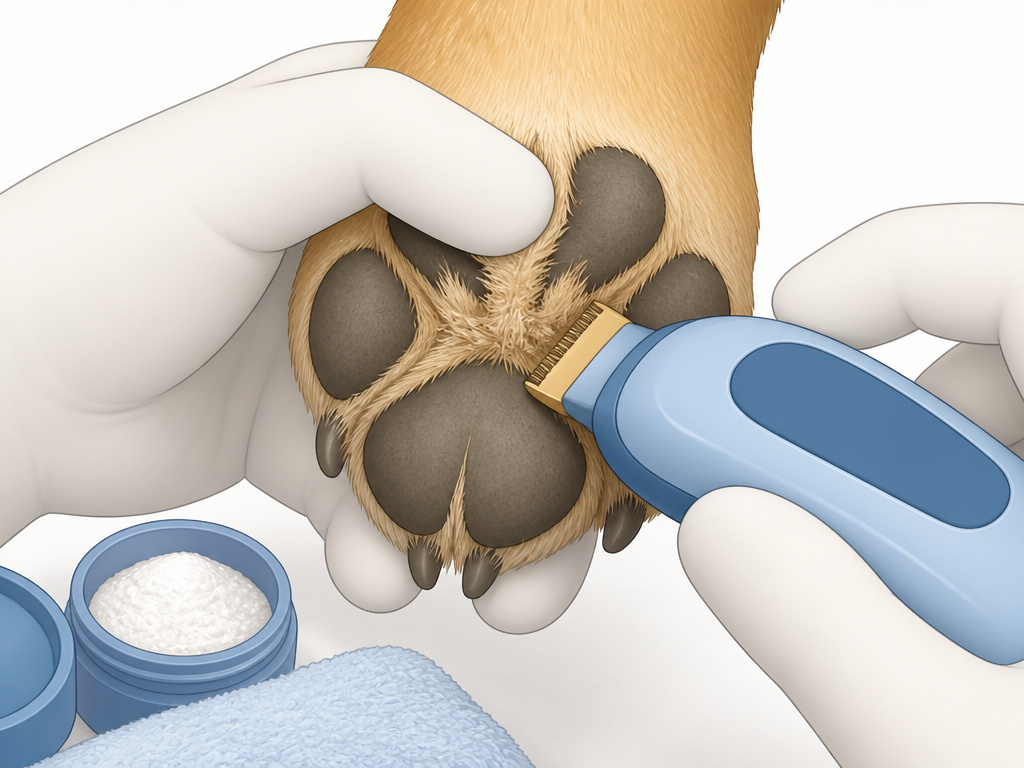
Four things happen in this order: clean and dry the foot, spread the pads, scoop from the toes toward the large pad, then tidy the perimeter.
Before you start: A clipper blade warms up as it runs, so switch the tool off between feet and tap it against your wrist before it goes back on skin. The skin between the pads is thin and hides in folds, and a blade that catches a wrinkle will draw blood before you feel resistance. Keep styptic powder open on the towel next to you.
- Clean and dry the foot first. PetEdge notes that clipping dirty fur dramatically shortens blade life, so a muddy paw costs you a blade as well as time.
- Spread the pads with your thumb. Press into the center of the paw so the small digital pads separate. That’s the only way to see the hair that actually mats.
- Set the blade and scoop from the toes toward the large pad. PetEdge’s technique lets the blade skim close to skin for a tight clip. Running the other direction digs the teeth into the hair and stalls the motor.
- Work the blade under any tangle instead of through it. Forcing a mat lifts skin up into the teeth, and that’s where nicks happen.
- Cut a thin line at the rear edge of the large pad. PetEdge uses this to make the finished foot look deliberate instead of chewed.
- Trim the outside edges of the toes before you pick up scissors. That way the scissor pass is a finish, not a rescue.
- Rub the paws afterward. The Vet Desk suggests coconut oil, vaseline, or a dog-specific lotion to keep pads from drying and cracking.
What Do You Do With a Dog That Won’t Hold Still?
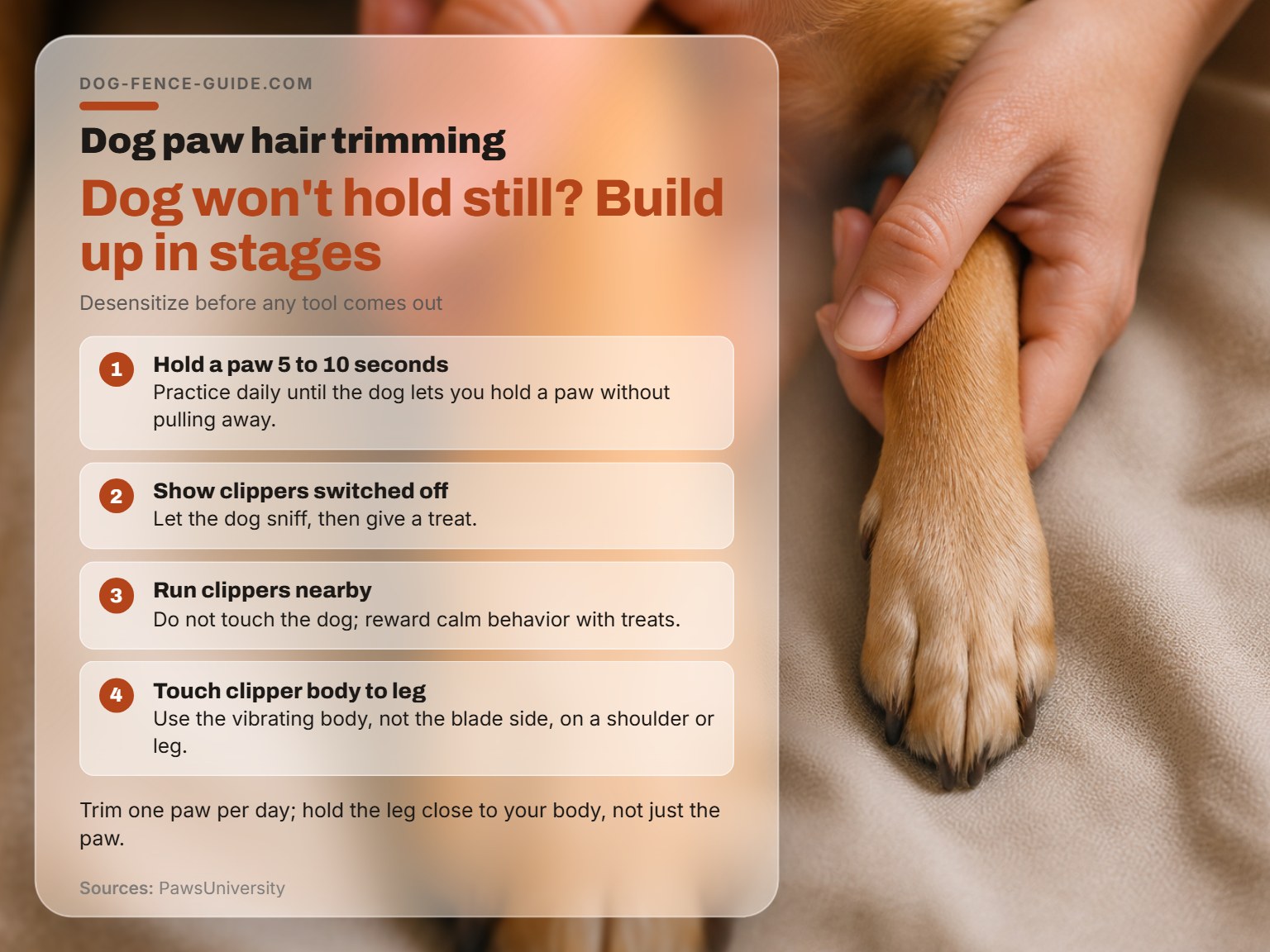
The back left paw is done, the dog stands up, walks three steps, and lies down on the exact foot you just finished.
The Vet Desk’s answer is the one that works: several sessions of nothing but touching the feet and handing over treats, before any tool comes out. PawsUniversity puts a number on the goal, and it’s a reasonable one. Practice daily until the dog allows you to hold a paw for 5 to 10 seconds without pulling away.
Then build up in stages:
- Show the clippers while they’re switched off, let the dog sniff, treat.
- Run the clippers nearby without touching, reward calm.
- Touch the body of the vibrating clipper (not the blade side) to a shoulder or leg.
- Trim one paw per day. Short sessions beat a full set of four.
- Hold the leg close to your body, not just the paw, so kicking has somewhere to go.
The off-and-sniffing stage is the one people skip, and it’s the one that decides whether the next five years of grooming are a fight. If your dog is already panicking at the sight of the tool, there’s more on how to calm a dog for nail trimming before you start.
One more disagreement worth knowing about. PawsUniversity suggests a comb or slicker brush to lift the hair out from between the pads first. The Vet Desk says skip the bristles, because many dogs hate the feel between their toes.
Mats, Snow, and Mud: When the Standard Cut Fails
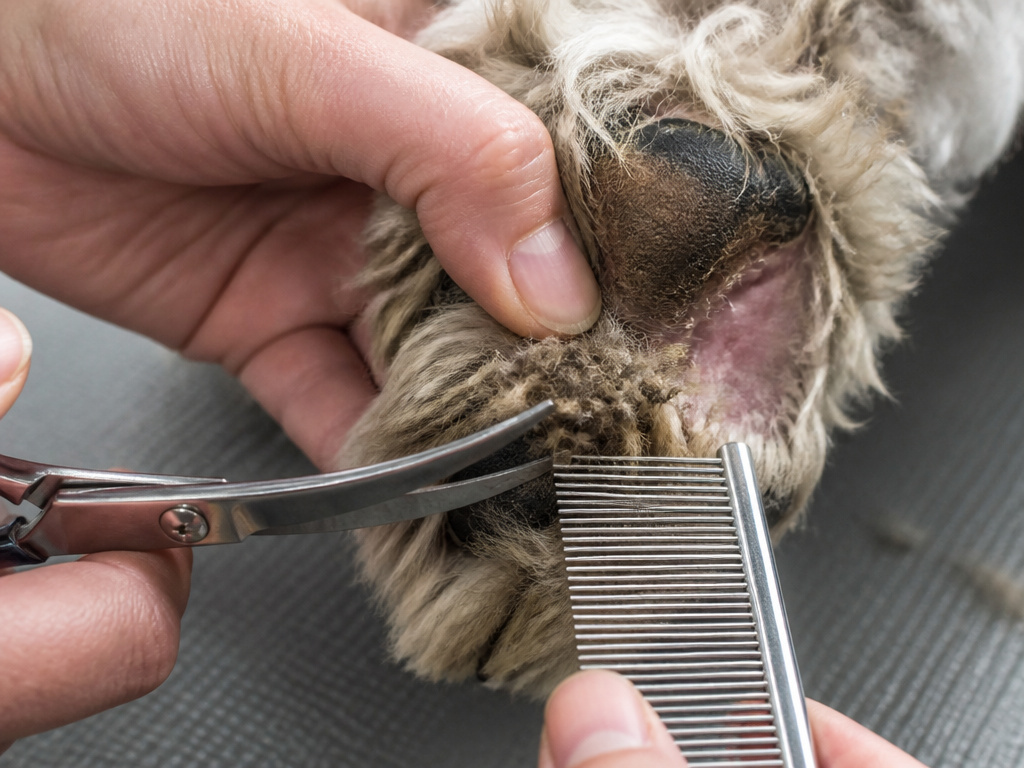
A hard mat under the pad will not come off with a scooping motion, and this is where most home trims end with a nick.
PetEdge’s method is to work the blade carefully under the tangle rather than pushing through it. If the skin looks pink or irritated once the tangle is gone, a soothing spritz is the next step, and a paw pad that’s actually cut needs more than a spritz.
My terrier mix is the reason I check pads on a schedule instead of when I think of it. Her coat runs oily by week five, and the one time I let her go past the usual check, I found a hard little knot tucked under the big pad. That’s the failure PetEdge describes: a mat that close holds moisture against the skin and irritates it.
If a mat is tight enough that you can’t slide a comb between it and the skin, stop. That’s a groomer’s job, and a blade in the wrong spot turns a mat into a wound.
Where this goes sideways: Cutting a mat out with scissors. The skin tents up inside the tangle, the scissor tip goes where your eye can’t follow, and the nick always lands in the crease between pads.
Winter is the other failure mode, and it’s seasonal. Snow packs into interdigital hair and freezes into little balls that press on the pads with every step. Trim before the walk, not after, and dry the foot first.
PawsUniversity draws the line for professional help clearly: severely matted hair down to the skin, or a dog showing extreme fear, aggression, or anxiety during handling. Anything that looks like infection, a deep cut, bleeding, or a limp goes to a veterinarian.
The Tools Worth Buying and the Ones to Skip
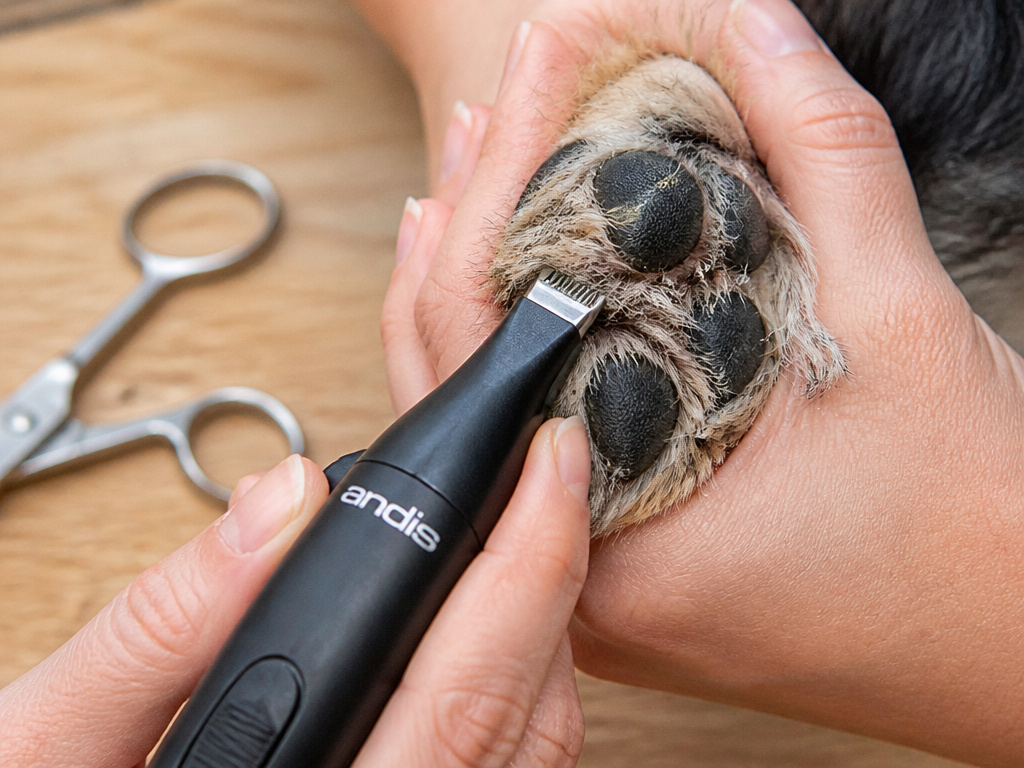
Two tools cover almost every home paw trim, and neither one is expensive. A clipper with a narrow head and a pair of blunt-tip scissors handle the whole job.
If you want one answer: an Andis clipper running a blade in the #10 to #40 range, plus blunt-tip scissors for the perimeter. That covers the large majority of household dogs, and the blade sizes match what the paw actually needs.
Skip the clipper entirely if your dog’s coat is smooth and short. PawsUniversity notes that smooth-coated breeds rarely need pad trimming at all, because the hair never grows long enough to cover the pads. Buying a trimmer for a Beagle is money you don’t need to spend.
While the clipper is out, check the dewclaws too. They grow on the same schedule and get forgotten twice as often.
The finish standard is the last thing to settle. The Vet Desk follows the natural shape of the paw with even length all around. PawsUniversity cleans up stray hairs around the outer perimeter of the toes and nails.
Frequently Asked Questions
Can I use regular household scissors on paw hair?
No. Household scissors are long, sharp at the tip, and angled for paper, not for a crease between pads. The AKC allows small blunt-edge scissors, and only after a groomer, breeder, or veterinary staff member has shown you the procedure.
How short is too short on paw hair?
Skin is the limit, and the published targets stop above it. The AKC says even with the pads or slightly shorter. PawsUniversity says only the hair protruding past pad level. The Vet Desk says as short as possible, with exceptions for long-haired breeds.
What blade should I use for paw pads?
It depends which guide you follow. PetEdge selects the medium or short setting on an adjustable trimmer blade. PawsUniversity specifies a #10 to #40 blade, or a battery mini trimmer with a head about 1 inch wide.
My dog’s pads look pink after trimming. What now?
PetEdge recommends a soothing spritz on skin that looks pink or irritated after a tangle comes off. Watch it for a day or two. Redness that spreads, swelling, or a dog that won’t put weight on the foot is a vet call, not a lotion problem.
Do I need to trim paw hair in winter?
Yes, and that’s when it matters most. The Vet Desk notes that interdigital hair catches ice and snow and forms tiny snowballs between the pads. Trim and dry the foot before a walk in freezing conditions.
Can I skip paw trimming if my dog has short hair?
Usually, yes. PawsUniversity notes that smooth-coated breeds rarely need pad trimming because the hair doesn’t grow long enough to cover the pads. PawsUniversity puts long-haired and curly coats on a two-to-four-week schedule, while The Vet Desk’s anecdotal Siberian Husky needed trimming only every few months.
The Bottom Line
Here’s the trigger I’d give you. If you can slide a comb through the hair between the pads and it comes out clean, leave that foot alone this month. If the comb stops, it’s trim day.
That rule handles most of the calendar questions without a chart. It also catches the dogs that don’t fit the breed schedule, which is most of them once you’re actually holding a paw, though PawsUniversity and The Vet Desk disagree on how often trims are needed.
One concession, because it matters: none of this applies to a dog with a smooth, short coat. There’s no hair to manage, and a clipper on a Beagle’s pad is a solution looking for a problem.
And if you take one thing from all of this, take the pace. I’d rather see you do one paw a week for a month than all four in one sitting. The dogs that end up afraid of the clipper are almost always the ones where somebody tried to finish the job in one go.
