
How to Remove Mats From a Dog’s Coat: Step-by-Step
This post contains affiliate links. As an Amazon Associate, we earn from qualifying purchases.
To remove mats from a dog’s coat, use clippers with a size 10 blade held at a 45-degree angle to the skin, blade flat against the body, working in the direction the hair grows. Veterinary sources warn against scissors because mats sit close enough to skin that a sudden move means a cut.
The 45-degree hold is a key part of how to remove mats from a dog’s coat, and it’s the detail nobody prints on the clipper box. Held perpendicular, the teeth point straight down into skin you can’t see under the mat. Held at 45, the blade glides along the body surface and the mat lifts away in one piece.
What follows covers the blade and the hold, the order to clip in, the bathing question the sources answer differently, the scissors argument, and the point where you should put the tool down and call someone.
Key Takeaways
- Size 10 blade, 45 degrees, flat to the skin. That combination is the technique; everything else is order and patience.
- Clip a dry dog. Cohn and Côté say no bath before clipping, and a bath after is fine.
- Stop when the dog says stop. Resentment can mean the skin is too painful to clear without sedation.
- Daily brushing beats weekly brushing on long coats, even though the AKC sets the floor at once a week.
- A metal comb finds what a slicker hides. If the comb stops, you’ve found a mat.
The Blade, the Angle, and the Hold That Keep Skin Out of the Teeth
A size 10 blade is the blade Cohn and Côté name for mat removal, and it’s the one to have on the clipper before you touch the dog. Cohn and Côté list it alongside blade wash, blade lubricant, and a brush as the complete equipment list. That’s the whole kit.
Mat removal requires a size 10 clipper blade. The body of the clippers is held at a 45-degree angle to the skin surface, with the flat of the blade parallel to the body. Clipping runs in the direction of hair growth. A perpendicular hold drives the teeth into the skin and is the most common technique error.
The angle matters because of where the teeth point. A clipper blade is a row of sharpened teeth, and the flat of the blade is the only part designed to ride the body. Tilt the body of the tool toward perpendicular and the tips become the leading edge, which is exactly the geometry that catches a skin fold.
Common mistake: Holding the clippers perpendicular to the skin, pointing at the surface instead of gliding along it. Cohn and Côté name this as the most common error, and the consequence is teeth digging into skin that was never visible under the mat.
What Belongs in the Kit
- Clippers that accept a standard size 10 blade. Check the box before buying a second.
- Clipper blade wash. New blades carry a factory film that drags.
- Clipper blade lubricant, a small amount on clean, dry blades.
- A metal comb for the finish check.
- A leash you can secure, so the dog stays in one place.
Blade heat is the part people underestimate. Friction from a running blade builds fast, and a blade that feels warm against your palm may be hot enough to hurt a dog’s skin. Cohn and Côté call for letting the clippers cool during a long session. Switch off, set them down, and use the pause to check the dog’s mood.
The Friction Zones Where Mats Actually Start
Mats start where something rubs. PetMD points at collars, harnesses, bedding, and other body parts, and the AKC singles out the spot where the front legs meet the chest. Cohn and Côté add behind the ears, under the neck, the armpits, the hips, and the buttocks to the daily check.
That how to remove mats from a dog’s coat list is short enough to memorize. Run your hands over those spots once a day and you’ll catch most mats while they’re still combable.
| Zone | Why it mats | What your fingers find |
|---|---|---|
| Behind the ears | Ear leather rubs against the coat | A hard pea you can’t see from above |
| Under the neck and collar | Strap friction, all day | A flat felted patch |
| Chest and front legs | Leg movement against the chest wall | A tight knot in the crease |
| Armpits | Skin folds trap loose undercoat | A rope-like tangle |
| Hips and buttocks | Bedding and sitting friction | A wide, dense plate |
A mat holds moisture and debris against the skin. PetMD notes that trapped damp under a mat can turn into irritation or an infection, which makes this a health problem as much as a grooming one. A mat is like a soft spot in a deck board: by the time it’s obvious from standing height, the material underneath has been going for a while.
The daily habits that prevent matting cost little time and save the dog a shave. The USDA Animal Care coat care document approaches coat care from the prevention side, which is where most of the work actually sits.
How to Remove Mats From a Dog’s Coat: The Clipping Order
Three things decide whether the clip goes well: the hold, the direction, and when you stop.
Before you start: A running blade builds friction heat, so plan to switch off and let it cool during a long session. A matted dog can bite or scratch when a mat pulls, so secure the leash and keep your face back from the blade. If the skin under a mat looks broken or angry, stop and book a vet visit.
- Set up on a dry dog. Cohn and Côté are direct about this: no bath before clipping. Cohn and Côté are direct about this: no bath before clipping.
- Clean and lubricate the blade. Blade wash strips the factory film, and a small amount of lubricant on clean, dry blades keeps the teeth moving.
- Secure the leash and pick your spot. A dog that can walk away mid-mat will.
- Start at the mat closest to the spine and work toward the toes if you’re only taking the mats. That order clears the biggest mats while the dog is still patient.
- Hold at 45 degrees, blade flat, and clip with the grain. Clipping in the direction the hair grows is what keeps the teeth from nicking skin.
- Elevate the mat instead of pulling it up. Lift the mat gently to see where it joins the skin, then walk the blade into that junction. Do not pull the mat up toward the clippers; gently elevate the mat and advance the clippers into the junction at the base of the hairs.
- Brush the whole dog when you’re done. A full brush-out confirms nothing was missed. The mat you leave under an armpit is the one that becomes a sore.
What a Full-Body Shave Changes
If the matting covers the dog, the route changes. Cohn and Côté give a different order for a full clip: start near the neck, work along the spine toward the tail, then continue down to the toes. That’s shaving matted fur rather than spot-treating.
Do You Have to Bathe Before You Clip?
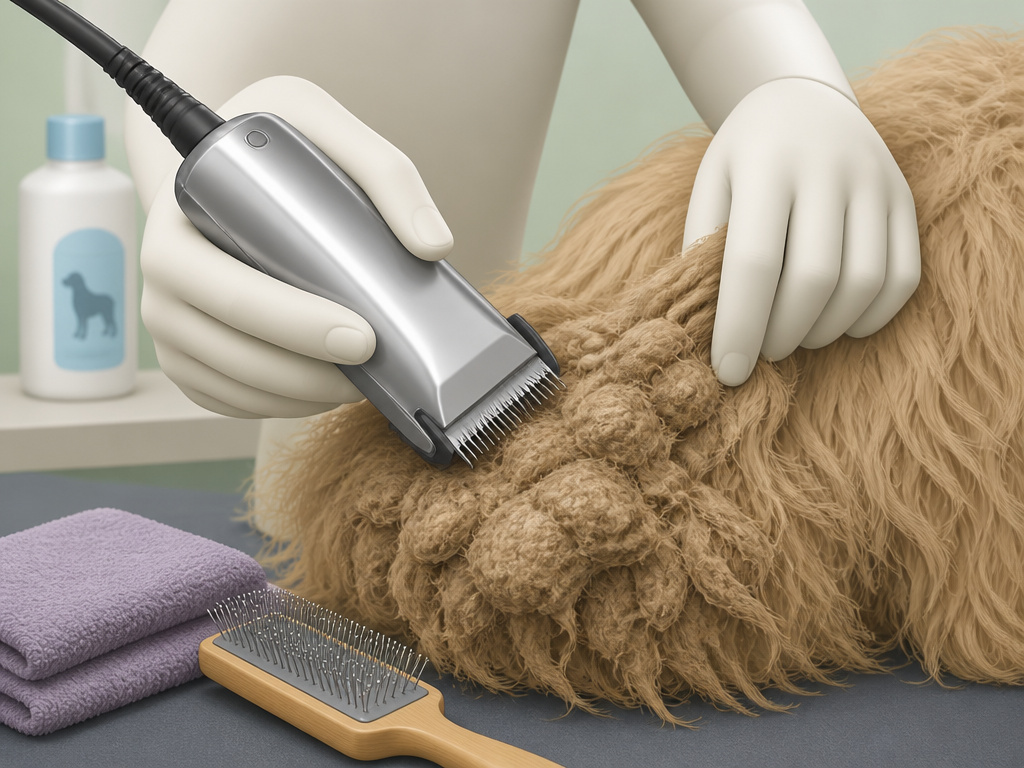
There’s a matted dog in front of you and a bottle of shampoo on the shelf, and the reflex is to wash first and deal with the mat after. The veterinary sources don’t all agree on that sequence, and the disagreement is worth knowing before you turn on the tap.
I learned the drying lesson the expensive way with a thick-coated shepherd mix. One spring bath, air-dried on the porch, and a hot spot appeared. The drying got no blame. The shampoo took all of it.
Cohn and Côté say to clip on a dry pet and not to bathe beforehand, though a bath after clipping may be appropriate. VCA takes the other route: brush burrs and tangles out before bathing, because tangles can become impossible to remove once wet. PetMD says the same thing and adds that the coat needs to be thoroughly dried afterward.
The sources differ on the sequence: Cohn and Côté say to clip on a dry pet and not bathe beforehand, while VCA and PetMD say to brush tangles out before bathing. They differ on the sequence: Cohn and Côté say to clip on a dry pet and not bathe beforehand, while VCA and PetMD say to brush tangles out before bathing.
The part nobody mentions: A matted coat that gets wet and stays damp holds water against the skin. That’s the setup for the irritation PetMD describes, which can become a skin infection.
VCA Says Never Scissors, Then Says Cut the Clump Out
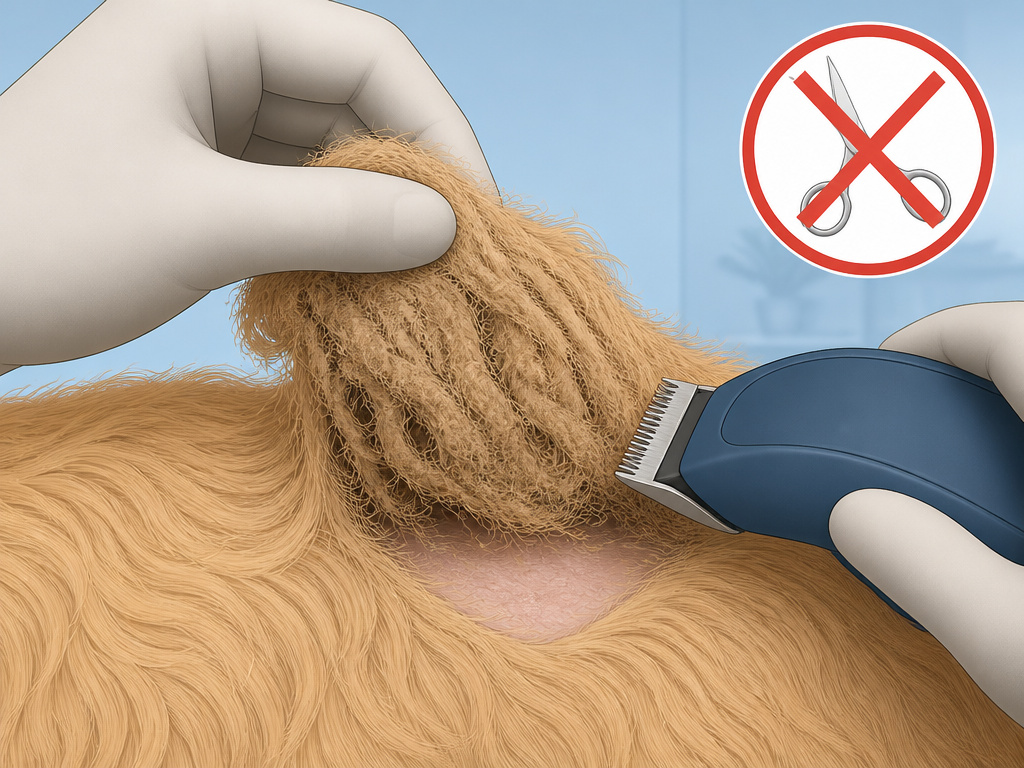
Ask three veterinary sources whether scissors belong near a mat and the answer comes back split. Cohn and Côté state that scissors should never be used to remove hair mats. PetMD says never cut mats out with household scissors. VCA says only use clippers, never scissors.
Then VCA adds that if the tangle is extensive or a large clump of burrs forms a mat, you may have to cut out the clump of hair, being extremely careful to avoid cutting the skin. That’s the same page, a few lines apart.
The mechanism behind the warning is simple. PetMD notes that mats sit surprisingly close to the skin, which makes it hard to tell where the hair ends and the skin begins. Add one sudden movement and the blade goes where you can’t see. That’s the whole argument, and it’s why a sudden movement is the real risk.
My read: use the clippers. If you’ve reached the point where scissors feel like the only option, that’s your signal to hand the dog to a groomer rather than to prove you can do it yourself.
When to Put the Clippers Down and Call a Vet
Some mats are not a grooming job.
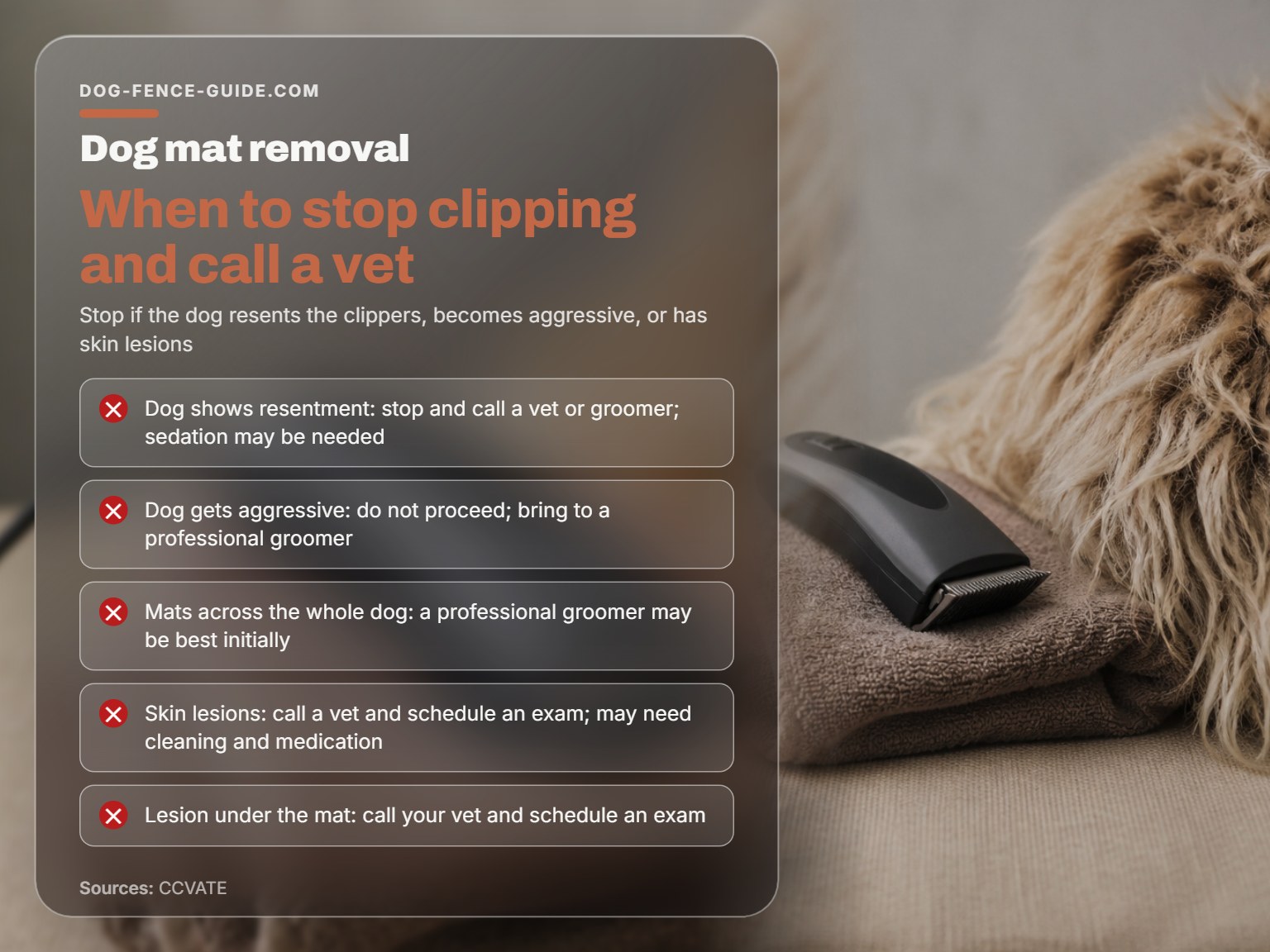
Fair warning: a dog that fights the clippers is telling you something about pain, not attitude. Cohn and Côté say to stop if the pet shows resentment, because the skin may be too painful to clear without sedation. An aggressive pet should go to a professional groomer, and an uncooperative one means enlisting a second pair of hands or referring out.
- The dog pulls away or yelps. Stop. Sedation may be the only humane route through a tight mat.
- The dog gets aggressive. Do not push through it. A bite is a worse outcome than a bad haircut.
- There are mats everywhere. Cohn and Côté say a professional groomer may be best able to remove them initially, and you can maintain the coat afterward.
- The skin looks irritated. VCA directs you to a vet for treatment rather than a groomer.
| Situation | Who should do it | Why |
|---|---|---|
| Small, loose tangle | You, with a comb | VCA says gentle combing works on minor tangles |
| One tight mat | You, with clippers | The size 10 procedure handles isolated mats |
| Mats across the whole dog | Professional groomer | Cohn and Côté recommend a pro for the initial removal |
| Red, swollen, or weeping skin | Veterinarian | The skin may need cleaning and medication |
| A dog that fights the clippers | Vet or groomer | Pain relief or sedation may be needed |
What a Lesion Under the Mat Looks Like
PetMD lists redness, swelling, odor, moisture, or discharge near the mat as reasons to stop. Cohn and Côté say to call your vet and schedule an exam if a lesion shows up under the mat, since it may need to be cleaned and medicated. You won’t see any of that until the mat is off, which is one more reason to work slowly.
How Often Should You Brush a Long-Coated Dog?
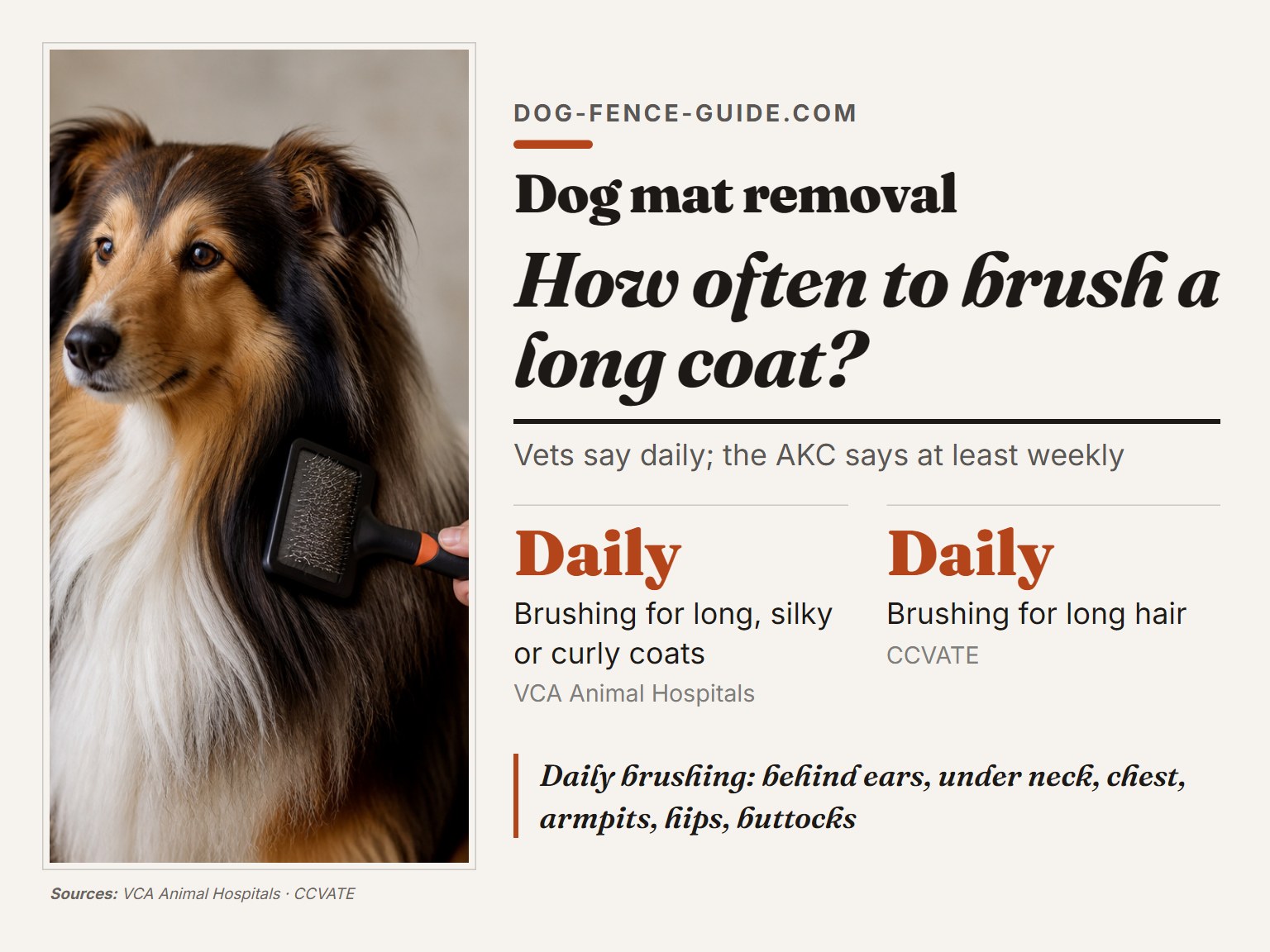
Once a week is the floor. Daily is what the veterinary texts actually say for long coats.
| Source | What they say | Coat type |
|---|---|---|
| VCA Animal Hospitals | Daily brushing | Long, silky, or curly coats |
| Cohn and Côté | Daily brushing | Long hair |
| American Kennel Club | At least once a week | Longer or denser coats |
The gap matters. A once-a-week pass keeps a short-coated dog in decent shape. On a doodle or a collie, a week can let a small tangle behind the ear felt into something that won’t comb out. If your dog has a long coat, treat the AKC number as the minimum and the daily figure as the target.
The tool has to match the coat, and this is where most people own the wrong brush:
- Rubber brushes suit short coats.
- Slickers are built for denser coats.
- Combs work on longer coats, and long-toothed combs with offset tines handle collies and other long-haired breeds.
- An undercoat rake earns its place during shedding season, when loose undercoat packs into felt before you notice.
A long-haired dog routine built around a regular comb pass beats dematting once a month. Poodles and doodles need curly coat grooming on a schedule, because a curly coat brushed only on top felts at the skin where nobody looks.
The Comb Is the Only Honest Tool in the Drawer
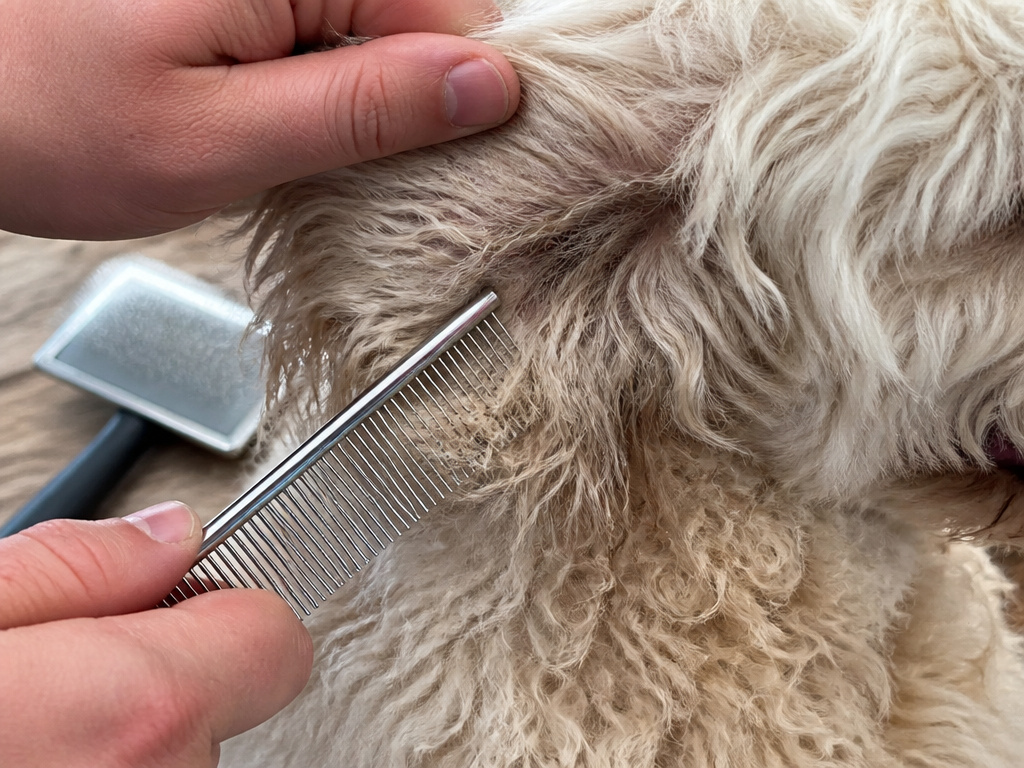
A slicker glides through the coat and you feel competent.
A metal comb does not lie. I finish every doodle with a comb, and if it stops, that’s where the mat is. Every time. I keep a metal comb in the drawer specifically because it finds what the slicker misses behind the ears and in the armpits.
If you’re shopping for the surface tool, the best brushes for matted dog hair all share one trait: pins stiff enough to reach past the topcoat. A slicker with stiff pins is the brush that survives a doodle coat without bending tines. A cheaper slicker is the second brush you keep by the door. An undercoat rake has a real job in shedding season, but only on a coat that’s already mat-free.
The dematting tools worth owning are a comb, a slicker, and a clipper, in that order of cost. Everything else is optional.
Now the caveat on sprays. Cohn and Côté are blunt about conditioner for mats: conditioners and detanglers don’t really work on matted hair, though they can make brushing a messy coat easier. A spray that helps you work through a loose tangle is doing something useful. A spray you’re using to avoid the clippers on a tight mat is buying time you don’t have.
I don’t trust a slicker as a finish check. It’s too forgiving. The comb is the tool that tells you the truth, and it takes only a moment to run one over a dog. If you only own one grooming tool, own the comb.
Here’s the part that ties this back to the yard. A brush session is the cheapest body check you’ll ever do on a dog. You’re already running your hands over the legs, the chest, and the armpits, which is exactly where scrapes, cuts, and ticks show up after a dog has been working a fence line. Same short session, two jobs.
Before You Go
If a mat is bigger than your thumb and tight against the skin, don’t comb it. Clip it with a size 10 blade at 45 degrees, blade flat, with the grain. Combing a tight mat is how people turn a grooming problem into a skin problem.
Three things to verify before you start on a matted dog:
- The blade is a size 10, and it’s clean and lightly lubricated.
- The dog is dry, and the mat is not sitting over broken or weeping skin.
- The dog is willing. If it isn’t, the clippers go away and the phone comes out.
One honest limit: none of this covers a dog that won’t be handled at all. That’s a vet conversation about sedation, not a technique problem, and no amount of practice at home changes it.
Frequently Asked Questions
Can I cut a mat out with scissors?
Cohn and Côté say scissors should never be used to remove hair mats, and PetMD says never cut mats out with household scissors. VCA says to use clippers only, though it also notes that an extensive clump of burrs may have to be cut out with extreme care. The risk is that mats sit close to the skin and you can’t see the boundary.
What blade size removes dog mats?
Size 10 clipper blade. It’s the only blade size named in the veterinary guidance for mat removal, and it’s the blade most clippers ship with. Hold the clipper body at 45 degrees so the flat of the blade rides along the skin rather than pointing into it.
Should I bathe my dog before removing mats?
Cohn and Côté say to clip on a dry dog and not to bathe beforehand. VCA and PetMD both say to get tangles out before bathing, because tangles can become impossible to remove once wet. The sequencing agrees even though the reasoning differs: tangles come out before water goes on.
What should I do if the skin looks red under a mat?
Stop and call your vet. Cohn and Côté say a lesion under a mat may need to be cleaned and medicated, and PetMD lists redness, swelling, odor, moisture, or discharge as reasons to seek professional help. Don’t clip over damaged skin to finish the job.
Can detangling spray get a mat out?
Cohn and Côté say conditioners and detanglers don’t really work on matted hair, though they can make brushing a messy coat easier. A spray is useful for a loose tangle you’re combing out. It won’t break up a tight mat that’s felted against the skin.
How often should I brush to keep mats from coming back?
Daily, for a long coat. VCA and Cohn and Côté both call for daily brushing on long-haired dogs, while the AKC sets the minimum at once a week for longer or denser coats. Concentrate on behind the ears, under the neck, the chest, the armpits, the hips, and the buttocks.
Before You Go
The gate is where most escapes happen, and the harness is where most mats start. Same principle, different problem: the weak point is rarely the part you’re looking at.
Buy the size 10 blade and a metal comb this week. Run the comb over the dog once a day, and when it stops, you’ll know exactly where the problem is before it becomes a shave.
