
How Often Should You Groom a Dog? By Coat Type
This post contains affiliate links. As an Amazon Associate, we earn from qualifying purchases.
Groom a dog on four clocks: brushing once a week for smooth coats and daily for curly or long ones, a bath every six to eight weeks, nails every three to four weeks, and ears every one to two months. Coat type sets the brushing interval. The rest of the calendar barely moves.
Brushing intervals come straight out of coat structure. A double coat holds dead undercoat against the skin, so it needs more passes than a smooth coat that sheds on its own. Bathing is the number nobody agrees on, and the split runs wider than most owners expect.
What follows is a coat-by-coat brushing schedule, the bath interval with the disagreement laid out, the four home tasks that run on their own clocks, and a straight answer on when to hand the dog to a professional.
Key Takeaways
- Smooth coats: once a week. Short-coated dogs without an undercoat get a weekly pass; add a midweek session if there’s an undercoat underneath.
- Curly, wavy, and long coats: daily. Poodles, doodles, and anything that grows hair continuously will mat against the skin within weeks on a lighter schedule.
- Bath every six to eight weeks for most dogs. Oily short coats and long coats sit at the four-to-six-week end; double coats can stretch further.
- Nails every three to four weeks. If you can hear them click on the floor, you’re already past due.
- Stop when the dog says stop. Freezing, pulling away, or a hard stare means today’s session is over.
How Often Should You Brush a Dog, by Coat Type?
Brushing frequency splits cleanly along coat type, and the gap between a Beagle and a Poodle is wide. Purdue University’s coat-care guidance puts short, smooth coats at roughly once a week and thick undercoats at one or two sessions weekly.
Short-haired and smooth-coated dogs require brushing roughly once a week. Dogs carrying a thick undercoat require one or two sessions weekly, increasing during spring and fall shedding. Wavy coats, including Poodles and their crosses, require daily brushing. Coats that grow continuously, such as Shih Tzus and Yorkshire Terriers, require regular trimming regardless of brushing routine.
| Coat type | Brushing interval | What a skipped week looks like |
|---|---|---|
| Smooth, no undercoat | Once a week | Loose hair on furniture, dull coat |
| Smooth with undercoat | Every other day | Dead undercoat packs against the skin |
| Double coat | Once or twice weekly; daily during a blow-out | Compacted undercoat that holds moisture |
| Wavy or curly | Daily | Knots behind the ears and under the collar |
| Long and silky | Daily brush and comb | Tangles at the armpits within days |
| Wire | Two to three times a week | Mats despite the harsh texture |
The intervals only make sense once you know what the brush is doing. Dead hair and dead skin cells sit in the coat until something lifts them out, and brushing also spreads the skin’s natural oils down the hair shaft. Skip it and the coat goes dull before it goes matted.
That stop is your signal to change tools. A slicker alone won’t break a packed undercoat. You need a metal comb behind it to find the spots the brush skated over, and a slicker paired with a plain steel comb handles most double coats without any powered tool at all.
Double coats are where owners get caught out. Purdue puts thick undercoats at once or twice a week, the AKC’s groomer guidance says a slicker followed by a comb at least once a week, and the professional groomers Rover interviewed say daily. That spread is real. It tracks how much undercoat is coming out that week.
Curly and wavy coats split the same way. Purdue and Rover both say daily. Caring Veterinarians, an Australian practice, says every two to three days between grooms. I’d take the daily end for a doodle in a humid climate, because a coat that doesn’t shed holds every loose hair against the skin.
Where this goes sideways: Brushing a dry, packed undercoat with a slicker alone. The brush skates over the felted layer, the owner assumes the job is done, and three weeks later the coat is tight enough to trap moisture against the skin.
Purdue’s brushing and coat care guide is the clearest public breakdown of the coat categories if you want the full taxonomy.
Bath Every Six to Eight Weeks, and the Case for Bathing Less
Six to eight weeks is where most veterinary clinics land for a healthy adult dog. Caring Veterinarians puts nearly every coat type on that window, with oily short coats and long coats at the shorter end.
The groomers Rover interviewed spread wider: every four to six weeks for oily short coats, long coats, and silky coats, monthly for double coats and curly coats, and every six to twelve weeks for other short-haired dogs.
Then there’s the other camp. SPCA New Zealand states plainly that bathing dogs generally isn’t necessary if the dog lives in a clean environment, and notes it mostly reduces odours humans dislike. PDSA says much the same, warning that shampoo strips the coat’s natural oils.
Short version: most dogs do fine on six to eight weeks, and the dogs that don’t are the ones with oily skin or a coat that holds water.
That’s not a coincidence.
The how often should you groom a dog calendar is a starting point, not a rule.
I’d rinse a muddy dog in warm water and skip the shampoo entirely rather than reach for a bottle every time the paws get dirty. Mud rinses out. Natural oils don’t come back on a schedule.
When you do bathe, PDSA is clear that it has to be a dog-specific shampoo, because human shampoo can irritate dog skin. The ASPCA goes further: ask your vet for a sterile eye lubricant before bath time, and skip shampoo on the head altogether, using a wet washcloth on the face instead.
If you’d rather not do it yourself, seeing a professional groomer every six to eight weeks covers the wash and the nail trim in one trip.
The Five Numbers the Experts Don’t Agree On
Pick almost any grooming interval and you can find a credible source that halves it. That’s a reason to know which end of the range your dog sits on, not a reason to ignore the numbers.
| Question | Position A | Position B |
|---|---|---|
| Brushing a curly coat | Daily (Purdue, Rover) | Every two to three days (Caring Veterinarians) |
| Professional groom, long coat | Every six weeks, stretchable with home brushing (Rover) | Every four to six weeks (Caring Veterinarians) |
| Bathing at all | Generally unnecessary in a clean home (SPCA New Zealand) | Every six to eight weeks (Caring Veterinarians) |
| Cleaning ears | Weekly wipe (AKC) | Every one to two months (Rover) |
| Trimming nails | Every three to four weeks (Rover) | Weekly for couch-bound dogs (ASPCA) |
Read the table as a range rather than a contradiction. The frequent end belongs to coats that mat, dogs in humid climates, and anything with a skin condition. The sparse end belongs to smooth coats on dogs that spend their days on a couch.
Ears are the one place where more isn’t automatically safer. The ASPCA warns against cleaning so frequently or deeply that the canal gets irritated, and says never to insert anything into it. The AKC’s weekly wipe is a wipe, not a flush.
Nails, Ears, Teeth: The Tasks That Don’t Follow the Coat
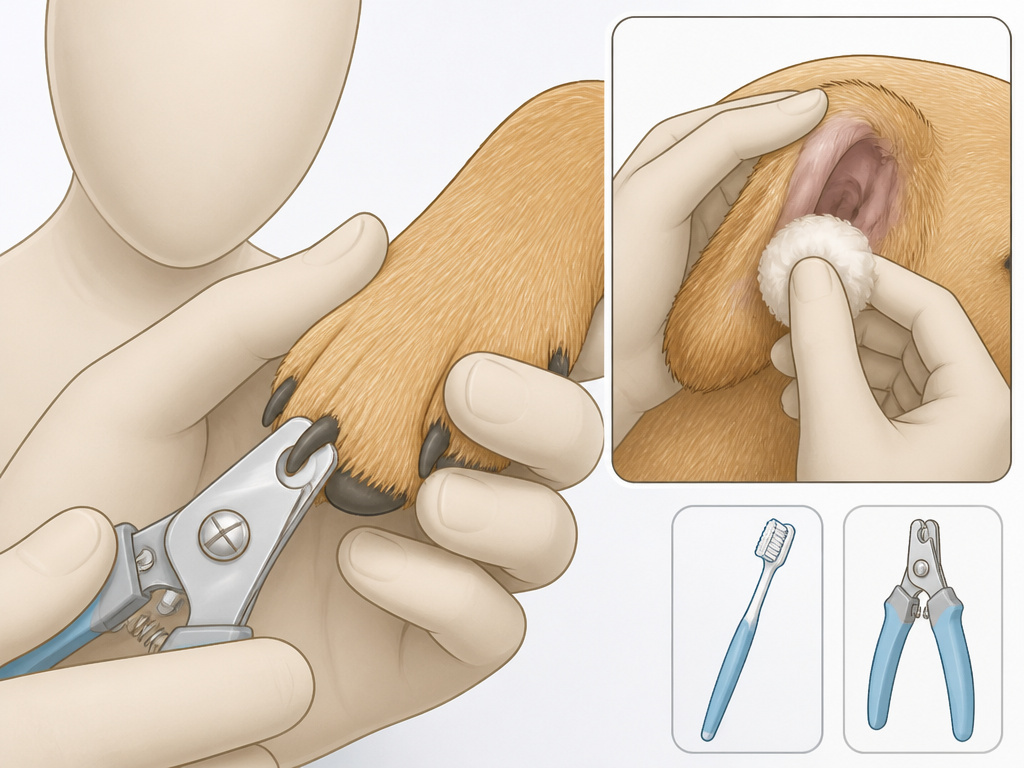
Four jobs run on their own clocks: nails, ears, teeth, and anal glands. None of them care what kind of coat the dog has.
Nails: Three to Four Weeks, or the Moment You Hear Clicking
The ASPCA’s rule is simple. Trim when the nails just about touch the ground as the dog walks, and if they’re clicking or snagging on the floor, you’re late.
Rover’s groomers put nails on a three-to-four-week cycle, with dogs who walk on pavement stretching further and puppies needing weekly trims. The ASPCA adds that a couch-bound dog may effectively need a weekly pedicure while an urban dog on rough sidewalks can go longer.
Watch for the signs the ASPCA lists during a trim:
- Panting or drooling when the clippers come out
- Trembling, whining, or freezing mid-paw
- Cowering or tucking the tail
- Growling, snarling, or snapping
Any of those means stop for today. There’s a fuller nail trimming walkthrough if you’re starting from zero.
Ears: One to Two Months, Weekly for Floppy Ears
Rover’s groomers put ear cleaning at every one to two months, tightening to weekly for floppy-eared dogs. The AKC at-home dog grooming guide recommends a weekly wipe with a moist cotton ball or soft cloth, checking and smelling each ear at the same time.
PDSA is firm on that point: if there’s wax or hair build-up, smell, or itchiness, call the vet before cleaning. The AKC adds that each ear should be dried thoroughly after the dog gets wet, since trapped moisture is what sets up an infection.
Teeth and Anal Glands: The Two Most Owners Skip
The AKC’s groomer guidance is daily tooth brushing with a soft brush and dog-specific toothpaste. Rover’s groomers allow two to three times a week as the realistic fallback.
Anal glands run every three to four weeks for the dogs that need help, according to Rover. The AKC is blunt that owners shouldn’t express them, and that a groomer or vet should do it.
What a Matted Coat Costs You, and When to Stop Brushing
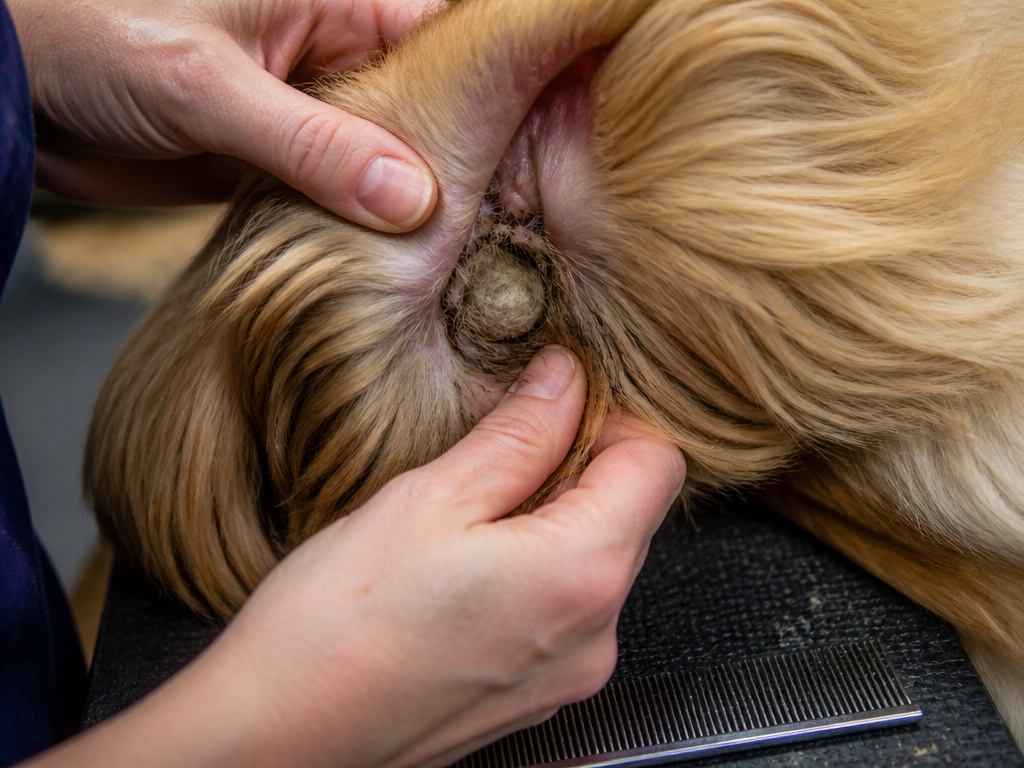
You find a hard lump behind the ear and it isn’t a lump. It’s a mat the size of a marble, tight against the skin, and the dog flinches when your fingers get near it.
Mats pull on skin. SPCA New Zealand lists painful matting and overgrown nails among the serious welfare consequences of inadequate grooming. The ASPCA adds that dogs with matted, dirty coats are prone to hot spots, and so are dogs that swim or get caught in rain.
They cluster at friction points: under the collar, behind the ears, in the armpits, and between the paw pads.
Small mats can often be worked out by hand if you go slowly, per Purdue. Larger or tighter mats are a vet or groomer job. The AKC is firmer still: don’t cut mats out yourself, because one wrong movement from a nervous dog can cause a serious injury.
The part nobody mentions:
Caring Veterinarians puts it plainly: a matted dog should expect a shave-down rather than a brush-out, because brushing out severe matting is painful and unsafe. If you’re picking someone to do that work, choosing a groomer who belongs to a trade body is the fastest quality filter, and PDSA names the Pet Industry Federation as one to look for.
How Often Should You Groom a Dog in Spring and Fall?
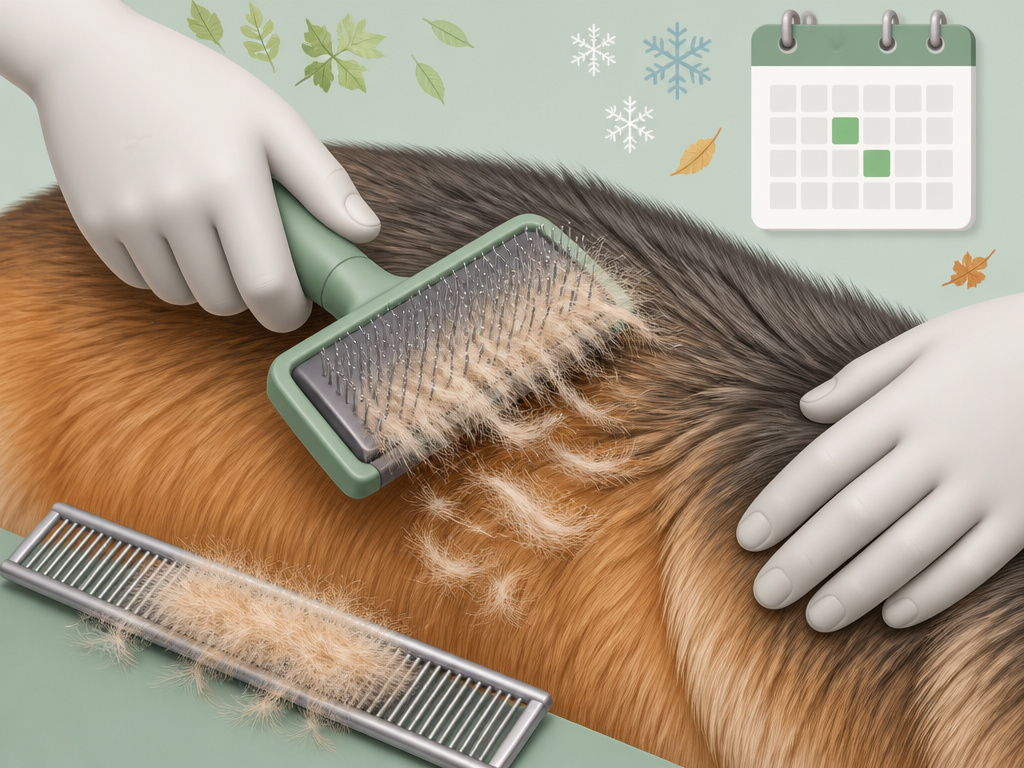
Spring and fall are the two shedding windows most coats follow, and both push the brushing interval up.
Purdue notes that dogs may need more brushing when they’re shedding in spring and fall. PDSA says the same for pets generally, and
Dale Martins, a groomer the AKC interviewed, adds a wrinkle: double coats in colder climates may shed only in spring and fall, while dogs in warmer climates can shed four times a year or constantly.
What to change when the season turns:
- Add a second weekly pass during a blow-out, and a third if the comb keeps loading
- Check for grass seeds in late summer, especially between the toes and around the ears
- Run your fingers over the coat after every walk once tick season starts
- Book the professional deshed before the coat packs, not after
The AKC double-coated dog grooming guide covers the undercoat side in more depth.
Building a Schedule Your Dog Will Actually Tolerate
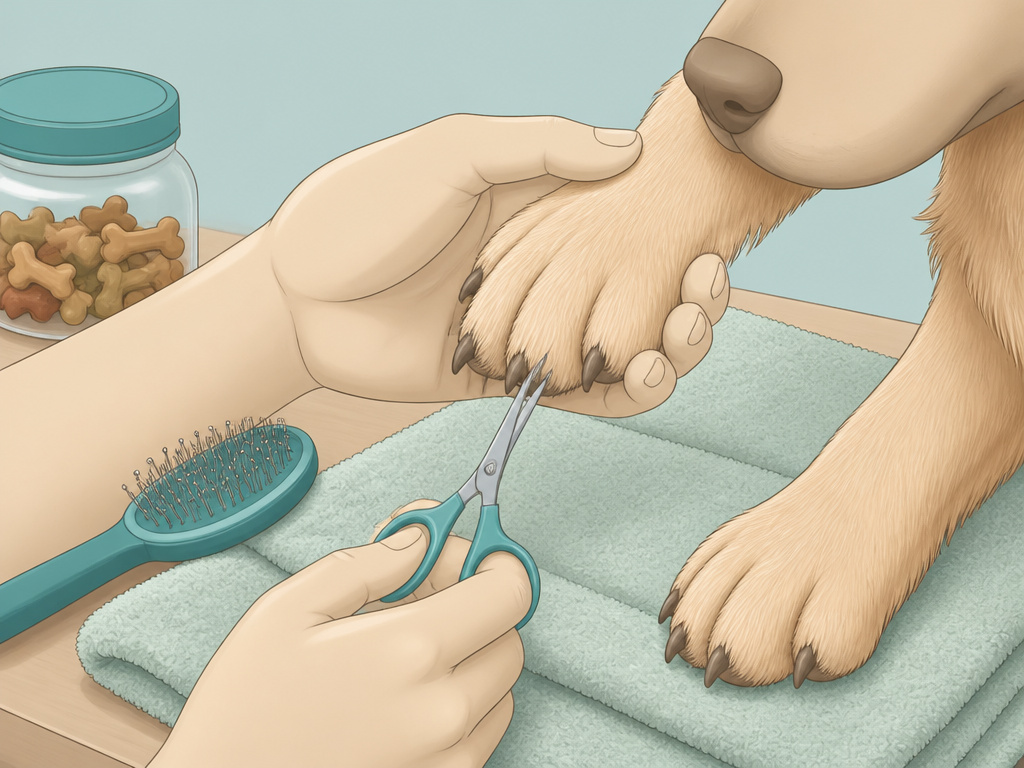
Most grooming fights are scheduling problems wearing a behavior costume.
Before you start: Clipper blades and scissors cut skin as easily as hair, so keep blunt-tip scissors for paw pads and never work blind under a mat. Nothing goes into the ear canal, including cotton buds.
- Pick the brushing days first, then hang everything else off them.
- Practise the handling before you need it. Touch paws, lift an ear flap, run a finger along the gum line, then pay the dog.
- Honour the stop signals. PDSA’s advice is to stop when the dog is worried and pair treats with the parts that go well, rather than pushing through.
- Book professional visits on the same rhythm as the home routine. That way the groomer is maintaining a coat instead of rescuing one.
The first professional visit matters more than most owners expect. The AKC’s groomer guidance is to book it once the puppy has had all its shots, at around 12 weeks, and to start gentle handling from the day the dog comes home.
A dog that’s already fearful needs the grooming anxiety approach first: shorter sessions, higher-value treats, and no forcing. SPCA New Zealand calls this cooperative care, and it works because the dog opts in rather than getting held down. The at-home grooming routine is the place to build it.
Frequently Asked Questions
Is it bad to bathe a dog every week?
Usually it’s more than the coat needs. PDSA warns that frequent shampooing strips the natural oils, and the AKC’s groomer guidance says the same. Rover’s shortest interval is four to six weeks, for oily short coats. Weekly washing is a vet-led decision for a skin condition, not a default.
How often should you groom a dog that lives indoors?
Coat type still sets the schedule. The ASPCA notes that indoor dogs tend to shed fairly evenly all year rather than in two hard seasonal pushes, so the brushing interval stays steadier. Bathing and nails don’t change at all.
Can I skip brushing if my dog gets a haircut every six weeks?
No. A haircut resets length, not the skin. Purdue notes that continuously growing coats need regular trimming, and they still need brushing between visits because loose hair and mats form against the skin. Caring Veterinarians puts doodle coats at matting within weeks without home brushing.
How often should a puppy be groomed?
The AKC’s groomer guidance is to start handling from the day the puppy comes home and book the first professional visit once all shots are done, at around 12 weeks. Rover notes puppy nails may need weekly trims.
Do short-haired dogs need grooming at all?
Yes, weekly. Rover puts short-coated dogs without an undercoat at once a week and dogs with an undercoat at every other day. Purdue lands in the same place for smooth coats. The difference is that a missed week shows up as loose hair rather than a mat.
The Bottom Line
The threshold that matters most is matting. The day you can’t get a comb through the coat to the skin, the schedule has already failed and you’re in recovery mode, not maintenance. Book the groomer that week.
One concession: none of this holds for a dog with a skin condition, an endocrine problem, or a coat shaved for surgery. Those dogs need a vet-set schedule, and no article should overrule it.
If you take one thing, take the brushing day. Everything else in the grooming calendar hangs off it, the way a gate hangs off its hinges. Get that one fixed and the rest is arithmetic.
