
How to Teach a Dog Tricks: 7 Steps That Stick
This post contains affiliate links. As an Amazon Associate, we earn from qualifying purchases.
To teach a dog tricks, chain four things in the same order every time: cue, lure, behavior, reward. Keep the reward inside a one-to-three-second window, start indoors with the TV off, and use pea-sized treats so a session doesn’t blow the dog’s daily calorie budget. The lure teaches the motion; the cue is what survives.
A dog that only performs when a treat is visible in your hand has learned to follow a hand. Fading the lure is where the real work happens, and it’s the how to teach a dog tricks step owners skip most often. The published sources don’t agree on how fast to fade it, which is why this guide shows you the competing schedules instead of picking one and calling it settled.
What follows is the four-part chain, a seven-step sequence built on it, the four places the published guidance contradicts itself, and the one test that tells you whether your dog actually knows the trick or is just reading your pocket.
Key Takeaways
- Chain the four parts in order: cue, lure, behavior, reward. Drop the mark and the dog stalls at “almost.”
- Pay inside one to three seconds. That’s the SF SPCA’s window. Later than that and you’re rewarding whatever happened after the sit.
- Small treats, counted. Dog Scouts is blunt: keep treats pea-sized and watch the daily caloric intake, because every rep is another treat.
- Three lures is one school’s rule, not a law. Dog Scouts says use a lure only three times, then eliminate it and turn the motion into a hand signal; the SF SPCA and Dogster let it run longer with no fixed limit. Pick a schedule and hold it.
- The peer-reviewed data does not crown the clicker. Gilchrist et al. 2021 found no significant advantage across three experiments.
The Four-Part Chain Behind Every Trick
The SF SPCA teaches every trick as four linked steps: cue, lure, behavior, reward. The order doesn’t change between tricks. What changes is how long you spend in each one.
The four-part chain runs in a fixed order: a cue is given, a lure draws the dog through the motion, the completed behavior is marked, and a reward follows. The lure is temporary and exists only to produce the first repetitions. The cue is the part that stays. Timing between the behavior and the reward decides whether the association forms at all.
The mark is the load-bearing piece. Dogster puts it plainly: say “yes” or click right before you offer the treat, so the sound lands on the exact behavior you want repeated.
A dog connects a reward to whatever it was doing when the reward arrived. A few seconds of lag and you’re paying for the stand-up at the end of the how to teach a dog tricks sit. The SF SPCA’s window is one to three seconds, and that feels generous right up until you’re the one holding the cheese.
Repetition carries the rest. The SF SPCA calls it the key to learning any trick, and the chain only holds if you run it the same way on every rep.
What Do You Need Before the First Session?
What do you actually need on the floor before the first rep? Four things: pea-sized treats, a marker, something to target, and a room with the television off.
Treats That Work and Treats That Don’t
Dog Scouts keeps the list cheap and specific: carrots, hot dogs, string cheese, cooked chicken. Treats the size of a pea are fine for dogs of all sizes, which matters more than it sounds.
A pea-sized pinch of string cheese comes apart between your thumb and forefinger, and that’s the whole portion. Twenty reps is twenty portions.
For a pouch staple, pick treats that break down small enough to keep a session honest without turning it into a meal. Dog Scouts also suggests trying several different foods rather than settling on one, because a dog that’s bored of chicken will work harder for hot dog.
The sources split on whether to use the dog’s dinner. Dog Scouts says it’s fine to use part of the regular meal, since hungry dogs are eager to learn, while the SF SPCA recommends keeping training-only treats ready so the reward stays distinct from the bowl.
A Marker, a Target, and a Mat
Your voice works as a marker. A clicker works too, and if you want one, choose one small enough to hold alongside a treat in the same hand.
A target can be almost anything, per Dog Scouts: a hand, a target stick, a sticky note, a plastic lid, a hat. A plastic lid is the one I’d start with, since it sits flat and doesn’t blow off the floor.
For “go to your bed,” the mat itself is the target. The SF SPCA’s version uses a treat in an upward-facing palm held close to the nose, leading the dog onto the bed and rewarding the moment all four feet arrive.
Before you start: Keep every treat pea-sized and subtract them from the day’s food, because Dog Scouts explicitly flags daily caloric intake as the thing owners forget. And be careful with your hands. The AKC states that pushing, shoving, and pulling a dog into position don’t work in trick training, while Dog Scouts says limited helping is fine but dogs learn better solving the puzzle themselves.
The 7-Step Sequence (and What Breaks at Each Step)
Seven steps, and each one has a specific failure mode attached. Run them in order.
- Match the trick to the dog. Dog Scouts points out that a dog bred to retrieve finds fetching easy, and a dog without that predisposition can still learn it with extra effort. Pick against the grain and you’ll spend far longer on what a retriever picks up quickly. I’ve never owned a giant breed, so on those I’m going off reader reports and the sources, not my own floor.
- Clear the room. The SF SPCA asks for no interruptions from other people or animals and no noise from the television or radio. A radio ad with a doorbell in it will break a stay faster than you can finish saying the cue.
- Get the behavior. For sit, the SF SPCA holds the treat about an inch from the nose, palm up, fingers pointing up, then brings the hand forward and above the nose. For tricks the dog does anyway, Dogster’s capturing method rewards the natural version: a bow during a stretch, a yawn, a bark.
- Mark it, then pay. Dogster: say “yes” or click right before the treat appears. Mark a moment late and you’ve marked the pop-up at the end of the sit.
- Turn the lure into a hand signal. Dog Scouts’ rule of thumb is three lures, then eliminate the food and let the motion become the signal, while the SF SPCA and Dogster let the lure run longer with no fixed limit. Keep luring indefinitely and the dog may learn to watch your hand instead of your cue.
- Add the verbal cue. Here the sources genuinely split. The SF SPCA gives the cue together with the lure from the start. Dogster notes some owners add the word immediately and others wait until the dog is fluent on the visual cue.
- Move it. The SF SPCA’s next step is the same cue, open hand, in a different location and from farther away.
The basics come first, and Dogster is firm about it: sit, down, and stay need to be solid before you attempt shake or roll over. If you’re starting from zero, work the sit command and the lie down command before anything with a flourish. The stand command is the one people forget, and it’s the foundation for paws-up and bow work.
Why Does My Dog Jump for the Treat During Sit?
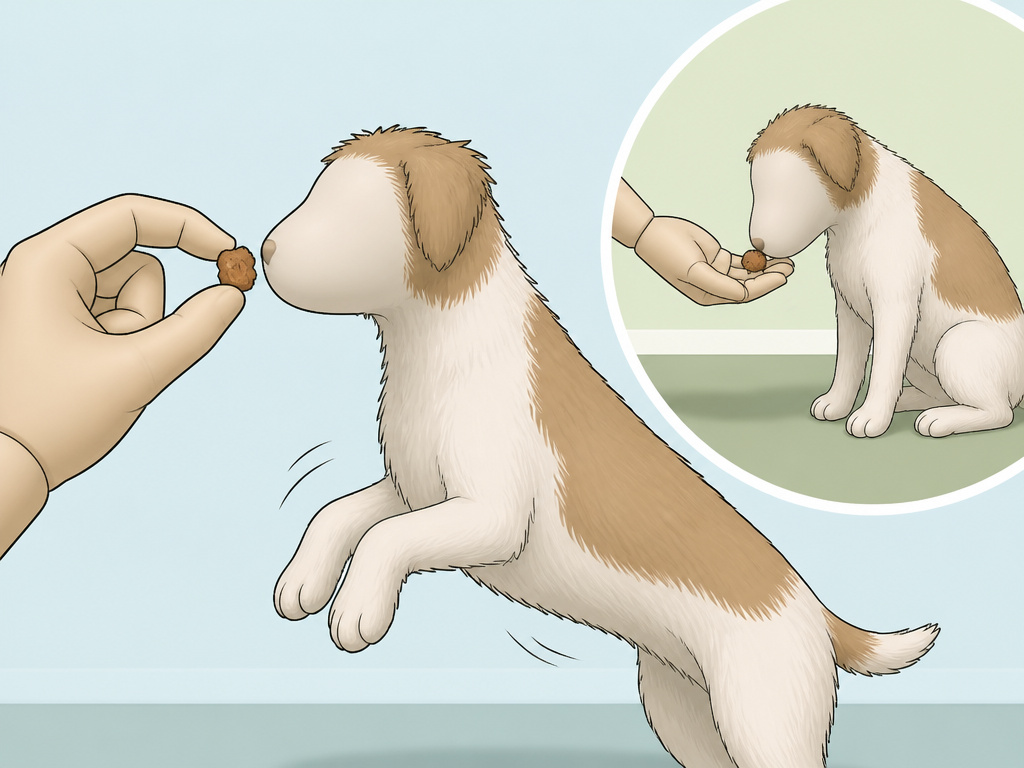
The first dog I tried to lure into a sit was a terrier mix who treated my hand like a piñata. Every rep she launched at the treat, I pulled my hand back, and we both got worse at it. The SF SPCA names the error in a single line: if the dog jumps for the treat, the lure moved too far away or too far upward. Mine was doing both.
That’s the useful thing about a documented failure mode. You don’t have to guess whether the dog is being rude. You check the hand.
| What You’re Seeing | Likely Cause | Fix |
|---|---|---|
| Dog launches at the treat during sit | Lure traveled too far away or too high | Shorten the arc, hold an inch from the nose |
| Dog goes for the treat during stay | Treat hand drifted toward the dog | Pull the treat hand back and reset |
| Dog won’t touch your hand | Waiting for full contact | Reward each approximation with “Yes!” |
| Dog won’t retrieve | Toy thrown too far too soon | Place it in front, back up one step only |
| Dog only performs with food visible | Lure never faded | Convert to hand signal, then verbal cue |
The retrieve row is straight from the University of Illinois Extension: for a dog that won’t fetch, place the toy directly in front, back up one step only, then add distance incrementally rather than throwing. That’s the whole fallback. One step, then another.
For the stay, the SF SPCA’s cue is a long, low tone with one hand up and palm facing the dog. If she goes for the treat, pull the treat hand back and try again. A dog that’s about to break a stay will shift her weight forward and lift one front paw just before she moves. Watch for the paw.
Clickers, Food, and Your Voice: What the Trial Data Shows
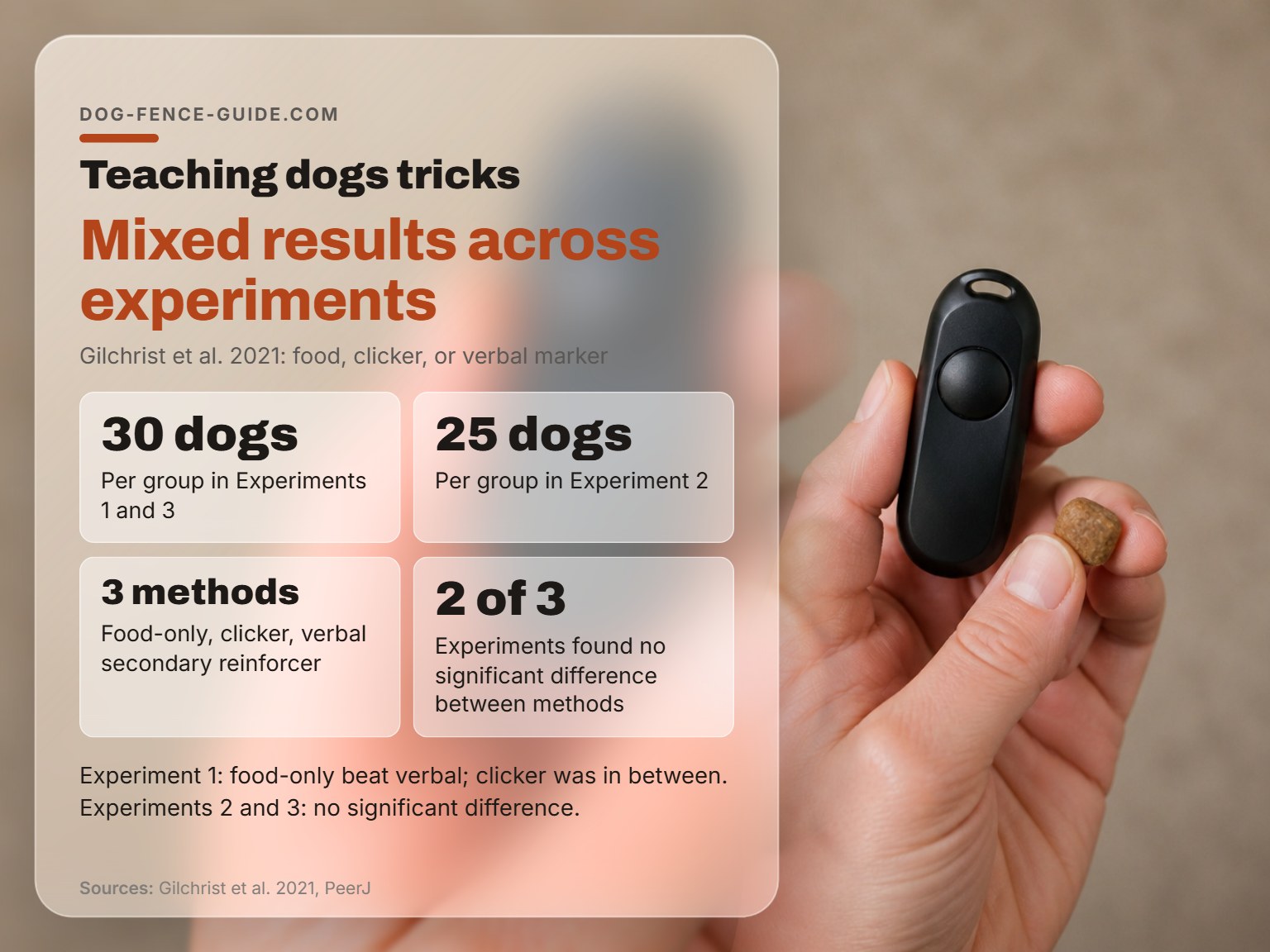
Gilchrist et al. 2021 ran three experiments with 30, 25, and 30 dogs per group, and the result is the least convenient finding in this whole area: no method beat any other.
In the first experiment, a sit-stay with increasing duration, the food-only group reached a significantly higher training-success criterion than the group reinforced with a verbal secondary reinforcer. The clicker group landed in between and wasn’t significantly different from either. Experiments two and three, both nose-targeting, found no statistically significant difference at all.
The authors are direct about the prior evidence: support for clickers being more effective than primary reinforcement or other secondary reinforcers is largely anecdotal.
That puts the popular guidance in an awkward spot. Dogster recommends saying “yes” or clicking right before the treat and treats the clicker as a standard marking tool. The SF SPCA lists a clicker as an equivalent option alongside training-only treats. Neither is wrong to offer it. Neither can point to a trial showing it teaches faster.
I still carry a clicker. I just stopped promising it would teach the trick faster, because the peer-reviewed work doesn’t back that promise and I got tired of repeating it.
The nuance is worth knowing. Thorn et al. 2006, cited in the same paper, found clicker-trained dogs had a significantly greater latency to sit on the second day than on their last trial of day one, which points to lower retention across days. And in piglets, clicker training produced faster acquisition of a fetch behavior while verbal reinforcement produced more correct choices on a later discrimination task. If you want the mechanics of either marker, the clicker training and marker word write-ups cover the timing in detail.
Where the Sources Disagree on Luring, Cueing, and Session Length
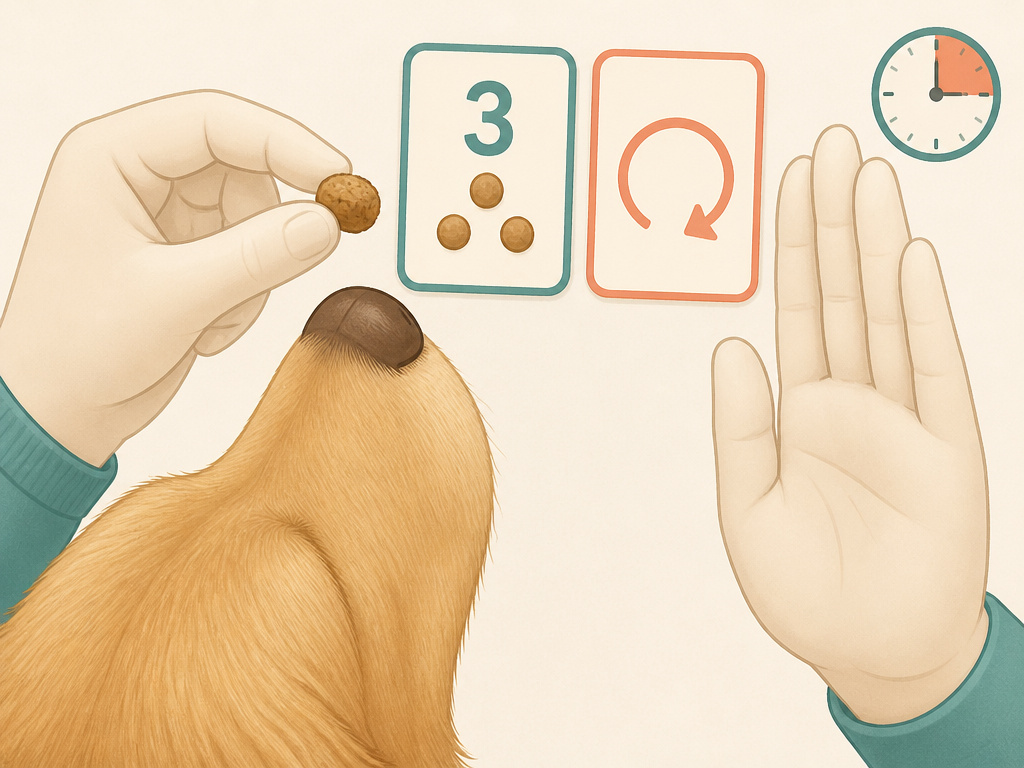
Three published sources, three different answers on how long to keep luring. None of them is obviously wrong, and the honest move is to show you the split rather than pick a winner for you.
| Question | One Position | The Other Position |
|---|---|---|
| How long to keep luring | Dog Scouts: three uses, then a hand signal | SF SPCA and Dogster: repeat until the association is clear, no fixed limit |
| When to add the verbal cue | SF SPCA: cue and lure together from the start | Dog Scouts: fade the lure first, cue comes after |
| How big the spin circle | Dogster: a tight circle, nose to tail and back | U. Illinois: large circle at nose level, then tighten |
| How often to train | Demant et al. 2011: once or twice weekly beat daily | Dogster and SF SPCA: repeat until mastered, no frequency limit |
| Helping the dog into position | AKC: pushing, shoving, pulling don’t work | Dog Scouts: limited helping is fine, but dogs learn better solving it |
The frequency row is the one that surprises people. Demant et al. 2011, cited in the Gilchrist paper, found that dogs trained to sit and stay once or twice weekly reached a significantly higher acquisition level than dogs trained daily, and that one session beat three consecutive sessions per day, while Dogster and the SF SPCA give no frequency limit. The paper reports the finding without pinning down why. My read is consolidation, but that’s a guess and I’d flag it as one.
What to do with all this: pick a lure schedule and hold it before you judge it. Switching mid-week because a video said three reps tells your dog the rules change, which is the one thing all five sources agree is bad.
Dog Scouts’ rule of thumb is three lures, then convert the motion to a hand signal, while the SF SPCA and Dogster let the lure run longer. Choose one schedule and stop shopping.
The underlying principle is the same everywhere, and it’s the one worth linking back to: positive reinforcement works because the dog is choosing the behavior, not because the food is magic.
Proofing: Why the Trick Works in the Kitchen and Dies in the Yard
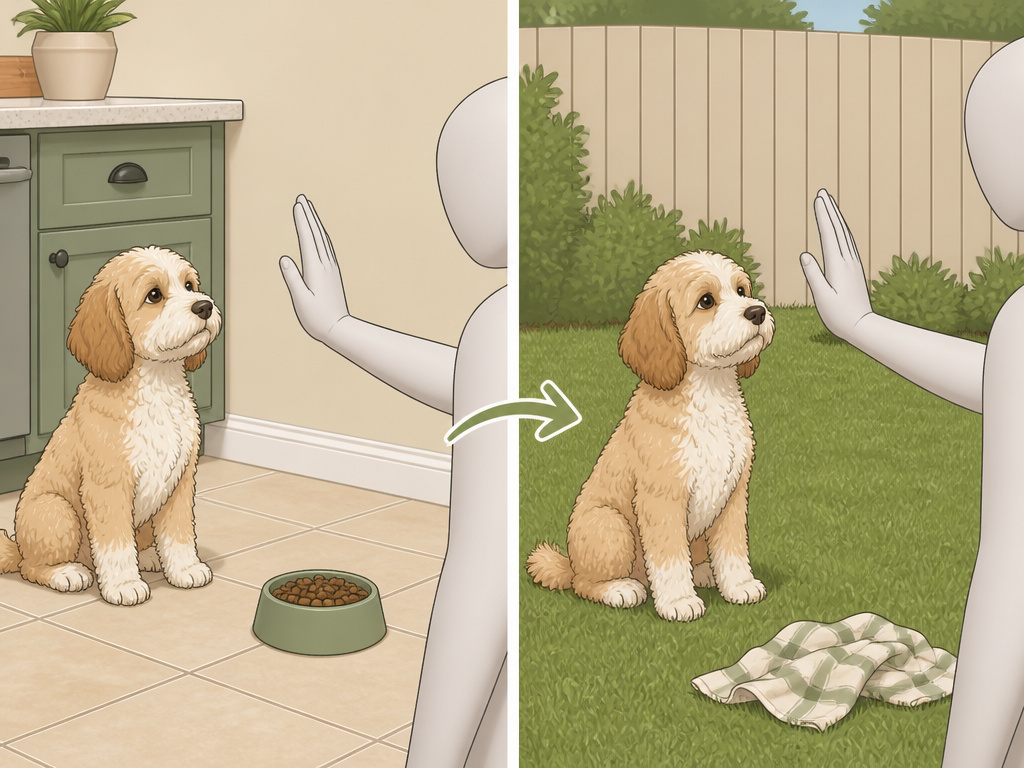
Generalization is a separate skill from the trick itself. A dog that sits in your kitchen has learned the kitchen version, and the hallway is a new problem.
The SF SPCA’s progression is specific. Once the association is clear, give the cue with an open hand in a different location and from farther away. That’s it. Same cue, new room, more distance.
There’s supporting evidence for the general idea. Marshall-Pescini et al. 2008, cited in the Gilchrist paper, found that dogs with more training experience performed significantly better learning a new task than dogs with none. Practice seems to build something that transfers.
This is the mistake I see most in handlers who’d call themselves advanced: they collect behaviors in one room and never take them anywhere. Then a trial or a park happens and the dog “forgets everything.” The dog didn’t forget. Nobody ever asked in that room.
Distance, Duration, Distraction
Add one variable at a time, and only one:
- Distance first, a step at a time, with the dog holding position.
- Duration second, a second at a time, and back off the moment it wobbles.
- Distraction last, and start with something mild like a dropped dish towel.
The stay command is where distance and duration get built properly, and proofing is where they get tested. Fading a lure is like seasoning a cast-iron skillet: thin layers, repeated, and no shortcut survives the first egg.
Titles, Tests, and What a Ribbon Doesn’t Prove
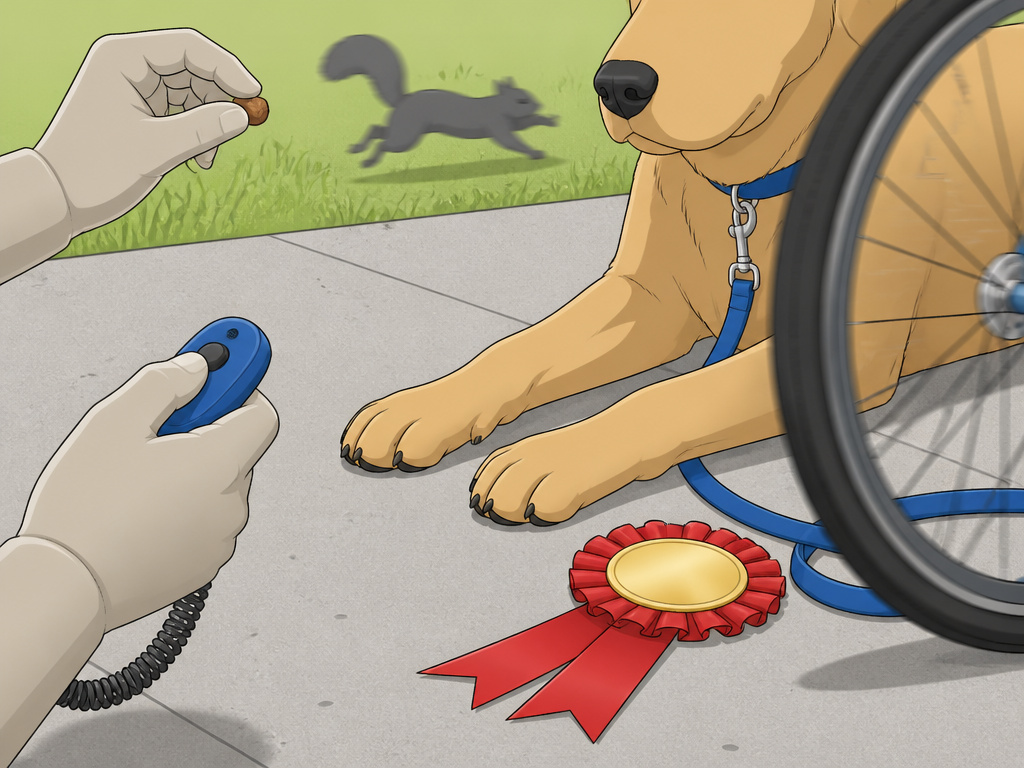
A trick title proves a dog performed on a specific day. It doesn’t prove the dog will perform in your front yard with a squirrel involved.
Two organizations issue the titles. Do More With Your Dog! Was started by Kyra Sundance in 2005 and certifies instructors, awards titles, and runs seminars. The AKC added trick dog titles in 2017, and its titles are noncompetitive and administered by AKC Approved CGC Evaluators.
There’s more history here than most people expect. The AKC dates trick dog training as we know it to the 1920s and the movie dog Rin Tin, notes that Pal’s trainer Rudd Weatherwax wrote a trick dog manual in the 1940s built on positive reinforcement and food rewards, and points out that Captain Arthur Haggerty co-authored “Dog Tricks” in 1977. Today there are at least 10 trick dog training books in print.
What a title tells you:
- The dog can perform a set of behaviors in a test environment.
- Someone put in the reps, which per Marshall-Pescini makes the next trick easier.
- Nothing at all about recall under prey drive.
I’d rather see a dog that holds a down-stay while a bicycle goes past than a dog with three title certificates and no proofing. Depth beats breadth, and a grand champion trick dog can still blow a recall the first time a rabbit breaks cover. If you want structured instruction beyond a book, look for online courses that are heavier on video review than on titles, which is the part I actually rate.
Frequently Asked Questions
How long should a training session last?
The sources give repetition counts rather than minutes, so I’d rather not invent a clock. Dog Scouts says one treat per attempt when a behavior is new, and starts variable rewards at two or three repetitions before a payout. Demant et al. 2011 found one session beat three consecutive sessions per day, which suggests fewer, cleaner sessions.
Do I have to use a clicker?
No. Gilchrist et al. 2021 found no significant advantage for clickers over food alone or a verbal marker across three experiments, and described the case for clicker superiority as largely anecdotal. A spoken “yes” is a legitimate marker and it’s free.
Can I use my dog’s regular dinner as training treats?
Dog Scouts says yes, and notes that hungry dogs are eager to learn. The SF SPCA recommends training-only treats so the reward stays distinct. Both work. Just count whatever you use against the daily ration.
How do I stop the dog from following the treat?
Fade the lure on purpose. Dog Scouts’ schedule is three lures, then convert the motion into a hand signal, while the SF SPCA and Dogster let it run longer before fading. Whichever you pick, the goal is a dog responding to a cue with empty hands.
At what age can I start?
Earlier than most people assume. Lozovskaia 1985, cited in the Gilchrist paper, reported that pups as young as 1.5 months learned an operant escape task more rapidly than 7-month-olds. That’s a lab task, not a trick, so treat it as a signal rather than a schedule.
What if my dog already knows sit and stay?
Then you’re past the hard part. Dogster’s advice is to make sure the basics are solid before shake, roll over, or play dead, because every one of those is built from a down or a sit. Use what the dog already knows as the on-ramp.
The Bottom Line
Here’s the trigger I’d give a friend: if your dog performs the trick in the kitchen and not in the hallway, stop teaching new tricks and go back to step seven. That’s a generalization gap, not a stubborn dog, and adding more behaviors on top of it just gives you more things that only work in one room.
The other concession worth making out loud: none of this requires a clicker, a title, or a course. Gilchrist et al. 2021 tested the clicker against plain food and a spoken word and found no meaningful gap. What the dog needs is a clear mark, a fast reward, and a lure that goes away on schedule.
Fair warning, though. The lure is the easy part. It’s the fading that separates a dog who knows the trick from a dog who knows your pocket, and that’s the step where most of us, me included, get lazy.
Start with one trick this week. One. Run the chain, fade the lure, then take it into the hallway before you add a second.
