
Can Dogs Eat Watermelon? What to Feed and Skip
This post contains affiliate links. As an Amazon Associate, we earn from qualifying purchases.
Yes, most dogs can eat watermelon, but only the flesh: no rind, no seeds, and no more than 10% of daily calories. A half-cup of diced watermelon is 23 kcal, so a dog on 100 calories a day has a 10-calorie treat budget, which is less than half that half-cup.
That arithmetic is where the can dogs eat watermelon question stops being a free snack. Weigh out 76 grams of diced fruit and you have 23 kcal sitting in the bowl, more than twice a 100-calorie dog’s entire daily treat allowance. Portion size decides whether this is a treat or a sugar delivery system.
What follows is the prep that matters (seeds, rind, piece size), the serving chart by dog weight, and the situations where the answer flips to a hard no.
Key Takeaways
- No rind, no seeds. The flesh is the only part that goes in the bowl, and both of the other parts carry a choking or blockage risk.
- 10% of daily calories is the ceiling, not a target. UC Davis puts half a cup of diced watermelon at 23 kcal.
- Pieces should be about 1 inch by 1 inch by 1/4 inch thick unless your vet says otherwise.
- Diabetic and overweight dogs need a vet’s sign-off first, and one veterinary source says skip it entirely.
- Frozen cubes are a version of this treat in hot weather, offered one or two at a time.
What Part of the Watermelon Is Actually Safe?
The red flesh, and nothing else. Rind and seeds both come out before the fruit goes near a bowl.
Watermelon flesh is roughly 92 percent water and low in calories, fat and cholesterol. The rind is tough, fibrous and slow to break down in the digestive tract. Seeds are small enough to lodge in a narrow airway. Flesh only, seeds and rind removed, is the standard preparation across veterinary sources.
| Part | Safe for dogs? | Why |
|---|---|---|
| Flesh, seedless | Yes, in moderation | Low in calories, fat, sodium and phosphorus |
| Rind | No | Tough, fibrous, does not break down, blockage risk |
| Seeds | No | Choking hazard, worse in small dogs |
| Flavored candies, popsicles, desserts | No | Added sugar, and xylitol is toxic to dogs |
Rind is the bigger hazard of the two. It is dense and fibrous, and it does not break down completely on the way through. The AKC warns that large pieces can cause stomach upset, vomiting, diarrhea, or an intestinal obstruction. Petplace makes the same point with a detail worth repeating: even big dogs struggle with rind, because the fiber is tough and slow to digest.
Seeds are a choking hazard first and a blockage risk second, with small dogs at the sharp end of both. PetMD notes that swallowing a few seeds is unlikely to cause problems for most dogs. Adoptapet points out that watermelon seeds contain cyanide, then concedes that a dog would have to eat an implausible number to be poisoned by them.
Comal Pet Hospital takes the strictest line of any source here, saying even a few swallowed seeds can cause discomfort later. Petplace and Lane Veterinary sit in the middle, saying a seed or two is unlikely to do harm while still advising removal.
The practical can dogs eat watermelon answer is the same under every version of that argument. Use seedless fruit or seed it by hand. A dog does not need the seeds, and the question of how many are safe is not worth settling with a dog who eats fast.
I spend most of my working life on fences and gates, and the pattern there is that failures cluster at the parts people skip. Feeding watermelon follows the same rule. The flesh is easy. The rind and seeds are where the trouble lives.
The 10% Rule Is the Only Number That Matters
Ten percent. That is the whole treat budget, and it covers the watermelon, the training treats, the crust of toast your dog talked you out of, and everything else that is not the main diet.
UC Davis Veterinary Medical Teaching Hospital states it plainly: treats and additional food items should not exceed 10% of daily caloric intake, with 90% or more coming from a complete and balanced food. Their worked example is the clearest version around. A dog eating 100 calories per day gets no more than 10 calories from treats, with the other 90 from the main diet.
Every item draws from the same small account.
Now the arithmetic gets interesting. UC Davis lists 76 grams of diced watermelon, about half a cup, at 23 kcal.
Those two figures cannot be lined up exactly, because the AKC number gives no gram weight for a cup. The UC Davis figure has a scale behind it, so it is the one to use when you are actually counting calories.
What “Complete and Balanced” Actually Means
The other 90% is where the nutrition lives. Petplace notes that AAFCO sets the nutritional standards commercial dog foods are formulated against, which is why the phrase “complete and balanced” on a label means something specific rather than something marketing invented.
Watermelon cannot fill that role, any more than bananas for dogs can. It is a treat, and a small one.
- Every watermelon cube, including the frozen ones
- The bit of chicken, the corner of cheese, the toast crust
- Anything the dog talks out of a houseguest
How Much Watermelon Can a Dog Have?
PetMD publishes a size-based chart, and it is a sensible starting point. Each piece should be about 1 inch by 1 inch by 1/4 inch thick unless your vet directs otherwise.
| Dog size | Weight | Slices per serving | Frequency |
|---|---|---|---|
| Extra-small | 2-10 lb | 2-3 | 2-3 times per week |
| Small | 11-20 lb | 3-4 | 2-3 times per week |
| Medium | 21-50 lb | 3-4 | 2-3 times per week |
| Large | 51-90 lb | 4-5 | 2-3 times per week |
| Extra-large | 91+ lb | 5-6 | 2-3 times per week |
Why the Chart Is a Ceiling, Not a Target
The chart gives you the top of the range for a healthy dog on a normal diet. It does not override the calorie math.
Run your own dog’s numbers before you trust the slice count. If you have never weighed a treat, the first weighing is usually a surprise.
Puppies and Small Dogs
PetMD says puppies can eat watermelon in moderation, without seeds or rind, as long as treats stay under 10% of daily calories. Comal Pet Hospital adds a timing condition: small pieces once the puppy is eating solid food, introduced slowly.
Small dogs deserve their own note. Seeds and rind are more dangerous at that size, and multiple sources single out small breeds for a higher blockage risk. The generic “remove the seeds” advice understates what that means for a ten-pound dog.
Preparing It Without Making a Choking Hazard
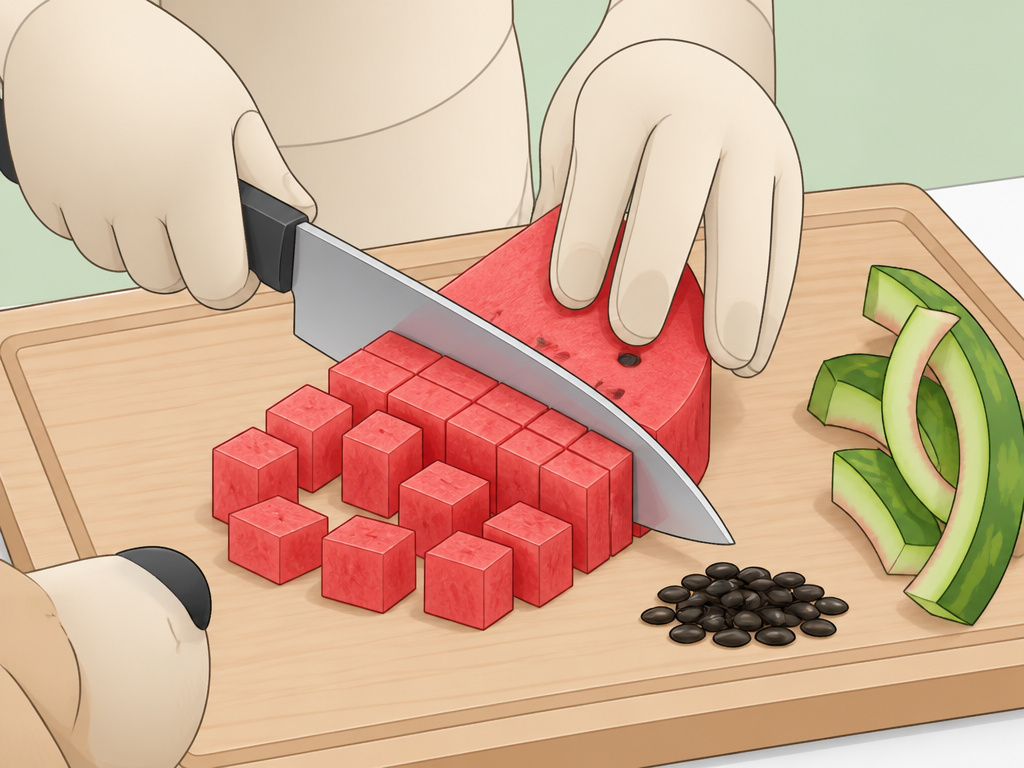
Picture a dog taking a whole wedge off a picnic blanket and swallowing it in two bites. That is the scenario these prep rules exist to prevent.
Before you start: Two hazards matter here. Rind does not break down and can lodge as an obstruction, and whole seeds can block a small dog’s airway. Remove both before the fruit leaves the cutting board, and cut pieces to roughly 1 inch by 1 inch by 1/4 inch.
- Wash the fruit first. Comal Pet Hospital recommends a thorough rinse to clear surface residue. Skipping it puts whatever was on the outside of the melon into your dog.
- Cut the rind away completely. Leaving a strip on as a “handle” is how dogs end up chewing the one part that can block them.
- Remove every seed, or buy seedless. This is the shortcut people take most often, and it is the one that lands small dogs at the vet.
- Dice to about 1 inch by 1 inch by 1/4 inch. Oversized pieces get swallowed instead of chewed, which defeats the point of cutting them.
- Offer one or two pieces and watch. The AKC advises starting small and monitoring for digestive upset. Skipping the trial run means you learn about a sensitive stomach the hard way.
A ripe watermelon gives under the knife and drips onto the board. The rind fights back and smells faintly of cut grass. If a chef’s knife struggles to get through it, a dog’s gut will struggle more.
Comal Pet Hospital suggests freezing cubes overnight and offering one or two at a time. A frozen cube keeps a dog busy far longer than the same amount of fresh fruit.
My own rule is that the fruit does not leave the cutting board until the rind is gone. It is easier to enforce at the counter than at the picnic blanket.
When Watermelon Is the Wrong Call
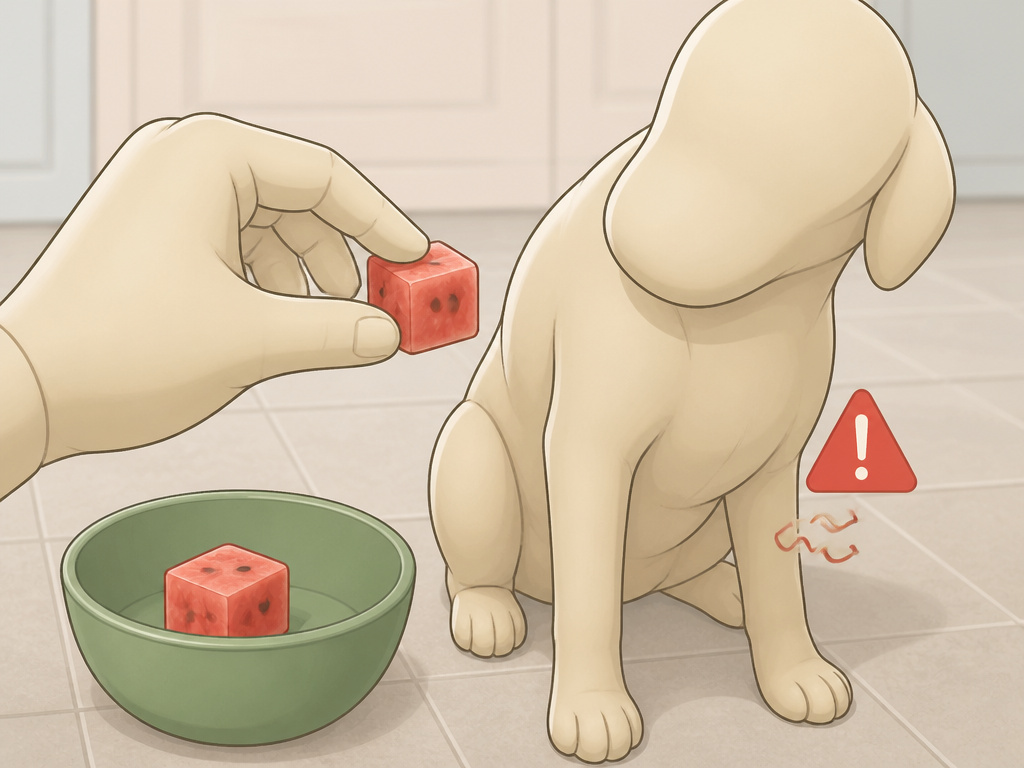
Some dogs should not get this treat at all.
When two credible sources disagree about risk, the cautious reading wins. Ask the vet first.
Digestive tolerance is a separate question. Adoptapet notes that dogs with sensitive gastrointestinal tracts may not handle watermelon well. Lane Veterinary puts it in plain terms: some dogs do not process fruit, and a soft stool after a small piece is your answer.
Fair warning. First-timers get a trial run, not a bowl. The AKC recommends a small amount and a watchful eye. Petplace goes further and says to stop entirely if you see loose stool, vomiting, or a dropped appetite.
Signs to stop and call it:
- Loose stool after the first piece
- Vomiting, or a dog who looks uncomfortable
- Turning up the nose at the next meal
- Gas or visible belly discomfort
Watermelon is not on it, unlike the grapes that are toxic. That is a citable, authoritative negative finding, and it is the reason this fruit keeps showing up on safe lists.
If you are comparing fruits, see our guide to apples for dogs before you assume fruit is automatically the safer snack.
Where this goes sideways: Handing over pieces from your own fork at the table. The dog learns to beg, you lose count of the pieces, and the 10% ceiling quietly breaks without anyone noticing.
Watermelon-Flavored Products and the Xylitol Trap
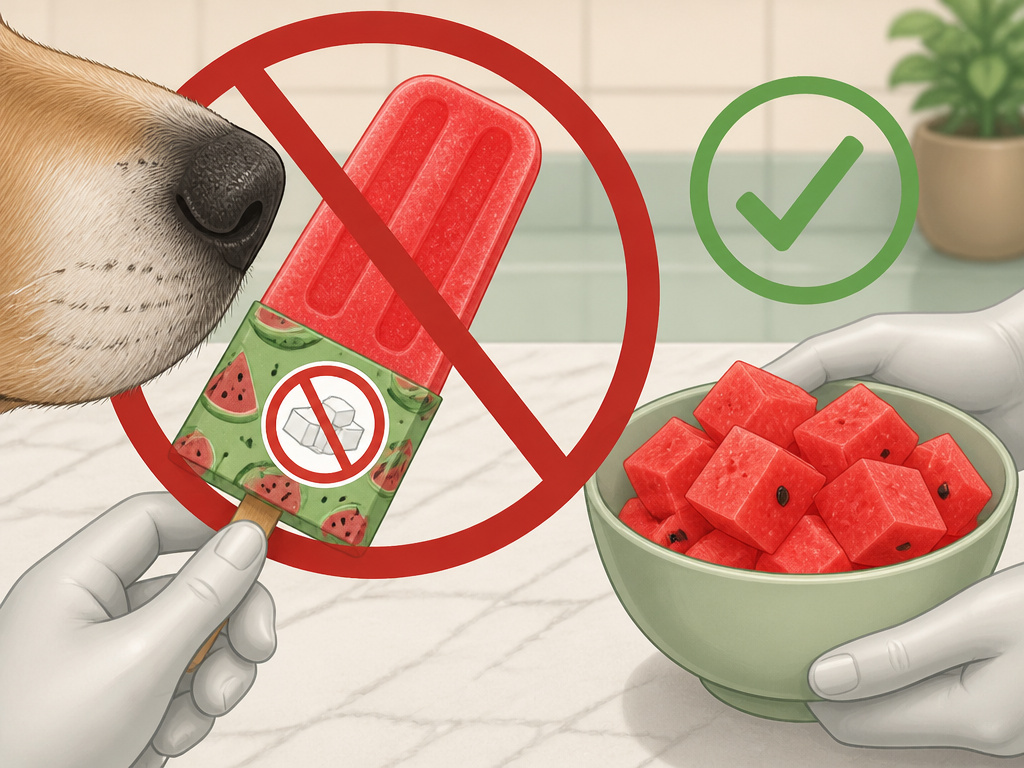
Xylitol is the reason a watermelon-flavored popsicle is a worse idea than it looks.
Comal Pet Hospital is direct about this: never give dogs watermelon-flavored candies, popsicles, or desserts, because they often contain added sugars or artificial sweeteners like xylitol, which is toxic to dogs. The fruit is fine, but check our list of human foods toxic to dogs before trusting anything flavored. The products built to taste like the fruit are a different category entirely.
If You Add Yogurt
The AKC’s guidance on watermelon “ice cream” is specific. Use plain yogurt with no added sugars, flavors, fruit, natural sweeteners, or artificial sweeteners, and read the ingredient label to confirm it contains no xylitol. Some dogs do not tolerate dairy, so a lactose-free or dairy-free alternative works if yours is one of them.
Read the label, not the front of the package. “Plain” on the front and “plain” in the ingredients list are two different claims.
That is a better use of the fruit than a bowl.
Does Watermelon Replace Water?
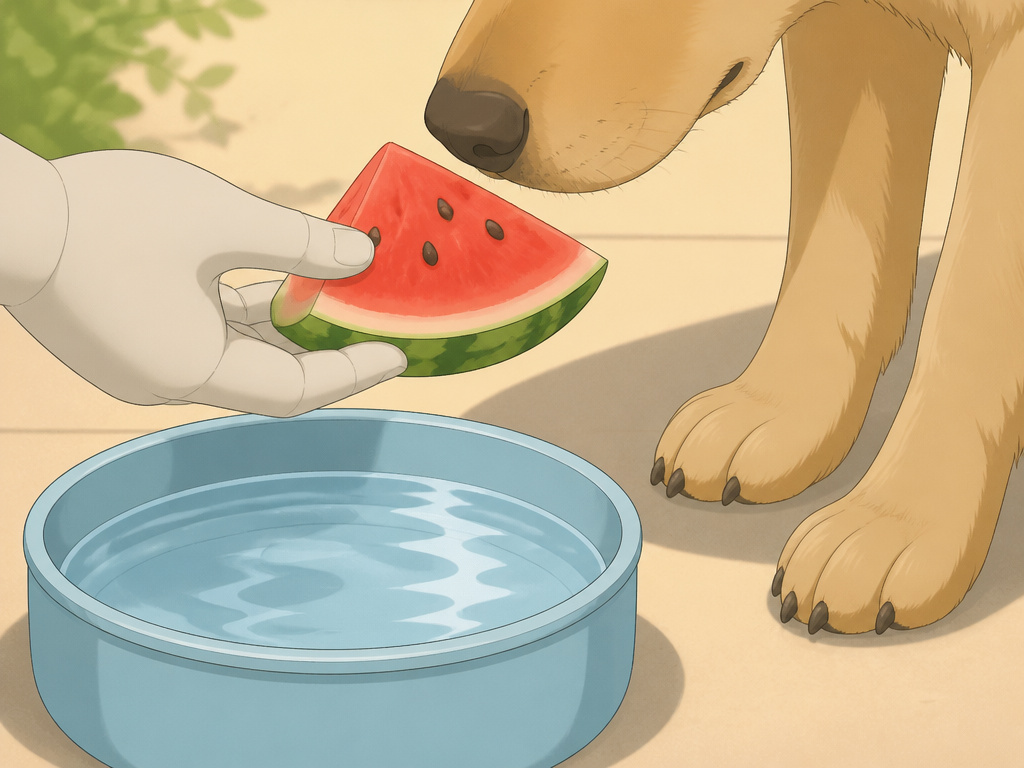
Watermelon is over 90% water, and it will not keep a dog hydrated on its own.
PetMD states that because treats are only a small portion of the diet, watermelon alone cannot provide all of a dog’s hydration needs. Lane Veterinary is equally clear that it should never replace fresh drinking water. The AKC adds that dogs should have access to clean water at all times regardless.
Here is where the sources genuinely disagree. PetMD and the AKC both frame watermelon as a source of vitamins A, B6 and C plus potassium. Adoptapet’s Dr. Washington takes the opposite position: properly prepared watermelon is not toxic, but it has not been proven beneficial either.
Both things can be true at once. Watermelon is a low-calorie, high-water treat that most dogs enjoy, and it is not a supplement. A dog on a complete and balanced diet already has the vitamins covered.
I have handed out a lot of watermelon on hot days. It is a treat that happens to be wet, not a water bowl.
Frequency is the last open question. PetMD says many healthy dogs can enjoy small amounts regularly, in moderation. Comal Pet Hospital says treat it as an occasional snack rather than a daily fixture. Two to three times per week, which is the frequency in PetMD’s own chart, sits comfortably between those two positions.
Frequently Asked Questions
Can dogs eat watermelon rind?
No. Rind is tough and fibrous, does not break down completely, and can cause stomach upset, vomiting, diarrhea, or an intestinal obstruction if eaten in large pieces. Even large dogs have trouble with it, per Petplace, because the fiber is dense and slow to digest.
What happens if my dog eats a watermelon seed?
Usually nothing. PetMD says accidentally swallowing a few seeds is unlikely to cause problems for most dogs, and Adoptapet notes that toxicity from the cyanide in seeds is highly unlikely at realistic amounts. The risk climbs with volume and drops with dog size, so small dogs and large handfuls of seeds are the two situations that matter. Remove them anyway.
How much watermelon is too much?
More than 10% of your dog’s daily calories. UC Davis lists 76 grams of diced watermelon, about half a cup, at 23 kcal, which is more than twice the entire daily treat allowance for a dog eating 100 calories a day. Use the size chart as a ceiling and the calorie math as the real limit.
Can puppies eat watermelon?
Yes, in moderation, without seeds or rind, and under the same 10% calorie ceiling. Comal Pet Hospital suggests small pieces once the puppy is eating solid food, introduced slowly. Start with one piece and watch for digestive upset before offering more.
Is watermelon good for dogs?
The sources disagree. PetMD and the AKC describe it as a low-calorie fruit with vitamins A, B6 and C, potassium, and high water content. Adoptapet’s Dr. Washington counters that it has not been proven beneficial to dogs. It is a reasonable occasional treat either way, and it does not replace a complete and balanced diet.
The Bottom Line
The trigger for stopping is simple. If you cannot say what fraction of your dog’s daily calories a treat represents, you are guessing, and guessing is how a “healthy” snack turns into weight gain. Weigh the food once. Weigh the fruit once. Do the division.
Everything above assumes a healthy dog on a complete and balanced diet. A diabetic dog, an overweight dog, or a dog with a touchy gut is a different conversation, and that one belongs to your vet rather than to a chart.
This week, do one thing: cut half a cup of diced watermelon, put it on a kitchen scale, and look at what 23 kcal actually is in the bowl. It is smaller than most people picture. Measure first, decide second.
