
Can Dogs Eat Eggs? How to Cook and Serve Them
This post contains affiliate links. As an Amazon Associate, we earn from qualifying purchases.
Can dogs eat eggs? Yes, when the egg is fully cooked and served plain. Boiled, scrambled, or poached eggs are safe for most dogs, while raw or undercooked eggs carry Salmonella and avian influenza risk and should be avoided.
Heat does the work. Cooking an egg to an internal temperature high enough to destroy pathogens is the step the AVMA points to, and that same heat neutralizes avidin, the raw-white protein that binds biotin, which is central to the can dogs eat eggs question.
What follows covers portion sizes by dog weight, the eggshell question that splits the veterinary sources, and the two groups of dogs that should skip eggs entirely.
Key Takeaways
- Cook it plain and cook it through. Boiled, scrambled, or poached, with no salt, butter, or oil added at any point.
- Eggs count against the 10% treat ceiling. Everything outside the main diet tops out at 10% of daily calories.
- The AVMA discourages raw or undercooked eggs, and PetMD and Canine Journal say to avoid raw eggs, while Is It Safe For My Dog frames the risk from a single fresh commercial egg as low but not zero. The AVMA also lists highly pathogenic avian influenza among the contaminants.
- Eggshells are genuinely disputed. PetMD and Canine Journal allow them; Purina NZ says do not give them at all.
- A dog up to 10 pounds gets about a quarter egg a week; a dog over 90 pounds up to two. That is PetMD’s per-size guide, not a universal rule.
What Makes a Cooked Egg Safe and a Raw One Risky?
The AVMA names eggs explicitly among the animal-sourced proteins it treats as a concern, and it discourages feeding any of them raw or undercooked.
Applying heat until the protein reaches an internal temperature adequate to destroy pathogenic organisms is the traditional method for eliminating pathogens in animal-sourced protein. Pasteurization works the same way. The AVMA treats cooking and pasteurization as the standard route, while noting that newer methods such as irradiation are also being developed and implemented.
That is the whole safety argument in two sentences. Cook the egg and the pathogen load drops to something a dog’s gut handles without drama.
The organism list is longer than most egg articles admit. Alongside Salmonella and Campylobacter, the AVMA names Clostridium, Escherichia coli, Listeria monocytogenes, Mycobacterium bovis, and enterotoxigenic Staphylococcus aureus. Seven pathogen groups, one small food.
Avian influenza is the contaminant most egg pages skip. The AVMA lists highly pathogenic avian influenza virus among the organisms that can contaminate raw or undercooked animal protein, and eggs sit on that same list of proteins of concern. That is a stronger argument against raw egg than Salmonella alone, and it does not appear in a single consumer-facing egg article I checked.
There is a household angle too. Apparently healthy dogs and cats can carry these organisms without showing a single sign, and the AVMA notes they then pose a risk to other animals and to people, especially children, older adults, pregnant women, and immunocompromised individuals. The full position sits in the AVMA raw protein diet policy, which covers raw milk and raw meat in the same breath.
Your dog might be fine. Your dog’s ability to infect a toddler is the part that gets forgotten.
How Much Egg Is Too Much for a Dog
Ten percent of a dog’s daily calories is the ceiling for all treats combined, and eggs count against it.
PetMD puts it as no more than 10% of the diet, with the rest coming from a complete food. Canine Journal uses the same 10% figure but frames it as daily calories. Either way, an egg is a supplement sitting on top of a balanced bowl, never a swap for part of it.
Portions by Dog Size
| Dog size | Weekly amount | Source |
|---|---|---|
| Up to 10 lb | About 1/4 egg per week | PetMD |
| More than 90 lb | Up to 2 eggs | PetMD |
| Any size | Not every day | Purina NZ |
| Any size | Roughly 1-2 times a week | Is It Safe For My Dog |
Notice the gap in the middle. PetMD gives a small-dog figure and an extra-large-dog figure, and nothing in between. If your dog is a 40-pound mix, you are interpolating between PetMD’s small-dog and extra-large-dog figures.
A quarter egg for a ten-pound dog and two eggs for a ninety-pound dog is the entire scale. If you cannot picture a quarter of an egg, scramble one, cool it, and cut it into four.
Frequency is where the sources actually part ways. Purina NZ says plainly that feeding eggs every day is not recommended. Is It Safe For My Dog lands on roughly one to two times a week inside the 10% rule. PetMD gives the per-size portion without capping the weekly count. I keep eggs to a couple of times a week, because the portion guide and the frequency guide are answering different questions and the cautious reading of both is the same number.
The Eggshell Question Nobody Agrees On
Ask four sources whether dogs should get eggshells and you get four different answers.
| Source | Position on eggshells |
|---|---|
| PetMD | Fine when prepared properly; rich in calcium and trace minerals |
| Purina NZ | Do not give; high mineral content can disrupt the diet |
| Canine Journal | Fine, but break the shell and egg into small pieces |
| AKC, quoted by Is It Safe For My Dog | Sharp edges can injure the throat or internal organs |
That is not a small disagreement. Two sources say yes with caveats, one says no outright, and one raises a physical-injury risk that has nothing to do with minerals.
Where the Shell Advice Splits
Purina NZ’s objection is nutritional: too much mineral load can throw a balanced diet out of kilter. PetMD’s position is that the calcium is a feature, not a bug, provided the shell is handled properly. The AKC’s concern is mechanical, and it is the one I take most seriously. The AKC warns a shell fragment is a sharp edge in a throat, while PetMD and Canine Journal allow properly prepared shells.
I do not feed shells, and it is not because I think calcium is dangerous. It is because the two failure modes are a mineral imbalance nobody will notice for weeks and a cut nobody will notice for hours, and neither is worth the calcium you could get elsewhere. If calcium is the actual goal, eggshell membrane supplements for dogs are a more controlled route than a handful of shell.
If you do feed shell anyway, grind it. Canine Journal is explicit that the shell and egg should be broken into smaller pieces, never handed over whole.
What the Raw-Egg Advice Actually Protects Against
The FDA’s Center for Veterinary Medicine screened 196 samples of commercial raw dog and cat food, bought online from different manufacturers and shipped directly to six participating laboratories.
The agency’s conclusion was not ambiguous. FDA CVM identified a potential health risk for the pets eating the raw food and for the owners handling the product, and noted that owners feeding a raw diet may run a higher risk of infection with Salmonella and Listeria monocytogenes. That is the FDA raw pet food diet facts page in its own words.
Treats carry their own numbers. A review in JAVMA reported that 41% of dog treats derived from pig ears and other animal parts, bought at retail in the US, were contaminated with Salmonella. The same review found commercial raw food diets containing chicken were five times as likely to be contaminated as those without. It is worth reading the Salmonella contamination in pet treats findings before assuming a dried or freeze-dried product is the safe middle ground.
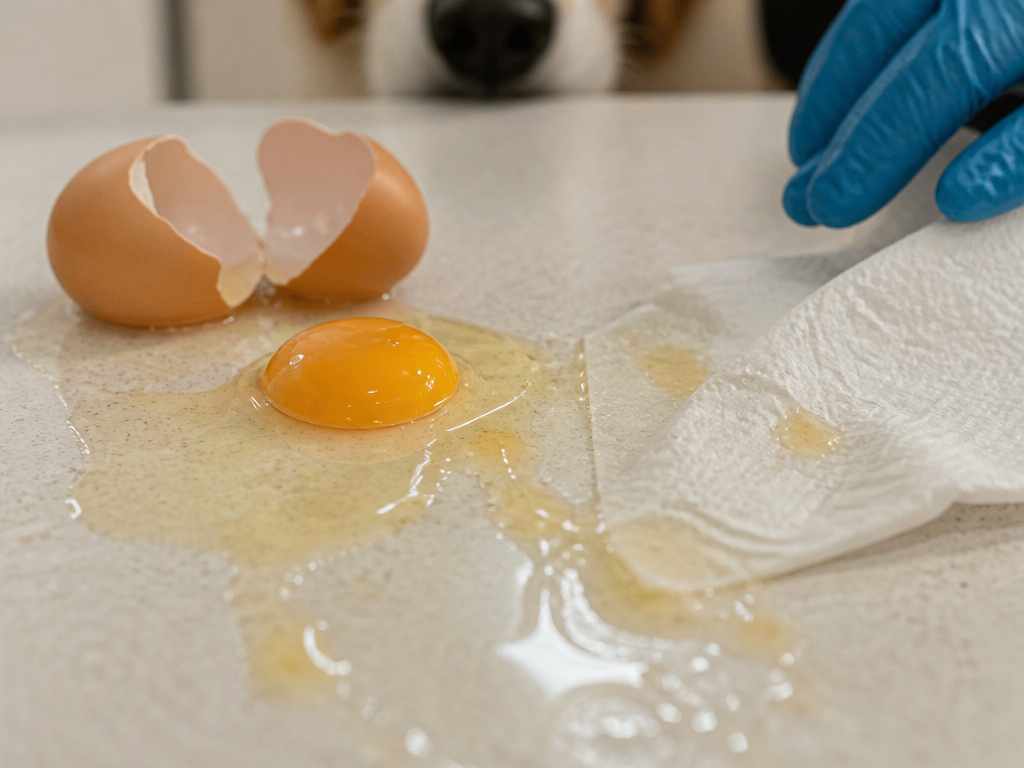
A cracked raw egg leaves a slick, clear film on the counter that a dry paper towel just pushes around. That film is the thing the FDA is talking about. The agency’s handling rules exist for exactly that surface: do not rinse raw meat, poultry, fish, or seafood, because the juices splash and spread. Thaw in the refrigerator or microwave, never on the countertop or in the sink.
Where this goes sideways: A dog that eats a raw egg can start vomiting anywhere from six to 48 hours later, and the illness can run a few days to over a week. By then the egg is long forgotten and the vet bill gets blamed on something else entirely.
The FDA adds two rules people find hardest to keep. Cover and refrigerate whatever the pet does not eat, or throw it out safely. And do not kiss your dog around the mouth or let your dog lick your face, especially right after raw food.
How to Cook and Store Eggs for a Dog
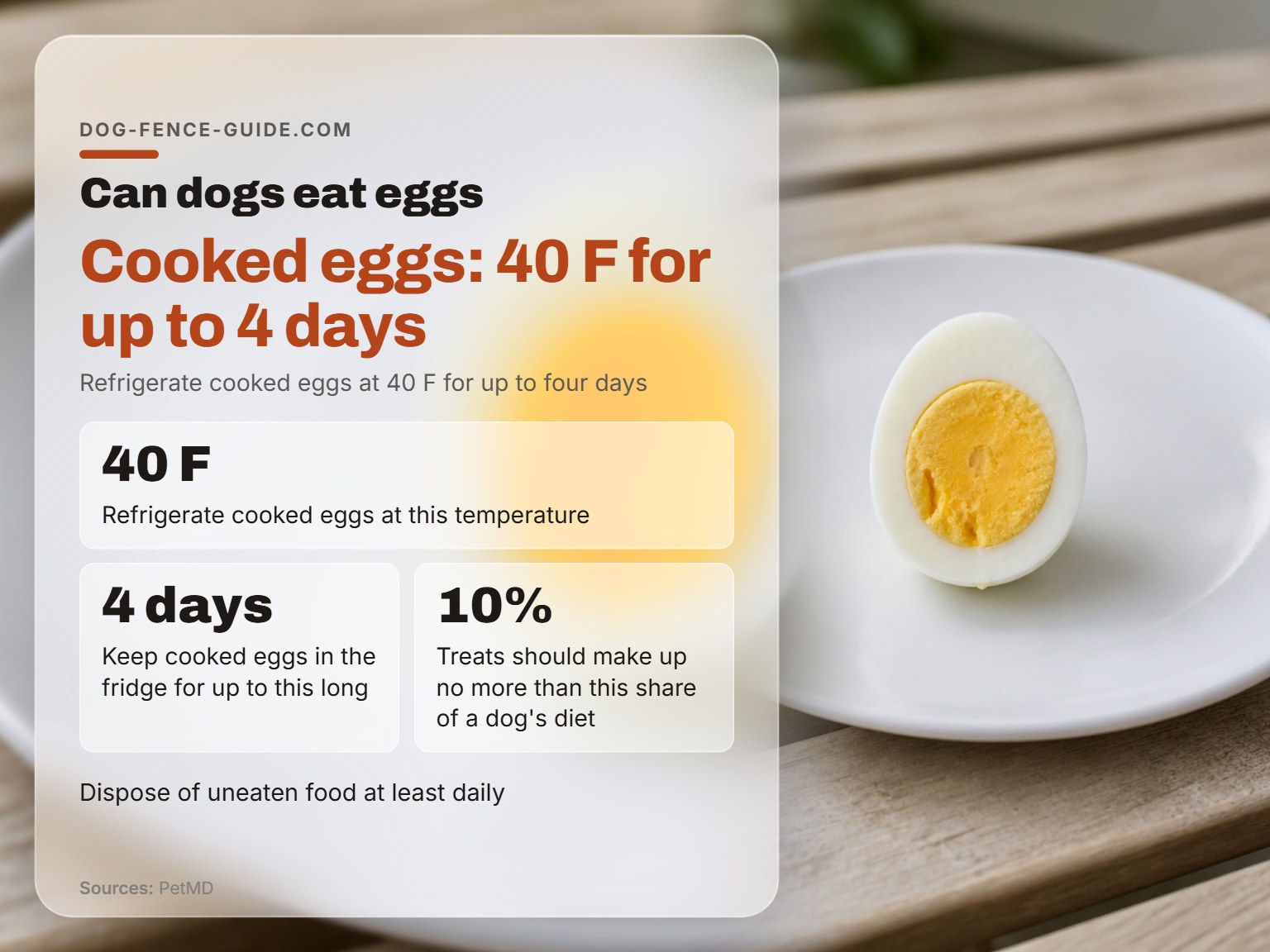
Three rules cover nearly all of it: cook it plain, cook it through, and keep the portion small.
Before you start: Salmonella can live on the outside of the shell as well as the inside, so wash your hands after handling raw eggs. Boiling water scalds fast when you drop eggs in, so use a slotted spoon rather than your fingers. And add nothing to the pan, because salt, butter, and oil are the parts of a human breakfast that cause the trouble.
The Plain-Cook Method
- Boil or poach in plain water. No butter, no oil, no salt. PetMD and Purina NZ both name boiled, poached, and plain scrambled as the safe methods, and both exclude anything cooked in fat.
- Cook the yolk through. A runny yolk is an undercooked egg, and undercooked is the category the AVMA discourages. Skip this and you have undone the entire point of cooking it.
- Cool it before it goes in the bowl. A hot egg straight from the pot gets gulped, and a gulped egg comes back up. Cool it before it goes in the bowl.
- Break it into pieces. Especially for small dogs. Canine Journal’s warning about whole pieces applies to the egg as much as the shell.
An over-cooked hard-boiled egg shows a grey-green ring where the yolk meets the white, and it smells faintly of sulfur when you peel it. That ring is harmless, but it means you boiled it long. Pull them when they are cooked through and put them straight into cold water.
Storing a Batch
PetMD’s guidance is to refrigerate cooked eggs at 40 F for up to four days. That is a batch you cook on a Sunday and finish by Thursday.
Anything the dog leaves in the bowl goes in the fridge or the bin, immediately. The AVMA’s own feeding guidance says to dispose of uneaten food at least daily, and the FDA says the same thing in different words.
One more thing on the pan: if you are cooking eggs for yourself at the same time, keep the dog’s portion out of the onions. Onion and garlic are the real hazard in a shared breakfast, and they turn up in omelettes and scrambles far more often than people realize. They sit at the top of the list of foods toxic to dogs for a reason.
Is the Avidin Warning Worth Worrying About?
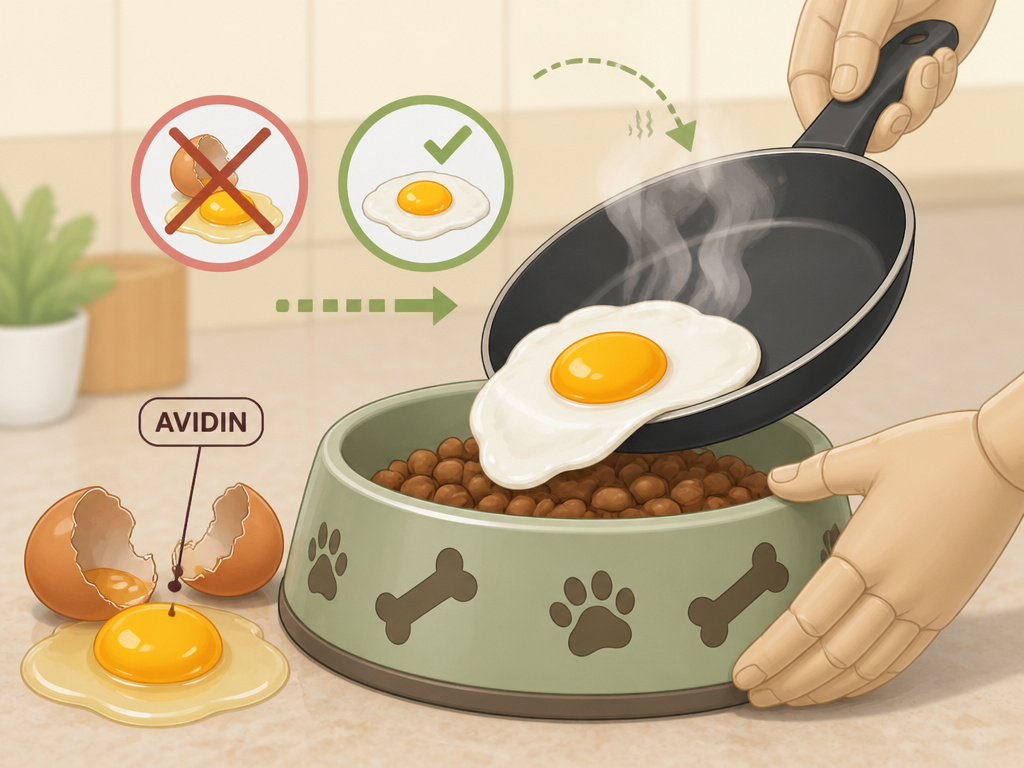
The avidin warning is disputed: PetMD and Purina NZ treat it as a concern, while Is It Safe For My Dog calls it a theoretical concern at realistic intake.
The mechanism is real. PetMD explains that raw egg whites contain avidin, a protein that binds biotin and can interfere with nutrient absorption when fed regularly, and that cooking neutralizes it. Purina NZ makes the same point about potential biotin deficiency from avidin in raw whites.
The dissent is worth taking seriously. Is It Safe For My Dog points to the Merck Veterinary Manual’s note that naturally occurring biotin deficiency is very rare in dogs, which makes avidin a theoretical concern at realistic intake rather than a practical one.
I have stopped treating avidin as the reason to avoid raw egg. Salmonella and avian influenza are the reasons. When a neighbor asks me about it, I say cook the egg and both arguments disappear at once.
That is the honest resolution. Nobody has run a trial on avidin at treat-level intake in pet dogs, and both camps are reading the same mechanism from different ends. Cooking settles it either way, because heat neutralizes avidin and kills the bacteria in the same pass.
So the avidin debate is interesting and almost entirely beside the point. Cook the egg.
Which Dogs Should Skip Eggs Entirely
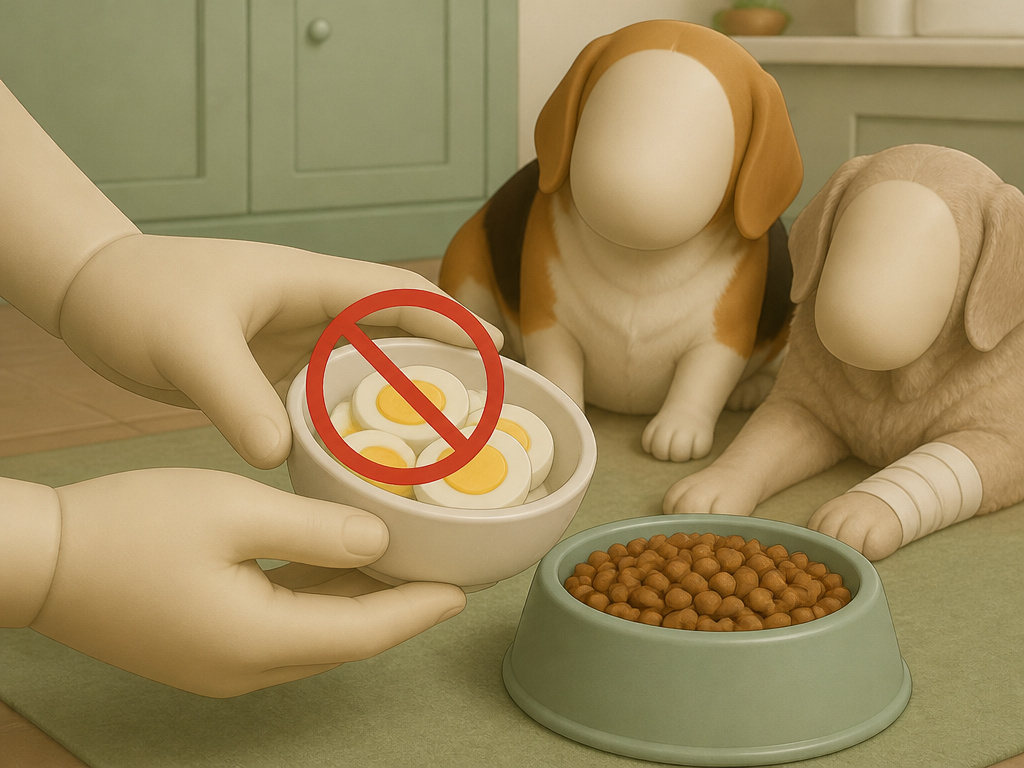
Does your dog have pancreatitis, a prescription diet, or a few extra pounds?
- Dogs on a prescription diet. PetMD is direct: no food or treats outside the diet unless the veterinarian says otherwise. An egg is outside the diet.
- Dogs with a history of pancreatitis, obesity, or a low-fat diet. PetMD suggests egg whites only, or skipping eggs altogether. The yolk is where the fat sits.
- Puppies. Purina NZ says puppies can eat eggs, but new foods should not be introduced suddenly, because that is how you get a digestive upset on a carpet.
- Dogs with weakened immune systems. Is It Safe For My Dog puts the risk from a single fresh commercial egg as low but not zero for a healthy dog, rising for puppies, senior dogs, and immunocompromised dogs.
If you are already careful about what goes in the bowl, the same reasoning that governs table food for dogs applies here. Small, plain, occasional, and checked against the vet’s list first.
Kidney Disease and Prescription Diets
Kidney disease is the one case where I would stop guessing entirely. There is older published research on egg protein in reduced protein diets for dogs in renal failure, and it is a conversation to have with your vet rather than something to act on from an article.
The broader point stands on its own. A dog with a diagnosed condition is not a dog you experiment on with people food.
Do Eggs Replace Anything in a Dog’s Bowl?
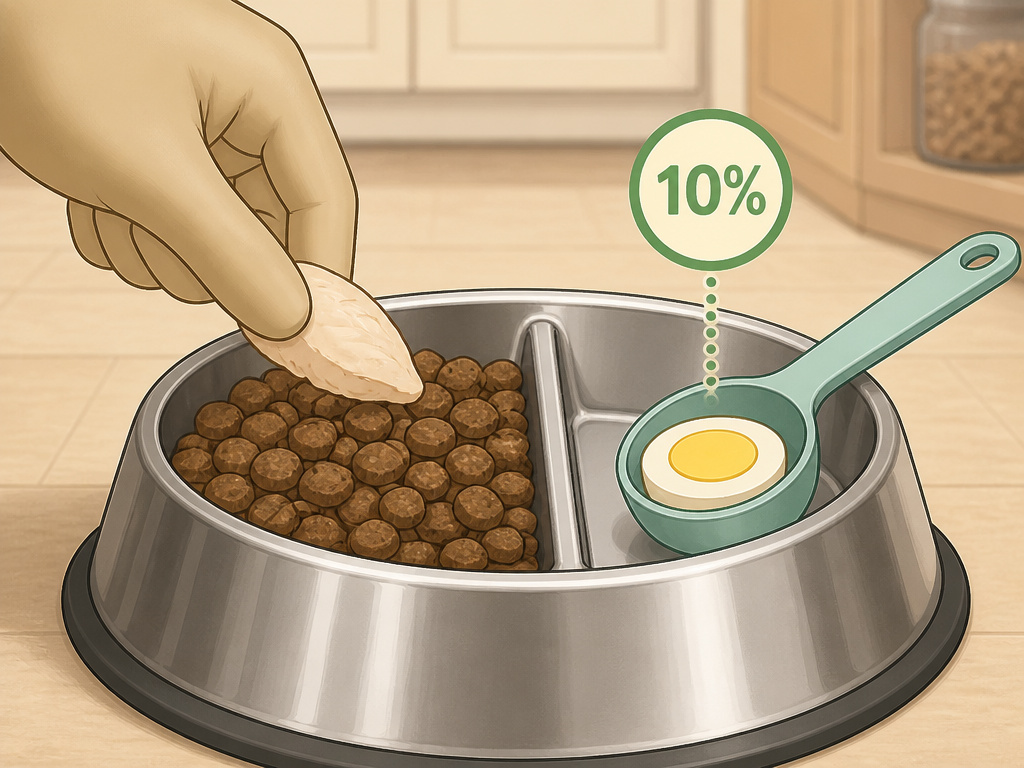
An egg is a supplement, not a meal.
Canine Journal is blunt about this: eggs should be a supplement, not a replacement for the regular diet, and treats should only make up 10% of daily calories. Purina NZ makes the nutritional case from the other direction, noting that a complete commercial food already supplies everything a dog needs, which makes the egg a bonus rather than a gap-filler.
The “ancestral diet” argument that often props up raw feeding does not survive contact with the genetics. A review in JAVMA reported 36 regions of the genome that differ between dogs and wolves, 10 of which play a critical role in starch digestion and fat metabolism. Dogs adapted to an omnivorous diet over domestication. The wolf comparison is a story, not a feeding plan.
The same review flags something practical: most freeze-dried treats, including freeze-dried liver treats, are raw, and carry substantial Salmonella contamination risk. “Freeze-dried” reads as processed on the packet. It is not cooked.
If you want a single-ingredient reward that is not an egg, plain cooked chicken follows the same rules: no seasoning, small pieces, counted against the 10%.
And no, eggs do not belong in the same conversation as bones for dogs. A shell is not a chew.
Frequently Asked Questions
Can dogs eat scrambled eggs?
Yes, provided they are scrambled plain and cooked through. PetMD and Purina NZ both allow plain scrambled egg with no salt, pepper, butter, or oil. The butter is the part that catches people out, because a scrambles pan usually has some.
Can dogs eat raw eggs?
The AVMA discourages feeding any raw or undercooked animal-sourced protein, including eggs, and the FDA’s testing of raw pet food found reason for concern about risk to both pets and the people handling it, while Is It Safe For My Dog frames the risk from a single fresh commercial egg as low but not zero. Cooking removes the question entirely.
How many eggs can a dog eat in a week?
PetMD’s guide runs from about a quarter of an egg per week for a dog up to 10 pounds, up to two eggs for a dog over 90 pounds. Purina NZ advises against feeding eggs every day, and Is It Safe For My Dog suggests roughly one to two times a week. Keep the total inside the 10% treat ceiling.
Can dogs eat eggshells?
The sources disagree. PetMD allows eggshells when prepared properly and notes their calcium content. Purina NZ says not to give them at all because of the mineral load. Canine Journal allows them only when broken into small pieces, and the AKC warns that sharp edges can injure a dog’s throat or internal organs.
Can puppies eat eggs?
Yes, but introduce them gradually. Purina NZ notes that puppies can eat eggs while warning that sudden new foods cause digestive upset. Cooked and plain, in a small amount, is the whole method.
The Bottom Line
Here is the threshold that decides it for you: if your dog is on a prescription diet, has a history of pancreatitis, or is carrying extra weight, the egg question belongs to your vet and not to this article. Everything above assumes a healthy dog eating a complete diet.
For everyone else, the first step is small and specific. Boil one egg tonight, cool it in cold water, peel it, and cut it into quarters. A dog under 10 pounds gets one quarter this week. A dog over 90 pounds gets up to two over the week. Watch the bowl for 6 to 48 hours afterward, because that is the window where a bacterial problem would show up.
Fair warning on one thing. This advice changes the moment kidney disease enters the picture, and it changes again for a dog whose immune system is already compromised. Those are not the same conversation, and treating them as one is how people get into trouble.
No pushy sales talk, just what works: cook the egg, keep it plain, keep it small, and count it against the treat budget. The dog will be just as happy with a quarter egg as with a whole one.
