
How to Walk a Reactive Dog: Stay Under Threshold
This post contains affiliate links. As an Amazon Associate, we earn from qualifying purchases.
To walk a reactive dog, keep the lead to 5-6 feet, stand at a distance where your dog can see the trigger without reacting, and feed high-value treats the moment the trigger appears. PAWS Chicago sets that lead length; the working distance is dog-specific.
Distance is the one variable you can change in real time. Every source here builds its method around the same idea: the how to walk a reactive dog question comes down to getting far enough away that the dog can still notice the trigger and still take a treat. Lose that gap and the training stops working, however good your timing is.
What follows is the equipment, the distance work, the route planning, and the brief window that decides whether a walk goes well. It also covers the places where the major sources genuinely disagree, because pretending they don’t won’t help you on a Tuesday morning.
Key Takeaways
- 5-6 feet is the lead length PAWS Chicago specifies for reactive-dog walking, and it’s shorter than most people picture.
- Under threshold means the dog can see the trigger and still eat. When the treats stop, you’re already too close.
- Front-clip harnesses and head halters both appear in the sources, but fit matters more than the category.
- Dogs Trust says keep moving; Cornell has you feed as the trigger passes. Both work if you stay consistent.
- Skip the long walk on a bad day. AKC and Dogs Trust both say a shorter day is fine.
What Does “Under Threshold” Actually Mean?
Threshold is a distance you can measure with your own feet. The Wisconsin Humane Society leash reactivity guide defines it as the distance at which the dog begins to react, so it shifts with the dog, the day, and the specific trigger.
Counter-conditioning pairs the sight of a trigger with food before the dog reacts. The handler stands at a distance where the trigger is visible but the dog remains calm, waits a split second after the trigger appears, then delivers high-value treats. Repetition at that distance changes the dog’s emotional response to the trigger over time.
Cornell’s Katherine Houpt offers a starting point that sounds ridiculous until you’ve watched a dog lock on from across a park: an entire soccer field between your dog and some kids playing. Start there and close the gap slowly. The Cornell Riney Canine Health Center also notes that some dogs only react in crowded spaces, or on night walks, which is why a fixed route plan won’t catch everything.
Before any of this works, PAWS Chicago lists four cues the dog should already have on board:
- Sit. The default position when you stop, and the thing you’ll ask for when you need a second to think.
- Watch. A trained eye contact cue. This one carries most of the weight, because a dog looking at you isn’t looking at the trigger.
- Go. Your exit cue. Without it, turning around mid-walk becomes a wrestling match.
- Leave it. The hardest of the four and the one that pays off most on a narrow pavement.
If you end up needing a private trainer, PAWS Chicago is specific about what to look for: someone who uses positive reinforcement and avoids punishment. That isn’t a philosophical preference. Punishment-based methods on a frightened dog tend to suppress the growl and leave the fear in place.
The Lead Length Rule That Decides Whether You Can Create Distance
Five to six feet is the number PAWS Chicago puts on a reactive dog’s lead, and it’s the single most useful piece of equipment advice in the whole set. A short lead keeps the dog close enough that you can turn your body and create space in one step.
Dogs Trust takes a different angle and recommends a long line for more freedom without going off-lead. Both positions are in the PAWS Chicago leash reactivity protocol and the Dogs Trust guidance, and they aren’t actually in conflict. The short lead is your working lead. The long line is for a different job entirely, and Dogs Trust is clear that it must always attach to a harness.
You’ll know the lead length is right by feel. A calm dog on a correctly sized lead leaves a soft hanging curve in the line. When that curve goes hard and straight, the reaction is starting.
Before you start: A collar-only setup on a lunging dog can damage the dog’s throat, and Dogs Trust notes a harness reduces injury risk for both of you. A long line must always attach to a harness, never a collar. Under the Dangerous Dogs Act 1991, a dog that is dangerously out of control is a legal matter in public or in private, and the law is not breed specific.
If you’re replacing gear anyway, the shortlist of leashes for reactive dogs is worth a look before you buy another retractable.
Which Is Better on a Reactive Dog: a Harness or a Head Halter?
PAWS Chicago names the Gentle Leader and the Opti Head Halter as appropriate tools, specifically because they give good control in a non-punitive way. That’s a genuine endorsement from a shelter training protocol, and it’s worth taking seriously.
Dogs Trust, by contrast, recommends a Y-shaped fixed-size harness for support and comfort, plus a two-point harness with D rings front and back for extra control. It doesn’t address head halters at all. So treat the head halter recommendation as single-source rather than settled.
| Tool | Why it’s on the list | Fit check |
|---|---|---|
| Front-clip harness | Named by PAWS Chicago as appropriate | Chest strap sits below the throat |
| Y-shaped fixed harness | Dogs Trust recommends for comfort | Clear of the shoulder joint |
| Two-point harness | Dogs Trust: extra control | Needs a double-ended clip lead |
| Head halter (Gentle Leader, Opti Head) | PAWS Chicago only | Condition the dog before first use |
| Basket muzzle | Dogs Trust: safety plus a visual signal | Must allow a full pant |
Equipment Fit: Where Most Harness Problems Start
Dogs Trust is blunt about this one. Gear that’s too tight causes tension or pain and makes the behaviour worse. Gear that’s too loose risks an escape. The middle ground is narrower than it looks in the shop.
There’s a second step most people skip. A dog that’s worried about the harness itself is more likely to react, so the equipment has to be conditioned before you rely on it. Put it on, feed, take it off. Repeat before you ever clip a lead to it.
I’ve watched a dog shut down completely over a harness that rubbed under the front legs. Nobody did anything wrong. It just didn’t fit, and the dog had no way to say so except by getting worse. The harnesses for reactive dogs roundup covers the shapes that clear the shoulder properly.
Where the Experts Disagree: Keep Walking or Stop and Feed?
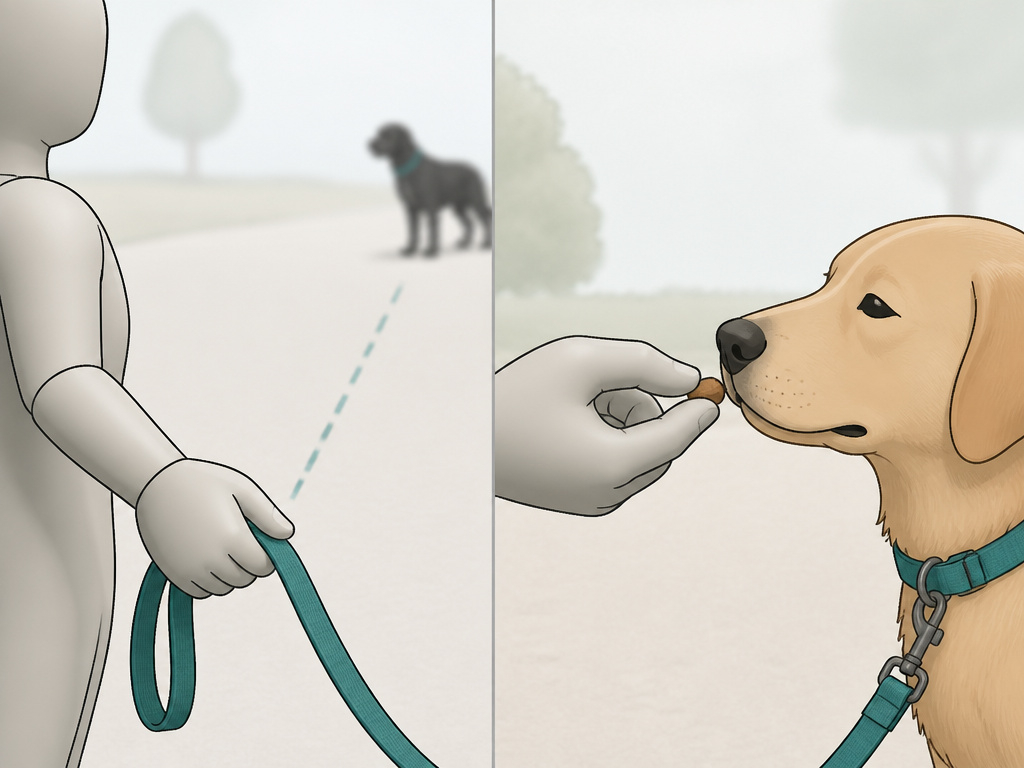
Dogs Trust tells you to keep moving, while Cornell has you feed treats as the trigger passes or as you move by. That’s a real split, and anyone who tells you there’s one correct answer is guessing.
Dogs Trust says to keep calmly and quietly moving if that helps your dog, and warns that stopping can sometimes make things worse. Cornell’s counter-conditioning approach has the handler feeding treats while the trigger passes or as you move by, which implies controlled delivery at a fixed safe distance.
| Source | Position | Best fit |
|---|---|---|
| Dogs Trust | Keep moving calmly; stopping can worsen it | Dogs that ramp up when stationary |
| Cornell (Houpt) | Feed as the trigger passes or as you move by | Dogs that take food reliably |
| PAWS Chicago | Stand at distance, wait a split second, feed | Early stage, controlled setups |
Here’s how I’d settle it for your dog. Try the stationary version first, in a controlled setup where you’ve chosen the distance. If the dog takes food and stays loose, you’ve got your method. If the dog gets stickier and more wound up the longer you stand there, switch to the moving version.
Fair warning: switching mid-walk is the worst of both. Pick one for a session and commit.
The underlying problem is the same either way. If your dog is barking and lunging at other dogs, the leash aggression side of this is worth reading next, because the fix depends on whether the driver is fear or frustration.
Should You Pause Walks Entirely While You Train?
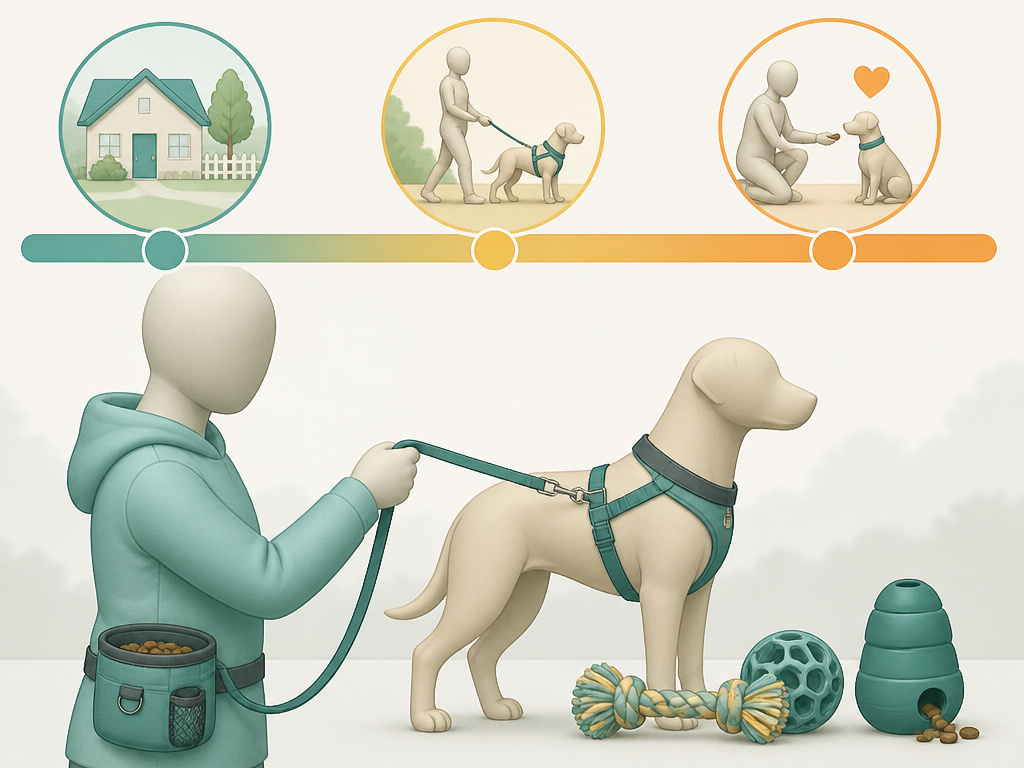
Sometimes the right answer is fewer walks. The AKC makes that case directly, endorsing what it calls pressing pause on walks: use the yard for toilet breaks and limit walks to decompression rather than training sessions.
Dogs Trust and Cornell both assume you’re still walking. Dogs Trust suggests keeping walks short and filling the day with enrichment, and says plainly that in the short term this beats longer walks with more trigger exposure. It also says it’s fine to skip long walks on days when the dog wakes up fizzy.
So you have a spectrum, not a rule. At one end, the AKC’s pause. In the middle, Dogs Trust’s short managed walks. At the other end, Cornell’s continued exposure with counter-conditioning.
If your dog has had a run of bad walks, cut the route shorter for a while. You lose nothing in fitness and you stop rehearsing the behaviour you’re trying to reduce.
Almost half of owners say their dog reacts to loud noises with signs of fear or anxiety, according to Dogs Trust, so the “just get them out more” instinct is doing more harm than most people realise. The positive reinforcement approach is the one all four sources agree on, and it’s the one to build the week around.
The Route Rules That Stop a Reaction Before It Starts
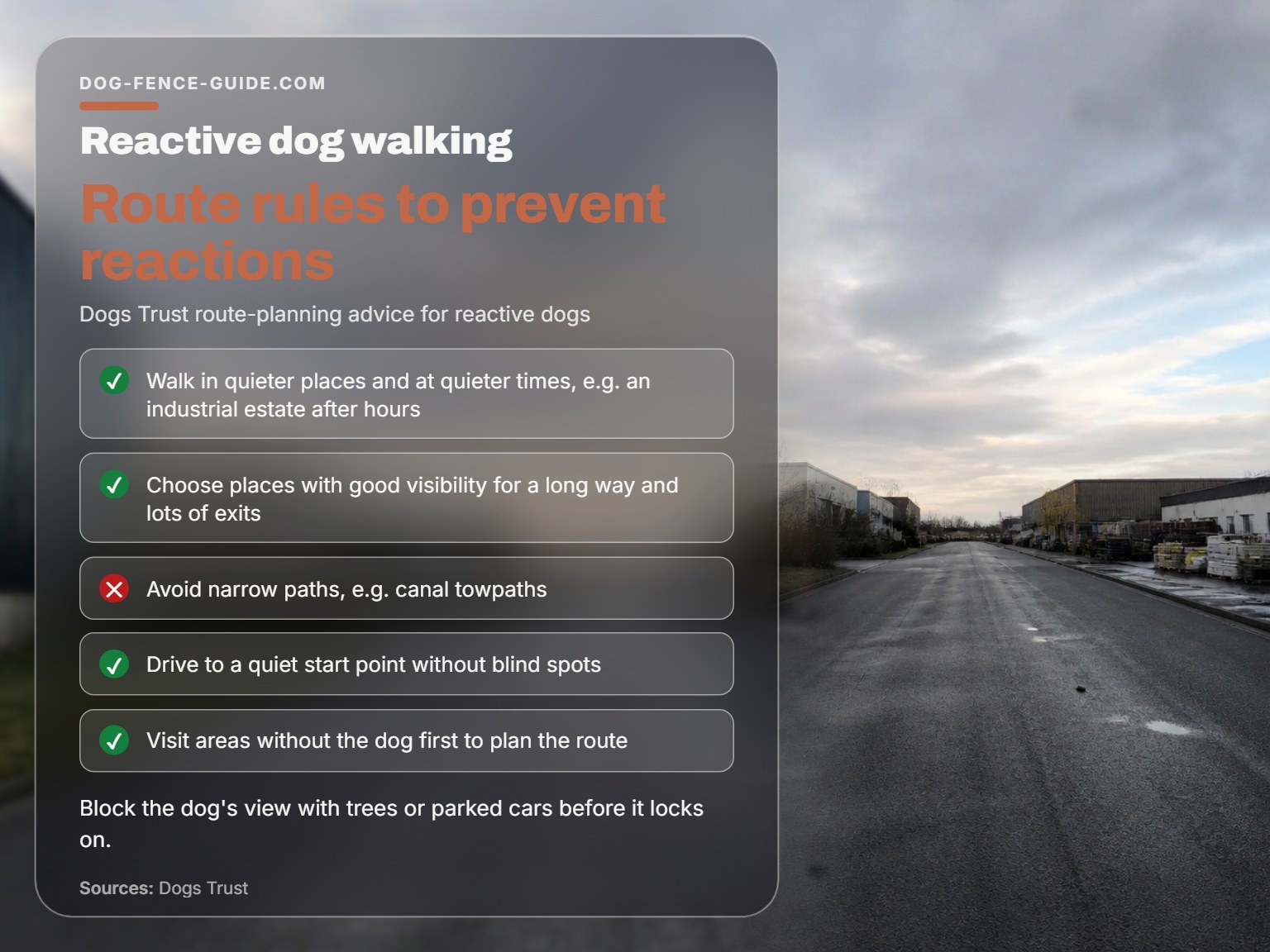
Route planning is the cheapest intervention available, and it costs nothing but a drive. Dogs Trust recommends quieter places at quieter times, and names an industrial estate after hours as the kind of spot that works.
The full list, in the order I’d apply it:
- Good visibility and lots of exits. You want to see a trigger coming from a long way off, with more than one way out.
- No narrow paths. Dogs Trust names canal towpaths specifically. A towpath gives you a hedge on one side and water on the other, which removes the entire distance strategy.
- Quiet times. Rush hour is not the moment for a training walk.
- Drive to the start. Walks don’t have to begin at your front door. Driving somewhere quiet without blind spots is a legitimate move.
- Scout it without the dog first. Visit the area alone and check when bin day is and when the post tends to come.
Sound matters more than most people expect. The jingle of a collar tag can reach your dog before you’ve registered anything, and by then you’ve lost the head start.
The part nobody mentions: Blocking the dog’s view with a parked car or a tree works, but only if you do it before the dog has locked on. Once the head is up and the body is still, you’re managing a reaction, not preventing one.
The ‘Find It’ Game and Why You Practise It With No Trigger
Dogs Trust teaches a scatter game called “find it”: say the cue as you toss treats on the ground, and the dog puts its nose down to search. A dog with its nose down is sending a clear signal to every other dog on the street that it’s busy.
The part people get wrong is practising it only when a trigger appears. Do that and the cue becomes a predictor of the scary thing, and the dog learns to look up instead of down. Practise it at home, in the garden, and on empty walks so it stays neutral.
This is the same principle behind proofing with distractions. A cue only holds up under pressure if it’s been rehearsed when nothing is happening.
How to Walk a Reactive Dog Past a Trigger Without a Reaction
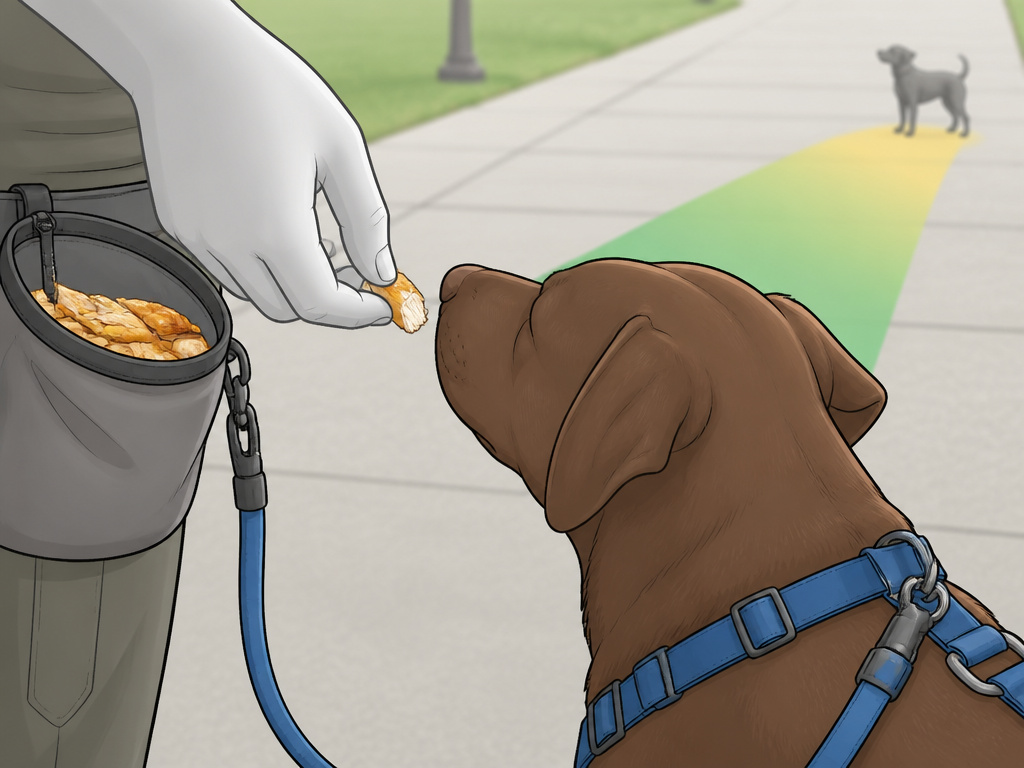
The head comes up, the ears go forward, and the mouth closes. That’s the three-second window where the walk either stays calm or turns into a scene.
What follows is the PAWS Chicago sequence with Cornell’s variation folded in at step four.
- Pick a treat the dog gets nowhere else. PAWS Chicago suggests roast chicken, steak, or cheese, kept in a bait bag or a pocket you can reach without looking. Skip this and you’ll be fumbling in a bag while the trigger walks past.
- Stand where the dog can see the trigger without reacting. That’s the whole definition of threshold, and it’s the step people rush. If the dog is already stiff, you’re too close.
- Wait a split second after the trigger appears, then feed. The delay matters. Feed too early and the food predicts the trigger instead of following it.
- Keep feeding as the trigger passes or as you move by. This is Cornell’s version, and it’s the one to use if standing still makes your dog worse.
- End on a win. Stop while the dog can still eat. One clean pass beats several sloppy ones, every time.
I’d rather see a handler nail one clean pass at a safe distance than muddle through several too close. The dog learns the pattern from the clean repetition, and you learn what your own timing feels like when it’s right.
Best Friends Animal Society teaches a related version called the Look at That game for reactive dogs, where the dog is rewarded for glancing at the trigger and then back at you. Same mechanism, different marker.
The tell that you’ve gone too far is food refusal. A frightened dog won’t take treats, and if the roast chicken stops working mid-walk, that’s your signal to add distance rather than push through. If the reaction has already escalated into dog lunging on leash, back the distance off before you work on anything else.
Everything above assumes the dog can hold a loose lead at all. If it can’t, start with loose leash walking in the driveway before you take it anywhere near a trigger.
When the Trigger Is Off-Lead, Narrow, or at Night
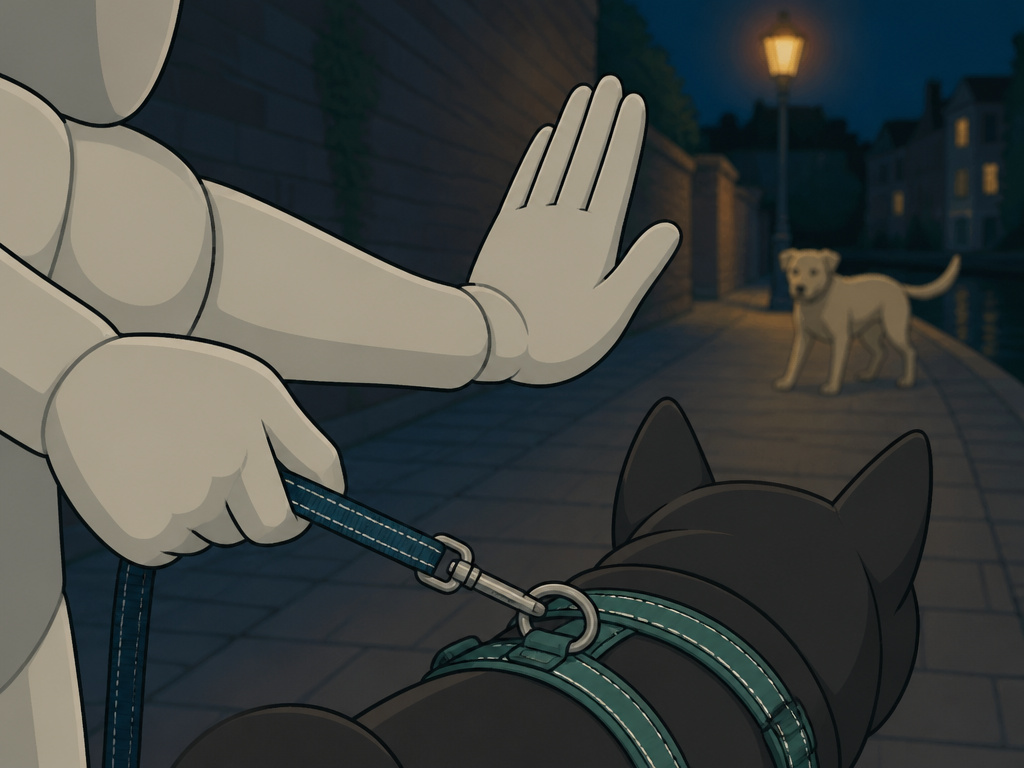
What do you do when the other dog isn’t on a lead at all? That’s the case the standard distance protocol can’t handle, and it’s the one that rattles people most.
Dogs Trust’s answer is to advocate for your dog out loud and ask the other owner to call their dog back. It doesn’t feel natural the first few times. Do it anyway, because the alternative is a loose dog closing the gap while you stand there hoping.
- Multi-dog households. Dogs Trust says walking them separately can be easier and safer. Two reactive dogs on one handler is a maths problem you can’t solve.
- Night walks and crowds. Cornell notes some dogs react only in congested spaces or after dark, so a route that works at 7am may fail at 8pm.
- Narrow ground. Canal towpaths and alleyways remove your exit options, which removes the strategy.
- Secure fields. Hiring a private dog field gives the dog off-lead running with no triggers at all. It’s a workaround, not a fix, but it keeps the dog’s exercise up while you train.
When a Muzzle Is the Right Call
Dogs Trust recommends muzzle training as an additional safety measure, and specifies a basket muzzle because it allows the dog to pant, take treats, drink, and exercise. A strap muzzle that holds the mouth shut doesn’t do any of that.
One thing to be clear about: a muzzle won’t change how the dog feels about the trigger. It reduces risk and it signals to other walkers to give you space. The emotional work still has to happen separately. The muzzles for reactive dogs guide covers the basket styles that allow a full pant.
Frequently Asked Questions
How long does it take to improve a reactive dog?
Dogs Trust says there’s no straightforward answer, and lists the factors that change it: why the dog is reactive, how strong the underlying emotion is, how often the dog meets the trigger, how long the behaviour has been practised, and how consistently you train. Anyone quoting you a fixed timeline is selling something.
Should I tell my dog off for growling at another dog?
No. Dogs Trust warns that telling a reactive dog off can intensify the behaviour, damage your bond, and suppress the growl. A dog that stops growling is still frightened, and it may lunge or bite next time with no warning first.
Can I just avoid other dogs entirely?
If your dog is barking, lunging and growling at other dogs, Dogs Trust says avoiding them or keeping your distance is the right move while you get support. The more a dog practises a behaviour, the stronger it gets, so avoidance buys you a clean baseline to work from.
Is a head halter cruel?
PAWS Chicago lists the Gentle Leader and the Opti Head Halter as appropriate for reactive dogs precisely because they give control in a non-punitive way. The caveat is fit and conditioning. A head halter the dog has never worn, yanked on during a lunge, is a different thing entirely.
What if my dog only reacts at night or in crowds?
Cornell notes this pattern specifically. It usually means the trigger isn’t the dog itself but the density of the environment. Try the same route at a quieter hour and see whether the reaction changes. If it does, you’ve found your variable.
The Bottom Line
Here’s the threshold I’d give you. If your dog won’t take roast chicken at the distance you’re standing, you’re too close, and no amount of cue repetition will fix it. Move back until the food works again, even if that means the other dog is a speck on the horizon.
The second thing is a concession. Everything above assumes a dog whose reactivity is behavioural. Dogs Trust is clear that you should get a vet check first to rule out underlying medical conditions, because pain lowers a dog’s tolerance and no training plan beats a sore tooth.
So the honest answer on how to walk a reactive dog is less exciting than the marketing: a short lead, a harness that fits, a pocket of chicken, and a route you scouted on your own first. That’s it. The rest is repetition, and repetition is boring, which is exactly why so few people stick with it long enough to see the pause before the turn-around.
