
How to Train a Dog in an Apartment: Step-by-Step
This post contains affiliate links. As an Amazon Associate, we earn from qualifying purchases.
To train a dog in an apartment, work in three layers: house training on a schedule the puppy can hold (one hour per month of age, give or take an hour, per Ohio State’s Indoor Pet Initiative), confinement that never exceeds that limit, and reward-based obedience in short daily sessions. The hallway, elevator, and street count as separate lessons.
The walk to the street is the detail that breaks the standard house-training loop. In the AKC’s apartment case, the dog began crying to go out only a couple of weeks into training, and then the walk to the street ate the minutes between signal and relief. The AKC’s own apartment case documents exactly that failure, which is why the how to train a dog in an apartment question often comes down to latency.
What follows: the age-based hold-time math, a crate setup that fits a small floor plan, the six-step introduction, and the crying rule that owners get half right.
Key Takeaways
- One hour per month of age, give or take an hour, is the ceiling on crate time, per Ohio State’s Indoor Pet Initiative. A 3-month-old tops out around three to four hours.
- Block off most of an adult-size crate for a puppy who will grow into it, so there is no spare corner to soil.
- End crate sessions before the food toy runs out. A session that stops on a good note beats one that stops on a whine.
- Crying comes in two flavors. A protesting puppy can wait a beat. A frantic one needs the session stopped and help called.
- Skip shock, prong, and choke collars. AVSAB’s 2021 position statement groups them with squirt bottles and alpha rolls.
How to Train a Dog in an Apartment Without a Yard
The apartment stretches the distance between a dog’s signal and the place she is allowed to go. That distance is the whole problem, and a house with a yard quietly solves it for you.
Blue Buffalo notes that apartment dogs and yard dogs land in similar territory on activity, as long as the walks actually happen. The yard’s one real advantage is speed: the door opens, the dog is outside, and the reward lands within seconds of the signal.
Take the speed away and the loop frays. The dog learns to signal, you learn to sprint, and the elevator takes its time.
None of that changes what the dog has to learn. Sit, down, stay, come, and a loose leash are still the entire foundation, and you can build all of it in 400 square feet with the same dog training at home you would use in a house.
What changes is where you practice and how fast the reward can arrive. Space matters less than traffic. A crate in the corner of the room where you actually sit beats a crate in a quiet spare bedroom, and a workable dog-friendly apartment setup is mostly about putting the dog where the family already is.
How Long Can a Puppy Actually Hold It?
How long can a puppy actually hold it? Ohio State’s Indoor Pet Initiative gives the only hard number in this conversation: one hour for each month of age, give or take an hour.
| Puppy’s Age | Hold Time (OSU Rule) | If You Are Gone Longer |
|---|---|---|
| 2 months | 1 to 3 hours | Exercise pen or gated kitchen |
| 3 months | 2 to 4 hours | Mid-day walker or neighbor |
| 4 months | 3 to 5 hours | Gated room, not a longer crate |
That figure is a ceiling on confinement. Your workday is a separate problem, and the same page is blunt about it: never confine a puppy longer than she can realistically be expected to hold her urine and feces.
A 3-month-old might easily resist urination for three to four hours, per OSU. A 2-month-old sits closer to one to three.
Fair warning: the table gives you the dog’s limit. Your building sets a different one, and the walk to the elevator is part of it.
I will flag a blind spot of mine here. Most of the dogs I have worked with have been medium and large, so the hold-time math for a very small dog comes from the veterinary sources rather than from my own floor.
Sizing a Crate for 400 Square Feet (and the Block-Off Trick)
Ohio State’s crate guidance is functional rather than dimensional. The crate has to be big enough for the puppy to sit, stand, turn around, and lie down comfortably on her side, and tight enough that she cannot soil one corner and sleep in another.
A crate is correctly sized when the puppy can sit, stand, turn around, and lie down comfortably on one side, with no surplus room to eliminate in one corner and rest in another. A puppy that will grow large uses an adult-size crate with most of the interior blocked off.
That second half is the part people skip. A dog avoids soiling her bed when she has any choice about it, so an oversized crate hands her a choice she did not need. Block the extra volume and the instinct does the training for you.
Wire crates often ship with a divider panel for exactly this. A divider panel lets you shrink the space on day one and widen it as she grows.
Placement matters as much as size. Put the crate where the family spends its evenings, because a puppy who can see you settles faster than one behind a closed door. OSU also suggests a DAP (dog appeasing pheromone) diffuser plugged in nearby for extra comfort.
Where this goes sideways: Giving a puppy the full adult-size crate on day one. She will sleep at one end and soil the other, and you will spend a week undoing a habit she learned in a single night.
The 6-Step Crate Introduction (and When to Stop)
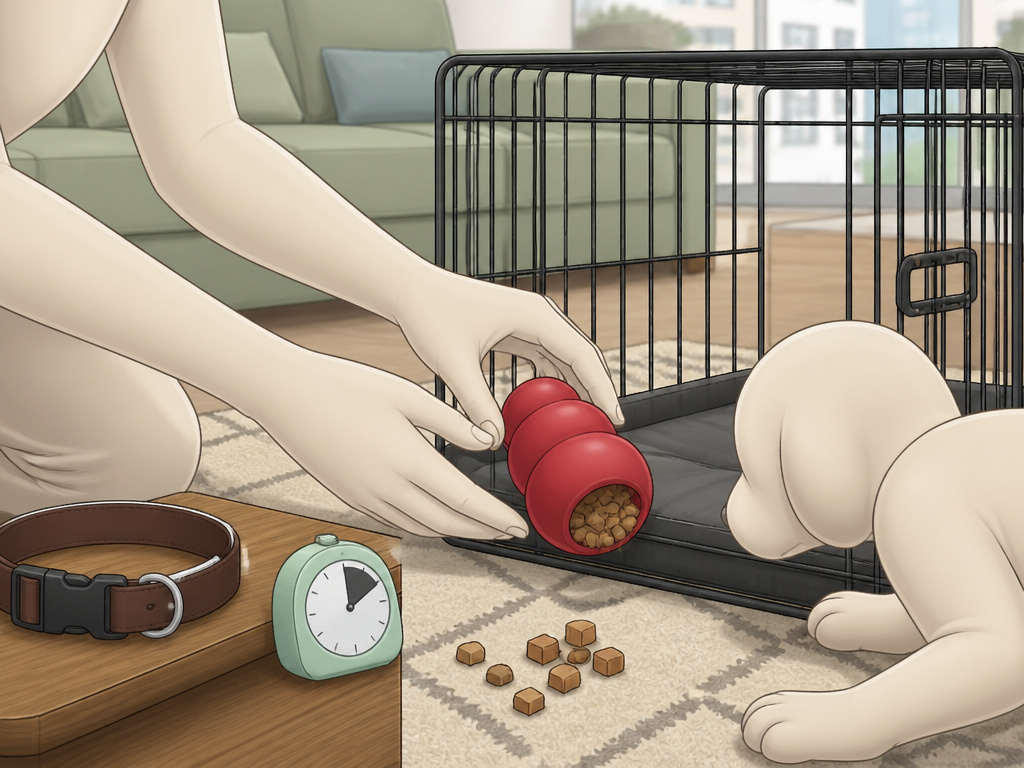
I learned the session-length lesson the hard way. Long crate drills made the dog worse. Short sessions, ended while she was still working on a stuffed KONG, got me further than any long drill ever did.
Before you start: Take the collar off before the door closes. A tag can catch between the bars, and a panicking puppy can hurt her neck in seconds. Set a timer for the hold-time limit above, because a crate session that runs long teaches her to soil where she sleeps.
- Put the crate where the family sits. A crate in a spare bedroom gets used twice and then holds laundry.
- Leave the door open and toss treats and toys inside. Let her walk in and out several times with the door open. Skip this and shut her in on day one, and you get a dog who braces at the sight of the crate.
- Feed meals and food-stuffed toys inside. A food-stuffed toy packed with her own kibble and a smear of wet food is enough. Close the door once she is eating comfortably.
- Stretch the time with a long-lasting chew. Leave the room for short stretches while she is occupied, and come back before she notices you are gone.
- End the session before the food runs out. OSU’s reasoning is simple: practice that stops before stress starts is practice that sticks.
- Repeat daily and keep it brief. A training session length you can hold to every day beats a long one you dread.
How often you run those sessions matters less than whether you run them at all. A how often to train a dog schedule built around meals is the easiest one to keep, because the puppy is already hungry and already paying attention.
The crate training sequence works the same way whether you are in a studio or a house. The only variable is how far the crate sits from the sofa.
What Do You Do When the Puppy Cries in the Crate?
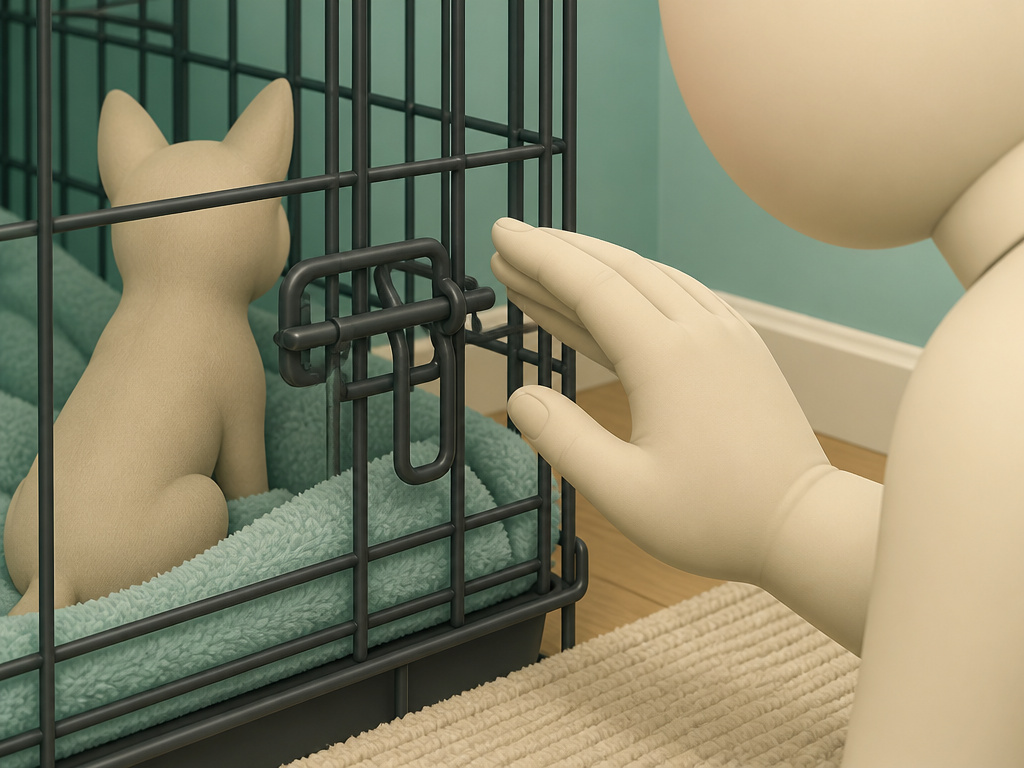
The short answer is that it depends on which cry you are hearing. OSU’s crate page gives two instructions that pull against each other, and the page knows it.
The first is to try not to let her out until she quiets, because a puppy who learns that crying opens the door will cry every time the latch clicks; the second is to stop the session right away and call for help if she is frantic rather than protesting. The second is to stop the session right away and call for help if she is frantic rather than protesting.
Protest or Panic: The Judgment Call
A protest has a rhythm. It starts, runs a few seconds, pauses while she listens for footsteps, then starts again. Panic climbs: the pitch rises, the pauses disappear, and you hear her scrambling against the crate pan instead of settling onto it.
That distinction is the whole judgment call, and OSU flags it as the hard part. If the anxiety signs show up (panting, yawning, salivation), the page says you may need to start over at a level she is comfortable with or consult a behavior specialist.
I will not let a puppy cry it out past the point where the sound changes. A rhythmic protest is one thing. A rising, scrambling panic is a dog learning that the crate is a bad place, and every minute past that point costs days of retraining.
Never punish a puppy for crying in the crate. OSU is explicit about that, and the reason is mechanical: punishment adds fear to the one place you are trying to make safe.
The sources leave a gap here. OSU frames crate training as a way to teach independence and help prevent separation anxiety, while the same page warns that panting, yawning, and salivation during crate training could be early signs of it. No source I found says exactly where one turns into the other.
House Training When the Relief Spot Is Four Flights Down
The AKC’s apartment case is the most useful failure story here. A dog named Emily started crying at the door to go out only a couple of weeks into training, and the accidents kept coming because her handler could not get her down to the street fast enough.
The dog had learned the signal. The building was the problem.
That is a latency problem, and it is the one thing a yard would have hidden. A reward that lands long after the behavior rewards whatever happened just before it, which is usually a second sniff of the same rug.
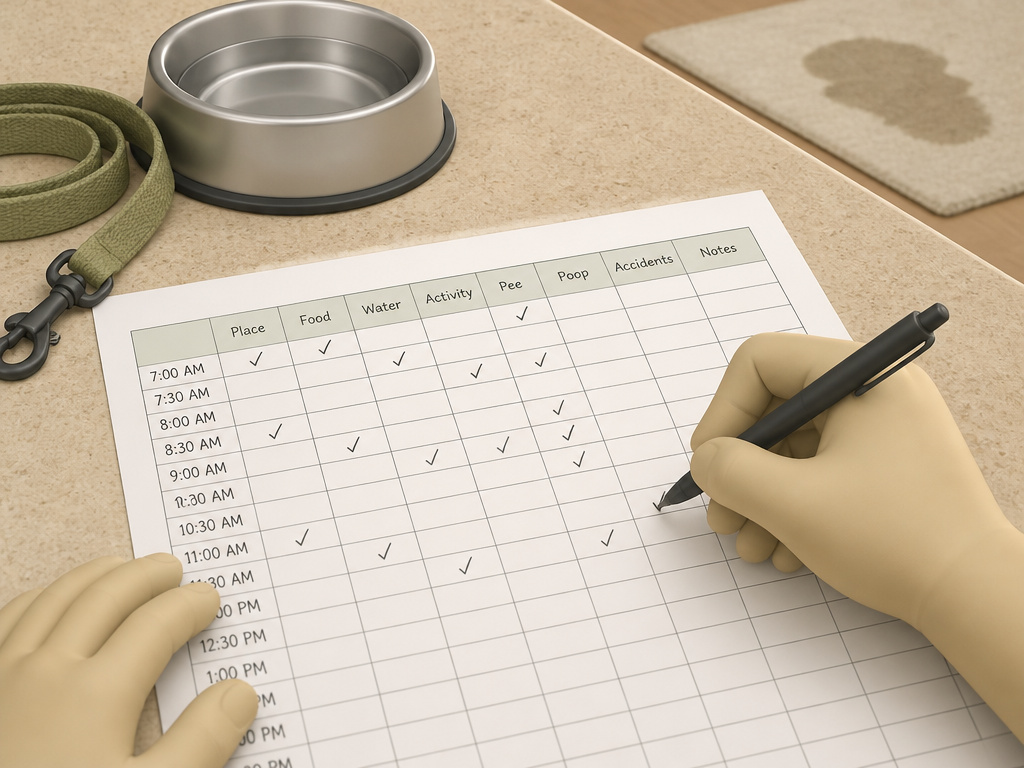
The fix in that case came from a trainer: a sheet ruled for every half hour of the day, with eight columns for Place, Food, Water, Activity, Pee, Poop, Accidents, and Notes. Fill it in and the pattern shows up. The accident lands at a predictable point after the water bowl instead of at random.
Why the Apartment, the Hallway, and the Sidewalk Are Three Different Lessons
- The apartment teaches the signal at the door, on your floor, with your rules.
- The hallway and elevator repeat the same signal with neighbors, noise, and a leash attached.
- The sidewalk and gutter are where the relief actually happens, and where a city dog is expected to go. The AKC calls gutter business good manners.
- A dog trained only indoors will fail in the hallway, because house training does not generalize across locations on its own.
Some buildings make the street trip impossible in the time you have. That is the case for indoor potty systems, which work as a bridge rather than a permanent answer.
| What You Are Seeing | Likely Cause | What to Change |
|---|---|---|
| Crying at the door, accident seconds later | Latency, not defiance | Start the trip before the signal peaks |
| Sniffing and circling on the rug | A missed signal | Log the times; you are late |
| Clean indoors, accidents in the hallway | No generalization | Train the hallway as its own location |
| Soiling inside the crate | Past the hold limit, or too much space | Shorten the session or block off the crate |
One more thing the log sheet catches: the rug corner. An apartment spot that has had accidents still smells faintly of ammonia even after the surface looks dry, and that is why she keeps going back to it.
Quiet-house practice has limits too. One dog I worked with only broke at the door when guests arrived, and months of drills in an empty apartment had not touched it. Short, controlled sessions with people coming in and out fixed what the quiet reps could not.
Reward Timing, and the 12 Tools AVSAB Wants You to Skip
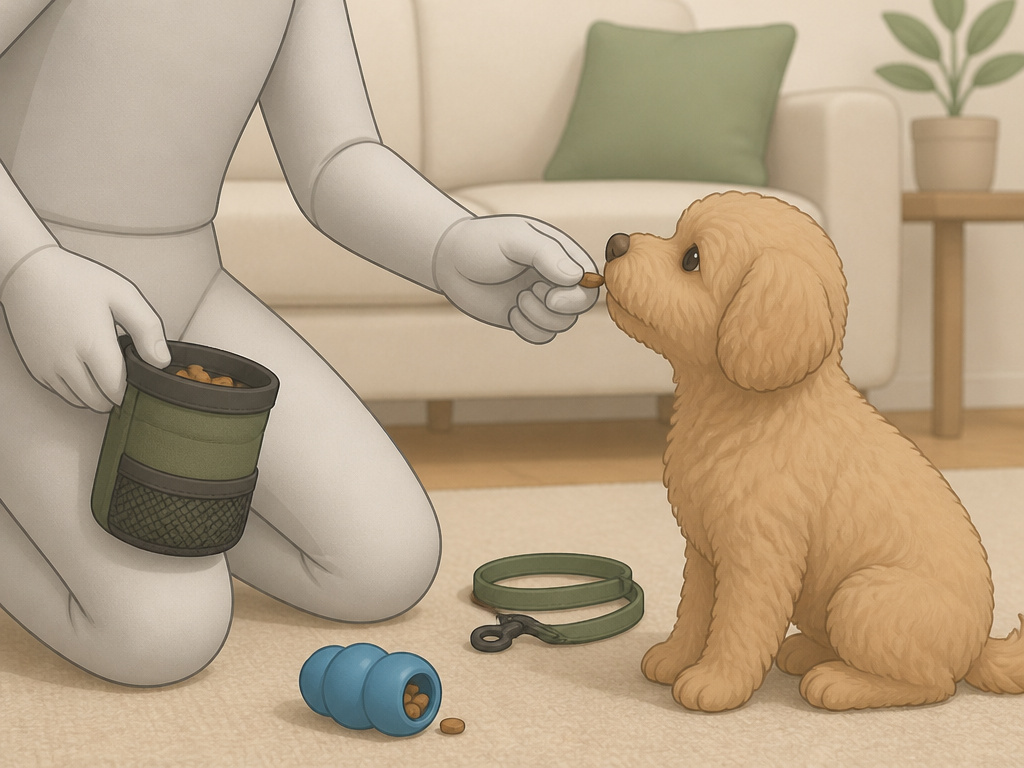
Pay the dog fast or do not bother.
VCA’s behavior team defines a reward as anything the dog likes that can be delivered quickly: treats, toys, attention, praise, and petting. Speed is the point. A treat that arrives after you have walked back to the kitchen is a treat for walking back to the kitchen.
Rate matters most when the behavior is new. VCA warns that if reinforcement drops too low, the dog wanders off, loses interest, or gives up.
Two mistakes VCA names directly: starving the dog to make treats more valuable, and locking up every toy so it only appears during training. Both make the dog worse off, and neither makes training easier.
Easy to miss: A treat pouch left open on the counter rewards the wrong thing. VCA’s guidance is to keep rewards in a pouch or pocket so they only appear when the dog earns them.
Reward-Based vs Aversive: What the Evidence Actually Shows
AVSAB’s 2021 position statement lists the tools it wants out of training: choke chains, prong collars, electronic shock collars, squirt bottles, shaker noise cans, compressed air cans, shouting, staring, alpha rolls, dominance downs, leash jerking, and flooding. The stated reasons are increased anxiety, fear-related aggression, avoidance, and learned helplessness.
Plenty of trainers and store shelves still disagree with that position. The retail and aversion-trainer segment sells most of those tools, and owners still buy them. It is worth knowing which side of that disagreement is a professional body of veterinary behaviorists and which side is a product listing.
The effectiveness argument gets oversold in both directions. AVSAB cites Hiby et al (2004), where obedience was highest in dogs trained only with rewards and lowest in dogs trained only with aversive methods, with mixed “balanced” training landing in between. AVSAB also notes that even in experienced hands, remote shock collars showed no effectiveness advantage over reward-based methods for teaching recall.
What to reach for instead:
- A food-stuffed toy stuffed with kibble and frozen, for crate sessions that need to last.
- A treat-dispensing chew toy for the puppy who empties a food toy faster than you would like.
- A training platform for the place command, which is how you keep a dog settled while you cook in a kitchen the size of a closet.
- A DAP (dog appeasing pheromone) diffuser near the crate, which OSU mentions for extra comfort.
None of this requires a trainer in the room, though VCA encourages professional coaching for families new to dog training. AVSAB goes further and suggests veterinarians interview and observe a trainer’s methods before recommending one, which is a decent filter for anyone hiring help.
Frequently Asked Questions
How often should you take a puppy out in an apartment?
As often as her age allows. Ohio State’s rule is one hour of hold time per month of age, give or take an hour, so a 3-month-old might manage three to four hours. In an apartment, subtract the elevator ride from that budget, because the trip itself eats the margin.
Is crate training cruel for an apartment dog?
OSU frames the crate as a management tool that prevents inappropriate elimination, protects the puppy from excessive handling by small children, and teaches independence. The same page warns that panting, yawning, and salivation during crate training could be early signs of separation anxiety. A crate used inside the age-based hold limit, introduced with food and rewards, is the version the sources describe.
What do you do with a puppy during a full workday?
OSU’s answer is a bigger space rather than a longer crate session: an exercise pen, a baby gate, or a confined kitchen, bathroom, or laundry room. A dog walker or a neighbor who can take her out mid-day covers the rest.
Should you use a shock collar or prong collar to stop crying in the crate?
AVSAB’s 2021 position statement says no. It lists choke chains, prong collars, and electronic shock collars among tools that involve pain, and ties aversive methods to increased anxiety and fear-related aggression. The statement also notes that remote shock collars showed no effectiveness advantage over reward-based methods for teaching recall, even in experienced hands.
How long should each apartment training session be?
Short enough that it ends before the puppy loses interest. OSU’s guidance is to set up practice that finishes before any stress begins, and VCA warns that a low rate of reinforcement makes dogs disengage. Short daily work beats a long session you only get around to on weekends.
The Bottom Line
Here is the trigger that matters most when you are working out how to train a dog in an apartment: if your puppy soils the crate more than once in a week, stop lengthening the sessions. Something upstream is wrong, whether that is too much space, too long a stretch, or a street trip that arrives late.
The rest is repetition. Short daily sessions, a log sheet, and a crate sized to the dog in front of you will do more than any piece of equipment.
That advice assumes a puppy. An adult rescue who has never lived indoors is a different job, and the hold-time math does not transfer cleanly, because the limit there is habit rather than bladder.
And if you cannot make the mid-day trip work, the honest answer is a pen or a walker. A bigger crate and a longer timer just teach the dog to soil where she sleeps.
