
4 Best Harnesses For Deep Chested Dogs in 2026
This post contains affiliate links. As an Amazon Associate, we earn from qualifying purchases.
The ThinkPet No Pull Escape Proof Harness is the best overall choice for deep-chested dogs because its third strap prevents backing out, a common escape trick for narrow-waisted breeds. The PETFORTA Anatomically Correct Y-Shape Harness wins for best anatomical fit, while the Kurgo Tru-Fit Smart Harness stands out as the only crash-tested option in this group.
Deep-chested dogs like Great Danes, Dobermans, and Boxers have a body shape that standard harnesses simply don’t accommodate. The chest is broad and deep, but the waist tucks in sharply, which means many harnesses slip, twist, or sit too far forward on the neck.
We evaluated these four harnesses based on manufacturer specifications, adjustment range, hardware quality, and patterns in owner feedback. This guide gives you the key differences so you can match a harness to your dog’s build and your daily routine.
Top 4 Harnesses For Deep Chests Dogs in the Market
Certain content that appears on this site comes from Amazon. This content is provided "as is" and is subject to change or removal at any time.
The Best Harnesses For Deep Chests Dogs, Reviewed
ThinkPet No Pull Escape Proof Harness
What We Like
- Third strap prevents backing out
- Front clip redirects lunging dogs
- Light-catching trim for low-light visibility
Trade-offs
- Third strap adds time to put on
- Not a car restraint or tie-out
- Hand wash or gentle cycle required
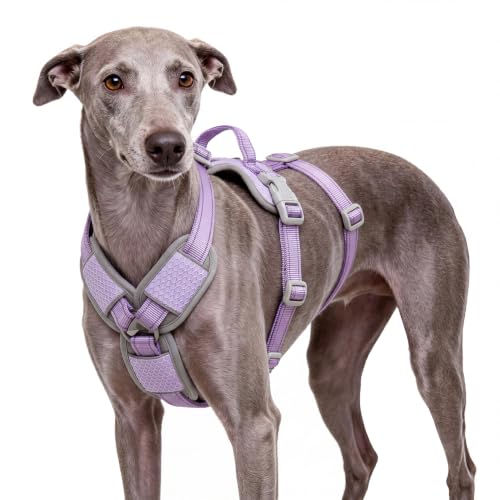
The third strap wraps the waist past the ribcage, which is the single feature that makes this harness work for deep-chested, narrow-waisted dogs that can reverse out of a standard two-strap design. The front panel uses a ring to link the chest straps, so the panel shifts as the dog runs rather than pressing in one spot, and the V-neck sits away from the throat. For owners of Greyhounds, Vizslas, or Huskies who have watched their dog slip a harness mid-walk, this addresses that exact failure point without adding bulky padding that restricts movement. The four adjustment points let you dial in the fit with two at the chest, one on top, and one underneath, and the front clip gives you steering leverage when a lunge happens.
The third strap means more buckles to check and a slightly slower process getting the harness on. It takes extra time if you switch between the three-strap escape-proof mode and the lighter two-strap mode for calm days. Compared to the PETFORTA Anatomically Correct Y-Shape Harness, which uses a Y-front to avoid shoulder restriction, the ThinkPet prioritizes security over speed of donning. If your dog has never tried to back out of a harness, the extra strap may feel unnecessary, but for anyone who has dealt with a narrow-waisted escape artist, that third strap is what makes this the most reliable option for deep-chested builds.
Product photos
PETFORTA Anatomically Correct Y-Shape Harness

What We Like
- Anatomically correct Y-shape frees shoulder joints
- 6-point adjustment fits deep-chested breeds
- Reflective stitching for low-light safety
Trade-offs
- Multiple adjustment points take time to set initially
- No front clip for redirecting pullers
A central triangular connector creates a true Y-shape across the chest, keeping shoulder joints free while distributing tension evenly over the ribcage rather than the neck. With six independent adjustment points you can dial the fit precisely around a broad chest and narrow waist, and the reflective stitching adds visibility without bulk. It suits owners who want a harness that respects canine biomechanics and stays put without chafing.
The harness redirects force across the dog’s chest, a naturally strong area, so you get balanced control without putting pressure on the neck. Six independent adjustment points let you calibrate the fit for everything from slim to deep-chested breeds. Reviewers note that dialing in all six points takes more time than simpler clip-and-go designs. Once adjusted, the balanced strap geometry keeps the harness centered and stable during active walks, and the D-rings tested to withstand up to 342 lb and buckles up to 335 lb provide everyday peace of mind.
Product photos
PETFORTA No Pull Y-Shape Harness with Neck Buckle

What We Like
- Neck buckle avoids overhead fitting
- 6-point adjustment fits deep chests
- Y-shape keeps shoulders free
- Reflective stitching for low-light safety
Trade-offs
- Multiple adjustment points need initial setup
- Neck buckle requires two hands to fasten securely.
A neck buckle that opens instead of pulling the harness over the dog’s head is the single most practical feature for a deep-chested dog that flinches at overhead gear. The Y-shape keeps the shoulder joints free, and the six adjustment points allow you to tune the fit around a broad ribcage without the harness twisting off-center. For owners who want a calm, no-fuss dressing routine with a breed that tends to resist, this design solves the first hurdle before the walk even starts.
Six points of adjustment mean more straps to tighten on first use, and the plastic buckles, while tested to 335 lb, aren’t as reassuring as the all-steel hardware on the Kurgo Tru-Fit Smart Harness. But if your deep-chested dog is sensitive about things going over the head and you value a quick on-and-off over bombproof buckles, the PETFORTA earns its keep as the easiest harness to get into and out of each day.
Product photos
Kurgo Tru-Fit Smart Harness
What We Like
- Crash tested for dogs up to 75 lbs
- Five adjustment points for custom fit
- All-steel nested buckles and hardware
- Padded chest plate for comfort
Trade-offs
- No rear-clip leash attachment for pullers
- Medium fits necks 16-25 inches, chest 18-28 inches
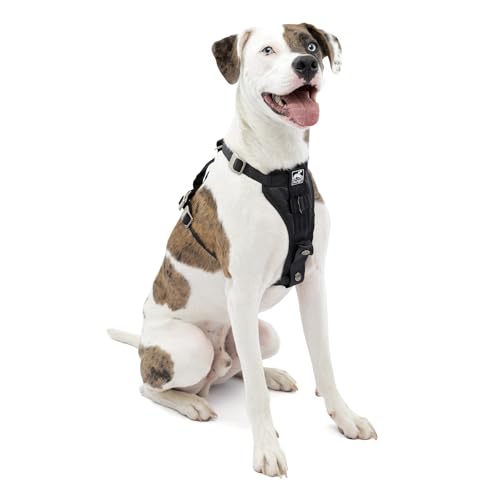
Crash tested for dogs up to 75 pounds, this harness gives you something most walking harnesses don’t: a seatbelt tether with a steel carabiner that actually holds in a collision. Five adjustment points allow you to tune the fit around a deep chest without the whole thing twisting sideways. The broad padded chest plate spreads pressure so your dog doesn’t fight the straps on every ride. If you drive with your dog loose in the car and want a single harness that handles both daily walks and crash protection, this is the one that checks that box.
The medium size tops out at a 28-inch chest and 25-inch neck, which leaves out larger deep-chested breeds like Great Danes or adult Dobermans. If your pup’s chest measures under 28 inches and you prioritize car safety over escape-proofing, this is the smarter pick.
Product photos
How We Evaluated Harnesses For Deep Chests Dogs
This guide is built from manufacturer specifications, expert round-ups, and the patterns we see in owner feedback across multiple sources. We focused on the design features that matter most for a deep, narrow chest shape.
The three criteria that drove our rankings were fit adjustability, escape prevention, and leash-attachment options. Deep-chested dogs need more adjustment points than average breeds, and a harness that cannot tighten sufficiently at the waist will let a dog slip the chest strap. We also looked at hardware quality because a strong puller can break plastic buckles on budget harnesses.
An honest limit of a research-led evaluation is that individual dog proportions vary. A harness that fits one Great Dane perfectly may sit differently on a Doberman with the same chest depth. We prioritized harnesses with enough adjustment range to cover multiple deep-chested breeds and included owner-reported fit notes for each pick.
What To Look For In Harnesses For Deep Chests Dogs
Choosing a harness for a deep-chested dog starts with understanding that a one-size-fits-all approach fails this body type. You need a harness that accommodates a broad chest while cinching securely at the narrower waist.
Look for a harness with at least 4-6 adjustment points, a Y-shape front that clears the shoulders, and a third belly strap if your dog is an escape artist. Avoid step-in styles that require the dog to lift a leg through a fixed opening.
Adjustment Points and Fit Range
Deep-chested dogs need a harness that adjusts at the neck, chest, and waist independently. A harness with only two straps often sits too loose around the midsection, letting the dog back out of the chest loop. The PETFORTA Anatomically Correct Y-Shape Harness offers six adjustment points, which allows a precise fit for breeds like the best harness for a Doberman or a German Shepherd.
Measure your dog’s neck, chest, and waist girth before buying. Many owners of deep-chested breeds find that the chest measurement alone is misleading, the waist can be 4-6 inches smaller, so a harness that fits the chest may be too loose at the waist.
Escape Prevention Features
The hallmark of a deep-chested dog is the ability to slip a standard harness. The ThinkPet No Pull Escape Proof Harness solves this with a third strap that runs behind the ribcage, creating a loop the dog cannot wriggle out of. This design is especially useful for big dogs that have learned the backward shuffle escape move.
Some harnesses address escape with a martingale-style loop at the chest. Others, like the Kurgo Tru-Fit, rely on a padded chest plate and multiple adjustment points to create a snug fit without a third strap. If your dog has already escaped one harness, prioritize a model with a dedicated anti-slip feature.
Leash Attachment Placement
Where the leash clips matters for control and comfort. A front clip on the chest lets you redirect a puller by steering the dog’s shoulders sideways, which is gentler than a collar correction. The ThinkPet has both a front clip and a back clip, giving you options depending on the walking environment.
A back clip alone can encourage pulling in a deep-chested dog because the harness pulls against the broadest part of the chest. The PETFORTA No Pull Y-Shape Harness with Neck Buckle uses only a back clip, so it is better suited for dogs that walk calmly on a loose leash. For a strong puller, look for a harness with at least one front attachment point.
- Measure your dog’s neck, chest, and waist separately before choosing a size.
- Test the harness indoors before using it on a walk.
- Check that the chest strap sits at least two finger-widths behind the armpit.
- Inspect buckles and D-rings weekly for wear if your dog is a strong puller.
- Wash the harness according to care instructions to prevent odor and fabric breakdown.
A good rule of thumb: if you can fit more than two fingers between the harness and your dog’s waist, the fit is too loose for a deep-chested breed.
Harnesses For Deep Chests Dogs Compared
The table below compares the four harnesses side by side, highlighting their fit range, attachment options, and key safety features so you can see the differences at a glance.
| Product | Chest Range | Adjustment Points | Clip Positions |
|---|---|---|---|
| ThinkPet No Pull Escape Proof Harness | 24-31 in | 4 | Front steering + back ring |
| PETFORTA Anatomically Correct Y-Shape Harness | N/A | 6 | N/A |
| PETFORTA No Pull Y-Shape Harness with Neck Buckle | N/A | 6 | Front D-Ring |
| Kurgo Tru-Fit Smart Harness | 18-28 in | 5 | Back and front |
Frequently Asked Questions
What makes a harness good for a deep-chested dog?
A harness for a deep-chested dog needs multiple adjustment points to fit both the broad chest and the narrow waist. It should also have a secure closure system, either a third belly strap or a martingale-style loop, to prevent the dog from backing out.
Can a deep-chested dog wear a step-in harness?
Step-in harnesses are generally not recommended for deep-chested dogs. The fixed leg openings make it difficult to get a snug fit around the narrow waist, and the harness tends to shift toward the neck during walks.
Should I use a front clip or back clip for my deep-chested dog?
A front clip gives you more steering control if your dog pulls, redirecting the shoulders instead of the neck. A back clip works well for dogs that walk calmly, but it can encourage pulling in strong breeds because the pressure hits the widest part of the chest.
How do I measure my dog for a deep-chested harness?
Measure the neck at its widest point, the chest just behind the front legs, and the waist at the narrowest point before the hips. Use the waist measurement to choose a harness size, many deep-chested dogs need a size based on their smaller waist rather than their larger chest.
Is a crash-tested harness worth it for a deep-chested dog?
A crash-tested harness like the Kurgo Tru-Fit provides verified protection for dogs up to 75 pounds, which is valuable for car travel. For daily walks, a non-tested harness with a good fit and escape prevention is usually sufficient.
The Bottom Line
The ThinkPet No Pull Escape Proof Harness is the best overall pick for deep-chested dogs because it solves the two biggest problems: escape and pulling. The third strap keeps narrow-waisted breeds secure, and the front clip gives you steering control without jerking the dog’s neck. This is the harness to choose if your dog has slipped out of previous harnesses or tends to lunge at squirrels.
If your priority is unrestricted shoulder movement for an active breed, the PETFORTA Anatomically Correct Y-Shape Harness offers the most precise fit with six adjustment points. For owners who want a single harness for walks and car travel, the Kurgo Tru-Fit Smart Harness provides crash-tested peace of mind for dogs up to 75 pounds.
The single most important factor in buying a harness for a deep-chested dog is the waist fit. No amount of padding or reflective stitching matters if the harness can slide over the dog’s ribs. Measure the waist, check the adjustment range, and choose a harness that cinches securely at the narrowest point.
