
How to Dog-Proof a Garden: Step-by-Step
This post contains affiliate links. As an Amazon Associate, we earn from qualifying purchases.
Dog-proof a garden by fixing containment first: a fence at least 6 feet tall, a dig barrier buried 12 to 24 inches deep along the inside perimeter, and a latch a dog cannot nose open. Then remove toxic plants, block compost, and drain standing water before you plant anything new.
That 12-to-24-inch figure comes from one source only, the Atlanta Humane Society. The AKC recommends a chicken wire L-footer for digging dogs and gives no depth at all. Both agree the barrier has to exist below grade. They just don’t agree on how far down it goes, which is why how to dog-proof a garden is not settled by a single number.
What follows walks the yard in the order that actually matters for how to dog-proof a garden: fence line, dig barrier, plants, chemicals, heat, and the small hardware most people forget until the dog is already through the gate.
Key Takeaways
- Six feet is the floor, not the finish line. The Atlanta Humane Society sets 6 feet as a minimum and 10 to 12 feet for a large dog, but height alone loses to a launch point.
- Compost is the highest-stakes item in the yard. UF/IFAS warns a mycotoxin-producing fungus in compost can cause severe, potentially deadly poisoning.
- Shade moves within an hour. The AKC notes a spot that was shady can be full sun by the time you check back.
How Tall Does a Dog Fence Actually Need to Be?
Six feet is the number most guides hand you. One source actually commits to it, and the same source goes much higher for a big dog.
Fence height guidance varies by source. The Atlanta Humane Society specifies a minimum of 6 feet, and 10 to 12 feet for a large dog. The AKC gives no numeric minimum, recommending increased height plus coyote rollers for jumpers and climbers. UF/IFAS addresses only decorative bed fencing at 1 to 3 feet.
Here is the honest version. Those three positions do not reconcile into one number, so pick the one that matches your dog.
| Source | Height guidance | What it covers |
|---|---|---|
| Atlanta Humane Society | 6 ft minimum; 10 to 12 ft for large dogs | Perimeter fence |
| AKC | No numeric minimum; raise height, add coyote rollers | Jumpers and climbers |
| UF/IFAS | 1 to 3 ft | Decorative fencing around beds only |
The worst escape I’ve dealt with was a low fence with a woodpile against it. The dog went over in one motion, every single time, and the owner kept pricing taller panels. We moved the woodpile well back from the fence and the escapes stopped that week. Nobody bought a taller fence.
Height buys you time. A launch point cancels it. Walk your fence line and look for anything a dog can stand on: a bench, a doghouse, a stacked pallet, a compost bin, a slope that rises toward the rails, and think about how to dog-proof a garden around each one.
If you’re still choosing a fence type, the honest starting point is your dog’s drive, not the catalogue. A outdoor fences comparison only helps once you know whether you’re containing a digger, a jumper, or a dog that simply leans on things.
For jumpers specifically, the AKC suggests coyote rollers. The AKC suggests coyote rollers, which mount along the top of the fence so a dog can’t get purchase with its front paws. It works on a flat-top fence. It does nothing on a fence with a launch point nearby.
The Fence Line Is Only as Strong as Its Weakest Joint
Watch a digger work a fence base for five minutes and the pattern is obvious. The nose goes down first, then one front paw, and the soil comes out in a fan behind the dog. By the third session there’s a smooth, polished groove worn where the collar drags the ground.
That groove is the joint in the pipe. A fence with one dug-out corner is a fence with no corner.
The fix is a barrier below grade, and the sources split on the spec. Atlanta Humane says bury chicken wire at least 12 to 24 inches deep around the perimeter inside the fence. The AKC recommends a chicken wire L-footer and gives no depth.
Burying the Barrier: Depth, Mesh, and the L-Footer
- Walk the line and mark every soft spot. Skip this and you bury mesh where the dog never digs while the corner it’s already working stays open.
- A shallower trench lets a determined dog reach the bottom edge in a single session.
- Form the L-footer the AKC describes by bending the lower edge of the mesh outward and laying it flat. A dog digging straight down hits the flat section and stops.
- Tie the mesh to the fence fabric with galvanized wire so the dog can’t push the barrier away from the base.
- Backfill and tamp it down. Loose backfill settles over time and reopens the gap you just closed.
If tree roots or a concrete footing make trenching impossible, an AKC-style chicken wire L-footer is an alternative to a deep trench. They cost more than a roll of chicken wire and they install in an afternoon.
I’d rather see a dog stopped by a barrier it can’t argue with than by a correction it doesn’t understand. Bury the mesh, then train the dog. Not the other way round.
Repairs matter as much as new hardware. The AKC points out that dogs squeeze through gaps in loose fencing planks and wonky chicken wire, so a fence that looks solid from the kitchen window can have a dog-sized hole at the bottom rail. Atlanta Humane adds the wildlife angle: check for holes and cracks where raccoons, coyotes, foxes, or opossums could get in, because a dog can be severely injured or killed fighting one.
For the full breakdown of digging under a fence, the depth question is only half of it. Where the dog digs tells you why.
Compost Is the Yard Hazard Owners Laugh Off Until the Vet Visit
Compost is the yard feature people joke about, right up until the dog is at the emergency clinic.
UF/IFAS is blunt: a mycotoxin-producing fungus can grow in compost and cause severe, potentially deadly systemic poisoning in dogs that eat it. The AKC’s Dr. Renee Schmid adds the part that matters most. Even a small amount of tremorgenic mycotoxins can trigger fast-acting, life-threatening signs, including ataxia, tremors, seizures, drooling, vomiting, and agitation.
Ataxia means the dog walks like the ground is moving under it. That is not a wait-and-see symptom.
The fix is cheap. UF/IFAS suggests creating a barrier with panels around the edges of the compost pile, or simply switching to a compost bin or tumbler with a lid.
If you can smell mold in the compost, the dog should not be able to reach it. A tumbler costs less than one emergency visit.
The sources scope this differently, and it’s worth knowing which claim is which. UF/IFAS warns about compost generally. The AKC says keep the pet away from any compost pile or bin because of tremorgenic mycotoxins. K-State makes a narrower point: dog waste belongs in the trash, not in your garden compost. All three point the same direction, but only two are talking about the whole pile.
The part nobody mentions: A compost pile that has gone moldy is the risk, not the fresh scraps you turned in yesterday. Mold develops over time, so a pile you turn regularly and keep covered is less likely to get there.
The Plants to Pull, and the One Plant Question the Sources Answer Differently
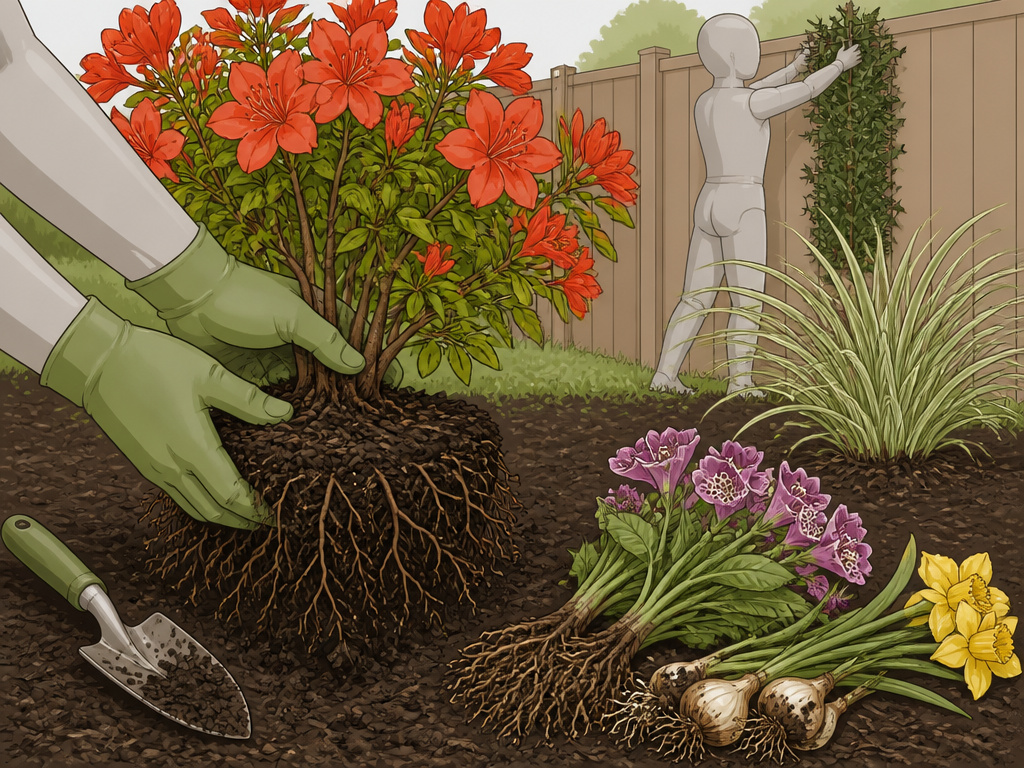
Start with the ASPCA’s toxic plant database, which K-State names as the place to begin. Then cross-check against the named lists, because the databases and the extension sheets don’t always overlap.
These appear on the Atlanta Humane list, the UC ANR list, or both:
- Azalea and rhododendron, named by both Atlanta Humane and UC ANR
- Yew and oleander, also on both lists
- Tulips and daffodils, both named by Atlanta Humane and UC ANR
- Sago palm, flagged by UC ANR
- Foxglove and lily of the valley, from the Atlanta Humane list
- Parsley and fennel, which surprise people
UC ANR adds cyclamen, hyacinths, lilies, tomatoes, grapes, autumn crocus, dieffenbachia, and kalanchoe.
Foxtail deserves its own line. K-State says keep it out of the garden because the barbed seeds cause ear problems. The AKC goes further: the seed heads burrow under the skin or enter through eyes, ears, nose, or mouth, risking severe infection. Miscanthus is the dog-safe ornamental grass the AKC suggests instead.
The Thorny Plant Question
Here the sources genuinely disagree, so I won’t pretend otherwise.
Atlanta Humane suggests planting prickly evergreens to add bulk to a fence and discourage jumping. K-State says avoid planting thorny plants in easily accessible areas to lessen eye injuries.
My read: those are two different locations. Prickly growth high on a fence line is above a dog’s face. A thorny shrub at nose height along a path is where the eye injury happens. If you use prickly evergreens at all, keep them up and back.
For the wider planting plan, dog-friendly landscaping covers bed placement and sight lines better than a plant list can.
Which Garden Chemicals Are Worth the Risk?
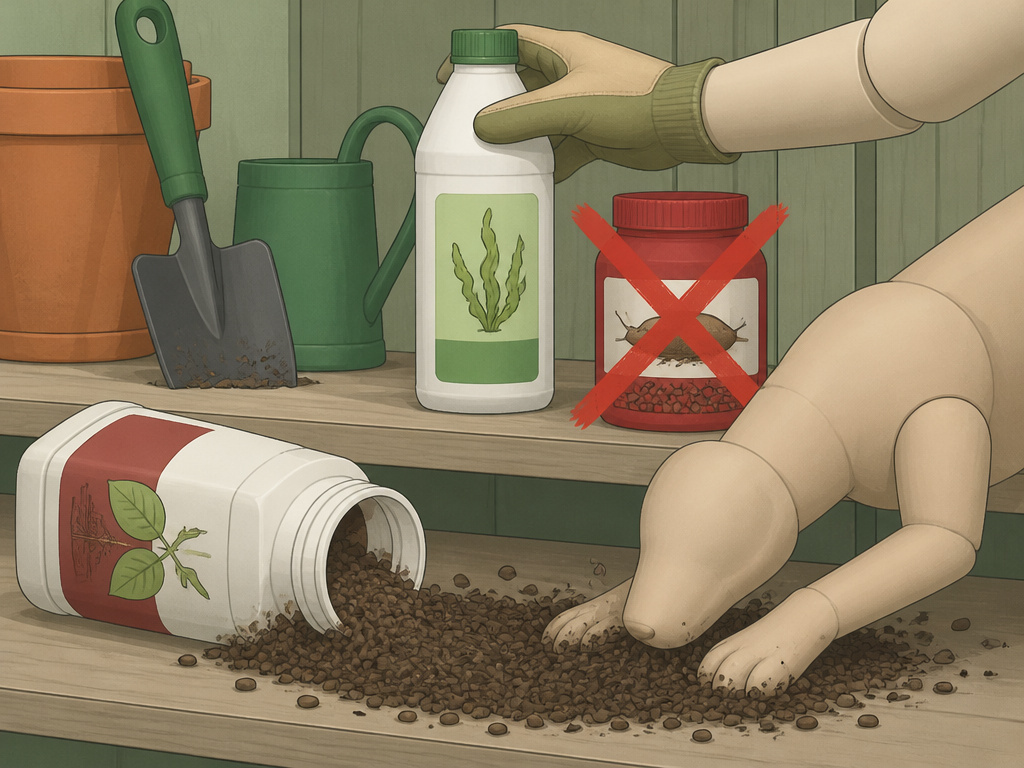
Blood meal is a garden product that UC ANR warns turns a dog into a digger, while the AKC says most organic fertilizers like blood meal only cause an upset tummy if ingested.
The sources do not agree on how bad that is, and the disagreement is worth understanding because it’s really three different claims. UC ANR / UC Marin Master Gardeners advise avoiding blood meal because dogs are attracted to it and will dig, and suggest seaweed-derived liquids instead. The AKC’s Dr. Schmid says most residential organic fertilizers, including bone meal, blood meal, fish emulsion, and manure, only cause an upset tummy if ingested, though where and how you apply them matters.
Both can be true. A dog digging up blood meal is an annoyance. A dog eating a slug pellet is a different category entirely.
Before you start: Atlanta Humane advises against spreading slug or snail killer and rat or mouse poisons at all, and using non-toxic and organic options wherever possible. If you spray anything else, UC ANR says keep the dog inside until the product is dry, while Atlanta Humane says keep the dog out until it is safe to return and the AKC says keep the dog away from a recently treated yard.
Atlanta Humane goes furthest, advising against spreading insecticides, pesticides, herbicides, fertilizers, slug or snail killer, or rat and mouse poisons at all, and using non-toxic and organic options wherever possible. The AKC says keep the dog off a yard recently treated with fertilizers, pesticides, or insecticides, and try to avoid insecticides because the chemicals can be very harmful. UC ANR’s integrated pest management approach sits in the middle: use the least toxic product first, go stronger only if necessary, and keep the dog inside until dry.
If you do need to treat, choose a dog-safe weed killer rather than reaching for the strongest bottle on the shelf. The strongest bottle is rarely the one you needed.
One more chemical note that gets missed. Atlanta Humane warns to drain any standing water, because puddles can harbor dangerous blue-green algae or infections such as leptospirosis, a bacterial infection that can be deadly to dogs. That includes the kiddie pool you left out, the wheelbarrow, and the plant saucer.
Shade, Water, and the Hot-Paver Problem Nobody Checks
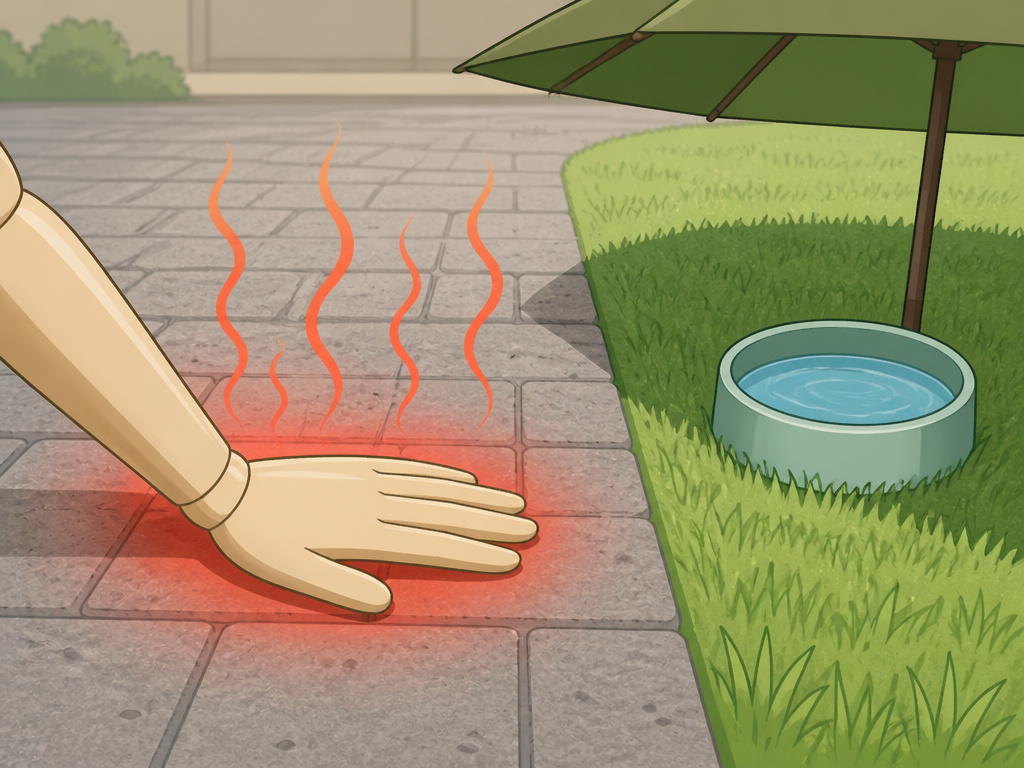
Put your palm flat on the patio on a hot afternoon. How long can you hold it there?
It’s most of the street.
Dogs can’t regulate temperature as well as humans, which is why the AKC treats shade as heatstroke prevention rather than comfort. A gazebo, a spot under shady trees, or a sun umbrella all work. Atlanta Humane suggests an arbor or gazebo plus a doghouse, and K-State points out you can create instant shade with a tarp or parasol, with the water bowl placed nearby.
The catch is that shade moves. The AKC notes that what was shady can become full sun in just an hour, so a static structure you checked earlier may be useless an hour later. Check on the dog often, and don’t leave it out unattended for long stretches.
Water needs a rule too. Atlanta Humane says fill a fresh dish every time the dog goes out, then empty it afterward, because standing water invites mosquitoes and the heartworm they carry.
Hard surfaces are the part people skip. Atlanta Humane warns that concrete, brick, asphalt, and other hard surfaces get extremely hot and injure paw pads, and suggests replacing flagstones and pavers with mulch, artificial turf, or sod. The AKC says limit yard time during a heatwave to reduce dehydration, overheating, and burned paws on heat-absorbing hardscaping.
The Artificial Turf Fight
Two land-grant extensions disagree here, and neither is being careless.
UF/IFAS advises against artificial turf, noting it builds up excess heat and is hard to clean. K-State lists artificial turf over a gravel pit base as an acceptable element of a potty spot. Atlanta Humane suggests artificial turf as one replacement for hot flagstones.
My take: the disagreement is about use. A small potty patch over gravel is not the same installation as a full artificial lawn in full sun. If you go artificial, keep it small and shaded.
A short heat checklist for the worst week of summer:
- Walk the surface with your hand before the dog walks it with its paws
- Move yard time to early morning and after sunset
- Refill and then empty the water dish, every time
- Have a shallow dog pool or a soaked sandpit available, per the AKC
- Keep the dog indoors as much as possible when the forecast spikes
The Potty Spot, the Path, and Working With the Dog You Have
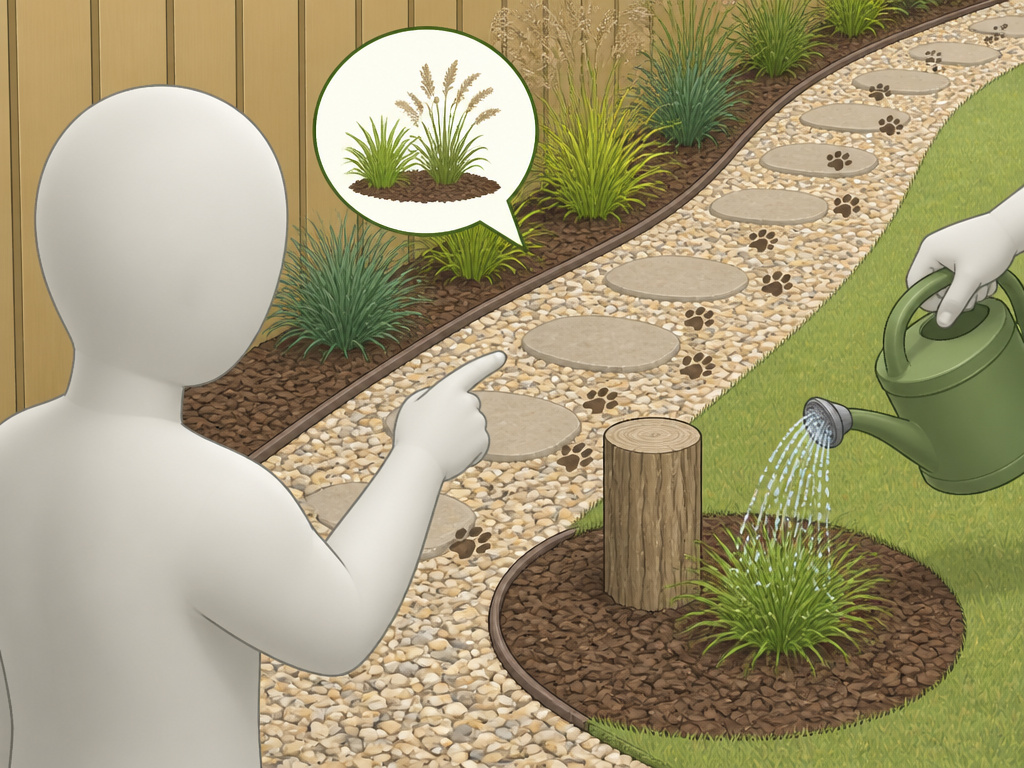
The extension sheet says most dogs create their own paths through the garden and along fence lines, and that trying to redirect them can cause stress for both of you. The recommendation is to hardscape the dog’s route into an official pathway instead, planting alongside the path rather than on it, and using a hedge row or tough ornamental grasses where the path interrupts a view.
UC ANR lands in the same place from a different angle: allow the dog’s natural flow and enhance the pathways with small mulch, pea gravel, bricks, or stepping stones. UF/IFAS adds the corollary. Don’t plant anything in areas where pets like to dig. Create a space where they’re safe to dig instead.
That’s a real shift in approach. You are not losing the garden. You are deciding which parts of it were never going to survive anyway.
The potty spot works the same way. K-State recommends training the dog to eliminate in one designated place, which protects the lawn and shrubs from urine’s high nitrogen content. For male dogs, add a marking post: a tree stump, an artificial fire hydrant, or a statue. Female dogs concentrate urine in one spot and create dead spots, and K-State says regularly diluting with water helps save the lawn. UF/IFAS doesn’t address dilution, focusing instead on a designated area and picking up waste.
The potty spot has one hard requirement from K-State. It has to be a place the dog will actually use when it rains or snows.
For layout details, dog potty area covers sizing and surface choice, and dog-friendly lawn handles the nitrogen problem in more depth.
Training Cues That Actually Stick
K-State’s cues are simple and they work because everyone in the house uses the same one.
- “Out” when the dog steps into a planting bed, with the same word and tone from every person, and praise when the dog steps back out
- “Leave it” to pull attention off something intense
- “Ouch” for plant chewing, starting indoors with a puppy
UC ANR adds the obvious half that people skip: reward the good behavior. Training a dog to stay out of an area is possible, and the reward is what makes it stick.
The Gate, the Bin Lid, and the Gaps People Forget
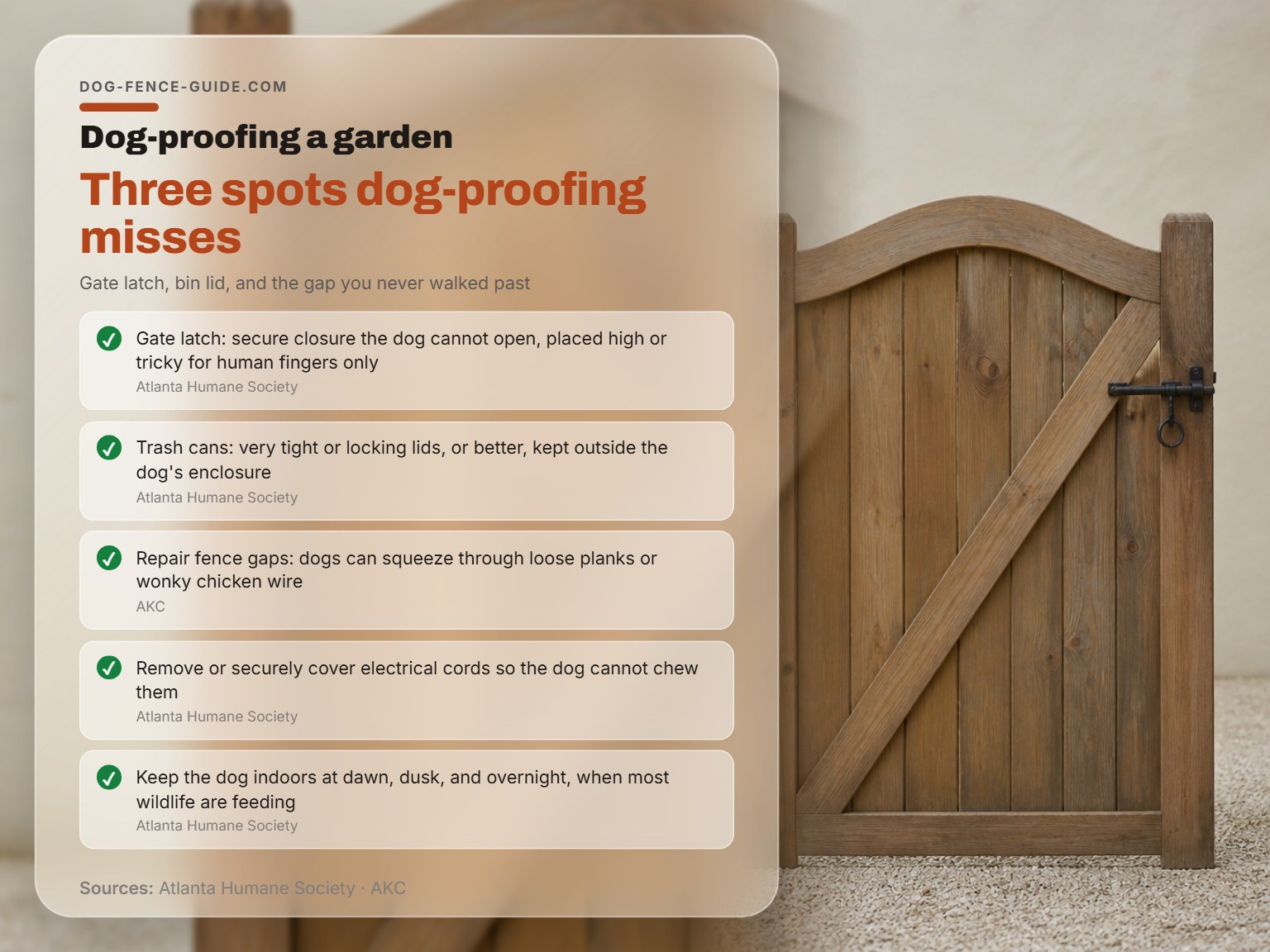
Three things fail on almost every dog-proofed yard: the gate latch, the bin lid, and the gap you never walked past.
Start with the latch. Atlanta Humane says any exit from the enclosed space needs a secure closure the dog cannot open, with the latch placed high enough to be out of reach or tricky enough that only human fingers can work it. The AKC suggests self-closing gates as a backstop for the gate someone left open.
Then the rest of the list:
- Trash cans need very tight or locking lids, or better, sit outside the dog’s enclosure entirely, per Atlanta Humane
- Electrical cords get removed or securely covered so the dog can’t chew them
- Mushrooms get pulled, all of them, unless you’re an experienced mycologist, per Dr. Schmid
- Alliums stay out of the vegetable bed: onions, garlic, chives, and leeks can damage red blood cells and cause hemolytic anemia, per the AKC
- Small dogs need supervision outdoors, because Atlanta Humane notes hawks and owls can take a small pet
That last one isn’t hypothetical. Atlanta Humane also recommends keeping the dog indoors at dawn, dusk, and overnight, when most wildlife are feeding. If your yard backs onto a greenbelt, that single habit prevents more incidents than any hardware on this page.
For gates specifically, dog-proof a gate covers latch height, self-closers, and the gap at the bottom. If you’re dealing with a dog that patrols and alerts at everything on the other side, dog deterrents is worth a look before you buy more fence.
Before You Buy
Here’s the trigger that should stop you shopping. If your dog keeps escaping, more fence is not the answer yet. Walk the line at dusk with a torch and find the launch point, the dug corner, or the gap first. Hardware fixes a hole. It doesn’t fix a route.
The other thing worth saying plainly: none of the plant and chemical work matters if the containment is soft. A dog that gets out will find the oleander on the other side of the fence, and you’ll have spent your weekend on the wrong problem.
So before you buy anything, ask yourself three questions. Where does my dog actually get out, and have I watched it happen? What can my dog stand on near the fence? And is there anything in this yard my dog could eat that would put it in a vet clinic tonight?
Answer those honestly and most of this article solves itself. Peace of mind is the real goal, and it usually costs less than the fence panel you were about to order.
Frequently Asked Questions
How tall should a dog fence be?
The Atlanta Humane Society recommends a minimum of 6 feet, and 10 to 12 feet for a large dog. The AKC gives no numeric minimum, instead recommending increased height plus coyote rollers for jumpers and climbers. Height helps, but a launch point like a woodpile or bench nearby cancels it.
Does chicken wire actually stop a dog digging out?
It stops the dog reaching open soil under the fence, which is the point. Atlanta Humane recommends burying it at least 12 to 24 inches deep around the inside perimeter. The AKC recommends a chicken wire L-footer with no stated depth. Either way, the mesh has to sit below grade and be tied to the fence fabric.
Is cocoa bean mulch really dangerous for dogs?
The AKC calls it the worst offender among mulches. It contains theobromine, the same compound that makes chocolate dangerous, plus caffeine. Eating a lot can cause heart rate increases, arrhythmia, hyperactivity, and seizures. Pine straw is the AKC’s suggested pet-safe alternative.
Can I still use fertilizer if I have a dog?
It depends which source you follow. The AKC’s Dr. Renee Schmid says most residential organic fertilizers, including bone meal and blood meal, only cause an upset tummy if ingested. UC ANR recommends avoiding blood meal entirely because dogs dig it up, and suggests seaweed-derived liquids instead. Both agree you should be careful about where and how you apply it.
Why is compost so dangerous for dogs?
UF/IFAS warns that a mycotoxin-producing fungus can grow in compost and cause severe, potentially deadly systemic poisoning. Dr. Renee Schmid notes that even a small amount of tremorgenic mycotoxins can cause ataxia, tremors, seizures, drooling, vomiting, and agitation. Use a lidded bin or tumbler, or panel off the pile.
What plants should I remove from a dog’s yard?
Start with the ASPCA toxic plant database. Named lists include azalea, rhododendron, yew, oleander, tulips, daffodils, sago palm, foxglove, and lily of the valley. UC ANR adds cyclamen, hyacinths, tomatoes, grapes, autumn crocus, dieffenbachia, and kalanchoe. Foxtail grass should come out too, because its barbed seeds cause ear problems.
