
Are Lawn Chemicals Safe for Dogs? What the Studies Show
This post contains affiliate links. As an Amazon Associate, we earn from qualifying purchases.
Lawn chemicals are safe for dogs at label rates in the ordinary case, and the numbers explain why: the dog no-observed-adverse-effect level for 2,4-D is 1.0 mg/kg/day, while residue on commercial lawns measured up to 196 micrograms per square meter at 48 hours. Exposure is real. Poisoning is rare.
Rare and zero are different words. A dog that crosses a treated lawn picks up a measurable dose on its paw pads and then licks them clean, and in one residue study four of nine treated households had 2,4-D in the dog’s urine afterward. The useful question is how much, how long it stays, and whether are lawn chemicals safe for dogs.
What follows walks the actual figures: the dose threshold, the residue that outlives the label, the cancer question two credible bodies answer in opposite directions, and the 48 hours I wait whether or not the label agrees.
Key Takeaways
- The 1.0 mg/kg/day no-effect level is the number every 2,4-D risk estimate in dogs comes back to, and the acid, DMA salt, and 2-EHE ester all land on it.
- Residue outlasts the label. Commercial lawns held up to 196 micrograms per square meter of 2,4-D at 48 hours, and dry brown turf held it longer than green turf did.
- The cancer question is contested. A 1991 NCI study by Hayes et al. Reported an association with canine malignant lymphoma, while Health Canada’s reviewers concluded the opposite after re-analysis.
- EPA companion animal tests do not set a safe dose. The guideline says so itself, in writing.
- The genuinely dangerous products are the old inorganic ones, plus any container a dog can reach and open.
What the EPA’s Companion Animal Safety Test Actually Measures
The EPA’s OPPTS 870.7200 guideline is the document that sets what a companion animal safety study has to prove, and it says something the sales copy never repeats.
The companion animal safety study under OPPTS 870.7200 is not a toxicity study. The stated intent is not to establish a no-observed-effect-level but to provide assurance that an adequate margin of safety exists for the product as labeled. A product can pass without a defined safe dose ever being calculated.
Read that against the industry line and the shape of the claim changes. Lawn Matters states that every pesticide used by professional lawn care companies has undergone rigorous safety testing and met EPA registration standards. That is true. The same page states that registration involves determining safe re-entry intervals, and that treatments are not harmful to dogs or cats when applied per label. Also true, as far as the label goes.
What the guideline adds is that the test confirms a margin of safety. It does not produce a number you can hold against your dog’s body weight. Those are different outputs, and only one of them helps you decide about Tuesday afternoon.
- A margin-of-safety check. The study asks whether the labeled product leaves an adequate cushion.
- No safe dose at the end of it. The guideline states plainly that establishing a no-observed-effect-level is not the intent.
- A registration hurdle, not a yard assessment. Passing tells you the product cleared the bar the EPA set for registration.
That gap is why the residue work matters more than the registration stamp. Registration tells you the product was reviewed. It does not tell you what a dog’s feet pick up on day two.
How Much 2,4-D Does It Take to Matter? The 1.0 mg/kg/Day Number
One milligram per kilogram of body weight per day. That is the no-observed-adverse-effect level for 2,4-D in dogs, and it held across both the subchronic and the one-year chronic feeding studies.
| Study | Doses tested (mg/kg/day) | NOAEL |
|---|---|---|
| Subchronic dietary | 0, 0.5 (acid only), 1.0, 3.75, 7.5 | 1.0 |
| Chronic, one year | 0, 1.0, 5.0, 7.5 | 1.0 |
| Form comparison | Acid, DMA salt, 2-EHE ester | 1.0 for all three |
The threshold scales with body weight, so a small terrier reaches it on far less active ingredient than a big retriever does. That scaling is the single most useful idea here, and it is exactly what a “safe when dry” label cannot tell you.
The formulation question is settled too. The 2,4-D dietary toxicity studies in dogs found the acid, the DMA salt, and the 2-EHE ester produced comparable toxicity in dogs. If you have read that ester formulations are harsher on animals, that claim does not hold for this species.
Push the dose up and the picture changes shape. A separate study intubated six Beagle dogs with a full lawn-care mixture, three consecutive daily doses at 10 mL/kg, delivering 2,4-D at 6.5 mg/kg alongside MCPP, dicamba, bensulide or chlorpyrifos, and fertilizer salts. The oral intubation dogs lawn chemicals work recorded no clinical illness at all. Plasma cholinesterase still fell to roughly half of control values, with no cholinergic signs.
That last detail is the one I keep coming back to. A dog can look completely normal and still have moved.
I am not a toxicologist and I do not play one in print. What I can read is a dose table, and the table is unambiguous about where the line sits.
Does 2,4-D Cause Cancer in Dogs? Two Studies, Opposite Answers
The question has been asked and answered twice, and the two answers do not match: Hayes et al. Reported a positive association, while Health Canada’s reviewers concluded no association after re-analysis.
What the 1991 NCI Study Found
Hayes and colleagues reported a positive association between a dog owner’s use of 2,4-D on the lawn and canine malignant lymphoma. The canine malignant lymphoma 2,4-D study is a real finding from a real case-control design, and it is the paper that launched a thousand worried forum posts.
What Health Canada’s Reviewers Concluded
Health Canada’s Pest Management Regulatory Agency tells a different story in its public question-and-answer document. A 1991-1992 independent panel concluded the NCI study design was severely flawed and did not show an association between canine malignant lymphoma and 2,4-D use. A 1999 re-analysis of the same NCI data by scientists at Michigan State University landed in the same place: no relationship.
| Position | Who holds it | What it says |
|---|---|---|
| Positive association | Hayes et al., NCI, 1991 | Owner-applied 2,4-D linked to canine lymphoma |
| Design severely flawed | Independent panel, 1991-1992 | The NCI study did not show an association |
| No relationship | Michigan State re-analysis, 1999 | Re-examined NCI data found no link |
The agency went further and determined that 2,4-D meets Canada’s health and safety standards and is acceptable for continued registration. The file has been open a long time; Health Canada announced a priority re-evaluation of the eight most commonly available lawn pesticides, 2,4-D among them, on September 27, 2000.
The part nobody mentions: The 1991 NCI paper gets cited in both directions. The 1991-1992 panel review and the 1999 re-analysis almost never do, so a reader searching this question sees one half of a two-sided file.
Here is where I land, and it is not a comfortable place. Hayes et al. Reported a positive association, while Health Canada’s reviewers concluded the association did not survive re-analysis, and that matters. It also is not the same thing as a clean bill of health for every formulation on every lawn. Anyone who tells you this question is closed is selling something, and that includes the people selling the weed killer.
The Residue Numbers That Break the “Wait Until Dry” Rule
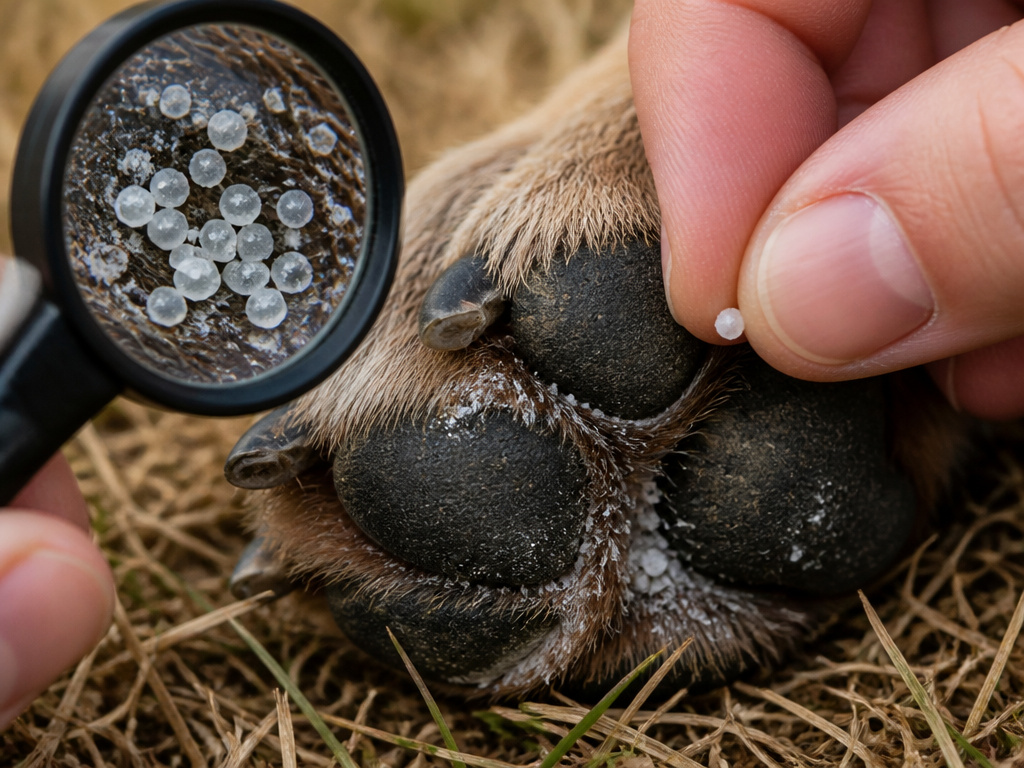
“Wait until it’s dry” is the line on the label and in most veterinary handouts. On dormant turf it stops working.
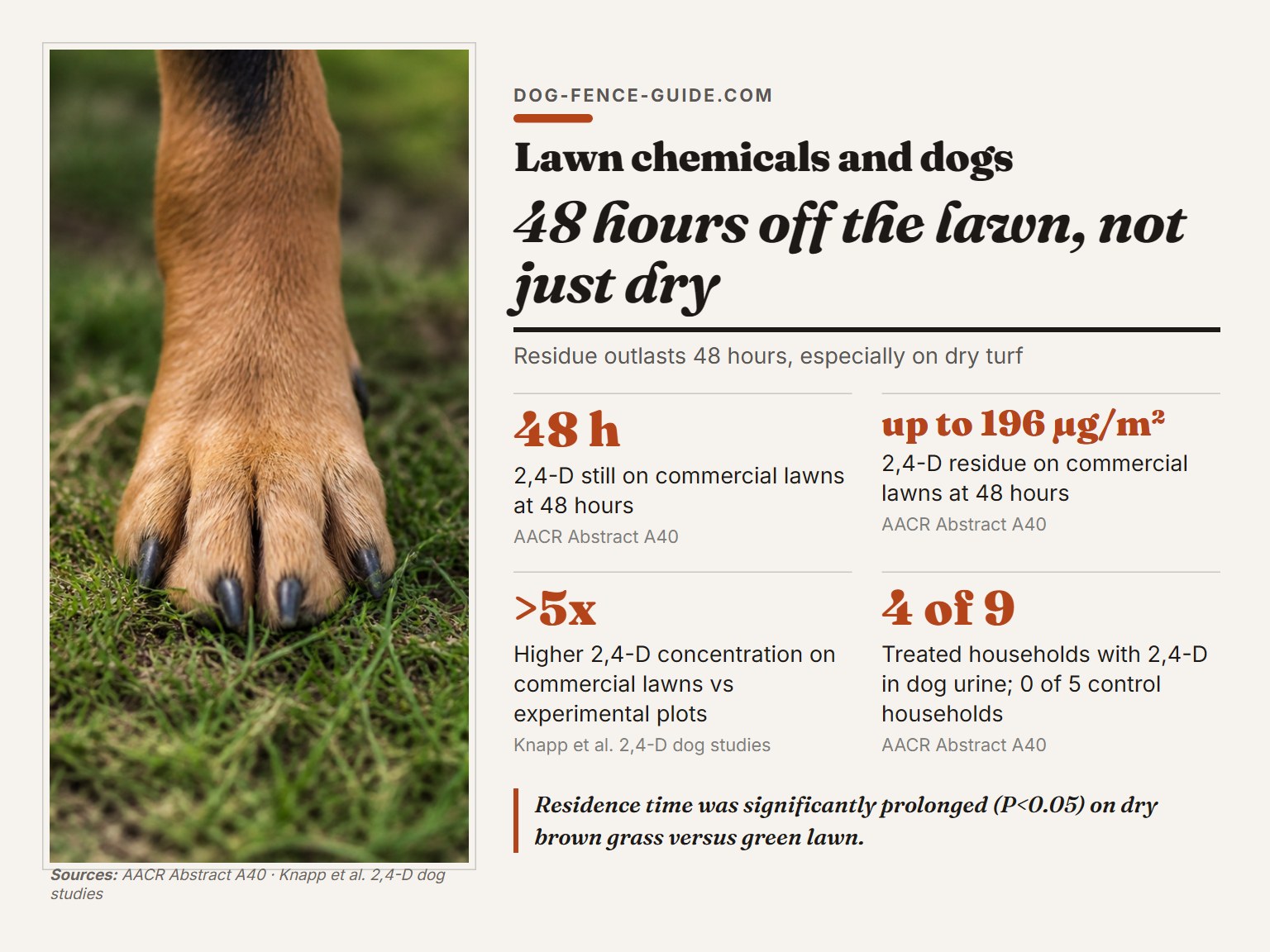
One residue study measured dislodgeable 2,4-D on household lawns by LC-MS at 0.17, 24, 48, and 72 hours after treatment. Commercial lawns carried up to 196 micrograms per square meter at the 48-hour mark. Experimental green plots treated at label rates were essentially clean by the same point.
The same work found commercial lawns carrying more than five times the concentration of the experimental plots, with residence times stretching past 48 hours, while MSD Veterinary Manual states vegetation treated at proper rates is usually not dangerous. Label rate and real-world application are not the same thing, and that gap is where a dog actually lives.
Then there is the dry-grass finding, which is the one that should change how you think about autumn. Chemical residence time was significantly longer on dry brown grass than on green lawn, at P<0.05. The dry-time rule assumes dry grass is spent grass, and MSD Veterinary Manual states treated vegetation is usually not dangerous especially after herbicides dry; however, AACR found that on dormant turf, dry is the condition that keeps the residue hanging around.
I have watched a dog work a granular edge with its nose down and its paws splayed, and I have dug a granule out of a paw pad with a thumbnail. Whatever the label says about dry, that dog is still picking product up. It is the same logic as a slow drip under a sink: nothing looks wet, and the damage is in the cabinet.
If you are choosing between products rather than arguing about this one, the weed killers safe for dogs comparison is the place to start, and the broader dog-friendly lawn care question covers what to do about the rest of the yard.
Why Your Dog’s Urine Tells a Different Story Than Your Child’s
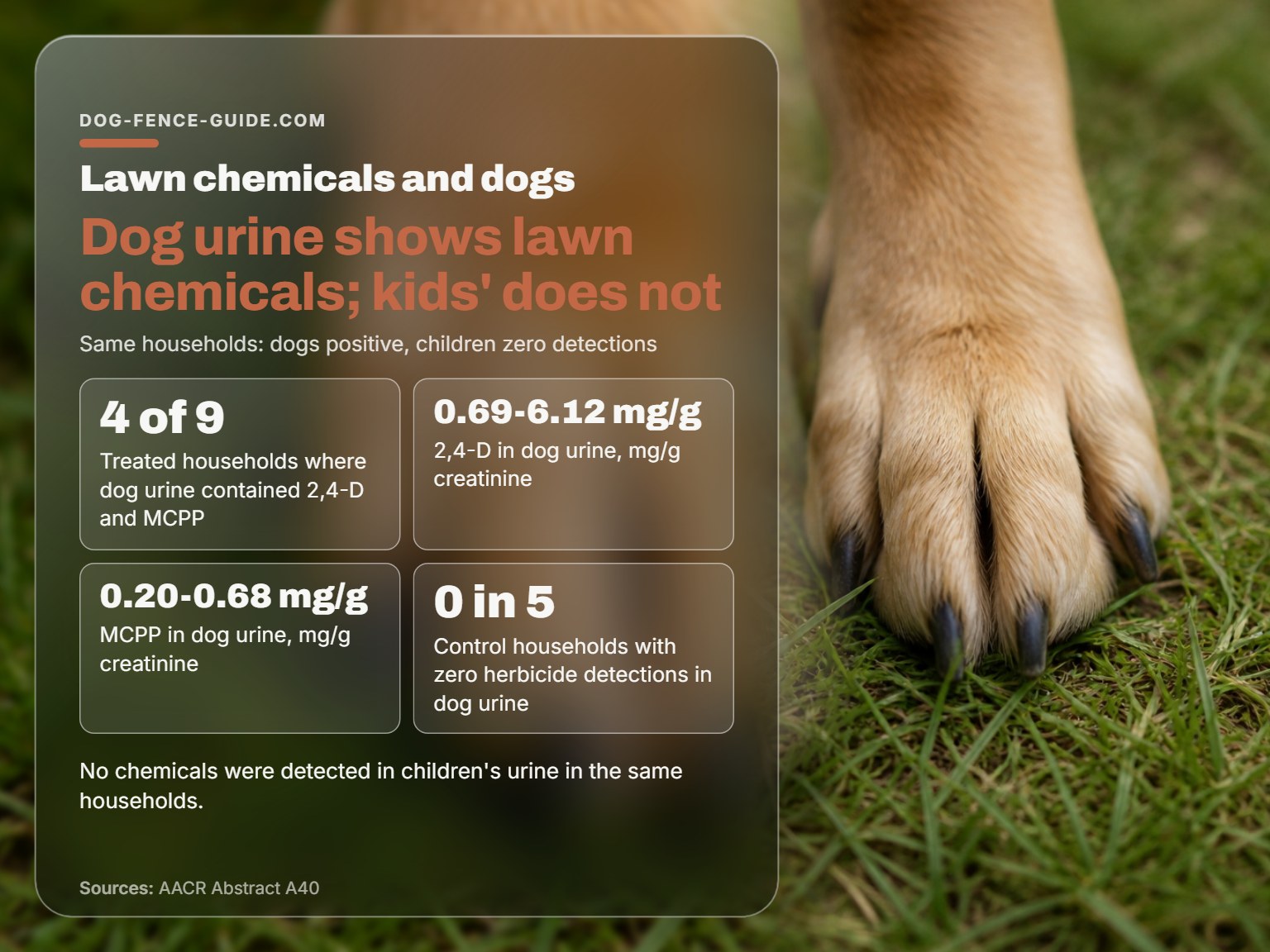
In four of nine treated households, dog urine contained 2,4-D at 0.69 to 6.12 mg/g creatinine and MCPP at 0.20 to 0.68 mg/g creatinine. In those same households, no chemicals turned up in the children’s urine.
Five control households had zero detections in the dog urine. That contrast is the useful part. Same lawn, same week, two species, two results.
The researchers attributed it to a species-specific route: dogs lick their paws and their bellies. A child runs across the lawn and washes her hands afterward. A dog runs across the lawn and then cleans its own feet with its tongue, which is a very different relationship with the same surface. It is also why grass for dogs to eat deserves a second look if your dog grazes.
The herbicide detection in pet dog urine work confirmed the same pattern: dogs excrete 2,4-D in urine after a lawn application, which means the compound got in and got processed.
A dog’s exposure route is its own mouth on its own feet. No amount of human urine data will ever answer this question for you.
That is the flaw in every “it’s fine, my kids play out there” argument. Lawn Matters states exposure to a treated lawn does not by itself constitute a health risk when applied at correct rates with re-entry guidelines followed, but AACR found no chemicals in children’s urine while detecting them in dogs’ urine in the same households, so the children’s data is genuinely reassuring for children but says nothing about the animal grooming residue off its own fur.
The 48 Hours I Actually Wait, and Why the Label Says Less
A dog finishes, turns, and licks each front paw in order before you have got the bag tied off. That is the exposure event. It takes about four seconds and it happens on your schedule, not the label’s.
I will not let a client’s dog onto a broadcast-treated lawn for at least 48 hours, and longer if the product is granular and has not been watered in. The label says when dry. The dog’s nose is at blade height, and granules collect in paw pads, which is a surface the label never mentions.
Before you start: Granules lodge between paw pads and get licked out hours later, so a dog can dose itself long after it left the lawn. A granular product also crunches underfoot for a day or two after application, and that crunch is product still sitting on the surface. Bagged material stored on a garage floor is the other common route, because a bored dog will open a paper sack.
Why 48 Hours and Not “When Dry”
Dry is a surface condition you can see, and MSD Veterinary Manual states treated vegetation is usually not dangerous especially after herbicides dry; however, residue is what the dog picks up, and the AACR residue study measured 2,4-D on commercial lawns at 48 hours and beyond, so the two clocks do not stop at the same time.
- Find the re-entry interval on the label first. Health Canada’s guidance is blunt: read and follow the label directions, and do not use a product against a pest it is not listed for. Skip this and you are guessing at a number the manufacturer already printed.
- Keep the dog off for 48 hours minimum, longer for granular. Granular product sits on the leaf until water moves it, so a dry week stretches the window well past the label’s dry time.
- Water the granular product in before the dog goes back out. Water moves granules off the leaf surface and into the soil, which is the difference between a dog sniffing product and a dog sniffing grass.
- Store the bag where a dog cannot reach it. MSD Veterinary Manual puts most toxicity problems down to careless use or careless storage of containers, which makes the sack in the garage a route worth closing.
Fair warning: none of this replaces a call to your vet or an animal poison control center if you think a dog has gotten into concentrate.
Are Lawn Chemicals Safe for Dogs? Where the Real Risk Sits
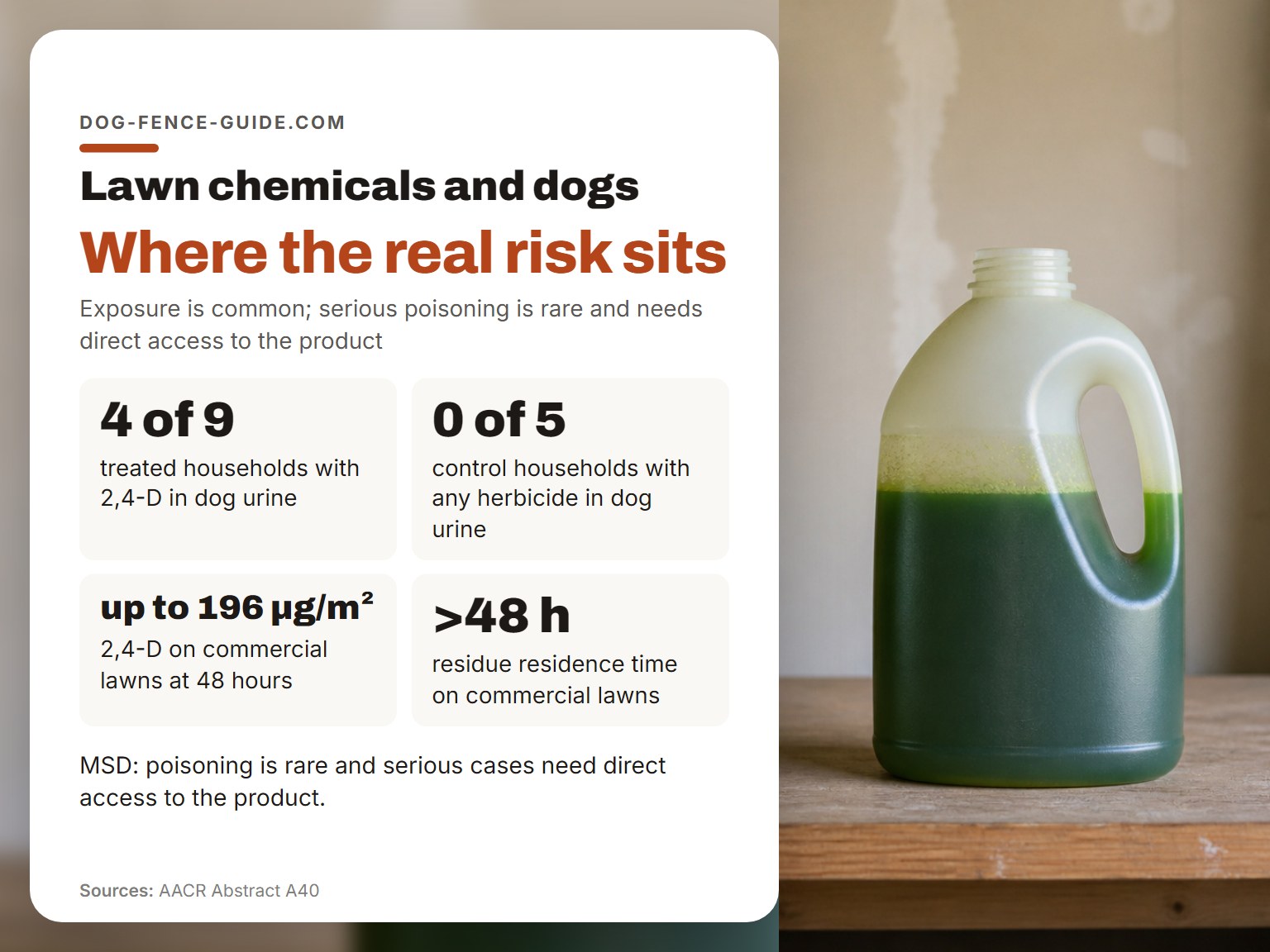
The products that actually hurt dogs are mostly not the ones a lawn crew sprays according to Lawn Matters, which states professional pesticides applied per label are not harmful to dogs or cats, though AACR found dogs in treated households had detectable 2,4-D and MCPP in urine.
MSD Veterinary Manual is direct about it: herbicide poisoning in animals is rare, and serious poisoning happens when animals get direct access to the product, though AACR found dogs in treated households had detectable 2,4-D and MCPP in urine, indicating exposure via lawn residues. The inorganic herbicides are the older and more toxic group, and arsenicals, chlorates, and dinitrophenols are all more dangerous to animals than the newer compounds. Borax is toxic at moderate to high doses as well.
So the risk profile splits. MSD Veterinary Manual states a properly applied phenoxy herbicide on a lawn is a low-order problem with poisoning rare and requiring direct access to the product, while AACR found dogs in treated households had detectable 2,4-D and MCPP in urine; a bag of concentrate sitting open in a shed is a different category entirely.
- Inorganic herbicides. Arsenicals, chlorates, and dinitrophenols are more toxic than newer compounds and are largely out of use in developed countries.
- Borax-based products. Toxic at moderate to high doses, and still sold for home use.
- Open containers and unlabeled decants. MSD names careless storage and missing labels as a recurring setup for poisoning.
- Anything a dog can reach and chew. Access to the product is the variable that turns a rare event into a real one.
The same re-entry question applies to a mosquito spray safe for dogs and to any yard flea treatment, both of which put a different active ingredient at nose height on the same grass; Lawn Matters states re-entry intervals are communicated to customers, while AACR found residues persisting beyond 48 hours on commercial lawns.
Where this goes sideways: Decanting concentrate into an old drink bottle. A dog investigates a bottle faster than a bag, and MSD lists lost or missing labels as a recurring setup for poisoning.
Chronic herbicide illness is the hard case. MSD notes it can take weeks, months, or even years to identify, which means a slow change in a dog’s stamina or behavior will not get traced back to a lawn product by anyone who was not already looking for it. I tell people to walk their own garage before they worry about the lawn. The Iowa State pesticide toxicity guide is the reference I hand over when someone wants to look up a specific active ingredient rather than a category.
What Lower-Exposure Options Actually Look Like
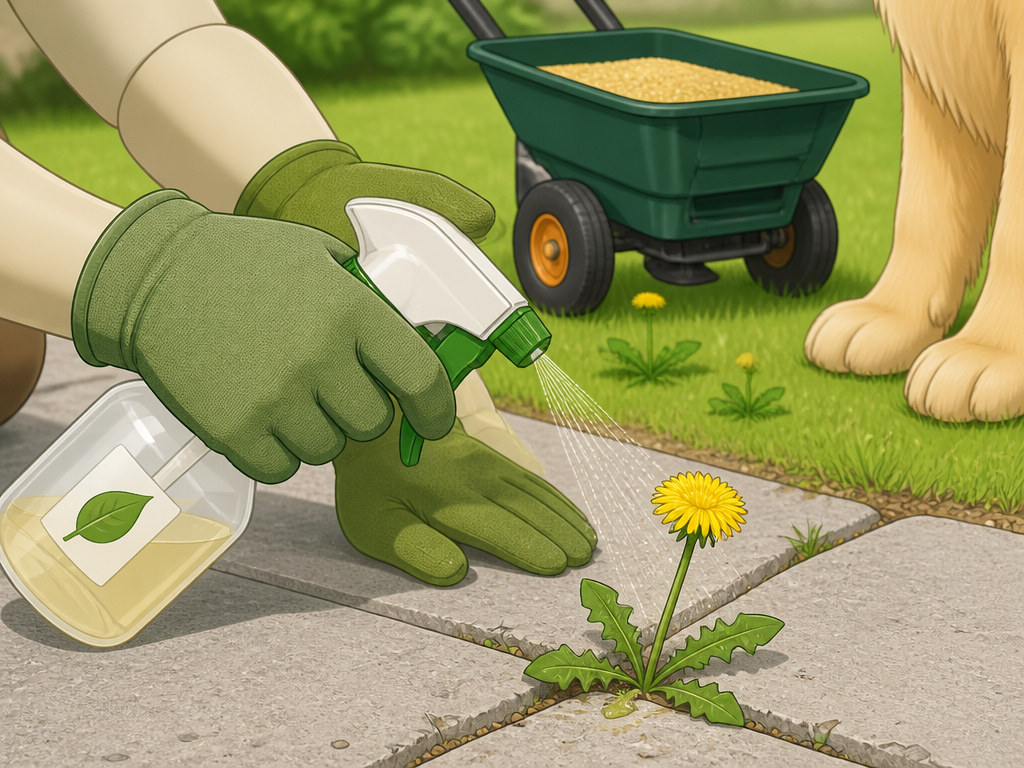
Broadcasting herbicide across a whole lawn is the highest-exposure way to solve a weed problem. It is also the fastest, which is why it keeps winning.
Corn Gluten Meal as a Pre-Emergent
Corn gluten meal works before the weeds show up. It suppresses root formation in germinating seeds, so timing is the entire product: down before the weed seeds germinate, or you have bought an expensive bag of protein.
Espoma Organic Weed Preventer and Preen Organic Vegetable Garden Weed Preventer are both corn gluten meal products, and a Scotts Turf Builder EdgeGuard Mini spreader will put either one down evenly.
I have had better luck steering people toward corn gluten meal for pre-emergent than toward a blanket herbicide. The lawn looks worse for a season. The dog stops sneezing after every mow, and that trade has been worth it every time.
Spot-Spraying Instead of Broadcasting
Vinegar-based contact killers burn down what they touch and leave the soil alone. Bonide BurnOut Weed & Grass Killer is the one I reach for on driveway cracks and fence lines, where a spot treatment replaces a broadcast pass entirely.
Spot-spraying is slower and it looks worse for a few weeks. It also cuts the treated area from the whole yard down to a few square feet, and treated area is the variable that drives everything above.
I would rather see a lawn with a few visible weeds and a dog that is not grooming its own feet for an hour afterward. Aesthetics lose that argument at my house every time.
If you want a single answer: spot-spray what you can see, put corn gluten meal down before the weeds germinate, and keep the dog off anything you have treated for two days. For the longer game, the dog-safe weed control products list and the question of lawns for dogs both matter more than which bottle you buy.
Frequently Asked Questions
Are lawn chemicals safe for dogs once the grass is dry?
Dry grass is a surface condition, not an exposure limit. MSD Veterinary Manual states treated vegetation is usually not dangerous especially after herbicides dry, but the AACR residue study measured 2,4-D on commercial lawns at 48 hours and found residence times stretching past that point, so a dry lawn can still carry product. Dry brown turf held residue significantly longer than green turf did.
How long should a dog stay off a treated lawn?
At least 48 hours after a broadcast herbicide, and longer for granular product that has not been watered in. If the label lists a re-entry interval, use the longer of that figure and 48 hours. Watering granular product in shortens the window.
What are the signs of herbicide poisoning in a dog?
MSD Veterinary Manual notes that severe gastrointestinal symptoms are frequent in herbicide poisoning cases. The harder problem is the chronic picture, which can take weeks, months, or even years to identify. Call your vet or an animal poison control center rather than waiting for a pattern to emerge.
Does the form of 2,4-D matter, acid or ester?
Not for dogs, based on the comparative work. The acid, the DMA salt, and the 2-EHE ester produced comparable toxicity in dogs, all landing on the same 1.0 mg/kg/day no-observed-adverse-effect level. Claims that ester formulations are harsher do not hold for this species.
Are granular products riskier than liquid?
They stay on the surface longer and they collect in paw pads. Granular product needs water to move it off the leaf, so a dry stretch after application extends the window past what the label’s dry time suggests. MSD Veterinary Manual states treated vegetation is usually not dangerous especially after herbicides dry, but the AACR residue data still shows activity at 48 hours.
Before You Go
The threshold I would give you is this: Lawn Matters states re-entry intervals are determined and communicated to customers, while AACR found residues persisting beyond 48 hours on commercial lawns, so if the label lists a re-entry interval, use the longer of that number and 48 hours. If the product is granular and the forecast is dry, add time rather than subtracting it.
All of this assumes a lawn treated at label rate by someone actually reading the label. MSD Veterinary Manual states vegetation treated at proper rates is usually not dangerous, but the AACR residue study found commercial applications running more than five times the concentration of experimental plots treated at label rates, so if a crew treats your yard, the label rate is not necessarily what landed on it.
Start with your dog and your yard, not the product. Three questions before anything goes down: Does my dog lick its paws after it comes inside? Does it graze the grass? And can I keep it off the treated area for two full days without a fight? If the answer to the third one is no, the herbicide is not the problem you need to solve first.
