
How to Tell If a Dog’s Nails Are Too Long: Step-by-Step
This post contains affiliate links. As an Amazon Associate, we earn from qualifying purchases.
To tell if a dog’s nails are too long, check three things: whether they touch the ground when the dog stands, whether the dog clicks across hard floors, and whether the tips curve toward the pad. Sources disagree on the click test, so a single sign means look closer.
The how to tell if a dog’s nails are too long checks carry different weight, and the disagreement between them is where most owners get stuck. Five veterinary and kennel sources treat clicking on a hard floor as proof the nails are long. Dogs Trust, the UK welfare charity, says clicking alone does not mean the dog needs a trim. Both positions hold up under scrutiny, which is why the visual check carries more weight than the sound test.
What follows walks through the signs in order of reliability, the trim intervals each source recommends, and the cases where the answer is a vet visit rather than a pair of clippers.
Key Takeaways
- Nails touching the ground when the dog stands is treated as a sign of overlong nails by VCA, the Royal Kennel Club, and North Jersey Animal Hospital, while Dogs Trust says gently touching, worn-flat nails do not need trimming.
- The click test is contested. Five sources treat clicking as an indicator of overgrowth, with the Royal Kennel Club calling it only an indicator a trim may be needed; Dogs Trust says it does not necessarily mean the nails are long.
- Trim intervals range from weekly to monthly across the sources, so pick a schedule and check the nails between sessions.
- Dewclaws almost always need trimming because they never contact the ground and will not wear down on their own.
- Splaying toes or a nail growing into the pad is a vet visit, not a home trim.
The Click Test: Five Sources Say Yes, One Says Maybe
Five of the six sources I checked treat a clicking nail as an indicator of overgrowth, though the Royal Kennel Club calls it only an indicator a trim may be needed. The sixth, Dogs Trust, says the opposite.
A dog’s nail contains a central quick, a blood and nerve supply running partway along the nail. On light-colored nails the quick shows as a pink core. On dark nails the quick cannot be seen, and trimming proceeds in small increments until a grayish oval or black dot appears at the cut surface.
VCA Animal Hospitals calls clicking “a clear indicator that the nails are too long.” The Royal Kennel Club calls it “an indicator” a trim may be needed. Community Animal Hospitals puts it flatly: clicking means the nails are too long. North Jersey Animal Hospital and Dogster agree.
Dogs Trust dissents. The charity’s guidance says hearing a dog’s nails on the floor “does not necessarily mean that they are too long,” and recommends asking a vet whether the dog needs regular clipping at all.
| Source | Position on clicking nails |
|---|---|
| VCA Animal Hospitals | Clear indicator the nails are too long |
| Royal Kennel Club | Good indicator a trim may be needed |
| Community Animal Hospitals | Clicking means the nails are too long |
| North Jersey Animal Hospital | Clear sign a trim is required |
| Dogster | Needs a trim sooner rather than later |
| Dogs Trust | Does not necessarily mean too long; ask a vet |
The gap is real. Clicking measures whether the nail strikes the floor, which is a different question from whether the nail is hurting the dog, changing the gait, or pushing the toe out of alignment. Dogs Trust is drawing that distinction. The other five are using the sound as a practical shortcut.
Easy to miss: The click test only works on hard flooring. A dog that lives on carpet, grass, or mulch can have seriously overgrown nails and never make a sound.
If you want one rule to run with, use the sound as a trigger to look, then check the nail by eye.
How to Tell If a Dog’s Nails Are Too Long: The Ground Check
This one splits the sources cleanly too, and the split is more useful than a single verdict.
VCA is direct: get down at eye level, look at the nails, and if they touch the ground, they are too long and should be trimmed, though Dogs Trust says gently touching, worn-flat nails do not need trimming. The Royal Kennel Club states it as a general rule: a dog standing on a flat surface should have claws that do not touch the ground. North Jersey Animal Hospital says the same.
Dogs Trust adds a condition the others leave out. If the nails touch the ground gently and are worn flat, the charity says, they do not need trimming, because exercise is already doing the job.
That condition matters for dogs that live on pavement. A dog walked daily on concrete or asphalt files its own nails down. VCA notes those dogs may go longer between trims. The Royal Kennel Club is more cautious, saying hard-surface walks help but may not be enough to keep claws as short as they should be.
What most people get wrong: Assuming a dog that walks on pavement never needs a trim. Walking files the nail tip, but it does not touch the dewclaws, and it does nothing for a dog that is small and light enough that its own weight does not press the nail into the ground.
The Dogs Trust point about small dogs deserves a second look. A small, light dog on a sidewalk puts a fraction of the abrasion on its nails that a larger, heavier dog does. If your dog is small and light, the pavement is not doing the work you think it is.
So the ground-contact check has two versions. VCA, the Royal Kennel Club, and North Jersey Animal Hospital treat any contact as too long, while Dogs Trust says gently touching, worn-flat nails on hard ground do not need trimming.
How Often Should You Trim a Dog’s Nails?
The how to tell if a dog’s nails are too long recommended interval varies by source, and the spread matters more than any single number.
VCA says most dogs need a trim approximately once a month. Inactive dogs, or dogs that never spend time on hard surfaces, may need one every three weeks. The Royal Kennel Club says once or twice a month, depending on activity and walking surface. North Jersey Animal Hospital puts it at every two to four weeks. Dogster goes shorter: at least every other week, or weekly.
Dogs Trust sits outside that range entirely, saying many dogs never need their nails clipped.
| Source | Recommended trim interval |
|---|---|
| VCA Animal Hospitals | About once a month; every three weeks if inactive |
| Royal Kennel Club | Once or twice a month |
| North Jersey Animal Hospital | Every two to four weeks |
| Dogster | At least every other week, or weekly |
| Dogs Trust | Many dogs never need clipping |
All five are describing different average dogs. A dog that runs on asphalt regularly and a dog that lives on a carpeted apartment have different wear rates, and each source is writing about a different typical case.
Four things move that interval:
- Walking surface. Hard pavement files the nail; grass, sandy soil, and mulch do not.
- Activity level. An inactive dog needs trims more often, per VCA.
- Weight. A small, light dog may not generate enough abrasion to wear its own nails down.
- Age. An older dog that moves less will grow longer nails on the same routine.
The Quick Recession Schedule
For a dog whose nails have not been trimmed in months, the interval changes. The quick grows longer the longer you wait. Dogster notes that infrequent trims lengthen the quick. Cutting a long quick back to a healthy length in one session means cutting into it, which is painful and bleeds.
The sources agree on the fix but disagree on the timing. The Royal Kennel Club says shorten a little at a time, maybe once a week. Community Animal Hospitals says every one to two weeks. Dogster says tiny amounts about once a week. Dogs Trust says a small amount, wait a week or so, repeat over a number of weeks, while the Royal Kennel Club says maybe once a week, Community Animal Hospitals says every 1 to 2 weeks, and Dogster says about once a week.
The Royal Kennel Club adds the part owners do not want to hear: getting a long quick to retreat can take months.
Skip this if: Your dog’s nails are already short and worn flat by pavement. Adding a weekly trim to a nail that is already at length just risks nicking the quick and teaching the dog that clippers hurt.
How to Read a Nail Before You Cut
A dog stands on a tile floor and the front nails splay outward like a duck’s foot. That is the picture to hold in your head before you pick up clippers, because it tells you more than any sound will.
If you have never done it, a guide to how to cut dog nails walks through the grip and the angle before you ever reach the quick.
The reading depends on nail color, and the two cases are different enough to warrant separate handling.
Light Nails: Cut 2-3 mm Back From the Pink
On a light or translucent nail, the quick shows through as a pink core running partway down the nail. VCA’s guidance is to cut approximately 2 to 3 millimeters away from the quick. That gap is the margin that keeps the cut painless.
Dark Nails: Cut the Tip and Watch for the Dot
On a black or dark nail, the quick is invisible. VCA’s instruction is to trim just the very tip. Dogster adds a check that works after each cut: look at the cut surface, and if a grayish oval or black dot appears in the center, that is the quick and you stop.
Think of the quick the way you would think of a pipe behind a wall. You cannot see it, so you work in small increments and stop at the first sign of water.
North Jersey Animal Hospital recommends cutting at a 45-degree angle to avoid the quick vein. That is the only source in this set that specifies an angle, so treat it as one practice’s preference rather than a universal rule.
Before you start: Have styptic powder within reach before the first cut, because a nicked quick bleeds and the dog will react to the sting. VCA notes flour or cornstarch works as a substitute. Keep the dog on a non-slip surface, since a scrambling dog is how clippers end up in the wrong place.
The order matters. Work through it like this:
- Trim the hair around the paw first if the dog is long-haired, so you can actually see the nail.
- Check the nail against the ground before you cut anything.
- Take one small cut, then look at the cut surface.
- Stop at the first sign of a grayish oval or black dot.
- Apply styptic powder if the quick bleeds, then stop for the day.
Step 1 is the one owners skip. Dogster notes that nails on long-haired dogs are harder to see, and the Royal Kennel Club and Dogs Trust both recommend trimming paw hair for visibility. Skipping it means cutting blind.
Dewclaws: The Nails That Never Touch the Ground
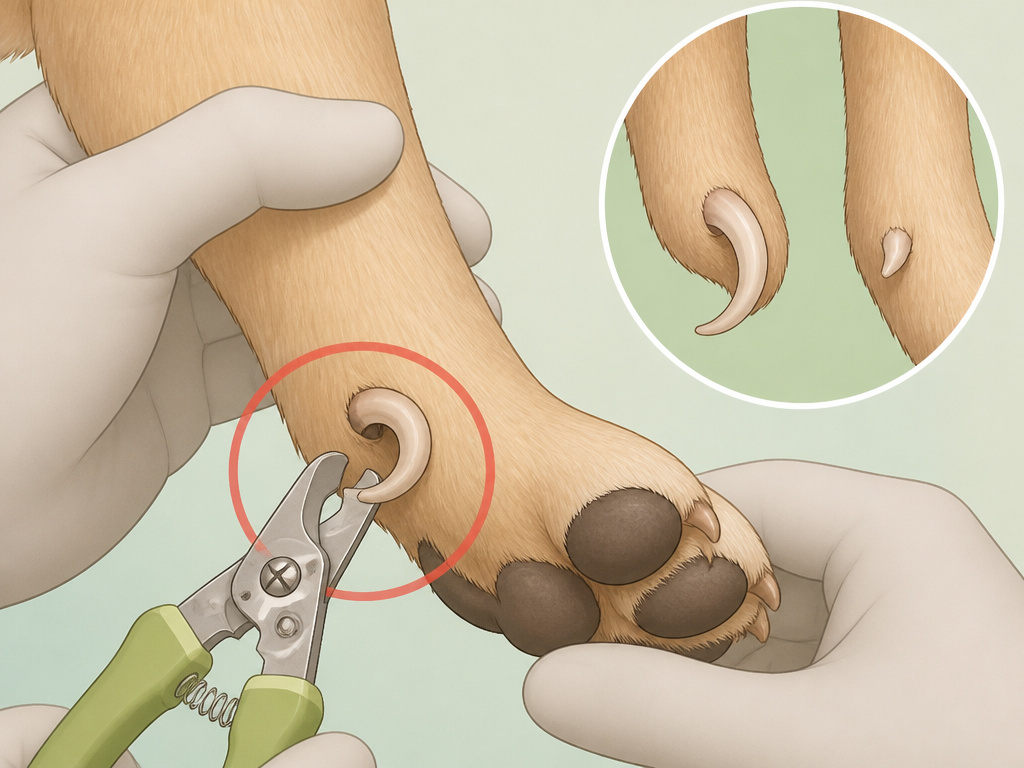
Dewclaws are the ones owners forget. They sit on the inner leg, higher than the other nails, and they do not contact the ground during normal movement.
That is exactly why they overgrow. VCA notes dewclaws often become overgrown and can curve around until they grow into the paw pad. Community Animal Hospitals says they can grow in circles if neglected. Dogster says they can curl back until they are embedded in the dog’s leg.
The trim itself is the same as any other nail, but the check is different. There is no ground contact to use as a reference, so the only reliable check is to look. If the dewclaw is curving, it needs a cut.
Dogs Trust notes that dewclaws often don’t contact the ground, so they will not wear down naturally and are likely to require clipping even if the other nails wear down.
The part nobody mentions: A dewclaw that has grown into the pad is painful and can become infected. Dogs Trust notes that case needs a vet, and possibly sedation, because the nail has to come out of tissue rather than off the surface.
When Long Nails Are a Vet Problem, Not a Trim Problem
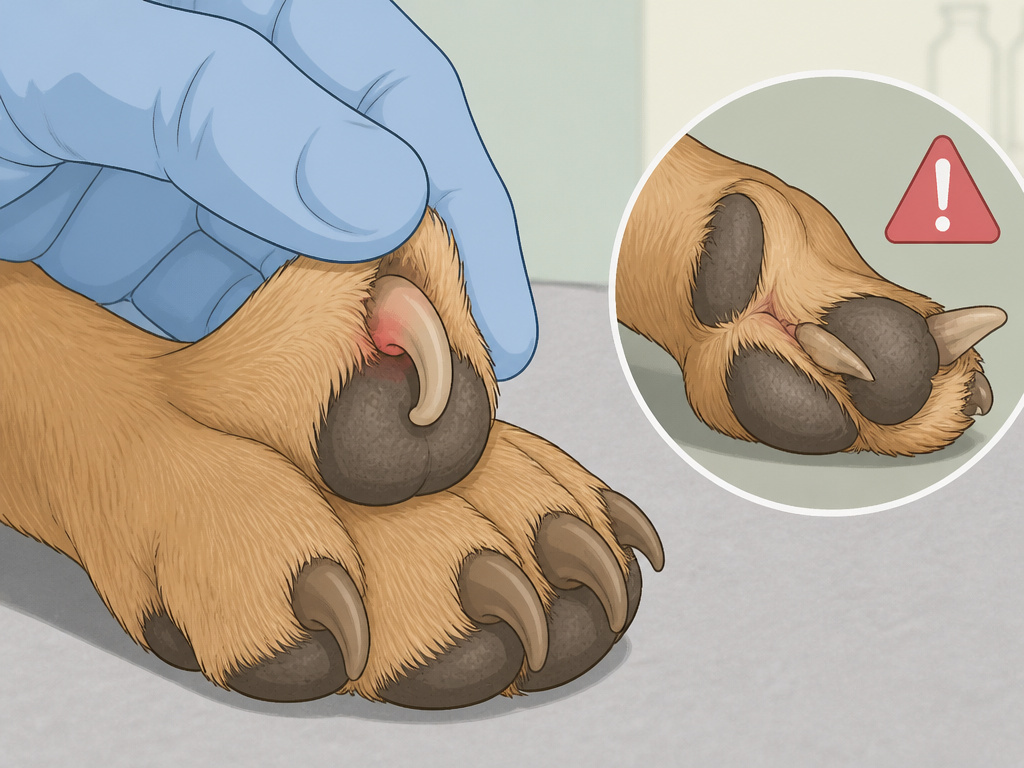
Splaying toes, an upward-pushed nail bed, and distorted toes are the three findings Dogs Trust flags for a vet referral. Those are structural changes, not a length problem, and cutting the nail does not reverse them.
Other cases that belong with a professional:
- A nail growing into the pad. Dogs Trust describes this as very painful and prone to infection, and it may need sedation to treat.
- Very long nails on a dog with black nails. Dogster recommends a vet or groomer for that combination, because the quick cannot be seen. Trimmers for black nails help, but they do not solve the visibility problem.
- A dog that panics despite gradual introduction. The Royal Kennel Club says never force it, and suggests a vet who may refer to a behaviourist. If you are still at the stage where the dog will not sit still, calm a dog first and come back to the nail later.
- Limping or paw licking with no obvious cause. Dogster lists both as possible signs of pain from long nails, but they can also point to something else.
A nail that has torn rather than overgrown is a different problem, and a broken nail needs its own handling before you think about length.
Dogs Trust adds a longer-term concern. Overgrown nails can hide other underlying disease, including arthritis. A dog that shifts weight off a painful joint may walk in a way that lets the nails grow longer, and the nails become the visible symptom of a hidden problem.
VCA notes that vet clinics can offer sedation for dogs that are very upset by trims. That is a legitimate option.
The Tools That Make the Check Easier
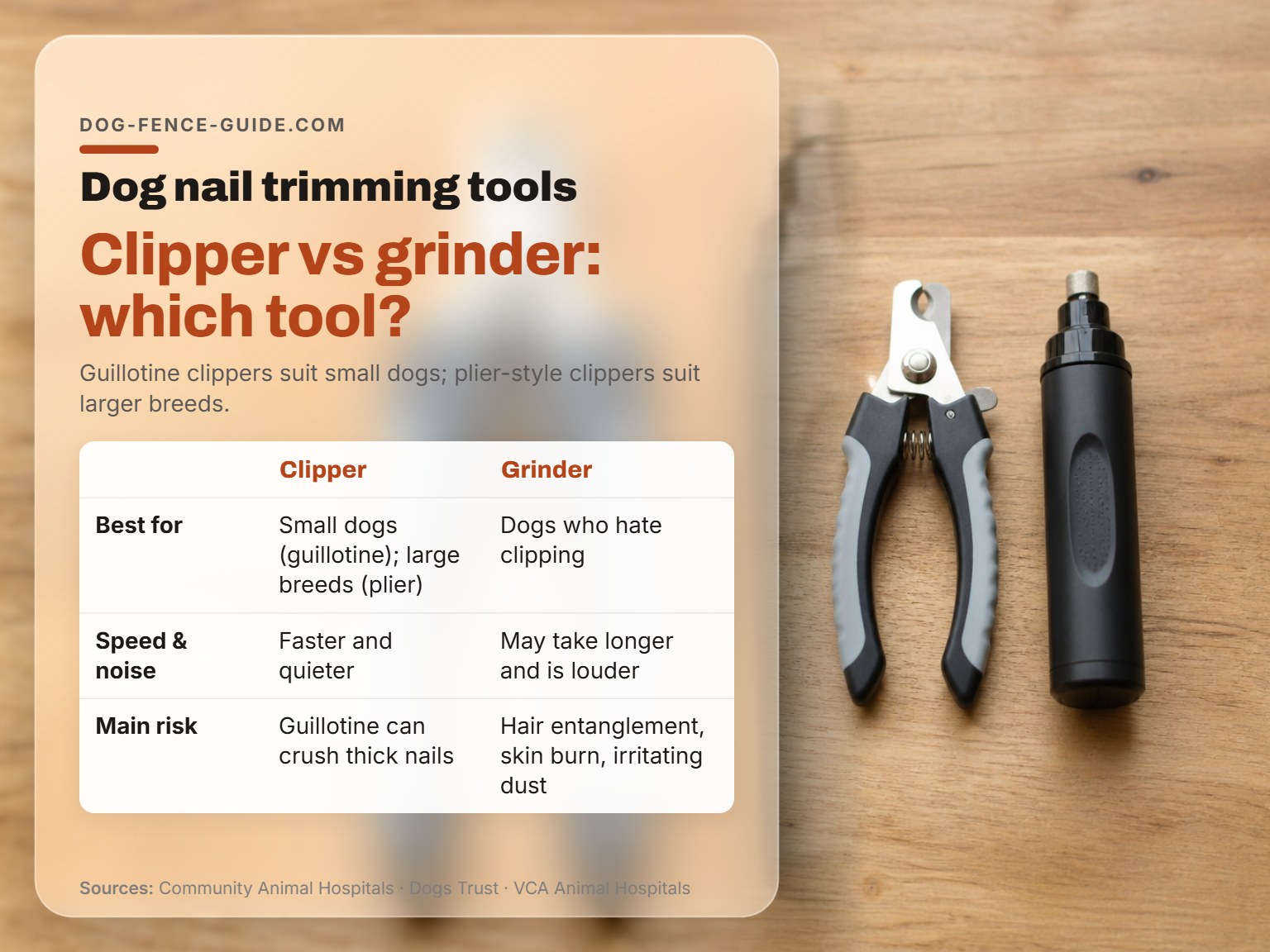
Guillotine clippers get recommended for small dogs, and for thick nails they are the wrong tool. Community Animal Hospitals draws the line at size: guillotine-style clippers work well for small dogs, and plier-style clippers are better for larger breeds.
Here is the honest version. Most owners do not need a grinder, and the ones who buy one often stop using it.
A plier-style clipper handles a thick nail without the crushing action a guillotine applies, and the cut comes out cleaner. For a small dog with thin nails, a guillotine is fine and cheap.
Clipper vs Grinder
The choice comes down to the dog’s temperament more than the nail.
A nail grinder grinds the nail down in small increments, so you can watch for the quick as you go. Dogster notes grinders leave a smoother nail with less chance of splitting, and that they are an advantage on long nails specifically because you can grind slowly. VCA warns that the spinning file can catch long hair, can cause a severe skin burn if it contacts skin, and that the dust can be irritating.
The trade-off is time and noise. Dogs Trust notes grinders may take longer to use and have a louder noise, and Dogster lists the extra time as the main disadvantage. A dog that tolerates clippers but flinches at the grinder’s louder noise may need the grinder introduced gradually, like clippers.
A clipper with a safety guard is a reasonable middle option for a dog with moderate nails and an owner who wants a guarded cut. Dogs Trust notes that some clippers ship with a safety guard that limits how much nail is taken per squeeze, which helps while you are learning where the quick sits on your particular dog.
Worth knowing before you start: Learn to read the nail by eye before you buy a grinder. Grinding only helps if you can already see where the quick sits, and a tool that removes material slowly still removes it.
Frequently Asked Questions
Can I tell if my dog’s nails are too long just by listening?
On hard floors, clicking is a reasonable prompt to check. Five sources, including VCA and the Royal Kennel Club, treat it as an indicator of overgrowth. Dogs Trust disagrees, saying clicking does not necessarily mean the nails are too long. Use the sound to trigger a visual check, then decide from what you see.
Do nails touching the ground always mean a trim is due?
Sources disagree. VCA, the Royal Kennel Club, and North Jersey Animal Hospital treat ground contact as a sign the nails are long, while Dogs Trust says nails touching gently and worn flat are being maintained by exercise and do not need trimming.
How often should I actually trim?
The sources range from weekly to monthly. VCA says about once a month, the Royal Kennel Club says once or twice a month, North Jersey says every two to four weeks, and Dogster says at least every other week. Pick the interval that matches your dog’s activity and surface, then check the nails between sessions.
What if I can’t see the quick?
On dark nails, you usually cannot. VCA’s guidance is to trim just the very tip. Dogster recommends checking the cut surface after each small cut for a grayish oval or black dot, which is the quick. If the nails are very long and black, Dogster recommends a vet or groomer, while VCA says to trim just the very tip on dark nails.
Are dewclaws really necessary to trim?
Yes. Dewclaws do not contact the ground, so they do not wear down. VCA notes they can curve into the paw pad, and Dogs Trust notes an ingrown dewclaw is painful and prone to infection. Trim them with the other nails.
When should I stop and call the vet?
Dogs Trust lists splaying toes, an upward-pushed nail bed, and distorted toes as referral triggers. A nail growing into the pad also needs a vet, and may need sedation. A dog that panics despite gradual introduction should be seen rather than forced.
Before You Pick Up the Clippers
The most useful thing you can do this week takes no clippers: stand the dog up on a hard floor, get down at eye level, and look at whether the front nails touch the tile. That single observation tells you more than any schedule.
If they touch, and the dog is walked mostly on grass or mulch, book the trim. If they touch gently and the tips are worn flat from pavement, you have a dog that is maintaining itself, and the right move is to keep checking rather than to cut.
Here is the concession worth making. If your dog is small and light, or elderly and moving less, the ground-contact check will under-report the problem. A small, light dog does not generate enough abrasion to wear its own nails down, and an older dog that walks less will grow longer nails on the same diet and the same yard. Judge those dogs on the calendar, not on the floor.
And if the nails are already splayed or curving into the pad, skip the clippers entirely. That is a vet call, and the sooner it happens the less the dog has to endure.
