
How Often Should You Trim a Dog’s Nails? Vets Disagree
This post contains affiliate links. As an Amazon Associate, we earn from qualifying purchases.
A dog’s nails need trimming somewhere between every 3 weeks and every 8 weeks, and the sources disagree about where your dog lands in that range, or whether it needs trimming at all. VCA Animal Hospitals says about once a month, or every 3 weeks for inactive dogs. Dogs Trust says many dogs never need clipping.
The gap between a 4-week schedule and an 8-week schedule is real, and it changes how often should you trim a dog’s nails on a Sunday afternoon. It also changes what happens to a dog whose nails never get checked at all. Dogs Trust lists the variables that decide it: weight, breed or type, how much and how long the dog exercises, the ground it exercises on, and whether it has dewclaws.
What follows is the range the sources actually give, the two tests that tell you your dog’s number, how much nail to take off light versus dark nails, and the point where you stop and call a vet instead.
Key Takeaways
- 3 to 8 weeks is the honest range, and no source reconciles the two ends.
- Clicking on hardwood is a signal, not proof. Dogs Trust says it doesn’t necessarily mean the nails are too long.
- Light nails: stop 2-3 mm from the quick. Dark nails: 1-2 mm per clip, or just the very tip.
- Dewclaws need trimming even on dogs that never need a full pedicure.
- Bleeding past 10 minutes means a vet visit, not more styptic powder.
How Often Should You Trim a Dog’s Nails? What the Sources Actually Say
The published advice for dogs runs from every 3 weeks to every 8 weeks, and nothing reconciles the two ends.
The quick is the pink core of the nail, carrying blood vessels and nerves. Quick and shell lengthen together, so a dog that has gone months without a trim carries a longer quick than a dog on a regular schedule. Frequent small trims keep the quick receded. A neglected nail cannot be shortened all at once.
| Source | Interval they give | Type of source |
|---|---|---|
| VCA Animal Hospitals | About once a month; every 3 weeks if inactive | Veterinary hospital network |
| PetMD | About every 4 weeks | Vet-reviewed pet media |
| Well & Good WGN01/WGN02 manual | Every 3 to 4 weeks | Manufacturer instructions |
| Texas A&M Vet Med | As often as necessary for dogs | University veterinary school |
| Dogs Trust | Many dogs never need clipping | National welfare charity |
| Dogster | Every 4 to 6 weeks | Vet-answered blog |
Six credible sources, six different numbers. The disagreement isn’t a sign that one of them got it wrong. It reflects the fact that a dog’s nails wear down at a rate set by the dog, and each of these sources is writing for a different average.
VCA lands at about once a month for most dogs, then shortens that to every 3 weeks for dogs that are inactive or never walk on hard surfaces. PetMD says about every 4 weeks. The Well & Good WGN01/WGN02 grinder manual says every 3 to 4 weeks and calls that essential (a word doing a lot of work in a product manual). Dogster stretches to every 4 to 6 weeks. The Texas A&M pet nail trimming guide takes the widest position of all: clipping can be done as often as it needs to be, and pairing it with bath time makes it easy to remember.
Then there’s Dogs Trust, which breaks the pattern completely. Many dogs never need their nails clipped, the charity says, and adding pavement walking to the daily routine can be enough on its own.
What most people get wrong: Treating one interval as the rule for every dog. Apply a 4-week calendar to a dog that pounds pavement every day and you’ll eventually cut into a nail that was already worn flat. Do that twice and you’ve got a nail bed that bleeds and a dog that fights the clippers.
The practical move is to check the nails on a schedule and let the how often should you trim a dog’s nails question be settled by evidence. how to tell if nails are too long walks through the two tests that matter, and how often should you groom a dog covers how the nail check fits into everything else you do.
Treat all of it as a range.
Do Clicking Nails Really Mean a Trim Is Due?
You can hear the clicking from the next room and still be wrong about whether your dog needs a trim.
VCA Animal Hospitals calls audible clicking on hard floors a clear indicator that the nails are too long. PetMD agrees: once the nails start to tap on hard surfaces, it’s time. Dogs Trust disagrees outright, saying that hearing your dog’s nails on the floor doesn’t necessarily mean they’re too long, and advising owners to ask a vet.
That’s a straight contradiction between a national welfare charity and two veterinary hospital networks, and it matters because clicking is the test most owners actually use.
The reason the test is unreliable is that it measures sound, not length. A long nail on a hard floor makes noise. So does a short nail on a dog with a springy gait and hardwood throughout the house.
| What you see or hear | What it usually means | What to do |
|---|---|---|
| Clicking on hardwood | The nail is long enough to strike the floor | Check where the tip sits when standing |
| Tip touching the ground but worn flat | Natural wear from hard surfaces | Leave it alone |
| Tip curving sideways or hooking | No natural wear, so the nail is overgrown | Trim in small stages |
| Dewclaw curling toward the pad | No ground contact, so no wear | Trim it |
The visual test is better. Get down at floor level while your dog stands and look at where the tips sit. Dogster’s rule is that toenails should skim just above the ground when the foot is down. VCA says that if the nails touch the ground, they’re too long. Dogs Trust splits the difference: if the nails touch the ground gently and are worn flat, they’re wearing down naturally and don’t need trimming.
Here’s where the two positions actually meet. A worn-flat nail has a blunt, squared-off tip and a dull sheen across the end where it’s been scuffed against pavement. An overgrown nail tapers to a thin hook that catches on the rug when the dog walks past. Those two nails look nothing alike, and once you’ve seen both on your own dog you stop needing the sound test.
Easy to miss: The dewclaw. It sits up the leg, it never touches the ground, and it never wears down. On a dog whose other nails stay short on their own, a dewclaw can curl all the way around into the pad before anyone notices.
Dogs Trust agrees on one nail: dewclaws don’t contact the ground, so they don’t wear down and are likely to need clipping even on a dog whose other nails never do.
That’s the whole test. Look at the tip, not the floor.
What the VetCompass Data Actually Shows
A 2025 study in the Journal of Small Animal Practice pulled VetCompass records for dogs under UK primary veterinary care in 2019 and found that 5.64 percent of them had a nail clipping recorded that year.
That’s the only population-level number anyone has published on this question, and it sits badly against the idea that most dogs need a trim every four weeks. If monthly clipping were universal, the recorded share would look nothing like 5.64 percent.
The study authors flag part of the reason. Their records captured primary veterinary care events only, so clips done by groomers or by owners at home were never counted. The real total is higher than 5.64 percent, and the paper says so directly. The dog nail clipping frequency research also notes that the job status of whoever performed the clip wasn’t routinely recorded.
Of the recorded events, nail clipping was the primary reason for the visit in 59.4 percent. The two most common clinical justifications were overgrown or ingrown nails at 12.66 percent and broken claws or dewclaws at 8.84 percent. Those two categories are the most common, and together they still account for only about a fifth of the recorded events.
Check the source. A figure like 5.64 percent is only useful if you know what it excludes.
Breed mattered too. Compared with non-designer crossbreds, Chihuahuas had 2.21 times the odds of a recorded clip, Beagles 2.09 times, and Greyhounds 2.02 times. Dogs aged 1 to 2 years had the highest odds of any age group, at 1.61 times.
The study doesn’t explain the breed pattern, and I’m not going to invent a reason for it. Dogs Trust offers a plausible link without claiming it as fact: small, light dogs may not weigh enough for their nails to wear down through exercise, which would leave more of them needing help.
Reading Your Own Dog: The Five Variables That Set the Interval
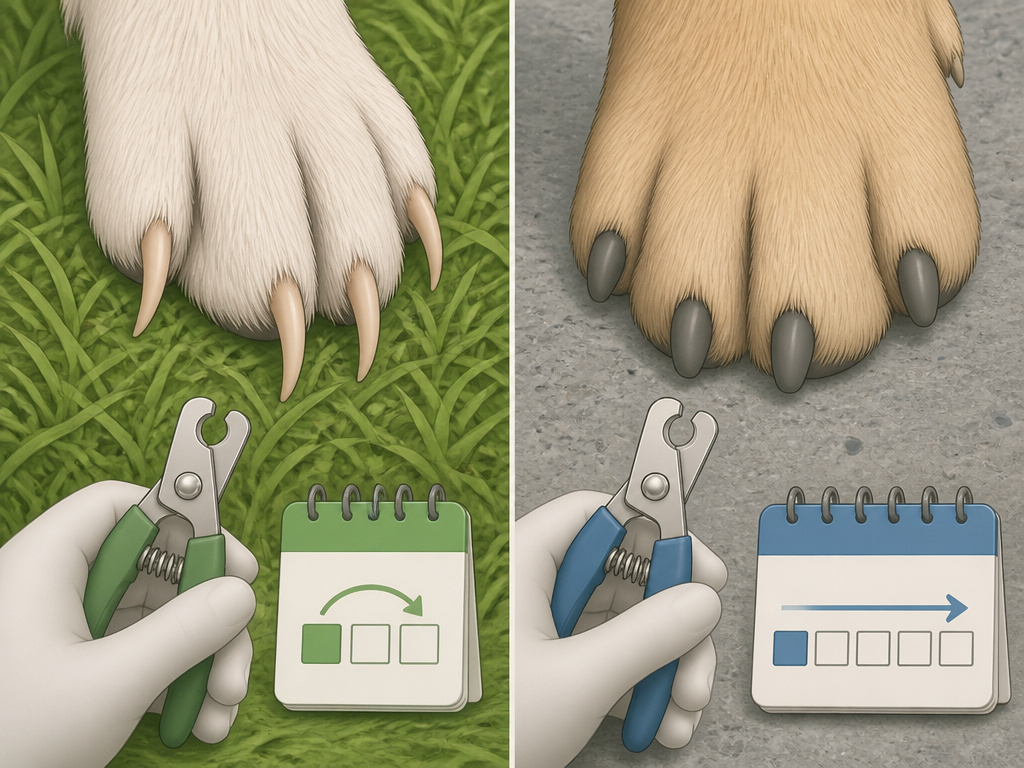
Your neighbor’s labrador gets infrequent trims and never clicks on the kitchen tile. Your chihuahua clicks frequently. Both are normal.
Dogs Trust names five things that decide whether your dog needs regular clipping at all:
- Weight. A small, light dog may not weigh enough for its nails to wear down through exercise.
- Breed or type. Foot and coat shape vary enormously, and the VetCompass data puts Chihuahuas at 2.21 times the odds of a recorded clip compared with non-designer crossbreds.
- Exercise. How much, and for how long.
- Ground surface. Concrete and pavement file nails down. Grass and carpet do nothing.
- Dewclaws. Present or absent, and there’s no wear either way.
Read that list again and notice what’s missing from it. There’s no entry for the owner’s age, the brand of food, or how much you love the dog.
The mechanism behind the ground-surface variable is simple abrasion. A nail dragged across concrete loses material every step, the same way a fence post loses paint where the gate rubs it. A nail that only ever meets grass keeps everything it grows.
Run a thumb across the tip of each nail. A nail doing its job feels smooth and blunt. One that needs cutting has a thin, sharp point that catches on your skin.
High-Wear Dogs vs Low-Wear Dogs: Who Needs the Shorter Interval
Low-wear dogs need the shorter interval, and it isn’t close. A dog that’s small, light, mostly indoors, and walked on grass will need more frequent checking and may need trimming most of those times. A heavy dog that runs on pavement regularly can go far longer, and Dogster notes that some dogs need to wait past 6 weeks.
The low-wear dog is also the one most likely to be missed, because nothing about the dog announces the problem. The nails just grow. Regular nail trimming is the only thing that resets the clock for a dog like that.
I keep a grooming calendar, and I treat it as a starting point rather than an answer. My double-coated dogs get pushed to the long end of every interval. My oily terrier mix sits at the short end, because she starts looking greasy sooner than my other dogs. The nail interval behaves the same way: set a check date, then let the dog tell you what to do on it.
Worth knowing before you start: A dog that stops exercising because of arthritis or a bad hip stops wearing its nails down, even though the nails keep growing at the same rate. Dogster notes that older dogs often drag their back toes on carpet because they aren’t lifting their hind legs as high. That’s a nail problem and a mobility problem at the same time.
How Much Nail Should You Take Off Light Nails vs Dark Nails?
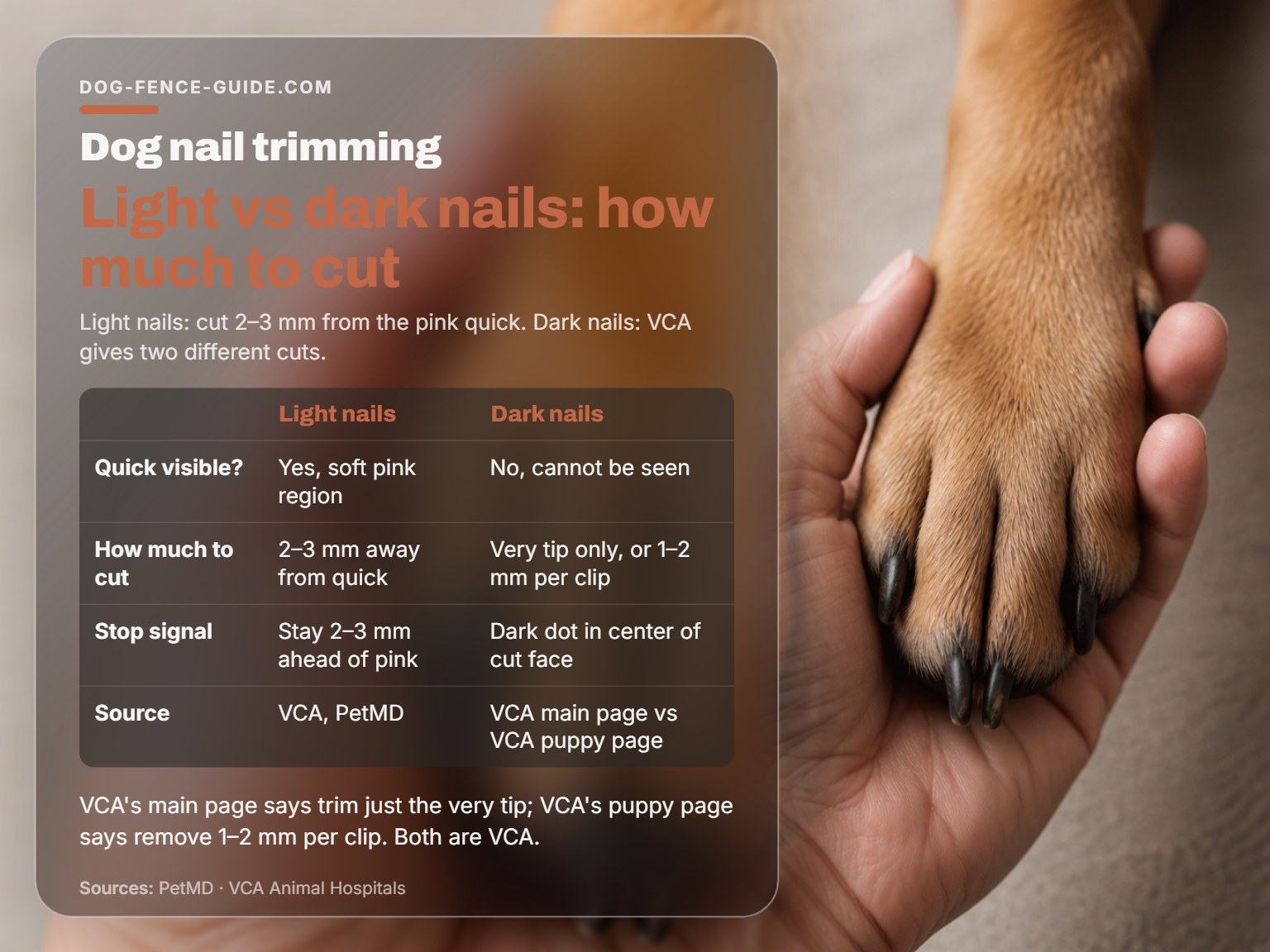
Light nails and dark nails need two different cuts, and VCA gives two different numbers for the dark ones depending on which page you read.
On a light or white nail, the quick shows through as a soft pink region. PetMD describes it that way, and VCA’s guidance is to cut about 2-3 mm away from it. That gap is your margin.
On a dark nail you can’t see anything, and this is where the sources split. VCA’s main nail-trimming page says to trim just the very tip off the nail. VCA’s puppy page says to remove 1-2 mm with each clip and progressively shorten the nail over several sessions. Both come from the same hospital network, published for different audiences, and neither one is wrong. The tip-only instruction is the safe first pass. The 1-2 mm instruction is what you graduate to once you know where the quick sits on your dog.
PetMD adds the tell that makes a dark nail workable: trim slowly and watch the cut face for a dark dot in the center. That dot is the quick arriving, and you stop there.
Before you start: Have styptic powder open on the table before the first clip, not after. A cut quick bleeds freely, and a dog that won’t let you hold the toe makes it worse. Keep the blade sharp, because a dull clipper crushes the nail instead of cutting it, and a crushed nail hurts more than a clean cut.
Here’s the sequence I use:
- Hold the paw and look at the nail in good light before you cut anything. Skipping this is how you cut a pink nail blind.
- On a light nail, find the pink core and cut 2-3 mm ahead of it. Cut into the pink and you get pain, blood, and a dog that remembers.
- On a dark nail, take 1-2 mm and then look at the cut face. A dark dot in the center means stop.
- Do the dewclaws. They never touch the ground, so they never wear down, and an ignored one can curve around into the pad.
- If you hit the quick, tap styptic powder onto the end of the nail. If you have none, VCA and PetMD both say flour or cornstarch works.
One warning worth repeating, because it’s the strangest piece of advice in the veterinary literature. Don’t put plastic wrap on your head and smear peanut butter on it for the dog to lick while you trim. VCA warns that a startled or hurting dog may bite or injure your face. Use a licky mat on the floor instead.
If you want the full anatomy, the quick explains what you’re cutting toward and why it recedes with regular trimming.
Small cuts, good light, and a stop rule.
Clippers, Grinders, and What Actually Holds Up
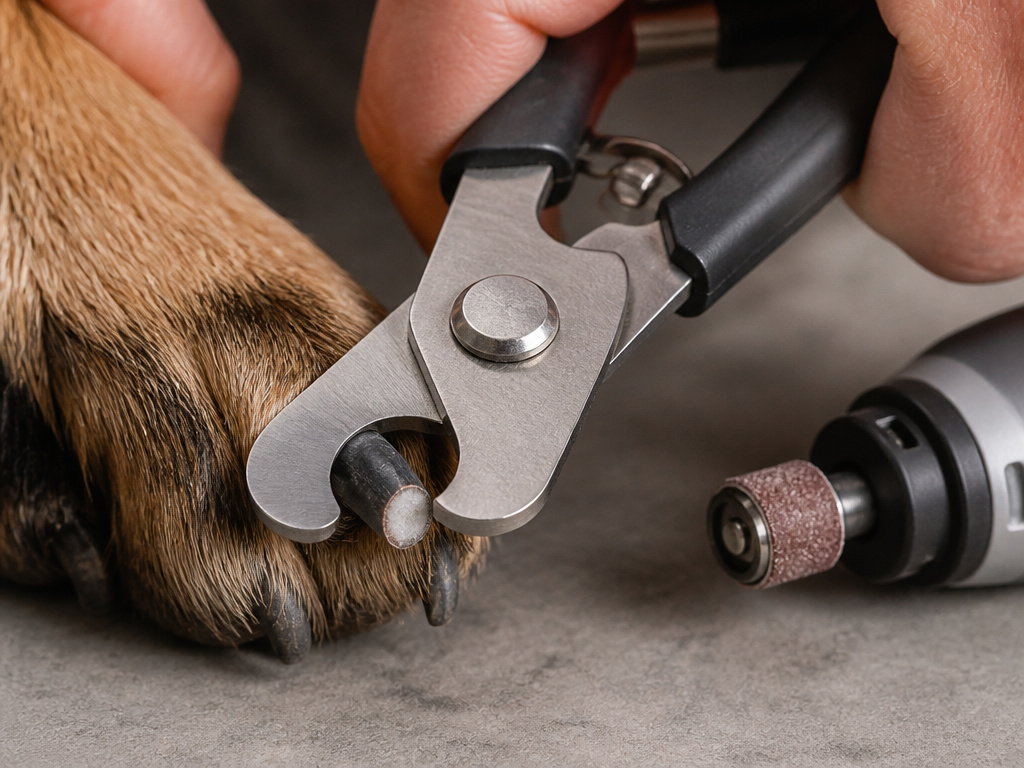
Guillotine clippers are the wrong tool for a thick nail.
They work by trapping the nail in a ring and driving a blade across it, which is fine on a thin nail and miserable on a heavy one. VCA notes that guillotine trimmers can cause a crushing sensation, and that puppies in particular may resist putting a nail through the hole. If your dog has thick, dark nails, skip the guillotine entirely.
What I reach for:
- Millers Forge clippers. Pliers-style, stainless, and they take a thick nail in one clean bite. This is the clipper I’d hand to anyone with a large dog.
- Safari scissor-type clippers. VCA suggests scissor-type clippers for dogs that resist the guillotine style, and Safari’s are the ones I’ve used most.
- Dremel 7300-PT. The grinder I keep for touch-ups and for dogs with thin nails.
- Well & Good WGN01/WGN02. A budget grinder with two speeds. The WGN01 sets Lo for dogs and cats under 20 LB and Hi for dogs over 20 LB, and the manual caps grinding at 2-4 seconds per nail, alternating between nails. That 20 LB threshold doesn’t apply to the WGN02.
Clipper vs Grinder: Which Wins for Thick Nails
Clippers win on thick nails, and grinders win on everything else.
A pliers-style clipper leaves a flat cut face you can inspect for the dark dot. A grinder on the same nail takes multiple passes, and each pass is a chance for the dog to move.
Flip it for a small dog with thin nails. A grinder takes off thin layers and you can pull it away instantly, which is exactly what you want when the quick is close. That’s why I keep both and use them on different dogs.
Grinding carries its own risks, and VCA lists three: the spinning file can catch and tangle long hair, it can cause a severe skin burn if it contacts skin, and the dust it throws is irritating to people and presumably to dogs. Grind outside, or at least somewhere you don’t have to breathe it.
That dust settles on the table, the dog’s paw, and your sleeve. Long-haired dogs need the coat pulled back before the file goes anywhere near a nail.
Where this goes sideways: Grinding a long-haired dog without checking for loose hair. The file catches the coat, the dog pulls away while the file is still turning, and you end up with a burn or a cut that has nothing to do with the nail.
using a nail grinder covers the technique in more detail.
Dogs That Hate It: Why Two Nails a Day Beats a Full Session
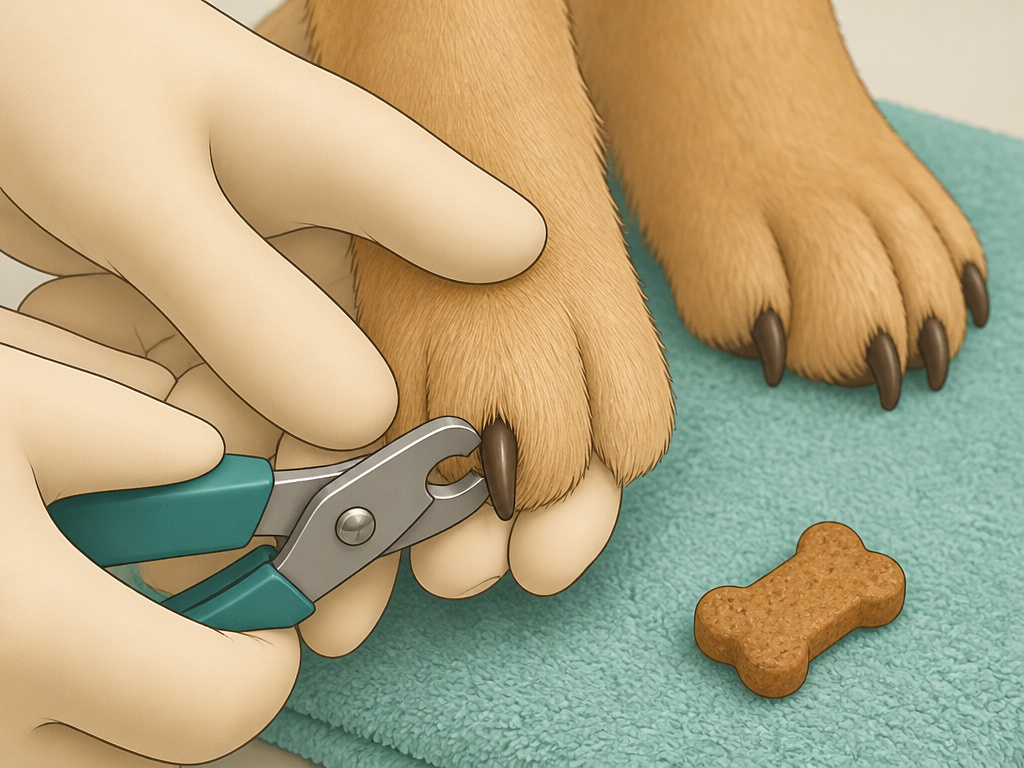
Ever tried to hold a dog still for a full set of nails?
VCA’s advice is blunt: if your dog hates nail trims, don’t set a goal of clipping all the nails in one sitting. Dogster and Texas A&M both land in the same place, recommending one or two toes a day instead. That’s slower, and it works.
The reason it works is that a full session teaches the dog one lesson, and it’s the wrong one. A full set of nails means many chances to feel a pinch, and the dog learns that the clippers predict discomfort. One nail a day teaches the opposite. The clippers come out, something mildly strange happens, and then there’s a treat and it’s over.
I’d rather see an owner do one nail a day for two weeks than a full trim in one go. The dog learns that the clippers mean a treat and then stop. A full session teaches the opposite lesson, and you’ll spend months undoing it.
Start smaller. VCA lays out a progression that takes several weeks on purpose: handle the feet with treats and no clippers, then trim one nail, then two or three, then a whole paw,
Frequently Asked Questions
Do indoor dogs and outdoor dogs need different trimming schedules?
Yes, and the difference can be substantial. A dog that spends hours on pavement or gravel wears nails down naturally and may stretch toward the 8-week end of the range. A dog that mostly walks on grass, carpet, or stays inside has almost no natural wear and tends to need attention closer to the 3- or 4-week mark.
Can I tell whether the nails are too long without a vet or groomer?
Stand your dog on a flat, hard floor and look at the paws from the side. If nails touch the ground and lift the toes out of their normal position, they are too long. You can also look at the underside of the paw: long nails push the toes sideways and can make the foot splay.
What happens if I skip trims for several months?
The quick grows longer along with the nail, so the nail cannot be taken back to a short length in one session. Bringing it down safely takes a series of small trims spaced a few weeks apart. Skipping trims also changes how the dog stands, which over time can affect posture and comfort.
Does the answer change for puppies or senior dogs?
Puppies generally need more frequent attention because their nails grow quickly and they are often on soft surfaces. Senior dogs that move less may also need more frequent checks, since reduced activity means less natural wear. In both cases, inspect the nails every couple of weeks and trim based on what you see rather than a fixed calendar.
