
How to Teach a Dog Drop It: 4 Steps That Stick
This post contains affiliate links. As an Amazon Associate, we earn from qualifying purchases.
To teach a dog drop it, trade something better for the item. Bring a high-value treat to the dog’s nose or drop it at your feet, mark the moment the mouth opens, then pay. Add the words “drop it” only after the trade works, and never chase or pry the mouth open.
That trade works because the dog chooses to let go. Chase a dog and the choice turns into a contest, which is where the trouble starts.
Here is what actually matters: the four steps in order, the three treat-delivery methods the major protocols disagree about, and the exact point where you should stop and hand the job to a trainer.
Key Takeaways
- Trade first, cue later. The words “drop it” go on after the dog already releases for food, never before.
- Say the cue once. Oregon Humane Society is blunt about this: don’t repeat it. Make the food more interesting instead.
- Never chase or pry. Chasing raises the odds the dog swallows the item, and prying puts your hand near teeth.
- Guarders need a trainer first. Both the AKC and Toronto Humane Society say get professional help before starting.
- Fade treats slowly. AVSAB suggests praise alone about half the time, then a gradual reduction from there.
The Trade: Give Something Better, Then Pay
The trade works because the dog chooses to let go.
Drop it training pairs a release with a reward. The dog holds an item, a higher-value food or toy appears, and the release gets marked and paid. The verbal cue is added only after the release is reliable, then generalized to items of increasing value. Distance from the dog is varied, and the reward value rises alongside the item value.
That choice is the whole mechanism, and it’s why the how to teach a dog drop it question makes force backfire. VCA Animal Hospitals notes that the chase-and-capture cycle creates emotional conflict in some dogs and can trigger an aggressive response. The American Kennel Club points at a second cost: a chased dog is more likely to swallow the item to keep it, and even a harmless object can choke or block an intestine.
Prying has its own bill. The AKC warns that forcing a mouth open puts your hand at risk and can push the dog to gulp the thing down faster.
Watch the shoulders instead. A dog that’s about to release goes soft through the neck and jaw just before the mouth opens, and that softness is the signal to mark, not the drop itself.
This is positive reinforcement in its plainest form. Nothing gets taken. Something better gets offered, and the dog decides.
Drop it handles what’s already in the mouth. Leave it handles what the dog is thinking about picking up. They’re different jobs, and most owners teach them in the wrong order.
How to Teach a Dog Drop It in 4 Steps
Four steps, and they go in order.
Before you start: A dog that freezes, stiffens, or growls over an object is a bite risk, so stop and call a qualified trainer before you run a single repetition. Keep sessions short and end them while the dog is still loose. Never pry a mouth open, and never corner a dog against a wall or furniture.
- Trade with the food visible. Hold a toy in one hand and a treat in the other, let the dog grab the toy, then bring the treat to the nose. Skip this and you’re asking for a behavior the dog has no reason to offer yet.
- Name it at the moment of release. Say “drop it” once, just as the mouth opens, then pay. Name it too early and the word turns into background noise the dog learns to ignore.
- Fade the food in small steps. AVSAB’s guidance is praise alone about half the time and praise plus treat the other half, then a gradual reduction, while the AKC suggests giving the cue without showing treats and providing a jackpot reward if the dog drops the item. AVSAB warns that if you quit treats all at once the dog may stop releasing the ball, while the AKC suggests giving the cue without showing treats and providing a jackpot reward if the dog drops the item.
- Raise the value of the item. VCA’s sequence moves from a low-value toy to something more valuable, with the reward climbing to match. Jump straight to the stolen shoe and you’ll get a stare and a locked jaw.
If the dog doesn’t let go when it hears the cue, VCA says go back to the previous level for a few more sessions, while Oregon Humane Society says don’t repeat the cue and instead make the food more interesting. That’s the whole repair. No new technique, just an easier version of the last one.
Marking the release matters more than people think. A marker word like “yes” or a click tells the dog exactly which half-second earned the food. If you’re new to it, PAWS Chicago recommends getting some practice with clicker training before teaching drop it, though the word “yes” can stand in for the click.
Sound carries the timing here. That tick is your competition, so keep the treat small enough to eat in one bite.
Which Treat Delivery Method Should You Use?
Three methods show up across the major protocols, and they don’t agree with each other.
| Method | Who teaches it | Best for | Watch out for |
|---|---|---|---|
| Toss the treat on the floor | VCA, Oregon Humane Society | Dogs that guard the toy | Dog may bolt for the food and skip the lesson |
| Bring the treat to the nose | AKC, AVSAB | Tug and fetch games | Hand gets close to the mouth |
| Pop the treat in the mouth | Toronto Humane Society | Dogs that won’t open up at all | Doesn’t teach a choice, just a swallow |
The floor toss keeps your hands clear. VCA positions you a few feet away so it’s obvious you aren’t about to steal the toy, then tosses a treat close to the dog while it’s still playing. Oregon Humane Society does the same thing but says the cue once, clearly, before the toss.
The nose trade is tighter and faster. The AKC places a high-value treat right in front of the nose and waits for the drop, while AVSAB brings the treat to the nose with the free hand during tug; VCA and Oregon Humane Society instead toss the treat onto the floor, and Toronto Humane Society pops it straight into the mouth. Both put your fingers within reach of teeth, which is fine for a relaxed dog and a bad idea for a stiff one.
Toronto Humane Society goes the other direction entirely: say “Drop!” and pop the treat straight into the mouth without waiting for the dog to open on its own, while the AKC waits for the drop before giving the treat and Oregon Humane Society tosses the treat on the floor. The dog has to drop the item to eat. It works, and it’s the fastest of the three, but it teaches less about choosing to release.
Pick the one that matches your dog’s temperament. A soft, eager dog handles the nose trade fine. A dog that tightens up when a hand comes near gets the floor toss.
What to Do When the Dog Won’t Let Go

This is where the protocols split hardest, and it’s worth knowing both positions.
Oregon Humane Society says do not repeat the cue, while VCA says go back to the previous training level for a few more sessions. Instead, make a big deal about the food on the floor, point at it, talk it up, and praise the instant the dog disengages from the toy. VCA takes a different route and sends you back a training level for a few more sessions, while Oregon Humane Society says don’t repeat the cue and make the food more interesting instead. Toronto Humane Society splits the difference: trade a treat for the toy, return to step one, practice a few more times, then retry, while Oregon Humane Society says don’t repeat the cue and VCA says go back a training level.
Common mistake: Repeating “drop it, drop it, drop it” while the dog clamps down. The word stops predicting anything, and the dog learns that the cue is just noise you make before giving up.
What all three agree on is the direction of travel. You make the alternative better. You don’t make the hold worse.
A few things to try before you reset:
- Toss the treat a few feet away so the dog has to move to get it.
- Switch to a genuinely higher-value food, like meat or cheese.
- End the session and come back tomorrow with an easier item.
- Put the dog on a leash so it can’t leave with the prize.
That last one comes from the AKC, which suggests leash work or a treat tossed a few feet away to buy yourself time to reach the toy. Both beat a footrace, and the AKC is clear that racing the dog to the dropped object is a losing move.
Tug, Fetch, and the Two-Toy Trade
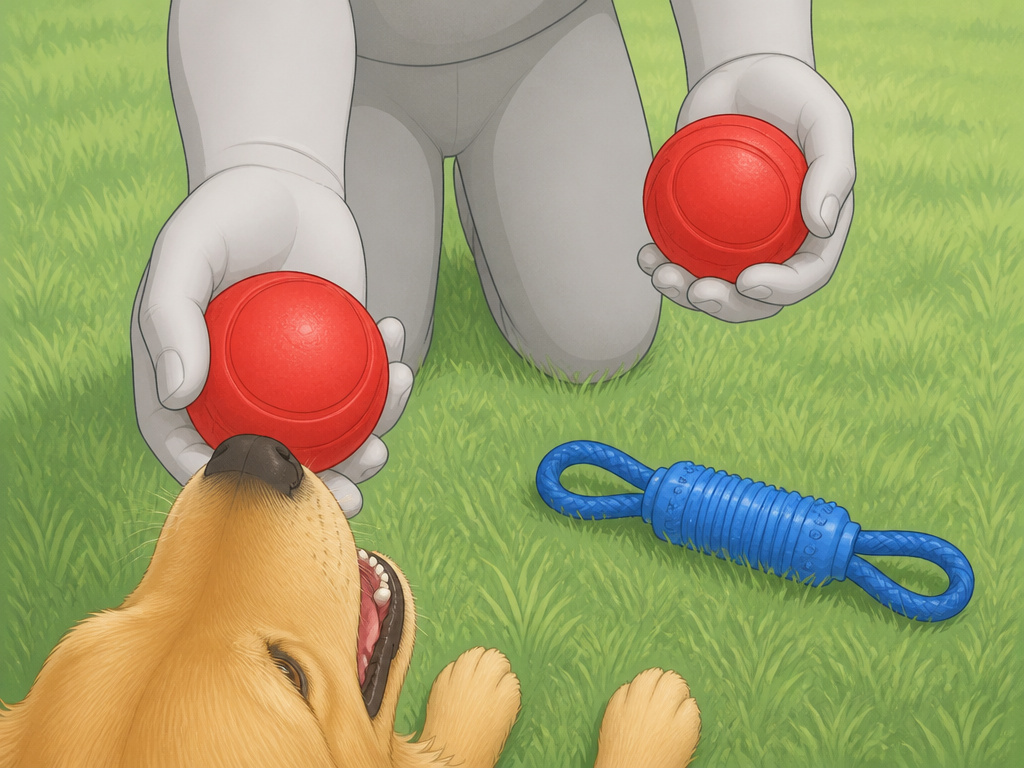
Games are where drop it earns its keep, and they’re also where owners get the most advice that contradicts itself.
The Two-Toy Trade for Fetch
Start with two toys of roughly equal value in the dog’s eyes. VCA’s version: play with one, animate it on the ground, then when the dog brings it back, say “drop it” and toss the second toy as payment. The dog releases the first to chase the second, and you pick up the first without a struggle.
AVSAB has a useful tweak for ball-obsessed dogs. If the ball outranks every treat in the house, throw the second-favorite toy and trade it when the dog returns with the favorite. It’s the same mechanic with the values flipped.
Tug of War: Who Should Skip It
AVSAB draws a clean line. Don’t play tug with a dog that is already aggressively possessive of its toys. AVSAB says tug is safe for a dog that has never shown aggression as long as the dog reliably responds to “drop it,” but AVSAB also says not to play tug with a dog that is already aggressively possessive of its toys.
The mechanics matter. VCA says move the toy side to side, never up and down, and use no sharp movements. The AKC’s version of tug training is to go still after a few seconds and wait, though AVSAB says not to play tug with a dog that is already aggressively possessive of its toys. The AKC’s version is to go still after a few seconds and wait; the dog eventually drops the toy and earns another round as the reward, though AVSAB says not to play tug with a dog that is already aggressively possessive of its toys.
AVSAB adds the practical version: keep treats in your pocket, tug for a few minutes, then bring a treat to the nose with the other hand and say “Drop it.” Praise, deliver the treat as you take the tug toy, then start playing again, though Oregon Humane Society frames the exercise as redirecting rather than taking the toy, and also has you take the toy away for a few seconds and then return it. After a few repetitions, say the cue as soon as you reach for your pocket.
When the Item Is Worth More Than Any Treat

Some objects beat food. A dog with a stolen sock, a dead bird, or a bone it buried last week isn’t thinking about an ordinary training treat.
Toronto Humane Society’s advice is to build fluency on boring items first. The more forbidden the object, the higher its value, and the less inclined the dog is to give it up. Practice with a plain household item long before you ask for the thing you actually care about.
The Stop Signals That End the Session
Oregon Humane Society lists the signals that mean stop now: freezing, stiffening, baring teeth, snarling, or growling. Note the point just before the dog showed stress, take a break, and when you come back, stop short of that point.
Growling deserves its own paragraph. Oregon Humane Society warns that a dog punished for growling often stops using that warning and goes straight to snapping or biting. The growl is information. Removing it doesn’t remove the discomfort.
If your dog already guards objects, the AKC and Toronto Humane Society both say the same thing: work with a qualified trainer or behaviorist before starting any of these exercises. That’s not a disclaimer tacked onto the end. Standard trade work is genuinely the wrong tool for a dog with a resource guarding history, and a trainer needs to see the dog in person.
Drop It Stalls Out? Match the Symptom to the Fix
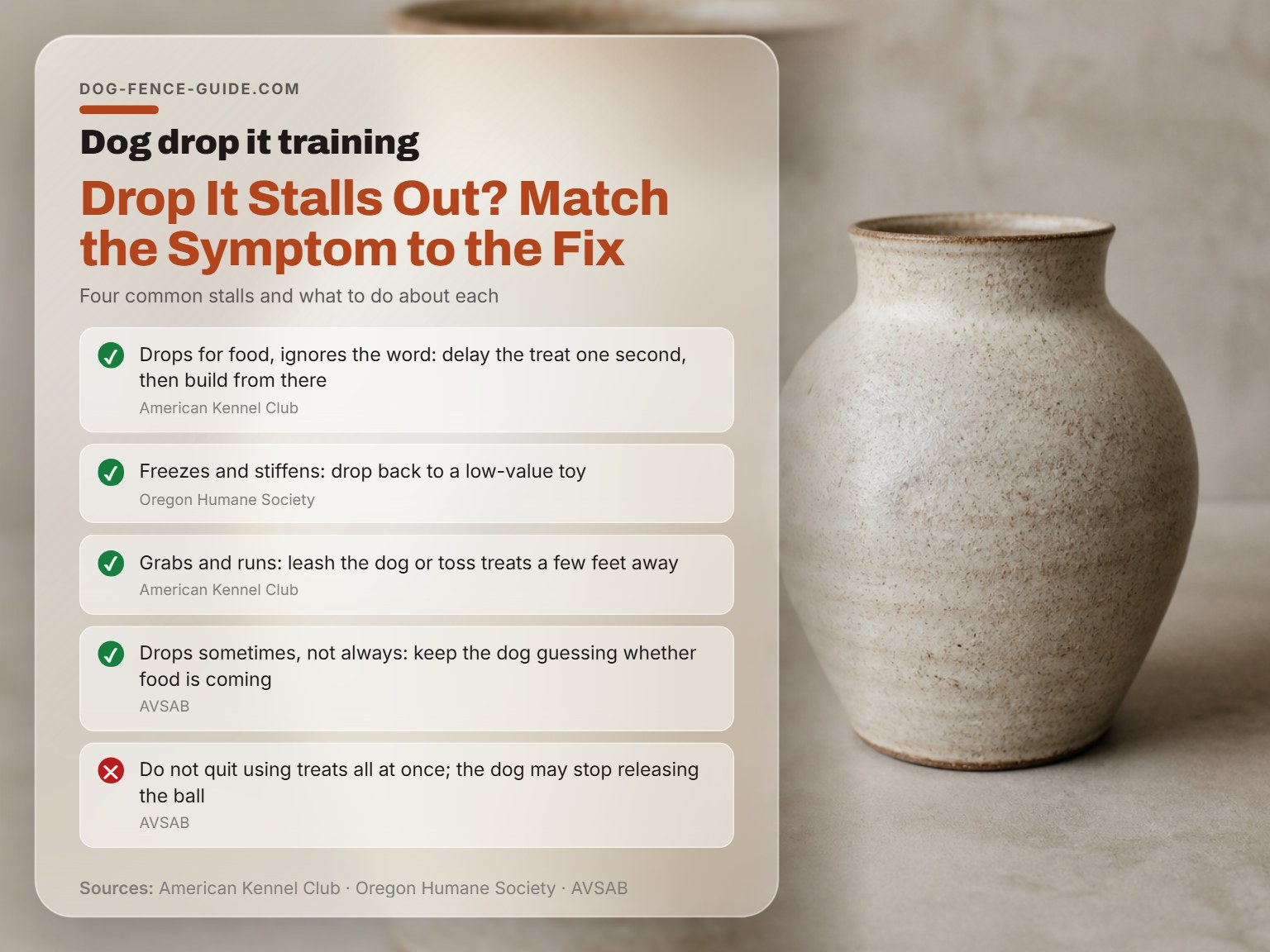
Most stalls trace back to one of four causes. Here’s how to tell them apart.
| Symptom | Likely cause | Fix |
|---|---|---|
| Drops for food, ignores the word | Cue added before the behavior was solid | Delay the treat one second, then build from there |
| Freezes and stiffens | Item is too valuable for this stage | Drop back to a low-value toy |
| Grabs and runs | Chasing has paid off before | Leash the dog or toss treats a few feet away |
| Drops sometimes, not always | Treats faded too fast | Keep the dog guessing whether food is coming |
The one-second delay in that first row comes from the AKC, which suggests waiting a second between the cue and showing the treats, then slowly stretching that gap across repetitions.
The fourth row is the one that catches careful owners. AVSAB’s warning is specific: if you quit using treats all at once, the dog may stop releasing the ball. Keep it unpredictable. A dog that doesn’t know which drop pays will keep dropping.
Once the behavior is reliable in the kitchen, it has to survive the yard. That’s proofing with distractions, and it’s the step that separates a dog that drops a toy from a dog that drops a chicken bone on the back lawn.
Frequently Asked Questions
How long does it take to teach a dog to drop it?
The timeline depends on the dog, not the calendar. VCA’s sequence runs the first session at about five tossed treats, then moves to dropping treats one at a time about a minute apart. The cue goes on once the dog is reliably letting go, so the timeline depends on the dog, not the calendar.
Should I say “drop it” more than once?
Oregon Humane Society says no. Oregon Humane Society says if the dog doesn’t release, don’t repeat the cue, while VCA says go back to the previous training level for a few more sessions. Make the food more interesting instead and praise the moment the dog disengages. VCA’s approach is different: go back to the previous training level for a few more sessions rather than pushing through, while Oregon Humane Society says don’t repeat the cue and make the food more interesting instead.
What if my dog only drops the item for food?
That’s normal at the start. AVSAB recommends praise alone about half the time and praise plus a treat the other half, then gradually reducing the food, while the AKC suggests giving the cue without showing treats and providing a jackpot reward if the dog drops the item. Cut treats out completely and many dogs stop releasing altogether.
Can I use drop it with a dog that guards its toys?
Not without help. The AKC and Toronto Humane Society both advise consulting a trainer or behaviorist before starting if the dog already shows guarding behavior. A dog that freezes, stiffens, bares teeth, snarls, or growls should have the exercise stopped immediately.
Is tug of war safe while teaching drop it?
For a dog with no history of aggression that reliably responds to the cue, AVSAB considers tug safe, but AVSAB says not to play tug with a dog that is already aggressively possessive of its toys. For a dog that is already aggressively possessive of its toys, AVSAB says don’t play tug at all, while for a dog that has never shown aggression AVSAB considers tug safe as long as the dog reliably responds to “drop it.”
What treats work best for this?
Something small, soft, and genuinely high value. VCA suggests meat or cheese for the final training stage, and Oregon Humane Society stresses that the dog should be as motivated by the treat as by the toy. A soft training treat beats a hard biscuit because it disappears in one bite and the game restarts faster.
Before You Start Training
If your dog freezes, stiffens, or growls over an object, stop and call a trainer before you run another repetition. That’s the line, and it doesn’t move based on how badly you want the behavior this week.
For everyone else, here’s the first thing to do this week: pick one low-value toy and one food your dog would cross the yard for, and run five trades in a single session. That’s it. No cue, no distractions, no stolen socks.
The rest follows the same logic as a fence line. The failure is rarely in the long straight run. It’s at the joints, the gate latch, the corner where the dog finds the gap you walked past. Drop it is a joint. Practice it where it’s easy, then test it where it counts.
So: trade, mark, pay, and say the words once. That’s how to teach a dog drop it without a chase, a scuffle, or a hand near the teeth.
