
Normal Breathing Rate for Dogs: Why Sources Disagree
This post contains affiliate links. As an Amazon Associate, we earn from qualifying purchases.
A normal breathing rate for dogs is 15 to 30 breaths per minute at rest or asleep, the range VCA Animal Hospitals publishes. Anything consistently above 30 counts as abnormal there. The Merck Veterinary Manual lists a wider resting range of 18 to 34, so the two don’t fully agree.
The gap between 30 and 34 is small on paper and enormous at 11 p.m., because it decides whether you pick up the phone. Both numbers come from real data. They just answer slightly different questions, and neither one was built to be read by an owner holding a phone in one hand and a stopwatch in the other.
What follows is the practical version: how to count without fooling yourself, what resting and sleeping actually measure, why one high number means almost nothing, and the specific signs that turn a high count into a drive to the clinic.
Key Takeaways
- 15 to 30 breaths per minute is the VCA screening band for a resting or sleeping dog. Merck’s reference range runs 18 to 34, and both are defensible for what they measure.
- Count one breath per full chest in-and-out cycle, time 30 seconds, and double it. A cat must not be purring while you count.
- A single reading above 30 proves nothing. Recount a few times over the next couple of hours before you call anyone.
- A consistent increase gets a vet call the same day and usually a recheck within a day or two.
- Sleeping rates run lower than resting rates, so pick one state and use it for every count in your log.
Why the Normal Breathing Rate for Dogs Varies by Source
VCA Animal Hospitals publishes 15 to 30 breaths per minute and calls anything consistently above 30 abnormal. The Merck Veterinary Manual, working from Dukes’ Physiology of Domestic Animals, lists 18 to 34 for dogs. Both are correct for what they’re measuring.
Resting respiratory rate is counted as full chest excursions per minute while the animal is calm and undisturbed. Published reference ranges differ by population and method: clinical screening bands are set to trigger action, while physiology tables describe the spread of measurements across a healthy species. A dog at 32 breaths per minute falls inside one and outside the other.
The VCA number is a screening cutoff. It exists so an owner at home can decide whether to make a phone call, and it’s set low on purpose so a real problem doesn’t slide past. VCA adds a caveat that gets skipped everywhere: for some individual dogs, a rate under 30 may already be abnormal in the vet’s judgment. Ask what number is abnormal for your dog specifically.
Merck’s table comes from a physiology textbook, which describes the spread of resting rates across a healthy population. That’s a wider and flatter thing than a trigger line. The table was reviewed in September 2022 and last updated in September 2024.
| Source | Population measured | Resting rate (breaths/min) |
|---|---|---|
| VCA Animal Hospitals | Healthy dogs plus stable heart disease | 15-30 (above 30 abnormal) |
| Merck Veterinary Manual (Dukes’) | Healthy dogs | 18-34 |
| JAVMA 2013, subclinical heart disease | 190 dogs with early heart disease | Sleeping mean 16, resting mean 21 |
| AI-COLLAR 2025 | 703 healthy dogs, collar-measured at home | Lower at night than in daytime |
Primary research sits underneath both published bands. The 2013 JAVMA study of 190 dogs with subclinical heart disease measured sleeping and resting rates separately and landed on means of 16 and 21 breaths per minute, comfortably inside either range. The 2025 AI-COLLAR study, drawn from 703 healthy dogs wearing a collar-mounted monitor at home, found rates were lower at night than during the day (p < 0.0001).
So a normal breathing rate for dogs has a floor around 15, a ceiling somewhere between 30 and 34 depending on who you ask, and a wide band of individual variation in between.
Pick one source and stick with it. Bouncing between 30 and 34 mid-monitoring turns a screening tool into an argument with your vet.
How Do You Count Breaths Without Fooling Yourself?
Pick one state and stay in it. A count taken while the dog is asleep and a count taken while the dog is standing at the back door are two different measurements, and mixing them makes the whole log useless.
The 30-Second Count
- Wait for sleep or genuine rest. Count a dog that just came in from the yard and you’re measuring the cooling system, not the resting heart.
- Watch the chest and count one breath per full in-and-out. Counting the in and the out separately doubles your number and sends you to the vet for nothing.
- Time 30 seconds, then multiply by 2. A 15-breath count in 30 seconds is 30 breaths per minute. That’s the whole method VCA publishes.
- Write the number down before you do anything else. Memory rounds toward whatever you were already worried about.
The 60-Second Count
VCA lists a second option: count the full 60 seconds and skip the multiplication entirely. The arithmetic step is the part people fumble at two in the morning, so if you’re half asleep, take the longer count.
Cats need one extra rule. They must not be purring while you count, because a purr rides on top of the breathing cycle and inflates the total.
If you’re already timing breaths, the same 30-second habit works for normal heart rate for dogs, and the two numbers together tell a fuller story than either one alone.
Common mistake: Counting while your dog waits at the door to go out. Anticipation alone pushes the rate up, and you’ll record a number that has nothing to do with rest. VCA’s own instruction is to wait until the pet is sleeping or resting quietly.
Resting and Sleeping Are Not the Same Number
Sleeping is the cleaner measurement. VCA notes that sleeping rates run a little lower than resting rates, and the JAVMA study that measured both found a five-breath gap between them in dogs with early heart disease.
That means a dog resting at 22 will often sleep at 17. Log both in the same column and your record will look like it’s swinging wildly when nothing has changed.
The fix is boring. Choose sleeping, because a sleeping dog can’t anticipate a walk or hear the mail truck, and count at roughly the same time each day. VCA’s starting protocol is once per day for a week while you learn the exercise, which is enough to establish what your own dog’s baseline looks like.
I’d count sleeping every time if I could only pick one. A sleeping dog can’t decide you’re about to leave, and the number you get is the number the heart is actually doing.
If your dog sleeps flat out and snores, the best sleeping position for collapsed trachea question is worth a look, because position changes both the sound and the effort of each breath.
What Does One High Reading Actually Mean?
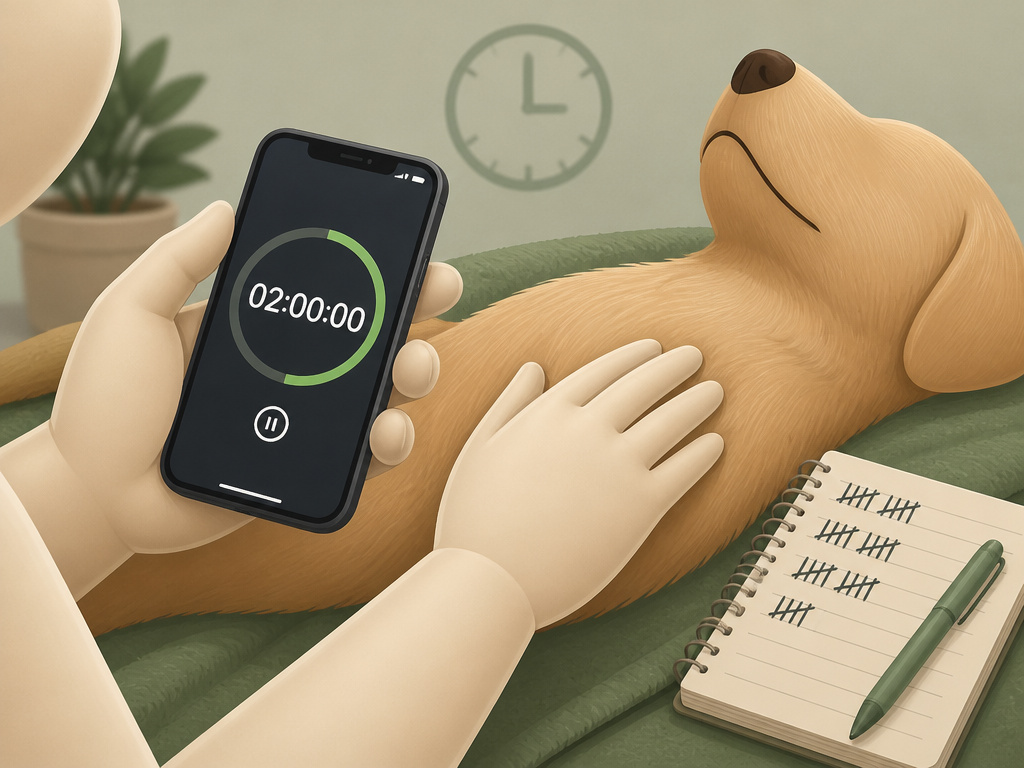
One number above 30 tells you almost nothing on its own. VCA’s instruction is to count the rate a few times over the next couple of hours and confirm the increase is consistent before you call.
Heat, stress, and activity all push the rate up legitimately. A dog who has been sprinting the fence line will read high for a while, and why dogs pant covers the cooling mechanics behind that spike.
The JAVMA researchers made a related point that matters here. A high sleeping rate isn’t specific to heart disease, because pneumonia, heatstroke, stress, and pain all produce the same signal on a home count. The number tells you something is happening. It doesn’t tell you what.
| What you’re seeing | Likely cause | What to do |
|---|---|---|
| Above 30, settles within minutes | Heat, stress, excitement | Recount in a couple of hours |
| Above 30 at rest, holding steady | Possible heart or lung problem | Call the vet, expect a recheck in a day or two |
| Above 30 plus labored breathing | Emergency | Go to an emergency clinic now |
| Below 15, dog otherwise normal | Normal for this dog | Note it and move on |
Where this goes sideways: Recounting once, twenty minutes later, then calling it confirmed. VCA’s instruction is a few counts spread across a couple of hours, which is what separates a real trend from a dog that just got excited about the mail.
The Trend Beats the Number

703 healthy dogs wore a collar in the AI-COLLAR study, and the resulting dataset is the closest thing to a real-world reference we have for home measurements. Median age was 3.8 years and median body weight 23.0 kg.
The device was the Invoxia Biotracker GPS for Dogs, launched initially as Minitailz. It only records when the dog is lying down and immobile for at least 40 seconds, in sessions of 1 to 3 minutes spaced at least 15 minutes apart, giving up to 120 minutes of usable data a day across 10 to 15 days on a charge. Accuracy was validated at 99.6% for heart rate and 98.6% for respiratory rate against portable ECG and manual counting from thoracic video.
What Smart Collars Actually Measure
Most smart dog collars don’t measure breathing rate directly. Per Veterinary Partner, they estimate it from the heart-rate variation that happens with breathing in a resting or sleeping dog.
That works because a normal dog’s heart rate shifts slightly with every breath. When a dog develops congestive heart failure, that variation disappears, and it can return once treatment takes hold. So the collar is reading a proxy, and the proxy is meaningful.
The 40-Day Moving Average
The AI-COLLAR team flagged a statistical event when the daily difference between the current 40-day moving average and the value 40 days earlier exceeded plus or minus 3 standard deviations of the cohort-wide distribution. Days with under 15 minutes of valid data were excluded from the math.
In one dog with degenerative mitral valve disease, a steady rise in the 40-day moving average of daytime heart rate crossed the alert threshold roughly 60 days before a similar change showed up in respiratory rate from congestive heart failure.
A trend needs about six weeks of data before it says anything. One bad Tuesday is weather. Six weeks of drift is climate.
When Does a High Count Become an Emergency?

It’s 11 p.m., the count is 44, and the dog won’t settle. That combination is the one VCA treats as urgent.
A consistently increased rate on its own gets a call and a recheck within a day or two so medication can be adjusted. Add any other clinical sign and the guidance changes: after hours, go to an emergency center rather than waiting for morning.
The signs VCA lists alongside a high rate:
- Labored breathing, or visible effort with each breath
- Restlessness and trouble finding a comfortable position
- A change in sleep posture, such as sitting up or lying in a sphinx position
- Coughing or gagging, and why dogs cough covers the common causes behind that sound
- Weakness, collapse, or fainting
- Reduced ability to exercise, decreased appetite, weight loss
- A distended belly, or a flat and withdrawn attitude
Take a temperature while you’re at it. The normal temperature range for dogs gives you a comparison point, and a high number alongside a high breathing rate narrows the picture fast.
If the dog actually goes down, what to do if a dog collapses walks through checking responsiveness, and how to perform CPR on a dog covers chest compressions if it comes to that.
The American Red Cross pet first aid guide is worth keeping on your phone for the same reason. The Texas A&M home breathing rate guide is the printable version of the counting method, and it’s the handout most cardiology services send home.
Frequently Asked Questions
Is 32 breaths per minute normal for a dog?
It depends on the state you measured. VCA calls anything consistently above 30 abnormal, while Merck’s resting range for dogs runs to 34. A single 32 taken while the dog was awake and interested in something is not a finding. A 32 that holds across several counts over two hours is worth a call.
Should I count while my dog is asleep or just resting?
Sleeping, if you can get it. VCA notes sleeping rates run slightly lower than resting rates, and the JAVMA study found a five-breath gap between the two in dogs with early heart disease. Pick one and stay with it so your log compares like with like.
Does panting count toward the breathing rate?
No. Panting is a cooling mechanism, and a panting dog will read far above any published resting range. VCA is explicit that much higher rates are normal when dogs are hot, stressed, or active. Wait for the panting to stop and the dog to settle before you start the timer.
How often should I be counting at home?
VCA’s starting protocol is once a day for a week while you learn the exercise, which establishes your dog’s normal. After that, dogs with advanced asymptomatic heart disease are typically recorded once or twice per week, though a vet may ask for daily counts. Dogs with no symptoms may not need monitoring at all until the vet says so.
Can a smart collar replace counting by hand?
Not entirely. Per Veterinary Partner, most collars estimate breathing rate from heart-rate variation rather than measuring it directly. The AI-COLLAR device hit 98.6% accuracy for respiratory rate against manual counting from video, which is strong, but a collar also needs 40 seconds of stillness to record anything. Hand counting still works when the dog won’t hold still.
What if the rate comes in below 15?
Lower rates are possible and are no cause for concern as long as your pet is otherwise acting normally, according to VCA. Write it down and keep going. A number below the band only matters if it arrives with lethargy, weakness, or a change in appetite.
The Bottom Line
Three counts spread over two hours, all sitting above 30, is the point where VCA’s guidance says pick up the phone. Not one reading. Not the number you got when the doorbell rang.
Here’s the part that doesn’t make it into most guides: the 15 to 30 band is a population screening tool, and your dog may not sit inside it. VCA says plainly that some individuals run abnormal below 30, and only your vet knows which dog you have. So the single most useful thing you can do this week is ask a direct question at your next appointment: what number is abnormal for this dog?
Before you call anyone, verify three things in your own home. That the dog was actually asleep or resting quietly when you counted. That you counted full chest cycles, not individual movements. And that you have more than one number written down, because a trend is the only thing in this whole exercise that carries real weight.
Everything else is a single reading on a single afternoon, and dogs have bad afternoons just like the rest of us.
