
How Long Do Dogs Live? What the Data Says
This post contains affiliate links. As an Amazon Associate, we earn from qualifying purchases.
Dogs live 11.23 years on average in the UK, according to the largest life table study of companion dogs, built from 30,563 recorded deaths between 2016 and 2020. US clinical data puts the figure at 12.69 years. Breed and body size move that number by years, not months.
The gap between a Jack Russell Terrier at 12.72 years and a French Bulldog at 4.53 years comes from the same study, the same country, the same decade. That spread inside one dataset is why a single answer to how long do dogs live tells you almost nothing about the dog in front of you.
What follows is the breed-by-breed spread, the country-by-country disagreement, and the honest caveats behind every number you see quoted. Here is what actually matters.
Key Takeaways
- UK life expectancy sits at 11.23 years, per the VetCompass life tables built from 30,563 deaths between 2016 and 2020.
- Breed swings the number hard: Jack Russell Terriers reach 12.72 years, French Bulldogs just 4.53.
- Purebred vs crossbred has no settled answer – three major datasets disagree on which group lives longer.
- Body condition is the clearest lever: obese dogs average 11.71 years versus 13.18 at ideal weight in US clinical data.
- Skull shape matters independently of size: brachycephalic dogs average 9.8 years in Swiss data, below mesocephalic at 11.9.
How Long Do Dogs Live? What the UK Life Tables Actually Measure
A life table answers one question: given a dog is alive at age X, how many more years should it expect? The UK VetCompass study built one from 30,563 deaths recorded between 1 January 2016 and 31 July 2020, and it remains the largest single dataset of its kind for companion dogs.
Life expectancy at age 0 in the UK VetCompass dataset is 11.23 years (95% CI 11.19-11.27), calculated from 30,563 deaths recorded between January 2016 and July 2020. Female dogs average 11.41 years; male dogs average 11.07 years. The estimate reflects dogs under primary veterinary care, not the entire UK dog population.
The UK companion dog life tables are the most conservative of the major datasets. The US Banfield data puts life expectancy at birth at 12.69 years. The clinical data life expectancy tables from that study cover survey years 2013 through 2019.
Here’s how the four major datasets compare:
| Study | Population | Life expectancy at age 0 |
|---|---|---|
| Teng et al. 2022 (VetCompass) | UK, 30,563 deaths | 11.23 years |
| Montoya et al. 2023 (Banfield) | US dogs | 12.69 years |
| O’Neill et al. (England) | England dogs | 12.0 years median |
| McMillan et al. 2024 | UK, 584,734 dogs | 12.5 years median |
The spread between 11.23 and 12.69 years in how long do dogs live isn’t noise. It reflects different estimators, different populations, and different study windows. A life table built from confirmed deaths produces a different number than a Kaplan-Meier median that includes dogs still alive at the end of the study. Neither method is wrong. They answer slightly different questions.
The UK figure is also 2.47 years shorter than the 13.7-year life expectancy reported in two Japanese dog life tables. That gap is worth sitting with, because it shows how much country-level breed demographics shape the number.
Which Breeds Live Longest, and Which Die Young?
The Jack Russell Terrier averages 12.72 years. The French Bulldog averages 4.53. Both figures come from the same UK study, the same country, the same decade of deaths.
The Breed Group Ranking
The Kennel Club groups sort cleanly, with one surprise at the bottom:
| Kennel Club group | Life expectancy at age 0 |
|---|---|
| Terrier | 12.03 years |
| Gundog | 11.67 years |
| Pastoral | 11.20 years |
| Hound | 10.71 years |
| Toy | 10.67 years |
| Working | 9.14 years |
Working dogs come in last at 9.14 years, shorter than every other group at every age. That’s the opposite of what most people expect, since Working includes breeds people think of as sturdy. The Terrier group wins at 12.03 years, and the gap between Terrier and Working is nearly three years.
The Extremes: Jack Russell vs French Bulldog
The Jack Russell Terrier at 12.72 years and the French Bulldog at 4.53 years sit at opposite ends of the same dataset. That’s an eight-year spread inside one country’s dog population.
Three other breed-level figures worth knowing:
- Labrador Retriever: 11.77 years in the UK, 14.1 in Japan, 10.5 in Denmark
- Pug: 7.65 years in the UK, 12.8 in Japan
- Shih Tzu: 11.05 years in the UK, 15.0 in Japan
The country-level gap for the same breed is as large as the breed-level gap within one country. That’s the point most breed-average charts miss.
I’ve seen breed averages get treated as predictions, and they aren’t. A dog is a sample of one. The French Bulldog figure reflects a real pattern: brachycephalic breeds as a group average 9.8 years in Swiss data, well below mesocephalic dogs at 11.9 years.
Why Do Purebred and Crossbred Studies Disagree?
Three major datasets have looked at whether purebreds or crossbreds live longer, and they don’t agree. Not on the size of the effect, not even on the direction.
The companion dog breed longevity study by McMillan et al. 2024, covering 584,734 dogs, found purebreds lived longer: median 12.7 years versus 12.0 for crossbreds, with a hazard ratio of 1.1 (p<0.001). That’s a small but statistically significant edge for purebreds.
The England primary-care data from O’Neill et al. Found the opposite: crossbreds outlived purebreds by 1.2 years (95% CI 0.9-1.4, P<0.001), and the authors invoked hybrid vigour as the explanation. The Swiss Amicus database study landed on the same side, with mixed-breed dogs at 12.4 years versus 11.5 for purebreds.
Three primary datasets, three different populations, and opposite conclusions on the same question. When the direction of an effect flips between studies, the honest answer is that the effect is small enough to be swamped by population differences.
What Each Dataset Actually Found
The McMillan study covered UK dogs and used median survival. The O’Neill study covered central and southeast England and used a different estimator. The Swiss study added skull shape as a variable.
The disagreement isn’t a data-quality problem. It’s a population problem. Breed structure varies widely between countries, and the purebred/crossbred split interacts with which breeds are popular where. A country with a lot of brachycephalic purebreds will show a different purebred average than a country with a lot of working terriers.
The Body Condition Lever You Actually Control
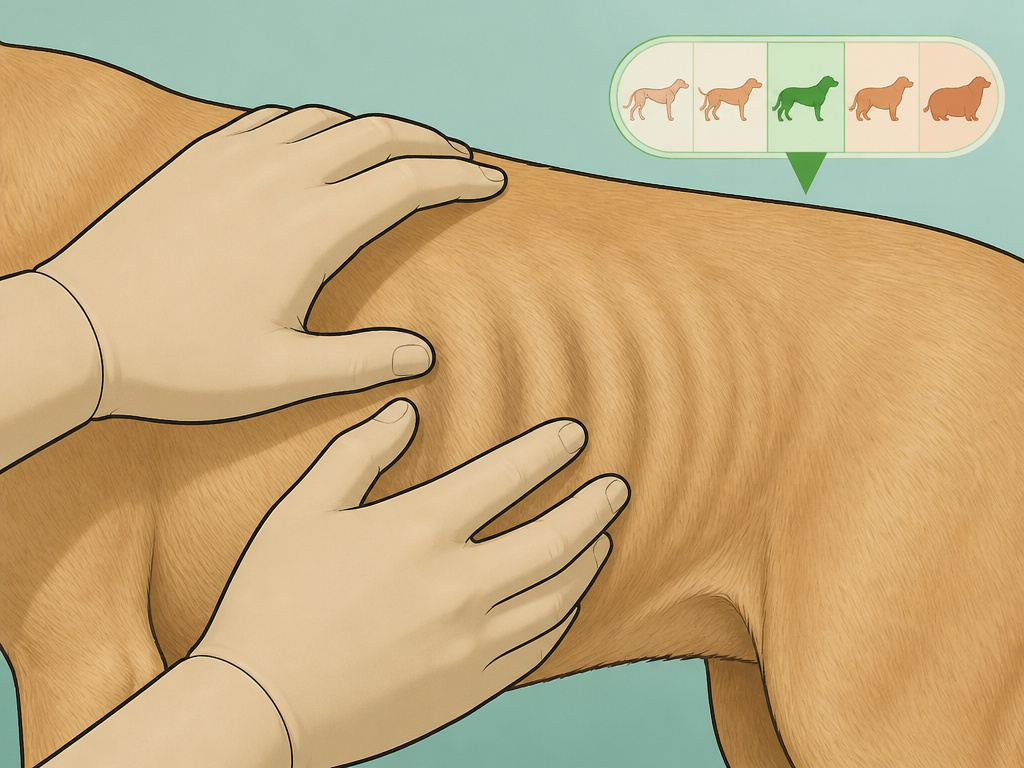
Of all the variables in these datasets, body condition is the one an owner can actually move. The Banfield data makes the size of the effect clear.
Dogs at ideal body condition (3/5 on the five-point scale) averaged 13.18 years. Overweight dogs (4/5) averaged 13.14. Obese dogs (5/5) averaged 11.71. That’s a 1.47-year gap between ideal and obese, which is larger than the gap between male and female dogs in the UK data.
Run your hands along a dog’s ribs. You should feel them under a thin layer of flesh, like the back of your hand. Not like a padded couch cushion, and not like knuckles under skin.
Short version: body condition is the lever that moves. The senior dog diet question is worth asking your vet, and routine vet checkups catch the changes that bloodwork misses.
The body condition pattern holds across primary-care datasets, and the lifespan risk factors in pet dogs literature covers the full set of variables. But the size of the body condition effect is what stands out.
Common mistake: Judging body condition by eye instead of by hand. A thick winter coat hides a full point on the five-point scale, and by the time the ribs disappear under a hand test, the dog has been obese for months.
Size, Skull Shape, and the Numbers That Break the Pattern

Bodyweight alone doesn’t explain breed lifespan differences. The Swiss data shows that skull shape is an independent risk factor, and a bodyweight-only model misclassifies the breeds most at risk.
Three skull-shape categories, three different averages:
- Brachycephalic (flat-faced): 9.8 years
- Mesocephalic (medium-faced): 11.9 years
- Dolichocephalic (long-faced): 11.5 years
The brachycephalic gap is 2.1 years below mesocephalic and 1.7 years below dolichocephalic, and it doesn’t disappear when you account for bodyweight.
Why Skull Shape Breaks the Weight Rule
The UK VetCompass study frames the size effect by breed group and body size: Toy and small breeds live longer than large breeds. That’s true as far as it goes. But the Swiss data adds a variable the UK tables don’t include, and the result is that a flat-coated retriever and a French Bulldog can weigh similar amounts and have very different life expectancies.
That’s a confounder absent from UK and US tables, and it’s one reason the Swiss numbers don’t map cleanly onto the others.
If you’re caring for a dog that’s already past middle age, the caring for a senior dog guidance covers the day-to-day adjustments that matter more than breed averages.
Is Dog Lifespan Actually Declining?

Popular press coverage has reported that dog lifespan is declining. The largest methodological review of the question says the opposite.
Salt et al. 2024 reviewed cohort studies spanning 1981 to 2023 and concluded that median lifespan has increased steadily over that period. Their wording is direct: “there is little evidence that the lifespan of domestic dogs has decreased over the last 40 years.”
The trend line goes up.
The part nobody mentions: The “dogs are dying younger” narrative is built on a handful of high-profile breed studies, not on population-level data. The population-level data says the opposite.
That doesn’t mean individual breeds haven’t seen declines. The French Bulldog at 4.53 years in the UK data is a genuine outlier, and the Swiss data shows elevated young-age mortality in brachycephalic dogs. But the population-level claim that dogs are dying younger doesn’t hold up.
The dog years conversion is a separate question, and the seven-to-one rule is a myth that doesn’t track with any of these datasets.
An old dog’s coat goes dull before the bloodwork shows anything. The shine goes first, then the muscle along the spine, then the willingness to jump into the truck.
How to Read Any Lifespan Number You See Quoted
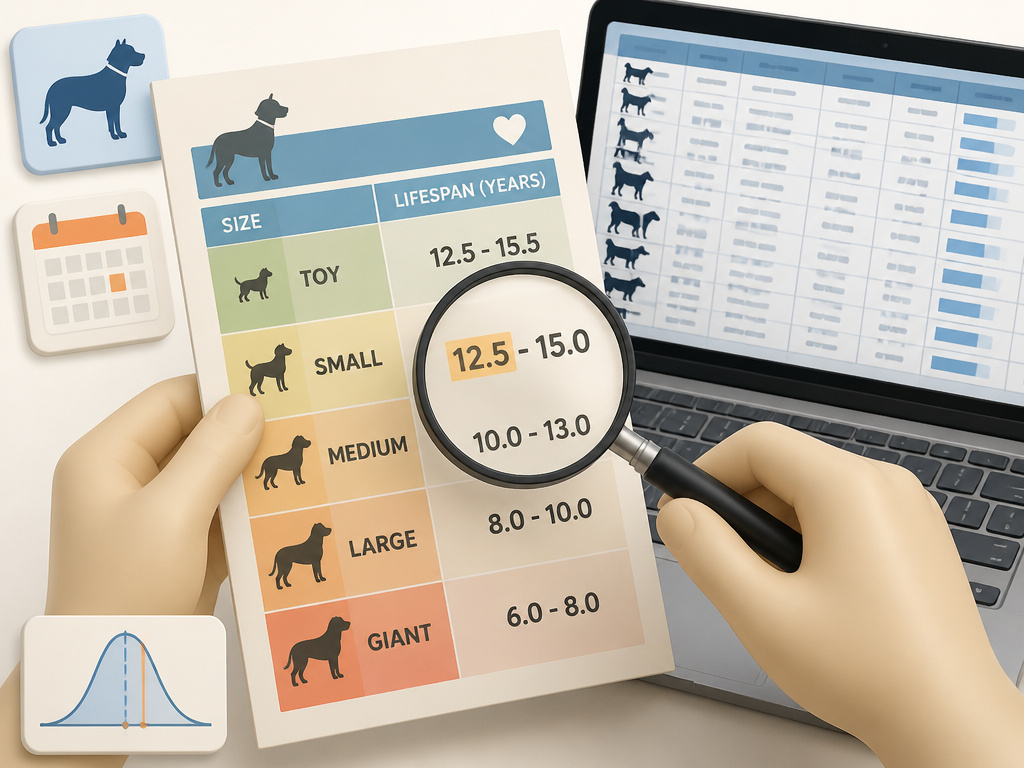
Almost every lifespan number you see quoted comes with a caveat the headline leaves out. Here’s how to read the next one you encounter:
- Check the population. A life table built from insured dogs may overstate lifespan, because insured dogs receive more veterinary care. A dataset that excludes dogs lost to follow-up inflates the estimate further.
- Check the estimator. A life table at age 0 and a Kaplan-Meier median answer different questions. Neither is wrong, but they aren’t interchangeable.
- Check the era. The VetCompass window is 2016 to 2020. The Banfield window is 2013 to 2019. A 1990s dataset will produce a lower number for reasons that have nothing to do with breed.
- Check whether it’s a mean or a median. Means get pulled by outliers. Medians don’t. When a study reports 12.5 years, ask which one it is.
The Urfer et al. 2024 lifespan study restricted its cohort to dogs aged 3 months or older that visited at least twice. That’s a reasonable design choice, but it excludes dogs lost to follow-up, which inflates the estimate relative to an all-b
Frequently Asked Questions
Does neutering affect how long a dog lives?
The evidence is mixed and depends heavily on breed, sex, and age at surgery. Some large-dataset analyses find intact dogs living slightly longer on average, while others show the opposite for specific breeds. Rather than treating neutering as a lifespan lever on its own, weigh it against the condition-specific risks your vet flags for your dog’s breed and size.
Do small dogs really live longer than large ones?
Yes, and the pattern holds across nearly every major dataset. Small breeds tend to mature faster but age more slowly at the cellular level, while giant breeds grow rapidly and often show earlier onset of conditions like cardiac disease and joint failure. The size effect is one of the most consistent findings in canine longevity research, though individual breed outliers exist on both ends.
Can I estimate my dog’s remaining lifespan from its current age?
Roughly, but with wide error bars. Life expectancy at birth and remaining life expectancy at age five or eight are different numbers, and the second is what actually applies to an adult dog. Breed-specific life tables give a better estimate than national averages, but no table accounts for your individual dog’s weight, dental health, or existing diagnoses.
What is the single biggest modifiable factor in a dog’s lifespan?
Body condition consistently ranks at or near the top in observational data. Keeping a dog at a lean, ideal weight is associated with roughly a year or more of additional expected life compared with obesity, and the effect appears across breeds and sizes. Dental care, routine screening, and early treatment of chronic disease are the next most cited levers.
