
Labrador Retriever Pros and Cons: The Honest Trade-Offs
This post contains affiliate links. As an Amazon Associate, we earn from qualifying purchases.
Labrador Retriever pros and cons come down to what the breed was built for: retrieving all day, eating everything, and staying friendly through both. The pros are temperament and trainability. The cons are joint disease, at 14.91% prevalence in UK primary-care data, and a weight problem the breed is known for. Median longevity is 12.0 years.
That 14.91% figure comes from a study of Labradors seen in ordinary veterinary practice, and the same paper found the breed has lower odds of dental disease than non-Labradors. So the labrador retriever pros and cons ledger runs in both directions at once. Which direction matters more depends on how you plan to live with the dog.
What follows is the honest accounting: what the breed gives you, what it takes back, where the published numbers disagree with each other, and the one decision that splits the veterinary literature down the middle.
Key Takeaways
- Median longevity is 12.0 years in UK primary-care records, but published figures run from 10 to 14 depending on which source you trust.
- Musculoskeletal disorders affect 14.91% of Labs, and osteoarthritis odds run 2.83 times higher than in non-Labradors.
- Overweight and obesity is the most recorded disorder in the breed, ahead of ear infections and degenerative joint disease.
- Neutering before 6 months roughly doubles joint-disorder risk against a 5% baseline in intact dogs.
- Chocolate coats carry a possible signal: 10.7 years median longevity against 12.1 for non-chocolate, on a sample of just 34 dogs, though the AKC treats chocolate only as a coat and nose-colour matter.
What a Labrador Was Bred to Do (and What It Costs You)
The Labrador’s original job was retrieving shot waterfowl from cold water, then doing it again twenty more times without arguing.
The Labrador carries a short, dense, weather-resistant outer coat over a soft undercoat, plus a thick otter tail. The coat sheds year-round and holds water against the skin after a swim, which keeps the ear canal damp long after the dog is out of the pond.
Size is where the authorities start drifting apart. The AKC Labrador Retriever breed profile puts dogs at 22.5 to 24.5 inches at the withers and 65 to 80 pounds in working condition, with bitches at 21.5 to 23.5 inches and 55 to 70 pounds.
The Canadian Kennel Club standard sets dogs at 60 to 80 pounds and bitches at 55 to 75 pounds. PetMD lists 55 to 80 pounds overall with females on the lower end. None of those are wrong. They’re measuring slightly different populations.
Then the practice data lands somewhere else again. In UK Labrador data, the mean adult bodyweight was 33.0 kg, with males at 35.2 kg and females at 30.4 kg. That’s a breed sitting near the top of its own published range.
Labs sit in the sporting dog breeds group, and the shared trait across that group is a dog that needs a job. Give a Lab nothing to do and it invents work, usually involving your garden.
The Pros: A Temperament That Forgives Beginner Mistakes
The temperament is the whole sale.
- Biddable to a fault. A Lab will keep working for food and praise long after most breeds have clocked off for the day.
- Forgiving of a bad training week. Take seven days off and the dog comes back to the task. Plenty of breeds quietly forget.
- Soft mouth and stable temperament. The Canadian standard notes the breed’s soft mouth and biddable nature, and both show up in daily life around the house.
- Genuinely versatile. Labs work as hunting dogs, service dogs, therapy dogs, and detection dogs, which is a wider job list than most breeds can fill.
- Patient with children. PetMD describes them as affectionate and tolerant around kids and other dogs.
That versatility is the part people underrate. A dog that will retrieve a dummy, hold a sit-stay in a busy car park, and settle under a café table is a dog you can take places.
Setup costs less drama than most breeds, too. A best Labrador crate earns its keep in the first month, mostly because a Lab settles faster in a den than in an open hallway.
Durable best Labrador toys matter more than new owners expect. A durable rubber toy is the one that survives most Labs past the first week, and it doubles as a food puzzle when you stuff and freeze it.
The Labrador Retriever Pros and Cons That Land on Your Vet Bill
Three conditions account for most of what you’ll actually deal with: overweight and obesity, otitis externa, and degenerative joint disease.
Those three topped the recorded disorder list in the UK primary-care cohort. Here’s how the bigger picture breaks down by age.
| Condition | Typical age at diagnosis | What you’d notice first |
|---|---|---|
| Tricuspid valve dysplasia | 2 to 5 months | A murmur picked up at a puppy check |
| Elbow dysplasia | Mean 2.5 years | Stiffness after rest, reluctance on stairs |
| Hip dysplasia | Mean 3.5 years | Odd gait behind, slow to rise |
| Cruciate ligament rupture (females) | Mean 5.5 years | Sudden three-legged lameness |
| Progressive retinal atrophy | 3 to 9 years | Bumping into furniture in low light |
| Exercise-induced collapse | Around 1 year | Wobbling after hard fetch |
Tricuspid valve dysplasia is the one to catch early. PetMD notes symptoms usually appear between 2 and 5 months and the condition tends to stabilise after 1 year of age, which means a puppy murmur is worth chasing rather than watching.
Why the Ears Are the Weak Point
Water gets in, the canal stays warm and damp, and the bacteria do the rest. That’s the whole mechanism.
PetMD recommends cleaning with a vet-recommended drying ear cleaner every two to three weeks for maintenance, plus after every swim or bath, unless your vet sets a different schedule. Zoetis Petcare lists ear and skin conditions among the breed’s concern categories but gives no cleaning interval at all, deferring to veterinary guidance.
If your Lab swims, the schedule isn’t every two to three weeks. It’s after every swim, plus the maintenance clean. A damp canal, warm weather, and a drop ear is a yeast infection on a timer.
Skip the drying step and the canal stays wet. By day three you’ll smell it before the dog starts shaking its head.
Coat care runs on the same logic. A best Labrador brush isn’t optional kit in a house with a double coat, because PetMD is blunt that frequent brushing is required to manage the shedding.
How Long Do Labrador Retrievers Live?
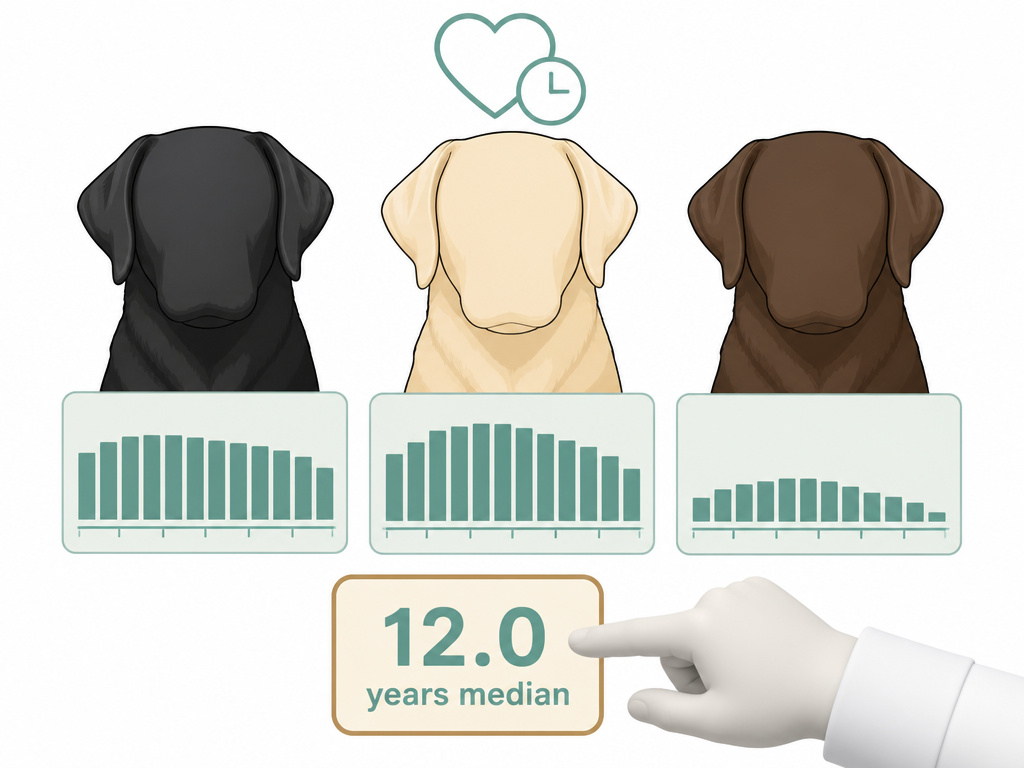
- VetCompass, 33,320 dogs: median 12.0 years, interquartile range 9.9 to 13.8, full range 0.0 to 16.0.
- Kennel Club-registered Labs, prior work: 12.3 years, against 11.3 years across all recognised breeds.
- PetMD: 11 to 13 years.
- Zoetis Petcare: 10 to 14 years.
The UK Labrador veterinary demography study is the largest of those datasets, and it’s the one I’d weight heaviest. Its 12.0-year median is a useful cross-check against the other published figures.
One finding from that same study surprises people. Neutered Labradors had a longer median longevity than entire dogs, at 12.5 years against 11.6 (P = 0.010). Hold that thought, because it sits in direct tension with the joint data further down.
Does Coat Colour Actually Matter?
In the UK data, yes, with a caveat you need to hear. Chocolate Labradors had a median longevity of 10.7 years against 12.1 years for non-chocolate dogs (P = 0.028).
The chocolate group was 34 dogs. That’s a real statistical result on a small sample, and the study authors flagged it as such. Treat it as a signal worth knowing, not a life sentence.
For what it’s worth, the AKC standard treats chocolate purely as a nose-colour matter, requiring brown noses on chocolate dogs with no health implication attached. The breed standard and the epidemiology are answering different questions.
Colour distribution across the UK cohort: black 44.6%, yellow 27.8%, chocolate 23.8%.
Is the Labrador a Healthy Breed or a Predisposed One?
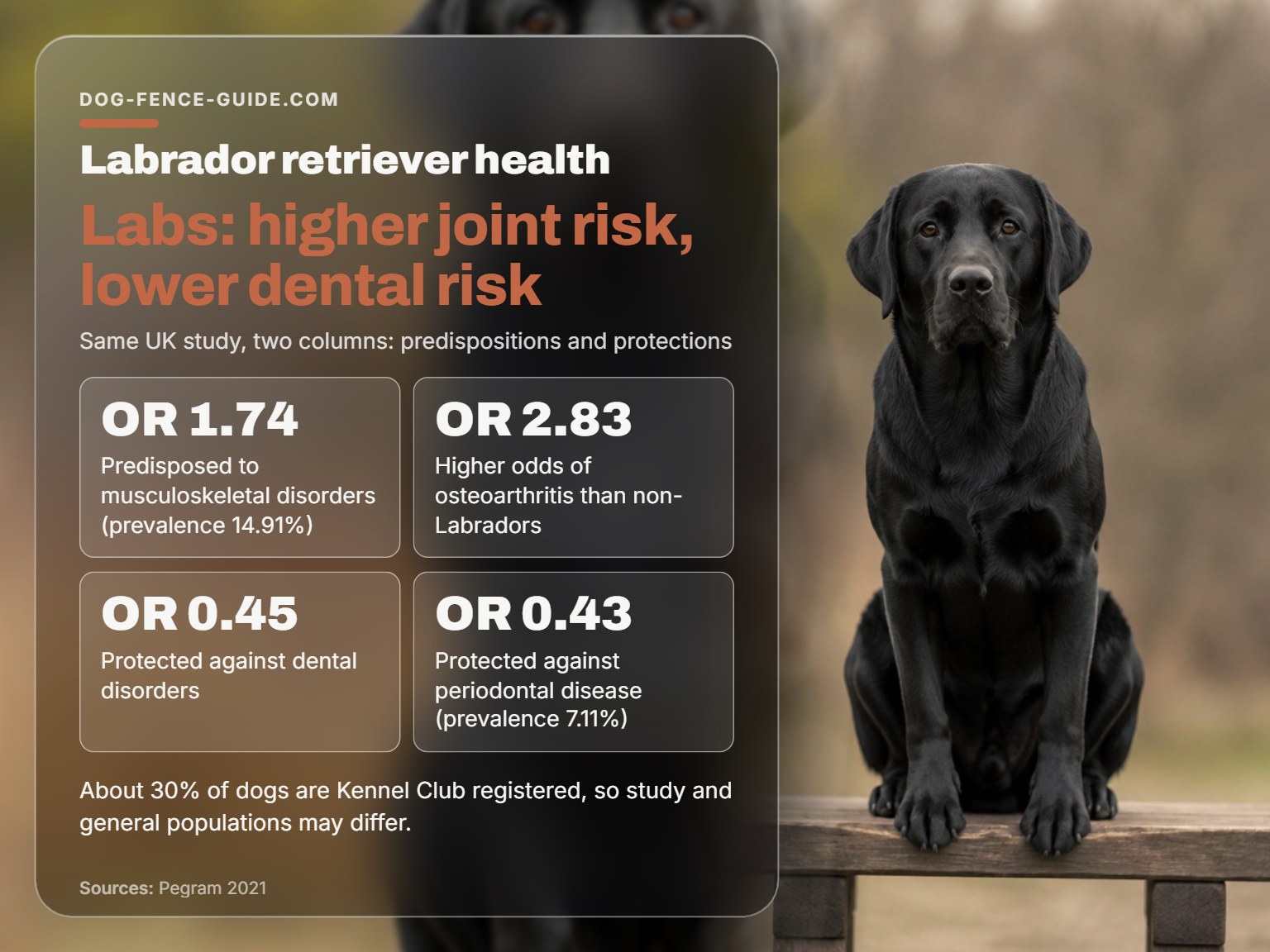
Breed profiles list the Labrador’s health risks and stop there. The peer-reviewed data carries a second column.
The UK Labrador disorder predisposition study found the breed predisposed to musculoskeletal disorders at grouped precision (OR 1.74), with a prevalence of 14.91%. Osteoarthritis odds ran 2.83 times higher than non-Labradors. Lameness came in at OR 1.62 and stiffness at OR 2.08.
Now the other column. The same study found the breed protected against dental disorders (OR 0.45), periodontal disease (OR 0.43, prevalence 7.11%), and retained deciduous teeth (OR 0.28).
Easy to miss: the protections are as well documented as the risks. A Lab is statistically less likely to land in the dental chair than a random breed at the same clinic, and that never makes the breed profile.
Compare the consumer sources. Zoetis Petcare lists eight health concern categories with no protections at all. PetMD calls the breed relatively healthy but then lists the problems. Both are describing the same dog from one side.
One caveat sits under all of it. Roughly 30% of dogs are Kennel Club registered, so the study population and the general population may not match.
Measuring a whole breed’s health is harder than it looks. Even a national Dutch Labrador health-status quantification came with its own authors’ warning about bias in the method, which tells you how careful you should be with any single number here.
Whether you go rescue vs breeder, ask for the parents’ hip and elbow scores. The study authors still concluded the breed remains at increased risk.
Feeding a Labrador Without the Weight Creep
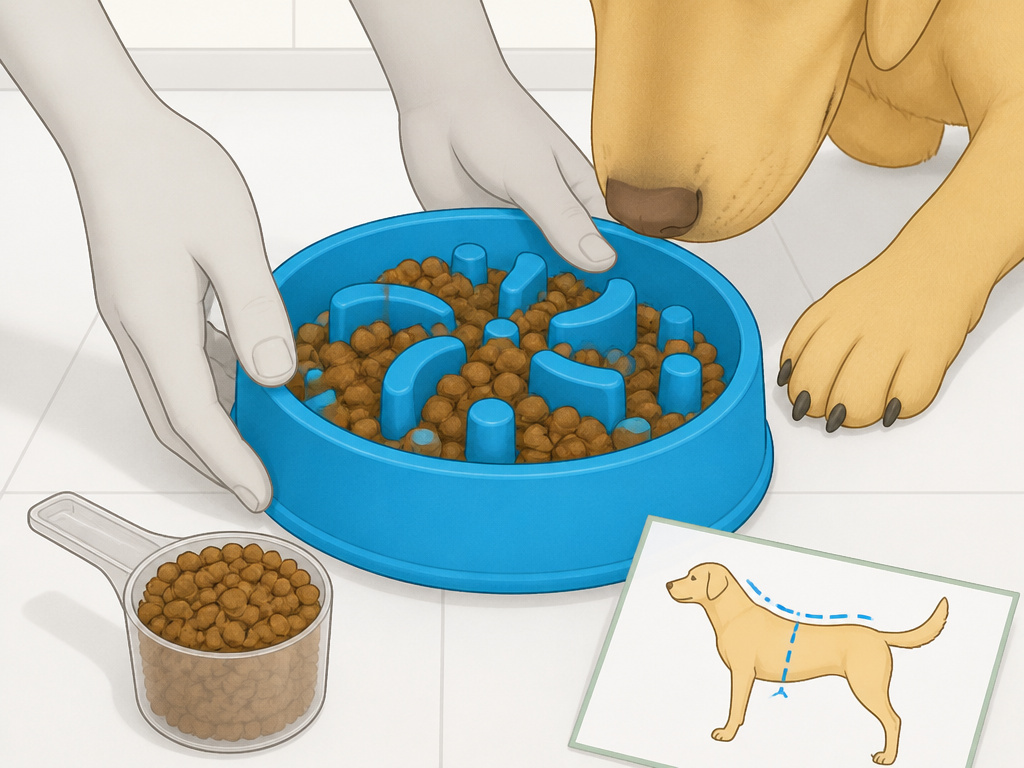
You fill the bowl, the dog finishes in ninety seconds, and then sits beside the empty bowl looking at you like you skipped a step.
PetMD’s guidance is straightforward. Large-breed puppy food until 12 months of age, then a high-quality adult formula, because the adult version carries fewer calories and guards against unwanted weight gain.
Here’s the sequence that actually holds up.
- Feed large-breed puppy food until the dog is 12 months old. Generic puppy food runs hotter than a growing Lab needs, and rapid growth is the window where joint problems get set.
- Switch to an adult formula at a measured amount, not a scooped guess. Free-feeding a Labrador is how the breed’s number one recorded disorder happens.
- Add a slow feeder if the bowl empties in under a minute. PetMD recommends a slow-feeder bowl to regulate intake and prevent stomach upset. A slow-feeder bowl is the one I’d start with.
- Body-condition score monthly, not annually. You want ribs under a light cover of fat and a waist behind the ribcage. Lose that waist and you’re already behind.
A Labrador that licks the bowl clean and then asks for more is not starving. That’s the breed doing exactly what it was built to do, and it will talk you into overfeeding if you let it.
If you want the deeper version, there’s a full breakdown on best Labrador food that goes strain by strain.
Neutering a Labrador: What the Long-Term Data Shows
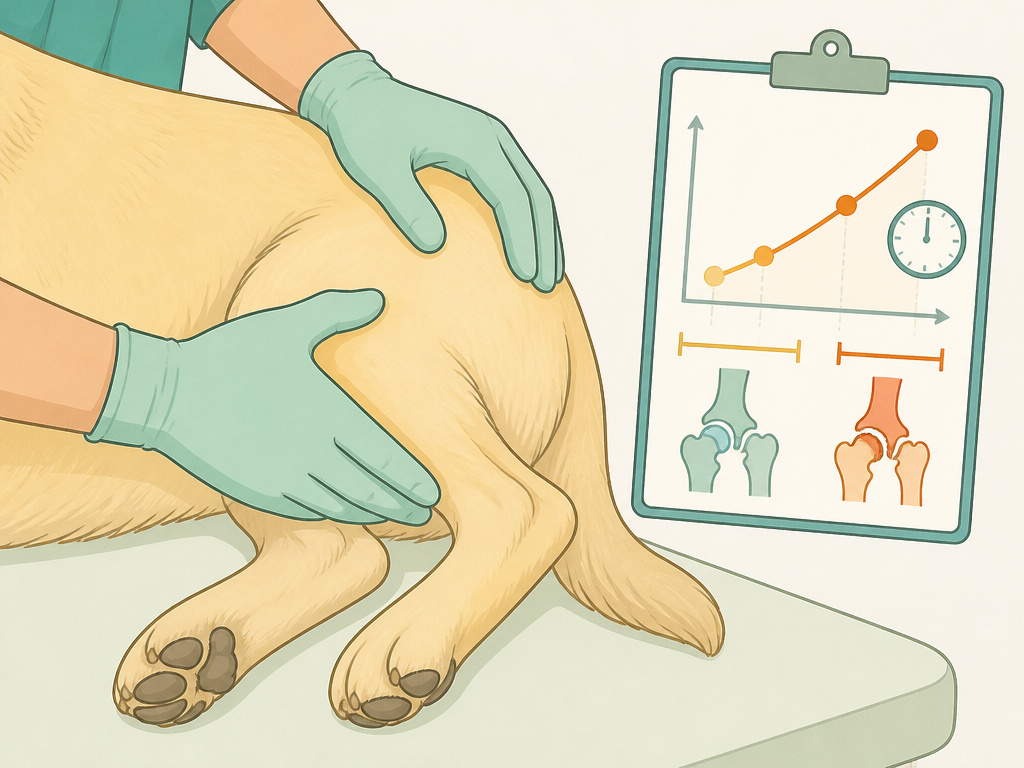
Neutering advice for Labs splits on more than one variable: the age at surgery matters for joint risk, while the longevity data favors neutered dogs.
The neutering health effects Labrador study analysed 1,500 Labrador cases, 808 males and 692 females. Neutering before 6 months raised the risk of at least one joint disorder to roughly double the 5% level seen in intact dogs (p = 0.044 and 0.043). In females, hip dysplasia incidence ran 4 to 5% through the first year against 1.5% in intact females.
| Timing | What the data shows | What it means in practice |
|---|---|---|
| Before 6 months | Joint-disorder risk roughly doubled vs a 5% intact baseline | Highest joint risk in the dataset |
| 6 to 11 months | Same doubled risk bracket | Waiting a few months bought no joint protection |
| 2 to 8 years | Mammary cancer appeared only in this group, at 3.5% | Later surgery carries its own trade-off |
| Left entire | Pyometra 1.8% at mean age 6; longevity 11.6 vs 12.5 years | A real cost, and a modest one |
The ages matter as much as the odds. Mean age at diagnosis was 3.5 years for hip dysplasia, 2.5 years for elbow dysplasia, and 5.5 years for cruciate rupture in females. You won’t see the bill in the puppy year.
Where this goes sideways: borrowing Golden Retriever neutering guidance for a Labrador. The neutering data for Labs is specific to the breed, so a rule of thumb built on Goldens may land wrong on a Lab.
The Labrador vs Golden Retriever comparison is worth reading in full if you’re choosing between the two, because the neutering picture is one of the clearest places they part company.
Fair warning: this is the section where I’d stop taking advice from anyone who hasn’t read the primary paper. The longevity data and the joint data point in opposite directions, and both are correct.
Containment, Exercise, and the Part I Test Myself
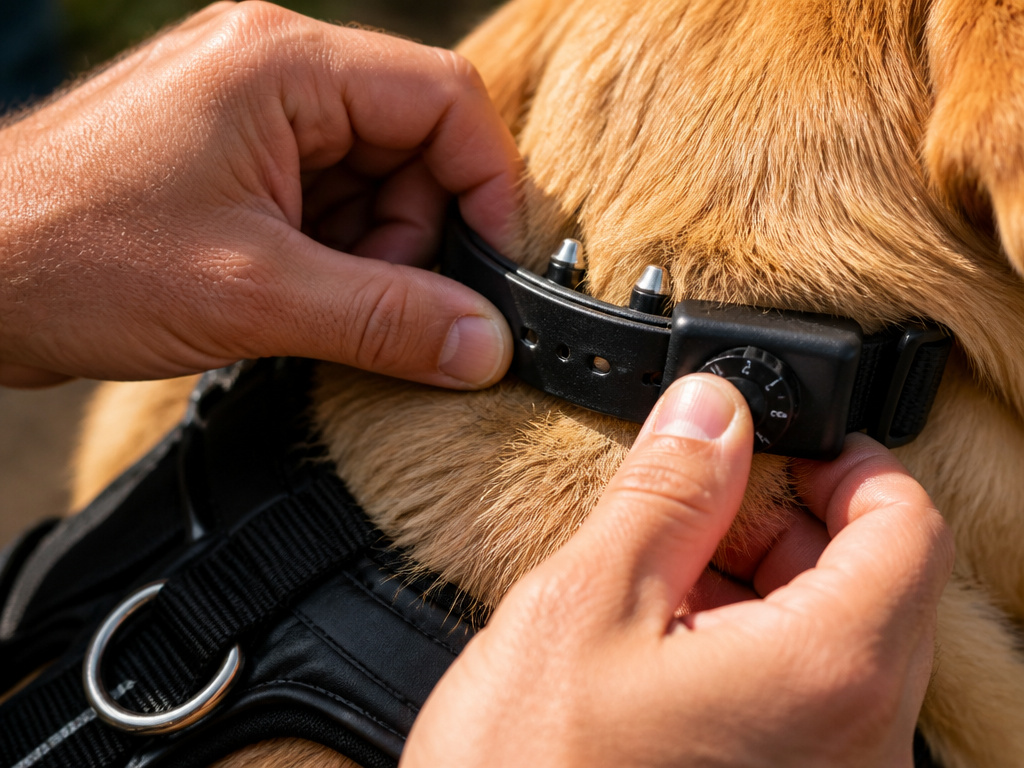
My spreadsheet has a column for published correction voltage, and half the rows are blank.
I keep published correction levels for the major in-ground brands, PetSafe, SportDOG, and Invisible Fence among them, and the spread is absurd. Some systems have no published voltage at all. Others list many levels running up to a high voltage. If a manufacturer won’t print the voltage range, I assume the number is embarrassing.
A collar with many levels sounds generous until you realise the low settings do nothing on a thick-coated dog with real drive. The useful range is the top three settings, which is why I compare effective ceiling instead of number of levels.
Before you start: a correction collar on a dog that hasn’t been trained on a leash and a long line first is a punishment delivery system, not a boundary. Pair it with a physical marker line the dog can see, and check the contact posts against the neck daily for the first two weeks, because a loose fit arcs and a tight one burns.
My honest gap here: I test the physical containment, not the software. GPS collar subscription plans and app interfaces are where I defer to reader feedback, and I’ve missed a pricing restructure more than once.
For the walking side, a best Labrador harness does more for a pulling Lab than any collar will. A front-clip harness turns the pull sideways instead of into your shoulder.
Frequently Asked Questions
Are Labradors good first dogs?
Yes, with one condition. The breed is biddable and forgiving of inconsistent handling, which is why it suits new owners better than most. That patience only pays off if you actually train, because an untrained Lab is a large, strong dog with no off switch.
Do Labradors shed a lot?
Constantly. The double coat sheds year-round, and PetMD is direct that frequent brushing is required to manage it. Expect dog hair as a permanent feature of your home rather than a seasonal event.
Is a chocolate Lab less healthy?
The UK data shows chocolate Labradors had a shorter median longevity, 10.7 years against 12.1, and the result was statistically significant. The chocolate group was only 34 dogs, though, so the finding is real but built on a small sample. The AKC standard treats chocolate as a nose-colour matter with no health implication.
Do Labradors get cancer often?
Neoplasia accounted for 21.1% of recorded deaths in the UK cohort, second behind musculoskeletal disorders at 24.5%. That’s a meaningful share, and it’s one reason the breed’s health picture is more complicated than the friendly-dog reputation suggests.
How much exercise does a Labrador need?
Enough to tire the dog out mentally as well as physically. A Lab with a job to do settles; a Lab with a garden and nothing else invents its own entertainment, usually along the fence line. Training sessions count toward the total.
Does a Labrador need a fence?
Visible boundary helps enormously, and a Lab that understands the line tends to respect it. What matters more is the training behind the boundary. A fence the dog has never been taught is just a suggestion.
The Bottom Line
Here’s the trigger I’d use. If your household can’t guarantee regular walks and daily training for the first year, don’t buy the puppy. That single test predicts more of the breed’s outcomes than any health certificate will.
None of this makes the Lab a bad dog. It makes it a dog whose problems are almost entirely predictable, and predictable is a far better deal than random. The joint odds, the weight risk, and the ear schedule are all known before you sign anything.
And if the honest answer is that you want a calm, quiet, low-grooming dog that settles in a small house, a retired racing Greyhound does most of what people claim they want from a Lab. It also ends up in rescue for no reason I can defend. Go and look at one before you decide.
