
Which Dog Breeds Bark the Most? What the Research Shows
This post contains affiliate links. As an Amazon Associate, we earn from qualifying purchases.
Sources disagree on which dog breeds bark the most: Hide & Scent Pets rates hounds and Chihuahuas “extremely high,” Pet Control HQ’s top-10 list includes Pomeranian, Chihuahua, Fox Terrier, Kelpie, German Shepherd, Cattle Dog, Jack Russell, Border Collie and Beagle, and Fullwood names Chihuahuas and German Shepherds plus Border Collies and terriers as high-energy barkers. Editorial breed lists name Beagles and several terriers among the most vocal breeds.
That top-decile finding came from structured expert scoring. The breed lists you’ll find online today came from editorial roundups, and they don’t agree with each other about which dog breeds bark the most.
What follows compares the four sources that actually name breeds, explains why herding dogs keep surfacing in the research, and covers the one factor that outweighs breed entirely.
Key Takeaways
- Up to 35% of owners list barking as a behavior complaint, which is why breed lists get searched so hard in the first place.
- Beagles and several terriers are named among the most vocal breeds in editorial breed lists.
- Age and household circumstances matter, and barking can vary by individual temperament and environment even within a breed.
- The same dog barks differently by context. Doorbell barks run harsh, low and fast. Isolation and play barks climb higher and turn tonal.
- Skip any list that mixes watchdog barking with excessive barking. They’re scored as separate traits for a reason.
What Barking Research Actually Measured
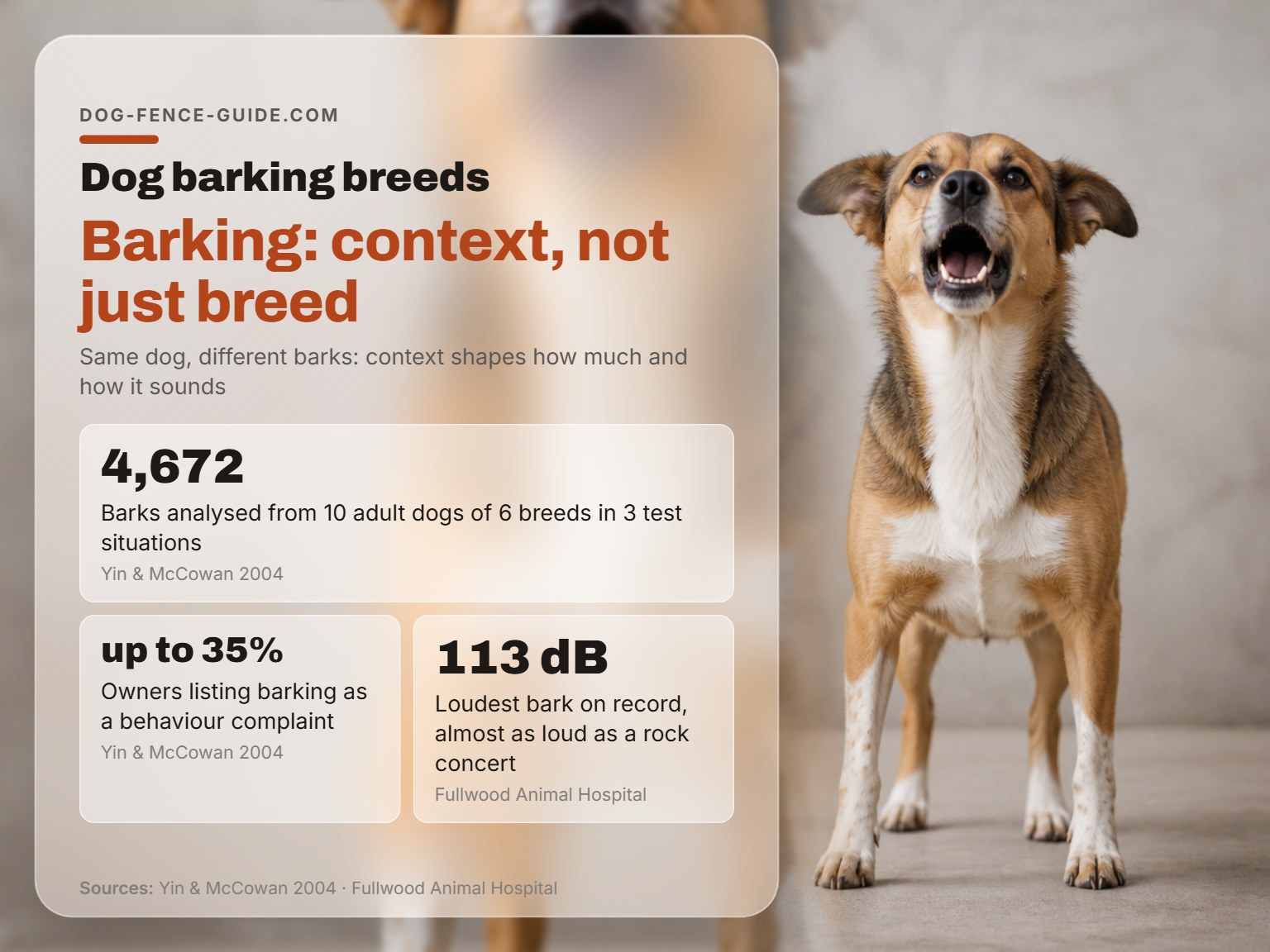
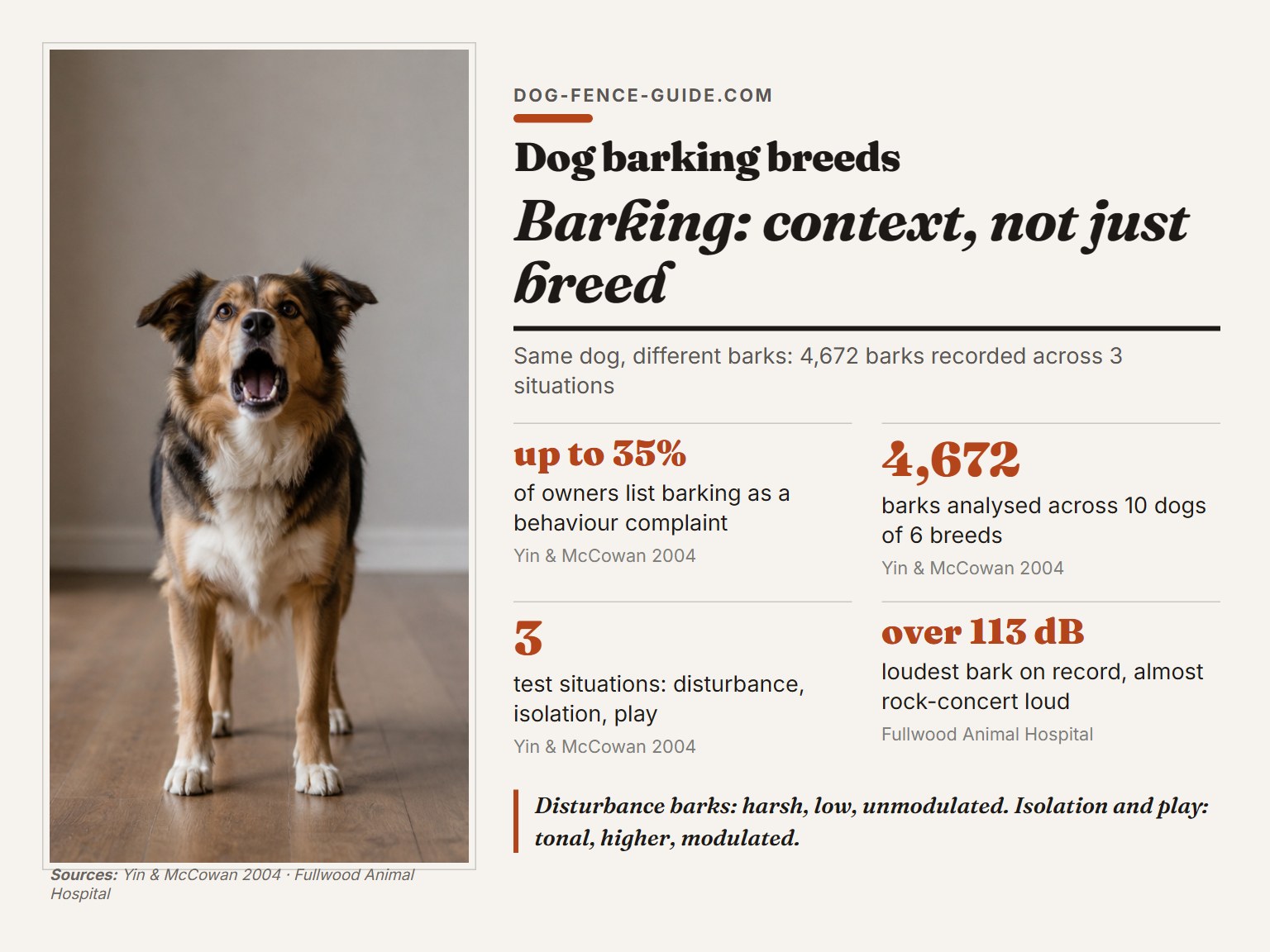
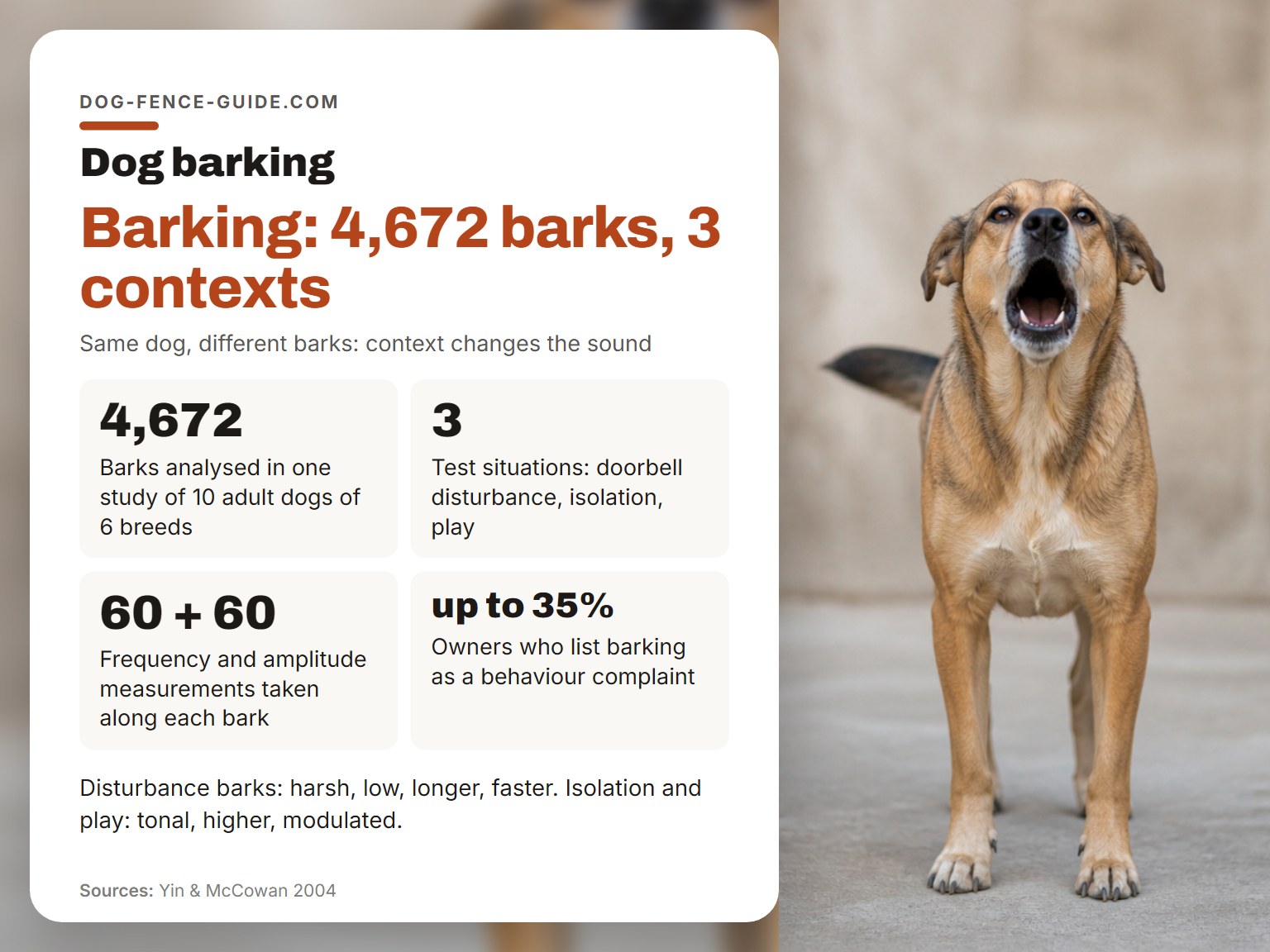
Sophia Yin and Brenda McCowan recorded 4,672 barks from 10 adult dogs of six breeds, then took 60 frequency measurements and 60 amplitude measurements along every single call.
Barks grade from harsh, low-frequency, unmodulated calls to harmonically rich, higher-frequency, modulated calls. Across three test situations, disturbance barks ran longer and repeated more rapidly than isolation or play barks. Discriminant analysis separated context subtypes within individual dogs, and individual dogs stayed identifiable from spectrograms regardless of context.
Three situations produced those recordings: a stranger ringing the doorbell, the dog shut away from its owner, and either two dogs or a person and a dog playing. The acoustic split came out clean.
Doorbell barks land hard and flat, low in pitch, with almost no modulation, and they repeat fast. Isolation and play barks climb higher, turn tonal, and wobble.
You can hear the difference from the hallway. That’s the whole point.
Here’s why it matters for anyone reading a breed chart. If the same dog produces acoustically distinct barks by context, then a single breed-level barking score measures something narrower than it claims to. The broader ethological approach to dog barking treats barking as situation-driven rather than a fixed breed output.
Barking also sits high on the list of owner complaints. Yin and McCowan note that up to 35% of owners list it as a problem, that many US counties have ordinances addressing it, and that it’s a major source of noise pollution in kennels.
The Two Studies That Ranked Breeds, and What Each One Counted
The breed lists you’ll find online today came from editorial roundups rather than structured measurement.
Editorial breed lists rank general vocalisation, and they assign each breed one fixed label when answering which dog breeds bark the most: extremely high, very high, high.
Beagles and several terrier breeds are named among the most vocal breeds in editorial lists. Barking can vary by individual temperament and environment even within a breed.
Both the study’s authors and the clinical review that reports their decile results put a ceiling on how far you should carry this. Excessive barking scored only moderate predictive value, and the review is explicit that not every member of a breed behaves like its profile predicts.
Editorial breed lists take a different route. Instead of ranking breeds by expert opinion, it looked at dogs with nuisance-barking complaints and calculated odds ratios for the circumstances around them. That work sits alongside the older behavioral profiles of dog breeds literature rather than replacing it.
Which Breeds the Sources Name, and Where They Disagree
Four sources name breeds, and no two of them produce the same list.
| Source | Breeds named as heaviest barkers | What it’s based on |
|---|---|---|
| Hide & Scent Pets | Hounds and Chihuahuas “extremely high”; Jack Russell “very high” | Editorial breed profiles |
| Pet Control HQ | Pomeranian, Chihuahua, Fox Terrier, Kelpie, German Shepherd, Cattle Dog, Jack Russell, Border Collie, Beagle | Editorial top-10 list |
| Fullwood Animal Hospital | Chihuahua and German Shepherd; Border Collies and terriers as high-energy | Veterinary practice blog |
| Hart & Hart 1985 (via Juarbe-Diaz) | Beagle plus several terriers, top decile | 96 expert raters, 56 breeds |
Read the middle column carefully. Those lists are answering two different questions.
The veterinary study ranks excessive, problem barking. The editorial lists rank general vocalisation, and they assign each breed one fixed label: extremely high, very high, high. One is a behaviour complaint. The other is a personality sketch.
If a breed chart hands you a single barking score with no context attached, it’s telling you how often that breed tends to vocalise, not how likely you are to have a complaint. Those are different numbers.
Two more disagreements worth naming. Pomeranians top one list and appear on no other. Retrievers show up as vocal in one roundup and are absent from every other source here. And Fullwood notes that barking varies by individual temperament and environment even within a breed, which undercuts the fixed-label approach entirely.
What the Hound and Terrier Argument Gets Right
Hounds were bred to be heard across a field. Beagles, Coonhounds and Bloodhounds use loud barks, baying or howling to communicate over distance, and that’s a working requirement rather than a quirk.
Terriers were bred to go to ground after things that bite back. The voice is part of the toolkit.
The hound-and-terrier answer is one view: Hide & Scent Pets rates hounds and Chihuahuas “extremely high,” while Pet Control HQ’s top-10 list and Fullwood’s breed names differ. It’s also why hound owners describe the noise as baying rather than barking, and why understanding why dogs howl explains half of what a Beagle does at dusk.
Why Do Herding Dogs Keep Showing Up on Barking Lists?
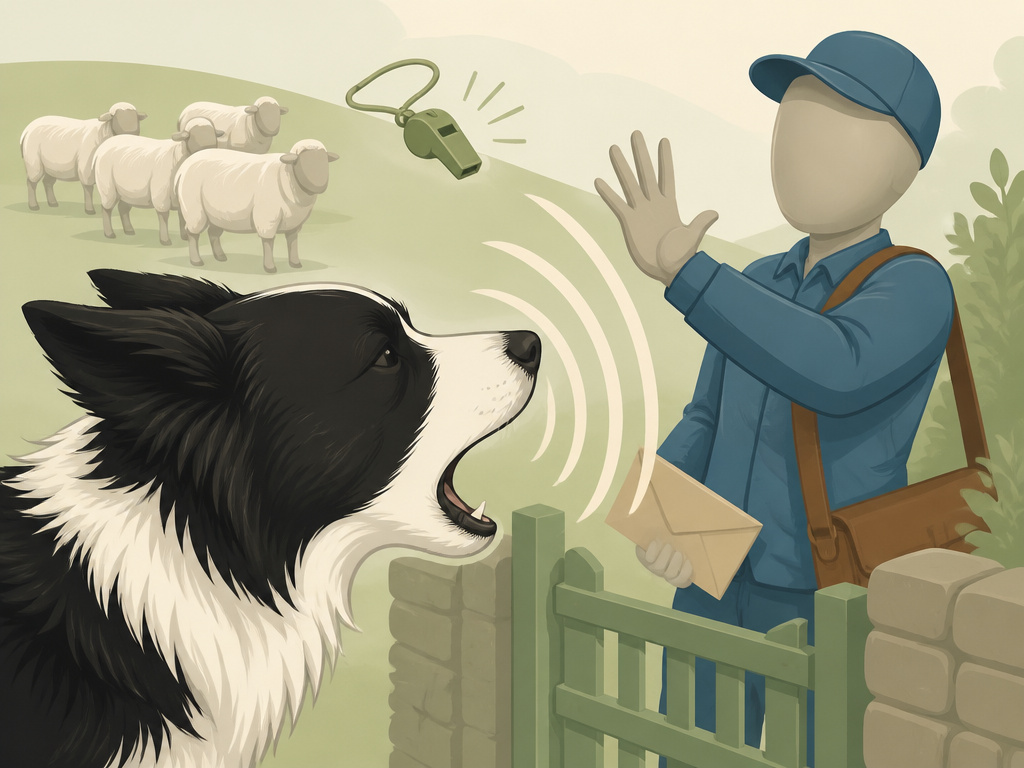
Because herding breeds were selected to move stock with their voices, and that same voice shows up in a living room with nothing to move.
Pet Control HQ puts Kelpies, Cattle Dogs and Border Collies in its top ten and frames all three as herding-driven vocalisers. Kelpies use the bark as a tool to direct livestock. At home, the tool gets pointed at the postman.
I learned the shape of this the hard way with a terrier. I assumed a trained dog would respect a boundary, and he went under the line in a single afternoon. What changed wasn’t my training method. It was my planning. I stopped treating a breed’s drive as a training failure and started treating it as a design constraint.
Herding and terrier barking is the one category where I’d rather see an owner plan around the drive than train against it. Give the dog a job and the noise drops. Skip the job and you’ll be correcting the same bark for years.
The sources don’t fully agree here, and it’s worth saying so. Hide & Scent Pets rates Border Collies only “high” and calls them explicitly not constant barkers. Fullwood frames collie barking as a boredom and stimulation problem rather than a breed ranking. The Brisbane study found herding type raised nuisance-barking odds by 3.2 times, which is real but modest next to the household factors below.
Does a Barking Problem Depend More on Age Than Breed?
Barking can vary by individual temperament and environment even within a breed.
| Factor | Compared with | Odds ratio |
|---|---|---|
Barking can vary by individual temperament and environment even within a breed.
Barking can vary by individual temperament and environment even within a breed. A single settled older dog of a “loud” breed may never generate a complaint.
That’s the finding I’d hand to anyone agonising over a breed chart. The risk factors for nuisance barking are mostly about circumstances, not pedigree.
One caveat the study’s design imposes: it classified dogs by type rather than breed, and the older ranking work covered only 56 pure breeds. Neither method transfers cleanly to a mixed-breed dog, which is most of them.
How to Read a Breed’s Bark Before You Bring It Home
A breed’s barking level tells you less than the conditions it was bred to bark in.
Ask what the dog was selected to do with its voice, then ask whether that job exists in your house. A hound that was bred to be heard across open ground will be heard across your street. A herding dog that was bred to move stock will move something.
- Watchdog barking versus excessive barking. A German Shepherd alerting at the door is doing its job. That’s a different trait from barking at nothing for an hour.
- Carry distance. Some barks travel. If you share a wall with a neighbour, this matters more than volume on paper.
- Whether the breed needs a job. Herding and terrier types fall apart without work, and the noise is the first symptom.
- Individual variation. Fullwood is right that temperament and environment shift barking within a breed. Meet the actual dog.
The Three Questions to Ask the Breeder
Ask how vocal the dam is, not the sire. Ask what the puppy’s litter has been doing with its voice since it could stand. Then ask what happens when the puppy is denied something it wants.
That third question tells you more than any chart. A puppy that barks through frustration and gets the thing anyway is already learning the pattern.
If noise is your main constraint, start from the quiet end of the range. Sources here name the Shih Tzu, French Bulldog and Greyhound as breeds that tend to be more reserved. My own list of quiet dog breeds leans on the same logic, and the dog breeds for apartments question is really a barking question wearing a different hat.
Fair warning: I’ve never owned a dog over eighty pounds, so my read on heavy-breed containment comes from reader mail and research rather than first-hand experience. Take the large-breed specifics with that in mind.
What Actually Reduces Barking: 5 Steps That Work
Five things move the needle, and only one of them is about the dog’s breed.
- Rule out the trigger before you train the response. If the doorbell sets it off and the doorbell never changes, you’re training against a firehose. Fullwood suggests teaching a “quiet” command or adding a distraction at the moment the dog reacts.
- Train the cue on an easy trigger first. Skipping the low-stakes repetition means the cue collapses the first time a real visitor walks up the path.
- Withhold attention until the dog is calm. Fullwood is direct about this: don’t reward attention-seeking barking, and wait for calm before offering affection or play. Feeding a barker mid-bark teaches a longer bark.
- Add physical and mental work. A Border Collie with no outlet barks because the energy has nowhere else to go. Walks, play and enrichment toys address the cause rather than the symptom.
- Keep every human in the house consistent. One person yelling “quiet” while another laughs at the same bark resets the whole thing.
What most people get wrong: Yelling at a barking dog. Fullwood notes the dog may read it as you joining in, which means the behaviour gets reinforced on the spot and you’ll hear it louder within a week.
The first change you’ll notice isn’t silence. Watch for the pause. The dog opens its mouth, stops, and looks at you. That’s the training landing.
The One Step Most Owners Skip
Consistency over weeks, not days. This is the cast-iron skillet problem: you season it slowly and repeatedly before it holds, and every shortcut ruins the surface. Barking works the same way.
If you want the full sequence laid out, my guide on how to stop barking walks the order. For households where training alone isn’t landing, bark deterrent devices covers the tools. Owners of bigger, more determined dogs usually end up comparing bark collars for large dogs instead, because the smaller units don’t sit or hold the same way.
A camera with bark alerts is the other option worth knowing about, mainly because it tells you whether the barking happens while you’re out or only while you’re home. Those are two different problems.
When Barking Is a Vet Question, Not a Training Question

Sudden changes in a barking pattern go to the vet, not the trainer.
Fullwood is clear that excessive vocalisation can be linked to anxiety or to health concerns such as hearing loss or cognitive decline in older dogs. A dog that starts barking in new ways is describing something.
- A bark that changed pitch or volume recently.
- Barking that starts at nothing in particular, with no door, person or animal involved.
- New vocalising in an older dog, especially paired with confusion.
- Any barking alongside pacing, head pressing or disorientation.
The part nobody mentions: If the pattern changed suddenly, book the checkup before you buy any training tool. You’ll spend weeks correcting a behaviour that has a medical cause, and the dog pays for the delay.
The Bottom Line
Here’s the threshold I’d actually use. If your dog is young, or you have more than one dog, treat barking as a household-management question first and a breed question second. Barking can vary by individual temperament and environment even within a breed.
If you’re still choosing a breed, the honest answer is that the ranking you’re reading probably came from an editorial list rather than a measurement. The one structured ranking we have puts Beagles and several terriers at the top for excessive barking, and even its own authors warn against reading it as a prediction for an individual dog.
I’ll concede the appeal of a clean list. It’s easier to pick from a top ten than to think about drive, age and household composition together. But breed traits are ranges, and the owners who get surprised are the ones who bought the brochure.
So start with one question instead: what was this dog bred to do with its voice, and does that job exist in my house? Answer that honestly and the rest of the list stops mattering much.
Frequently Asked Questions
Which dog breed barks the most?
Sources disagree: Hide & Scent Pets rates hounds and Chihuahuas “extremely high,” Pet Control HQ’s top-10 list includes Pomeranian, Chihuahua, Fox Terrier, Kelpie, German Shepherd, Cattle Dog, Jack Russell, Border Collie and Beagle, and Fullwood names Chihuahuas and German Shepherds. Editorial breed lists name Beagles and multiple terriers among the most vocal breeds. Editorial lists name Chihuahuas, Pomeranians and Jack Russells, but those rankings aren’t based on measurement.
Do small dogs really bark more than large ones?
Sources disagree: Hide & Scent Pets rates Chihuahuas “extremely high,” while Fullwood names Chihuahuas and German Shepherds and Pet Control HQ’s top-10 list includes Pomeranian, Chihuahua, Fox Terrier, Kelpie, German Shepherd, Cattle Dog, Jack Russell, Border Collie and Beagle. But the veterinary practice source here names German Shepherds alongside Chihuahuas, and the Brisbane study found household factors like age and dog count mattered far more than size or breed.
Are herding dogs actually a barking problem?
It depends which source you follow. One top-ten list includes Kelpies, Cattle Dogs and Border Collies as herding-driven vocalisers. Another source rates Border Collies only “high” and calls them not constant barkers, framing the noise as boredom instead.
Does neutering stop a dog from barking?
The fact sheet contains no finding that male dogs bark more than female dogs. If barking is a problem in your house, the documented levers are training consistency, stimulation and a vet check, not desexing.
Can I tell what my dog is barking at from the sound?
Often, yes. Yin and McCowan found doorbell and disturbance barks were harsh, low-frequency and unmodulated, while isolation and play barks were higher, more tonal and modulated. Disturbance barks also ran longer with faster repetition. The same dog produced distinct subtypes by context.
When should barking send me to the vet?
When the pattern changes suddenly. Excessive vocalisation can be tied to anxiety or to health issues such as hearing loss or cognitive decline in older dogs, so a new bark in an older dog deserves a checkup before any training tool comes out.
