
10 Best Electric Dog Fences in 2026
This post contains affiliate links. As an Amazon Associate, we earn from qualifying purchases.
After comparing dozens of systems, we found the Dogtra GPS Fence System to be the best overall for its no-subscription GPS boundaries, 100-level adjustable correction, and rugged IPX9K waterproof collar. For dogs that test every rule, the PetSafe Stay & Play Wireless Fence offers a tone-only training mode. And for owners with irregular property lines, the SpotOn Nova GPS Dog Fence delivers fully custom-shaped fences without any recurring fees.
The real challenge with electric dog fences isn’t the technology, it’s matching the system to your specific yard, dog, and lifestyle. A wireless fence that works perfectly in a half-acre circle will leave gaps on a long, narrow property. A GPS fence with no subscription costs more upfront but saves money over time. Getting it right means fewer escapes and less training frustration.
This guide is based on manufacturer specifications, expert round-ups, and patterns we’ve seen in owner feedback across hundreds of real-world installations. We’ve organized the 10 best electric dog fences by their strongest use case so you can find the right fit without sifting through marketing claims.
Top 10 Electric Dog Fences in the Market
Certain content that appears on this site comes from Amazon. This content is provided "as is" and is subject to change or removal at any time.
The Best Electric Dog Fences, Reviewed
Dogtra GPS Fence System

What We Like
- No subscription fees ever
- Custom-shaped boundaries via app
- 100-level adjustable correction
- IPX9K waterproof rechargeable collar
Trade-offs
- Requires 3/4 acre minimum property
- No live tracking or notifications
- App needed only during setup
A GPS fence that charges no monthly subscription and works on properties of three-quarters of an acre or larger means you get the freedom of a wire-free boundary without a recurring bill. The Dogtra GPS Fence uses the free app to set up circular or custom-shaped zones. The collar handles everything independently after a quick app setup. With 100 adjustable levels of tone, vibration, or stimulation, plus a return reminder tone that guides your dog back home, it suits owners who want precise control and reliable containment for dogs 15 pounds and up.
The Dogtra GPS Fence is designed for outdoor use only and omits live tracking or notifications. If you need to know where your dog is at all times, you would need a different system. But for straightforward containment without digging, wires, or ongoing costs, the Dogtra’s IPX9K waterproof rating and multi-dog support (up to three dogs sharing one fence profile) make it a practical, no-nonsense choice. Just remember to remove the collar when your dog comes indoors.
Product photos
PetSafe Stay & Play Wireless Fence

What We Like
- Tone-only mode for sensitive training
- Portable for camping or travel
- Static-free reentry when dog returns
Trade-offs
- Circular boundary only, no custom shapes
- Coverage limited to 3/4 acre maximum
- Transmitter requires indoor outlet access
The tone-only mode lets you start with a gentle warning before any correction kicks in, which helps stubborn dogs learn the boundary without getting spooked. It covers up to three-quarters of an acre from a transmitter you place indoors, and because there’s no wire to bury, you can set it up in a few hours and take it with you when you travel. This is the system for the dog who treats every boundary as a suggestion.
The PetSafe Stay & Play Wireless Fence creates a circular boundary, so you cannot shape it around a non-circular yard or exclude a driveway. If your property has an irregular shape or you need to cover more than three-quarters of an acre, the SpotOn Nova GPS system lets you draw any shape fence on a map and scale up to any size. But for a straightforward yard and a dog who needs a fence that matches their persistence, the PetSafe Stay & Play delivers exactly that.
Product photos
SpotOn Nova GPS Dog Fence
What We Like
- No subscription fees ever
- Unlimited custom-shaped fences via app
- Escape prevention 99.3% of the time
Trade-offs
- App required for all fence setup and adjustments
- No in-ground wire backup if GPS signal drops
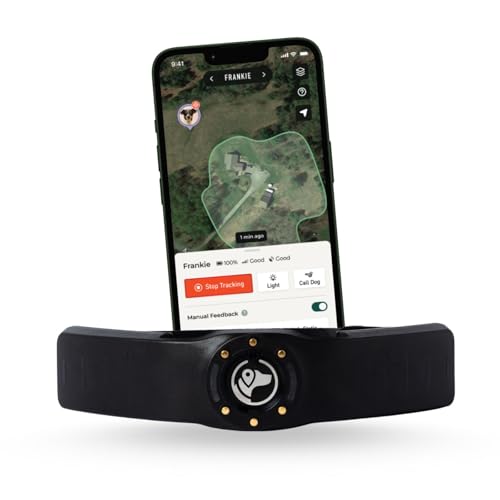
The dual-band, dual-feed GPS technology inside this collar tracks both the dog and the fence boundary in real time, so the virtual line stays exactly where you drew it even across uneven or wooded ground. That matters if your property has a hill, a patch of pines, or an odd shape that a circular base station can’t handle. You can create unlimited fences of any shape and size, add keep-out zones around a garden or pool, and adjust everything from the app without digging or burying wire. For owners who want to contain a dog across varied terrain without paying a monthly fee, this is the most flexible GPS option on the market.
The trade-off is weight and reliance on the app. At 0.8 pounds, the collar is heavier than the Dogtra GPS Fence System’s 0.5-pound unit, so a small dog might feel the difference on a long afternoon. And while the app gives you real-time containment activity and access to certified trainer support, you need it for every fence change and boundary tweak, there is no physical transmitter to fall back on. If you prefer a system that works without a smartphone, the Dogtra offers GPS containment with a lighter collar, though its feature set is not detailed in available product information.
Product photos
SportDOG In-Ground Fence System
What We Like
- Expands to 100 acres and unlimited dogs
- Two collars included in the kit
- Waterproof to 25 ft with rechargeable lithium battery
- Tone and vibration warning before static
Trade-offs
- Requires burying wire for the boundary
- 1000 ft of wire covers only 1 1/3 acres
- Needs extra wire and flags for larger yards
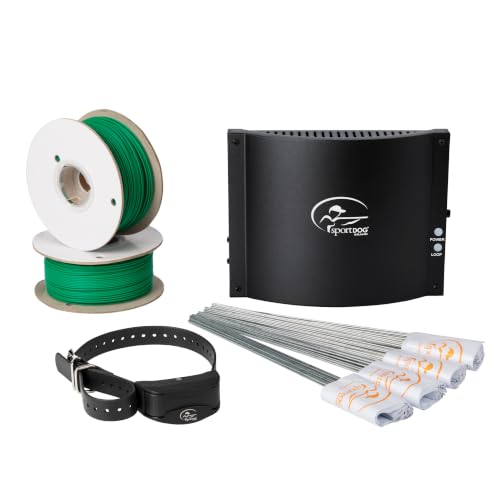
The kit includes 1000 feet of wire and two collars, enough to cover 1 1/3 acres for one dog. That coverage suits a typical suburban lot, and you can expand the system to cover up to 100 acres and an unlimited number of dogs by adding more wire and collars. This makes it a flexible option if you plan to enlarge your yard or add more dogs later.
The biggest difference from wireless fences is that you still have to bury wire, a weekend project, not a plug-and-play setup. A GPS fence like the SpotOn Nova lets you draw boundaries from an app with no digging, but that system uses a single collar per purchase. If you want a wired system that can expand to cover more ground and more dogs, this in-ground fence gives you that flexibility.
This system requires burying the boundary wire, so it is not a quick plug-and-play option. Renters or anyone who cannot dig into their yard may find this inconvenient. However, for homeowners who can install it, the wired design provides a reliable containment zone that can be expanded as needed.
Extreme Dog Fence Pro-Max Kit
What We Like
- Covers up to 25 acres
- Receiver waterproof to 10 feet
- 14-gauge wire lasts 25+ years
- Includes surge protector and training flags
Trade-offs
- Requires burying or running boundary wire
- Single-dog kit only; multi-dog not included
- Twisted wire needed for crossover points
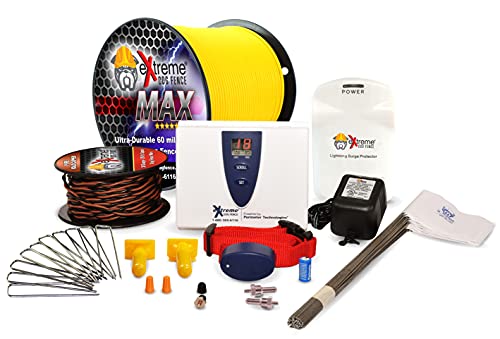
Covering up to 25 acres, the Extreme Dog Fence Pro-Max Kit handles the kind of property where your neighbor’s fence line is a speck on the horizon. The 14-gauge-plus wire is designed to be run above ground or buried and is claimed to last 25+ years, so you’re not digging it up again next season. It’s a straightforward DIY system for anyone comfortable running a few hundred feet of wire around a large yard, with a receiver that keeps working even if your dog finds the deepest mud puddle on the property. If you’ve got acreage and want a boundary that stays put without monthly fees, this is the kind of gear that gets installed once and forgotten.
The Extreme Dog Fence Pro-Max Kit demands you actually lay cable around the full perimeter. Unlike GPS or wireless systems that let you set a boundary from your phone, this one requires a weekend project on a 25-acre spread. Compared to the SpotOn Nova GPS Fence, which creates any shape boundary without wire at all, the Extreme Dog Fence gives you a more physically permanent solution but less flexibility to change the boundary on a whim. It’s also a single-dog kit, so if you’ve got multiple dogs, you’ll need to buy extra receivers separately. For one dog and a big piece of land, the upfront labor pays off in reliability.
Extreme Dog Fence Standard 5-Dog Kit

What We Like
- Fully waterproof receiver submersible to 10 ft
- Covers up to 6 acres with included wire
- Includes 5 collar receivers for multi-dog setup
- Manufactured in USA with imported parts
Trade-offs
- Requires burying wire around entire boundary
- 20-gauge wire is thinner than some heavier-duty kits
Five collar receivers and 1,500 feet of boundary wire in one box mean this kit handles a multi-dog household on a sizable property without forcing you to buy extra receivers piecemeal. The coverage stretches to 6 acres, and the collars are fully waterproof, submersible up to 10 feet, so a swim in the pond won’t shut the system down. For anyone with several dogs and a decent-sized yard who wants a straightforward in-ground setup without paying per extra collar, this is the practical, budget-conscious way to go.
With any in-ground fence system, the primary task is burying the boundary wire. The Standard 5-Dog Kit includes 1500 feet of 20-gauge high-tensile wire with a heavy protective jacket, so it resists damage from weather or ground movement. Covering up to 6 acres, this kit suits owners willing to invest the digging time for a permanent, reliable containment solution. The trade-off for that effort is a system that, once installed, requires no ongoing subscription fees and works regardless of power or internet outages.
PetSafe Wireless Dog Fence System
What We Like
- Sets up in hours, no digging
- Static-free reentry for safe return
- Portable for camping or travel
Trade-offs
- Circular boundary only, no custom shapes
- Coverage limited to 1/2 acre
- Uses disposable batteries, not rechargeable
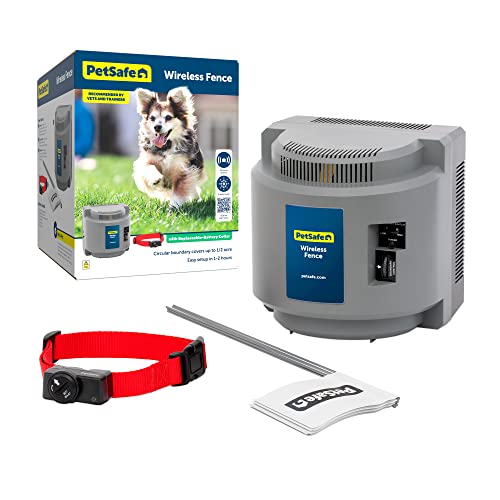
A half-acre circular boundary means this system covers a typical suburban yard without you lifting a shovel. The portable indoor transmitter plugs into any outlet, so you can take it to a vacation home or campsite and have a containment zone set up in a couple of hours. That simplicity is the whole point: no burying wire, no trenching, no permanent installation. It suits someone who wants a straightforward way to keep a small-to-medium dog safe in a yard they don’t own, or who just doesn’t want to spend a weekend digging.
The PetSafe Wireless Fence is stuck with a circle. If your property is oddly shaped or larger than half an acre, it won’t adapt. You would need to look at a GPS-based system like the SpotOn Nova, which lets you draw any boundary shape. The collar also runs on a disposable battery that lasts up to two months; when it dies, you replace it rather than plugging in. For the price, though, you get a reliable, no-fuss fence that does exactly what it promises without the labor of a buried-wire setup.
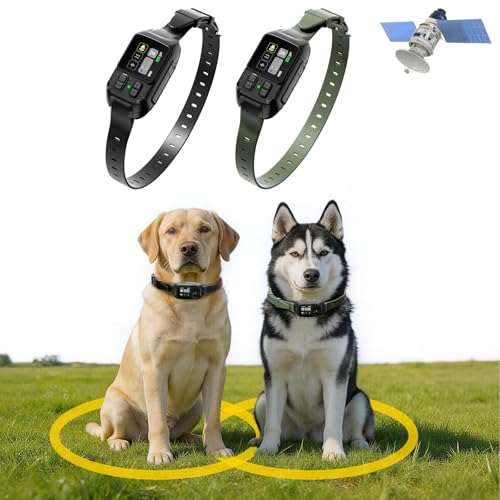
Gladsmile GPS Wireless Dog Fence
What We Like
- No subscription required
- Custom and circular fence modes
- IPX7 waterproof collar
- 40-hour rechargeable battery
Trade-offs
- No app control for adjustments
- Requires reset if training location changes
A 6561-foot adjustable range means the Gladsmile ZF550 can cover everything from a small suburban yard to a large farm without any monthly fees. The system uses upgraded GPS to create a virtual boundary in either a simple circle or a custom shape that matches irregular yard layouts. That way you aren’t stuck with a round zone that cuts through your garden. With three correction types, beep, vibration, and static, you can start your dog on sound alone and work up gradually, which makes it a practical choice for owners who want subscription-free containment and the flexibility to take the fence on camping trips or to a new home.
The Gladsmile GPS Wireless Dog Fence uses a direct on-system interface rather than a smartphone app, so you adjust the boundary and correction levels on the unit itself. That keeps setup straightforward, but it also means you cannot see a map of the fence or tweak it remotely. Compared to the Dogtra GPS Fence, which offers a return reminder tone and vibration/correction, the Gladsmile is simpler, but you trade away the convenience of on-screen control. If you prefer a hands-on, no-subscription system and don’t mind dialing in settings on the unit itself, this is a capable and portable option.
Product photos
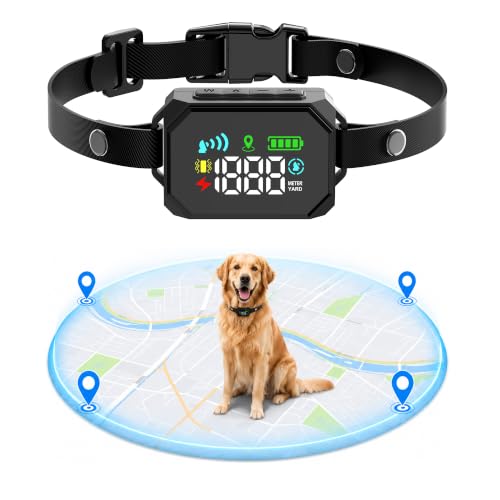
TTPet GPS Wireless Dog Fence
What We Like
- Covers up to 2,500+ acres
- IPX7 waterproof collar
- AI-enhanced GPS for stable boundaries
- Smart Memory saves settings
Trade-offs
- Circular boundary only, no custom shapes
- Requires recalibration when moving locations
- Continuous collar wear limited to 12 hours
A maximum range of 1,999 yards means this system can contain a dog across 2,500 acres of open land without digging a single trench or paying a monthly subscription. That makes it a practical fit for farms, ranches, or anyone with acreage too large for traditional fencing. The AI-enhanced GPS chip helps reduce drift, so the boundary stays consistent even when your dog covers serious ground. The progressive training modes let you start with a beep and work up to adjustable static correction as your dog learns the limits.
The PetSafe Stay & Play Wireless Fence has a circular boundary, so you cannot trace an irregular property line or exclude a driveway the way you can with an in-ground system like the SportDOG In-Ground Fence. You also need to recalibrate when moving to a new location or after several days without use, which adds a step if you plan to take it between a home and a weekend property. For someone with wide-open space who wants a no-dig, portable solution, that flexibility is worth the extra setup attention.
Product photos
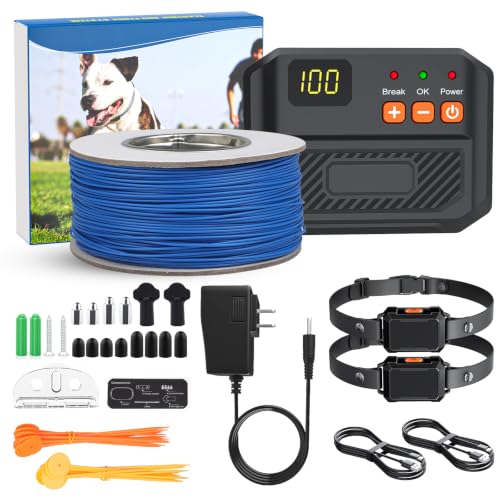
AOZOOM Underground Dog Fence
What We Like
- 180-day standby battery life
- IPX7 waterproof receiver collar
- USB-C charging in 2 hours
- Fits 22-66 cm neck sizes
Trade-offs
- Requires burying or laying boundary wire
- Maximum 0.95 acre without extension wire
A 180-day standby battery means you can charge this collar twice a year and forget about it. That’s the whole point of the AOZOOM system: minimal fuss for a basic containment job. It covers up to 0.95 acre with the included 722 feet of wire, charges fully in two hours via USB-C, and the IPX7 waterproofing shrugs off rain, mud, and puddles without complaint. For owners who want a straightforward underground fence with long battery life, this kit delivers on its standby claim.
Setting up a wired containment system does require more effort than a wireless alternative. The included 722 feet of boundary wire must be laid or buried around the yard, which adds to the initial installation time. Owners who prefer a quick, no-dig setup might find wireless options like the PetSafe Stay & Play more convenient, since that system requires no burying of wire and can be operational in hours. However, for those willing to invest the time, the wired approach creates a permanent, reliable boundary that doesn’t depend on battery-powered transmitters or GPS signal strength.
Product photos
How We Evaluated Electric Dog Fences
We started by studying the technical specifications and manufacturer documentation for every major electric fence system on the market. That gave us the raw data on coverage area, correction levels, battery life, and waterproof ratings. From there, we cross-referenced owner feedback to see which specs actually held up in real yards, a receiver rated IPX7 that dies after one rainstorm tells a different story than the manual does.
The three criteria that mattered most were boundary flexibility, correction adjustability, and ongoing costs. A fence that can only make a perfect circle is useless on a pie-shaped lot. A system with only one correction level can overwhelm a sensitive dog or bore a stubborn one. And a subscription fee that adds up over five years can turn a budget fence into an expensive one. We also weighed installation effort, because a fence that sits in the box for six months helps no one.
This is a research-led evaluation, not a hands-on test. We haven’t buried wire in every yard or walked every boundary line ourselves. What we have done is read thousands of owner reports and compared them against the spec sheets to surface the honest trade-offs. We tell you what works, what doesn’t, and who each fence is actually for.
What To Look For In Electric Dog Fences
Every electric dog fence promises to keep your dog safe, but the details determine whether it actually works for your property and your dog’s temperament. Here’s what matters most.
Choose a fence system that matches your property’s shape and size, your dog’s correction sensitivity, and your tolerance for installation work, then compare ongoing costs before you buy.
Boundary Type and Flexibility
The shape of your yard determines which fence technology will work. Wireless systems create a circular boundary from a central transmitter, which works well on square or round lots but leaves gaps on irregular property lines. In-ground fences let you run wire anywhere, so they handle odd shapes, narrow side yards, and split-level lots. GPS fences create boundaries on a digital map through an app, which gives you custom shapes without burying wire, but they require a minimum property size and a clear view of the sky.
Consider the pros and cons of electric fences before choosing a boundary type. The right answer depends on whether you own or rent, how large your yard is, and if you are willing to dig.
Correction Levels and Training Modes
Dogs respond to correction differently. A system with adjustable static levels lets you start low and increase only as needed. Tone-only modes are valuable for sensitive dogs or early training. Vibration warnings give a physical cue without static. The best systems offer at least 5 to 10 levels so you can fine-tune the response to your dog’s temperament.
A comparison of wireless and in-ground fence systems often shows that wired systems offer more correction levels, while wireless systems tend to have simpler, fewer settings.
Coverage Area and Expandability
Know your property’s size before you buy. Wireless systems typically cap out at 1 to 3 acres. In-ground kits come with a set length of wire, usually 500 to 1000 feet, and you buy more for larger yards. GPS fences cover from a few acres up to hundreds, but many require a minimum lot size. If you plan to add more dogs later, check whether the system accepts additional collars and what they cost.
Power Source and Battery Life
Receiver collars run on either disposable batteries or rechargeable lithium cells. Rechargeable collars save money over time but require remembering to charge them, usually every few weeks to a few months. Disposable batteries are convenient for backup but add ongoing cost. Look for a battery indicator on the collar or transmitter so you’re not guessing when power runs low.
Waterproofing and Durability
The collar lives on your dog’s neck through rain, puddles, and the occasional swim. An IPX7 rating means the collar survives submersion in 1 meter of water for 30 minutes. IPX9K is a step above, it handles high-pressure, high-temperature water sprays. For most dogs, IPX7 is sufficient. For dogs that swim or work in heavy rain, the higher rating adds peace of mind.
- Measure your yard’s longest straight-line distance to confirm wireless systems can cover it.
- Check whether the fence requires a smartphone app for setup or adjustment.
- Look for a static-free reentry feature so your dog isn’t corrected when coming back inside the boundary.
- Confirm the collar fits your dog’s neck size, some systems don’t fit very small or very large breeds.
- Verify the warranty length and what it covers; some manufacturers exclude water damage.
A fence that fits your yard and your dog’s temperament will train faster and fail less often than a more expensive system that doesn’t match your situation.
Electric Dog Fences Compared
The table below compares the 10 best electric dog fences across their key specs so you can see at a glance which systems fit your property and your dog.
| Product | Boundary Type | Max Dogs | Min Dog Weight |
|---|---|---|---|
| Dogtra GPS Fence System | GPS | 3 per fence profile | 15 lbs |
| PetSafe Stay & Play Wireless Fence | Wireless | N/A | 5 lb |
| SpotOn Nova GPS Dog Fence | GPS | N/A | N/A |
| SportDOG In-Ground Fence System | In-Ground | Unlimited | 10 lb |
| Extreme Dog Fence Pro-Max Kit | In-Ground | 1 | N/A |
| Extreme Dog Fence Standard 5-Dog Kit | In-Ground | 5 | N/A |
| PetSafe Wireless Dog Fence System | Wireless | N/A | 8 lb |
| Gladsmile GPS Wireless Dog Fence | GPS | 2 | 15 lbs |
| TTPet GPS Wireless Dog Fence | GPS | N/A | 18+ lbs |
| AOZOOM Underground Dog Fence | In-Ground | 2 | 10-68 kg |
Frequently Asked Questions
How does an electric dog fence work?
An electric dog fence uses a buried wire, wireless transmitter, or GPS signal to create a boundary. The dog wears a receiver collar that detects the boundary and delivers a warning tone, vibration, or static correction when the dog approaches the limit. Most systems include a training period where the dog learns the boundary flags before the correction is activated.
Can an electric dog fence be used for a dog that already escapes other fences?
Yes, but only if you address why the dog is escaping. Dogs that climb, dig under, or break through physical fences may respond well to a containment system once trained. However, dogs with high prey drive or severe separation anxiety sometimes push through correction. A wireless or in-ground fence decision should factor in your dog’s specific escape behavior.
How long does it take to train a dog to an electric fence?
Most manufacturers recommend a two-week training period with boundary flags and a leash. The dog learns the boundary by tone alone for the first week, then experiences a mild correction in the second week. Consistent daily sessions of 10 to 15 minutes produce the best results. Some dogs pick it up in a few days; others need three to four weeks.
What happens if the power goes out or the battery dies?
If the transmitter loses power, an in-ground or wireless fence stops working. GPS fences also fail if the collar battery dies or the GPS signal drops. Most owners keep a backup collar battery or a secondary containment plan for storms and outages. No electric fence should be your dog’s only safety measure if you live in an area with frequent power loss.
Can I use an electric dog fence for a puppy?
Most manufacturers recommend waiting until the puppy is at least six months old and has basic obedience training. Puppies are still learning impulse control, and the correction may confuse them. The collar size also matters, many collars are too heavy for dogs under 8 to 10 pounds. Check the minimum weight and neck size listed by the manufacturer before starting training.
The Bottom Line
For most dog owners with at least three-quarters of an acre, the Dogtra GPS Fence System hits the sweet spot of no subscription fees, fully customizable boundaries, and 100 levels of adjustable correction. It’s the best overall because it eliminates the two biggest frustrations of electric fences: ongoing costs and rigid boundary shapes.
If your property is smaller or your dog needs a tone-only training mode, the PetSafe Stay & Play Wireless Fence is a strong choice for stubborn dogs. For owners with large, irregular lots who want GPS flexibility without a subscription, the SpotOn Nova GPS Dog Fence delivers unlimited custom fences. And if you’re on a budget with multiple dogs, the Extreme Dog Fence Standard 5-Dog Kit covers up to 6 acres without buying extra collars.
The single most important factor in choosing an electric dog fence is matching the boundary type to your property’s shape and size. A perfect system for a square half-acre lot will fail on a narrow two-acre strip. Measure your yard first, then pick the technology that fits.
