
10 Best Gps Dog Fences in 2026
This post contains affiliate links. As an Amazon Associate, we earn from qualifying purchases.
The Dogtra GPS Fence is the best overall GPS dog fence because it combines custom-shaped boundaries, a rugged IPX9K waterproof collar, and no subscription fees. For long battery life, the PetSafe Guardian GPS Dog Fence stands out, while the SpotOn Nova offers the best precision for tricky terrain.
Choosing a GPS fence means deciding between freedom and limits. You want your dog to roam safely without digging under a fence or slipping a collar. But you also need a system that fits your property’s shape, size, and tree cover without locking you into monthly fees.
This guide is based on manufacturer specifications, expert round-ups on containment technology, and patterns in owner feedback. We focused on boundary flexibility, battery life, subscription costs, and reliability across different yard conditions to help you find the right match.
Top 10 GPS Dog Fences in the Market

Certain content that appears on this site comes from Amazon. This content is provided "as is" and is subject to change or removal at any time.
The Best GPS Dog Fences, Reviewed
Dogtra GPS Fence

What We Like
- No subscription fees
- Custom-shaped boundaries via app
- IPX9K waterproof collar
- Come-home sequence with return reminder tone
Trade-offs
- Requires 3/4 acre or larger property
- No live tracking or notifications
- Flags for training sold separately
A collar that can hold up to 30 different virtual fences means you can tailor the boundary to an oddly shaped lot or even multiple properties without paying a dime in monthly fees. The IPX9K waterproof rating is designed for tough outdoor conditions, so a dog that loves water won’t sideline the system. It supports dogs as light as 15 pounds, which includes many smaller breeds that some other GPS fences exclude. For anyone who wants a set-it-and-forget-it containment system that doesn’t nickel-and-dime you over time, this is the one to beat.
The trade-off is that the collar works best on properties of three-quarters of an acre or larger, which rules out small city yards. And unlike some competitors, this system is strictly containment, you won’t get a map ping if your dog slips the boundary. The return reminder tone is a built-in feature for guiding them back, but you’ll need to buy flags separately for the recommended training phase. If your priority is a straightforward, no-subscription fence with serious weatherproofing and room for multiple dogs, the Dogtra delivers exactly that without the extras you might not use.
Product photos
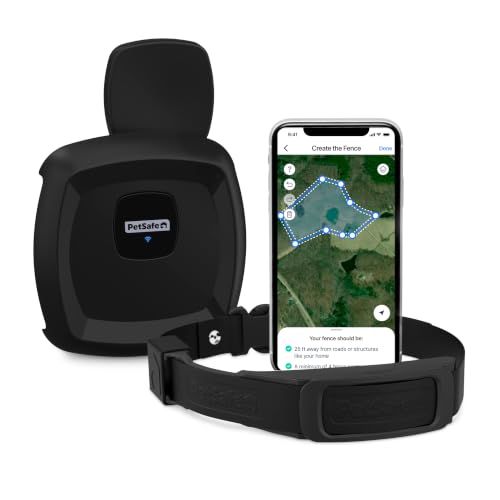
PetSafe Guardian GPS Dog Fence
What We Like
- Up to 5-day battery life
- No subscription fees
- Install in about 1 hour
- Choose tone, vibration, or static correction
Trade-offs
- Requires 3/4 acre or larger property
- No tracking or portability features
A five-day battery life on a single charge means you’re not hunting for the charger every other afternoon. That kind of staying power matters when you’ve got a dog that likes to test boundaries on a Tuesday evening and you just want the fence to work without babysitting the collar. The PetSafe Guardian uses AccuGuard tech that blends GPS satellite data, motion detection, and AI to decide when to correct, so it’s trying to be smarter than a simple boundary line. For anyone with a property of three-quarters of an acre or more who wants a set-it-and-forget-it system without monthly fees, this is the one that keeps running while you’re busy living your life.
The trade-off for that long battery life is that this collar is built for stationary use, no tracking, no portability. So if you want to take the fence on a camping trip or move it between yards, you’re better off looking at something like the SpotOn Nova. The collar itself is slim and lightweight, designed for dogs over 25 pounds with neck sizes 13 to 28 inches. It installs in about an hour through the My PetSafe app, which is genuinely fast for a GPS fence, but that speed comes from keeping the fence tied to one location. If you want a collar that stays put and stays charged, this is your pick.
Product photos
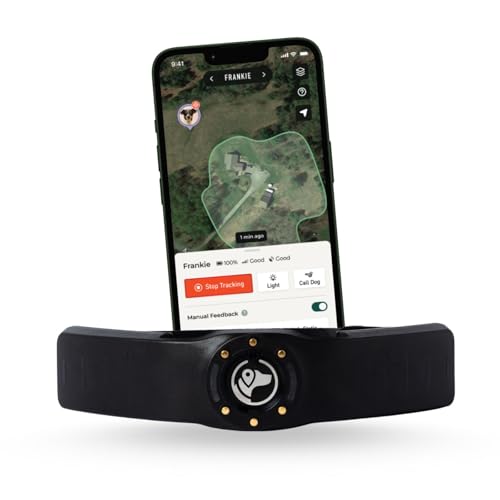
SpotOn Nova GPS Dog Fence
What We Like
- 99.3% containment rate from user data
- Dual-band GPS for real-time boundary precision
- Unlimited fences of any shape and size
- Certified 1:1 training support included
Trade-offs
- Heavier than some collar-only systems at 0.8 lb
- Requires app for all fence adjustments
Based on aggregate user data, the collar keeps dogs within virtual boundaries 99.3% of the time, with containment activity viewable in the app. The dual-band, dual-feed GPS is engineered for dependable signal performance in dense tree cover and low-signal areas, so the boundary stays where you drew it. This makes it a good fit for owners who need precise containment across challenging terrain and want no subscription fees.
Product photos
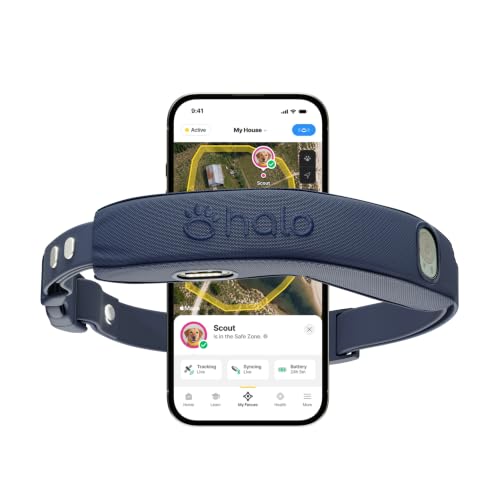
Halo Collar 5 GPS Dog Fence
What We Like
- Dual-frequency L1/L5 GPS with ground-station corrections
- AlwaysOn GPS tracks location 24/7
- Works on rural properties and remote areas
- Built-in training program by Cesar Millan
Trade-offs
- Subscription required to activate GPS and fence features
- Requires ongoing subscription for GPS and fence features.
GPS accuracy within two feet of your dog’s actual location means you can set boundaries on acreage where other collars lose the signal entirely. The collar updates position 20 times per second using Wi-Fi, Bluetooth, and cellular connections, so it stays reliable across wide-open spaces, hiking trails, and rural properties. That kind of precision makes it a practical choice for anyone whose dog has room to roam.
The subscription requirement is the main catch here: unlike the Dogtra GPS Fence, which works with no ongoing fee, the Halo Collar 5 needs a paid membership to unlock GPS tracking, virtual fence creation, and training guidance. That recurring cost buys you AlwaysOn GPS that never stops tracking and instant smartphone alerts when your dog approaches a boundary, plus access to Cesar Millan’s built-in training program. If you prefer a one-time purchase and don’t need the extended range, the Dogtra is simpler. But for large properties where consistent GPS accuracy matters, the Halo’s correction network makes the subscription worth the extra cost.
SpotOn Omni GPS Dog Fence

What We Like
- 128 satellites for heavy woods accuracy
- Unlimited fences any shape or size
- No subscription required for fence use
- Off-Grid mode for remote areas
Trade-offs
- Minimum 1/2 acre property required
- Battery drops to 35+ hours with tracking subscription
Connecting to 128 satellites, this collar maintains precise boundaries even under dense tree canopy where lesser GPS systems lose signal. The dual-feed GPS antenna and True Location technology mean you can set up a reliable containment zone in heavily wooded acreage without clearing sightlines or burying wire. Minimum property size is half an acre, but it scales up to 100k+ acres, so it works just as well on a small wooded lot as it does on a large rural property.
The trade-off shows up in battery life: skip the optional tracking subscription and you get 40+ hours of runtime, but activating the tracking feature drops that to 25 hours (or 35 hours in Extended Battery Life Mode). That is still enough for a full day of off-leash freedom, but you will charge more often if you want real-time location and escape alerts. Compared to the Dogtra GPS Fence, which skips tracking entirely to keep things simple, the SpotOn Omni gives you the option at the cost of some runtime.
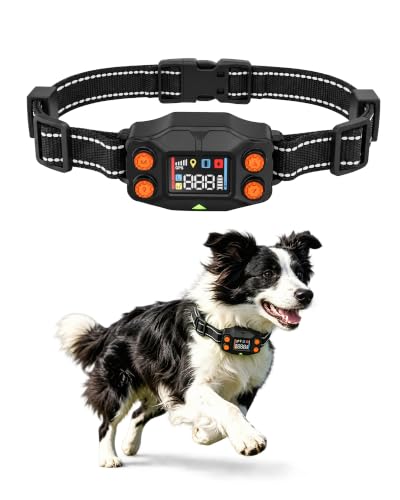
NASlus GPS Dog Collar Fence
What We Like
- No app, Wi-Fi, or subscription needed
- IPX7 waterproof for wet outdoor play
- Adjustable circular boundary up to 999 yd
Trade-offs
- Circular boundary only, no custom shapes
- Satellite accuracy reduced near trees or buildings
A GPS dog fence that works without an app, Wi-Fi, or monthly fee is the kind of straightforward solution that appeals to anyone who just wants to set a boundary and move on. The NASlus F830 creates a circular perimeter from 25 to 999 yards using multi-constellation GNSS satellites, so you dial in the radius with button controls and the collar handles the rest. It suits owners who prefer a simple, no-fuss setup for open outdoor spaces like yards, farms, or campsites, and the IPX7 waterproof rating means it can handle wet grass, puddles, and active play without worry.
The trade-off for that simplicity is a circular-only boundary, which won’t work for yards with irregular shapes or obstacles you need to fence around. Other systems, like the SpotOn Nova, let you draw custom fences of any shape through an app, but they also require more time to configure and a smartphone. The NASlus keeps things basic and affordable, but if your property has a complex layout, you may find the circular limit frustrating. It works well for open land where a simple radius makes sense, not for tight, oddly shaped lots.
Product photos
PetYon GPS Wireless Dog Fence

What We Like
- Dual mode: circular or custom shape
- No app or subscription required
- 10 ft early-warning zone
- IPX7 waterproof for swimming and rain
Trade-offs
- Needs clear sky view for GPS signal
- Not recommended for small spaces or dense forests
- No app-based boundary editing or tracking
The PetYon ZF550 covers up to a 6,561-foot radius, so it works for large open areas like farms or beaches. Its dual-mode setup lets you choose a simple circular boundary or walk the perimeter and drop anchor points for custom shapes like rectangles or hexagons. That flexibility makes it useful for properties that aren’t a perfect circle, and the lack of any app or subscription means you don’t need a smartphone to get it running. The bright LCD screen and button controls guide you through setup directly on the collar, and the IPX7 waterproofing holds up through rain and swimming. This is a straightforward, no-fuss system for someone who wants reliable containment without monthly fees or phone pairing.
The PetYon GPS fence relies entirely on satellite signal, so it needs a clear view of the sky. Dense forests, narrow city yards, or heavy tree canopy will cause dropouts, and there is no app to adjust the boundary remotely. The SpotOn Nova offers app-controlled fence editing and tracking, but if your property is open and you just want to set a fence and forget it, the PetYon delivers that simplicity. If you plan to contain a dog in a heavily wooded lot or need to tweak boundaries often, an app-based alternative may serve you better.
Product photos
DOGOITM Wireless Dog Fence 2 Dogs
What We Like
- Two collars included for multi-dog homes
- 50-hour rechargeable battery per collar
- No app, subscription, or transmitter needed
- IPX6 waterproof for wet conditions
Trade-offs
- Not suitable for yards under 0.3 acres
- Circular boundary only, no custom shapes
- No app for real-time boundary adjustments
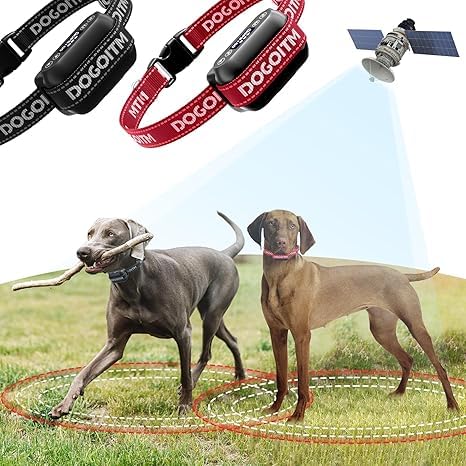
The two included collars make this system a practical choice for households with two dogs, avoiding the need to buy a second unit or swap collars between pets. Each collar runs up to 50 hours on a charge, which means several days of typical use before recharging. The IPX6 waterproofing handles rain and damp grass without worry. Setup is simple: no app to download, no transmitter to bury, no subscription fee, just power on the collars, set your boundary in 10-foot increments, and the GPS handles the rest. It fits dogs from 10 to 120 pounds, so most medium-to-large breeds can use it right out of the box.
The boundary is always a perfect circle, which is the main limitation here. You cannot carve out irregular shapes to avoid a garden, a driveway, or a neighbor’s yard. If your property has odd angles or you need to exclude specific areas, a system with app-drawn custom fences would be more flexible. Also, the 0.3-acre minimum yard size means this won’t work for tiny city lots or apartments with a patch of grass. For straightforward open yards with two dogs, though, this is a practical, no-fuss solution that keeps both pets contained without extra gear or ongoing costs.
Product photos
VERSMELO GPS Dog Fence & Training
What We Like
- 2-in-1 fence and remote training system
- AI-powered Swiss u-blox GPS chip
- IPX7 waterproof collar
- Adjustable static correction with 24 levels
Trade-offs
- Circular boundary only, no custom shapes
- Requires 2.5-hour charge for 40+ hours runtime
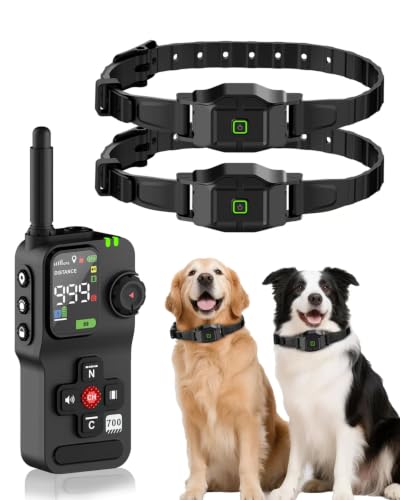
The VERSMELO system uses a Swiss u-blox GPS chip with AI-powered positioning algorithms, which means it acquires satellite signals quickly and maintains stable boundaries with reduced drift. That reliability matters when your dog is near a road and you need the correction zone to stay consistent. The 2-in-1 design lets you switch between containment mode and a standalone remote training collar, so you get both functions in one device without a subscription fee or buried wire.
The VERSMELO combines a GPS wireless fence and a remote training collar in one system, so you don’t need to buy separate devices or pay any subscription fees. Its adjustable boundary can be set from 75 to 2,997 feet, which covers most standard yards. The remote controller has a 900-foot range, enough for typical suburban use, while the collar’s IPX7 waterproof rating means it can handle rain, mud, and splashes during outdoor play.
Product photos
Dogtra PATHFINDER2 MINI Compass GPS Tracking System
What We Like
- No subscription fees ever
- Offline maps and GPS fence
- Rugged handheld with 2-second updates
- Expandable up to 21 dogs
Trade-offs
- Only for dogs 25 pounds and up
- Handheld remote adds one more device to carry
A 4-mile range with no subscription and offline maps means you can roam deep into the woods without a cell signal or a monthly bill. The system updates your dog’s position every two seconds on a bright 2-inch LCD display, so you can keep track of where they’ve gone without pulling out your phone. This system suits anyone who wants reliable GPS tracking and e-collar training in one rugged package, especially if you hunt, hike, or live in an area with spotty cellular coverage. The free app adds satellite views and customizable fence boundaries, but the core tracking works entirely without it.
This system is built for dogs over 25 pounds, so it won’t fit smaller breeds. And while the handheld remote keeps your phone safe and charged, it’s another gadget to remember on the way out the door. If you want tracking plus training in one device and don’t mind carrying a dedicated remote, this is the better fit.
How We Evaluated GPS Dog Fences
We researched every major GPS fence on the market by studying product specs, manufacturer documentation, and expert round-ups on containment technology. Owner feedback patterns helped us understand what works in real yards versus what looks good on paper.
Four criteria mattered most. Boundary flexibility came first, some systems only make circles, while others let you trace the exact edge of your property. Subscription cost was second, because a low upfront price means nothing if you pay monthly forever. Battery life ranked third, since a dead collar is no fence at all. Finally, we weighed satellite accuracy in wooded or uneven terrain, because GPS signals behave differently under tree cover than in an open field.
A research-led evaluation has limits. We cannot predict how a specific fence will perform on your unique property, and owner experiences vary widely based on tree density, house construction, and local satellite coverage. Use this guide as a starting point, then check your yard’s GPS reception before buying.
What To Look For In GPS Dog Fences
The right GPS fence matches your property size, boundary shape, and tolerance for ongoing costs. Start by measuring your yard and noting any heavy tree cover or irregular lot lines, then compare systems on these three factors.
Choose a GPS fence that fits your yard’s shape (circle or custom), your budget for ongoing fees, and the battery life your dog’s daily routine demands.
Boundary Shape and Flexibility
Some GPS fences only create circular boundaries centered on a base unit. That works fine for a round, open yard but fails on L-shaped lots, long narrow properties, or acreage with a house in the middle. Custom-shape systems like the Dogtra GPS Fence and SpotOn Nova let you trace property lines on a map, following driveways, gardens, and outbuildings. If your yard is irregular, pay the premium for a system that draws any shape.
Subscription Costs
GPS fence pricing splits into two camps. Some systems, like the Dogtra and PetSafe Guardian, charge nothing after purchase. Others, like the Halo Collar 5, require a monthly or annual subscription to activate GPS and containment features.
The difference adds up fast, a subscription model can cost as much as a new fence every two years. If you want a no subscription GPS fence, look for models that advertise lifetime free use of GPS and boundary features. The subscription-free GPS fences on our list prove you can get reliable containment without recurring fees.
Battery Life and Collar Weight
A GPS collar that dies mid-day leaves your dog unprotected. Look for at least 20 hours of real-world battery life, and prefer systems with rechargeable lithium batteries over disposable ones. The PetSafe Guardian leads with up to five days per charge. Heavier collars can bother small dogs, so check the weight, the SpotOn Nova weighs 0.8 lb, which is fine for a 40-pound dog but might drag on a 15-pounder. For small breeds, consider compact GPS dog fences designed for lighter collars.
Satellite Accuracy and Terrain
GPS fences rely on satellite signals, which weaken under heavy tree cover, near tall buildings, or in deep ravines. Systems like the SpotOn Omni use more satellites (128) to maintain accuracy in woods, while dual-band GPS (L1/L5) on the Halo Collar 5 helps in remote areas. If your property has thick canopy or steep hills, prioritize a system with multi-band or multi-satellite support. Understanding the pros and cons of GPS containment helps you decide if satellite-based fencing works for your land.
- Measure your yard’s shape and tree cover before choosing a fence type.
- Calculate two-year ownership cost including any subscription fees.
- Check the collar weight against your dog’s size and neck circumference.
- Read owner reviews specific to your region’s terrain and weather.
A GPS fence is only as good as the satellite reception on your property, test the collar’s signal strength in your yard’s worst spot before committing.
GPS Dog Fences Compared
The table below compares all 10 GPS dog fences side-by-side on boundary type, subscription cost, battery life, and key features so you can spot the differences at a glance.
| Product | Dog Size | Correction Levels | Battery |
|---|---|---|---|
| Dogtra GPS Fence | 15 lbs+ | 100 adjustable | Rechargeable, all-day |
| PetSafe Guardian GPS Dog Fence | 25 lbs+ | 10 levels | Up to 5 days |
| SpotOn Nova GPS Dog Fence | N/A | N/A | N/A |
| Halo Collar 5 GPS Dog Fence | N/A | N/A | N/A |
| SpotOn Omni GPS Dog Fence | N/A | N/A | 40+ hours |
| NASlus GPS Dog Collar Fence | 15 lb | Beep, Vibration, Static | Rechargeable |
| PetYon GPS Wireless Dog Fence | 15 lbs | Beep, Vibration, Static (0-9) | 24-36 hours |
| DOGOITM Wireless Dog Fence 2 Dogs | 10-120 lbs | Three Adjustable Correction Modes | 50 hours |
| VERSMELO GPS Dog Fence & Training | 18 lbs | Beep Vibration Static | 40+ hours |
| Dogtra PATHFINDER2 MINI Compass GPS Tracking System | 25+ lbs | N/A | N/A |
Frequently Asked Questions
How does a GPS dog fence work compared to an in-ground fence?
A GPS fence uses satellite signals to create a virtual boundary around your property, while an in-ground fence requires burying a wire around the perimeter. GPS fences are portable and don’t need digging, but they require a clear view of the sky. In-ground fences work in dense woods where GPS signals may drop.
Can I use a GPS fence for a dog under 10 pounds?
Most GPS collars are too heavy for very small dogs. The Dogtra PATHFINDER2 MINI requires dogs 25 pounds and up, and the SpotOn Nova is not recommended for dogs under a 10-inch neck size. Look for lightweight collar systems designed for small breeds, or consider a traditional in-ground fence with a lighter receiver.
Do all GPS dog fences require a monthly subscription?
No. Several top-rated models, including the Dogtra GPS Fence, PetSafe Guardian, SpotOn Nova, and SpotOn Omni, have no subscription fees. The Halo Collar 5 requires an ongoing subscription to activate GPS and fence features. Always check the fine print before buying.
Can a GPS fence contain two dogs at once?
Yes, but the system must support multiple collars. The DOGOITM Wireless Dog Fence 2 Dogs comes with two collars in the box, and the Dogtra PATHFINDER2 MINI can expand up to 21 dogs. For multi-dog homes, look for GPS fences for multiple dogs that include or support extra collars.
What happens if my dog runs past the GPS fence boundary?
Most GPS fences trigger a warning tone when your dog approaches the boundary, followed by a static correction if they cross it. Some systems, like the Dogtra GPS Fence, include a “come home” sequence with a return reminder tone that guides the dog back into the safe zone. The collar continues correcting until the dog returns.
The Bottom Line
The Dogtra GPS Fence is our top pick for most owners. It delivers custom-shaped boundaries, a waterproof collar, and no subscription fees, all on a system that works for properties of 3/4 acre or larger. If your yard is heavily wooded, the SpotOn Omni’s 128-satellite system gives you the best chance of reliable containment under tree cover.
Budget buyers should look at the NASlus GPS Dog Collar Fence for a simple, app-free circle at a low upfront cost. Multi-dog homes get the best value from the DOGOITM system with two collars included. The PetSafe Guardian is the right choice if long battery life matters most to you.
The single most important buying factor is your property’s shape and satellite reception. A custom-boundary system with no subscription will serve you better over time than a cheaper circle-only fence with ongoing fees. Measure your yard, check the sky, and pick the fence that fits both.
